
The AI Paradox: Why Technology Makes Us More Human Than Ever Before
Xpert Pre-Release

Available in 27 languages 📢
Prefer Xpert.Digital on GoogleⓘPublished on: September 14, 2025 / Updated on: September 14, 2025 – Author: Konrad Wolfenstein

The AI Paradox: Why technology is making us more human than ever before – Image: Xpert.Digital
Forget the tech hype: This one factor truly determines your business success
The human constant: Why empathy is your most valuable skill in the AI age
In an era where artificial intelligence dominates the headlines and is discussed both as a panacea for efficiency and as a threat to jobs, a fundamental paradox emerges. This text presents a provocative counter-argument to the prevailing narrative of complete automation: the further technology advances, the more irreplaceable and valuable what makes us profoundly human becomes. It is the quality of our interactions, our capacity for complex judgment and the ability to build trust, that proves to be the decisive and sustainable competitive advantage in the digital age.
We embark on a strategic journey that begins with demystifying the digital world and revealing its inextricable connection to our physical reality—including its ecological costs and geopolitical dependencies. We then analyze the actual limits of automation and demonstrate, using data, that AI is primarily a tool to augment human capabilities, not to replace them. At the heart of our argument is the realization that business success, particularly in the B2B sector, relies less on algorithms and more on the complex psychology of trust, empathy, and organizational diplomacy.
This article is more than an analysis – it's a strategic roadmap. It defines the human-centered skillset of the future, ranging from social to intercultural competence, and culminates in concrete imperatives for businesses. It shows how true mastery lies not in the race against machines, but in the intelligent synthesis of people and technology to create a more resilient, innovative, and ultimately more humane economy.
The human constant: Why success in a world of artificial intelligence will still be made by humans
The technological tsunami and the rediscovery of man
The current economic landscape is characterized by a technological acceleration unprecedented in its speed and scope. Artificial intelligence (AI) and automation are no longer science fiction concepts, but everyday tools that are fundamentally transforming business models, value chains, and ways of working. This technological tsunami, however, creates a central paradox: the more ubiquitous and powerful technology becomes, the more crucial those qualities that are genuinely human become. In a world where algorithmic efficiency and data-driven processes become commodities, the quality of human interaction, judgment, and relationship building proves to be the ultimate and sustainable competitive advantage.
This report argues that technology is not an end in itself, but a powerful amplifier of human capabilities. The strategic focus is shifting away from the mere implementation of technological solutions toward the conscious cultivation of an environment in which humans and machines operate in symbiosis. True differentiation in the marketplace of the future lies not in the possession of AI, but in the ability of a company's employees to use these tools to unleash uniquely human strengths such as creativity, empathy, and complex problem-solving skills. Many companies are developing a strategic blind spot here: while investing in technology in a race for efficiency gains, they neglect investing in precisely those human competencies whose value increases exponentially through the automation of routine tasks.
This report's journey leads from the tangible, physical realities of the digital world, through an analysis of the limits of automation, to an examination of the primacy of human relationships in business success. It culminates in a strategic roadmap for a human-centered, technology-driven company of the future. The guiding principle is digital humanism – a philosophy that consistently places people at the heart of technological change and demands that technology must serve humanity, not the other way around.
The economic logic follows this ethical premise: the economic value of non-automatable human skills will increase dramatically in the future. Companies that focus their strategy solely on technological implementation without pursuing a parallel human capital strategy are preparing for yesterday's battles. The real challenge lies in creating a symbiotic relationship in which AI takes over routine tasks and frees up human talent to concentrate on high-quality, relationship-driven work.
The digital foundation and its physical anchor
The discourse surrounding digitalization is often characterized by the metaphor of a "weightless" or "immaterial" economy. This notion, however, is misleading and obscures a fundamental truth: the digital world is inextricably linked to and dependent on the physical world. A profound understanding of the digital age requires acknowledging its material foundations, its ecological costs, and its geopolitical realities.
The irreversible entanglement of bits and atoms
Digital infrastructure is not an ethereal cloud, but a global network of concrete, physical hardware. Submarine cables, cell towers, server farms, and data centers form the material backbone of our society and economy. This physical foundation establishes a fundamental and irreversible dependency. The core paradigm of this relationship can be summarized simply: A factory can theoretically exist without a cloud connection, as was the case for decades. A data center or cloud infrastructure, however, is economically pointless without a physical economy it serves. Digital services are not primary value creators, but rather supporting structures that optimize processes in the real economy—be it in production, trade, or services. Their function is supportive, not original.
The material costs of immateriality
The idea of a clean, resource-efficient digital economy is a myth. The physical reality of digital infrastructure comes with significant environmental and material costs. The "cloud" consists of vast, energy-intensive data centers that require massive buildings, backup generators, complex cooling systems, and physical security measures. The energy consumption of these facilities is immense; data centers alone account for almost one-fifth of total digital energy consumption, a share equivalent to that of all internet-enabled devices combined.
Furthermore, the production of the necessary hardware – from servers and network components to end devices such as computers and smartphones – consumes a large amount of raw materials. Specific metals are required for production, the mining of which is often associated with environmentally damaging practices and the release of toxic waste. The entire life cycle of digital hardware, from raw material extraction and energy-intensive manufacturing to the disposal of electronic waste, places a significant burden on the environment.
Digital sovereignty as a strategic necessity
The physical nature of digital infrastructure also has a significant geopolitical dimension. Control over data flows and computing capacity has become a strategic power factor. In this context, Europe is experiencing a worrying dependence on foreign, particularly US, technology companies. The European cloud market is dominated by a small number of US providers. Amazon Web Services (AWS) and Microsoft Azure together hold market shares of 70% to 80%, representing a massive concentration of control over critical infrastructure in the hands of a few foreign companies.
This dependency not only creates economic disadvantages but also significant security risks. For example, the US CLOUD Act of 2018 allows US authorities to access data stored by US companies, even if the servers are physically located in Europe. This undermines European data sovereignty and represents a potential security vulnerability for businesses and public administrations. Initiatives such as Gaia-X were launched to create a sovereign European data infrastructure, but their impact has so far been limited.
Recognizing these interconnections leads to a reassessment of the concept of "digital risk." It no longer encompasses only cybersecurity but must be expanded to include geopolitical and supply chain-related risks. Choosing a cloud provider is therefore no longer merely a technical or business decision, but inevitably also a geopolitical strategic one. Executives, particularly CIOs and CTOs, must no longer evaluate providers solely based on cost, performance, and availability. They must now also consider the provider's country of origin, the applicable legal framework for the stored data, and the stability of geopolitical relations. A seemingly technical IT decision is thus deeply intertwined with strategic risk management and international politics, demanding a new level of strategic awareness.
A new dimension of digital transformation with 'Managed AI' (Artificial Intelligence) - Platform & B2B solution | Xpert Consulting

A new dimension of digital transformation with 'Managed AI' (Artificial Intelligence) – Platform & B2B solution | Xpert Consulting - Image: Xpert.Digital
Here you will learn how your company can implement customized AI solutions quickly, securely and without high entry barriers.
A managed AI platform is your all-inclusive, worry-free solution for artificial intelligence. Instead of dealing with complex technology, expensive infrastructure, and lengthy development processes, you receive a ready-made solution tailored to your needs from a specialized partner – often within just a few days.
The key advantages at a glance:
⚡ Rapid implementation: From idea to ready-to-use application in days, not months. We deliver practical solutions that create immediate added value.
🔒 Maximum data security: Your sensitive data stays with you. We guarantee secure and compliant processing without sharing data with third parties.
💸 No financial risk: You only pay for results. High upfront investments in hardware, software, or personnel are completely eliminated.
🎯 Focus on your core business: Concentrate on what you do best. We take care of the entire technical implementation, operation, and maintenance of your AI solution.
📈 Future-proof & scalable: Your AI grows with you. We ensure continuous optimization and scalability, and flexibly adapt the models to new requirements.
More information here:
From efficiency to trust: The new role of AI in B2B sales
The promise and limitations of intelligent automation
Artificial intelligence and automation are the driving forces behind current technological transformation. They promise increased efficiency, reduced costs, and the unlocking of new business opportunities. However, a closer look reveals that while these technologies are transformative tools for extending human capabilities, they are subject to clear limitations. The most valuable and complex business activities will remain the domain of humans for the foreseeable future.
AI as a tool for increasing efficiency and expanding skills
The practical applications of AI in companies are diverse and extend across all functional areas. It acts as a powerful tool that does not replace human capabilities, but rather complements and enhances them.
A key application area is decision support. AI systems can analyze vast amounts of data in a very short time to identify patterns, trends, and correlations that would remain hidden to humans. This enables more informed strategic decisions in areas such as marketing, sales, and product development. In process automation, AI algorithms take over repetitive and rule-based tasks. Examples range from automated creditworthiness checks in finance to the pre-selection of applicant profiles in human resources. This relieves employees of routine tasks and frees up capacity for more strategically important activities.
Another important area is personalization. AI enables hyper-personalized customer interaction on an unprecedented scale, from individual product recommendations in e-commerce to intelligent chatbots in customer service that provide fast and context-aware answers around the clock. Furthermore, AI serves to enhance employee skills. AI tools can summarize complex reports, translate foreign language communication in real time, generate initial drafts of documents or presentations, or identify skills gaps within an organization to facilitate targeted training.
The limits of automation in practice
Despite the impressive progress, there are clear technological and conceptual limitations to automation. A comprehensive analysis by McKinsey provides crucial data on this and precisely distinguishes between the automation of individual tasks and entire professions.
The key finding is that less than 5% of all current jobs could be fully automated with currently available technologies. Automation therefore does not affect entire job profiles, but primarily individual tasks within these jobs. The study shows that approximately 60% of jobs consist of at least 30% tasks that are potentially automatable.
The potential for automation varies considerably depending on the type of work. It is highest for predictable physical labor (approximately 81%), data processing (approximately 69%), and data collection (approximately 64%). These are typically structured, repetitive, routine tasks. In contrast, activities requiring high levels of social or cognitive skills have very low automation potential. These include management and leadership, creative problem-solving, complex decision-making, and interpersonal interaction. Their automation potential is often below 20%.
There are also significant differences between sectors. Sectors with a high proportion of structured processes, such as hospitality (73%) and manufacturing (60%), have high automation potential. This is considerably lower in sectors where human interaction and expertise are paramount, such as healthcare and social services (36%) or education (27%).
When automation reaches its limits
Attempting to push automation beyond its natural limits often leads to negative consequences. Excessive automation, particularly in customer-facing areas, can significantly impair customer satisfaction. While it can increase response times, it often results in a perceived loss of control, privacy concerns, and a lack of human touch. Beyond a certain level of automation, customer satisfaction declines sharply.
Furthermore, automation projects often fail when applied to unsuitable processes. Particularly in complex project-based businesses, characterized by numerous exceptions, unforeseen changes, and the need for human judgment, rule-based Robotic Process Automation (RPA) quickly reaches its limits. Projects fail when the underlying processes are not stable, repeatable, and clearly structured. Even in highly automated environments like modern manufacturing, the vision of a fully autonomous, unmanned factory ("lights-out manufacturing") remains largely a pilot concept. Humans are still needed for flexible responses to unforeseen events, solving complex problems, and monitoring the systems.
The available data defines a clear "human-AI boundary." The strategic conclusion is not which jobs can be eliminated, but rather how workflows must be redesigned to maximize the synergy between human and machine intelligence. The primary business case for AI lies not in cost reduction through staff cuts, but in value creation through the enhancement of human capabilities. Companies that master this human-AI collaboration will unlock new levels of innovation and customer proximity. Those that pursue a simple strategy of automation for cost reduction will encounter a wall of declining revenues and alienated customers.
Automation potential by industry and field of activity
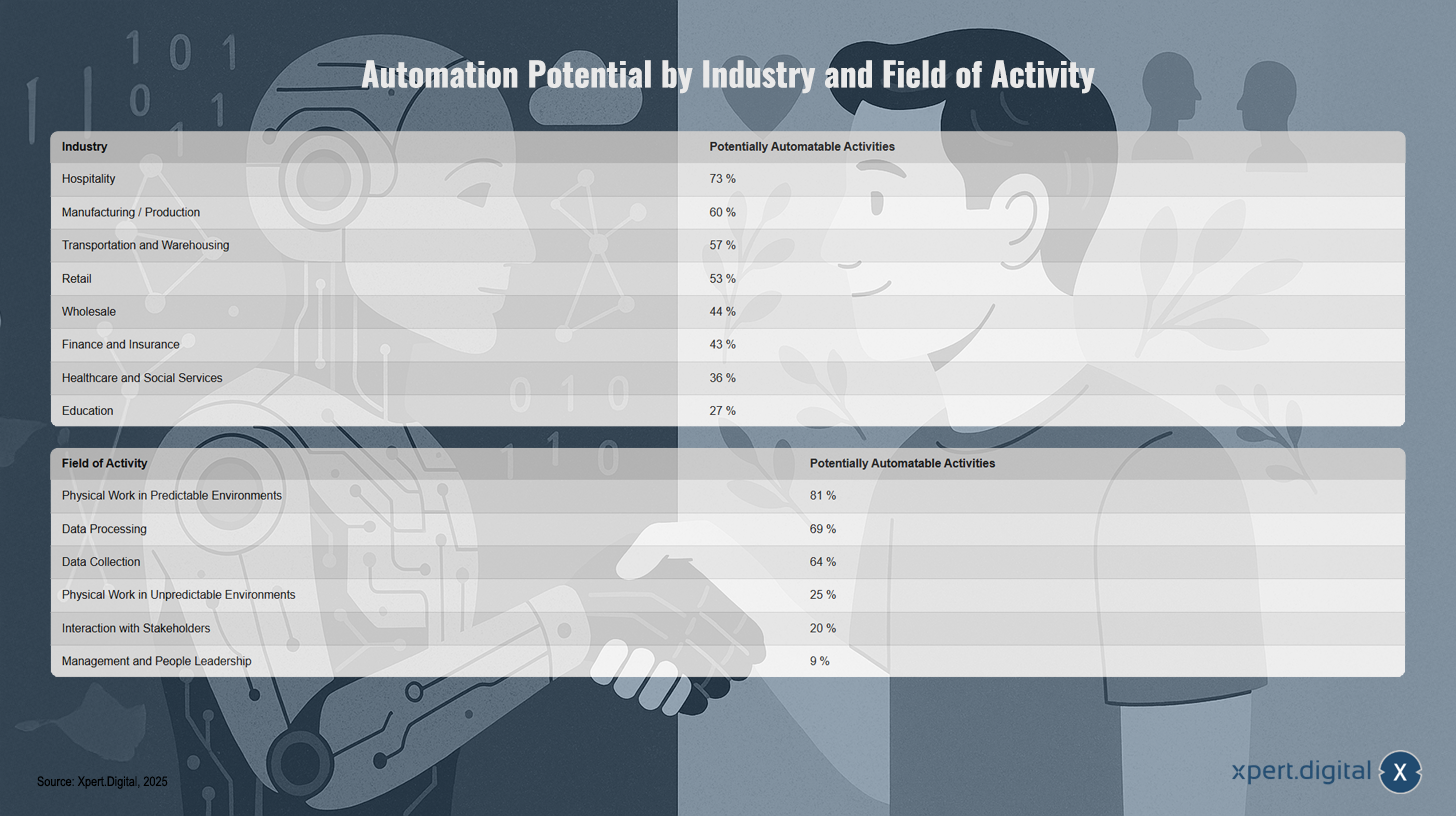
Automation potential by industry and field of activity – Image: Xpert.Digital
Comparing sectors, 73% of activities in the hospitality industry are potentially automatable, followed by 60% in manufacturing/production, 57% in transportation and warehousing, 53% in retail, 44% in wholesale, 43% in finance and insurance, 36% in health and social services, and 27% in education. Looking at specific job functions, 81% of physical work in predictable environments is potentially automatable, as are 69% of data processing and 64% of data collection; in contrast, physical work in unpredictable environments is 25%, stakeholder interaction is 20%, and management and personnel leadership is 9%.
The primacy of humans: Why relationships define business success
Having analyzed the technological foundations and limitations, the focus now turns to the sociological and psychological dimensions of business success. Particularly in the business-to-business (B2B) environment, it becomes clear that markets are not anonymous transaction platforms, but rather complex social arenas. Success here is determined less by product specifications and price lists, and more by the quality of human relationships, trust, and the skillful handling of emotional dynamics.
Project business as a relationship business: A sociological perspective
Sociological market research has convincingly demonstrated that B2B markets are characterized by deep and stable social relationships between companies, suppliers, and customers. Decisions within organizations are not isolated, rational acts, but rather embedded in a dense network of previous decisions, established routines, and institutionalized norms. This social structure creates path dependencies and shapes the expectations of the actors involved.
This realization is reflected in modern sales. The rise of "social selling" is a clear indication of a strategic realignment towards the systematic building and maintenance of relationships on digital platforms. The primary focus is no longer on closing deals quickly, but rather on establishing expert status and building trust. Data confirms this development: 75% of all B2B decision-makers actively use social media as part of their purchasing process to research potential partners and assess their reputation. Successful sales teams are those that understand these social dynamics and leverage them to build long-term, valuable business relationships.
The psychology of business decisions: Trust as currency
At the heart of these social dynamics lies a central psychological construct: trust. It is the foundation upon which long-term and successful business relationships are built. Without trust, no deal is closed, no matter how convincing the rational arguments may be. Trust is psychologically complex; it operates in a state between knowing and not knowing and always involves a risk for the trustor – the risk of disappointment.
In research, two core components of trust are typically distinguished: credibility, meaning the belief in the partner's competence and ability to fulfill their promises, and beneficence, the belief in the partner's good intentions, even when unforeseen difficulties arise. Quantitative analyses of B2B relationships show that the perceived value of a business relationship positively influences trust. This trust, in turn, has a direct and positive effect on commitment, meaning the willingness to invest in and maintain the relationship. Interestingly, it is this commitment, and not trust directly, that is the primary driver of a customer's long-term loyalty. Trust is therefore the necessary prerequisite for generating the engagement that is crucial for customer retention.
Emotions in the B2B context: The irrational factor in rational business
The B2B world often gives the impression of pure rationality, where decisions are made solely based on numbers, data, and facts. However, this assumption is incomplete. Business decisions, especially high-stakes ones, are deeply influenced by emotions and cognitive biases. Within the so-called "buying center"—the group of people involved in a purchasing decision—a variety of emotions come into play, such as tension due to the financial implications, ambition to achieve the best results for one's own department, or frustration with complex negotiation processes.
Furthermore, B2B negotiators, like everyone else, are susceptible to psychological pitfalls. These include the anchoring effect, where the first figure mentioned (e.g., a price quote) disproportionately influences the entire subsequent negotiation; overconfidence bias (excessive confidence in one's own judgment); and loss aversion, the tendency to weigh losses more heavily than equally large gains. Ultimately, even for complex technological solutions and large capital goods, the principle remains: people buy from people. The decision is often made emotionally and intuitively, "gut-feeling," and only later reinforced with rational arguments.
These findings make it clear that the traditional, linear B2B sales funnel is an inadequate model. It ignores the complex, non-linear, and emotionally charged social dynamics of organizational decision-making. A more accurate image is that of a "trust-building matrix" that spans time and multiple stakeholders. A successful B2B strategy doesn't push a single contact through a funnel. Rather, it orchestrates a multifaceted campaign to build trust over an extended period and manage the emotional dynamics across the entire buying center. This requires identifying decision-makers, influencers, and gatekeepers, understanding their individual (rational and emotional) motivations, and building a supportive coalition. B2B sales thus transforms from a transactional process into a long-term exercise in organizational diplomacy.
Comparison of decision-making dynamics in a B2B vs. B2C context
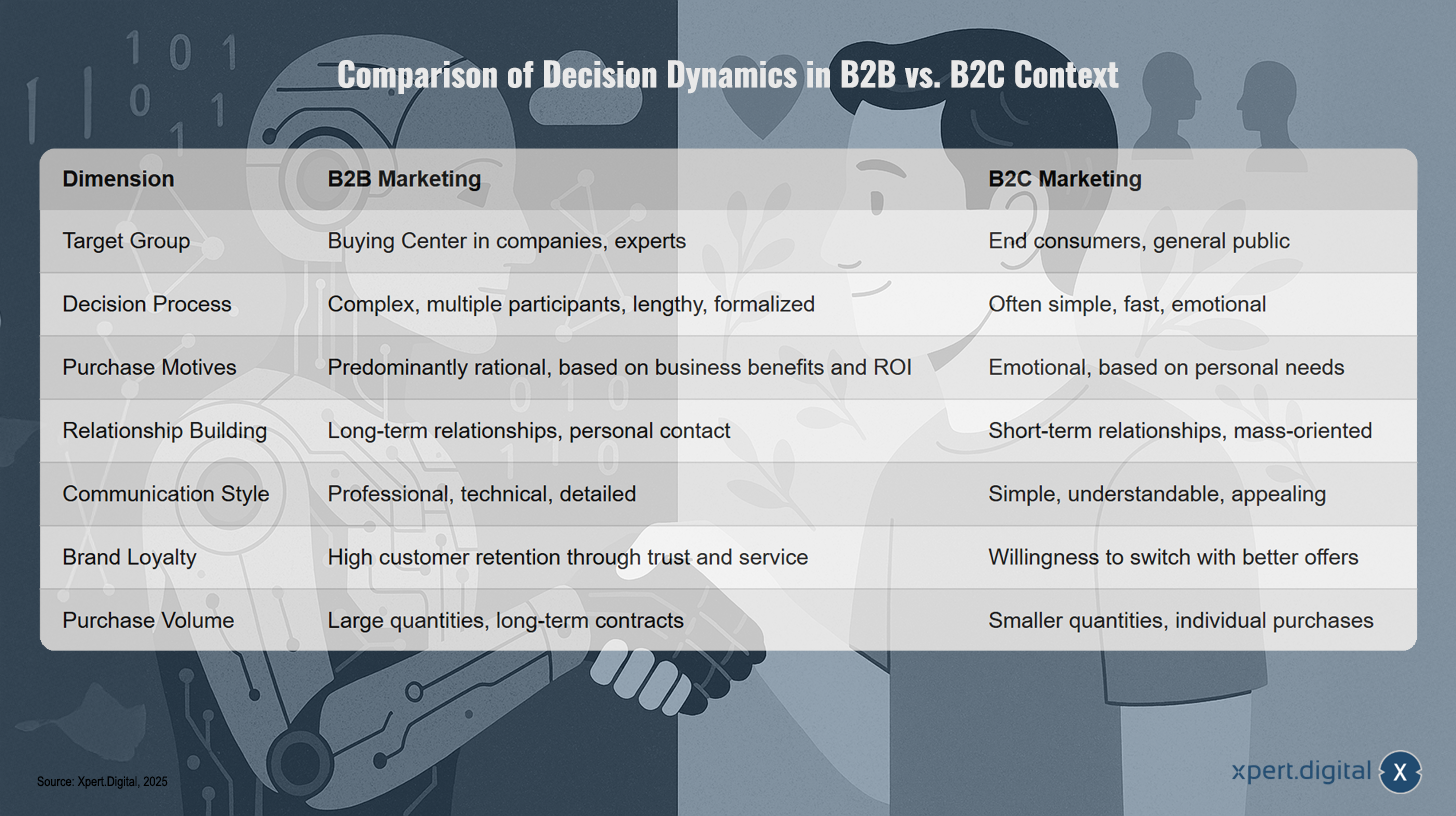
Comparison of decision-making dynamics in a B2B vs. B2C context – Image: Xpert.Digital
In B2B marketing, the message is usually directed at a buying center within a company and at experts, while B2C marketing is aimed at end consumers and the general public. Decision-making processes in B2B are often complex, formal, lengthy, and involve multiple participants; in B2C, on the other hand, purchasing decisions are often made quickly, easily, and emotionally. Purchasing motives in B2B are predominantly based on rational criteria such as business benefits and ROI, whereas in B2C, personal needs and emotions play a greater role. Relationship building in B2B aims for long-term contacts and personal exchange, while in B2C, short-term, mass-oriented relationships usually prevail. Accordingly, the communication style in B2B is professional, technical, and detailed, while in B2C it tends to be simple, understandable, and appealing. Brand loyalty also differs: B2B customers often demonstrate strong loyalty through trust and service, while B2C consumers are more likely to switch brands when better offers appear. Finally, in B2B, purchase volumes are generally larger and characterized by long-term contracts, while in B2C, it is predominantly smaller quantities and individual purchases.
🎯🎯🎯 Benefit from Xpert.Digital's extensive, five-fold expertise in one comprehensive service package | BD, R&D, XR, PR & Digital Visibility Optimization

Benefit from Xpert.Digital's extensive, five-fold expertise in a comprehensive service package | R&D, XR, PR & Digital Visibility Optimization - Image: Xpert.Digital
Xpert.Digital possesses in-depth knowledge across various industries. This allows us to develop tailored strategies precisely aligned with the requirements and challenges of your specific market segment. By continuously analyzing market trends and monitoring industry developments, we can act proactively and offer innovative solutions. The combination of experience and expertise generates added value and provides our clients with a decisive competitive advantage.
More information here:
The 5 human skills that AI cannot replace
The skills of the future: A human-centered skillset
The increasing automation of routine tasks and the commodification of technical skills are leading to a fundamental reassessment of the competencies in demand in the labor market. While the importance of standardizable skills is declining, the strategic value of a specific set of human-centered competencies is increasing. These are not "soft" or optional skills, but hard, strategic assets that enable innovation, resilience, and long-term market success.
Digital Humanism: The Human Being as the Benchmark in Technological Change
Digital humanism serves as an overarching framework for shaping the digital future. This school of thought posits that digital transformation must be actively designed to serve humanity and uphold fundamental humanistic principles such as dignity, autonomy, and ethical responsibility. Digital humanism understands technology not as an autonomous, uncontrollable force, but as a tool that can be shaped by society.
From this stance, concrete demands are derived: Responsibility for the impact of technology always remains with humans; it cannot be delegated to machines or algorithms. In particular, ethically relevant decisions, such as those arising in autonomous driving, must never be made solely by AI. This approach formulates a "European way" of digitalization, which consciously distinguishes itself from purely technocratic or purely profit-oriented models, such as those often associated with Silicon Valley. For companies, digital humanism offers a strategic guideline for implementing technology in a way that enhances human capabilities rather than replacing them, and for building trust with customers and employees.
Social competence as a strategic competitive advantage
In a world where products and services are becoming increasingly similar, the quality of interpersonal interaction is evolving into the decisive differentiator. In this context, social competence is not merely a "nice-to-have," but a significant competitive advantage. Such an advantage must meet three criteria: it must be important to the customer, perceived by the customer, and sustainable, meaning it cannot be easily imitated by the competition. Social competence fulfills these criteria to a high degree.
Key components include teamwork, empathy, the ability to resolve conflicts constructively, and the competence to motivate and lead others. Even if social competence within a company is not directly visible to the end customer, it can have an indirect positive impact. Improved internal collaboration and communication can lead to more efficient processes, lower costs, and ultimately to more competitive prices or higher service quality, which is certainly noticeable to the customer.
Intercultural competence in a globalized world
In a globally networked economy, the ability to operate effectively across cultural boundaries is indispensable. Intercultural competence is defined as the ability to communicate and act effectively in different cultural contexts. It is a crucial success factor for internationally active companies.
This competence can be divided into three dimensions: a cognitive dimension (knowledge about other cultures, their values and norms), an affective dimension (openness, curiosity, and empathy towards the unfamiliar), and a behavioral dimension (the ability to adapt one's own behavior and communication to the situation). A lack of intercultural competence can lead to costly misunderstandings in negotiations, conflicts in multicultural teams, and ultimately the failure of international business relationships. Conversely, a high level of intercultural competence enables the building of trust, the effective leadership of diverse teams, and the successful development of new markets.
The competencies discussed here—thinking oriented toward the principles of digital humanism, strong social skills, and high intercultural sensitivity—are not isolated abilities that can be ticked off a checklist. Rather, they are facets of a single, integrated, "human-centered" mindset. This mindset is the strategic response to technological disruption. An employee who has internalized this mindset can conduct a complex negotiation with a partner from another culture (intercultural competence), build an authentic and trusting relationship (social competence), and simultaneously make informed decisions about when to use an AI tool for data analysis and when to rely on their human intuition for the final decision (digital humanism). This integrated competence is the ultimate, non-automatable asset that makes individuals and organizations resilient and adaptable to the unpredictable changes of the future.
Strategic imperatives for the human-centered company
The preceding analysis has shown that sustainable business success in an increasingly digitalized and automated world depends on the intelligent synthesis of technology and human skills. This concluding section translates this insight into concrete, action-oriented strategic imperatives. It provides data-driven arguments for investing in human capital, outlines a practical roadmap for implementing technology that serves people, and summarizes the findings into a vision for the successful company of the future.
Investing in people: The measurable ROI of soft skills training
Investing in the development of human-centered competencies is not merely a cost item, but a strategic investment with a demonstrably high return on investment (ROI). The notion that the benefits of "soft skills" are immeasurable is outdated. Modern evaluation methods allow for an increasingly precise quantification of the value of human capital.
The direct link to company performance: A comprehensive study by McKinsey demonstrates that companies exhibiting both strong financial performance and a strong employee focus (so-called "People & Performance Winners") are more resilient and profitable. These companies have a five percentage point lower employee turnover rate, resulting in significant cost savings when filling vacancies.
The ROI of social skills: The financial impact of emotional intelligence (EQ) in sales is significant. Sales representatives with high EQ achieve, on average, twice the revenue compared to colleagues with average scores. Targeted training to increase emotional intelligence has led to revenue increases of 12% and more in case studies, representing an enormous ROI.
The ROI of intercultural competence: Investments in intercultural training demonstrably pay off. Case studies show a return on investment of 4:1. This figure results from a 15% increase in operational efficiency and a 20% improvement in customer satisfaction after the implementation of corresponding training programs.
Methods for measuring the "Return on Learning": To systematically capture the success of such measures, models such as the Kirkpatrick model or the extended Phillips ROI model have become established. These approaches measure not only the direct financial return, but also changes in employee behavior and the resulting impact on the business result. They enable the calculation of a "Return on Learning" (ROL) that takes both quantitative and qualitative success factors into account.
Technology in the service of humanity: A roadmap for practice
A human-centered business strategy is not anti-technology. On the contrary, it strategically uses technology to maximize human strengths. The following roadmap outlines specific areas of application where AI systems support employees and create space for high-quality, human work.
Competitive analysis: Companies should use AI tools like Meltwater, Native AI, or Tableau to automate the collection and analysis of market data, competitor strategies, and customer sentiment. This relieves strategic analysts of time-consuming data collection and allows them to focus on interpreting the results and deriving strategic recommendations.
Knowledge management: The implementation of AI-powered knowledge management systems (e.g., ClickUp, Guru, Confluence) is crucial for centralizing a company's collective knowledge and making it immediately accessible to all employees. Such systems break down information silos, answer employee questions in real time, and ensure that every employee receives the information they need to do their job.
Sales and marketing automation: Modern CRM platforms and AI agents (e.g., from HubSpot or Salesforce) can be used to automatically enrich lead data, identify relevant case studies for potential customers, automate routine communication, and personalize customer outreach at scale. This frees up more time for the sales team to focus on building direct, personal relationships.
Internal communication and training: AI tools can revolutionize personnel development by creating personalized learning paths for employees, generating training materials, and even facilitating internal communication through real-time translation and summarization services.
The synthesis of man and machine as a successful model for the future
The future of business belongs neither to companies that blindly rely on technology and lose sight of people, nor to those that resist technological progress. It belongs to those who master the art of synthesis. Sustainable success is defined by the ability to create organizations where technology automates the everyday and supports the complex, freeing up human talent for what they do best: building relationships, making nuanced judgments, innovating creatively, and leading with empathy.
The traditional organizational silos of IT, HR, and strategy are obsolete in this new reality. An effective AI strategy is inconceivable without a corresponding human capital strategy. Selecting a new CRM system (an IT decision) has direct implications for sales training (an HR decision) and customer relationship strategy (a strategy decision). An organization that keeps these functions separate erects structural barriers to the necessary synthesis. Future-proof companies will therefore need to adapt their organizational structure by creating cross-functional teams or even establishing a new, integrated function for the holistic development of technological and human capabilities.
The ultimate competitive advantage lies in a corporate culture that consciously and strategically cultivates this partnership between humans and machines. This creates companies that are not only more efficient and profitable, but also more resilient, innovative, and fundamentally more human.
We are here for you - Consulting - Planning - Implementation - Project Management
☑️ SME support in strategy, consulting, planning and implementation
☑️ Creation or realignment of the AI strategy
☑️ Pioneer Business Development

Konrad Wolfenstein
I would be happy to serve as your personal advisor.
You can contact me by filling out the contact form below or simply call me on +49 7348 4088 965 (Munich) .
I'm looking forward to our joint project.
Write to me

Xpert.Digital - Konrad Wolfenstein
Xpert.Digital is a hub for industry focusing on digitalization, mechanical engineering, logistics/intralogistics and photovoltaics.
With our 360° Business Development solution, we support renowned companies from new business to after-sales.
Market intelligence, smarketing, marketing automation, content development, PR, mail campaigns, personalized social media and lead nurturing are part of our digital tools.
You can find more information at: www.xpert.digital - www.xpert.solar - www.xpert.plus
Keep in touch








