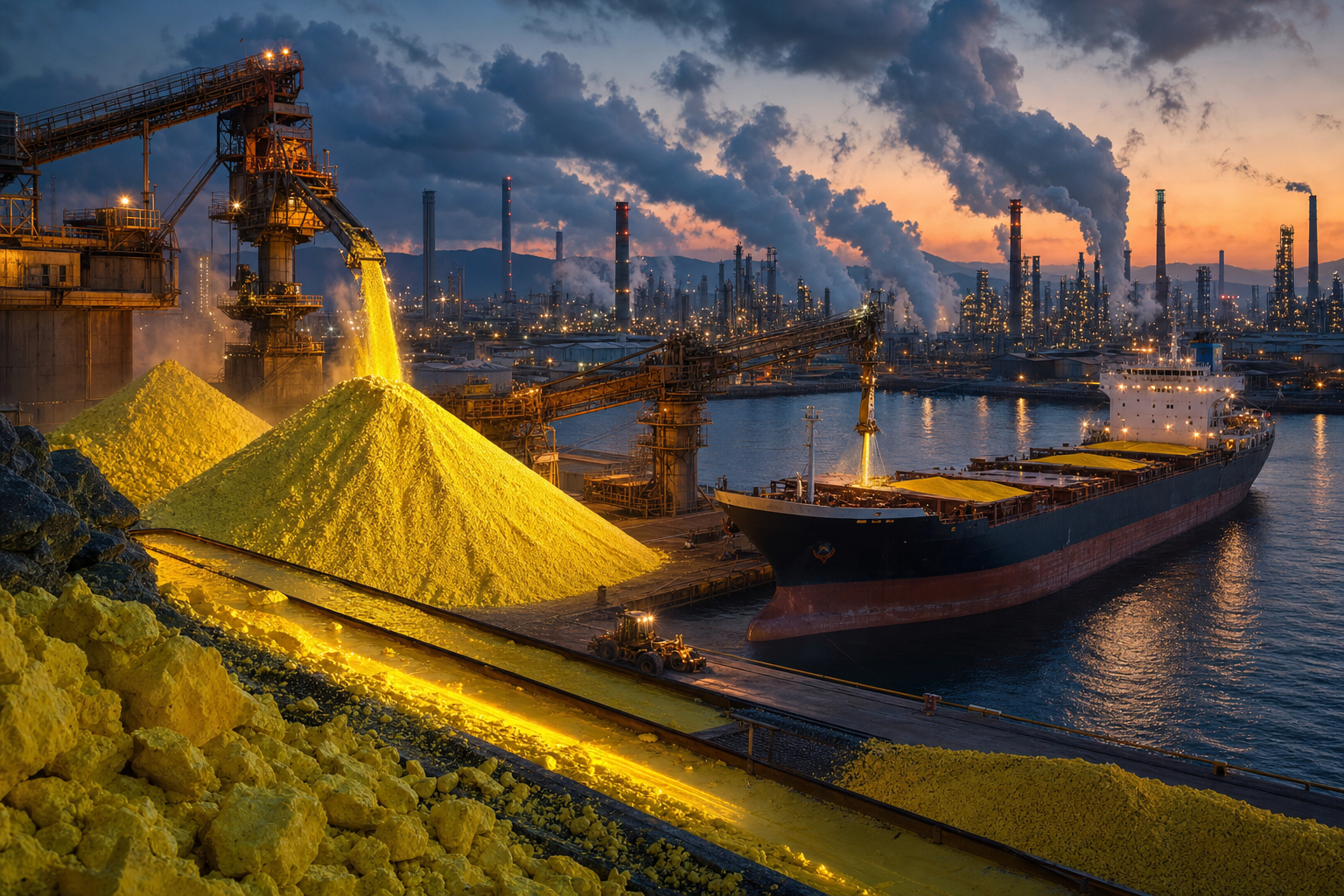
The Hormuz crisis is escalating: Why sulfur is now the scarcest raw material in the world – Image: Xpert.Digital
From waste to battery gold: The incredible price rise of sulfur
Danger to our harvests: The secret raw material shock that surprised everyone
Fertilizer Crisis 2026: Why Central Asia is now becoming the savior of agriculture
A raw material that most previously dismissed as a mere byproduct of the oil and gas industry is suddenly holding the global economy in its grip: sulfur. In the summer of 2026, geopolitical tensions surrounding the Strait of Hormuz, coupled with structural scarcity, catapulted the price to an unprecedented $1,000 per ton. This unprecedented cost explosion is not only hitting the fertilizer industry hard, thereby jeopardizing global food security, but is also putting massive pressure on future markets such as battery and metal production. The current crisis reveals in all its dramatic detail how an inconspicuous byproduct became the new Achilles' heel of the global economy, why there are no quick fixes for the bottleneck, and why supply chains are now being hastily rerouted toward Central Asia.
Sulfur: When a byproduct shakes the global economy
A year ago, a ton of sulfur cost around US$100. In July 2026, the state-owned oil company ADNOC from the United Arab Emirates raised its official selling price for the Indian subcontinent to US$1,000 per ton FOB Ruwais. This is an increase of US$140 compared to the June price and a historic high, significantly exceeding the previous record from 2008, when the price was between US$800 and US$820. Kuwait Petroleum Corporation (KPC) also raised its July price to US$950 FOB, an increase of US$145 compared to the previous month, while Qatar Energy increased its price from US$805 to US$890 FOB. This parallel movement by three major Gulf producers within a few weeks demonstrates that this is not an isolated incident, but rather a structural shift in the global supply and demand balance.
Why a waste product is becoming the Achilles' heel of the fertilizer industry
The core economic problem lies in the nature of the raw material itself. Sulfur is not primarily mined but is a byproduct of crude oil desulfurization and the processing of acid natural gas. There are no producers who can simply increase production when prices rise, because the supply depends on oil refining and gas processing capacity, not on market demand for sulfur itself. Furthermore, there are no strategic reserves like those found for crude oil or rare earth elements, meaning that supply shocks have an unfiltered impact on prices. This structural inelasticity explains why a relatively small trigger can generate such an extreme price movement as observed in 2026.
The geopolitical fuse in the Gulf of Hormuz
The immediate trigger of the crisis lies in the escalating conflict between the United States and Iran, which at times led to military clashes around the Strait of Hormuz and repeatedly disrupted shipping through this critical waterway. Since a significant portion of the world's traded sulfur originates from the Gulf States and is shipped via precisely this route, the tensions resulted in insurance premiums, higher freight rates, and cargo delays. Furthermore, in July 2026, US authorities revoked a previously granted exemption for Iranian oil imports, putting additional pressure on regional supply chains. Reports from the spring of 2026 also point to a so-called Hormuz shock, which triggered noticeable disruptions in fertilizer prices as early as February and March, long before the current record highs were reached.
How the price shock is tearing through the supply chain
The magnitude of the price increase is most evident in the freight costs themselves. For a shipment of 40,000 to 45,000 tons from Ruwais to India, freight rates recently ranged from US$105 to US$108 per ton, resulting in a delivery price of approximately US$1,105 to US$1,108 per ton CIF. Deliveries to the Chinese market from Qatar incur an additional US$125 to US$140 per ton in freight costs, raising the landing price there to US$1,015 to US$1,030 per ton. Additional war risk insurance premiums and higher bunkering costs drive the final prices even higher. The Brazilian market shows a similar dynamic: there, granulated sulfur was valued at US$1,200 per ton CIF at the beginning of July, compared to a pre-war level of just US$525 in February.
The fertilizer industry bears the brunt of the burden
Approximately 88 percent of global sulfur demand is attributable to fertilizer production, particularly the production of sulfuric acid, which is needed to convert phosphate ore into diammonium phosphate and monoammonium phosphate. Historically, sulfur accounted for about 30 to 35 percent of the phosphate fertilizer price; now, this figure exceeds 130 percent. This means that the raw material alone costs more than the finished product fetches on the market. This cost distortion has serious consequences: The US corporation Mosaic has completely withdrawn its production forecast for 2026 and is reducing production at its sites in Louisiana and Bartow, Florida, to limit the additional sulfur demand at the currently high prices. In early July 2026, the company also announced plans to gradually reduce phosphate production in Brazil, with the Uberaba complex in the state of Minas Gerais scheduled to enter an orderly shutdown starting in September, once the sulfuric acid reserves are depleted.
The numbers behind margin compression
The following overview illustrates how dramatically the price relationship between raw material and finished product has shifted within just a few months.
| Key figure | Pre-crisis level (beginning of 2026) | July 2026 |
|---|---|---|
| ADNOC sulfur price FOB Ruwais | approximately 100 to 150 US dollars/t | 1,000 US dollars/t |
| KPC sulfur price FOB Kuwait | approximately US$490/t (record 2022) | 950 US dollars/t |
| Granulated sulfur CIF Brazil | 525 US dollars/t | 1,200 US dollars/t |
| Phosphoric acid contract price India (P2O5 CIF) | approximately US$1,360/t | 1,700 US dollars/t |
| Sulfur content in the DAP price (historical vs. current) | 30 to 35 percent | over 130 percent |
This shift explains why producers like Mosaic speak of a severe strain on their so-called stripping margins, i.e., the difference between the selling price of phosphate fertilizer and the costs of sulfur and ammonia as the main inputs.
Why short-term solutions are lacking
A market so closely tied to the production logic of other industries cannot simply respond by investing in new capacity. Since sulfur is a byproduct of oil and gas refining, increasing production would require expanding crude oil refining or gas production, decisions made independently of sulfur demand. Even if refineries wanted to increase their capacity utilization, the additional sulfur could not be produced within weeks or months, but rather through investment cycles spanning years. Furthermore, many production projects in remote regions, for technical and environmental reasons, prefer to inject acidic gas back into the reservoir rather than refining it if sulfur prices are not high enough to justify the logistical effort.
Central Asia as an emerging anchor point for supply security
While the Gulf region is burdened by geopolitical risks, Central Asia is increasingly coming into focus for international buyers. Kazakhstan produced an estimated 4.3 million tons of sulfur in 2024, the vast majority of which came from the large-scale Tengiz and Kashagan projects, while domestic consumption – primarily by the uranium industry – amounted to only around 600,000 tons. Turkmenistan currently exports about one million tons annually, with the prospect of an increase towards two million tons later in the decade, while Uzbekistan sells around 300,000 tons of its 550,000-ton production abroad. The entire CIS region thus contributes about 17 percent to global sulfur production and most recently accounted for around 20 percent of the internationally traded volume.
🎯🎯🎯 Global Sourcing & Commodity Trading with integrated logistics


Raw materials, global procurement & trade - Image: Xpert.Digital
State-of-the-art cargo planes, optimized transport routes, and multimodal logistics chains are interchangeable—they can be bought, leased, or outsourced. What money can't buy are direct contacts with producers in Peruvian mines, reliable supply relationships in the CIS countries, and years of built-up trust in markets that are unfamiliar to outsiders. The decisive competitive advantage in global commodity trading lies not in transporting the good from A to B, but in knowing where the good comes from, who produces it, and how to gain access before others even know the market exists. Whoever owns the network sets the price. Everyone else pays it.
More information here:
Turning away from the Persian Gulf: How Central Asia is becoming the key to resource security
Logistical hurdles as a double-edged sword
The geographical isolation of Central Asian oil fields is both a curse and an opportunity. The distance from the oil fields to traditional export ports like Ust-Luga on Russia's Baltic coast can reach up to 3,000 kilometers, requiring weeks of rail transport, which increases costs and lead times. However, this very distance is now proving to be a strategic advantage, as it has forced the development of independent logistics corridors that bypass the Strait of Hormuz. Suppliers with access to alternative routes via the ports of Baku and Alat on the Caspian Sea, as well as via the Black Sea and Georgian or Turkish ports, are thus positioning themselves as more geopolitically resilient sources of supply for buyers in Europe, Africa, and Asia. Kazakhstan increased its exports by 35 percent to just over four million tons in 2024, although this was partly driven by inventory reduction, which is expected to end in 2026 and then return to a level of around 3.5 million tons annually.
New sources of demand outside of agriculture
An often overlooked factor exacerbating the structural shortage is the growing demand from the battery and metals sectors. In 2000, 98 percent of global sulfur demand came from fertilizers and traditional industrial applications, while metal-related uses have since risen to around 9 percent. This is driven primarily by nickel processing using the high-pressure acid digestion process in Indonesia and lithium clay extraction in the United States. A nickel plant with an annual production of 60,000 tons in Indonesia already requires 1.5 million tons of sulfuric acid, which corresponds to a sulfur consumption of around 500,000 tons. By 2030, the Indonesian nickel industry is expected to require approximately 6.75 million tons of sulfur in total. The lithium industry in Nevada and the Chinese production of lithium iron phosphate batteries are also increasingly contributing to a structural shift in demand, which was previously almost exclusively agricultural.
The reaction of the global fertilizer industry
The production cuts at Mosaic are not an isolated event but reflect an industry-wide pattern. Analysts point out that the combination of soaring sulfur prices, disrupted ammonia supply chains, and renewed tensions in the Gulf of Hormuz is forcing producers worldwide to fundamentally revise their operating plans for the second half of 2026. Mosaic's CEO described current stripping margins on finished products as being under considerable pressure despite historically high selling prices. This shows that even increased fertilizer prices cannot fully offset the explosion in raw material costs. Meanwhile, Indian importers have accepted a phosphoric acid price of $1,700 per tonne of P2O5 CIF for the third quarter of 2026—an increase of $340 over the previous quarter, largely attributed to firm sulfur prices.
Impacts on agriculture and food security
The consequences of this cost spiral extend to the farmers themselves, who have to pay higher prices for phosphate fertilizers as the application windows for the upcoming growing season approach. Agricultural analysts warn that persistent sulfur shortages could restrict the availability of affordable fertilizer precisely when farmers depend on reliable supplies. Bangladesh launched a tender for 15,000 tons of sulfur in July 2026, after an earlier attempt in April failed due to a lack of acceptable bids – a clear indication of the strained availability even for smaller import volumes.
The strategic realignment of the purchasing department
Against this backdrop, a noticeable shift is taking place in the procurement strategies of major buyers. Instead of continuing to rely primarily on the Gulf region, purchasers are increasingly examining supply relationships with countries of origin that have independent logistics corridors separate from the Strait of Hormuz. Central Asia benefits from its dual role as a significant producer and as a geographically decoupled location whose export routes lead across the Caspian Sea, the Caucasus, and the Black Sea, thus exhibiting a fundamentally different risk profile than the Persian Gulf. This diversification is less a question of price than one of security of supply, because even buyers who would have to accept higher costs in the short term are increasingly prioritizing supply chain reliability over the pure purchase price.
Historical context of the current price peak
A look at previous sulfur cycles shows that extreme price fluctuations in this market are nothing new, but their current intensity is unprecedented. The previous record from 2008 was around $800 to $820 per ton FOB and was triggered by a global combination of high oil demand, limited refining capacity, and strong fertilizer demand. The current price of $1,000 at ADNOC is therefore $180 to $200 above this historical high, but is accompanied by an additional geopolitical risk factor that did not exist in a comparable form in 2008. The KPC record of $950 is also $460 above the previous high from 2022, further underscoring the speed and magnitude of the current price movement.
Long-term structural trends beyond the acute crisis
Even without the geopolitical escalation, the sulfur market would have been heading towards a supply shortage even before the current crisis, as global crude oil refining growth is slowing while demand from the fertilizer, metals, and battery sectors is structurally increasing. Market analysts had already warned of increasing supply constraints in early 2026, driven by the parallel development of the energy transition and the nickel boom in Indonesia, which is transforming sulfur from a mere waste product into a strategically important resource. According to industry forecasts, the global sulfur market will grow from around US$9.1 billion in 2026 to approximately US$14.7 billion by 2035, representing an annual growth rate of 5.45 percent and highlighting the increasing economic relevance of this seemingly minor by-product.
From waste to strategic asset: The new importance of sulfur in the supply chain
The events of 2026 exemplify how a seemingly insignificant byproduct of the oil and gas industry can become a limiting factor for global food security when geopolitical disruptions coincide with a structurally inelastic supply base. For companies along the entire value chain—from phosphate producers to trading houses and logistics providers—the strategic focus is increasingly shifting from pure price optimization to securing reliable, geopolitically decoupled supply chains. Regions with independent export corridors that are not dependent on the Strait of Hormuz are likely to benefit disproportionately from this realignment of global procurement strategies in the coming years.
Your contact for raw materials ⛏️ Global sourcing 🚢🌐 & trading 📦

Dmitry Kovalenko
I would be happy to serve as your personal advisor.
Dmitry Kovalenko
Tel: +49 7348 4088 961
Your contact for raw materials ⛏️ Global sourcing 🚢🌐 & trading 📦

Konrad Wolfenstein
I would be happy to serve as your personal advisor.
Konrad Wolfenstein
Email: wolfenstein@xpert.Digital
Our global industry and economic expertise in business development, sales and marketing

Our global industry and economic expertise in business development, sales and marketing - Image: Xpert.Digital
Industry focus areas: B2B, digitalization (from AI to XR), mechanical engineering, logistics, renewable energies and industry
More information here:
A thematic hub offering insights and expertise:
- Knowledge platform covering global and regional economies, innovation and industry-specific trends
- A collection of analyses, insights, and background information from our key areas of focus
- A place for expertise and information on current developments in business and technology
- A hub for companies seeking information on markets, digitalization, and industry innovations