Structured data (markup) in the AI age with Schema.org: What Google's engineers really think
Xpert Pre-Release

Available in 27 languages 📢
Prefer Xpert.Digital on GoogleⓘPublished on: May 7, 2026 / Updated on: May 7, 2026 – Author: Konrad Wolfenstein
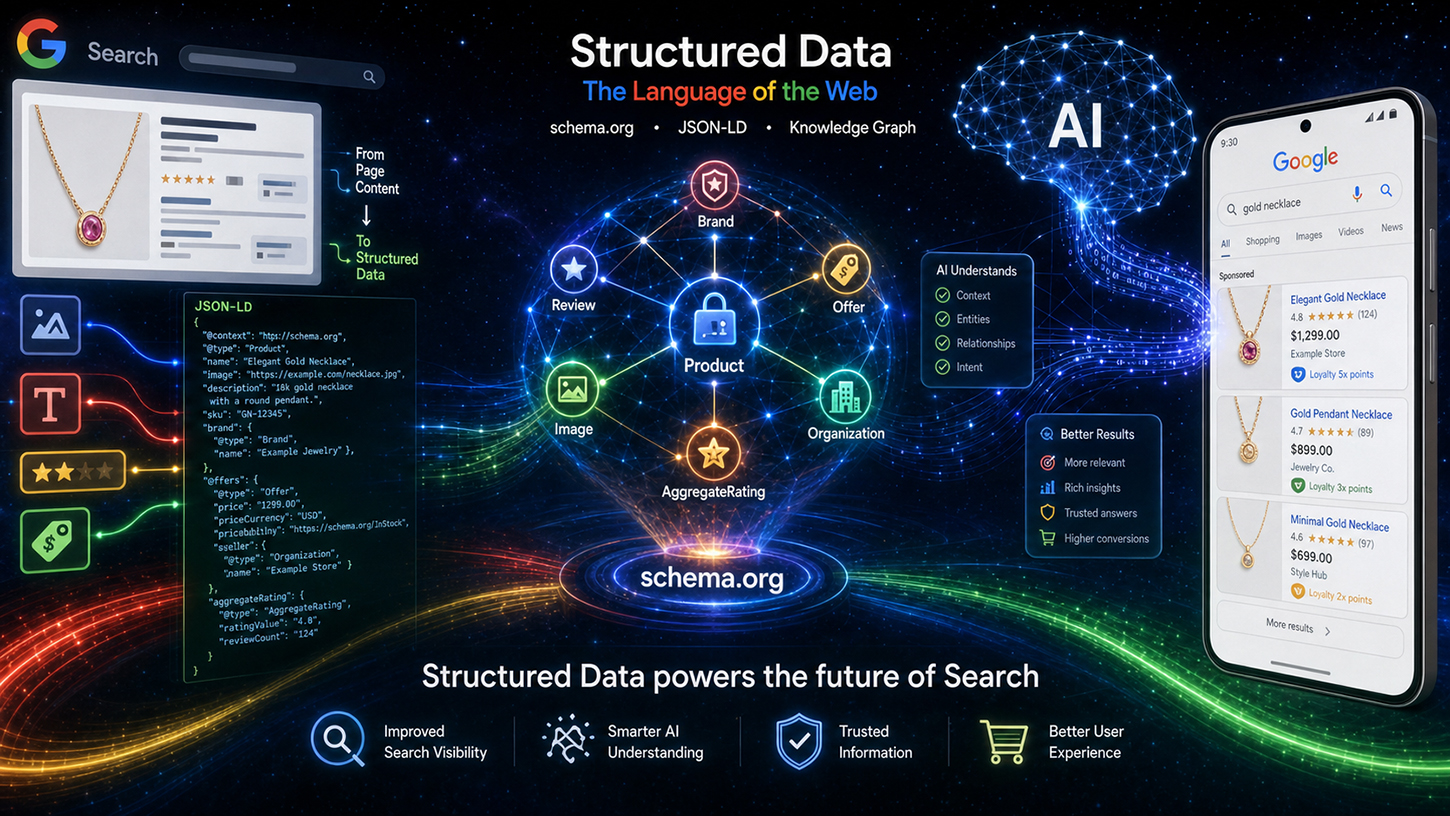
Structured data (markup) in the AI age with Schema.org: What Google's engineers really think – Image: Xpert.Digital
Google's SEO secret: Why AI fails without structured data
Despite ChatGPT & Co.: Why Google engineers continue to swear by Schema.org
SEO Update: Why Schema.org is now displacing Open Graph on Google
A persistent myth circulates in the SEO world: In the age of brilliant AI language models that effortlessly understand even unstructured text, painstakingly maintained structured data like Schema.org has simply become obsolete. But the reality is quite different. At the Google Search Central Live event, Google engineer Ryan Levering debunked this misconception and made it unequivocally clear: Structured markup is not a relic of the past, but rather the fundamental backbone of the new AI-powered search.
From new AI overviews to autonomous shopping agents, language models need precise, machine-readable guidelines to avoid hallucinating and to operate computationally efficiently. Those who want to remain visible on the modern web must help machines understand context without ambiguity. This article examines Google's strategic realignment, presents revolutionary innovations for e-commerce and user-generated content, and shows why technical SEO is now the decisive competitive advantage in the battle for machine visibility.
Machines can read the web – but only if you help them understand it
On April 21, 2026, the first Google Search Central Live event on Canadian soil took place in Toronto – and it was no ordinary industry gathering. Ryan Levering, an engineer with Google Search Engineering, delivered what was arguably the most technically dense and strategically significant presentation of the day: “Structured Data, Quality & AI.” What he presented was more than a technical review. It was a clear statement about the future of the semantic web in an era where artificial intelligence is increasingly taking on the role of intermediary between users and information.
Between two extremes: The wrong either-or
At the beginning of his presentation, Ryan Levering contrasted two diametrically opposed opinions circulating in the SEO community. On the one hand, there's the conviction that structured data is simply superfluous in the age of powerful language models: If AI models can easily interpret unstructured text, why bother laboriously adding schema.org markup to the source code? On the other hand, some enthusiasts propagate the idea that structured data is the future of the internet – a universal semantic communication protocol between autonomous AI agents that will largely replace the traditional web.
Levering rejected both extremes and instead presented a nuanced, empirically grounded perspective. Both positions contained a kernel of truth, he concluded, but neither fully described reality. This nuance is characteristic of Google's current approach to the topic: it's not about dogma, but about pragmatic efficiency.
Four arguments that explain everything
Levering's central argument can be summarized in four key points, which he elaborated on under the title "Value of Structured Data." The first point is precision: Structured data provides significantly higher accuracy for complex schemas such as sales prices or loyalty programs than LLM-based extraction from free text. Language models can be misleading—they fill in missing attributes, nest data incorrectly, or access information out of context. When extracting product prices from a large e-commerce site with dozens of similar items, the error rate is significantly higher with AI inference than with cleanly implemented, structured markup.
The second point concerns additional content: Structured data often contains invisible metadata that is simply not present in the rendered HTML of a page. Complete ISO date formats, stable identifiers for user-generated content, or internal entity IDs—this information exists exclusively in the markup. No language model can extract what is not in the text.
Thirdly, efficiency: Parsing structured markup is many times cheaper than processing a large language model to extract complex data. Google indexes billions of pages daily. The calculation is simple: A regular parser processing JSON-LD consumes a fraction of the computing resources of an LLM inference step. Structured data is therefore not only semantically superior—it is also significantly more efficient from a business perspective. This point is of direct relevance to Google's infrastructure.
The fourth, and perhaps most underestimated, aspect is focus: Structured data explicitly highlights which information is relevant on a page, thus preventing AI systems from picking up irrelevant data. On a product page with a main article, several related products, and a navigation bar full of prices, a language model without explicit annotation cannot be certain which price to refer to. Structured markup solves this problem through unambiguous assignment.
How structured data is actually processed
Levering also made the technical processing flow transparent. Schema.org data is first processed through specific cleaning and filtering before being categorized as indexed data – divided into areas such as events, shopping, and reviews. This prepared data then flows into two different output channels: on the one hand, the classic search results page (SRP), and on the other hand, as context for Google's AI-based systems, specifically the so-called AI Overviews (AIO) and AI Mode (AIM). Structured data is thus no longer just a rich results tool, but direct input for generative AI responses. This represents a fundamental shift in the strategic importance of schema.org markup.
🎯🎯🎯 Data-driven B2B industry hub as a quasi-in-house solution

The quasi-in-house solution: How Xpert.Digital closes operational gaps in B2B marketing and sales – Smart Content-Driven Business - Image: Xpert.Digital
Xpert.Digital is a data-driven B2B industry hub led by Konrad Wolfenstein . The company acts as an external, quasi-in-house solution for industrial partners, closing operational gaps in marketing, content, and sales – without requiring additional resources on the client side.
More information here:
Why structured data is becoming the infrastructure for AI agents
Shopping in focus: Shipping, loyalty and variations
A significant portion of the presentation focused on innovations in e-commerce. Levering explained that, according to data from the Baymard Institute, unexpected shipping information ranks second and third among the most common reasons for shopping cart abandonment. Structured markup for shipping services can directly address this problem: Merchants can now precisely define origin and destination regions, dimensions and weights, order value thresholds, processing times, and loyalty program affiliations directly in the code.
The shipping time model that Google uses is divided into two phases: the handling time, i.e., the time from order receipt until handover to the carrier, and the actual delivery time. Both phases can be annotated separately and with high granularity – down to order cutoff times and whether processing also takes place on weekdays. The corresponding JSON-LD examples show how the `ShippingConditions` type can be used to define free shipping for certain countries (e.g., France and Germany) and minimum order values (e.g., €50).
The integration of shipping services with loyalty programs is particularly innovative. Using the `validForMemberTier` property, a shipping service can be explicitly linked to a membership program and a specific tier. This makes it possible to declare shipping benefits for premium members directly in the markup – a feature previously only configurable via the Google Merchant Center. The associated loyalty program itself is defined as a `MemberProgram` object under the `Organization` entity, with tiers such as "Gold" or "Silver" and associated benefits like loyalty awards or point rewards.
Loyalty programs as semantic entities
The introduction of loyalty program markup is economically significant. Organizations can define multiple independent membership programs, each with several tiers and differentiated benefits—points, member prices, return policies, shipping bonuses. This information then appears directly in Google search results, as Levering demonstrated with real-world examples, including a Sephora offer that displayed a 30 percent member discount directly in the shopping snippet. Cross-page ID linking, the ability to link to loyalty program definitions from other pages, is, according to Levering, the next planned step, currently titled "Blazing the path for cross-page @id linkage." The goal: stronger organizational references between product pages and company policies.
User-Generated Content: The Problem of AI Labeling
Another important topic was the further development of schema types for user-generated content (UGC). Two new features are particularly relevant here. First, embedded posts and reposts are supported in forum and Q&A markup, enabling a more accurate semantic representation of discussion structures. Second—and this is of even greater strategic importance—the `so#digitalSourceType` property is introduced to explicitly identify machine-generated content.
This development is a direct response to the flood of AI-generated content on platforms like forums and Q&A sites. Webmasters can now declare whether a post was generated algorithmically or by a language model. Those who don't specify this are implicitly assumed by Google to be human authors – a rule that incentivizes transparent labeling. The `digitalSourceType` property is based on the IPTC codes for digital sources and distinguishes, among other things, between algorithmically generated and model-generated content.
Image selection: Schema beats Open Graph
A less noticed but practically effective update concerns Google's image selection logic. The system is being consolidated internally, with a clear prioritization hierarchy: Schema.org markup, specifically the properties `primaryImageOfPage` and `mainEntity → image`, takes precedence. Only then does the `og:image` meta tag from Open Graph follow. This change means that for website operators, a clean schema.org implementation of the main image directly influences its display in Google search results and AI Overviews – a concrete, measurable advantage.
Schema.org itself receives investments
Also noteworthy is Google's announced reinvestment in schema.org as an open specification. Three concrete measures were mentioned: the publication of statistics on the usage frequency of individual schema terms (prevalence data, as a slide shows, is already available for individual terms like `digitalSourceType` with information on approximately 10,000 domains), the publication of Google's own validation rules in machine-readable standard formats such as SHACL or ShEx, and improved support for order rules. This is significant because it would allow external developers to build their own validation tools based on Google standards – independent of the official testing tools, which occasionally crash under load.
Validation: Two tools, one goal
Levering presented two validation tools that complement each other but apply different testing criteria. The Rich Result Test Tool at `search.google.com/test/rich-results` accepts URLs or pure JSON and checks whether the markup is suitable for Google Search Rich Results – it is therefore based on Google's specific requirements, not on the schema.org standard itself. The `validator.schema.org`, on the other hand, checks whether the markup is schema.org-compliant, i.e., adheres to the open vocabulary, regardless of whether Google generates rich results from it. This leads to a clear recommendation for web developers: both tools should be used, because markup can be schema-compliant but not rich-result capable – and vice versa.
The bigger picture: Structured data as AI infrastructure
Looking at the Toronto event as a whole, a shift is evident that extends far beyond traditional SEO optimization. Structured data is evolving from a tool for achieving rich snippets to a fundamental data layer standard for AI systems. Google's AI Overviews and AI Mode actively use schema.org markup as context for answer generation and entity verification. Those who implement correct, complete, and precise structured data not only improve their chances of achieving visual highlights in search results—they position their content as a reliable primary source for AI answers.
The mention of the Universal Commerce Protocol (UCP) and WebMCP in this context is no coincidence. Both agent-based communication standards, which Google released in early versions in 2026, require that websites be semantically described. Schema.org forms the basis for this. In a world where AI agents act autonomously on the web, searching, comparing, and initiating transactions, machine readability of content is no longer optional, but a prerequisite for economic relevance. Ryan Levering's presentation in Toronto was therefore not just a technical update report—it was a glimpse into the infrastructure of the next web.
You can find out for yourself in 10 seconds
If you want to know how well and comprehensively your or another website uses structured data, you can use exactly the two tools that Ryan Levering from Google (from our text above) recommended:
Google Rich Results Test (focus on Google visibility):
Go to search.google.com/test/rich-results, copy the URL of any xpert.digital article, and click "Test URL." The tool will show you exactly which markups Google recognizes on that page and whether they are error-free.
Schema Validator (focus on pure standards compliance):
Go to validator.schema.organd paste the same URL. Here you can see directly in the source code, highlighted in color, which JSON-LD scripts (structured data) xpert.digital has incorporated.
Your global marketing and business development partner
☑️ Our business language is English or German
☑️ NEW: Correspondence in your native language!

Konrad Wolfenstein
I and my team are happy to be available to you as your personal advisor.
You can contact me by filling out the contact form here simply call me at +49 7348 4088 965. My email address is [email protected]:or
I'm looking forward to our joint project.
☑️ SME support in strategy, consulting, planning and implementation
☑️ Creation or realignment of the digital strategy and digitization
☑️ Expansion and optimization of international sales processes
☑️ Global & Digital B2B trading platforms
☑️ Pioneer Business Development / Marketing / PR / Trade Fairs
B2B support and SaaS for SEO and GEO (AI search) combined: The all-in-one solution for B2B companies

B2B support and SaaS for SEO and GEO (AI search) combined: The all-in-one solution for B2B companies - Image: Xpert.Digital
AI search changes everything: How this SaaS solution will revolutionize your B2B ranking forever.
The digital landscape for B2B companies is undergoing rapid change. Driven by artificial intelligence, the rules of online visibility are being rewritten. For companies, it has always been a challenge not only to be visible in the digital mass, but also to be relevant to the right decision-makers. Traditional SEO strategies and managing local presence (geo-marketing) are complex, time-consuming, and often a battle against constantly changing algorithms and intense competition.
But what if there were a solution that not only simplified this process but also made it smarter, more predictive, and far more effective? This is where the combination of specialized B2B support with a powerful SaaS (Software as a Service) platform comes into play, specifically designed for the demands of SEO and GEO in the age of AI search.
This new generation of tools no longer relies solely on manual keyword analysis and backlink strategies. Instead, it leverages artificial intelligence to more accurately understand search intent, automatically optimize local ranking factors, and conduct real-time competitive analysis. The result is a proactive, data-driven strategy that gives B2B companies a decisive advantage: they are not only found, but perceived as the leading authority in their niche and location.
Here's the symbiosis of B2B support and AI-powered SaaS technology that transforms SEO and GEO marketing, and how your company can benefit from it to grow sustainably in the digital space.
More information here: