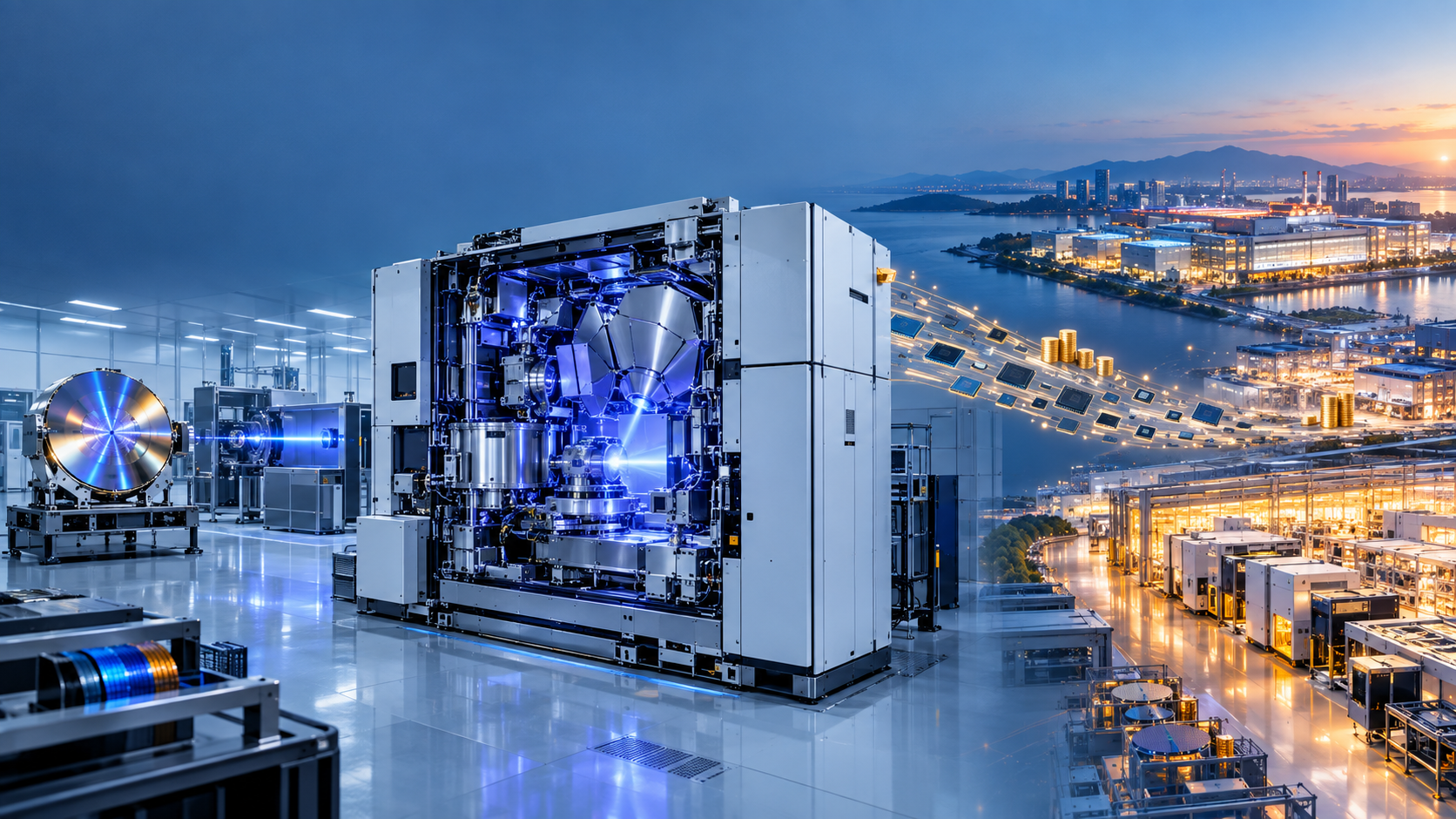
Shocking figure from ASML: Why Europe is slipping to 0% in state-of-the-art chip manufacturing – Creative image on the topic, with AI: Xpert.Digital
The secret tech monopoly: How European companies are driving the global AI revolution
Billions in subsidies wasted? The inconvenient truth about Europe's chip industry
Europe's fatal chip dependency: Why sheer technological strength is no longer enough
Europe faces a historic industrial policy paradox: While domestic technology leaders like ASML, ZEISS, and TRUMPF supply the essential tools and machines for the global AI and semiconductor revolution, the actual production of high-performance chips takes place almost exclusively in Asia and the USA. A recent figure dramatically underscores this imbalance: In the second quarter of 2026, Europe's share of shipments of state-of-the-art lithography systems was exactly zero percent. The continent is selling the tools for the digital gold rush but leaving the lucrative mines to others. After setbacks like the failed Intel project in Magdeburg and in light of growing geopolitical risks, the European semiconductor strategy stands at a crucial crossroads. It is becoming clear that simply distributing billions in subsidies cannot compensate for a lack of competitive advantages. This article analyzes why the real problem often lies in the lack of aggregated demand, what opportunities projects like the one in Dresden offer, and what a realistic “Chips Act 2.0” must look like in order to avoid permanently losing Europe’s technological sovereignty.
We're building the tools of the AI revolution – and leaving the factories to others
Europe possesses technologies without which modern high-performance chips can hardly be manufactured. Nevertheless, the majority of industrial value creation takes place where the machines developed by European companies are used: in South Korea, Taiwan, China, and the United States. ASML's second-quarter 2026 data encapsulates this paradox in a figure that could hardly be more politically explicit. Europe's share of shipped lithography systems was zero percent, while Asian locations dominated sales.
This snapshot doesn't prove that Europe no longer has a semiconductor industry. However, it does show how far Europe's position in new manufacturing capacities for state-of-the-art chips lags behind its own technological ambitions. Europe is a leader in crucial areas such as equipment, optics, laser technology, power electronics, and industrial research. At the same time, it lacks large, rapidly growing manufacturing clusters for highly integrated logic chips, AI accelerators, and advanced memory products. The continent is thus supplying some of the raw materials for the global gold rush, but is building too few of its own mines.
One quarter as an industrial policy warning signal
ASML achieved sales of €9.326 billion and a net profit of €2.918 billion in the second quarter of 2026. Compared to the same quarter of the previous year, in which sales were €7.692 billion and net profit €2.290 billion, sales increased by just over 21 percent and profit by around 27 percent. The gross margin reached 54 percent, the operating margin 37.1 percent, and the net profit margin 31.3 percent. These figures not only indicate a strong economy but also the exceptional pricing power of a company whose cutting-edge technology is virtually irreplaceable.
Of the €9.3 billion in total revenue, €6.6 billion was attributable to new systems and €2.8 billion to the installed base business, including maintenance, spare parts, and upgrades. Within the systems business, EUV technology contributed €3.8 billion, including the delivery of a latest-generation high-NA EUV system. The remaining €2.8 billion came from other lithography systems, primarily the still indispensable DUV technology. The ratio between logic and storage applications was almost balanced at 51 to 49 percent. The upswing was therefore not driven by a single sub-market, but by a broad wave of investment in AI, data centers, and modern storage architectures.
ASML has therefore raised its revenue forecast for the full year 2026 to between €43 billion and €45 billion. The midpoint of this range is €44 billion, approximately 16 percent higher than the midpoint of the previously mentioned range of €36 billion to €40 billion. The expected gross margin of 54 to 56 percent underscores that demand is not only strong in terms of volume, but also focused on particularly valuable systems, upgrades, and services. The global semiconductor cycle in 2026 will be significantly driven by AI investments, and ASML is positioned at a bottleneck where a disproportionate share of this dynamic is becoming apparent.
The geography of the boom lies in Asia
The regional distribution of system revenues recorded in the second quarter clearly illustrates the shift in industrial power. South Korea accounted for 43 percent, Taiwan for 30 percent, China for 14 percent, and the United States for 9 percent. South Korea alone thus represented almost as much revenue as Taiwan, China, and the US combined. This share is primarily driven by massive investments in advanced storage and logic capabilities, further fueled by the demand for high-performance computers, AI accelerators, and high-bandwidth memory.
Europe reached zero percent during the same period. This figure is striking, but it requires careful interpretation. The geographical distribution refers to systems shipped and is prone to fluctuations from quarter to quarter due to high unit prices and limited production volumes. Even a few very expensive systems can significantly alter regional shares. Furthermore, Europe has existing factories that produce, maintain, and upgrade systems without purchasing new large-scale systems every quarter. Therefore, the zero figure does not mean that no chips are manufactured in Europe or that ASML has no business there. It means that European manufacturers played no visible role in the acquisition of new lithography systems during this quarter.
However, this very limitation does not make the signal harmless. In the first two quarters of 2026, Europe's share of system revenues was already zero. Previously, the region had only achieved low single-digit figures. A single quarter could be dismissed as a temporary shift. However, a prolonged period of extremely low shares points to a structural problem: the development of new capacities is taking place predominantly outside Europe, while the European market generates only a few projects that regularly trigger large orders for state-of-the-art lithography technology.
Europe's invisible technology monopoly
An EUV system is not an isolated Dutch product, but rather the result of a European innovation network. ASML in Veldhoven designs and integrates the entire system. ZEISS develops and manufactures the high-precision optics in Oberkochen. TRUMPF from Ditzingen supplies the powerful laser system for generating the extreme ultraviolet light. In addition, there are research institutes, specialized suppliers, and manufacturing expertise built up over many years that can hardly be replicated in the short term.
The physical challenge is exceptionally demanding. EUV lithography uses light with a wavelength of 13.5 nanometers. A high-power CO₂ laser strikes tens of thousands of tiny tin droplets per second in a vacuum chamber, generating a plasma that emits EUV radiation. Because this light is absorbed by air and virtually all materials, it cannot be guided by ordinary lenses. Instead, it requires extremely smooth, multi-layered mirrors whose surfaces and positioning operate on the atomic scale. ASML integrates the light source, optics, mechatronics, metrology, software, and process control into an industrially usable system.
This combination forms one of Europe's strongest technological control points. ASML is the sole supplier of production-ready EUV lithography systems. ZEISS exclusively provides the necessary optics, while TRUMPF plays a key role in the laser source. This is not just an export advantage, but geopolitical power. Without this technology, the most advanced production lines cannot be operated economically. At the same time, the monopoly is vulnerable because its commercial growth depends on factory investments outside Europe, and the systems require numerous non-European components, services, and customer relationships.
Technological strength does not replace industrial depth
Europe's problem is not a complete lack of semiconductor expertise. The continent is strong in power semiconductors, sensors, microcontrollers, analog and high-frequency chips, industrial electronics, and chips for vehicles. Companies like Infineon, STMicroelectronics, NXP, and Bosch serve markets where reliability, energy efficiency, long product lifecycles, and robust supply capabilities are more important than the smallest structural node. In addition, there are internationally leading research centers, material suppliers, equipment manufacturers, and highly specialized medium-sized suppliers.
These strengths align with Europe's industrial demand. A large proportion of semiconductors used in Europe go into vehicles, machinery, energy systems, and automation technology. The automotive industry alone accounts for a significant portion of regional demand. Electrification, driver assistance systems, software-defined vehicles, power electronics, and networked production systems are further increasing the need for chips. For many of these applications, mature manufacturing processes are more economically viable than the most expensive cutting-edge nodes.
But therein lies a strategic divide. Europe is well-positioned in several long-lasting and profitable niche markets, while it is weaker in leading logic processors, AI accelerators, state-of-the-art memory chips, and advanced packaging. The digitalization of European industry, however, is increasing its dependence on these high-performance components. A modern vehicle needs not only power semiconductors and sensors, but increasingly central computers for driver assistance systems, infotainment, and artificial intelligence. An industrial automation system requires not only robust control chips but also high-performance processors, communication components, and secure software platforms. Europe's traditional strengths, therefore, do not automatically protect it from new dependencies.
Factories do not follow the origin of the machine
It would be economically wrong to assume that European manufacturing technology automatically leads to European chip factories. Semiconductor factories are built where several conditions are met simultaneously: reliable customer demand, competitive energy and operating costs, qualified personnel, short permitting times, water and electricity infrastructure, attractive financing, a robust supply network, and long-term political stability. The origin of individual machines is only one factor among many.
Modern factories are extremely capital-intensive. Their profitability depends on high capacity utilization, stable process yields, and rapid learning curves. A technologically advanced plant that remains chronically underutilized wastes capital. Therefore, manufacturers prefer to invest in locations where customers, engineers, material suppliers, maintenance services, packaging capacities, and other factories are already concentrated. Each additional player reinforces the locational advantage of the existing cluster. Taiwan and South Korea have benefited from such feedback loops for decades.
In contrast, Europe often tries to win political support for individual large-scale projects without simultaneously scaling up the entire industrial environment. A factory alone does not create an ecosystem. Without local customers, qualified specialists, design firms, packaging suppliers, and fast permitting processes, it remains a costly island. Industrial policy then becomes a competition for the highest investment subsidy, even though long-term location quality over decades, not the initial grant approval, is what truly matters.
The cost difference is not an excuse, but a challenge
Costs are a disadvantage for Europe, but they don't explain everything. According to current comparative calculations, manufacturing advanced chips in Germany can be around 40 to 50 percent more expensive than in Taiwan or mainland China. Wages, construction costs, operating expenses, and the construction time are particularly significant factors. While energy isn't the only cost driver for semiconductor factories, an expensive and fluctuating power supply worsens the calculations. Added to this are high costs for cleanrooms, water treatment, chemicals, maintenance, and the 24/7 availability of technical staff.
Other regions also compensate for locational disadvantages with government support. The United States mobilizes substantial resources through grants, tax credits, loans, and state incentives. Japan supports strategic projects with billions of dollars. South Korea and Taiwan combine subsidies with dense industrial networks, a skilled workforce, and strong domestic customers. China offers, in addition to subsidies, a large domestic market, lower costs in many intermediate goods and services, and politically driven capacity building. Europe, therefore, does not compete with a free global market, but rather with several industrially organized systems.
However, this does not mean that Europe should permanently close every cost gap with subsidies. A location that only functions with ever-increasing aid remains vulnerable. Funding must be time-limited, tied to verifiable investment, production, research, and supply targets, and concentrated in areas where Europe can achieve realistic economies of scale. At the same time, structural costs must decrease. Faster planning, reliable energy prices, better grids, coordinated training programs, and a more robust capital market are more important in the long run than spectacular one-off payments.
The underestimated demand problem
The debate about semiconductor policy often focuses on the supply side: subsidies, factory locations, research lines, and approvals. ASML's weak sales in Europe, however, point to the other side of the market. A factory isn't built because a continent symbolically desires it, but because enough customers have committed to purchasing wafers, chips, or computing power. Without long-term orders, even generous subsidies can only help to a limited extent.
While Europe boasts large user industries, their demand is fragmented. Automotive manufacturers, mechanical engineering companies, energy technology firms, telecommunications providers, defense contractors, and public institutions typically procure chips indirectly through supply chains. This rarely results in a consolidated, long-term secured volume that would motivate a manufacturer to build a new European factory. Many European corporations optimize their procurement globally and in the short term. From a business perspective, this is understandable, but from an industrial policy perspective, it weakens the development of regional capacities.
An effective strategy would need to coordinate demand without creating inefficient purchase guarantees. European companies could agree on common specifications, long-term supply contracts, and transparent demand forecasts for strategic chip types. Public procurement in defense, energy, administration, transport, and research could give greater consideration to security and resilience criteria. Large European AI and data center projects could also generate demand for components designed, manufactured, or packaged in Europe. Crucially, political objectives must be translated into bankable contracts.
🎯🎯🎯 Data-driven B2B industry hub as a quasi-in-house solution


The quasi-in-house solution: How Xpert.Digital closes operational gaps in B2B marketing and sales – Smart Content-Driven Business - Image: Xpert.Digital
Xpert.Digital is a data-driven B2B industry hub led by Konrad Wolfenstein . The company acts as an external, quasi-in-house solution for industrial partners, closing operational gaps in marketing, content, and sales – without requiring additional resources on the client side.
More information here:
The path to European chip autonomy
The Chips Act: Between Ambition and Reality
The first European Chips Act set the goal of increasing Europe's share of global semiconductor production to 20 percent by 2030. Politically, this target was understandable: it was intended to generate mobilization and highlight Europe's dependence. Economically, however, it was problematic from the outset because the global market is growing rapidly at the same time. To double its relative share, it is not enough to simply double its own production. Europe would have to grow faster than the global market and roughly quadruple its capacity, depending on the measurement method.
Actual progress remains significantly below this target. The European Commission recently projected that Europe's share of the global value chain could rise from 9.8 percent in 2022 to only 11.7 percent in 2030. The European Court of Auditors accordingly assessed the 20 percent target as virtually unattainable. This highlights a fundamental problem: the target was not sufficiently linked to a project pipeline, funding volume, responsibilities, timeline, and measurable milestones.
The frequently cited investment figures are also easily misleading. More than €100 billion in politically initiated public and private investments sounds enormous. However, in an industry where individual factory complexes cost tens of billions of euros and global manufacturers invest hundreds of billions over just a few years, this amount quickly becomes less significant. Furthermore, not every announced euro is additional, not every project is guaranteed, and not every expenditure is aimed at advanced production. Research, pilot plants, existing investment plans, and national funding programs are sometimes added together. For the industrial impact, what matters less is the headline-grabbing figure than the actual number of sites built, equipped, and operating at full capacity.
Magdeburg as a cautionary tale of false certainty
The failed Intel project in Magdeburg demonstrates how risky it is to equate announcements with industrial reality. A factory complex was planned with an investment volume of more than 30 billion euros and promised German subsidies of nearly ten billion euros. Initially, the project was postponed, and finally abandoned in July 2025. Intel justified its change of course by citing premature and overly extensive capacity planning without sufficient demand.
The cancellation was not proof that a chip factory could not be built in Germany at all. It also reflected the company's financial and strategic crisis. Nevertheless, it exposed weaknesses in European investment policy. A massive range of subsidies could not compensate for the lack of planning certainty on the company's side. At the same time, the public debate had already treated the project as a near-certain success, even though construction, equipment installation, process ramp-up, and customer capacity utilization were still years away.
For future projects, this means that funding decisions must be more closely linked to verifiable milestones. Disbursements should be tied to the start of construction, machine installation, job creation, the start of production, and qualified purchase agreements. Equally important is a realistic risk-sharing arrangement. The state may enable strategic investments, but should not assume the majority of the market risk, while a company can withdraw from a project without significant consequences if the situation changes.
Dresden shows a more realistic way
The ESMC project in Dresden offers a different approach. The joint venture between TSMC, Bosch, Infineon, and NXP is scheduled to begin production in the second half of 2027 and create approximately 2,000 direct jobs. Construction reached a visible milestone in September 2026 with the topping-out ceremony. Unlike the Magdeburg project, the Dresden plant is embedded in an existing microelectronics cluster and connects a world-leading contract manufacturer with European industrial customers.
Technologically, the company isn't aiming for the very latest AI processors, but primarily for chips for vehicles and industrial applications. Some see this as a lack of ambition. In fact, this specialization can be economically advantageous because it taps into existing demand, European expertise, and long product cycles. Resilience isn't created by the smallest structural node. During the supply chain crisis, the automotive industry often lacked relatively mature components, whose unit value was low, but whose failure could halt entire production lines.
Dresden won't solve the high-end chip problem. However, the project demonstrates that Europe can invest more credibly when demand, partner structure, clusters, and technological focus align. A successful strategy requires several such building blocks: robust manufacturing for automotive and industrial applications, advanced logic capabilities, power semiconductors, sensors, memory, chip design, and packaging. Not every location needs to excel in every area. However, Europe must develop sufficient complementary capabilities to transform individual factories into a resilient network.
Top-level manufacturing begins long before the cleanroom
Focusing solely on factory buildings underestimates the breadth of the value chain. Before production begins, there are chip architecture, intellectual property, design software, verification, and mask creation. After wafer fabrication, testing, packaging, and the integration of multiple chiplets into complex systems follow. Especially with AI hardware, a growing portion of the effort is shifting to advanced package technologies, high-speed memory interfaces, and the combined optimization of hardware, software, and cooling.
Europe has gaps in several of these stages. While it boasts strong research institutes and individual successful chip designers, it lacks a pool of large AI processor and design platform providers comparable to the US. Asia dominates in advanced packaging. Furthermore, the providers of key software tools and many processor architectures are located outside the European Union. A new European fab would therefore remain dependent on global partners in crucial upstream and downstream stages.
Industrial policy must therefore promote entire systems. This includes open and licensable architectures, design expertise, European cloud and AI demand, pilot production, packaging, testing, materials, chemicals, maintenance, and recycling. The connection between European user industries and chip developers is particularly important. When vehicle manufacturers, mechanical engineering companies, and energy technology firms collaborate with semiconductor companies to design specific components, an advantage arises that pure mass production can hardly replicate. Europe's opportunity lies not only in its size but also in its ability to combine complex industrial applications with customized semiconductor systems.
Subsidies need a strategic hierarchy
Not every chip category is equally critical. A rational policy must differentiate between areas where a disruption would cause significant economic damage, where Europe can pool its own demand, and where defense-capable capabilities already exist. This results in a hierarchy rather than a blanket target for global market share.
First and foremost are technologies where Europe has global control points. These include EUV lithography, precision optics, lasers, specialty materials, and certain process equipment. These capabilities must be protected through research, skilled labor, secure supply chains, and investment conditions. Secondly, Europe should build on its established strengths in power semiconductors, sensors, microcontrollers, secure automotive electronics, and energy-efficient industrial chips. Thirdly, the continent needs targeted capabilities in advanced logic chips, AI components, and packaging so that strategic applications are not entirely dependent on non-European supply chains.
Such prioritization is less spectacular than the promise of complete sovereignty, but more economically credible. It prevents scarce resources from being spread across too many projects. At the same time, it demands tough decisions. A funded project should not only promise jobs, but also be integrated into a European supply chain, establish research and training collaborations, serve multiple customers, and make demonstrable contributions to security of supply or technological leadership.
Strategic autonomy is not autarky
No economic region can control the entire semiconductor value chain on its own. Even the United States, Taiwan, South Korea, Japan, and China depend on international technologies, raw materials, equipment, or sales markets. Therefore, Europe's goal cannot be autarky. A more realistic goal is strategic capability that limits critical dependencies, creates alternative sources of supply, and reduces vulnerability to political blackmail.
To achieve this, Europe needs to understand which dependencies are truly critical. A high import share is not automatically dangerous if there are several trustworthy suppliers, sufficient stockpiles, and short-term alternatives. Conversely, a small component with only one manufacturer can make an entire industrial system vulnerable. Key factors are interchangeability, lead times, geographical concentration, and the economic consequences of a failure.
ASML's position gives Europe negotiating power, but it is not a universal shield. Export restrictions can generate foreign policy pressure, but at the same time they can cost sales, provoke countermeasures, and accelerate foreign efforts to develop alternative technologies. The European interest therefore lies in a rules-based trade policy coordinated with partners. Technological control should be used selectively, not as a substitute for a domestic industrial growth strategy.
The geopolitical price of spatial concentration
The high concentration of advanced manufacturing in East Asia is economically efficient, but geopolitically risky. Natural disasters, energy shortages, trade conflicts, or military tensions could disrupt supply chains, and replacing them would take years. The rapid expansion of artificial intelligence, in particular, increases dependence on a few production sites and companies. Data centers, defense systems, communication networks, and industrial automation are increasingly competing for similar high-performance chips.
Europe bears this risk on several levels. Its own industry needs semiconductors, European cloud and AI providers require computing capacity, and its defense capabilities depend on reliable electronics. At the same time, European plant manufacturers export key production technology to regions whose political stability Europe does not control. The more geographically concentrated global production remains, the greater the value of redundant capacity becomes.
Redundancy costs money and contradicts short-term efficiency. Nevertheless, it can be economically beneficial if the damage from a supply disruption is extremely high. The real question is not whether European manufacturing beats the cheapest location, but what premium for security of supply is acceptable. This premium must be transparent. Hidden, long-term subsidies obscure costs, while clearly defined resilience premiums enable objective political decision-making.
What an effective Chips Act 2.0 would have to change
A second Chips Act must not simply expand the first with additional programs, committees, and reporting requirements. It must accelerate implementation and establish the link between research, demand, and industrial scaling. The political process, which was further discussed in September 2026 and aims for an agreement by the second quarter of 2027, is under considerable time pressure. Semiconductor projects take years from site selection to achieving stable production yields. Every additional negotiation cycle pushes real capacity further into the future.
First, Europe needs a central, transparent project pipeline. It should track planning status, financing, permits, purchase interest, technological objectives, and expected production capacity. Second, binding deadlines for decisions are needed, without undermining environmental and safety standards. Parallelized reviews, standardized documentation, and designated contact persons can increase speed without eliminating oversight.
Third, the demand side must be institutionally anchored. Strategic projects should have solid letters of intent or long-term purchase agreements with European customers. Fourth, a European financing mechanism is needed that can support large projects across national borders. Otherwise, financially strong member states will win the subsidy competition, while smaller states will have little access to high-quality projects. Fifth, skilled workers, energy, water, networks, and housing must be part of the location decision from the outset.
Sixth, success measurement should be moved away from a single market share figure. More meaningful would be several key performance indicators (KPIs): additional wafer capacity by technology category, share of European demand from European production, number of strategically critical components with at least two sources of supply, packaging capacity, private follow-up investments, production yield, research transfer, and time from approval to operation. Such metrics demonstrate whether programs are generating substantial industrial value.
Europe's window of opportunity is shrinking
Europe has not yet lost its technological crown jewels. ASML, ZEISS, TRUMPF, and other specialized companies form an industrial network that is difficult to replace worldwide. Significant expertise also exists in Dresden, Grenoble, Eindhoven, Leuven, Catania, Villach, and other clusters. Therefore, the assertion that Europe no longer has a chance would be just as wrong as the notion that existing know-how automatically guarantees future strength.
Knowledge remains economically powerful only when it is translated into new products, capacities, and applications. Engineers migrate to where the most ambitious projects are being developed. Suppliers invest where customers are growing. Research focuses on the problems that large production facilities actually pose. Therefore, when more and more state-of-the-art factories are built outside of Europe, it's not just the ongoing value creation that shifts. Over time, learning curves, process knowledge, talent, and startups also migrate away.
ASML's zero percent share is therefore less a balance sheet entry than a leading indicator. It reveals the gap between European inventiveness and industrial implementation. Europe can still close this gap because it possesses key technologies, powerful industrial customers, strong research institutions, and large public budgets. However, every lost investment cycle increases the cost of catching up later.
The real decision is made in the implementation
Europe needs neither industrial policy fatalism nor the illusion of complete technological independence. What is needed is a pragmatic strategy that defends existing strengths, closes critical gaps, and concentrates investments where demand and expertise align. This also includes the willingness to end projects that could only be artificially kept alive through permanent subsidies.
The provocative statement that others are building factories while Europe is building processes contains a grain of truth. However, it falls short if regulation is made the sole scapegoat. Europe's lag stems from a combination of factors: weak aggregated demand, high operating costs, fragmented financing, slow decision-making, a lack of economies of scale, a shortage of skilled workers, and an incomplete value chain. Less bureaucracy is necessary, but it replaces neither customers nor capital, energy, or industrial learning curves.
The crucial economic policy task, therefore, is to translate European market power into concrete investment signals. Europe's automotive, mechanical engineering, energy, defense, and data center industries can constitute a large and demanding domestic market. When common standards, long-term demand, and focused support come together, European factories will be built not out of patriotism, but because they are profitable.
ASML's record quarter demonstrates that Europe can profit from its position at the global forefront. At the same time, the regional sales distribution reveals that technological leadership remains incomplete without domestic scaling. The machines are manufactured in Europe, but the learning curves for state-of-the-art manufacturing are predominantly developed elsewhere. This is precisely the strategic contradiction that Europe must resolve. Not with another binder, but with faster decision-making, robust demand, and factories that actually produce.
📈🚀 From visibility to trust 👀🤝 Your scalable path with Xpert.Digital


From visibility to trust: Your scalable path with Xpert.Digital - Image: Xpert.Digital
In industrial B2B, sustainable business relationships rarely emerge overnight. They develop step by step – through visibility, professional relevance, recurring touchpoints, and growing trust. Xpert.Digital's 4-stage model addresses precisely this: It offers a structured path that begins with a manageable entry point and can evolve into deeper collaboration in business development if needed.
Instead of relying on loud marketing promises, this model puts the relationship at the forefront. Companies start with clearly defined, easily calculable measures and then decide, based on their own experience, how far they want to expand the collaboration. A key factor for this undisturbed trust-building process: The platform completely avoids annoying advertising ads, so the editorial focus remains solely on the companies' expertise.
More information here:
Your global marketing and business development partner
☑️ Our business language is English or German
☑️ NEW: Correspondence in your native language!

Konrad Wolfenstein
I and my team are happy to be available to you as your personal advisor.
You can contact me by filling out the contact form here wolfenstein@xpert.digital:or simply call me at +49 7348 4088 965. My email address is
I'm looking forward to our joint project.