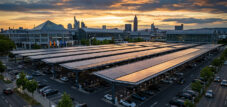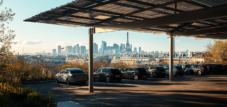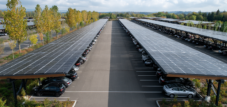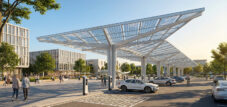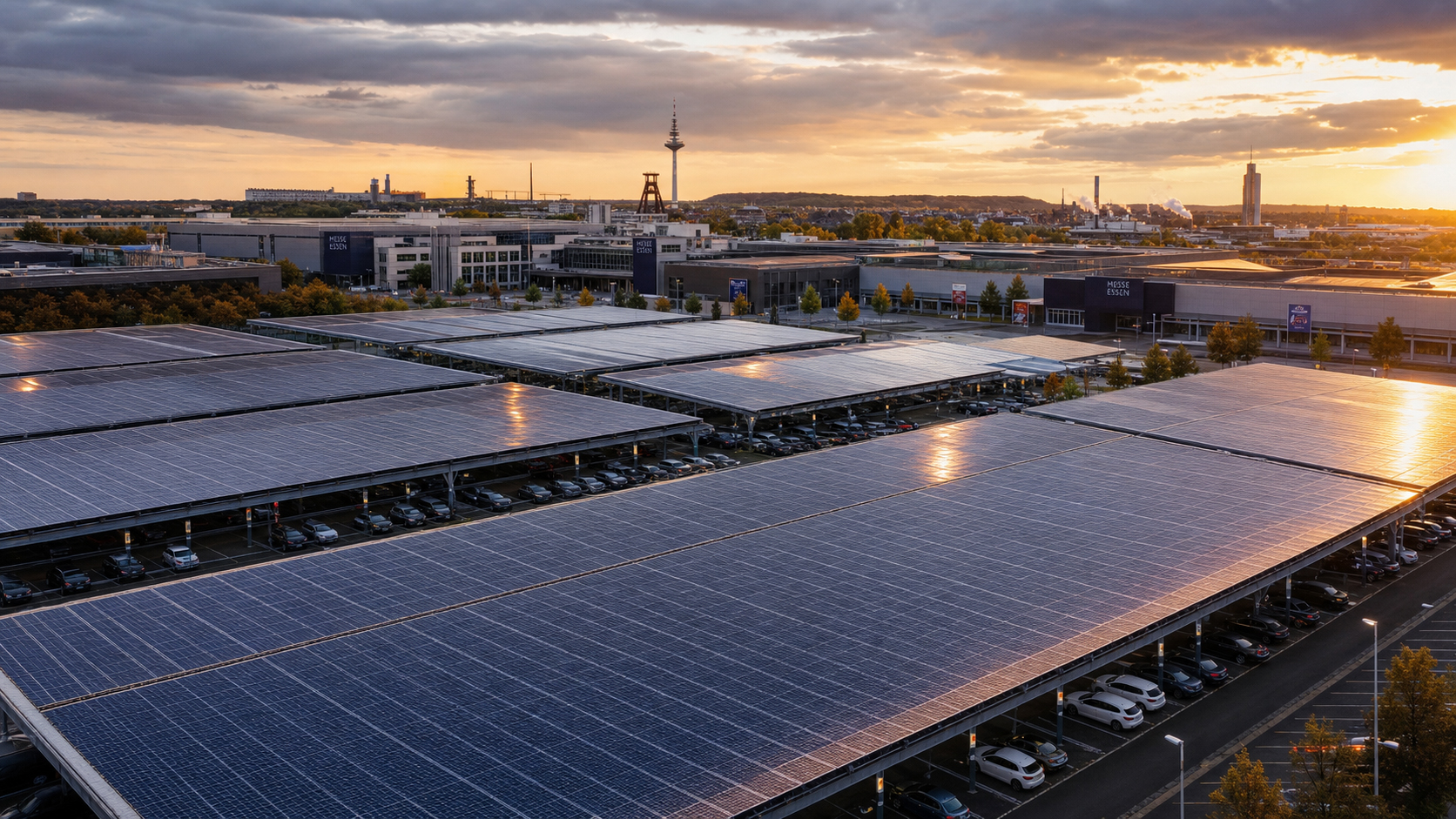
25,000 solar modules for a solar parking lot above the cars in Essen: The mega-project at the P10 trade fair parking lot – Creative image: Xpert.Digital
Up to 20 million euros in investment: How this Essen parking lot suddenly makes money
19 hectares of asphalt are being turned into a power plant: Essen is building a huge solar parking lot
Concrete, endless lines of cars, and unused space – that's what everyday life looked like in many large parking lots until now. But in the age of the energy transition, sealed asphalt is suddenly becoming a valuable resource. In Essen, one of Germany's most exciting infrastructure projects is currently under construction in the P10 trade fair parking lot: a huge solar carport that transforms the unused airspace above the parked cars into a green power plant. With 25,000 solar modules and an investment volume of up to 20 million euros, the Ruhr metropolis is demonstrating how climate protection and economic sense can be cleverly combined without having to seal off new natural areas. This pioneering mega-project could soon become a blueprint for cities throughout Germany.
A parking lot learns to earn money: Essen's trade fair parking lot becomes a power plant
Anyone familiar with parking lot P10 at the Essen Trade Fair has so far associated it with little more than a paved area, endless lines of cars on trade fair days, and yawning emptiness on all other days. It is precisely this ordinariness that makes the project planned there by the Essen Public Utilities and Transport Company (EVV) in cooperation with the Essen Trade Fair so remarkable. On approximately nineteen hectares of asphalt, one of Germany's largest solar carport projects is being built – a structure that transforms the previously unused second dimension of a parking area, the airspace above the cars, into a source of revenue. Around 25,000 photovoltaic modules are expected to generate a peak output of just over eleven megawatts and produce around eleven gigawatt-hours of electricity annually, enough to power several thousand households. The city anticipates annual savings of approximately 5,000 tons of carbon dioxide, a figure that can be readily compared to the emissions of several thousand mid-range cars in operation over the course of a year. The project is being realized by the EVV together with the Essen Trade Fair, while the Bochum-based company ROOF+ is responsible for the technical implementation as the general contractor. Construction is scheduled to begin in autumn 2026, with an estimated investment volume of fifteen to twenty million euros.
The project fits into a trend that has gained momentum in many German cities in recent years: the systematic dual use of sealed surfaces. Parking lots, supermarket roofs, and logistics centers were long considered purely functional spaces without any added energy value. This view is currently undergoing a fundamental shift because falling module prices, rising electricity prices, and political pressure to accelerate the energy transition have combined to create an economic environment in which such projects are suddenly becoming attractive. Essen, with its industrial past in the Ruhr region, is thus consciously positioning itself as a pioneer of a new urban energy infrastructure.
From coal mining region to solar power plant
Why Essen of all places is taking this step
For over a century, Essen was a symbol of the fossil fuel industry, home to mines, steelworks, and energy companies whose names were inextricably linked to coal and coke. The fact that this very city is now realizing one of the country's largest solar projects on a parking lot is more than just a footnote in economic history. It reflects a structural transformation that has been underway in the Ruhr region for years and is being actively shaped by municipal utilities like EVV. EVV already operates more than 250 photovoltaic systems within the city limits of Essen and has thus developed a certain level of expertise in handling large-scale solar projects, which is advantageous for implementing such a complex undertaking.
The chosen location is no coincidence. The P10 parking lot at the Essen Trade Fair is only partially utilized on most days of the year, as the fairgrounds don't use their halls continuously, but rather for individual, time-limited events. This structural underutilization, often perceived as waste in traditional inner-city parking areas, proves to be an advantage here, because the area is available for a solar roof over a large area and for the long term, without restricting its primary use as a parking space. The grid connection will be made via a nearby substation, for which a connection commitment has already been secured, significantly simplifying the project's technical feasibility.
Also noteworthy is the conscious decision to use a local company for the construction of the carports. ROOF+, based in nearby Bochum, symbolizes the attempt to keep the project's economic benefits within the Ruhr region and prevent them from flowing outwards. This is no small economic consideration, as large-scale projects of this kind can, depending on the tendering process, either act as a regional economic stimulus or result in a simple outflow of capital to international suppliers.
Numbers that make the change tangible
What performance, area and yield really mean
The project's technical specifications may seem abstract at first glance, but they become more meaningful when put into context. An installed capacity of approximately eleven megawatts peak corresponds roughly to the power required to equip several thousand single-family homes with a typical photovoltaic system, but concentrated on a single, compactly developed area. The projected annual electricity generation of around eleven gigawatt-hours is sufficient to cover the electricity needs of several thousand households or, alternatively, to supply a significant portion of the electricity demand of municipal properties. This is particularly interesting because a large part of the generated electricity is intended to flow directly to the city of Essen.
The project's land-use efficiency deserves special attention. On approximately nineteen hectares of parkland, roughly the size of twenty-seven football fields, a facility is being built that is being realized without converting agricultural or natural land. This aspect is economically significant because the expansion of photovoltaics in Germany is increasingly confronted with land-use conflicts, for example, when ground-mounted systems are built on formerly agricultural land, thereby triggering resistance from farmers and local politicians. A solar carport on an already sealed, economically underutilized area almost completely avoids these conflicts and demonstrates how the expansion of photovoltaics can be accelerated without additional land consumption.
The carbon dioxide balance can also be specified more precisely. The estimated annual savings of around 5,000 tons of carbon dioxide correspond roughly to the emissions produced annually by several thousand mid-range vehicles, or alternatively, the annual emissions of several hundred single-family homes with gas heating. Assuming a system lifespan of twenty to thirty years, the savings amount to well over 100,000 tons of carbon dioxide over the entire operating period – an effect that, in relation to the capital investment of fifteen to twenty million euros, represents a comparatively inexpensive lever for climate protection.
The business model behind the tin roof
How such an investment actually pays off
The crucial question in any large-scale project of this kind is whether and how the invested fifteen to twenty million euros will pay for itself. Solar carports differ fundamentally in their economic viability from traditional rooftop or ground-mounted systems because they incur additional construction costs for the supporting steel structure, which would be eliminated with a standard rooftop installation. These additional costs must be offset by other advantages, and this is precisely where the true economic core of the project lies.
The first advantage lies in the dual use of space. While a conventional ground-mounted solar power plant requires an area exclusively for energy generation, the parking area under the solar carport remains fully usable, thus eliminating opportunity costs for alternative land use. The second advantage is the proximity to the point of consumption. Because the generated electricity is to be marketed almost entirely directly to the city of Essen and its properties, long transport routes and the associated grid fees are eliminated, significantly improving profitability compared to feeding the electricity into the general grid. This form of direct electricity supply, often referred to as a Power Purchase Agreement (PPA), guarantees the operator stable and predictable revenues over fixed contract terms, independent of the often volatile market prices for electricity.
The third, and perhaps most important in the current market situation, advantage is the development of electricity prices. An operator investing today in a photovoltaic system with a lifespan of two to three decades is not calculating based on today's electricity prices, but rather on the expected prices over the entire operating period. Given the structurally increasing demand for electricity due to electric vehicles, heat pumps, and the growing electrification of industrial processes, a long-term investment in one's own generation capacity appears significantly more attractive from today's perspective than it did a decade ago. Added to this is the planned financing structure, in which EVV intends to raise a substantial portion of the capital through debt financing. This significantly increases the return on equity if the system is successful, but at the same time also exacerbates the risk of miscalculation should electricity price developments differ from expectations.
Also of interest is the proposed inclusion of potential citizen participation, about which discussions have been held with a regional credit institution. Such models allow citizens to participate in the financing with relatively small amounts and, in return, share in the profits of the facility. From an economic perspective, this is less a purely financial question than a tool for increasing local acceptance of a major project, the construction of which will inevitably involve temporary restrictions on parking.
The scalable City Solar Carport Module for businesses, cities and municipalities

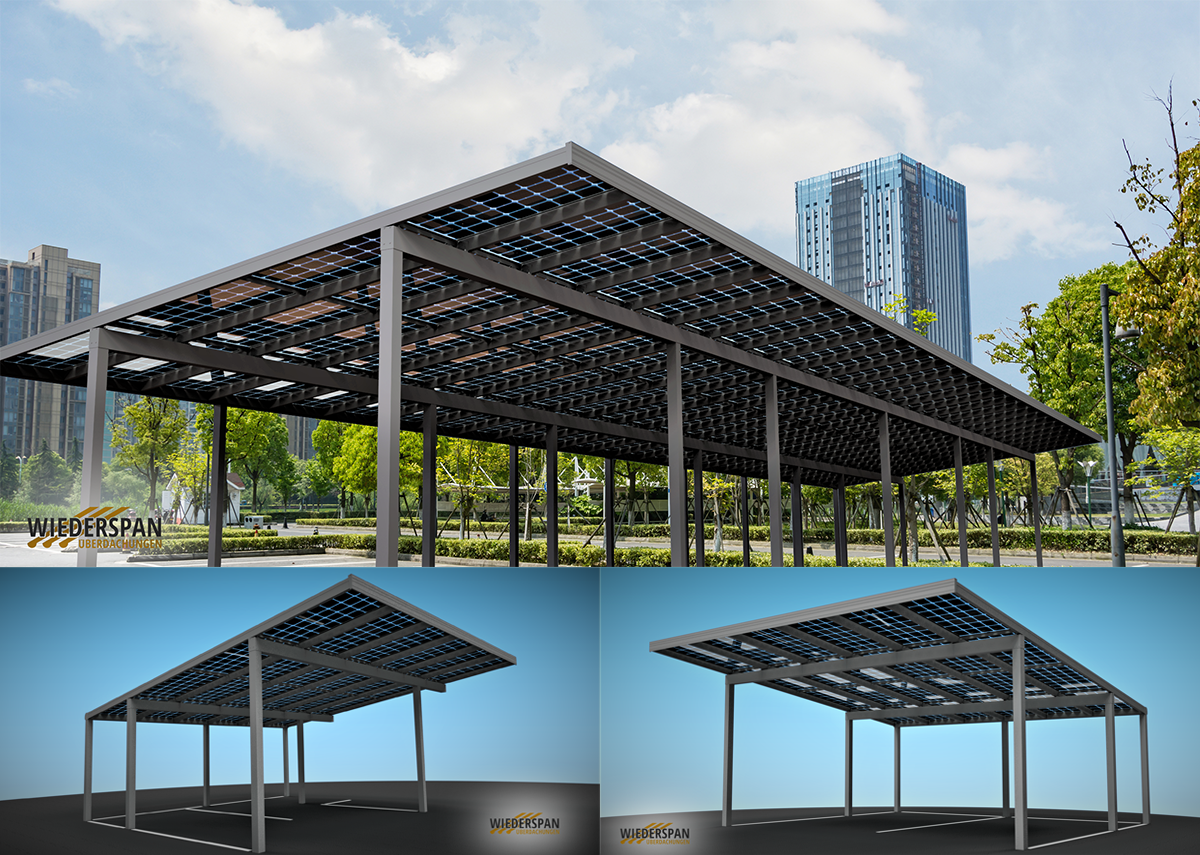
Solar canopy: Solar-covered parking lot - Image: Wiederspan.Solar
More information here:
We can also offer alternative solar-powered large parking lot systems!
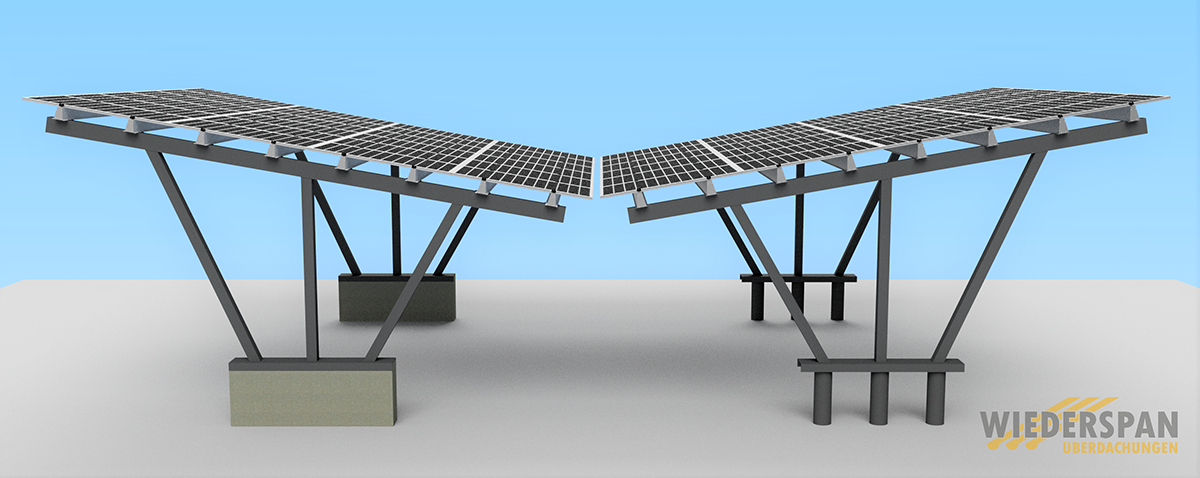
Photovoltaic systems for large parking lots - Image: Wiederspan.Solar
👉🏻 Let us advise you 👈🏻
👉🏻 Cars and trucks both possible! 👈🏻
We would be happy to help you find the optimal solar roof for your needs.
Our preferred city solar carport or solar carport module
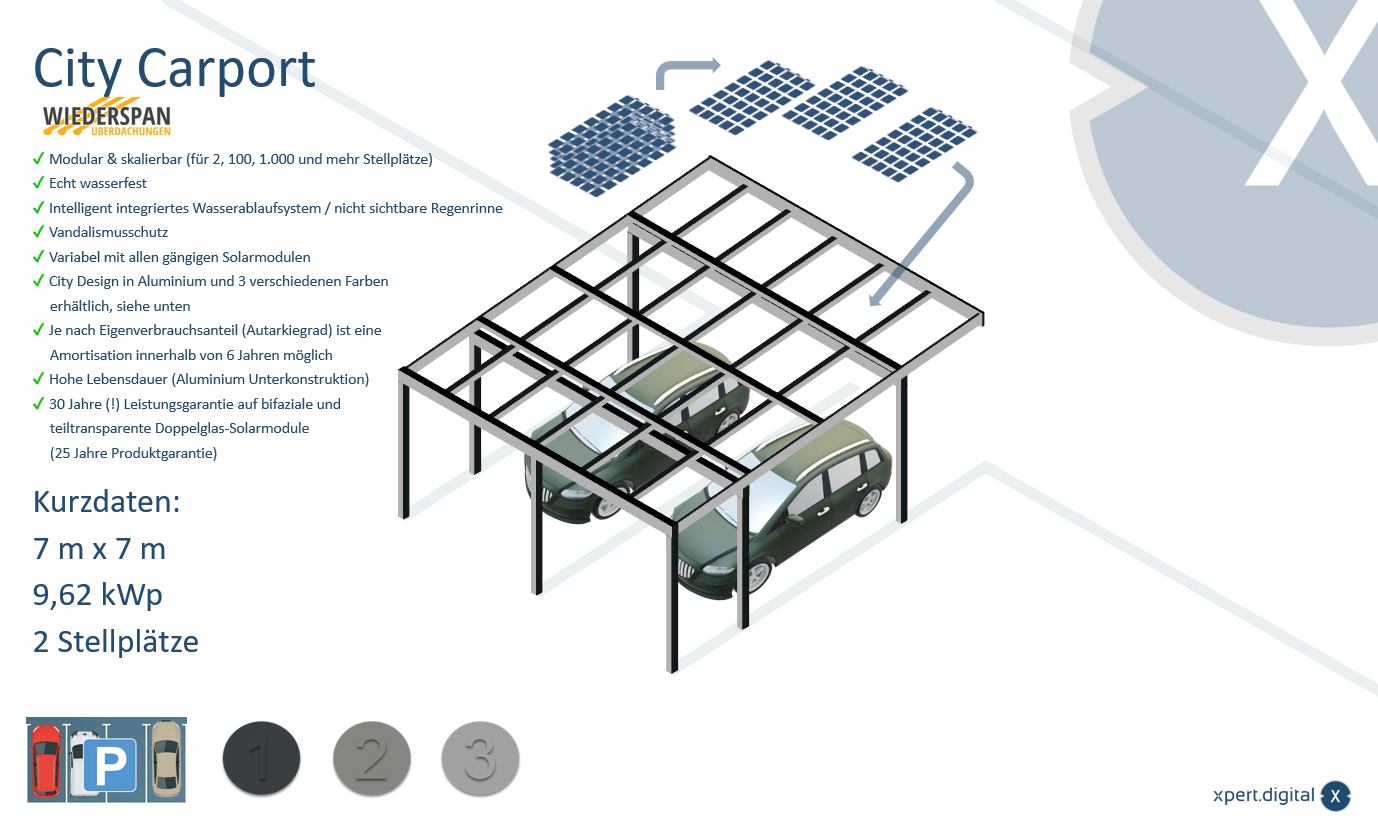
The City Solar Carport - with enhanced impact and vandalism protection - Image: Xpert.Digital
Advantages at a glance
- Support & Made in Germany
- Modular & scalable (for 2, 100, 1,000 and more parking spaces)
- Truly waterproof
- Integrated water drainage / concealed rain gutter
- Vandalism protection, optionally with integrated impact protection
- Compatible with all common solar modules
- City Design available in aluminium and 3 different colours
- Depending on the level of self-consumption (degree of self-sufficiency), amortization is possible within 6 years
- Long service life (aluminum substructure)
- 30-year (!) performance guarantee on bifacial and semi-transparent double-glass solar modules (25-year product guarantee)
- Reduction of urban heat islands
- Building-integrated photovoltaics
- Ideally suited for transparent and translucent double-glass solar modules with overhead mounting approval!
From parking lot to power plant: Essen's solar project could set a nationwide precedent
A building block of a larger movement
How the solar carport trend is spreading across Germany
Essen is not alone in this endeavor, but rather part of a trend currently observable in many major German cities. Similar projects are underway in Leipzig, among other places, where a pilot project is testing various technical and economic options for parking lot roofs incorporating photovoltaics in order to gain reliable insights for scalable rollouts in other cities. It is obvious that exhibition grounds and large parking lots are preferred locations, as they combine large, contiguous areas, often already low average occupancy rates, and proximity to grid connection points, which are typically already available at exhibition grounds due to their own high electricity demand.
On the corporate side, increasing market dynamics are also evident. The established solar installer Enpal recently announced a collaboration with ROOF+ to jointly implement larger photovoltaic projects in the commercial and industrial sectors, with the Essen trade fair parking lot project explicitly cited as the starting point of this partnership. Such collaborations between specialized carport manufacturers and larger, more financially sound solar companies suggest that the market for large-scale parking lot canopies is likely to professionalize and consolidate in the coming years. This should create an increasingly attractive and more accessible market segment for companies with large parking areas offering a potential connection capacity of around one hundred kilowatts or more.
This development is economically significant because it addresses a structural bottleneck in Germany's energy transition expansion: land availability. While the expansion of onshore wind energy regularly fails due to lengthy permitting processes and local resistance, and ground-mounted photovoltaics increasingly compete with agricultural use, parking lots offer a largely untapped land reserve that can be developed without additional sealing of the soil. Estimates of the total parking area nationwide suggest a theoretical photovoltaic potential on a scale that could replace several conventional large-scale power plants if this potential were consistently realized.
Between opportunity and challenge
What speaks in favor of the project and where the risks lie
Despite the justified enthusiasm for the Essen project, a sober look at the challenges associated with a project of this scale is worthwhile. First, the sheer construction time of a facility of this size should not be underestimated. Originally, commissioning was targeted for 2025, but the ongoing building permit process and the selection of project partners have delayed the project by more than a year. Such delays are not uncommon in complex infrastructure projects, but they illustrate how much even seemingly straightforward projects on already developed land remain dependent on bureaucratic processes.
Another risk lies in the technical complexity of the construction itself. Unlike a conventional rooftop structure, the carport structure must be designed to bridge large spans without restricting the usability of the parking spaces below with too many support pillars. At the same time, the structure must be able to safely withstand wind loads, snow loads, and the stresses caused by parked and maneuvering vehicles. These technical requirements drive up construction costs compared to a simple ground-mounted structure, which directly impacts the amortization period.
The question of economic viability, as with any long-term infrastructure project, remains fraught with uncertainty. EVV's calculations apparently assume that the investment will pay for itself within approximately ten years, provided electricity prices develop roughly as they have in recent years. However, should the electricity market develop in a direction of falling wholesale prices due to an accelerated expansion of renewable energies and a corresponding increase in the supply of inexpensive solar and wind power, the actual returns could be lower than originally calculated. This so-called cannibalization risk, in which many solar power plants feeding into the grid simultaneously drive prices down during sunny hours, affects virtually every new photovoltaic project in Germany and can only be partially mitigated by fixed supply agreements, as in the case of the Essen project.
On the other hand, it is a positive aspect that the project, due to its close integration with a municipal utility and a public institution like Messe Essen, enjoys a comparatively high degree of planning certainty, a level rarely found in purely private-sector projects. Furthermore, the political backing of the city of Essen should help to ensure that any further bureaucratic hurdles encountered during the project's progression are overcome more quickly than in comparable projects without municipal involvement.
A model with a signal effect
Why P10 is more than just a solar project
Beyond its purely energy-related significance, the Essen project has a certain symbolic importance for the debate on the future of urban infrastructure. It exemplifies that Germany's energy transition need not be achieved solely through the construction of new open-field solar installations in rural areas or through the controversial expansion of onshore wind energy, but can also be advanced through the smarter use of existing urban infrastructure. For municipalities with similar land potential, such as at trade fair grounds, hospitals, universities, or large retail locations, the Essen project provides a concrete reference point against which the technical and economic feasibility of such projects can be assessed.
Last but not least, the project demonstrates how the role of municipal utilities is changing in the energy transition. While municipal utilities and similar institutions were traditionally primarily responsible for operating networks and ensuring security of supply, they are increasingly assuming the role of active project developers of their own generation facilities. This shift is likely to continue in the coming years, as municipal companies possess the necessary capital resources and local networks, but are also facing increasing political pressure to demonstrate their own, visible contributions to climate protection.
Should the Essen solar carport be realized as planned and actually achieve the projected yields, it is likely to serve as a blueprint for similar projects far beyond the city limits. The P10 trade fair parking lot would thus be transformed from an inconspicuous concrete parking lot into a visible symbol of how economic sense and ecological necessity can be combined in a surprisingly pragmatic way.
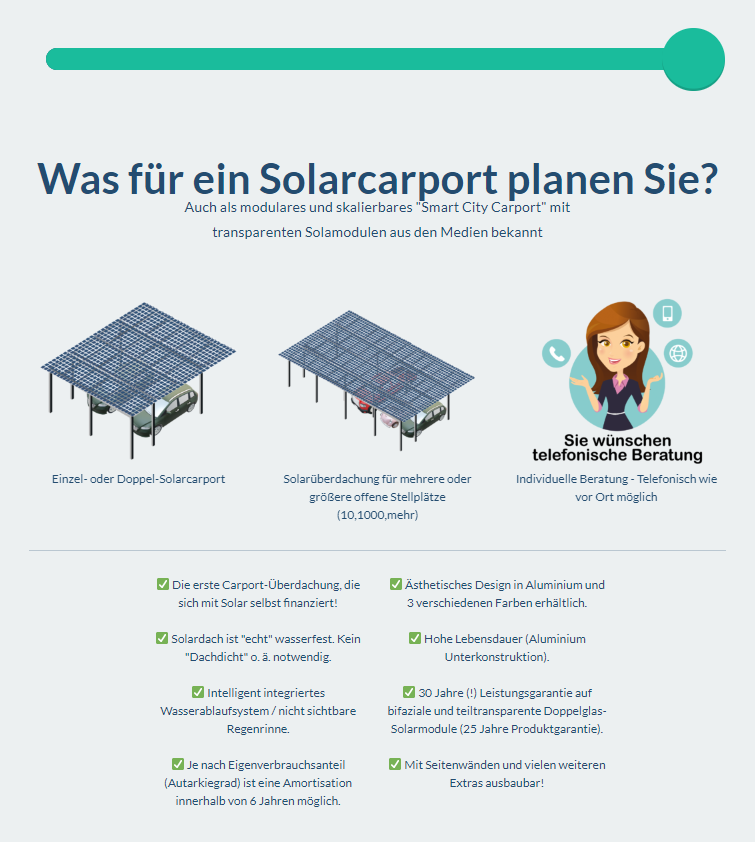
The Xpert.Solar solar carport planner
Solar parking spaces are a promising way to generate renewable energy while simultaneously optimizing the limited space available in cities and urban areas. However, there are indeed some challenges that can hinder the implementation of such parking spaces.
One of the biggest hurdles is the high cost and planning effort associated with installing solar panels in parking lots. Not only must the cost of the solar panels themselves be considered, but also the cost of the infrastructure required to connect them to the power grid. Furthermore, the space required for the installation of the solar panels must be precisely planned and coordinated to ensure effective use of the available area.
Another obstacle is bureaucratic hurdles and permitting procedures, which can complicate the installation of solar panels in parking lots. Depending on the region or country, different regulations and rules may apply, further complicating the approval and implementation process.
Despite these challenges, there is high demand for solar parking spaces, as they represent an effective way to promote renewable energy while simultaneously optimizing space utilization in urban areas. With careful planning and collaboration between the stakeholders, the obstacles can be overcome to facilitate the implementation of such parking spaces.
➡️ We specialize in providing consulting and planning support for such solar carport projects and in advancing their implementation.
➡️ Our solar carport planner simplifies the process.
➡️ We are here for you for the next steps, thus minimizing costs and effort for you.

Xpert.Solar solar carport planner
More information here:
Your partner for business development in the fields of photovoltaics and construction
From industrial rooftop PV to solar parks and larger solar parking lots
☑️ Our business language is English or German
☑️ NEW: Correspondence in your native language!

Konrad Wolfenstein
I and my team are happy to be available to you as your personal advisor.
You can contact me by filling out the contact form here wolfenstein@xpert.digital:or simply call me at +49 7348 4088 965. My email address is
I'm looking forward to our joint project.
☑️ EPC services (Engineering, Procurement and Construction)
☑️ Turnkey project development: Development of solar energy projects from start to finish
☑️ Site analysis, system design, installation, commissioning, maintenance and support
☑️ Project financier or intermediary of capital providers