
Solar carport boom in German trade fair cities: When parking lots become power plants – and why Essen and Leipzig are just the beginning
Xpert Pre-Release

Available in 27 languages 📢
Prefer Xpert.Digital on GoogleⓘPublished on: April 18, 2026 / Updated on: April 18, 2026 – Author: Konrad Wolfenstein
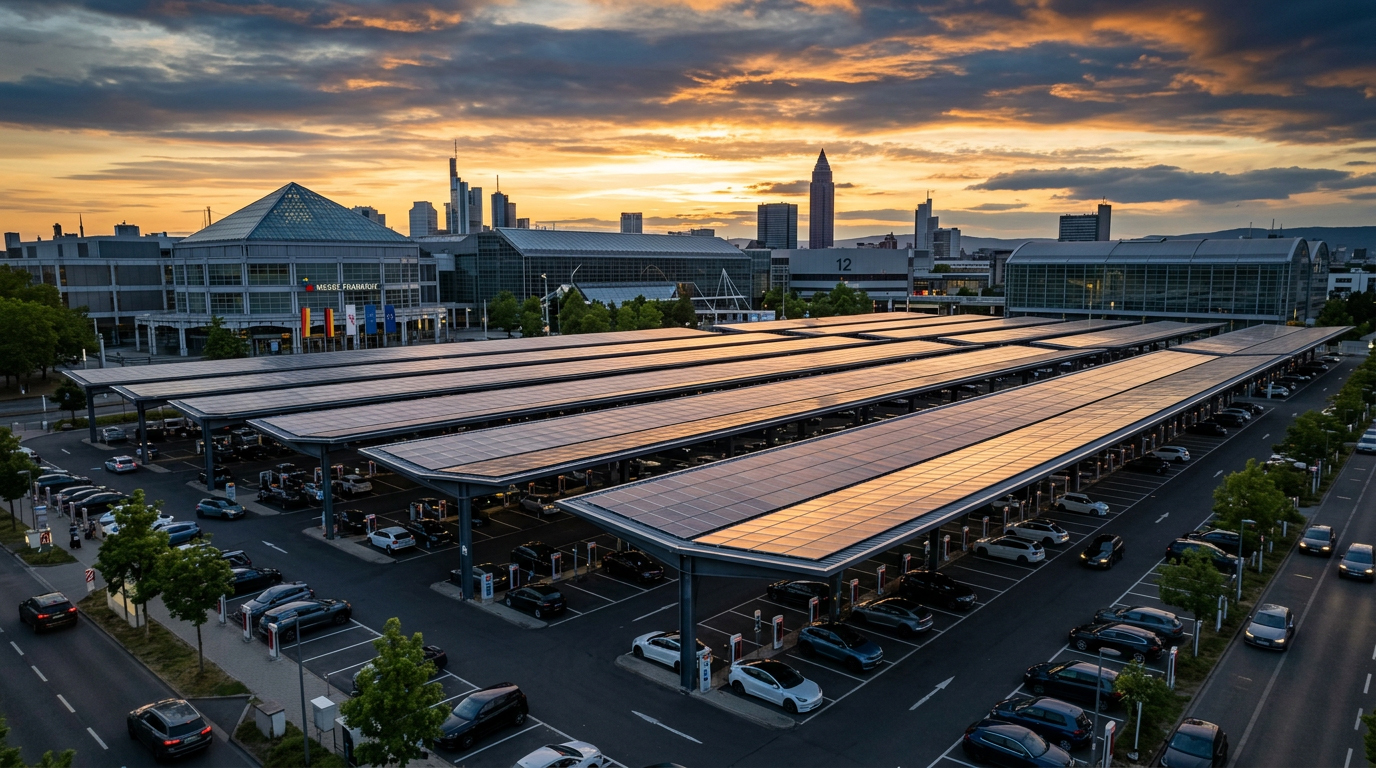
Solar carport boom in German trade fair cities: When parking lots become power plants – and why Essen and Leipzig are just the beginning – Creative image: Xpert.Digital
Power plant instead of asphalt desert: The ingenious mega-trend in German cities
Climate protection with dual benefits: Why giant PV carports will soon conquer every large parking lot
Parking lots were long considered a necessary evil in urban planning – gigantic, sealed asphalt deserts that store heat in the summer and offer no added value beyond their basic function of parking. But that is now changing rapidly. A massive transformation is taking place in major German cities: the simple parking lot is being transformed into a smart power plant. Above all, two pioneering large-scale projects in Essen and Leipzig, scheduled for completion in 2026 and 2027, mark a turning point in the urban energy transition. While a gigantic plant with a capacity of over 11 megawatts is being privately constructed in the Ruhr region, Saxony is relying on a sophisticated, state-funded pilot project at a park-and-ride facility. Both projects impressively demonstrate that solar carports have long since outgrown their infancy. They illustrate how the smart dual use of space not only protects the climate but is also evolving into a highly profitable business model for municipalities and companies. A look at the blueprints of a completely new infrastructure logic.
Essen and Leipzig as a blueprint for a new infrastructure logic
Two major projects in German trade fair cities will mark a turning point in the history of commercial photovoltaics in Germany in 2026. In Essen, a solar carport system with a nominal output of over 11 megawatts peak is being built on the P10 trade fair parking lot – one of the largest of its kind in Germany. 25,000 solar modules will be installed on an area of approximately 53,000 square meters, which, after commissioning, are expected to generate around 11.5 million kilowatt-hours of electricity per year. This corresponds to CO₂ savings of more than 5,200 tons annually. Simultaneously, in Leipzig, the city is approving a pilot project with 15 PV carports and 330 covered parking spaces at the park-and-ride facility at the new trade fair grounds – a smaller initial project, but one that is groundbreaking for urban development, with an installed capacity of 1 megawatt peak and an expected annual yield of around 915,000 kilowatt-hours.
These two projects are not placed side by side by chance. They represent two different approaches – the privately driven large-scale expansion on the one hand, and the municipally co-financed pilot project on the other. Together, they illustrate how solar carports can evolve from a niche technical product to a robust component of urban energy infrastructure. The key question is no longer whether this dual use of parking spaces works, but rather how quickly, with which stakeholders, and with which business models the rollout will succeed.
Essen P10: Industrial policy meets energy transition in the Ruhr region
The project on the P10 parking lot at the Essen trade fair grounds is the product of an unusual constellation: Essen's public utilities and transport company (EVV), the municipal energy and mobility provider, is acting as the developer and operator. ENVIRIA, a Frankfurt-based solar start-up founded in 2017, is the strategic partner and project developer. ROOF+ GmbH from Bochum, a company specializing in large-scale solar carport structures and already cooperating with the Bochum municipal utilities, will take over the actual implementation as general contractor starting in February 2026. This constellation is no coincidence: With ROOF+ as the Ruhr region-based general contractor, a significant portion of the added value – from planning and steel construction to installation – is generated within the region itself.
The electricity generated will be delivered almost entirely directly to the city of Essen, via a direct supply model without feeding it into the public grid. This is significant from a financing perspective: Instead of relying on the volatile feed-in tariff under the Renewable Energy Sources Act (EEG), the electricity will be marketed directly to the municipal buyer based on a long-term Power Purchase Agreement (PPA). For the city, this means planning certainty regarding energy costs; for the operator, it means a secure cash flow profile over the entire lifespan of the plant. Especially in a market environment where negative wholesale electricity prices and falling PPA prices are putting pressure on traditional project financing, direct municipal purchase is a structural advantage that significantly improves the project's bankability.
Construction is scheduled to begin in autumn 2026, subject to final regulatory approvals. The technical complexity of the project lies not only in its sheer size but also in the structural challenge: A carport structure that supports 25,000 modules, simultaneously serves as weather protection for parked vehicles, and will allow for the future integration of charging infrastructure for electric vehicles, requires far more precise structural and foundation planning than a simple open-field power plant on a greenfield site.
The scalable City Solar Carport Module for businesses, cities and municipalities

Solar canopy: Solar-covered parking lot - Image: Wiederspan.Solar
More information here:
We can also offer alternative solar-powered large parking lot systems!
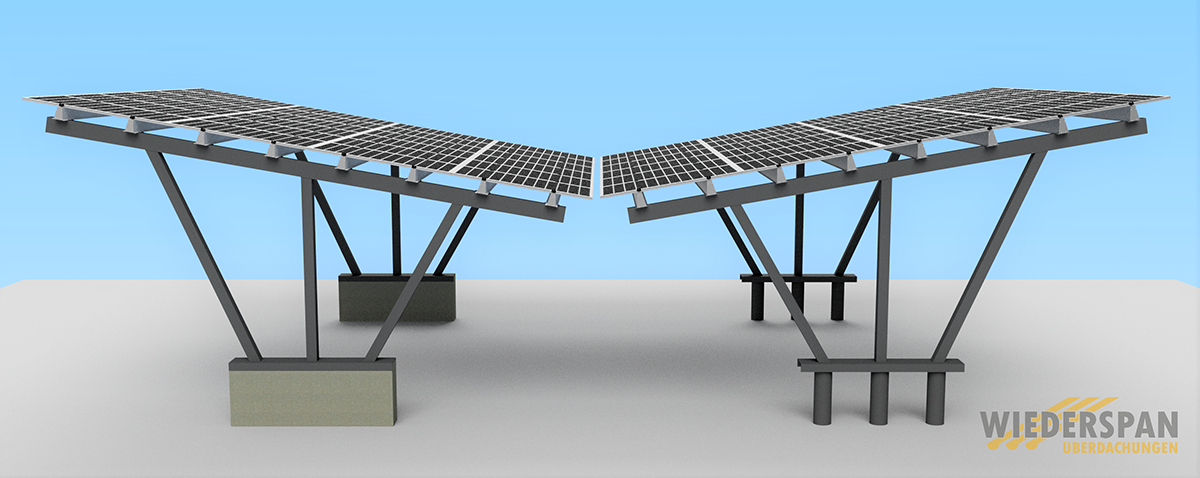
Photovoltaic systems for large parking lots - Image: Wiederspan.Solar
👉🏻 Let us advise you 👈🏻
👉🏻 Cars and trucks both possible! 👈🏻
We would be happy to help you find the optimal solar roof for your needs.
Our preferred city solar carport or solar carport module
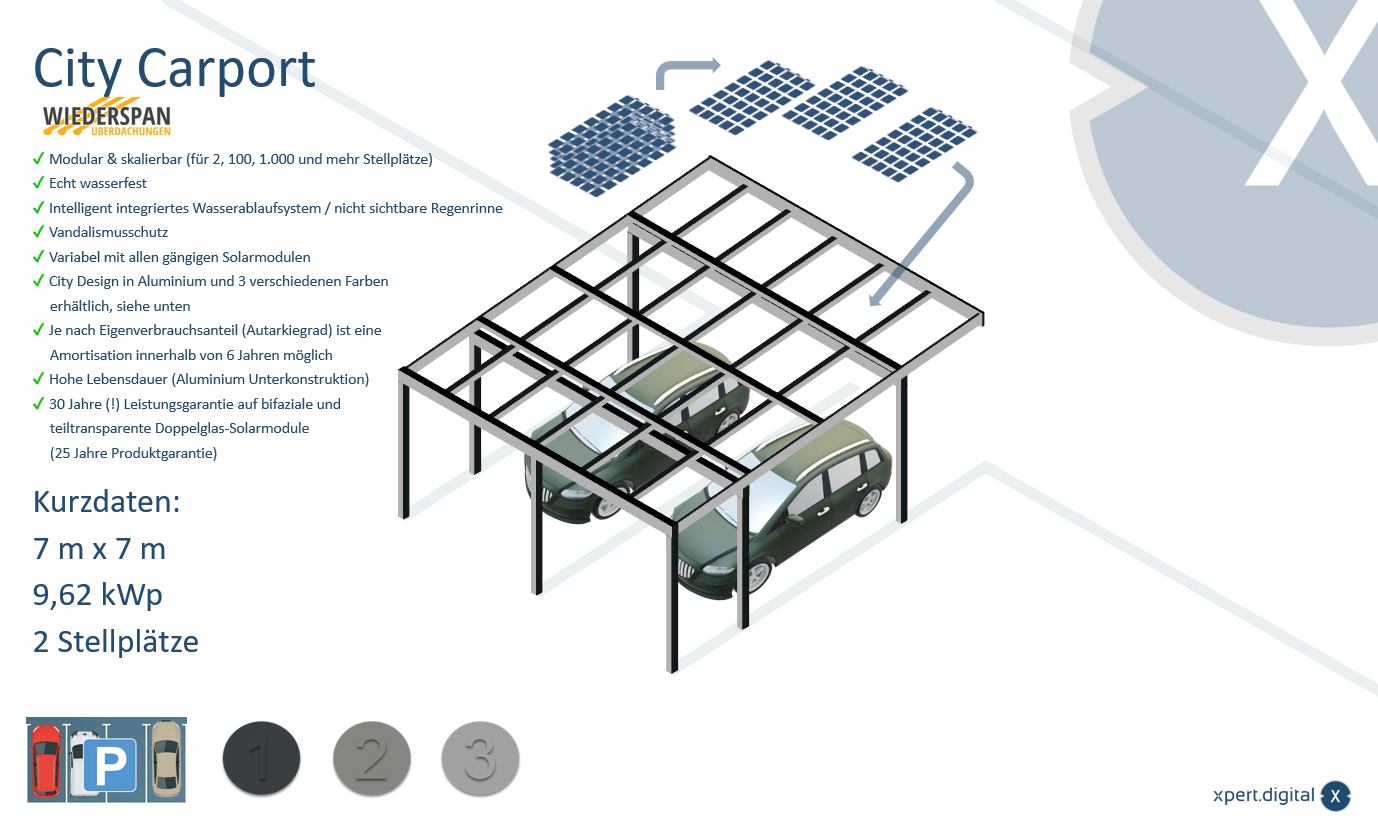
The City Solar Carport - with enhanced impact and vandalism protection - Image: Xpert.Digital
Advantages at a glance
- Support & Made in Germany
- Modular & scalable (for 2, 100, 1,000 and more parking spaces)
- Truly waterproof
- Integrated water drainage / concealed rain gutter
- Vandalism protection, optionally with integrated impact protection
- Compatible with all common solar modules
- City Design available in aluminium and 3 different colours
- Depending on the level of self-consumption (degree of self-sufficiency), amortization is possible within 6 years
- Long service life (aluminum substructure)
- 30-year (!) performance guarantee on bifacial and semi-transparent double-glass solar modules (25-year product guarantee)
- Reduction of urban heat islands
- Building-integrated photovoltaics
- Ideally suited for transparent and translucent double-glass solar modules with overhead mounting approval!
From parking lot to power plant: PV carports as a municipal investment model
Leipzig P+R: Municipal due diligence as an investment model
The Leipzig project differs fundamentally from the Essen project in scale and financing structure, but is no less insightful in its conceptual logic. The city of Leipzig is approving 15 photovoltaic carports, each with 22 parking spaces, at the park-and-ride lot at the Leipzig Trade Fair Center – a total of 330 covered parking spaces, supplemented by charging infrastructure for electric vehicles. The Free State of Saxony is funding the pilot project with a total of €2 million from its Municipal Energy and Climate Protection Program (KomEKG), while the city of Leipzig is contributing an additional €528,000 from its own funds. Construction is scheduled to begin in September 2026, with commissioning planned for May 2027.
The operator is Leipziger Kommunale Energieeffizienz GmbH (LKE), a subsidiary of Stadtwerke Leipzig (Leipzig Municipal Utilities). This is structurally important: LKE already has experience operating municipal photovoltaic systems on city-owned rooftops – by the end of 2024, the company had installed around 2.3 megawatts on city-owned properties. With the carport project, LKE is now expanding into a new category of installation and simultaneously tapping into a type of site that offers considerable potential in Leipzig, as in other major German cities: large municipal parking lots, which until now have been designed almost exclusively as purely traffic infrastructure.
The pilot nature of the project is deliberate. A city that erects 15 different carport units in a single parking lot is thereby testing various construction variants, module types, and assembly concepts under real-world operating conditions. Insights into yield profiles, maintenance requirements, and user acceptance—especially in the context of park-and-ride operations with daily vehicle turnover and fluctuating occupancy—can then be evaluated for citywide scaling. Leipzig is thus pursuing an evidence-based rollout approach that sounds more expensive than a direct mass expansion but delivers more robust results in the long run.
Project comparison: Different logics, same direction
The following comparison shows the key parameters of both projects in direct comparison:
| feature | Essen P10 | Leipzig New Trade Fair PR |
|---|---|---|
| Installed power | >11 MW peak | ~1 MW peak |
| Area | ~53,000 m² | n/a (15 units with 22 parking spaces each) |
| Module | 25.000 | n/a. |
| Annual yield | ~11.5 million kWh | ~915,000 kWh |
| CO₂ savings | >5,200 t/year | ~335 t/year |
| operator | EVV (municipal) ENVIRIA | LKE / Leipzig Municipal Utilities |
| financing | PPA with the city of Essen | Funding of €2 million (Saxony) €528,000 city |
| Construction start | Autumn 2026 | September 2026 |
| commissioning | 2026/27 | May 2027 |
| Characteristics | Large-scale industrial expansion | Municipal pilot project |
The Essen P10 project has an installed capacity of more than 11 MWp on an area of approximately 53,000 m²; it comprises around 25,000 modules and achieves an annual yield of approximately 11.5 million kWh, resulting in CO₂ savings of over 5,200 tons per year. The operators are EVV (municipal) and ENVIRIA; the project is financed through a Power Purchase Agreement (PPA) with the city of Essen. Construction is scheduled to begin in autumn 2026, with commissioning planned for 2026/27. A large-scale industrial development is a defining characteristic. In comparison, the Leipzig New Trade Fair Park and Ride project has an installed capacity of around 1 MWp; the area is not precisely specified, but consists of 15 units with 22 parking spaces each. Information on the number of modules is not available. The expected annual yield is approximately 915,000 kWh, resulting in CO₂ savings of around 335 tons per year. The operators are LKE and the Leipzig municipal utility company; financing includes a €2 million grant from Saxony and €528,000 from the city. Construction is scheduled to begin in September 2026, with commissioning planned for May 2027. The project is designed as a municipal pilot project.







