
Solar parking lot: Solar carports and solar parking lot systems - the sustainable type of photovoltaics on asphalt surfaces

Available in 27 languages 📢
Prefer Xpert.Digital on GoogleⓘPublished on: November 4, 2022 / update from: April 25, 2023 - Author: Konrad Wolfenstein
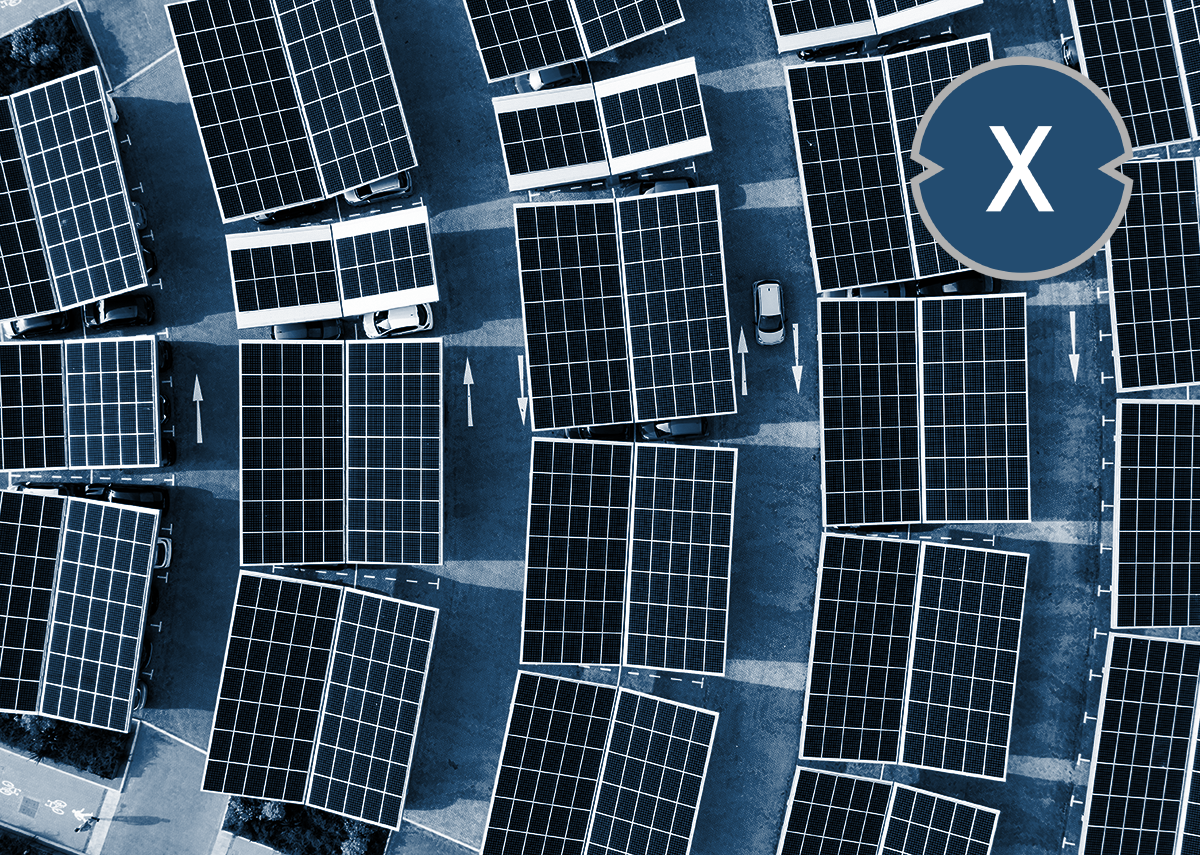
Solar parking lot: Solar carports and solar parking lot systems – Image: Xpert.Digital / Nicholas Simon Jackson|Shutterstock.com
Why solar carports and solar parking systems are the sustainable type of photovoltaics on asphalt surfaces
Asphalt surfaces are common in many cities and provide a large area that can be used for the installation of solar carports and solar parking systems. This type of photovoltaics is particularly sustainable because it is installed on existing areas and does not take up any new areas. At the same time, shading helps prevent cities from overheating, as overheated streets are one of the biggest climate problems in urbanization. In addition, solar carports and solar parking systems can help reduce environmental impact through emission-free electricity generation.
Urban planning is a key factor in combating the overheating of urban environments
The problem of overheating the cities is a big and serious problem, but most people don't know what they can do about it. Urban planning is a key factor in combating the overheating of urban environments. According to the climate researcher Dr. EBI Krypton are “79 % of global CO2 emissions directly or indirectly due to urban activities”. This high percentage of guilt for greenhouse gas emissions illustrates how much our cities are under pressure with increasing population density. Unfortunately, many modern architects and city paners tend to accept the heat in their designs as an inevitable element. But there is hope - if we are enthusiastic and implement for climate -adapted architectural solutions, this can help to limit global warming to 1.5 ° C to 2 ° C.
More about it here:

Smart City: Green infrastructure and power supply – Image: Xpert.Digital / studiostoks|Shutterstock.com
Solar parking spaces are an accelerator of the energy transition
A study by 'de Lorean Power' from Switzerland showed that the parking behavior of the employees ideally corresponds to the amount of solar power generated. The daily kilometers of the electric vehicle can be covered in almost any weather and the excess can be fed into the network. The annual solar power generation in the parking lot corresponds to the energy requirement of the vehicle. Solar parking spaces of all infrastructure areas have the greatest potential for electricity generation. About 2 parking spaces are available in Switzerland. In available regions, it can generate over 10 terawatt hours of solar power per year (15 % of current power consumption). "It is astonishing how few pilot plants there are," said the authors of the study. In addition, such a roof protects the car from the weather and reduces the heat of the car in summer.
According to an evaluation by the Federal Statistical Office (FSO), Switzerland has at least 5 million above-ground parking spaces (6,400 hectares) with around 4.7 million registered cars. These parking areas were recorded using a digital process that only recognizes larger adjacent areas and not individual parking spaces. Traffic experts therefore expect 8 to 10 million parking spaces. That's about 2 per car.
According to the other study “Solar power generation for infrastructure facilities and conversion areas”, above-ground or open parking areas have the greatest PV potential of all infrastructure areas. These areas can deliver up to 10 terawatt hours (TWH) PV current per year. This means that the entire electricity production in Switzerland is 65.5 TWh.
The average parking area is 12.5 square meters (2.5 meters x 5 meters). This is also the area that a solar roof must have. The energy yield of a PV system depends on many factors, including solar radiation, component efficiency and module orientation. In Thurgau, with 1 kW of installed PV power, around 1000 kWh of electricity can be generated per year (1000 kWh per 1 kWp).
Depending on the PV modules used, 1 kWp requires an installed capacity of 4 to 8 square meters. In this study, 5 m2 per kWp are calculated. This means that a 12.5 m2 parking space with 2.5 kWp output can be installed, which generates 2,500 kWh of solar power per year. The average Swiss household consumption is around 4,500 kWh/year (excluding heating, ventilation and electric vehicles).
Solar roofing variants specifically for vehicles
The modular structure of a carport system is advantageous and allows you to adapt the roof to almost any parking space, thus ensuring continued good utilization of the parking space and ensuring expandability.
Using bifacial modules, the carport can be made transparent. This is visually very interesting and leads to higher solar yields, as corresponding PV modules can also use light coming from below and thus deliver 10-20% additional yield. Bifacial technology is currently not used much because it is not necessarily cost-effective due to higher module prices. However, it is assumed that this technology will become established in the next few years.
In our 4+2+ modular and scalable solar carport system, where partially transparent and bifacial modules are used, these points apply and are now also a price alternative :
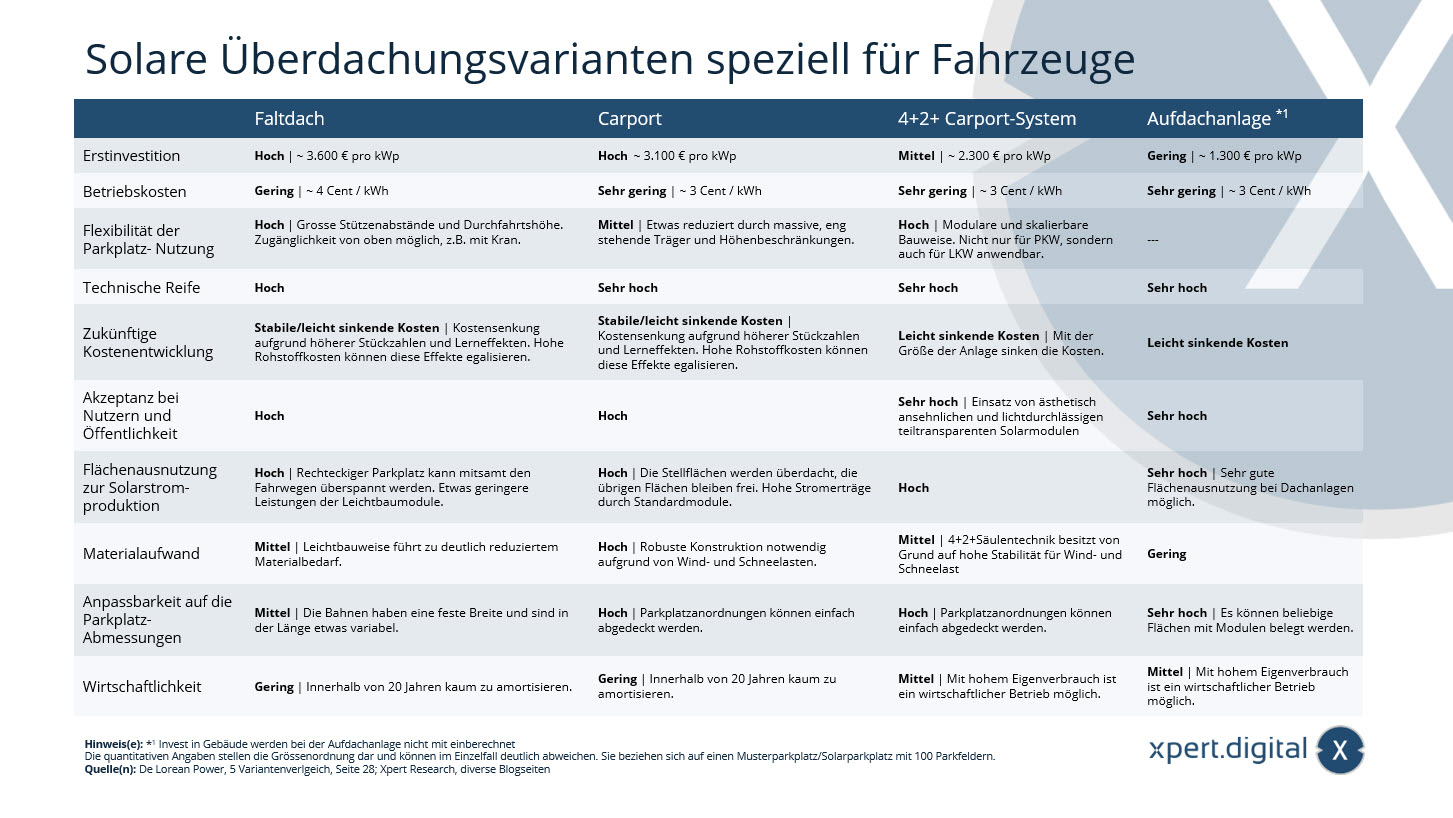
Solar roofing variants specifically for vehicles – Image: Xpert.Digital
More about it here:
We can also do large parking facilities with solar roofs!
Limitless: Modular and scalable solar carport system for cars and trucks
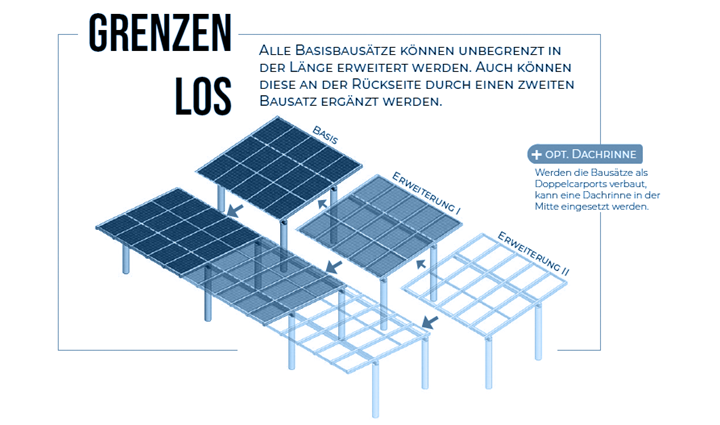
Limitless: Modular and scalable solar carport system for cars and trucks
Technical data: Modular and scalable solar carport system for cars and trucks
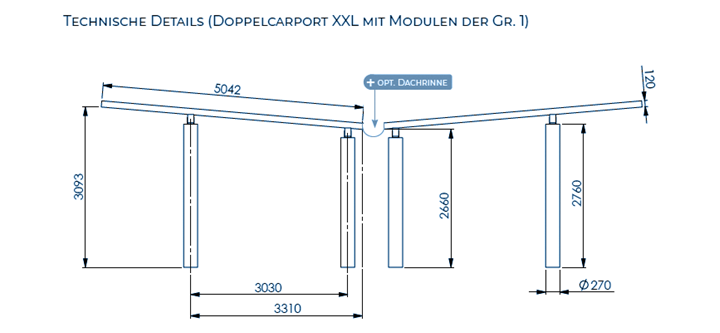
Technical data: Modular and scalable solar carport system for cars and trucks
The advantages at a glance:
- Flexible and modular (scalable) design
- Clearance height for cars from 2.66 m (expandable to 4.5 m or more for trucks)
- Parking space depth for cars up to 6.1 m, opposite possible up to 12.5 m.
The depth depends on the dimensions of the solar modules used - Solar carport system is optimally designed for partially transparent solar modules
12% / 40% light transmission (!) - With certified approval for overhead installation - Optionally with powerful LED lighting, dimmable and with motion control
- Can also be used for parking stands with inclined positioning
- No hidden costs regarding foundations
Use of point foundations (cheapest variant, no complex excavation of the ground for concrete slabs etc. necessary for statics) or installation with floor slabs, depending on the existing ground conditions/asphalting
Further sources:
- Ground foundation cost factor for solar carports
- Solar carports where there is no longer a standard - the optimal solution for every challenge with solar roofing for open parking spaces
- Solar carport systems: Which is the better and/or cheaper option?
- The solar carport strategy for open parking spaces
- The modular solar carport system for all applications and cases
Truck solar carport system
Due to the fact that the 4+2+ column technology is the most flexible solution (both technically and in terms of price) for a parking space roofing system, it can also be easily expanded and used for larger vehicles such as trucks with appropriate modifications.
Solar parking systems for asphalt parking help reduce the impact of urban heat islands
The increasing overheating of cities is a global problem. In recent years, the temperature in urban areas worldwide has increased by an average of 0.5 to 1 degree Celsius. This warming is primarily due to the absorption of sunlight by asphalt and other dark surfaces.
Scientists agree that this urban heat island effect is the result of global warming. However, temperature differences between urban and rural areas can also be influenced by other factors such as vegetation, wind and construction.
The effect is particularly noticeable in large cities, as this is where most people live and most cars drive. The heat is kicked up by the cars and rises into the air. It is then thrown back by the high-rise buildings and gets stuck in the urban canyons.
The problem of overheating in cities is twofold: on the one hand, the direct absorption of sunlight by asphalt and other dark surfaces and, on the other hand, the heat being stirred up by traffic.
A possible solution to the problem of overheating in cities is the installation of solar carports and solar parking systems. These systems can reduce both the absorption of sunlight and the dispersion of heat.
Solar carports are covered parking spaces that are equipped with photovoltaic modules. These modules convert the incident sunlight into electrical energy. At the same time, the heat from sunlight is dissipated and not passed on to the surroundings. This can reduce the temperature under the carport by up to 10 degrees Celsius.
Installing solar carports and solar parking systems is an effective way to reduce overheating in cities. However, these systems not only offer a solution to the problem of overheating, but can also be used to generate renewable energy.
More about it here:
Urban heat island (UHI)
An urban heat island is an urban or metropolitan area that is significantly warmer than surrounding rural areas due to human activity. The temperature difference is usually greater at night than during the day and is most noticeable when winds are light. UHI is particularly noticeable in summer and winter. The main cause of the UHI effect is the change in the land surface. A study has shown that heat islands can be influenced by proximity to different types of land cover, such that proximity to barren land causes urban soil to warm, while proximity to vegetation makes it cooler. The waste heat generated by energy use is another factor. As a population center grows, its area increases and the average temperature increases. The term heat island is also used; it can be used for any area that is relatively hotter than the surrounding area, but generally refers to areas disturbed by humans.
Monthly rainfall is greater in the lee of cities, partly due to the UHI. Increasing heat in urban centers lengthens growing seasons and reduces the occurrence of weak tornadoes. The UHI worsens air quality by increasing the production of pollutants such as ozone, and it worsens water quality as warmer water flows into the region's rivers and strains their ecosystems.
Not all cities have a pronounced urban heat island, and the characteristics of the heat island depend heavily on the background climate of the area in which the city is located. The urban heat island effect can be reduced by green roofs, passive daytime radiative cooling, and the use of light-colored surfaces in urban areas that reflect more sunlight and absorb less heat. Urbanization has exacerbated the impacts of climate change in cities.
The phenomenon was examined and described by Luke Howard for the first time in the 1810s, although he was not the one who named the phenomenon. The research of the urban atmosphere continued in the nineteenth century. Between the 1920s and 1940s, researchers in Europe, Mexico, India, Japan, Japan and the United States were looking for new methods for understanding the phenomenon in the emerging area of local climatology or microscale meteorology. In 1929, Albert Peppler used the term “Staedtische Waerminsel”, which is the first example to be used for a Staedtische Waerminsel. Between 1990 and 2000, around 30 studies were published annually; This number rose to 100 by 2010, and in 2015 there were already more than 300.
More about it here:

- Warehouses, production halls and industrial halls with their own power source from a photovoltaic roof system - Image: NavinTar|Shutterstock.com

- Industrial plant with its own power source from an outdoor photovoltaic system - Image: Peteri|Shutterstock.com

- Plan solar systems with photovoltaic solutions for freight forwarding and contract logistics
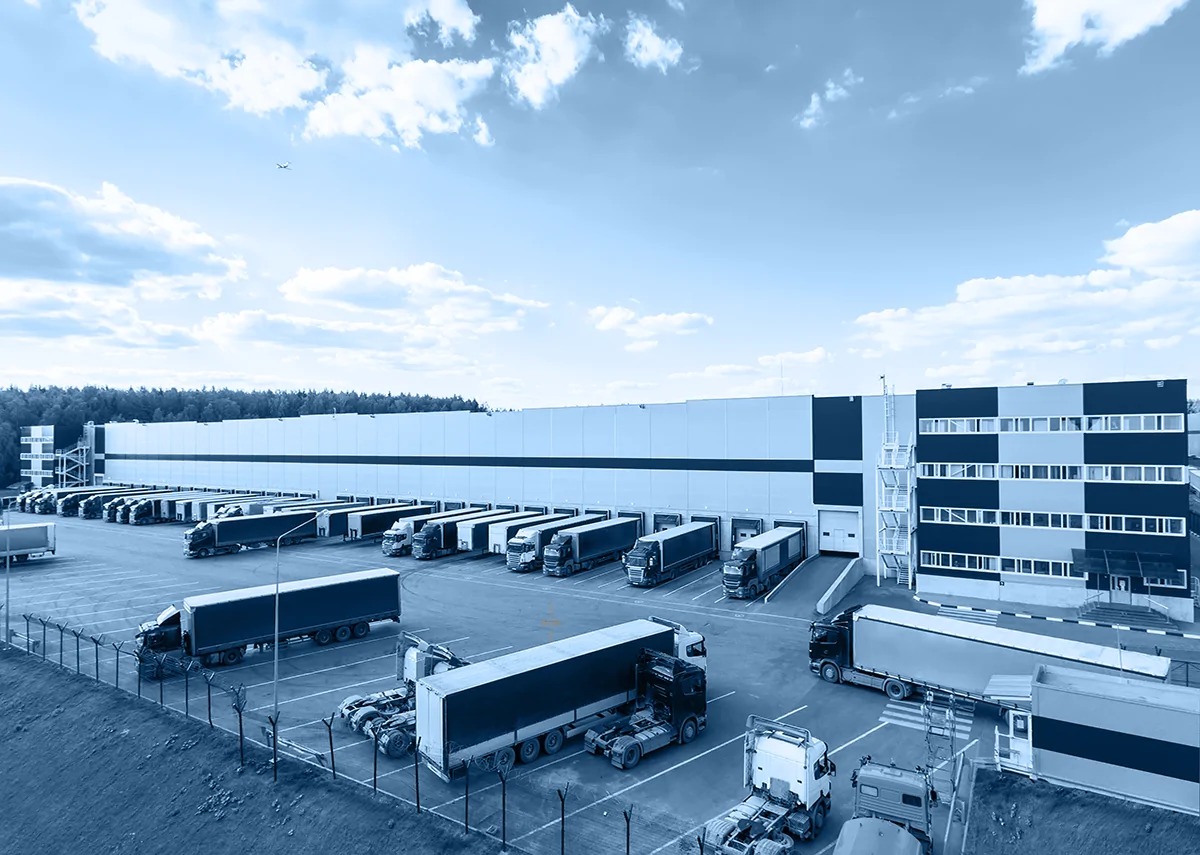
- B2B solar systems and photovoltaic solutions & advice
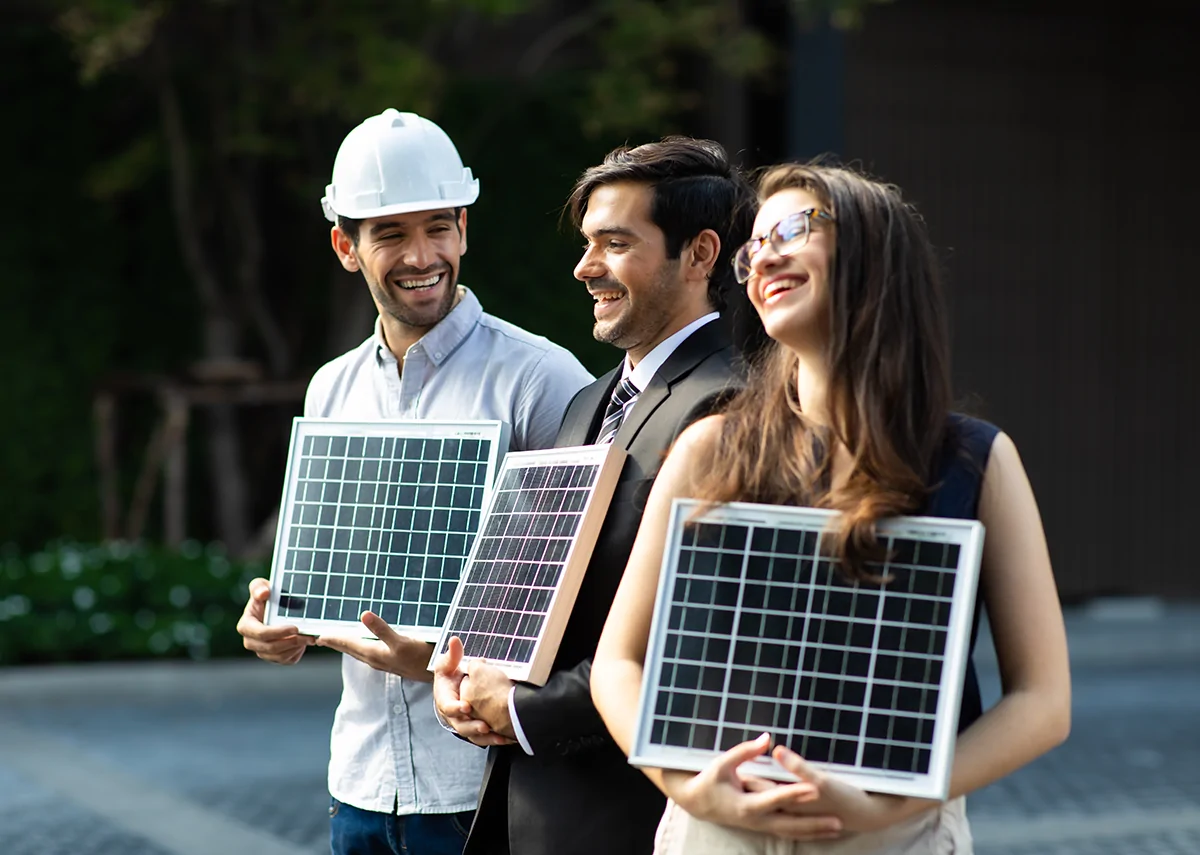
- Plan photovoltaics for warehouses, commercial halls and industrial halls
- Industrial plant: Plan a photovoltaic open-air system or open-space system
- Plan solar systems with photovoltaic solutions for freight forwarding and contract logistics
- B2B solar systems and photovoltaic solutions & advice
From simple solar carports to large systems: With Xpert.Solar, your individual solar carport advice – the combination of wooden substructure, steel columns and semi-transparent solar modules

Konrad Wolfenstein
I would be happy to serve as your personal advisor.
You can contact me by filling out the contact form below or simply call me on +49 7348 4088 965 (Munich) .
I'm looking forward to our joint project.
Write to me

Xpert.Digital – Konrad Wolfenstein
Xpert.Digital is a hub for industry with a focus on digitalization, mechanical engineering, logistics/intralogistics and photovoltaics.
With our 360° business development solution, we support well-known companies from new business to after sales.
Market intelligence, smarketing, marketing automation, content development, PR, mail campaigns, personalized social media and lead nurturing are part of our digital tools.
You can find out more at: www.xpert.digital – www.xpert.solar – www.xpert.plus
Keep in touch








