
Discover Engine Optimization: SEO, GEO… DEO? What the Discover Core February 2026 update means for your traffic strategy
Xpert Pre-Release

Available in 27 languages 📢
Prefer Xpert.Digital on GoogleⓘPublished on: February 10, 2026 / Updated on: February 10, 2026 – Author: Konrad Wolfenstein
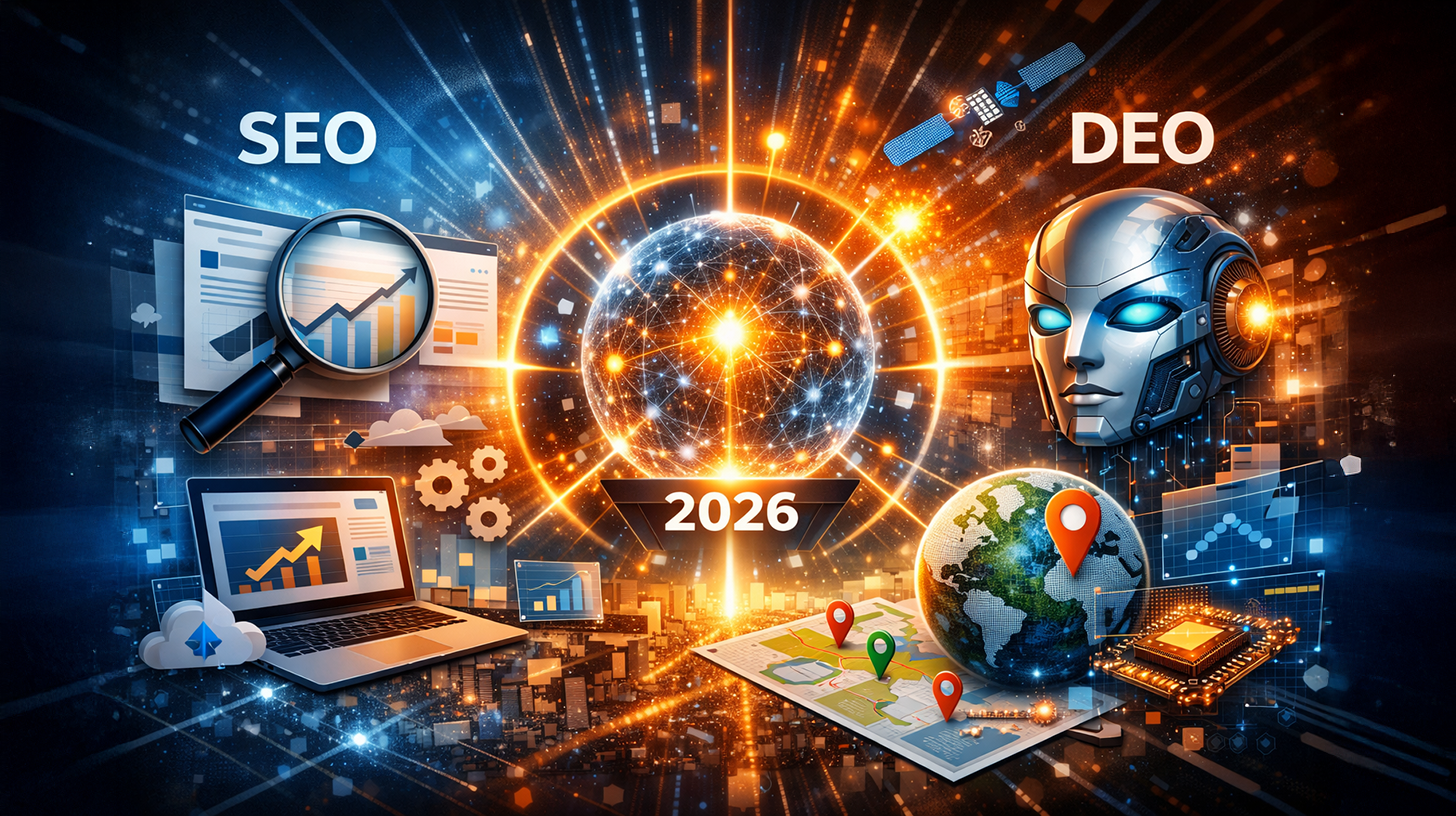
Discover Engine Optimization: SEO, GEO… DEO? What the Discover Core February 2026 update means for your traffic strategy – Image: Xpert.Digital
Anticipating traffic fluctuations: Google launches major update for the Discover feed
New update rolling out: Why local news and experts are now gaining ground in the Discover feed
With the launch of the "February 2026 Discover Core Update," Google is explicitly focusing on the Discover environment and deliberately differentiating this update from the classic core updates for organic search. While webmasters and SEOs have primarily been accustomed to ranking shifts in the SERPs (Search Engine Result Pages), this algorithm adjustment targets the curated feeds on millions of mobile devices.
The rollout, planned over a period of approximately two weeks, promises significant changes in the traffic mix of many publishers. Google has defined three clear goals: reducing clickbait and sensationalist reporting, massively strengthening local news, and prioritizing content with in-depth, expert knowledge. Those who have previously relied on sensationalist headlines without substance are likely to suffer a massive loss of visibility, while local media outlets and specialized news portals could be among the winners.
But the update not only brings qualitative shifts, it also raises new strategic questions. The industry is already discussing whether, in addition to traditional search engine optimization (SEO) and local optimization (GEO), a separate discipline of Discover Engine Optimization (DEO) is now necessary. At the same time, publishers face a paradox: While the increasing integration of AI summaries directly into the feed could increase visibility (impressions), it could also decrease the click-through rate (CTR), since users can obtain the desired information without clicking.
This article summarizes what webmasters need to know now, how long the fluctuations will last, and how you need to adapt your content strategy to remain relevant in the Discover feed in 2026.
More information here:

Which update will Google roll out in February 2026?
In February 2026, Google will launch the so-called February 2026 Discover Core Update. Unlike traditional core updates, which primarily affect rankings in regular search, this update specifically targets the Google Discover discovery environment. Google describes it as an algorithm adjustment that changes how users find content in Discover and how publishers gain visibility there.
What is the difference compared to regular core updates?
Classic core updates re-evaluate search results in Google Search and lead to typical ranking fluctuations in organic results. The February 2026 Discover Core Update, however, focuses on Google Discover, the area where users receive article, news, and video recommendations without actively searching. In terms of content, the update is similar to search updates because it also focuses on quality, relevance, and expertise, but it is specifically aimed at the Discover environment.
When does the rollout start and how long will it last?
Google has announced that the rollout of the February 2026 Discover Core Update will take place in several phases. The process will initially begin in the US for English-language search results. The rollout is expected to last approximately two weeks. During these two weeks, webmasters and website operators can expect significant fluctuations in Discover traffic, similar to the ranking fluctuations seen after traditional core updates. In the coming months, the update will then be rolled out to other countries, including Germany.
Why is this update so important for publishers?
For many publishers, Discover is a crucial traffic source alongside organic search and social media. Changes in how content is delivered on Discover can directly impact page impressions and click-through rates (CTRs) from this source. Since the update explicitly aims to curb clickbait, promote local news, and increase the visibility of expert content, the rules of the game for visibility on Discover could fundamentally change.
What role will Discover play in digital marketing in 2026?
By 2026, Discover will increasingly be understood as an additional layer of visibility, creating a distinct dimension in online marketing alongside traditional SEO and GEO (Geo-SEO / Local Search). While SEO and GEO will continue to focus on the traditional search page and local discoverability, Discover deals with the discovery of content outside of targeted search queries. This raises the question for many publishers of whether, in addition to SEO and GEO, a separate Discover Engine Optimization (DEO) will be necessary in the future.
It fits with this:

According to Google, what are the three core objectives of the update?
Google identifies three key areas that the February 2026 Discover Core Update will address:
1. Reduction of clickbait content
Google aims to significantly reduce clickbait articles. This primarily includes posts that use exaggerated or misleading titles to generate as many clicks as possible without offering users any real value.
2. Strengthening local news
The update aims to increase the amount of local news users see. This means that content from their own country, region, or city will be featured more prominently in Discover. The goal is to increase relevance to individual user locations.
3. Focus on in-depth expertise
Pages with specialist expertise and a long-standing reputation will be given greater prominence in the Discover feed. Google primarily wants to show users current, in-depth content from recognized experts. This applies to both large specialist portals and local publishers with expertise in specific subject areas.
What does Google consider "sensational" content?
Google defines "sensational" content as content that deliberately relies on exaggerated sensationalism to generate attention. This includes:
- Exaggerated titles that clearly distort reality
- Claims that are not or hardly verifiable
- Phrases designed to evoke strong emotional reactions without providing substantial information
Such content will be shown less frequently in Discover in the future, in order to improve the quality of recommendations.
What should the emphasis on local news look like in concrete terms?
Strengthening local news means that Discover will not only cover global or national topics, but will also give greater consideration to local events, regional news, and city-related reports. This could mean, for example:
- Local political developments become more visible
- Local sporting events, cultural events, or happenings appear in Discover
- National news stories are given priority when they are particularly relevant to the respective region
This gives local publishers and regional media a better chance to position themselves in the feed.
Why is Google putting more expertise on the agenda?
Google wants to show users in Discover content that is genuinely helpful and trustworthy. Therefore, demonstrable expertise on a page is becoming increasingly important. Essentially, this means:
- Pages must be thematically consistent and address a specific subject area over an extended period of time.
- Isolated articles outside the core area are valued less as expertise.
- Publishers who have established themselves in a particular subject area over many years are given greater preference.
The aim is to ensure that users receive not just any content, but contributions that are professionally sound.
How is quality defined in the Discover feed?
Google defines quality in the context of Discover using several parameters. These include:
- Value creation: Does the article offer a clear answer to a question or genuine added value?
- Relevance: Is the content current or at least timelessly valuable?
- Technical depth: Does the article go beyond superficial descriptions?
- Regularity: Does the publisher publish on a topic over a longer period of time?
- Trustworthiness: Is the source reputable and demonstrably well-known or established?
These factors combine to influence whether an item remains visible in Discover or is scaled back.
What changes can webmasters expect in Discover traffic?
Significant fluctuations in Discover traffic are expected during the rollout of the February 2026 Discover Core Update. Similar to core updates in search, individual pages may:
- to experience a sharp drop in impressions in the short term
- but also suddenly appear more prominently in the feed
- Different reactions are shown depending on the content type, topic area and target group
These fluctuations will be particularly pronounced in the first two weeks, until the algorithm has stabilized.
How long do these fluctuations usually last?
According to Google, the rollout itself is limited to approximately two weeks. However, the subsequent stabilization phases can last for several weeks to months. During this time, publishers can:
- repeatedly observe minor highs and lows in Discover traffic
- However, in the long term a new “normal distribution” is considered assured
Therefore, it makes sense not to react to individual days or weeks, but to observe trends over a longer period.
Which publishers are expected to benefit from the update?
The following publisher groups are expected to benefit most from the content changes:
- Local news portals that regularly publish regional and municipal content
- Specialist portals with clear expertise that have established themselves in a subject area over many years
- Editorial teams with in-depth articles, interviews, analyses and background reports
- Reputable news-based sites that avoid clickbait techniques
These publishers can expect better visibility in Discover and potentially increased traffic from this source.
Which publishers could suffer disadvantages?
The update primarily affects those pages that:
- heavily relying on clickbait titles
- working with sensational headlines without delivering the content
- Trying to cater to trend-driven topics only in the short term
- Publishing content that is off-topic or lacks discernible expertise
These pages may be affected by:
- declining impressions in Discover
- lower click-through rates because the articles become less visible
- More competition from expert and local publishers
come.
How can publishers maintain their visibility in the Discover feed?
To increase their chances of good visibility in Discover, publishers should consider the following points:
- Quality-oriented content creation: Depth, helpfulness, and originality are paramount.
- Clear specialization: Focus on specific subject areas and work on them consistently. Purely generalist websites are less in demand.
- Local content: Integrate regional and local news more extensively where relevant.
- Timeliness: Regular updates and the release of new content to emphasize "freshness".
- Avoiding clickbait: No exaggerations, no misleading titles, no exaggerated announcements.
These measures are generally in line with Google's recommendations for all core updates and are also useful for the Discover update.
B2B support and SaaS for SEO and GEO (AI search) combined: The all-in-one solution for B2B companies

B2B support and SaaS for SEO and GEO (AI search) combined: The all-in-one solution for B2B companies - Image: Xpert.Digital
AI search changes everything: How this SaaS solution will revolutionize your B2B ranking forever.
The digital landscape for B2B companies is undergoing rapid change. Driven by artificial intelligence, the rules of online visibility are being rewritten. For companies, it has always been a challenge not only to be visible in the digital mass, but also to be relevant to the right decision-makers. Traditional SEO strategies and managing local presence (geo-marketing) are complex, time-consuming, and often a battle against constantly changing algorithms and intense competition.
But what if there were a solution that not only simplified this process but also made it smarter, more predictive, and far more effective? This is where the combination of specialized B2B support with a powerful SaaS (Software as a Service) platform comes into play, specifically designed for the demands of SEO and GEO in the age of AI search.
This new generation of tools no longer relies solely on manual keyword analysis and backlink strategies. Instead, it leverages artificial intelligence to more accurately understand search intent, automatically optimize local ranking factors, and conduct real-time competitive analysis. The result is a proactive, data-driven strategy that gives B2B companies a decisive advantage: they are not only found, but perceived as the leading authority in their niche and location.
Here's the symbiosis of B2B support and AI-powered SaaS technology that transforms SEO and GEO marketing, and how your company can benefit from it to grow sustainably in the digital space.
More information here:
Discover Engine Optimization (DEO): Is a new discipline needed for this?
What question is frequently asked in connection with the update?
Many publishers and webmasters are asking themselves, in light of the February 2026 Discover Core Update: Do we now need to implement DEO in addition to SEO and GEO? The term Discover Engine Optimization (DEO) is being discussed in this context to indicate that Discover could officially be treated as its own "search/discovery platform".
Related to this:

Does Google already have an official DEO discipline?
Google itself doesn't officially refer to DEO as a separate discipline, but emphasizes that the basic principles of content quality and guideline compliance still apply. The recommendations for Discover run parallel to those for traditional search. Therefore, there is no separate "DEO" guideline that requires entirely new techniques.
What can publishers do to become visible in the Discover feed?
There are certain points that publishers can actively influence:
- Establishing expertise: Working consistently on a long-term theme and positioning oneself as a specialist website.
- Publishing helpful content: Articles that clearly answer questions, solve problems, or provide valuable information.
- Structure and technical quality: Fast loading times, mobile optimization, clean structure and good metadata.
- Local content: Regional news, local reports or articles that are specifically relevant to the target audience.
Nevertheless, the direct influence on Discover delivery is limited, as Google controls the feed logic internally.
Which aspects are not directly controllable by the publisher?
Actual visibility in the Discover feed depends largely on algorithms that publishers cannot control. These include:
- The selection of users who see a particular article
- The weighting between local and national content
- The balance between different publisher types
Publishers can therefore only indirectly influence the quality and topic direction of their content, not the specific feed logic.
How does DEO compare to SEO and GEO?
If one considers DEO as an additional discipline, it differs in the following points:
- SEO focuses on organic search, i.e., rankings in the classic Google results pages.
- GEO focuses on local visibility in Google Maps, local search results and Google Business Profile.
- DEO refers to visibility in the Discover feed, i.e., content that is found without an active search and is often presented via tiles or topic categories.
Although the principles are similar (helpfulness, quality, local relevance), DEO focuses more on discoverability without a direct search query.
Do you need additional tools and strategies for DEO?
At the moment, it is not necessary to introduce completely new tools. Publishers can use existing instruments:
- Google Search Console: Now includes specific sections for Discover to analyze impressions, clicks, and performance.
- Analytics tools: To track traffic from Discover and measure behavior.
- Content management strategies: Regular quality assurance and thematic channeling.
Crucially, the content strategy as a whole must be qualitatively oriented, not just focused on the single new algorithm update.
What additional problem do publishers face despite the positive update?
In addition to Google's efforts to improve the quality of Discover, there's another major issue: AI summaries. Google has been integrating automatically generated article summaries into Discover for some time now, displaying them directly in users' feeds. These AI summaries can lead to users:
- the information already received in the feed
- and without clicking on the publisher link
This potentially means fewer clicks and less traffic for publishers, even if they receive more impressions.
Related to this:

How do AI summaries affect traffic?
The impact of AI summaries is multifaceted:
- Increased visibility: Articles can become more visible through summaries because users see more information in the feed.
- Lower click-through rate: If the summary already provides all the important information, the motivation to click the link decreases.
- Potentially more impressions, but less traffic: A publisher can therefore receive more impressions in parallel because the article is more present in the Discover feed, but generate fewer clicks, since the answer is already visible in the feed itself.
For many publishers, this presents a paradoxical situation: theoretically, the update will increase their visibility in terms of quality, but as a result, they might receive less traffic from Discover overall.
How can publishers still increase traffic despite AI summaries?
To retain traffic even when AI summaries suggest the completeness of the content in the feed, publishers can use the following strategies:
- Offer more in-depth content: AI summaries can often only provide an overview. Those who offer details, background information, analyses, case studies, or practical examples remain relevant to users.
- Incorporate entertaining or emotional elements: Facts are easy to summarize, but stories and emotional content are harder to replace.
- Interactive elements and added value offers: newsletter offers, downloadable material, checklists or further guides that are only available on the site.
- Strong brand building: Brands that are well-known and trustworthy receive more clicks, even if the AI summary is already sufficient.
In summary, AI summaries limit click-throughs, but not necessarily the importance of Discover as a visibility channel.
Does the visibility of Discover also depend on the user's side?
Yes, the content users see in their Discover feeds depends not only on the algorithm but also on personal settings and preferences. These include:
- Interests: Topics that a user has already consumed frequently are given more weight.
- Source preferences: Users can explicitly specify which sources or brands they want to see.
- Feedback mechanisms: If a user marks posts as "Not interested" or blocks sources, this changes the further delivery.
This means that the same content will not be visible to every user in the same way, but will be highly personalized.
How does the ability to tag sources affect publishers?
For some time now, Discover users have been able to directly influence their source preferences. This can present both opportunities and risks for publishers:
- Opportunities: If a brand is well-known and popular, users can specifically add it to their feed.
- Risks: If users negatively flag or remove a source, this can significantly reduce the visibility of that publisher.
Publishers should therefore ensure they deliver consistently high quality so that users are more likely to rate the source positively.
What's new with the AI prompts in the Discover feed?
A new and interesting aspect is that early adopters can now customize their Discover feed via AI prompts. Specifically, this means:
- Users can specify which topics, styles, or formats they want to see via chat-like input.
- The algorithm then adjusts the feed based on these instructions.
- This will make Discover even more personalized and user-driven.
This presents a new challenge for publishers: the more users control their own feed, the more important the brand and topic clarity of their own content becomes in order to be taken into account in such guided feed management.
How will Discover be positioned within Google's overall ecosystem in 2026?
By 2026, Discover will be an integral part of the Google ecosystem. It will complement traditional search, local search, and Maps results by adding another layer: content discovery without a direct search query. In this context, Discover will be understood not only as a traffic channel but also as a platform for brand and content discovery.
What role does Discover play compared to social media?
Discover differs from social media in that:
- The content is not suggested by friends or followers, but algorithmically by Google.
- Delivery is heavily based on quality, relevance, and user interests, not on social graphs.
- Publishers can control their audience less through "likes" and "shares" and more through the quality of their content.
This means that Discover can be an attractive alternative or complement to social media channels, especially for publications that focus on current news, specialist content or local reporting.
How should publishers adapt their content portfolio for Discover?
To succeed in the Discover feed in the long term, publishers should strategically adjust their portfolio:
- Thematic focus: Instead of spreading as many topics as possible, it is better to build one or two clearly defined core areas.
- Regular updates: New content, updates to existing articles, and ongoing reporting increase the chances of visibility.
- Local focus: Integration of local news, events and reactions, if these are relevant to the target audience.
- Multiple use of content: The same topic can be prepared in different formats (text, video, FAQ article, AI-friendly structure) to reach different feed types.
This makes Discover not just an additional channel, but part of an integrated content strategy.
Do publishers now have to "reinvent everything"?
No. The February 2026 Discover Core Update is less of a complete reinvention and more of a further step towards quality-first. Publishers who already:
- publish high-quality content
- to clearly position themselves thematically and
- Avoid sensationalism and clickbait,
You don't necessarily need to fundamentally rethink your approach. However, you should monitor the update, analyze the performance in Discover, and adjust your content and brand strategy accordingly.
What should you not expect after the February 2026 Discover Core Update?
Publishers should not assume that the update:
- Solving all problems overnight, such as all clickbait sites disappearing or all expert sites suddenly being the most used.
- All brands are equally favored.
- It offers traffic guarantees, even if the quality is right.
Algorithms are complex and results can vary greatly depending on the market, niche and target group.
What can publishers realistically expect?
Realistically, the February 2026 Discover Core Update can be expected to include:
- Local and topic-specific publishers generally have a better chance of becoming visible.
- Clickbait and sensationalist content is pushed back, leading to a higher quality discovery.
- AI summaries continue to influence click-through rates while simultaneously increasing visibility in the feed.
- Discover will remain a relevant channel in the long term, even as it continues to evolve.
Publishers should therefore see the update as an opportunity, not a threat, and focus on high-quality, helpful and authentic content, rather than short-term black-hat strategies.
Your global marketing and business development partner
☑️ Our business language is English or German
☑️ NEW: Correspondence in your native language!

Konrad Wolfenstein
I and my team are happy to be available to you as your personal advisor.
You can contact me by filling out the contact form here or simply call me at +49 7348 4088 965. My email address is: [email protected]
I'm looking forward to our joint project.
☑️ SME support in strategy, consulting, planning and implementation
☑️ Creation or realignment of the digital strategy and digitization
☑️ Expansion and optimization of international sales processes
☑️ Global & Digital B2B trading platforms
☑️ Pioneer Business Development / Marketing / PR / Trade Fairs
Our global industry and economic expertise in business development, sales and marketing

Our global industry and economic expertise in business development, sales and marketing - Image: Xpert.Digital
Industry focus areas: B2B, digitalization (from AI to XR), mechanical engineering, logistics, renewable energies and industry
More information here:
A thematic hub offering insights and expertise:
- Knowledge platform covering global and regional economies, innovation and industry-specific trends
- A collection of analyses, insights, and background information from our key areas of focus
- A place for expertise and information on current developments in business and technology
- A hub for companies seeking information on markets, digitalization, and industry innovations










