
Singapore: Economy and businesses – Expansion opportunities in and to Europe – Focus on Germany
Xpert pre-release

Language selection 📢
Published on: March 26, 2025 / Updated on: March 26, 2025 – Author: Konrad Wolfenstein

Singapore: Economy and businesses – Expansion opportunities in and to Europe – Focus on Germany – Image: Xpert.Digital
Singapore and Germany: A recipe for success for global expansion
Singapore in search of new horizons
In today's globalized world, the ability to expand and diversify markets is crucial for businesses to ensure long-term growth and stability. Singapore, an island nation with a remarkably dynamic economy, has traditionally established itself as a hub for trade, finance, and innovation in Asia. However, the need to look beyond regional boundaries is becoming increasingly apparent, especially given the ever-changing global economic landscape.
This article examines Singapore's current economic situation, identifies promising growth sectors, and analyzes the opportunities for Singaporean companies to expand into the European market. Germany is highlighted as a strategic starting point, as its economic strength, central location, and innovation-friendly environment make it an ideal base for market entry. Collaboration with a specialized German partner for marketing, PR, and business development is emphasized as a key factor for the successful market entry and establishment of Singaporean companies in Europe. Finally, specific recommendations are provided for Singaporean companies considering expansion into Europe.
Suitable for:

Singapore's economy in detail: An analysis of its strengths and challenges
Over the past few decades, Singapore has transformed itself from a developing country into one of the world's most advanced and competitive economies. This transformation is due to a combination of strategic planning, investment in education and infrastructure, and an open and business-friendly policy.
The current economic climate: growth and uncertainty
Singapore's economy grew by 4.4% in 2024, exceeding expectations and highlighting its robustness. However, this upswing is tempered by a degree of caution, as growth is projected to slow to 1-3% in 2025. This forecast reflects ongoing global uncertainties stemming from geopolitical tensions, trade conflicts, and the impact of monetary policy by major central banks.
The discrepancy between the strong growth in 2024 and the cautious forecast for 2025 highlights the need for Singaporean companies to diversify their markets and seek growth opportunities outside their domestic market. This strategy can help minimize the impact of future economic shocks and ensure sustainable long-term development.
Key economic indicators: Stability and adaptability
Singapore's unemployment rate was 2.0% in 2024, indicating a tight labor market and a healthy economy. Inflation was 4.8%, which can be considered moderate given global inflationary pressures. Real median income rose by 3.4% in 2024, strengthening workers' purchasing power and boosting consumption.
These indicators point to a robust domestic economy, providing Singaporean companies with a stable financial foundation and confidence for international expansion. However, the anticipated slowdown in growth in 2025 could serve as an additional incentive to explore new revenue streams in foreign markets.
Economic freedom and stability: A magnet for investment
Singapore is regularly ranked as one of the world's freest economies. This reflects a business-friendly environment characterized by strong protection of property rights, effective enforcement of anti-corruption laws, and transparent governance. Consistent budget surpluses and high foreign exchange reserves contribute to economic stability and bolster investor confidence.
Singapore's high degree of economic freedom and stability not only fosters a strong domestic business environment but also strengthens the credibility and attractiveness of Singaporean companies on the international stage. This makes them more attractive candidates for expansion into the European market.
Key economic sectors: Diversification as a success factor
Singapore's economy is characterized by broad diversification, with various sectors contributing to its growth:
- Manufacturing: The manufacturing sector is the largest, contributing 20-25% to GDP. The electronics industry is the leading sector, but biomedical sciences, precision engineering, and the energy and chemical industries also play important roles.
- Service sector: The service sector contributes over 70% to GDP and is therefore the main driver of Singaporean economic activity. Key sub-sectors include finance and insurance, wholesale trade, and the information and communication technology sector.
- Trade and logistics: Singapore is a global financial and import/export hub with a strategic location on major shipping routes. Its port is the second largest in the world and plays a crucial role in global supply chains.
This diversified economic structure makes Singapore more resilient to external shocks and offers Singaporean companies a wide range of opportunities for international expansion.
Factors contributing to economic strength: A success story
Singapore's economic strength is based on a combination of factors:
- Openness to global trade: Singapore is committed to free trade and maintains close trade relations with many countries worldwide.
- Competitive tax rates and regulatory environment: Singapore offers low tax rates and a lean regulatory environment that attracts businesses.
- First-class connectivity and infrastructure: Singapore boasts state-of-the-art infrastructure, including some of the best airports and ports in the world.
- Skilled and well-trained workforce: Singapore invests heavily in education and training to ensure a skilled workforce.
- Government initiatives and investments: The government actively supports economic growth and innovation through targeted initiatives and investments.
These factors create a strong ecosystem that enables Singaporean companies to confidently pursue international expansion opportunities.
Suitable for:

High-growth and innovative industries in Singapore: Ready for the leap to Europe
In recent years, Singapore has focused on promoting innovation and developing new growth sectors. This has led to a number of promising industries that offer significant potential for expansion into the European market.
Sectors with strong recent growth: The spearhead of expansion
Several sectors in Singapore have experienced particularly strong growth in recent years and could serve as a spearhead for expansion into the European market:
- Financial services: The financial services sector has benefited from the growing demand for wealth management and Singapore's increasing importance as a global financial center.
- Real estate: The real estate sector has seen significant growth, particularly in the area of co-living spaces for young professionals.
- Technology: The technology sector is booming, led by cybersecurity and AI. The increasing need for digital security and the development of AI-powered solutions are key drivers.
- Advanced manufacturing: Advanced manufacturing relies on Industry 4.0 and integrates AI, IoT and robotics into manufacturing processes.
- Biomedical sciences: Biomedical sciences were valued at over US$10 billion in 2023 and are expected to grow by an average of 10.5% over the next five years.
These industries have developed robust business models and competitive advantages that could be used for expansion into the European market, where similar trends and demands may exist.
Sectors with significant innovation potential: Shaping the future
Singapore invests heavily in research and development to create innovative solutions in various fields:
- Industry 4.0 and advanced manufacturing: Automation, digitalization and sustainability are the focus in order to increase productivity and innovation.
- Urban solutions and sustainability: heat resistance, autonomous vehicles, age-friendly design, urban logistics, use of underground space, urban agriculture and green technologies are important priorities.
- Fintech: Startups develop innovative solutions in the areas of payment transactions, blockchain, insurtech and asset management.
- Biotechnology and life sciences: Precision medicine, genomics and drug development are the focus in order to become a center for medical research and device manufacturing.
- Plant-based products: A growing trend towards clean eating and reduced meat consumption is being driven by government subsidies.
- Telemedicine: The introduction of technology is driving the advancement of telemedicine services, particularly highlighted during the pandemic.
- Deep Tech: AI, medical technology, autonomous vehicles and life sciences are heavily promoted through government support.
- Robotics: Advances in 5G and service robots are transforming business processes and are being used in retail and hospitality businesses.
The significant government investment and strategic focus on innovation in these sectors indicate strong potential for the development of advanced technologies and solutions that could address emerging needs and requirements in the European market.
Alignment with global and European trends: A promising sign
The innovation areas in Singapore align well with prevailing market trends and political priorities in Europe:
- Sustainability: Singapore's focus on sustainability aligns with the European Green Deal and the increasing demand for environmentally friendly solutions.
- Biomedicine and telemedicine: Europe's aging population and rising healthcare costs are creating a demand for biomedical and telemedicine solutions.
- Digital Transformation: The digital transformation across Europe is driving the need for cybersecurity, AI and fintech solutions.
- Plant-based products: The growing consumer awareness of health and environmental issues is fueling the demand for plant-based products.
- Industry 4.0: Europe's pursuit of advanced manufacturing and Industry 4.0 creates opportunities for related technologies and solutions.
This strong convergence indicates a high degree of market maturity and potential for synergistic growth and collaboration.
Our recommendation: 🌍 Limitless reach 🔗 Networked 🌐 Multilingual 💪 Strong sales: 💡 Authentic with strategy 🚀 Innovation meets 🧠 Intuition

From local to global: SMEs conquer the global market with clever strategies - Image: Xpert.Digital
At a time when a company's digital presence determines its success, the challenge is how to make this presence authentic, individual and far-reaching. Xpert.Digital offers an innovative solution that positions itself as an intersection between an industry hub, a blog and a brand ambassador. It combines the advantages of communication and sales channels in a single platform and enables publication in 18 different languages. The cooperation with partner portals and the possibility of publishing articles on Google News and a press distribution list with around 8,000 journalists and readers maximize the reach and visibility of the content. This represents an essential factor in external sales & marketing (SMarketing).
More about it here:
European markets: Strategies for Singaporean companies
European market opportunities for Singaporean companies: A look at the potential
The European market offers Singaporean companies a multitude of opportunities to diversify their business activities and develop new sources of revenue.
Overview of the European market landscape: A huge potential
Europe represents a large and diverse market with a significant consumer base. Demand for digital sustainability solutions in Europe is increasing, opening up new markets for companies developing innovations in this area.
Needs analysis for promising Singaporean industries in Europe, with a focus on Germany:
Germany, as Europe's largest economy, offers Singaporean companies an ideal starting point for market entry. There are a number of sectors in which Singaporean companies could be successful in Germany and Europe:
- Electronics: Germany is a major manufacturing hub with significant investments in smart manufacturing technologies. Singaporean electronics manufacturers, particularly those specializing in high-quality components and industrial applications, could find a strong market in Germany.
- Biomedical sciences: Europe's well-established pharmaceutical industry, coupled with Germany's leadership in CDMO and a growing focus on biotechnological innovation and personalized medicine, offers a favorable environment for Singaporean companies with advanced capabilities in these areas.
- Urban sustainability solutions: Strong political support and investment in sustainability across Europe, particularly in Germany, are creating significant demand for innovative urban solutions, an area in which Singapore has been actively developing expertise and technologies.
- AI and cybersecurity: The rapid digitalization of European economies, including Germany, coupled with the escalating threat of cyberattacks, is generating significant demand for advanced AI and cybersecurity solutions, areas in which Singaporean technology companies have strong capabilities.
- Plant-based products: The increasing acceptance of plant-based diets across Europe, with Germany being a leading market, offers a direct and growing opportunity for Singaporean companies specializing in plant-based food innovation and production.
- Telemedicine: The increasing pressure on European healthcare systems, particularly in Germany, combined with the growing acceptance of remote care solutions and government support for digitalization, is creating strong demand for the telemedicine technologies and services that Singaporean companies can offer.
- Advanced manufacturing: Germany's leading position in the manufacturing sector and its proactive introduction of advanced manufacturing technologies offer a significant opportunity to Singaporean companies offering specialized solutions in areas such as additive manufacturing and industrial automation.
Competitive landscape in the European market for these industries:
The European market is highly competitive in many sectors, with a mix of established global players and innovative startups. A thorough understanding of the existing competitive landscape in each target sector within Europe is crucial for Singaporean companies to identify their unique value proposition and develop effective strategies for market entry and differentiation.
Key table: Market potential in Europe (focus on Germany)
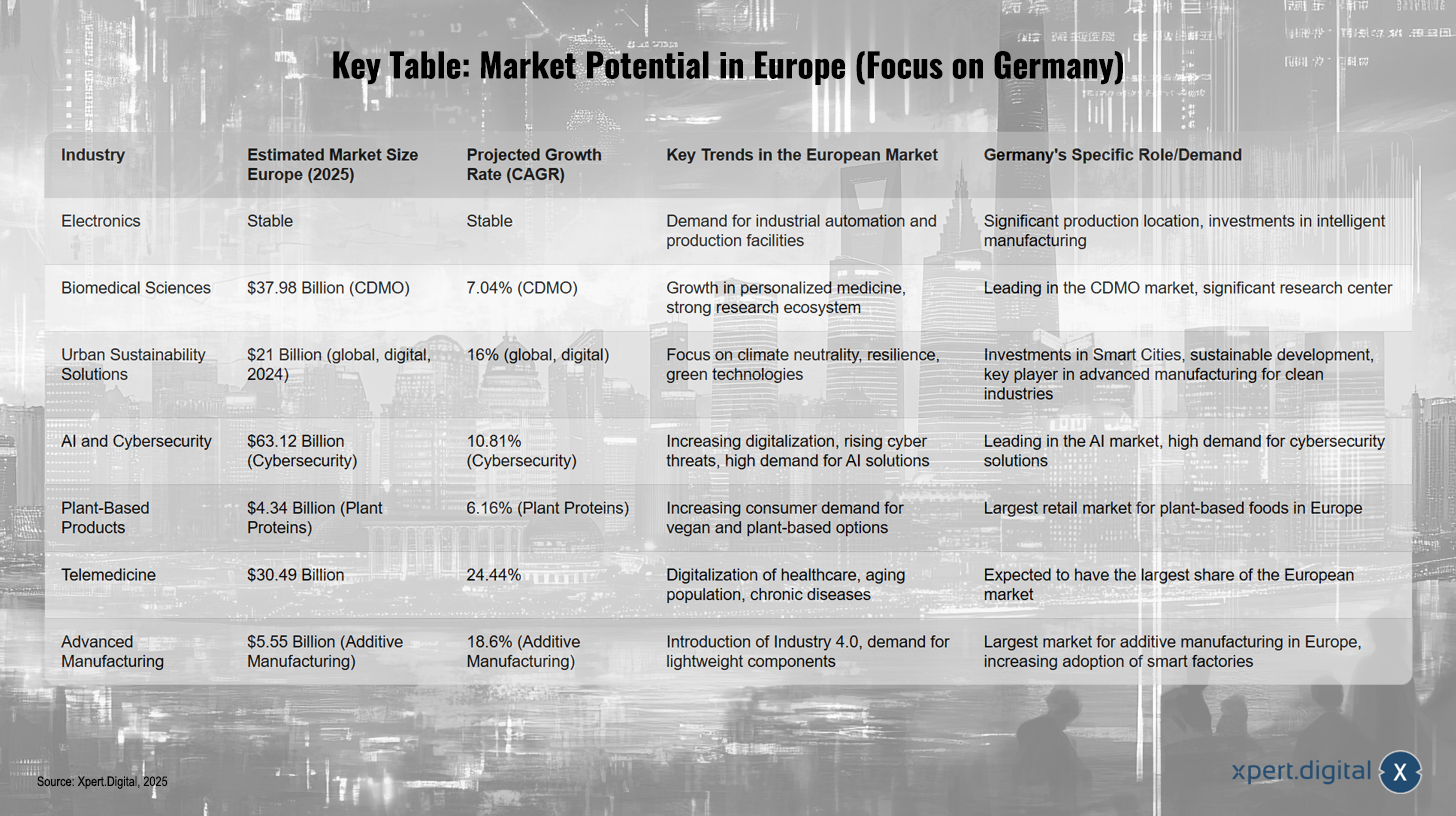
Key table: Market potential in Europe (focus on Germany) – Image: Xpert.Digital
The key table shows the market potential in Europe, with a particular focus on Germany, for various industries in 2025. In the electronics sector, market size and growth rate remain stable, with Germany standing out as a significant production location and investor in smart manufacturing. In the field of biomedical sciences, especially contract development and manufacturing organizations (CDMOs), growth to USD 37.98 billion is projected, with a growth rate of 7.04%. Here, Germany demonstrates its leadership and is a major research center. Urban sustainability solutions are being driven forward with growth rates of 16% worldwide, focusing on technologies for climate neutrality and smart cities. Germany is investing heavily in this area and is acting as a key player in clean industries. The artificial intelligence and cybersecurity sector is experiencing increasing demand, with a projected market size of USD 63.12 billion and a growth rate of 10.81%, particularly in Germany, which stands out both in terms of the need for cybersecurity solutions and as a leading AI market. Plant-based products such as plant proteins have a market volume of USD 4.34 billion, with a growth rate of 6.16%. Germany is the largest European retail market for vegan food. Telemedicine is growing particularly dynamically at 24.44%, reaching a market size of USD 30.49 billion. Due to digitalization in healthcare, an aging population, and the increasing prevalence of chronic diseases, Germany is expected to hold the largest market share in Europe. Advanced manufacturing (e.g., additive manufacturing) is projected to reach a market volume of USD 5.55 billion by 2025, with a growth rate of 18.6%. Here, Germany is once again the leader as the largest market in Europe, driven by the increasing adoption of smart factories and the demand for lightweight components.
Germany as a strategic starting point for the European market: The advantages at a glance
Germany offers Singaporean companies a number of advantages as a strategic starting point for expansion into the European market:
Germany's economic strengths: An engine for growth
Germany has the largest economy in Europe and the third largest worldwide. With a high GDP per capita and strong consumer spending, Germany offers an attractive and reliable market for market entry and a solid foundation for further expansion into other European countries.
Strategic location and access to the EU market: The gateway to Europe
Germany lies in the heart of Europe and borders nine countries. It boasts excellent transport infrastructure, including major ports, airports, and extensive road and rail networks. As a member of the European Union, Germany facilitates the free movement of goods and simplified trade within Europe.
Business environment and investment incentives: Welcome to Germany
Germany offers a business-friendly environment with straightforward company formation. The government provides various investment incentives and subsidies to attract foreign investors. A strong legal framework and protection of intellectual property are also in place.
Skilled workforce and focus on innovation: Leveraging the potential
Germany boasts a large and highly skilled workforce with a strong focus on vocational training and STEM fields. It is among the most innovative countries worldwide, with a strong commitment to research and development.
Challenges and opportunities for Singaporean companies expanding into Germany and Europe: A realistic assessment
Expanding into the European market presents challenges, but also offers significant opportunities for Singaporean companies.
Potential challenges: Minimizing risks
- Regulatory differences between European countries
- Cultural and linguistic barriers
- High level of competition in many sectors
- Compliance with data protection regulations such as the GDPR
- Different pricing and reimbursement systems, especially in the healthcare sector
- Protection of intellectual property rights
Proactive identification and careful planning to address these challenges are essential for Singaporean companies to minimize risks and maximize their chances of success in expansion.
Key opportunities: Take advantage of the benefits
- Access to a large and affluent consumer market with high purchasing power
- High growth potential in certain sectors that comply with European requirements
- Leveraging Germany's industrial strengths and its role as a gateway to other European markets
- Opportunities for partnerships and collaborations within the European innovation ecosystem
- Benefits of free trade agreements between the EU and ASEAN
- Access to a highly qualified and well-trained workforce in Germany
The role of a strong and specialized German partner: The key to success
Partnering with a local German company can give Singaporean companies a significant competitive advantage:
Advantages of a local partner: Leverage the benefits
- Deep understanding of German and European market dynamics
- Established local networks and connections
- Cultural understanding and language skills
- Expertise in local marketing, PR and business development strategies
- Support in navigating complex local regulations
- Insights into local consumer behavior
How a partner can support market entry and success: Combining strengths
- Development and implementation of targeted marketing and PR campaigns
- Identifying and nurturing key business development opportunities and partnerships
- Support with market research
- Consulting on the adaptation of products and services
- Facilitating communication and negotiation with local stakeholders
- Support in complying with local regulations and standards
Recommendations: The path to Europe
The analysis shows that Singapore has a robust and stable economy with promising growth sectors that are well aligned with the demands of the European market, particularly Germany. Germany offers Singaporean companies an ideal starting point for expansion in Europe.
The following recommendations are given for Singaporean companies considering expansion into Europe via Germany:
Focus on high-growth and innovative sectors
Focus on industries that align with European market demand.
Thorough market research
Conduct comprehensive market research to understand the specific needs, the competitive landscape, and the regulatory environment.
Strategic partnerships
Actively seek out and establish strong partnerships with specialized German companies.
Tailor-made market entry strategy
Develop a tailored market entry strategy that takes into account the specific challenges and opportunities.
Cultural and linguistic adaptation
Invest in understanding and adapting to the cultural and linguistic nuances of the target markets.
Compliance with regulations
Ensure compliance with all relevant European regulations.
With the right offers and partnerships, Singaporean companies that strategically approach the European market have optimistic future prospects.
Your global marketing and business development partner
☑️ Our business language is English or German
☑️ NEW: Correspondence in your national language!

Konrad Wolfenstein
I would be happy to serve you and my team as a personal advisor.
You can contact me by filling out the contact form or simply call me on +49 89 89 674 804 (Munich) . My email address is: wolfenstein ∂ xpert.digital
I'm looking forward to our joint project.










