

Published on: March 27, 2025 / update from: March 27, 2025 - Author: Konrad Wolfenstein

On March 26, 2025, US President Donald Trump announced punitive tariffs from 25 percent to all auto imports from abroad-picture: Xpert.digital
US tariffs and their consequences: a turning point for Europe's car economy
The effects of the 25% US criminal tariffs on the automotive industry: causes, solutions and countermeasures
On March 26, 2025, US President Donald Trump announced punitive tariffs from 25 percent to all auto imports from abroad that are due to come into force on April 2. This measure is another highlight in the intensifying trade conflict between the USA and the European Union, although the German automotive industry in particular will be very affected.
Suitable for:

The failure of politics, companies and consultants
Political misjudgments and dependencies
The close interlinking between the German automotive industry and politics has led to a problematic dependency. As early as 2013, this showed up when the then VDA President Matthias Wissmann asked in a letter to the Chancellor that she should work in Brussels against a “very ambitious and large parts of unbalanced” CO2 regulation-with reference to the “jobs of our automobile manufacturers in Germany”. Politicians have failed to develop alternatives to the US market in good time and pursue too one-sided orientation to the interests of the automotive industry.
A lack of risk diversification for automobile manufacturers
The German automotive industry focused too much on export and weighted the US market disproportionately. No other country took as many new cars from Germany as the United States: with a share of 13.1 percent, they were ahead of exports, followed by Great Britain and France. This high export dependency makes German manufacturers particularly susceptible to protectionist measures.
The failure of the management consultants and analysts
Management consultants have not adequately included the geopolitical risks and the vulnerability of global supply chains in their analyzes. Instead, short -term profit optimization was often recommended without appropriately evaluating the long -term risks. The blockade of the Suez Canal by the container ship "Ever Given" in 2021 should have been a clear warning signal for the susceptibility of global supply chains. However, no sufficient strategies for risk minimization were developed.
In the consulting industry, cases of liability for false advice are rare, although they certainly occur. An known case is the complaint by the financial investor Kingsbridge Capital against the US company consultancy Alix Partners over 30 million euros in damages for incorrect advice in connection with the Märklin bankruptcy.
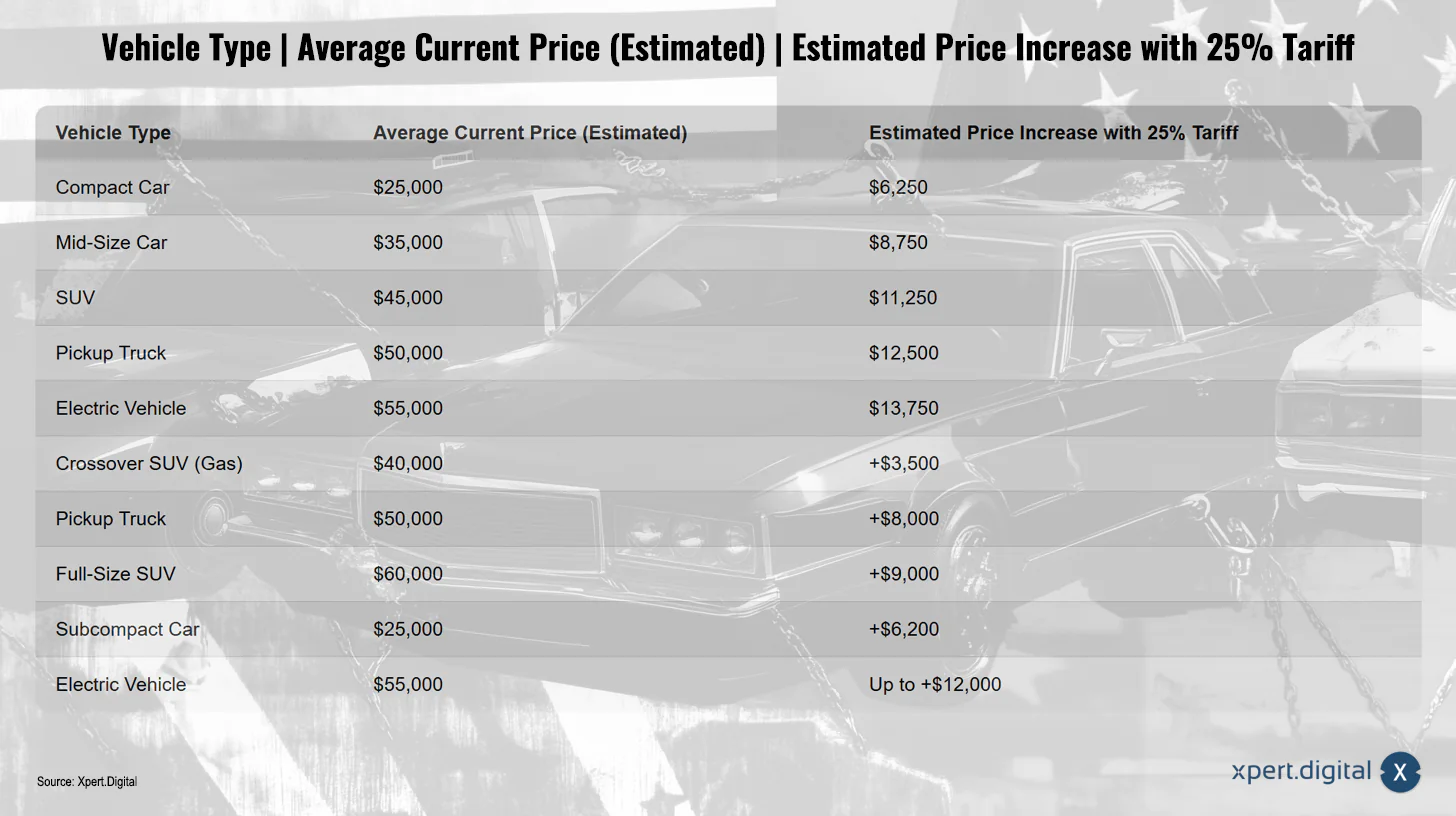
A profound cut in established trade patterns: 25% tariffs on auto imports in the USA - Image: Xpert.digital
25% US criminal tariffs could have a significant impact on consumer prices. For example, the average price for a compact car that is currently around $ 25,000 would rise by $ 6,250. A mid -range car with an estimated price of $ 35,000 would be $ 8,750. SUVs could experience a price increase of $ 11,250, based on an average price of $ 45,000. For pickup trucks, the current price of which is around $ 50,000, the price growth would be $ 12,500. Electric vehicles that currently cost an average of around $ 55,000 could be more expensive at $ 13,750. A crossover SUV with a petrol engine that costs around $ 40,000 could show a price increase of $ 3,500. Another pickup truck with a similar basic price could have price surcharges of $ 8,000. Full-Size SUVs, the average price of which is $ 60,000, could be $ 9,000 more expensive, while small cars with an output price of $ 25,000 would be affected by an increase of $ 6,200. Electric vehicles could even have a price increase of up to $ 12,000. These estimated price increases are used for illustration and can vary depending on the model, location and other factors.
Suitable for:
Strategies to avoid and bypass punishment tariffs
Circumn and production splitting
A strategy for circumventing punitive tariffs is the so -called “circumnean” or bypass by veiling the origin. In doing so, goods are processed or put together in such a way that they fall under cheaper customs conditions. This can be done using various methods:
- Wrong information in which the origin is veiled in an intermediate country
- Wrong classification of goods, so that a smaller duty rate is due
- Delivery of vehicles in individual parts and assembly in the USA
However, these practices are legally questionable and can lead to sensitive punishments if they are uncovered. The EU regularly carries out controls to prevent such circumstances, and the customs authorities of the Member States are responsible for the collection of tariffs and must take all necessary measures so that the financial interests of the EU are protected.
Instead of legally questionable practices such as production splitting, there are several legal options for companies to optimize their customs costs and to make goods traffic efficiently:
- Use of special customs procedures:
- Active refinement: Non-EU goods can be introduced, processed and then carried out again.
- Passive refinement: EU goods can be carried out temporarily and reintroduced after processing with a partial or full customs exemption.
- Customs warehouse: enables the storage of non-EU goods without immediate customs taxes.
- Application for binding customs tariff information: These provide legal certainty about the correct income of goods and the customs densities to be used.
- Use of customs simplifications: For example, simplified registration procedures or the approval as an approved economic -party (AEO).
- Correct application of preference agreements: Use of customs benefits when trading with countries with which the EU has free trade agreements.
- Optimization of the supply chain: Adjustment of production locations and delivery routes taking into account customs aspects.
- Use of the Union shipping procedure: enables the transport of non-EU goods within the EU without immediate customs taxes.
- Use of the wing regulation: for goods exported from the EU and brought back within three years.
These legal methods enable companies to optimize their customs costs and at the same time comply with all EU regulations.
Nearshoring as a strategic alternative
Nearshoring offers a legal and sustainable alternative to traditional offshoring. In contrast to offshoring (relocation to distant countries), company services are outsourced to companies based abroad, but in geographical proximity. This enables:
- Similar time zones to facilitate communication
- Faster answers and better coordination
- Production near the target market
- Cost reduction through shorter transport routes
The introduction of extensive tariffs for the import of goods to the USA has a significant impact on Germany as an export nation, but nearshoring can help to alleviate these effects.
Suitable for:

Reshoring: relocation of production
Reshoring is an even more direct answer to trade conflicts - the relocation of production to home country. Instead of producing low wages in countries, some companies decide to bring their production back to Germany. The reasons for this are:
- Rising wages in traditional “low-wage countries”
- Advances in digitization and automation that reduce production costs in Germany
- The elimination of the additional costs and risks caused by offshoring
Buffer warehouse for risk minimization
Buffer camps can play an important role in the protection against interruptions of the supply chain:
- Local supply of production -important goods
- Avoidance of production failures that can cause seven -digit sales failures per day
- These camps do not necessarily have to be located in logistically optimal locations
Such buffer camps are particularly useful in complex industries such as the automotive industry, since just-in-time production is particularly susceptible to disorders.
Further adaptation strategies
In addition to these main strategies, there are other options that companies can use to react to changed trade policy:
- Direct investments in the USA to build production capacities there
- Diversification of sales markets to reduce dependence on the US market
- Adaptation of the product range to the specific requirements of the US market
- Strategic alliances with US companies
International countermeasures and the trade conflict
The reaction of the European Union
The EU has already announced decided reactions to US tariffs. In a first step, the European Commission plans to collect EU extracülle again from April on the import of US products such as bourbon whiskey, jeans, motorcycles, boats and peanut butter. According to the EU Commission, the new US tariffs of 25 percent exports from the EU with a total value of EUR 26 billion, which corresponds to around five percent of the EU's total goods.
The planned EU countermeasures should affect US goods exports in the same value:
- In the first step, goods worth around 8 billion euros
- In the second step then by goods worth around 18 billion euros
EU Commission President Ursula von der Leyen, however, emphasizes the negotiation path: "It is no interest in tearing the gang of the global economy".
Global reactions and effects
Countermeasures have announced not only the EU, but also other affected countries:
- China wants to switch on the WTO (World Trade Organization)
- Canada has announced punitive tariffs
The economy Monika Schnitzer goes so far as to call Trump's customs policy as a “terrorist act” because they endanger the positive effects of globalization. The chairman at the Association of the Automotive Industry (VDA) sees this back and forth with great concern and emphasizes that the auto industry is a “prime example of globalization is positive”.
Suitable for:

US criminal offense: How the German automotive industry has to adapt
Current developments in US trade policy are a serious challenge for the global economy and especially for the German automotive industry. The penalty tariffs from 25 percent on all auto imports will have a significant impact on the competitiveness of German vehicles on the US market.
In the past, politics, companies and consultants have underestimated the risks of too strong export dependency and the geopolitical changes. Strategic adjustments are now required to react to these challenges.
Strategies such as nearshoring, reshoring, buffer camps and the legally harmless forms of production adaptation offer opportunities to alleviate the effects of punitive tariffs. At the same time, the international community has to work together for a de -escalation of the trade conflict in order to avoid long -term damage to the global economy.
The automotive industry is faced with a profound structural change, which is still accelerated by the current trade policy upheavals. Companies that react flexibly and innovatively to these challenges will emerge strengthened from this crisis.
Suitable for:
Your global marketing and business development partner
☑️ Our business language is English or German
☑️ NEW: Correspondence in your national language!

Konrad Wolfenstein
I would be happy to serve you and my team as a personal advisor.
You can contact me by filling out the contact form or simply call me on +49 7348 4088 965 (Munich) . My email address is: wolfenstein ∂ xpert.digital
I'm looking forward to our joint project.


