The shadow bureaucracy: How external consultants cost German taxpayers billions and undermine the government's ability to act – Image: Xpert.Digital
State trapped by consultants - How global consulting giants control German administration
McKinsey, BCG and the Big Four rake in millions – the Federal Court of Auditors warns of a loss of integrity in public administration
The German government's spending on external consulting services has reached alarming levels. An increase of 39 percent between 2020 and 2023, to nearly €240 million annually, is merely the tip of an iceberg revealing a profound and systemic dependence of the state on a small group of globally operating consulting firms. This report analyzes the anatomy of this costly dependence, identifies the main beneficiaries, and, through detailed case studies, documents a recurring pattern of project failures, mismanagement, and conflicts of interest.
The analysis shows that the exploding costs are not attributable to isolated incidents, but rather to structural deficiencies in public administration and procurement. Ministries, especially the Federal Ministry of the Interior (BMI) and the Federal Ministry of Finance (BMF), are increasingly outsourcing core tasks, particularly in the strategically critical IT sector. This is happening despite years of urgent and largely ignored warnings from the Federal Court of Auditors, which sees the "integrity of the administration" at risk.
The main beneficiaries of this system are the global industry leaders – McKinsey, Boston Consulting Group (BCG), the “Big Four” (PwC, KPMG, EY, Deloitte), as well as other major players such as Accenture, Roland Berger, and Capgemini. Their dominance is cemented by opaque framework agreements that undermine competition and secure privileged access to taxpayer funds.
The case studies in this report—from the “consultant scandal” at the Ministry of Defense and the car toll debacle to the chronic failures in the federal government’s IT modernization—demonstrate a pattern of inefficiency, waste, and a lack of political accountability. The costs to taxpayers extend far beyond direct fees and include billions in losses from failed projects and the gradual erosion of governmental competence. The report concludes that a fundamental reform of the use of consultants and a massive investment in domestic administrative expertise are essential to breaking the cycle of dependency and restoring the German state’s ability to act and public trust.
The anatomy of a 240 million euro addiction
This section outlines the extent and systemic nature of the problem and analyzes the structural causes identified by the federal auditors, from the raw expenditure figures to the underlying mechanisms.
A Decade of Escalation: The Chronicle of the Rise in Consultant Spending
The latest figures paint a dramatic picture: The German government's spending on external consulting and support services rose by 39 percent between 2020 and 2023 alone, reaching almost €240 million annually. This sum marks the second-highest level since official reporting began in 2007 and underscores a worrying trend that goes far beyond a temporary fluctuation.
This latest escalation, however, is not an isolated event, but rather the provisional culmination of a long-term trend. Over the past ten years, the German government has spent a total of more than €1.6 billion on external expertise. A closer look at the figures reveals a worrying acceleration of this dependency: roughly half of this sum, approximately €800 million, was spent in the last four reporting years alone (2020-2023). This indicates an exponential growth in dependency, with the state relying ever more rapidly and extensively on private companies to fulfill its responsibilities.
The drivers of this development can be clearly identified within the various ministries. Leading the way in spending is the Federal Ministry of the Interior and Community (BMI) under Minister Nancy Faeser, whose expenditures for external consulting amounted to €59.7 million in 2023 – an increase from €56.9 million the previous year. Closely following is the Federal Ministry of Finance (BMF), which, under then-Minister Christian Lindner, increased its spending from €31.1 million in 2022 to €38.2 million in 2023. The sheer number of contracts is also steadily growing, rising from 765 in 2022 to 816 in 2023, illustrating both the increasing fragmentation and the widespread integration of external consulting into ministerial processes.
The expenditures of the Federal Ministry of the Interior (BMI) rose from €56.9 million in 2022 to €59.7 million in 2023, representing an increase of 4.9 percent. The Federal Ministry of Finance (BMF) recorded a more significant increase, from €31.1 million to €38.2 million, which equates to a rise of 22.8 percent. Total expenditures across all ministries increased from approximately €186 million to around €240 million, a rise of roughly 29 percent.
These figures are more than just line items in a budget. They are symptoms of a fundamental shift in the way the German state functions. The acceleration of spending reveals a growing structural dependence on external actors to fulfill tasks that were once the core competencies of the ministerial bureaucracy. This development raises fundamental questions about the efficiency, control, and ultimately, the sovereignty of state action.
More information here:


The auditors' unheeded warnings: The ongoing criticism from the Federal Court of Auditors
While spending on consultants escalates, warnings from the highest federal financial control body, the Federal Court of Auditors (BRH), have consistently gone unheeded for years. The auditors not only criticize the rising costs but also issue urgent warnings about an erosion of core government competencies that fundamentally jeopardizes the "integrity of the administration.".
A central and recurring point of criticism is the increasing outsourcing of core tasks to private companies. A particularly egregious example, repeatedly denounced by the Federal Court of Auditors (BRH), is the approach taken by the Federal Ministry of the Interior in the mammoth project "Federal IT Consolidation." Here, financial controlling, a core governmental steering and control function, was outsourced to external consultants. According to the auditors, such a practice carries the risk that the Ministry will lose control and ultimate responsibility over key decisions.
Furthermore, the Federal Court of Auditors (BRH) criticizes the lack of any cross-departmental strategy for the use of consultants. The consultant reports submitted annually to parliament are dismissed as inadequate, "incomplete and vague." According to the auditors, they demonstrate "little willingness to change the use of external consultants." Most ministries have not even formulated concrete goals for reducing their dependence.
This criticism, however, is being systematically ignored by the government. The Federal Court of Auditors (BRH) notes that the lead ministry, the Federal Ministry of Finance, has not followed its recommendations for reforming the lack of transparency in financial reporting. This refusal to address the well-founded criticism from the top auditors reveals a profound problem in the culture of political oversight. It is not an oversight, but a deliberate decision to maintain the status quo.
The absurdity and wastefulness of such practices is illustrated by a case uncovered by the Federal Court of Auditors (BRH) at the German Federal Pension Insurance Fund (DRV Bund), a federal agency. For a fee of €765,000, a department commissioned the creation of a nearly 10-page set of "rules of procedure." According to the auditors, the document, the result of 230 rounds of consultations, contained largely meaningless keywords such as "pig rounds" or "surf listening." No justification was provided as to why this task could not be performed by in-house staff. The alleged "added value"—a "culture-changing process" and the establishment of a new staff unit—was not apparent from the document.
The relationship between the government and its auditors is therefore profoundly dysfunctional. The Federal Court of Auditors does not act as a petty accountant, but as a strategic warning system, pointing to an existential threat to the state's ability to function. The executive branch's consistent disregard for these warnings transforms the problem from one of mismanagement into one of deliberate government failure.
The procurement funnel: How framework agreements create a closed market
The massive diversion of taxpayers' money into the coffers of consulting firms is enabled and accelerated by a specific mechanism of public procurement law: the so-called framework contracts. These contracts are the primary channel through which ministries purchase their consulting services and simultaneously privilege a small circle of companies.
The figures demonstrate the dominance of this instrument. Between 2018 and 2022 alone, the Federal Ministry of the Interior and the Federal Ministry of Finance procured over 500 services from 149 different framework agreements, with a total volume of at least €261 million. At the Federal Ministry of the Interior, almost 90 percent of all consulting contracts exceeding €50,000 were recently awarded on the basis of such a framework agreement.
Although legally permissible, this practice de facto creates a closed oligopoly. Once listed as a potential service provider in a framework agreement, companies can be commissioned for specific projects through so-called individual call-offs. This often occurs within the framework of a "mini-competition" only among the providers listed in the agreement, or even entirely without a new tender process. This significantly simplifies the procurement process for the administration, but at the same time severely restricts competition and structurally disadvantages smaller, innovative providers.
The lists of framework contract partners maintained by the Federal Office of Administration (BVA) under the so-called "Three-Partner Model" (3PM) read like a "Who's Who" of the global consulting industry. The same names regularly appear as general contractors (GC) or subcontractors (SC): Accenture, BearingPoint, Capgemini, Cassini Consulting, Deloitte, Ernst & Young (EY), Horváth & Partner, IBM, KPMG, Kienbaum, McKinsey & Company, and PricewaterhouseCoopers (PwC). These firms have secured a firm place in the federal government's procurement system.
The "PD – Berater der öffentlichen Hand GmbH" (PD – Public Sector Consultants Ltd.) plays a particularly ambivalent role in this context. As the in-house consultancy for the federal and state governments, it is 100% publicly owned. However, instead of primarily developing and utilizing its own expertise, PD frequently acts as the main contractor, subcontracting the awarded contracts to precisely those private consulting firms with which it has framework agreements, including McKinsey, Boston Consulting Group, and Roland Berger. This creates an additional, opaque layer and raises the question of whether PD fulfills its role as an alternative to the private sector or rather serves as another channel for its engagement.
The procurement system is therefore not designed to find the best service at the lowest price. Rather, it is optimized for administrative convenience and rapid expenditure, which benefits an exclusive circle of established large consultancies. This system is one of the root causes of escalating costs, lack of transparency, and recurring project failures.
🎯🎯🎯 Benefit from Xpert.Digital's extensive, five-fold expertise in one comprehensive service package | BD, R&D, XR, PR & Digital Visibility Optimization

Benefit from Xpert.Digital's extensive, five-fold expertise in a comprehensive service package | R&D, XR, PR & Digital Visibility Optimization - Image: Xpert.Digital
Xpert.Digital possesses in-depth knowledge across various industries. This allows us to develop tailored strategies precisely aligned with the requirements and challenges of your specific market segment. By continuously analyzing market trends and monitoring industry developments, we can act proactively and offer innovative solutions. The combination of experience and expertise generates added value and provides our clients with a decisive competitive advantage.
More information here:
Conflicts of interest revealed: How McKinsey, Accenture and KPMG wasted millions
Profiles of Failure: The Profiteers and Their Misdeeds
This central part of the report provides the “negative examples” requested by the inquiry. Each subsection profiles a leading consulting firm and documents its involvement in a significant project failure, a scandal, or substantial criticism of its consulting services to the government.
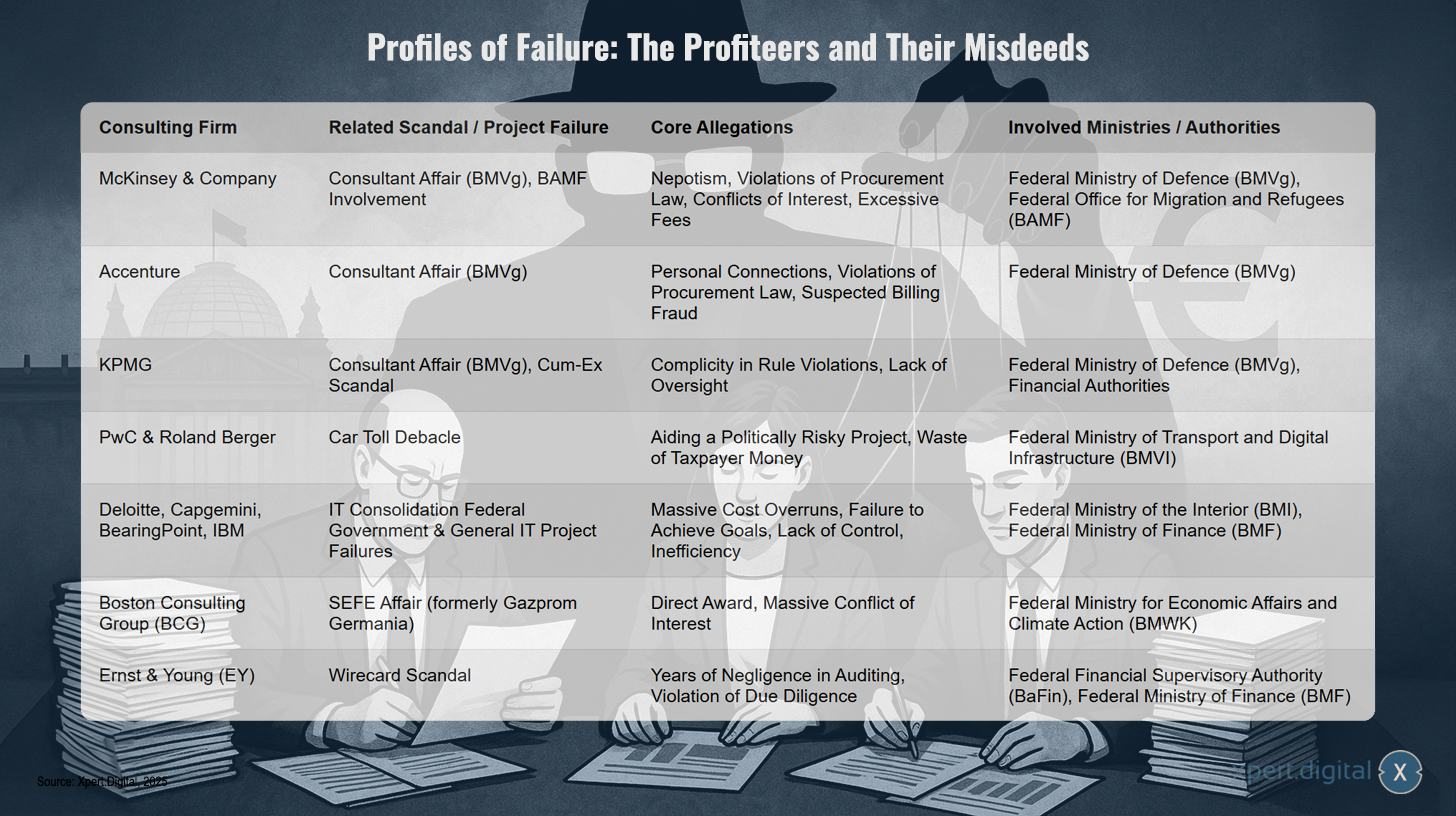
Profiles of Failure: The Profiteers and Their Misdeeds – Image: Xpert.Digital
The profiles of failure clearly reveal the beneficiaries and their serious failings. McKinsey & Company came under fire due to the consulting scandal at the Federal Ministry of Defense and its involvement with the Federal Office for Migration and Refugees (BAMF), with nepotism, violations of procurement law, conflicts of interest, and excessive fees at the heart of the allegations. Accenture was also implicated in the BMVg consulting scandal and faced accusations of personal connections, violations of procurement law, and alleged billing fraud.
KPMG faced criticism in both the Defense Ministry consulting scandal and the Cum-Ex scandal, particularly for complicity in regulatory violations and inadequate due diligence. Its cooperation with tax authorities and the Ministry of Defense was especially scrutinized. PwC and Roland Berger were significantly involved in the car toll debacle, supporting a politically risky project that ultimately led to the waste of taxpayers' money, for which the Federal Ministry of Transport and Digital Infrastructure was responsible.
Several large consulting firms were involved in the IT consolidation of the federal government and other IT project failures: Deloitte, Capgemini, BearingPoint and IBM were criticized for massive cost overruns, failure to meet targets, lack of control and inefficiency, with the Federal Ministry of the Interior and the Federal Ministry of Finance being among the affected authorities.
The Boston Consulting Group came under scrutiny in the SEFE affair, concerning the former Gazprom Germania, where it was criticized for awarding contracts without competitive bidding and for massive conflicts of interest with the Federal Ministry for Economic Affairs and Climate Action. Ernst & Young ultimately faced serious accusations in the Wirecard scandal, as the company failed for years in its auditing of financial statements and violated its due diligence obligations, affecting both the Federal Financial Supervisory Authority (BaFin) and the Federal Ministry of Finance.
The nexus of the “consultant affair”: A case study on cronyism and waste
The so-called "consultant affair" at the Federal Ministry of Defense (BMVg) under then-Minister Ursula von der Leyen (CDU) is not an isolated incident, but rather a cautionary tale about the systemic risks of external consulting. It revealed a close-knit network of personal relationships, questionable contract awards, and massive waste of money, in which several of the world's largest consulting firms were implicated.
McKinsey & Company: At the center of the affair was McKinsey, one of the world's most prestigious strategy consultancies. The allegations ranged from cronyism and irregular contract awards to the squandering of millions of euros in taxpayer money. A key role was played by the then State Secretary for Defense, Katrin Suder. Ursula von der Leyen had brought the former senior partner from McKinsey into the ministry in 2014 to reform the Bundeswehr's notoriously dilapidated procurement system. Instead, Suder opened the doors to her former colleagues. A high-ranking McKinsey manager was quoted in a New York Times report as saying: "Katrin was put in a position where she could repeatedly hire McKinsey.".
The facts support this impression. The Federal Court of Auditors found that the ministry had frequently awarded large consulting contracts "without competitive bidding" and that the reasons for this were "not always convincing." Furthermore, the ministry lacked a "comprehensive overview of contracts awarded to external parties"—a damning verdict for an institution managing billions in budgets. A concrete example was the awarding of contracts worth millions to the McKinsey subsidiary Orphoz by the federally owned IT company BWI without a proper tendering process. When State Secretary Suder was informed internally about irregularities, she did forward them to the minister, but cited her "personal involvement"—a clear conflict of interest.
Accenture: The IT and strategy consultancy Accenture also benefited from the lax conditions within the ministry. A parliamentary inquiry revealed that the company enjoyed "special access to the Federal Ministry of Defense" through a "friendly relationship" between one of its managers, Timo Noetzel, and General Erhard Bühler, a high-ranking military officer. These personal connections appear to have circumvented formal procurement rules.
The entanglements extended to alleged billing fraud. The final report of the parliamentary inquiry committee stated that the main contractor, SVA, allegedly overcharged the ministry by €631,049.56. This sum corresponded to 2,654 hours of consulting services that, according to the investigation, were never provided by the subcontractor, Accenture. In another instance, after the affair had already become public, Accenture submitted a final invoice for approximately €3 million directly to the ministry, instead of following the official channels via the originally used framework agreement – further evidence of the informal and irregular practices.
KPMG: The auditing firm KPMG, one of the "Big Four," was also involved in the affair early on. It was part of a consortium that received one of the first major consulting contracts from Minister von der Leyen shortly after she made the reform of the procurement system a top priority. This marked the beginning of the massive expansion of consulting contracts within the ministry.
Although KPMG's direct role in the most serious procurement violations was less prominent than that of McKinsey or Accenture, its involvement must be viewed in the context of its overall credibility as a government advisor. It was revealed that KPMG auditors knew as early as 2010 that the refunding of capital gains taxes in connection with Cum-Ex transactions at a bank they were auditing might be illegal. This complicity in one of the biggest tax scandals in German history casts a shadow on the company's integrity and raises the question of whether such a firm can be a suitable partner for the public sector.
The "consultant scandal" was therefore not an accident, but the result of systemic failure. It exposed a "buddy system" in which personal networks took precedence over procurement law, a "revolving door effect" between the consulting industry and top political offices created massive conflicts of interest, and inadequate political oversight led to millions of euros in wasted resources. The opposition, in the final report of the parliamentary inquiry, spoke of a "de facto complete failure.".
The car toll debacle: The costly collapse of a political prestige project
The debacle surrounding the introduction of a car toll in Germany is a prime example of how a political prestige project, coupled with inadequate risk assessment and the support of expensive consultants, can lead to a financial fiasco for taxpayers. The project was declared illegal by the European Court of Justice (ECJ), but only after the Federal Ministry of Transport and Digital Infrastructure (BMVI), under then-Minister Andreas Scheuer (CSU), had already signed binding contracts with the future operators. As a result, the federal government had to pay €243 million in compensation, with further claims pending that, according to expert opinions, could drive the total costs up to €776 million.
PricewaterhouseCoopers (PwC) & Roland Berger: In this costly disaster, the consulting firms PricewaterhouseCoopers and Roland Berger played a central role as financial beneficiaries. Both companies were among the highest earners among the external consultants for whom the Ministry of Transport spent around €12 million in the crisis year of 2018 alone. They provided operational support for a project whose legal and financial risks were immense from the outset.
For PwC, involvement in questionable contracts from the Ministry of Transport is nothing new. Back in 2008, the Federal Court of Auditors criticized the ministry, then under the SPD minister Wolfgang Tiefensee, for the unlawful extension of a consulting contract with PwC without a public tender. The auditors criticized the fact that PwC had gained an informational advantage through other contracts, that the ministry had deprived the responsible federal agency of its decision-making authority, and that it had failed to ensure a cost-benefit analysis. This pattern of procurement law violations and a lack of oversight within the Ministry of Transport appears to have been repeated in the toll project.
The parliamentary inquiry committee investigating the toll scandal concluded that the risk of losing the case before the European Court of Justice should have been given greater weight. While Minister Scheuer's decision to sign the contracts before the court ruling was deemed justifiable, it was also noted that a later signing would have been legally permissible. The opposition, in a separate opinion, expressed its criticism far more sharply, speaking of a "political abyss of ignorance, irresponsibility, recklessness, and breach of the law.".
The car toll scandal exemplifies how external consultants can enable politically motivated but poorly conceived projects. They provide the necessary expertise and legitimacy to push a project forward, while the political leadership ignores the legal and financial risks. In the end, the consultants pocket millions in fees, while the taxpayer foots the bill for the inevitable collapse.
The swamp of IT modernization: A collective failure of strategy and implementation
The digitalization of German public administration is a perpetual construction site, plagued by chronic failures, exploding costs, and missed targets. At the heart of this predicament is the mammoth project "Federal IT Consolidation," which serves as a prime example of the collective failure of government management and external consultants.
Deloitte: The "Federal IT Consolidation" project was launched with the ambitious goal of centralizing, standardizing, and modernizing the fragmented and outdated IT landscape of the federal administration. However, the assessment by the Federal Court of Auditors is devastating. The project is suffering from massive cost increases: the federal government's annual IT and digitalization expenditures have almost quadrupled from €1.5 billion in 2015 to a planned €6 billion in 2023.
At the same time, key project goals were missed or abandoned. The original objective of significantly reducing the federal government's more than 1,300 data centers and server rooms by the end of 2022 was abandoned. The scope of service consolidation, intended to avoid duplication of effort, was also scaled back. The Federal Court of Auditors (BRH) fundamentally criticizes the lack of effective management structures, a central IT budget, and functioning controlling mechanisms, resulting in inefficient and costly development.
The consulting firm Deloitte was involved in this process, among other things through an analysis of the federal administration's database landscape. This study confirmed the strong dependence on market leaders Oracle and Microsoft and urged the strengthening of "digital sovereignty." Although Deloitte is not solely responsible for the overall project's failure, its involvement places it at the center of an undertaking that is considered by the highest financial oversight bodies to be a costly mess lacking a clear strategy.
Capgemini, BearingPoint, IBM: These three companies, like Deloitte, are regular fixtures in the German government's major IT framework contracts. They are frequently called upon for tasks such as IT architecture management, project management, process digitization, and organizational consulting. Their ubiquitous presence makes them co-creators – and co-responsible – for the state of government IT.
Criticism of the federal government's IT project culture is fundamental. Sources describe an environment within the Federal Ministry of the Interior where there are "neither targets nor service contracts" and consultants are paid by the hour – a model that practically invites projects to "never" be completed. This practice leads to a culture of inefficiency and exploding costs, from which the consultants' time-based billing models directly benefit.
A historical example of the failure of major federal IT projects involving large providers like IBM is the De-Mail project. Despite significant investment and political support, this attempt to establish secure and legally binding email communication failed due to a lack of public and business acceptance. It is emblematic of many public sector IT projects that are planned without regard for actual user needs.
The German government's attempt to modernize its IT is a case study in strategic failure. The "Federal IT Consolidation" project demonstrates that simply allocating billions of euros and commissioning dozens of consulting firms without clear political leadership, without building internal expertise, and without a functioning governance structure does not lead to better results. Instead, it creates a vicious cycle of rising costs, declining ambition, and growing dependence on the very consultants who are part of the problem.
Other notable cases: A pattern of questionable engagements
In addition to the major systemic failures, there are a number of other cases that highlight the problematic relationship between government and consultants and confirm the recurring patterns of conflicts of interest, excessive costs and lack of oversight.
The Boston Consulting Group (BCG) and the SEFE affair: This case is a textbook example of conflicts of interest and the circumvention of procurement law. In April 2022, shortly after the German government's takeover of the former Gazprom Germania (now SEFE), the now state-controlled gas company awarded a multi-million-euro consulting contract to the Boston Consulting Group – without a competitive bidding process or public tender.
Particularly explosive: The contract was awarded just six days after former BCG partner Egbert Laege was appointed by the German government as its chief executive officer at SEFE. His former employer thus directly benefited from his new position. The opposition sharply criticized this move as a clear conflict of interest. The responsible Ministry of Economic Affairs defended the direct award, citing the "extreme urgency" of the situation, as the company was on the verge of insolvency. Nevertheless, the impression remains of a questionable award process in which personal networks were more important than transparent procedures.
McKinsey and the BAMF engagement: At the height of the refugee crisis in 2015, McKinsey was brought in to support the completely overwhelmed Federal Office for Migration and Refugees (BAMF). What began as a commendable pro bono effort quickly developed into a lucrative business. The German government paid McKinsey over €20 million for various consulting services.
One particularly controversial contract was a study on deportations. For a fee of €1.86 million, consultants were tasked with determining how rejected asylum seekers could be deported more quickly. This equated to an average daily rate of over €2,700 per consultant. When the transparency platform FragDenStaat (AskTheState) sued for the release of the study, the agency initially argued that publishing the PowerPoint presentation would endanger public safety—a claim that was later dropped. The case illustrates not only the exorbitant costs of consulting services but also the outsourcing of highly sensitive, sovereign tasks to profit-oriented companies.
Ernst & Young (EY) and the Wirecard scandal: The collapse of the DAX-listed company Wirecard is one of the biggest financial scandals in post-war German history and a case of massive failure on multiple levels. At the center of the criticism is the auditing firm Ernst & Young, a company that regularly receives major contracts from the German government. For years, EY had audited Wirecard's financial statements, overlooking a €1.9 billion shortfall consisting of fictitious revenues. The German Audit Oversight Authority (APAS) later determined that EY had violated its professional due diligence obligations during the audit.
This case is crucial for evaluating government advisors, as it exposes a catastrophic failure of competence and due diligence at one of the world's largest auditing and consulting firms. At the same time, the scandal revealed the total failure of state oversight by the Federal Financial Supervisory Authority (BaFin). For years, BaFin ignored credible evidence from Financial Times journalists, instead filing charges against the journalists and even imposing a short-selling ban to protect Wirecard shares. The Wirecard scandal is thus a double example of failure: it demonstrates the failure of a key private partner of the state and the simultaneous failure of state regulatory bodies.
These individual cases are not isolated incidents. They underscore the overarching themes of this report: conflicts of interest arising from the "revolving door" between politics and consulting (BCG/SEFE), exorbitant costs for questionable services (McKinsey/BAMF), and a fundamental failure of due diligence on the part of both private contractors and government oversight (EY/Wirecard/BaFin). The problem is widespread and multifaceted.
Hub for Security and Defense - Advice and Information

Hub for Security and Defense - Image: Xpert.Digital
The Security and Defence Hub offers expert advice and up-to-date information to effectively support companies and organizations in strengthening their role in European security and defence policy. Working closely with the SME Connect Defence Working Group, it particularly promotes small and medium-sized enterprises (SMEs) that wish to further develop their innovative capacity and competitiveness in the defence sector. As a central point of contact, the Hub thus creates a crucial bridge between SMEs and European defence strategy.
Related to this:
Revolving door politics and millions wasted: The dark side of government consulting
Analysis and recommendations: Breaking the vicious cycle
The findings from the above-mentioned case studies have been summarized here in order to draw overarching conclusions about systemic dysfunctions and to propose concrete, implementable reforms.
A pattern of dysfunction: Common characteristics of failed government projects
The analysis of the presented case studies reveals recurring patterns that point to profound, systemic problems in the German government's dealings with external consultants. These are not isolated incidents, but rather symptoms of a chronic illness in the administrative culture and political governance.
First, there is a systematic disregard for procurement law. The repeated practice of awarding contracts without competitive bidding, as documented in the consultants' affair and the SEFE case, is a clear indication that administrative convenience and personal networks often take precedence over the principles of transparency and efficiency. Framework agreements, which are actually intended to increase efficiency, become a tool that favors an exclusive club of large consultancies and undermines competition.
Secondly, massive conflicts of interest are commonplace. The "revolving door effect," in which high-ranking consultants move to top political positions and vice versa, creates an environment in which objective decisions are virtually impossible. The cases of Katrin Suder (McKinsey/BMVg) and Egbert Laege (BCG/SEFE) are prime examples of how such moves can lead to preferential treatment of former employers. The "buddy system" uncovered in the consultant scandal demonstrates that even personal friendships are enough to circumvent procurement law.
Thirdly, there is a culture of a lack of political accountability. Ministers like Ursula von der Leyen and Andreas Scheuer held political leadership positions in departments where billions of euros in failures and massive rule violations occurred. However, personal or far-reaching political consequences were largely absent. This impunity at the highest level sends a disastrous signal to the administration and encourages the continuation of problematic practices.
Fourth, and perhaps most fundamentally, is the lack of internal expertise. Particularly with complex IT projects and major reform initiatives, the government is no longer able to design, manage, and control them without massive external support. The Federal Court of Auditors has been warning for years about this loss of competence, which is driving the state into a self-reinforcing spiral of dependency: the more tasks are outsourced, the more internal expertise diminishes, which in turn leads to even more outsourcing.
The erosion of the state: Consequences of a gutted administration
The annual costs of €240 million are only the most visible part of the damage. The true, long-term danger of excessive dependence on external consultants lies in the gradual erosion of state efficiency, democratic control, and public trust.
The first consequence is the loss of institutional competence and memory. When core functions such as IT strategy, project management, or even financial controlling are systematically outsourced to external companies, the public sector forgets how to perform these tasks itself. This results in a gutted administration that is no longer capable of acting without its external helpers. This loss of competence creates a permanent dependency that is difficult to reverse and weakens the state in the long run.
The second consequence concerns democratic accountability. External consultants are not democratically elected. They act on behalf of their profit-oriented companies and are primarily accountable to their partners and shareholders, not the common good. When these non-accountable actors exert significant influence on the drafting of laws, the management of ministries, and the direction of public administration, this undermines fundamental principles of democratic control and transparency.
The third and final consequence is the erosion of public trust. High-profile and costly failures such as the car toll, the endless debacle of public administration digitalization, or the scandals in the Ministry of Defense severely damage the state's reputation. They reinforce the impression of an inefficient, wasteful government driven by special interests, incapable of carefully managing taxpayers' money and effectively providing basic services.
A path to reform: Actionable recommendations for accountability and competence
Reversing this worrying trend requires more than just cosmetic corrections. It demands a fundamental rethink and bold political decisions. Based on the findings of this report and the repeated but ignored recommendations of the Federal Court of Auditors, the following concrete reform steps can be derived:
Reform of public procurement for consulting services: The use of negotiated procedures and opaque framework agreements for strategic consulting services must be drastically reduced. Open, competitive tenders must become the norm for all major consulting projects. The decisive criterion must not be price alone, but rather the best value for money.
Enforcement of radical transparency: All consulting contracts above a low threshold must be fully published, including detailed specifications, agreed deliverables, and total costs. Disclosure of all subcontractors involved must be mandatory to prevent the use of firms like PD as opaque intermediaries.
Launch of a "Public Sector Competence Offensive": The German government must make a massive and sustainable investment in rebuilding internal expertise. This applies particularly to the areas of IT and digitalization, complex project management, and strategic planning. The goal must be to make the use of external consultants the "exception," as critics have long demanded, and not the rule.
Establishing clear political and administrative responsibilities: For major projects, clear responsibilities must be defined at the ministerial and state secretary levels. Failures, massive cost overruns, and missed targets must have tangible consequences. A culture of political accountability must replace one of impunity.
Strengthening the Federal Court of Auditors: The recommendations of the Federal Court of Auditors must be given greater legal weight. Ministries that choose to ignore the recommendations of the supreme financial control body should be required to provide a formal and public justification.
Reversing this trend is not merely a fiscal necessity. It is crucial for restoring the German state's capacity to act, its integrity, and its trustworthiness in the 21st century.
A constructive alternative approach to the federal government's expensive flood of consultants


A constructive alternative to the German government's expensive flood of consultants – Image: Xpert.Digital
The German federal government faces a serious problem that affects both taxpayers and the integrity of the administration: its uncontrolled dependence on external consulting firms. In its latest report, the Federal Court of Auditors sharply criticized the government's lack of a strategy to reduce this costly reliance. The figures speak for themselves and reveal the extent of this problematic trend.
This development is all the more worrying given that the Budget Committee of the German Bundestag had already called for a substantial reduction in consulting costs in 2020. However, the Federal Government has not complied with these demands, as the Federal Court of Auditors has unequivocally stated. Instead, the government's annual consultant reports show little willingness to change the use of external consultants.
The structural weaknesses of the current approach
- Lack of strategic planning
- Threat to administrative integrity
- Quality problems and copy-paste advice
More information here:
Consulting - Planning - Implementation

Markus Becker
I would be happy to serve as your personal advisor.
Head of Business Development
Chairman SME Connect Defense Working Group
Consulting - Planning - Implementation
Konrad Wolfenstein
I would be happy to serve as your personal advisor.
You can contact me at wolfenstein∂xpert.digital or
Just call me on +49 7348 4088 965 .