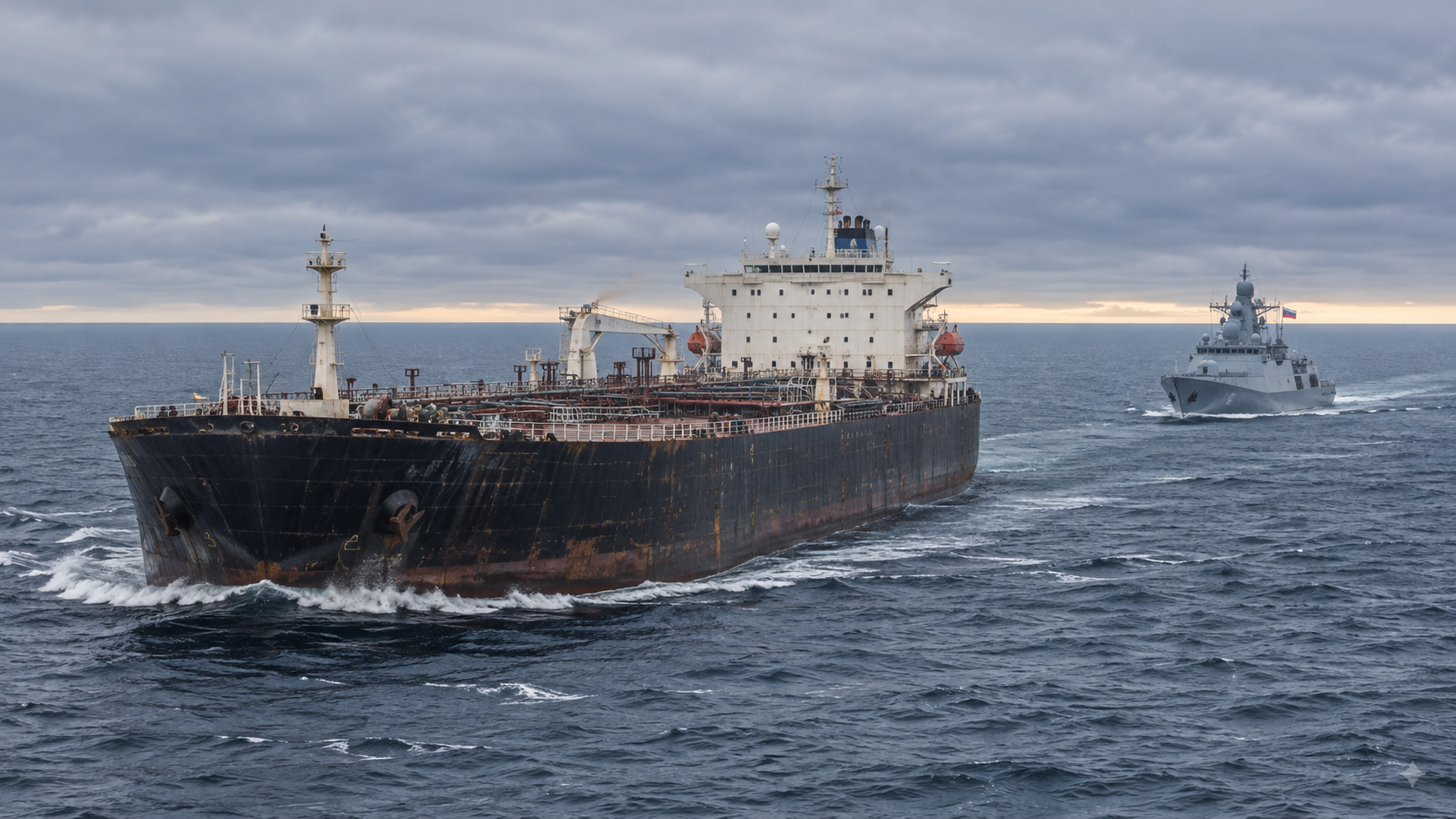
Russia's shadow fleet is becoming a cost trap: Why protecting oil exports is burdening the navy – Creative image on the topic, created with AI: Xpert.Digital
Putin's oil is supposed to finance the war – but protecting him is costing Russia more and more
Russia's tankers under protection: How oil exports strain the navy's operational readiness
How Europe's controls are making Russia's shadow fleet more expensive – and placing additional demands on the navy
Russia's shadow fleet keeps vital oil exports flowing despite Western sanctions. But tankers operating outside established service and control structures incur additional costs: longer routes, more complicated insurance and payment processes, and higher risks for operators and coastal states. At the same time, Russia is increasingly forced to deploy military forces to secure its trade routes. This creates a strategic conflict of objectives: oil revenues are meant to finance the state and its war effort, while protecting these shipments ties up scarce naval resources and can complicate maintenance and other tasks.
The extent to which this strain is already affecting the operational readiness of the Russian fleet cannot be reliably quantified based on publicly available information. Indications of extended deployments and postponed maintenance should be taken seriously, but do not prove an imminent collapse. What is crucial is the overall economic balance: After price reductions, transport costs, and additional safeguards, how much of each shipment actually remains for Russia? Developments show that an export model can continue to function while simultaneously becoming less efficient.
Russia's shadow fleet is becoming a cost trap: How protecting oil exports is wearing down the navy
Russia's shadow fleet continues to secure vital revenue from the oil trade. However, the economic benefits of this system are increasingly being overshadowed by its own costs. The more difficult it becomes to move sanctioned or otherwise conspicuous tankers through European waters, the more frequently Russia must deploy military forces to safeguard its trade flows. This creates a costly link between commodity exports, sanctions evasion, and military readiness: warships protect tankers whose profits are intended to finance the state and its war effort, while the additional deployments consume maintenance capacity and crowd out other military tasks.
The assessment, made public in November 2026, that Russian warships are being deployed to their limits by these protection missions, therefore describes more than just a technical problem with individual vessels. It points to an economic conflict of objectives. Russia can secure export revenues in the short term by keeping its available navy at sea longer. However, it thereby risks impairing the long-term availability of these same ships. The extent to which this process has already progressed cannot be reliably quantified publicly. The indications of extended deployments and postponed maintenance should be taken seriously, but they do not replace an independent assessment of the technical condition of the Russian fleet.
The crucial question, therefore, is not whether the shadow fleet is on the verge of collapse. There is no reliable basis for that. Rather, the decisive factor is whether securing Russian oil exports is tying up ever more resources and consequently reducing the economic return per unit transported. This is precisely where the strategic significance of this development lies: a system can continue to function while simultaneously gradually losing efficiency, reliability, and financial viability.
The Baltic Sea is Russia's export corridor and strategic bottleneck
The Baltic Sea holds economic significance for Russia that extends far beyond its geographical size. A substantial portion of Russian oil exports is handled via its ports and sea lanes. A report published in May 2026 puts this share at around 48 percent. At the same time, despite sanctions, total Russian oil export revenues are still estimated at more than ten billion euros per month. These figures represent different points of reference: the 48 percent figure refers to export flows, while the monthly revenues encompass all of Russia's oil business with foreign countries. Therefore, they cannot simply be multiplied together.
The economic vulnerability stems from the geographical concentration. Extraction areas, pipelines, storage facilities, loading facilities, and port infrastructure form value chains built up over decades. Such systems cannot be relocated at short notice. If a key export corridor is more tightly controlled, an exporter cannot simply ship all quantities via other ports. There may be a lack of inland transport capacity, suitable terminals, additional tanks, or a sufficient number of available vessels.
Furthermore, a distinction must be made between loading at the port and successful delivery to the buyer. A loaded tanker does not yet constitute a complete economic cycle. Only when the cargo arrives as agreed, is paid for, and the proceeds become available is the transaction fully realized. Any additional uncertainty along the sea route can increase the cost or delay this process.
The Baltic Sea is thus both a revenue corridor and a control zone. Russia needs it for a significant portion of its raw material trade. The European coastal states, in turn, have a direct interest in safe shipping, functioning underwater pipelines, and compliance with environmental standards. This overlap gives rise to conflicts that cannot be reduced to a simple juxtaposition of trade and military might.
The Shadow Fleet replaces Western services with a more expensive parallel system
The term "shadow fleet" does not refer to a uniformly organized fleet under a single state owner. Rather, it refers to a shifting network of ships, owners, operators, brokers, insurers, and other service providers that enables Russian oil exports outside or on the fringes of the Western-dominated sanctions and service architecture. Common characteristics include older tankers, opaque ownership structures, changing flags, and limited transparency regarding insurance coverage. Not every ship exhibiting these characteristics automatically violates applicable law. The decisive factors are the specific activity, the actors involved, and the applicable regulations.
Economically, this involves building a replacement infrastructure. Where established providers are forced out due to sanctions, liability risks, or compliance requirements, other companies and intermediaries step in. These take on additional risks and demand higher fees. Russia gains flexibility as a result, but loses some of the advantages of an open and competitively organized service market.
As early as 2025, the capital invested in building Russia's shadow fleet was estimated at around ten billion US dollars. Studies at the time assumed up to 650 ships were involved, though only a portion were regularly deployed. Later, different definitions led to significantly higher figures. These discrepancies are not a minor statistical issue, but rather reflect a dynamic system in which definitions, changes in ownership, and operational profiles significantly influence the count.
Acquiring used tankers therefore only solves part of the problem. A ship must be operated, crewed, refueled, maintained, and insured. It requires access to ports, spare parts, technical inspections, and payment channels. The more of these functions have to be organized outside of established structures, the greater the inefficiencies become.
The shadow fleet thus demonstrates both adaptability and economic strain. It proves that sanctions can be circumvented. However, it does not prove that this circumvention is free or as efficient as regular trade.
The ratio of ten to one is a snapshot, not a complete balance of power
The depiction of an almost tenfold NATO superiority in the Baltic Sea creates a striking image. However, its significance depends on which ships, which time period, and which sea area are being compared. The assessment, cited in November 2026, compared more than 30 allied ships in connection with Operation Baltic Sentry to approximately four Russian ships. This data demonstrates a clear numerical superiority in the described operational scenario. However, it provides neither a complete inventory nor a reliable overall assessment of all regionally available military capabilities.
Even mathematically, 30 to four initially equates to 7.5 to one. Since more than 30 Allied units are mentioned, the exact ratio remains unclear. An approximation of ten to one is possible, but cannot be precisely derived from the published figures alone. This distinction is important for an objective assessment: A pointed ratio should not be treated as an exactly measured military reality.
Furthermore, ships are not interchangeable units. A frigate, a minehunter, a supply ship, and a patrol vessel fulfill different tasks. Aircraft, drones, coastal sensors, land-based weapons, and command structures also influence actual operational capabilities. A sheer number of vessels can demonstrate presence, but it cannot represent all capabilities.
Economically, the distribution remains significant. An alliance with many participating states can, in principle, distribute monitoring tasks, crew rotations, and maintenance phases across a broader base. If Russia has to fulfill the same tasks with fewer available units, the workload per ship increases. Therefore, the crucial factor is not so much the striking numerical ratio, but rather how sustainably both sides can maintain their presence over months and years.
Why additional sea days can disproportionately increase later costs
A warship is a complex technical system whose operational readiness depends on many interdependent components. Propulsion, power supply, cooling, sensors, communication, and safety systems must work together reliably. Additional days of operation therefore mean not only increased fuel consumption, but also longer operating hours, additional wear and tear, and a heavier workload for the crew.
Some maintenance can be carried out at sea. However, more extensive work requires suitable port facilities, shipyard capacity, spare parts, and specialized personnel. If such work is postponed, the ship remains available for the time being. This short-term availability, however, can come at the cost of increased downtime risks and longer subsequent repair phases. The current indications of Russian maintenance backlogs illustrate precisely this conflict of objectives, without quantifying its extent in a publicly verifiable way.
Economically, this creates a kind of maintenance debt. The state doesn't permanently save on maintenance, but rather postpones it. Unlike a regular payment obligation, this debt can grow if minor technical problems cause further damage or if a defect puts additional strain on other components.
However, it would be an overreaction to automatically conclude that a technical breakdown is imminent. A ship's condition depends on its design, age, previous use, the availability of spare parts, and the quality of maintenance. Some vessels can withstand longer deployments better than others.
The structural danger lies in the feedback loop. If several ships have to remain at sea for extended periods simultaneously, maintenance windows become more difficult to schedule. If one unit subsequently breaks down, the remaining ships must take on additional tasks. This can cause an initially limited workload to develop into a systemic availability problem.
Protecting a tanker costs more than fuel and pay
The direct expenses of a military escort are only one part of its actual costs. Fuel, supplies, spare parts, and operational wear and tear can generally be recorded. Less visible are the tasks that cannot be performed, or can only be performed to a limited extent, because of the same escort.
A ship escorting a tanker is not fully available for training, other duties, or scheduled maintenance during that time. This lost benefit is known in economics as opportunity cost. Especially when military resources are scarce, these costs can be substantial.
The situation cannot therefore be assessed solely on the basis of whether the value of an oil shipment exceeds the immediate costs of its security. This may well be the case with large shipments. The state must also consider whether it is thereby compromising long-term operational readiness or neglecting strategically more important tasks.
Conversely, the use of warships to protect economic interests is not inherently unusual or irrational. Naval forces traditionally secure trade routes and national connections. Problems arise when an export structure, originally intended as a fallback solution, permanently ties up an increasing share of scarce military resources.
Then the navy's function changes. It no longer merely protects abstract maritime interests, but assumes a portion of the operational security of a politically fraught trading system. The fact that Russian naval units escort ships of the shadow fleet to deter government intervention has now been described as a recurring pattern.
The real competition takes place in net revenue per barrel
The economic viability of Russian oil exports is not solely determined by the volume transported. What matters is the revenue remaining after price reductions and additional costs. An export flow can remain stable in terms of volume while its financial benefit decreases.
Several levels interact in this process. The buyer pays a certain price. From this, costs for extraction, transport, insurance, financing, brokerage, and other expenses are deducted. If additional ships are needed, voyages are extended, or risk premiums increase, the remaining profit decreases, all other things being equal.
A deliberately simplified calculation illustrates the scale of the issue. Assuming exports of three million barrels per day, additional costs of one US dollar per barrel would theoretically amount to three million US dollars per day. Extrapolated to a year of 365 days, this would be approximately 1.1 billion US dollars. These figures are not an estimate of the actual burden on Russia, but merely demonstrate how significant even small changes in unit costs can be when dealing with large volumes.
Furthermore, a distinction must be made between corporate profits, export revenues, and government revenues. Not every euro or dollar from an oil sale flows directly into the state budget. Taxes, duties, ownership structures, and payment methods determine what share reaches the government. Similarly, not every additional freight charge can be directly translated into a decrease in government revenue.
The overarching logic remains clear: if Russia has to deploy more capital, ships, and military support for the same exported volume, the efficiency of its export model deteriorates. Studies on the shadow fleet describe increased operating costs and more complex procedures, while a clear, correspondingly sharp decline in export volumes does not automatically follow.
Longer routes tie up ships, capital and time
A shipping company doesn't earn money solely from a ship transporting cargo. Crucially, it also depends on how quickly the next shipment can begin. If a voyage is extended, the potential number of annual round trips decreases, assuming the fleet size remains unchanged.
This is one of the most important, yet often underestimated, cost mechanisms of the shadow fleet. Detours, additional waiting times, and complex transshipment chains not only increase the cost of a single voyage, but also tie up the ship for longer periods, thus reducing the available transport capacity of the entire system.
A simple model illustrates the relationship. If a complete transport cycle takes 50 days instead of 40, the cycle time increases by a quarter. Under highly simplified conditions, approximately 25 percent more ships would then be required to provide the same transport capacity in the same time. In practice, port stays, speed, return loads, and capacity utilization alter the result. However, the fundamental relationship remains.
The economic impact also extends to financing. Cargo that is in transit for an extended period ties up capital. If the seller has to wait longer for payment, or if an intermediary handles the transaction over a longer period, financing costs or the required margins increase.
In November 2026, alternative routes west of Ireland and avoidance of the English Channel were described as a response to increased enforcement pressure. Such changes are economically significant, even if the cargo in question ultimately reaches its destination. The success of an enforcement regime is then reflected not only in stopped ships, but also in additional costs and a reduced turnaround rate.
Hub for Security and Defense - Advice and Information


Hub for Security and Defense - Image: Xpert.Digital
The Security and Defence Hub offers expert advice and up-to-date information to effectively support companies and organizations in strengthening their role in European security and defence policy. Working closely with the SME Connect Defence Working Group, it particularly promotes small and medium-sized enterprises (SMEs) that wish to further develop their innovative capacity and competitiveness in the defence sector. As a central point of contact, the Hub thus creates a crucial bridge between SMEs and European defence strategy.
Related to this:
The challenges of the shadow fleet in the oil business
Older tankers save on acquisition capital but at the same time increase operational risks
The use of older ships initially follows a sound economic logic. Used tankers are often available more quickly and require less capital investment than new builds. Those who need to quickly expand transport capacity outside of established providers can therefore react more rapidly.
This advantage, however, has its limits. As ships age, their condition, maintenance history, and technical monitoring become increasingly important. At the beginning of 2025, the average age of Russia's shadow fleet tankers was estimated at around 18 years. While this historical figure is not a current assessment of the condition of every vessel in service, it does explain the fundamental concerns regarding reliability and safety.
An older ship is not automatically unsafe. Well-maintained vessels can be operated reliably. The critical factor is the combination of advanced age, unclear technical maintenance, insurance that is difficult to verify, and long periods of operation.
For operators, low acquisition costs can therefore become a misleading indicator. Economically, the entire life cycle is what counts: purchase price, ongoing operation, repairs, downtime, potential liability, and subsequent residual value. A seemingly inexpensive tanker can become costly if it frequently breaks down or has difficult access to services.
The Shadow Fleet thus shifts some of the costs from the visible purchase price into less transparent risk positions. As long as no major damage occurs, the model can appear profitable. However, a major accident can abruptly change this calculation.
Europe's coastlines bear some of the unpriced risks
The economic consequences of the shadow fleet are not limited to Russia and its trading partners. If a tanker is inadequately maintained or the actual liability coverage remains unclear, risks can be transferred to coastal states and affected companies.
This includes potential expenses for rescue, salvage, and oil spill cleanup. Added to this are potential damages to tourism, fishing, ports, and coastal infrastructure. It is particularly problematic when those responsible are difficult to identify due to opaque ownership structures or when insurance claims are practically unenforceable. This very combination of technical uncertainty and unclear liability is described as a key risk of the shadow fleet.
Economically, these are external costs. Transport can be profitable for the companies involved, while part of the risk of damage is borne by uninvolved third parties. The market price then does not reflect all the societal costs.
The Baltic Sea exacerbates this problem due to its largely enclosed geography and limited water exchange. A serious oil spill could therefore have long-lasting consequences for the environment and the regional economy. However, the actual extent of the damage would depend on the cargo, the location of the accident, the weather, the time of year, and the speed of the response; a general estimate of the damage would be unreliable.
This gives rise to an independent European interest in verifiable safety and insurance standards. This interest exists regardless of how one evaluates individual sanctioning instruments. However, such standards will only remain credible if they are applied according to transparent criteria and not arbitrarily.
Baltic Sentry protects infrastructure and is not a blanket naval blockade
The increased NATO presence in the Baltic Sea must be distinguished from economic sanctions and national police measures. Baltic Sentry was established in January 2025 to better protect critical underwater infrastructure, particularly energy and communication links. Its resources include ships, maritime patrol aircraft, and unmanned systems; it also aims to improve the coordination of national surveillance capabilities.
This mandate does not equate to a general authorization to halt Russian oil exports. Military intelligence gathering, the protection of infrastructure, customs inspections, and the enforcement of sanctions are based on different jurisdictions and legal foundations.
This distinction is crucial for economic analysis. An increased military presence can influence the behavior of shipping companies and exporters without an actual blockade. It can make suspicious movements more readily apparent and provide national authorities with better information. Whether this results in inspection, detention, or other measures is a separate question.
NATO has explicitly emphasized this division of labor: The alliance is to identify and deter threats, while sovereign law enforcement measures are the responsibility of the competent national authorities.
This creates indirect economic pressure. Greater transparency can make circumvention more difficult. However, its usefulness depends on whether the information obtained is legally sound and practically applicable. Increased visibility alone does not guarantee successful enforcement.
Maritime law sets clear limits on economic pressure
The notion that a numerically superior fleet could simply stop all unwanted tankers misunderstands the legal foundations of international shipping. Rights and intervention options differ depending on whether a ship is in a port, territorial waters, an international strait, an exclusive economic zone, or on the high seas.
In addition, flag status, specific conduct, and the flag state's potential consent are also relevant. Inclusion on a European or British sanctions list does not automatically create a globally uniform authority for confiscation. Likewise, not every purchase of Russian oil by a third country is, in itself, a universally applicable violation of law. The economic and legal impact of sanctions depends on their specific scope and the individuals and services involved.
This is precisely why verifiable violations of shipping, registration, or safety regulations are of particular importance. They can provide concrete starting points, but must be assessed on a case-by-case basis.
For Europe, due diligence is not a mere formality. European economies themselves benefit greatly from reliable trade routes. If they overstep their powers of intervention, other states can use similar arguments against European ships.
The economically viable strategy therefore does not consist of the most far-reaching arbitrariness possible, but rather of the most consistent possible application of robust rules. This may have a slower effect than spectacular individual actions, but it creates a more stable foundation for international cooperation and limits the risk of costly countermeasures.
China's and India's purchasing power is growing as Russia's alternatives become more limited
Russia's export model depends not only on whether tankers can navigate European waters. Equally important is the condition under which buyers are willing to purchase the oil. Key markets include China, India, and Turkey. Continued demand from these countries ensures that Russian oil exports can proceed despite Western restrictions.
From an economic perspective, bargaining power shifts when a seller has fewer alternative customers and distribution channels. A buyer who can choose between different suppliers generally has a stronger position than a supplier with limited market access.
This stronger position can manifest itself in price reductions, payment terms, or the seller's assumption of additional costs. The extent of this in any given case depends on crude oil quality, transport distance, market conditions, and refinery requirements. Therefore, a blanket statement that every buyer receives the same discount at all times would be incorrect.
The shadow fleet has a dual effect here. It strengthens Russia by keeping alternative sales channels open. At the same time, its costly structure can increase the price Russia pays for this independence.
The central question regarding foreign trade is therefore not simply whether Russia will continue to find customers. It is what share of the added value remains with Russian producers and the state, and what share must be ceded to buyers, intermediaries, transporters, and other risk bearers.
A higher global market price can partially negate the successes of sanctions
Sanctions against a major raw material exporter face a fundamental conflict of objectives. They are intended to limit the exporter's revenues, but from the perspective of the sanctioning states, they must not unintentionally trigger such a sharp price increase that remaining exports generate higher revenues.
The relationship is simple: revenue is determined by quantity and price. If the quantity sold decreases while the price achieved rises sufficiently, total revenue does not necessarily have to decrease by the same amount. Under certain conditions, it can even increase. For the actual government budget, other factors such as costs, taxes, and exchange rates also come into play.
Therefore, price-related restrictions follow a different logic than a complete physical export ban. They aim to keep as much oil as possible on the world market while simultaneously limiting the revenue of the sanctioned exporter. The shadow fleet weakens this mechanism insofar as it circumvents the use of controllable services.
For assessing maritime pressure, this means that a halted tanker is not automatically an economic success, even if it triggers stronger price signals elsewhere. Conversely, an unspectacular increase in handling costs can be effective without removing large quantities from the market.
A sound strategy must therefore consider quantities, prices, costs, and contingency plans together. Those who focus solely on individual regulations or short-term export figures overlook the actual interrelationships.
NATO, too, must control its own cost structure
Applying pressure to Russia is not free. Surveillance vessels, aircraft, crews, maintenance, and data analysis consume considerable resources. A numerically superior maritime presence may appear politically convincing, yet it can become inefficient if too many high-value platforms are permanently tied up with tasks that could be performed more cost-effectively elsewhere.
Western navies also have limited resources. The debate surrounding stricter measures against the shadow fleet has already highlighted the additional burden on navies, coast guards, and other agencies. Surveillance is only the first step; inspections and subsequent support of detained vessels require further resources.
The division of tasks is therefore crucial. Satellite data, coastal sensors, drones, maritime patrol aircraft, and government information systems can help to mitigate risks before a manned vessel is deployed. Baltic Sentry explicitly relies on the integration of different platforms and national surveillance resources.
Technology alone, however, does not solve the problem. Conspicuous location data is not legally admissible evidence. Incomplete registers can lead to erroneous assignments. Therefore, an effective system requires technical analysis, legal review, and operational experience.
Europe's strategic advantage does not lie in providing a warship for every tanker. It lies in linking information and responsibilities in such a way that a few targeted measures make a larger number of risky business models more expensive.
The crews represent the human limit to sustained operational intensification
Ships cannot be considered independently of their crews. Extended deployments affect recovery, training, workload, and the ability to perform maintenance tasks as planned. Especially on complex military platforms, technical reliability and human performance are closely intertwined.
Current reports contain assumptions about declining morale among Russian crews. However, these statements cannot be equated with systematically collected data. Publicly available information on operational schedules, actual rest periods, or personnel shortages is insufficient to reliably assess the condition of all affected units.
The economic connection can nevertheless be clearly described. Overload can impair the quality of processes and make it more difficult to retain experienced specialists. If training or scheduled maintenance are postponed in favor of ongoing operations, potential consequential costs arise that only become apparent later.
The loss of specialized knowledge is particularly costly. Qualified technical personnel cannot be replaced in the short term. Even if sufficient funds are available, recruitment, training, and practical experience take time.
The human dimension thus reinforces the difference between short-term and sustainable availability. A ship may be operational today, but its deployment schedule may not be economically and personnel-wise sustainable in the long term.
Between adaptation and wear and tear, there are several possible development paths
Further developments are not necessarily heading towards collapse. A first plausible scenario is a sustained adjustment at a higher cost level. Russia acquires more used tankers, alters routes, distributes transport among different service providers, and concentrates military protection on particularly sensitive passages. Exports continue, while the cost per shipment increases.
A second scenario is a creeping availability crisis. If maintenance backlogs, technical failures, and personnel strains coincide, the number of reliably available escort vessels decreases. Russia would then have to prioritize more carefully which transports will receive military protection and which risks it is willing to accept.
A third scenario involves a significant escalation following a serious accident or direct confrontation. A major oil spill, an incident during an inspection, or military misconduct could alter the political costs of previous restraint. At the same time, countermeasures and the risks of escalation would increase.
None of these scenarios can be reliably deduced from individual reports. Furthermore, they can overlap: A system that is fundamentally adaptable can simultaneously become less efficient and more prone to failure.
Past experience suggests that neither Russia's adaptability nor the economic impact of additional friction should be underestimated. The shadow fleet has kept export channels open, while international measures have made their processing more complicated and expensive.
Which key performance indicators actually make economic success visible?
A serious assessment should not be limited to the number of sanctioned ships or spectacular individual cases. These figures describe political activity, but not yet reliably reflect its economic outcome.
More important are the actual realized sales prices, the development of transport costs, the duration of turnaround times, and the availability of suitable tankers. Added to this are waiting times at ports, the proportion of ships lying idle for extended periods, and the question of whether insurance and payment methods remain stable.
From a military perspective, sea days, scheduled and unplanned shipyard stays, technical failures, and the duration of crew rotations would be particularly informative. However, much of this data is only incompletely available to the public. This leads to a limitation of the analysis: plausible stress mechanisms must not be confused with precisely measured damage amounts.
Price changes must also be carefully assessed. Declining export revenues can be caused by stricter controls, but also by a lower world market price or changes in demand. Conversely, higher prices can temporarily mask structural cost increases.
The crucial metric, therefore, is how much economic benefit Russia can derive from a given export volume under comparable market conditions. The more capital, time, and military resources are required, the weaker the model becomes – even if the tankers continue to operate.
Europe's most effective lever lies in the combination of law, data and economic control
A successful long-term European strategy must integrate several levels. These include transparent ownership structures, reliable registrations, verifiable insurance, and consistent monitoring of participating service providers. Measures against individual ships remain important, but are more effective when the economic networks behind them are also addressed.
This argues for a systematic rather than a purely event-driven approach. A ship can be renamed or reflagged. However, a business model becomes more difficult to operate when several of its essential functions come under pressure simultaneously.
International cooperation is crucial in this regard. As long as registration states, ports, buyers, and financial service providers have very different requirements, loopholes will emerge. The broadest possible application of transparent standards can reduce these loopholes without categorically calling into question the freedom of shipping.
For Germany, the issue also has an industrial and infrastructure policy dimension. Ports, energy connections, offshore installations, and digital networks are integral components of economic performance. Their protection is therefore not solely a military task. It also involves regulation, disaster preparedness, repairability, and cooperation with private operators.
The quality of the strategy ultimately depends on whether it sustainably increases Russian circumvention costs while simultaneously limiting one's own costs, legal risks, and escalation risks.
Russia's export model remains functional, but securing it is becoming more challenging
The shadow fleet is neither proof of the complete ineffectiveness of Western sanctions nor a system whose imminent collapse can be considered certain. It is an elaborate adaptation to economic and political pressure. Its benefit for Russia lies in maintaining oil exports and thus important revenue streams. Its weakness lies in the numerous additional dependencies and costs it creates.
If warships are deployed more frequently to protect these trade routes, the calculation expands. Then, in addition to freight rates, insurance, and tanker purchases, tied-up military resources, maintenance backlogs, and lost operational opportunities must also be considered. The indications of overstretched Russian naval operations fit this mechanism, even if the actual extent of the technical strain cannot be independently and publicly assessed.
The clearly reasoned economic perspective is therefore this: The relevant pressure arises less from a sudden standstill than from a progressive deterioration of the ratio between output and expenditure. Russia can continue to export, yet become less efficient. It can secure current revenues and thereby consume a portion of its future military resources.
For Europe, this implies neither the necessity of maximum escalation nor an argument for inaction. A legally sound, internationally coordinated, and economically precise approach is promising. It measures its effectiveness not by heightened power dynamics, but by declining net revenues, higher circumvention costs, and a limited strain on domestic resources. In this competition, the decisive factor is not solely the number of tankers sailing or the number of warships escorting them. What matters is the economic and strategic price that must be paid for each additional voyage.
Consulting - Planning - Implementation

Markus Becker
I would be happy to serve as your personal advisor.
Head of Business Development
Chairman SME Connect Defense Working Group
Consulting - Planning - Implementation
Konrad Wolfenstein
I would be happy to serve as your personal advisor.
You can contact me at wolfenstein∂xpert.digital or
Just call me on +49 7348 4088 965 .