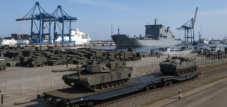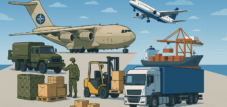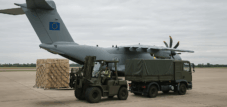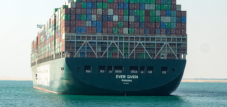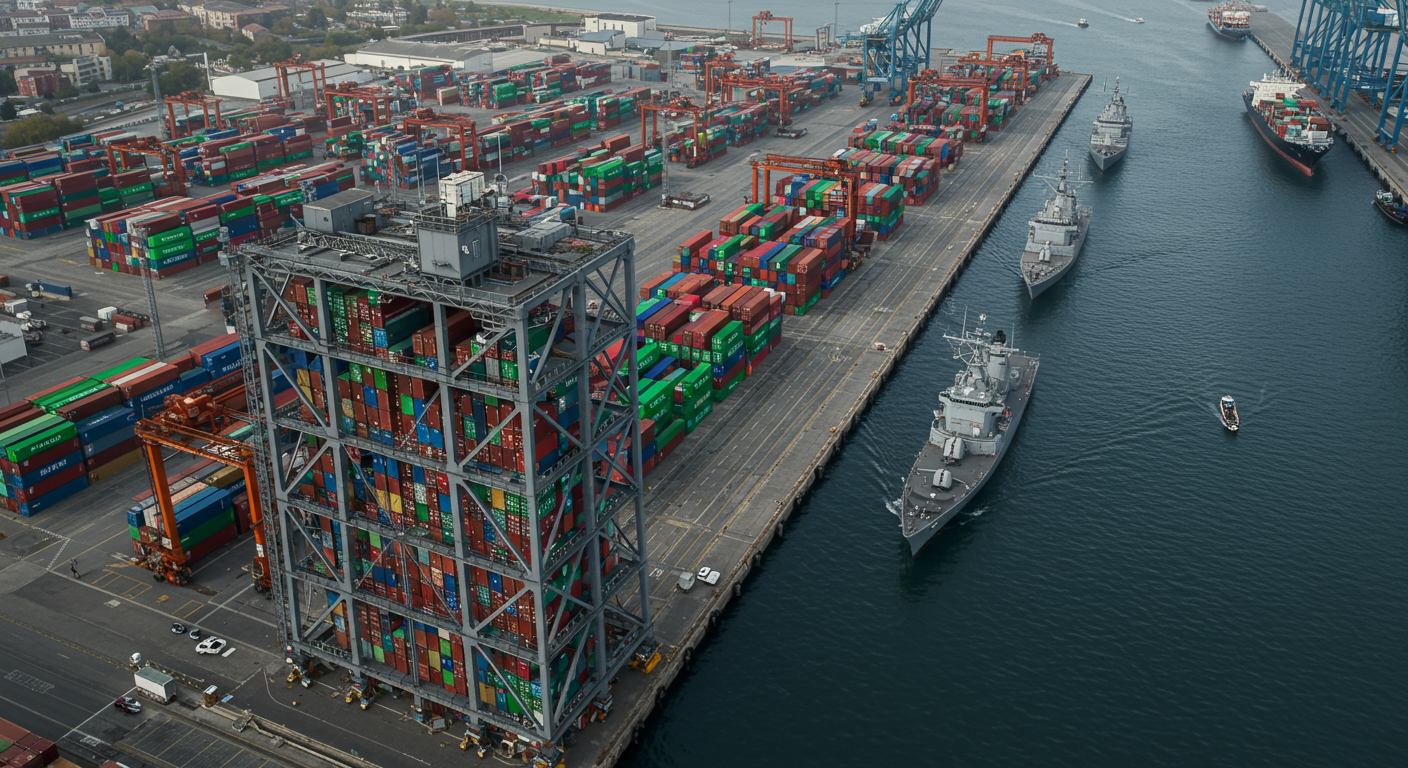
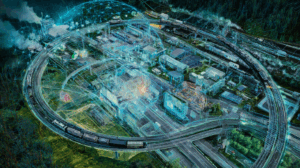
Rotterdam – Europe's largest port in transition: military logistics, NATO, dual-use logistics and high-bay container storage – Creative image: Xpert.Digital
Europe's largest port is becoming a testing ground for future-proof military-civilian logistics solutions
Artificial intelligence and vertical container warehouses are changing Rotterdam's future: Dual-use logistics is making Rotterdam a pioneer of the next generation of ports
The Port of Rotterdam is undergoing its biggest transformation since the construction of the Europoort complex in the 1960s. The current security situation, rising geopolitical tensions, and increasing demands for efficiency and sustainability have triggered a development that goes far beyond mere infrastructure measures. Rotterdam is becoming a testing ground for modern dual-use logistics, artificial intelligence control systems, and vertical container storage facilities capable of simultaneously serving both civilian global trade and military supply chains.
The Port of Rotterdam, Europe's largest cargo hub, is increasingly preparing for a potential military escalation with Russia. In light of growing tensions and warnings from NATO Secretary General Mark Rutte, the port authority is taking concrete precautions: joint planning with the Port of Antwerp, military exercises, and the provision of capacity for NATO ships are now commonplace. Against the backdrop of the Russian invasion of Ukraine and concerns about an attack on NATO territory, Rotterdam is moving into the spotlight of European security strategies.
1. Initial situation: From trade hub to strategic hub
Rotterdam handles more than 435 million tons of cargo annually and serves around 120,000 seagoing vessels and inland waterway vessels. Until now, the main focus has been on its role as the "gateway to Europe," with a virtually uninterrupted flow of goods along the Rhine-Meuse confluence. However, the Russian invasion of Ukraine, warnings of a possible attack on NATO territory by 2030, and demands from Western states for greater European sovereignty in defense have led to a change in thinking.
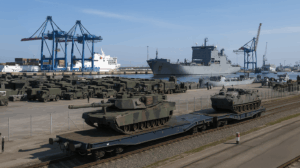
Since May 2024, it has been officially stipulated that Rotterdam must regularly provide berths for several NATO supply ships. These ships are to remain in port for weeks at a time, four to five times a year, while amphibious exercises are to take place throughout the year. Rotterdam has already lost eight percent of its trade volume following the sanctions against Russia, but sees opportunities in the realignment of security policy to establish itself as a logistical hub for European defense.
Related to this:

2. The vision of dual-use logistics
Dual-use logistics describes infrastructure, processes, and information systems that can seamlessly switch between civilian and military use, or enable both in parallel. Specifically, this means:
- Multimodal corridors: Ports, rail, road and air transport are being developed to provide bridge links for heavy equipment, combat vehicles and hazardous goods.
- Unified digital platforms: Customs, border and dangerous goods data are recorded only once and can be used by both civilian shippers and military planners.
- Scalable storage and depot structures: Containers, swap bodies, pallets and special cargo can be buffered in the same high-bay racking systems, regardless of whether a kit for offshore wind turbines or a field howitzer is being loaded.
The EU is supporting this approach with billions of euros through the Connecting Europe Facility program, while projects like NetLogHubs are building a Europe-wide network of logistics hubs. At the Dutch level, three military-certified corridors are being established, leading from the North Sea port to Eastern Europe and providing backup options for civilian transport.
Related to this:
3. Space problem solved: Vertical container high-bay warehouse
The classic container storage system still follows a principle from the 1950s: boxes are stacked six high. To retrieve a lower container, several above it often have to be rearranged – so-called re-stacks, which account for up to 60% of all movements.
With the ever-increasing size of megacarriers, this inefficient use of space is increasing dramatically. Highly automated high-bay storage systems (HBS) like BOXBAY or Konecrane's AHBCS shift the concept vertically:
- Containers are stored in individual compartments on eleven floors and moved simultaneously horizontally and vertically by a driverless stacking crane.
- Direct access eliminates the need for restacking; a target container is reached without intermediate steps.
- The capacity triples on the same footprint, or the same capacity requires only one third of the previous area.
- Roof surfaces can be covered with photovoltaics; regenerative energy feed-in from the crane drives reduces energy consumption.
At DP World in Dubai, the BOXBAY pilot warehouse demonstrated in 2021 that 300 container movements per hour are possible on the land side and 500 on the water side – with significantly reduced light and noise emissions. The Swiss Army uses a similar concept to store sensitive equipment in a protected and maintenance-friendly manner.
Since 2023, Rotterdam has been examining the possibility of converting parts of its existing open space into vertically stacked modules, thus replacing the current "chaotic" block stacking without relocating the quayside facilities. This would not only reduce container congestion but also shorten turnaround times and rail pre-carries.
4. The digital backbone: From IoT sensors to the digital twin
One of the key prerequisites for smooth dual-use operations is real-time transparency. IBM, Cisco, and other technology partners are developing a digital twin for Rotterdam – a digital representation of the 42-kilometer-long port area.
- IoT sensors in quay walls, buoys, locks and roads report weather, water level, salinity, current, traffic flow and load.
- Artificial intelligence predicts arrival and waiting times, optimizes crane deployment, adjusts truck windows, and provides early warnings of traffic jams or hazardous materials conflicts
- Cyber resilience – together with EU authorities, Rotterdam is developing a national cybersecurity framework that meets military security requirements without compromising civilian data sovereignty.
Integrating HBS warehouse management into the port dashboard allows for second-by-second planning of container flows and the generation of heatmaps that predict when military cargo needs to be prioritized without disrupting civilian operations. The system assigns priority markers, automatically assigning dynamic routes through the warehouse and terminal to each container – for example, ammunition, humanitarian aid, or fresh produce.
5. Synergies for civil and military logistics
- Land densification: High-bay warehouses create space for additional waiting or repair quays, rescue stations or energy hub terminals, without the need to dredge new port basins.
- Time savings: Eliminating re-stacks speeds up container handling by up to 20%, freeing up pier time for navy logistics or amphibious exercises.
- Sustainability: Fully electric cranes, photovoltaic roofs and regenerative brakes drastically reduce CO₂ emissions per box – a plus for military green defense programs.
- Resilience: AI-supported warehousing can reroute civilian freight routes and prioritize container blocks for humanitarian or military operations in a crisis, without causing chaotic road transport.
- Cost and revenue models: Terminal operators temporarily lease highly secure, weather-protected slots to defense ministries, while in peacetime traditional shipping companies use the same space.
Related to this:

6. Practical Implementation Scenarios
Terminal segmentation
Rotterdam divides terminal areas into four modular zones: civilian lanes, dual-use lanes with HBS access, a military security zone, and a buffer zone. AI-based traffic management allocates slots based on ship type, cargo profile, and port load.
Vector logistics for NATO corridors
When large equipment needs to be moved quickly to Eastern Europe, predefined enablement and sustainment corridors are activated. Port AI reserves rail lines, unlocks bridge weight limits, and consolidates containers in high-bay racks at the corridor exits.
Decentralized ammunition envelopes
Since only certain terminals are permitted to handle hazardous materials classes 1 and 7 simultaneously, HBS modules are designed as mobile hazardous materials racks. They can be installed in the edge basins of Antwerp or Rotterdam and are connected via underground conveyors – thus ensuring a safe distance from passenger and petrochemical quays.
7. Challenges and solutions
Investment volume
A fully developed high-speed rail system costs hundreds of millions of euros. Joint financing by port operators, EU CEF funds, and military procurement budgets reduces the risk.
Standardization
Military containers often deviate from ISO standards (e.g., "Tricons"). Adaptive gripping frames and variable shelf widths ensure compatibility.
Cybersecurity
Shared data rooms require hybrid encryption, air-gapped bridges, and emergency manual control. Rotterdam is building redundant data centers both domestically and internationally.
acceptance
Residents fear noise and light from high-bay warehouses. Enclosed construction, low-noise electric motors, and photovoltaic facades drastically reduce emissions.
8. Rotterdam as a blueprint for Europe's smart ports
The Port of Rotterdam Authority aims to become the "smartest port in the world" by 2030. High-bay warehouses, digital twin technologies, and dual corridors can be transferred to Antwerp, Hamburg, or Gdańsk and can become part of a seamless network for supplying industry and the armed forces.
For global shipping, this means shorter port times, more predictable routes, and a major step towards climate-neutral supply chains. For Europe, it means greater freedom of action should crises delay transatlantic support.
The close cooperation between business and defense makes Rotterdam a real-world laboratory where the coexistence of container traffic, energy transshipment and modern defense is understood not as a contradiction, but as a mutual accelerator – and therein lies the strength of the dual-use concept.
Rotterdam's change of course demonstrates how closely future viability, resilience, and innovation are linked. By thinking vertically, responding digitally, and creating civil-military synergies, the port is setting standards for ports worldwide. What is being developed today as a response to impending conflicts will make global trade more efficient, secure, and environmentally friendly tomorrow.
Related to this:
Your dual-use logistics experts

Dual-use logistics experts - Image: Xpert.Digital
The global economy is currently undergoing a fundamental transformation, a watershed moment that is shaking the foundations of global logistics. The era of hyper-globalization, characterized by the relentless pursuit of maximum efficiency and the "just-in-time" principle, is giving way to a new reality. This new reality is marked by profound structural breaks, geopolitical power shifts, and increasing fragmentation of economic policy. The once taken-for-granted predictability of international markets and supply chains is dissolving and being replaced by a period of growing uncertainty.
Related to this:
Hub for Security and Defense - Advice and Information

Hub for Security and Defense - Image: Xpert.Digital
The Security and Defence Hub offers expert advice and up-to-date information to effectively support companies and organizations in strengthening their role in European security and defence policy. Working closely with the SME Connect Defence Working Group, it particularly promotes small and medium-sized enterprises (SMEs) that wish to further develop their innovative capacity and competitiveness in the defence sector. As a central point of contact, the Hub thus creates a crucial bridge between SMEs and European defence strategy.
Related to this:
Consulting - Planning - Implementation

Markus Becker
I would be happy to serve as your personal advisor.
Head of Business Development
Chairman SME Connect Defense Working Group
Consulting - Planning - Implementation
Konrad Wolfenstein
I would be happy to serve as your personal advisor.
You can contact me at wolfenstein∂xpert.digital or
Just call me on +49 7348 4088 965 .