“Rollercoaster politics”: Why Germany’s top managers are now rebelling against the government – Image: Xpert.Digital
Scandal at important economic summit: Why politics is becoming the biggest obstacle to the energy transition
Billions in risk for Germany: How the Ministry of Economic Affairs is alienating its own industry
When business leads the way and politics fails – surprising figures: Businesses demand climate protection, but Berlin blocks it
The economy is ready, but politicians are holding back
The 2026 Sustainable Economy Summit in Berlin impressively demonstrated that German industry is significantly further along in terms of sustainability than its public reputation suggests. While hundreds of board members and top decision-makers are prepared to invest billions in the circular economy, green energy, and future-proof business models, the federal government's zigzagging political course is massively hindering the transformation. A new, comprehensive study confirms that the biggest obstacle for Germany as a business location is no longer a lack of corporate will, but rather a lack of political reliability. This is a look back at a summit that ruthlessly exposes the deep gap between entrepreneurial optimism and political inaction.
Tailwinds from below, headwinds from above: Why Germany's sustainability transformation is stuck in political limbo despite broad corporate support
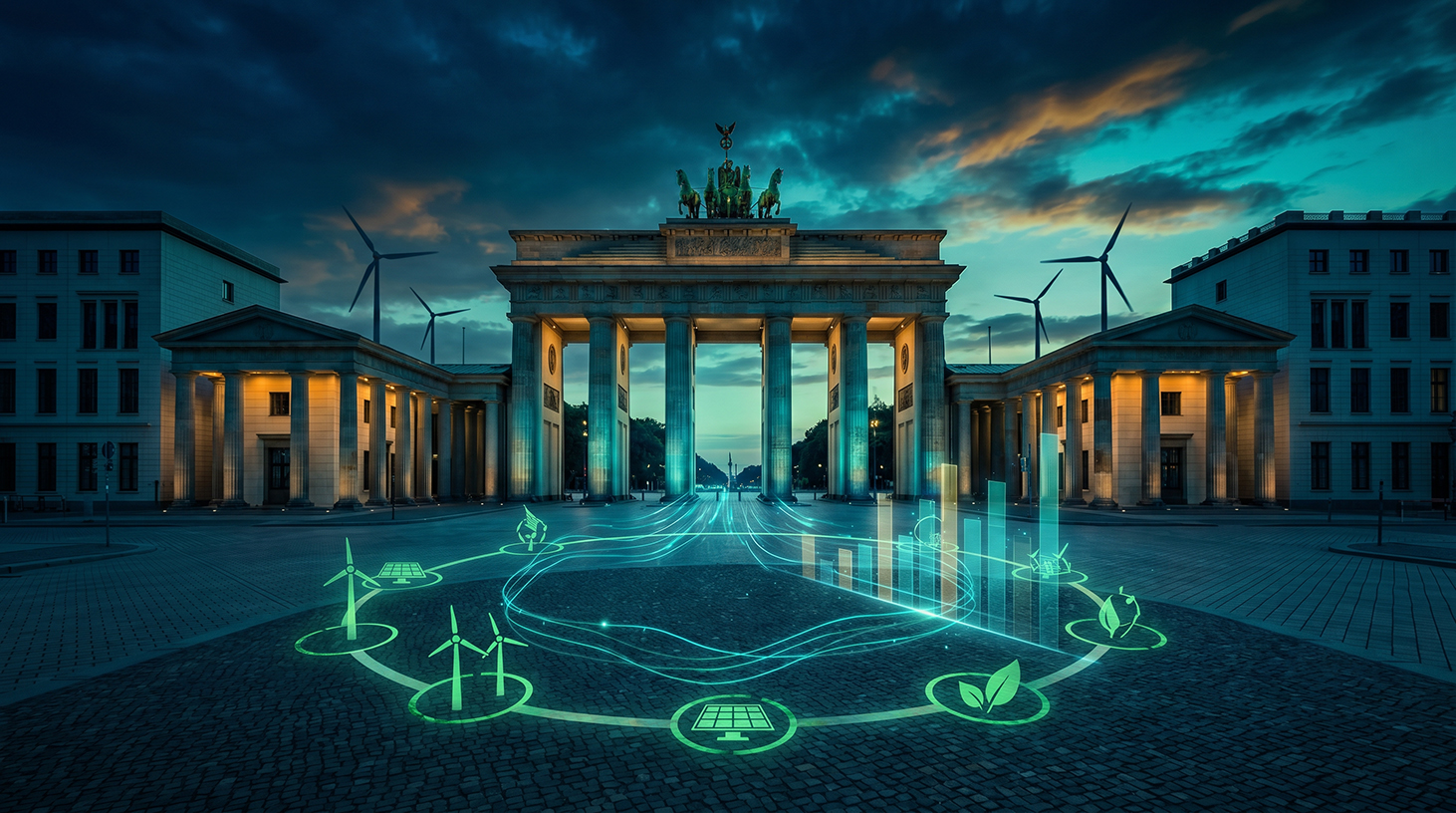
On April 21 and 22, 2026, the AXICA Congress and Conference Center, located directly at the Brandenburg Gate in Berlin, hosted the gathering of leading figures in the German-speaking world of sustainable businesses. Around 450 C-level decision-makers – CEOs, managing directors, investors, and academics – convened for the second Sustainable Economy Summit (SES), organized every two years by the alliance of progressive business associations Bioland, BAUM eV, BNW eV, DGNB eV, and the International Federation for the Economy for the Common Good. The summit was framed by a motto that served as both a program and a call to action: "Tailwind for the Economy of the Future." What was developed over two days in keynote speeches, panel discussions, and workshops is far more than just event documentation – it is a contemporary record of the economic policy dilemmas facing Germany in the spring of 2026.
The Forum of the Future Economy: Who was there and what was it about?
The Sustainable Economy Summit is explicitly not intended as an event for sustainability officers in middle management. It is aimed at those who make investment decisions, define corporate strategies, and fundamentally transform business models. In approximately 35 sessions with over 70 speakers, the key drivers of economic transformation were discussed: circular economy, energy transition, sustainable finance, sustainable mobility, social justice, sustainable agricultural and food systems, green building, and the protection of healthy ecosystems.
Confirmed speakers included transformation researcher Prof. Dr. Maja Göpel, physician and science journalist Dr. Eckart von Hirschhausen, Kerstin Erbe, CEO of dm-drogerie markt, Per Ledermann of the edding Group, and Stefan Müller, co-founder of ENERPARC. Raúl Krauthausen and Sebastian Klein supplemented the program with perspectives on inclusion and the new work culture. Federal Environment Minister Carsten Schneider was the patron of the event. The event was accompanied by a free livestream on YouTube, making the content publicly accessible far beyond the 450 participants in the hall.
Crucial to the content framework was the premiere of the Sustainable Economy Barometer 2026, a representative Civey study, which the Managing Director of Sustainable Economy gGmbH, Prof. Dr. Katharina Reuter, presented directly at the start of the summit. With a sample of 2,500 private sector decision-makers in companies with more than 50 employees, the study provides one of the most sound empirical foundations to have been contributed to the German sustainability debate in recent times.
What the numbers say: Companies want change – and demand reliable policies
The key finding of the Sustainable Economy Barometer 2026 strongly contradicts the public discourse, which in some quarters suggests that German businesses doubt climate targets and the sustainability transformation. Nearly two-thirds of the companies surveyed – precisely 65.1 percent – see sustainable business models as the driving force behind long-term business success. This represents an increase of seven percentage points compared to the initial survey in 2023. The shift is even more pronounced regarding location policy: 56.4 percent of respondents – ten percentage points more than in 2023 – confirm that a climate-neutral and sustainable economy is of paramount importance for securing Germany's economic competitiveness.
At the same time, the majority of companies see policymakers as having a responsibility: 65.8 percent of those surveyed consider the role of politics in achieving a climate-neutral and sustainable economy to be important. What at first glance sounds like an endorsement of government action turns out, upon closer analysis, to be a diagnosis of crisis. Because companies are not demanding more government intervention in the form of regulations and bureaucracy – they are demanding reliability. Professor Katharina Reuter summed it up perfectly: The constant debate about whether more or less climate protection is needed is considered by the majority of respondents to be detrimental to the economy.
This finding is also confirmed by the independent Sustainability Transformation Monitor 2026 (STM26), published shortly before the summit. Around 70 percent of companies surveyed stated that a lack of economic incentives is hindering their sustainability transformation. Only 17 percent currently see a clear and convincing business case for sustainability. The polarization is striking: On the one hand, many companies recognize the financial added value of sustainable business models; on the other hand, the costs often still outweigh these benefits. The Bertelsmann Foundation succinctly summarized the findings: Without clear, reliable signals from policymakers and markets, the transformation risks entering a phase of stagnation.
Particularly revealing is a systemic shift in the perception of politics as a driver of transformation. In previous years, political impulses were considered a key engine of change. In the STM 2026, their importance as a driver has decreased by 31 percentage points. At the same time, uncertain political and regulatory frameworks are perceived more strongly as an obstacle – an increase of 30 percentage points. In the business world's perception, politics has transformed from a pacesetter to a brake.
The empty chair: The Ministry of Economic Affairs refuses to talk
The most symbolically charged event of the Sustainable Economy Summit wasn't a presentation or a panel discussion – it was a cancellation. The Federal Ministry for Economic Affairs and Energy, represented by Minister Katherina Reiche, sent neither the Commissioner for Small and Medium-Sized Enterprises nor the responsible State Secretary. Both had confirmed their participation but canceled – according to Katharina Reuter, Managing Director of the BNW (German Sustainable Economy Association), not promptly and on equal terms, but only after repeated inquiries.
Anyone who considers this a mere protocol oversight is overlooking the political context: In the very week of the summit, reports appeared in manager magazin stating that Reiche's planned grid expansion packages and amendments to the Renewable Energy Sources Act (EEG) are fundamentally unsettling the energy industry. The Lower Saxony/Bremen Renewable Energy Association had already calculated that investments totaling around 32 billion euros were at risk in just one federal state. As early as the beginning of April, 5,300 companies had signed a public business appeal against Reiche's energy policy.
The assessment made by BAUM Chairwoman Yvonne Zwick after the summit directly articulates the imbalance: The business community is proactively paving the way to the future at a speed that politics is struggling to keep pace with. This is not the self-congratulatory rhetoric of an echo chamber – it is a sober diagnosis of the institutional decoupling currently taking place between the economic policy apparatus and transformation-oriented business practice. When board members and CEOs are prepared to invest billions in restructuring production processes, energy supply, and supply chains, but the responsible federal ministry doesn't even bother to engage in dialogue, it's more than a breach of protocol – it's a failure of government.
Habeck, Göpel and the question of the right narrative
Robert Habeck appeared at the Sustainable Economy Summit – no longer as a member of the government, but as a witness to a political logic that is being confirmed in real time by the geopolitical events of 2026. His speech was a historical comparison of the three major energy crises since 1973, and its conclusion was clear: This crisis – triggered by geopolitical instability surrounding Iran and the potential for blockage of international shipping lanes – will not slow down global electrification, but accelerate it.
Habeck presented figures that vividly illustrate the pressure for transformation. Five years ago, the global share of electric cars in new registrations was just under five percent. By 2025, it had already reached around 30 percent. If this trend continues, the figure in five years will not be 60 percent, but in all likelihood just under 100 percent. China is no longer a follower in this race, but the undisputed world market leader – from solar modules and batteries to digital grid control. At the same time, Habeck pointed to the fundamental geopolitical dynamics: Around 100 countries produce fossil fuels, but only 10 to 15 are significant exporters. The remaining approximately 150 importing countries worldwide, including Germany, are currently changing course – because they no longer trust the global fossil fuel market.
Professor Maja Göpel, political economist, transformation researcher, and member of the German Association of the Club of Rome, provided the conceptual complement to Habeck's geopolitical analysis. Growth, according to Göpel, is not an end in itself, but at best a means to achieve other goals. This seemingly abstract statement is a direct rejection of economic policies that link growth stimulation with abandoning climate targets—a pattern evident in the debates surrounding Reich's grid package and the amendment to the Renewable Energy Sources Act (EEG). Growth achieved at the cost of damaging productive natural capital is not a gain in prosperity, but rather an accounting illusion that shifts costs to the future.
The rollercoaster analysis: What Reich's course is really costing the economy
Few publications have highlighted the contradiction between the economic policy of the Federal Ministry for Economic Affairs and Energy and the industrial reality in April 2026 more sharply than the Cleanthinking report on the so-called rollercoaster energy transition. The term originates from Stiebel Eltron CEO Kai Schiefelbein, who described heat pump sales figures: plummeting from 350,000 to 193,000, then rising again to 284,000 – a rollercoaster of political signals on which reliable investment planning is impossible.
Vattenfall Germany CEO Robert Zurawski succinctly summarized the economic core of the problem: Less energy transition would lead to higher costs. Specifically, this concerns Reiche's plans to question the exemption from grid fees for new electricity storage facilities – possibly even retroactively. For Vattenfall's pumped-storage power plant in the Thuringian Slate Mountains, a project in the hundreds of millions of euros, this would render the project economically unviable. Vattenfall completely phased out coal-fired power generation by 2024 and is arguing from a purely business perspective – not from ideological conviction.
Markus Krebber, CEO of RWE, described Reiche's planned grid package to the pressmanager magazinas simply "absurd." The background to this is the elimination of compensation for curtailed wind and solar power plants in capacity-limited grid areas. Anyone wanting to connect there after 2026 will have to forgo legally regulated feed-in tariffs for up to ten years – even though grid expansion, not the plants themselves, is the real bottleneck. Georg Stamatelopoulos, CEO of EnBW, Germany's third-largest energy supplier, described the mood in the industry with a question that bluntly reflects reality: Many companies are wondering whether they even want to decarbonize anymore.
Minister Reiche's grid package also included plans to abolish the decades-old priority grid connection and feed-in for renewable energies. This would eliminate two core elements of the 2000 Renewable Energy Sources Act, which laid the foundation for Germany's rise to become the leading solar industry in the 2010s. Ursula Heinen-Esser, president of the German Renewable Energy Federation (BEE) and a member of the CDU party, commented strongly: If these plans are implemented, the Ministry of Economic Affairs will jeopardize the stability of the German energy system.
Oxford climate policy researcher Jan Rosenow provided the scientific context in the April 2026 issue of Nature Energy. His findings are sobering: 95 percent of the oil and 88 percent of the gas consumed in the EU are imported, while the electricity sector accounts for only 23 percent of European final energy consumption. The answer to geopolitical instability regarding fossil fuel imports, therefore, cannot be to continue searching for new suppliers, but rather to reduce fossil fuel demand itself. Rosenow specifically cited the German Building Modernization Act, with which Reiche intends to reverse Habeck's Building Energy Act, as a negative example of a political step backward.
Our EU and German expertise in business development, sales and marketing

Our EU and German expertise in business development, sales and marketing - Image: Xpert.Digital
Industry focus areas: B2B, digitalization (from AI to XR), mechanical engineering, logistics, renewable energies and industry
More information here:
A thematic hub offering insights and expertise:
- Knowledge platform covering global and regional economies, innovation and industry-specific trends
- A collection of analyses, insights, and background information from our key areas of focus
- A place for expertise and information on current developments in business and technology
- A hub for companies seeking information on markets, digitalization, and industry innovations
The AI paradox: Why computing power is urgently needed for the energy transition
The cost question: The energy transition is cheaper than its reputation suggests
One of the most persistent misconceptions in the current energy policy debate is the claim that the energy transition is simply too expensive for an already strained economy. The available data paints a fundamentally different picture. In 2024, PwC compared two scenarios: a "business as usual" scenario in which Germany fails to achieve climate neutrality by 2045, and an accelerated climate protection scenario in which the targets are met. The result is clear: The aggregated total costs of the accelerated scenario amount to approximately €13.2 trillion by 2050 – the standstill scenario costs €13.3 trillion. The difference lies not in the total costs, but in their composition: In the "business as usual" scenario, up to €1 trillion more must be spent on energy imports from fossil fuels, which leave the domestic value chain and flow abroad.
The German Institute for Economic Research (DIW Berlin) complements this perspective with historical data and modeling. Current studies confirm earlier projections: The economic benefits of climate protection significantly outweigh its costs. Accelerated investments in the energy transition alone will result in annual savings of €18 to €25 billion in energy imports and €8 to €12 billion in healthcare costs due to reduced air pollution. Climate-related damages already incurred in Germany between 2000 and 2021 amount to €145 billion – damages that will increase exponentially in the coming decades without more ambitious climate protection measures. Benefit-cost ratios between 1.8 and 4.8 underscore the economic rationale of consistent climate policy.
Global investments in the energy transition reached a new high of US$2.3 trillion in 2025, driven by increased investment in grids, storage, and electrified transport. China leads the global investment rankings, investing four percent of its gross domestic product annually in the energy transition – almost twice as much as Europe. The global volume of sustainable finance reached a total of US$2.2 trillion in 2025; for Europe, the growth of green bonds is expected to reach US$370 billion in 2026. Over 25 percent of all sustainable bonds now incorporate circular economy aspects, demonstrating the financial sector's growing commitment to circular production processes.
Sustainable Finance: Capital is changing sides
Back in the early 2010s, sustainable finance was considered a niche topic for committed investors and a handful of green fund managers. The figures for 2026 paint a fundamentally different picture. Deutsche Bank has significantly updated its 2026 sustainability strategy and set a target of €900 billion in sustainable and transition-related financing, as well as ESG investments, by the end of 2030 – including €440 billion already mobilized since January 2020. The bank distinguishes between sustainably financed activities such as solar parks and green hydrogen on the one hand, and transition financing for the transition of conventional industries to climate neutrality on the other.
The volume of this capital diversion is no longer a niche phenomenon, but a structural transformation of the financial system. The SEB analysis shows that circularity is increasingly being integrated into sustainable finance: Over a quarter of all sustainable bonds include circular economy components. In a new production model driven by artificial intelligence and robotics, the price of electricity will be more important than labor costs – and circularity will be firmly integrated into the production process. This is a statement with far-reaching consequences for location decisions: Anyone who wants to produce globally competitively in 2030 and beyond needs a reliable supply of affordable, renewable electricity.
From a corporate perspective, the sustainability transformation is no longer seen merely as risk minimization, but increasingly as a value driver. A PwC analysis from March 2026 shows that CFOs are becoming ESG data architects, supply chains are becoming risk management systems, and climate pathways are becoming financial scenarios. Scope 3 emissions are no longer just a reporting field, but an early warning system for material price spikes, supply disruptions, and strategic dependencies. Those who have internalized this logic no longer invest defensively in sustainability – but strategically, because it pays off.
Circular economy and the contribution of industry
A key theme of the summit was the circular economy as an economic model beyond the linear "take-make-discard" principle. The European Union has integrated the circular economy into its long-term industrial, climate, and economic policy strategies – a development that Germany, however, has so far only implemented in a fragmented way, focusing heavily on short-term, individual measures. This results not only in ecological but also economic risks: those who neglect circular business models will become increasingly dependent on volatile raw material imports.
The construction sector is one of the most vivid examples of this dilemma. Germany is facing an acute housing crisis with a shortage of over 800,000 apartments – and the trend is rising. At the same time, the sector is among the most CO₂-intensive and resource-wasteful: roughly half of the nation's raw material extraction comes from building materials, and construction and demolition waste accounted for around 52 percent of Germany's total waste volume in 2023. A sustainable and circular approach to construction, combined with a consistent energy transition, would offer a key solution to both crises simultaneously – but would require reliable political framework conditions, which were lacking in the spring of 2026.
In the chemical and construction industries, 2026 will mark the point where decarbonization is no longer an option, but a prerequisite for long-term competitiveness. The EU's Clean Industrial Deal is evolving into an economic transformation framework. Those who consistently implement efficiency programs, waste reduction, and circular economy approaches will lower energy and material costs and reduce their strategic dependence on raw material prices and CO₂ regulations.
Germany in international competition: Catching up or falling behind
Placing the summit within the global economic context is not an addendum, but rather its central theme. The Institute for Macroeconomics and Business Cycle Research (IMK) of the Hans Böckler Foundation forecasts GDP growth of just 1.2 percent for 2026 – a slight recovery after several years of economic weakness, but not a structural upswing. The IMK's annual report explicitly warns that it would be a mistake to slow the pace of the economic transformation toward climate neutrality – not only in light of global warming, but also with regard to the competitiveness of German companies. Investments in outdated technologies would not move the country forward. Furthermore, Europe risks being left behind by China, which is also becoming a market leader in the field of climate-friendly technologies.
This diagnosis is reflected in the figures for global capital flows. While China invests four percent of its gross domestic product annually in the energy transition, Europe – and Germany in particular – lags significantly behind. Agora Energiewende has calculated that Germany will need to invest approximately €147 billion, or three percent of its GDP, annually in climate protection measures between 2025 and 2045 to achieve climate neutrality – an economically feasible undertaking, as the study concludes. The majority of this investment will be required within the next ten to fifteen years; by 2030, the share of total investments could temporarily rise to around 13 percent of GDP.
The 2026 federal budget points in the right direction: Federal investments of around €118 billion are planned, of which €34.8 billion will come from the Climate and Transformation Fund alone. The Special Fund for Infrastructure and Climate Neutrality (SVIK) is intended to provide loans totaling €500 billion over twelve years. The foundation has therefore been laid – the problem lies in the political consistency of its use. A ministry that opens up funding opportunities while simultaneously dismantling the regulatory framework on which investors base their decisions creates uncertainty, not transformation.
The societal dimension: Sustainability as a question of justice
The Sustainable Economy Summit is not a forum for a technocratic climate elite. It is a platform where the social justice of the transformation is explicitly negotiated. The energy transition is not free, and its burden will be distributed unequally across society unless policymakers implement compensatory measures. For low-income households that have neither solar panels on their roofs nor electric cars in their garages, rising energy prices represent a direct burden – while wealthier households benefit from subsidies.
At the same time, the transformation offers significant social opportunities. The energy transition, which is fundamentally restructuring the heating market, is creating skilled trades jobs across the country that are neither globalizable nor automatable. The installation of heat pumps, building insulation, and the expansion of charging infrastructure – these are skilled trades jobs that are regionally rooted and cannot migrate to other countries. For an economic hub like Germany, which wants to retain industrial value creation, this is one of the few growth prospects that will endure even in a deglobalized global economy.
Inclusion activist Raúl Krauthausen brought the perspective of those often forgotten in the transformation process to the summit: people with disabilities, the socially marginalized, and population groups in structurally weak regions. An economy that sees itself as sustainable must integrate this demand for inclusion into its business models – not as an add-on, but as a constitutive element.
The AI Paradox: Digitization and Energy Consumption
A key technological theme at the summit was the paradoxical nature of AI-driven transformation. Artificial intelligence and automation help companies reliably collect ESG data, track Scope 3 emissions in their supply chains, and optimize energy flows. At the same time, emissions from data centers and algorithmic infrastructures are growing at a rate that partially offsets the savings elsewhere. Electricity is becoming the new currency of the AI economy – and thus a strategic resource.
At the summit, the Green AI Hub for SMEs presented concrete guidelines for the sustainable and responsible use of AI. The Guidelines for Green AI are designed to help medium-sized businesses shape their digital transformation path so that efficiency gains from AI outweigh the associated energy costs. This is no trivial task: The sheer computing power required by modern large language models and generative AI systems can only be operated in a climate-friendly manner if the underlying electricity generation is consistently decarbonized. This brings us full circle: Anyone who wants to use AI as a tool for sustainability transformation depends on a high-performance, renewable energy infrastructure – precisely the one that has come under attack in the Reiche grid package.
The constitutional dimension: climate protection and legal certainty
The Sustainable Economy Summit 2026 took place in a legal environment that is increasingly under pressure. Wolfram Cremer, a legal scholar at Ruhr University Bochum, believes that lawsuits against the German government are possible based on the prohibition of deterioration derived from the Basic Law (Germany's constitution). This means that the German government cannot arbitrarily lower the level of protection in climate protection. If the legislature does not do enough to achieve the 1.5-degree target, Cremer argues, it should be subject to constitutional review. This is a legal threshold that may be crossed during the current legislative period – and one that introduces a new dimension to the political debate.
In its 2021 climate ruling, the Federal Constitutional Court determined that insufficient climate protection violates the fundamental rights of future generations. Since then, the constitutional limits for climate policy setbacks have been more clearly defined than ever before. Combined with the growing economic evidence that transformation is more economically advantageous than inaction, this creates two fundamental sources of pressure on current energy policy: one market-based and one constitutional.
What the Summit reveals and what it cannot solve
Two days of intensive debate at AXICA did not result in any new government decision or force a change of course at the Federal Ministry for Economic Affairs and Energy. This is not a weakness of the format – it is a realistic expectation for a conference event. What the summit accomplished is a different, and perhaps more important, function: it made the critical mass visible. The 5,300 signatories of the business appeal, the 450 female decision-makers in the room, the CEOs of Vattenfall, RWE, and EnBW, the female academics, and the activists – together they calibrated what the politically proclaimed narrative of the "business-unfriendly energy transition" actually means: a minority position within the German business world.
Yvonne Zwick of BAUM eV succinctly captured the energy of the summit: Seven sustainable business initiatives demonstrated the wealth of knowledge, experience, concrete solutions, and willingness to change that already exists. The business community is proactively paving the way to the future. The real question raised by the summit, which it cannot answer, is: How long can a democratic industrial society afford to ignore the majority opinion of its business leaders in political practice?
The answer to this question is open. But it has a deadline: The markets, the geopolitical dynamics of global electrification, and possibly the Federal Constitutional Court will force a decision sooner or later. The Sustainable Economy Summit 2026 demonstrated that Germany's economy is ready. What's missing is the response from political circles in Berlin.