
Robotics companies: Germany Robotics Top 3 – Leading countries in robotics 2025 – Top 10 Industrial robotics and service robotics

Language selection 📢
Published on: October 2, 2024 / Update from: October 2, 2024 - Author: Konrad Wolfenstein

Leading countries in robotics 2025 – Top 10 industrial robotics and service robotics – Image: Xpert.Digital
✨🦾 Leading Countries in Robotics 2025 - Top 5 Industrial and Service Robotics
🤖✨ The leading nations in the field of robotics have made significant progress in recent years and will continue to play a significant role in the development and application of both industrial robots and service robots through 2025. These countries are characterized by high investments in research and development and the integration of robotics into various industries. In addition to the implementation of industrial robots, used primarily in the automotive and electronics industries, there are also growing advances in service robotics, which are increasingly gaining a foothold in areas such as healthcare, logistics and even the household sector. Below we will introduce the countries that have established themselves as leaders in robotics and highlight their key developments and strategies.
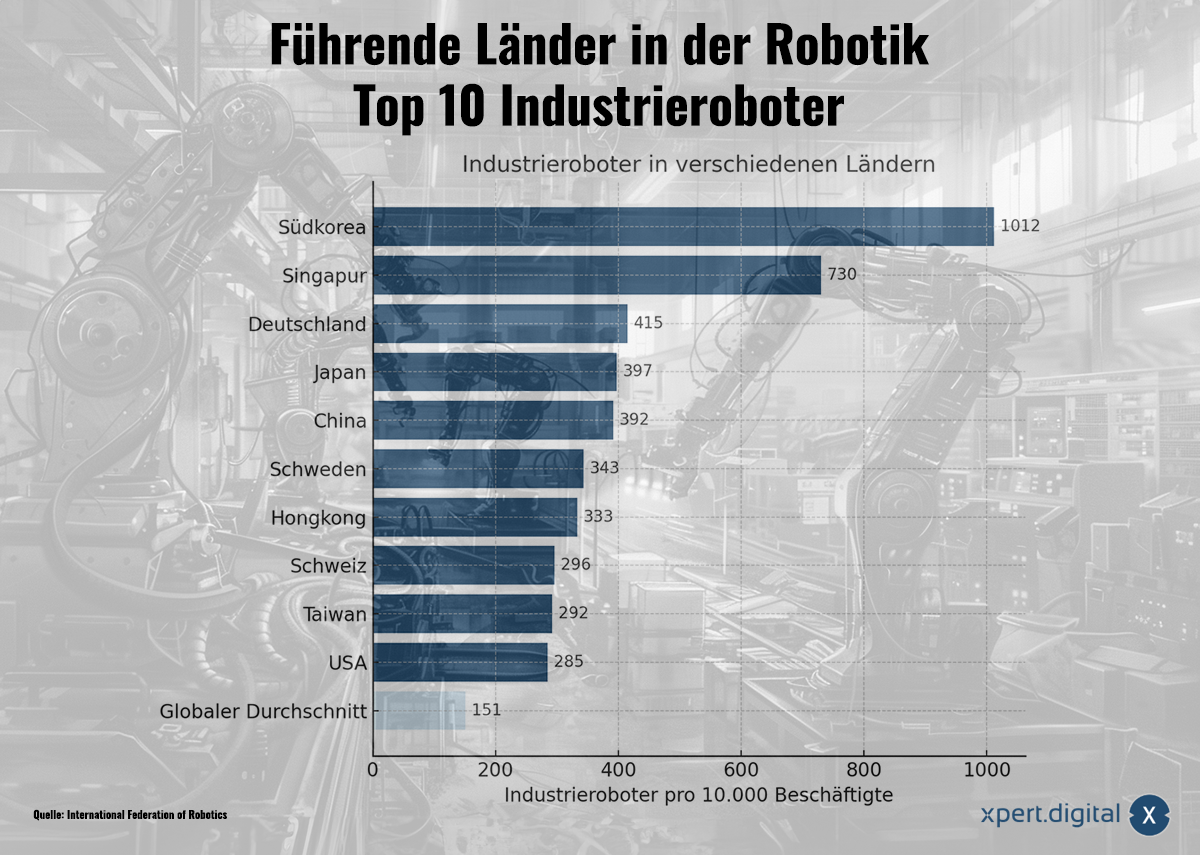
Top 10 industrial robots in different countries per 10,000 employees – Image: Xpert.Digital
🦿 1. South Korea: World champion in robot density
South Korea is the undisputed leader in global robotics, especially in the area of robot density. With more than 1,000 robots per 10,000 employees, the country far exceeds the global average. These impressive figures can be attributed to the dominant position of South Korea's electronics and automotive industries. Large corporations such as Samsung and Hyundai are driving demand for highly specialized robots that are becoming increasingly indispensable in production lines.
South Korea has also realized that the future of robotics lies not only in industry but also in the service sector. Robots are already being used in South Korean hospitals to support patients or take on administrative tasks. This fusion of technology and services will continue to make the country a pioneer in service robotics in the coming years. The government is investing heavily in supporting start-ups and universities working on developing new robotic technologies. With the goal of becoming a leading nation in artificial intelligence (AI) by 2030, the country's technological lead in robotics will be expanded even further.
🚀 2. Singapore: A leading hub for automation
Singapore, known as a global innovation hub, impresses with its high robot density of 730 robots per 10,000 employees. The government of Singapore recognized early on that automation was a key driver of economic growth. With extensive government funding programs, such as the “Smart Nation” initiative, Singapore is promoting the use of robotics in almost all sectors of the economy.
Of particular note is the role of robotics in Singapore's manufacturing and logistics industries. Automated warehouses and intelligent transportation solutions are already a reality, and the country is a leading location for experimentation with autonomous vehicles and drones. But Singapore doesn't just rely on robots in industry. In the public sector, robots are increasingly being used to support administrative processes and in educational institutions. This widespread use shows how strongly Singapore sees robotics as a key technology for its future development.
Another goal of Singapore is to integrate robots into the everyday lives of its citizens. We are working on technologies that enable older people to live independently for longer by having robots take on supporting tasks in the household. This strategy shows that Singapore is not only interested in industrial applications, but also has an eye on the social benefits of robotics.
⚙️ 3. Germany: Europe's pioneer in industrial robotics
Germany occupies a leading position in robotics in Europe and is known worldwide for its innovative strength, especially in the area of industrial robotics. With a density of 415 robots per 10,000 employees, Germany ranks third in the world. The widespread use of industrial robots is primarily due to the automotive industry, which is responsible for around 38% of robot installations in Germany. Companies like Volkswagen, BMW and Mercedes-Benz have been relying on automation for years to make production processes more efficient and precise.
However, what sets Germany apart from other countries is its expertise in collaborative robotics. Collaborative robots, or “cobots,” that can work directly with human employees are widespread in German factories. This technology opens up new possibilities for flexible and adaptive production processes, which are particularly important in high-tech industry and mechanical engineering.
In addition to industry, Germany has also made great progress in research into service robotics. Universities and research institutes such as the Fraunhofer Institute are working intensively on projects to develop robots for care facilities, agriculture and households. These developments are part of the German strategy to not only limit automation to industrial applications, but also to use it usefully in society.
🤖 4. Japan: Pioneer of robot technology
Japan, one of the first countries to adopt robots on a large scale in industry, remains a leading nation in robotics. With 397 robots per 10,000 employees, Japan is one of the global pioneers. The use of robots is deeply rooted, particularly in the electronics and automotive industries. Toyota and Honda, two of the world's leading automobile manufacturers, have been relying on automation to optimize their production lines for decades.
Japan also has the advantage of having an aging population, which has greatly boosted the development of service robots. In the healthcare sector, robots are used to support older people, whether by monitoring their health or performing simple care tasks. These developments show that Japan is capable of using robotic technology not only in industry but also in society.
Another exciting field is entertainment and household robotics. Companies like Sony and SoftBank have released robots that enable social interactions in recent years. These robots, called “social robots,” are capable of communicating and forming emotional bonds with people, which is of great interest in Japanese culture.
🔧 5. China: The largest market for industrial robots
In recent years, China has become the world's leading nation in terms of sales of industrial robots. In 2023 alone, over 276,000 robots were installed in China, accounting for more than half of global installations. China's rapid industrial rise has created enormous demand for automation, particularly in industries such as electronics, automobiles and consumer goods.
China's government is pursuing ambitious plans to further automate the economy. With the “Made in China 2025” strategy, the country aims to become more technologically independent and develop leading robot technologies itself. Particularly notable is the focus on artificial intelligence and machine learning, which are increasingly being integrated into Chinese robotics solutions. This technological advancement will allow China to gain prominence not only as a manufacturing base but also as a global exporter of robotics technology.
Furthermore, China has recognized that the future of robotics does not lie in industry alone. More and more start-ups are devoting themselves to developing robots for use in households and service sectors. Demand for intelligent household robots that perform tasks such as cleaning and care is growing rapidly, making the Chinese market a key innovation hub.
🔮 The future of global robotics
Developments in robotics will be significantly influenced by the countries mentioned above in the coming years. South Korea, Singapore, Germany, Japan and China have all taken a pioneering role in industrial and service robotics and continue to invest heavily in these technologies. Technological advances in robotics will not only increase efficiency in production, but also address societal challenges such as the aging population and increasing demand for services.
While these countries remain leaders, it is likely that more nations will catch up in the coming years. Robotics and automation will play a central role in how economies around the world develop, and new technological breakthroughs are expected to continue to transform the way robots are used.
📣 Similar topics
- 🤖 Future of Robotics 2025
- 🚀 Innovations in robotics
- 🏆 Discover leading technologies
- 🌐 Global Robotics Key Players
- 🔧 Mechanics meets AI
- 🔍 Insights into emerging markets
- 🎓 Research and development in robotics
- 🤝 Human-robot interaction
- 📊 Investment strategies for 2025
- 💡 Social changes through robotics
#️⃣ Hashtags: #Robotics #Technology #Future #Industry40 #AI
📌 Other suitable topics


✨🦾 Top 10 Industrial Robotics and Top 7 Service Robotics
These companies have a significant impact on the development of the robotics industry, both in the industrial sector and in the area of service robotics. They drive innovation and develop technologies that permanently change our daily lives and the way we work.
🤖✨ Industrial robotics
1. FIG
ABB is one of the leading companies in the field of automation technologies and is best known for its industrial robots. ABB's robotic solutions are used worldwide in various industries, including automotive, electronics and logistics. The company offers a wide range of robots that are used for both simple tasks such as welding and complex applications such as assembling precise electronic products. ABB relies on advanced technologies such as artificial intelligence (AI) and the Internet of Things (IoT) to increase efficiency and flexibility in manufacturing.
2. Epson Robots
Epson Robots is a leading global manufacturer of industrial robots with a focus on precision automation. The company offers a range of Selective Compliance Articulated Robot Arm (SCARA) robots that are particularly popular in electronics manufacturing and the pharmaceutical industry. Epson robots are known for their high speed and accuracy and are often used for applications such as pick and place and assembly. Their technology has proven particularly useful in smaller production processes where precision is crucial.
3.Mitsubishi Electric
Mitsubishi Electric is a Japanese technology group that offers a wide range of automation and robotics solutions. Their industrial robots are used in the automotive industry, electronics production and food processing. Of particular note is Mitsubishi Electric's commitment to integrating AI and machine learning into their robotics solutions to enable greater flexibility and efficiency. They also specialize in robots that can work in collaborative environments with humans.
4. Midea
Midea, a Chinese company, is primarily known for its household appliances, but has also made a name for itself in the field of industrial robotics in recent years through the acquisition of KUKA. Midea leverages its strong market position to develop innovative solutions in the field of factory automation, particularly in electronics and household appliance production. By acquiring KUKA, Midea gained access to world-class robot technology and established itself in industrial automation.
5. KUKA
KUKA is a German company and a global leader in industrial robotics. KUKA robots are used in a variety of industries, from automotive production to medical technology. Known for their reliability and flexibility, KUKA offers solutions that integrate robots, software and control technologies. They develop collaborative robots (“cobots”) that can work in close collaboration with humans and are known for their safe and easy operation. The company has also invested heavily in the research and development of AI-powered robotic systems.
6. Universal Robots
Universal Robots, a Danish company, is a pioneer in the field of collaborative robots (“cobots”). These robots are designed to operate directly with humans in a shared work environment without the need for safety barriers. Their robots are modular and can be used flexibly, which is particularly attractive for small and medium-sized companies. Universal Robots has revolutionized the collaborative robotics market and is known for its user-friendly and easily programmable robotics platform.
7. Fanuc
Fanuc is a Japanese company and one of the largest manufacturers of industrial robots in the world. Fanuc robots are used in the automotive industry, electronics manufacturing and metalworking. They are known for their reliability and durability. Fanuc has invested heavily in integrating AI into their robot control systems in recent years to take automation to the next level. Their “Field System” platform uses machine learning to optimize the performance of production systems.
8. Stäubli
Stäubli is a Swiss company that offers a wide range of industrial robots used in the automotive, electrical and food industries. Their robots are characterized by a particularly high level of precision, which makes them ideal for applications such as the production of semiconductors or medical technology. Stäubli is also a leader in the development of robotic solutions for cleanrooms, which is crucial in the pharmaceutical and biotechnology industries.
9. Adept
Adept is an American company specializing in industrial robots and automation solutions. They primarily offer mobile robots and vision-based systems that are used in the logistics and manufacturing industries. Adept robots are particularly in demand in areas where flexibility and mobility play a role, such as warehouse management or product picking.
10. Dematic
Dematic is a global leader in automated intralogistics solutions, including mobile robotics solutions. They develop advanced systems for warehousing and material handling systems that are commonly used in the e-commerce and logistics industries. Their robotic solutions help automate the movement of materials within warehouses, thereby increasing efficiency and accuracy.
🏥🚀 Service robotics
1. Intuitive Surgical
Intuitive Surgical is a global leader in surgical robotics. Their “da Vinci” surgical system has revolutionized minimally invasive surgery by allowing surgeons to perform complex operations with greater precision and control. Technology has fundamentally changed surgical methods in many areas of medicine, such as urology, cardiology and gynecology. Intuitive Surgical remains a pioneer in the field of medical robotics, continually developing new technologies to improve the precision and safety of surgeries.
2. Ecovacs
Ecovacs is a Chinese company specializing in household robots. Their best-known products are vacuum and mopping robots, which are used in millions of households worldwide. Ecovacs has revolutionized the household robotics market by developing easy-to-use and powerful cleaning robots that work autonomously. Their robots are particularly popular in regions with a high standard of living where time savings and convenience play a major role.
3.DJI
DJI is a world-leading manufacturer of drones and flying robots. The company has made a significant impact on the commercial and personal drone market, offering advanced technology for a variety of applications including aerial photography, surveillance, mapping and even agricultural inspections. DJI relies heavily on innovation and develops new technologies that make drones smarter and more autonomous.
4. iRobot:
iRobot is an American company and a pioneer in the household robot market. Their most famous products are the “Roomba” vacuum cleaner robots, which are used in millions of homes worldwide. iRobot has fundamentally changed the way people clean their homes. Their products are known for their reliability and ease of use. In recent years, iRobot has also invested in advanced AI and sensing to further improve the efficiency and autonomy of their robots.
5.Kawasaki
Kawasaki is a Japanese company that is active not only in industrial robotics, but also in service robotics. They have developed robots that are used in areas such as healthcare, transportation and logistics. Kawasaki is known for its robots that handle heavy-duty manufacturing tasks, and they have also made a name for themselves in the research and development of healthcare robots.
6.Sony
Sony is best known as an electronics company, but has also pioneered service robotics. Sony is particularly known for its Aibo robot dogs, which came onto the market in the 2000s. These robots were early symbols of the emotional and social potential of service robots. Although Sony does not currently have a strong presence in the household robotics market, they remain interested in developing robots that can assist people in everyday life.
7. Agrobot
Agrobot is a company that specializes in the development of autonomous harvesters. Their robots are primarily used in agriculture and help harvest fruit and vegetables precisely and efficiently. These robots are a promising solution for increasing agricultural productivity, especially in regions with a labor shortage. Agrobot is an example of how robotic technology can have a transformative impact even in traditional industries such as agriculture.
📣 Similar topics
- 🤖 Advances in robotics
- 💼 Industrial sector meets robots
- 🛠️ Revolutionizing the manufacturing industry through robots
- 🏭 Robotics in production
- 🔬 Precision and technology in robotics
- 👨🔧 Collaborative robots in industry
- 🚑 Medical technology and service robotics
- 🏡 Household robots and their benefits
- 🌾 Autonomous solutions in agriculture
- 📦 Automation and logistics with robots
#️⃣ Hashtags: #Industrial Robotics #Service Robotics #Automation #Innovation #Precision
We are there for you - advice - planning - implementation - project management
☑️ Industry expert, here with his own Xpert.Digital industry hub with over 2,500 specialist articles

Konrad Wolfenstein
I would be happy to serve as your personal advisor.
You can contact me by filling out the contact form below or simply call me on +49 7348 4088 965 (Munich) .
I'm looking forward to our joint project.
Write to me

Xpert.Digital - Konrad Wolfenstein
Xpert.Digital is a hub for industry with a focus on digitalization, mechanical engineering, logistics/intralogistics and photovoltaics.
With our 360° business development solution, we support well-known companies from new business to after sales.
Market intelligence, smarketing, marketing automation, content development, PR, mail campaigns, personalized social media and lead nurturing are part of our digital tools.
You can find out more at: www.xpert.digital - www.xpert.solar - www.xpert.plus
Keep in touch










