
Understanding the background, understanding the situations | Rail chaos and security of supply: Why the mixed traffic network is reaching its limits
Xpert Pre-Release

Available in 27 languages 📢
Prefer Xpert.Digital on GoogleⓘPublished on: February 6, 2026 / Updated on: February 6, 2026 – Author: Konrad Wolfenstein
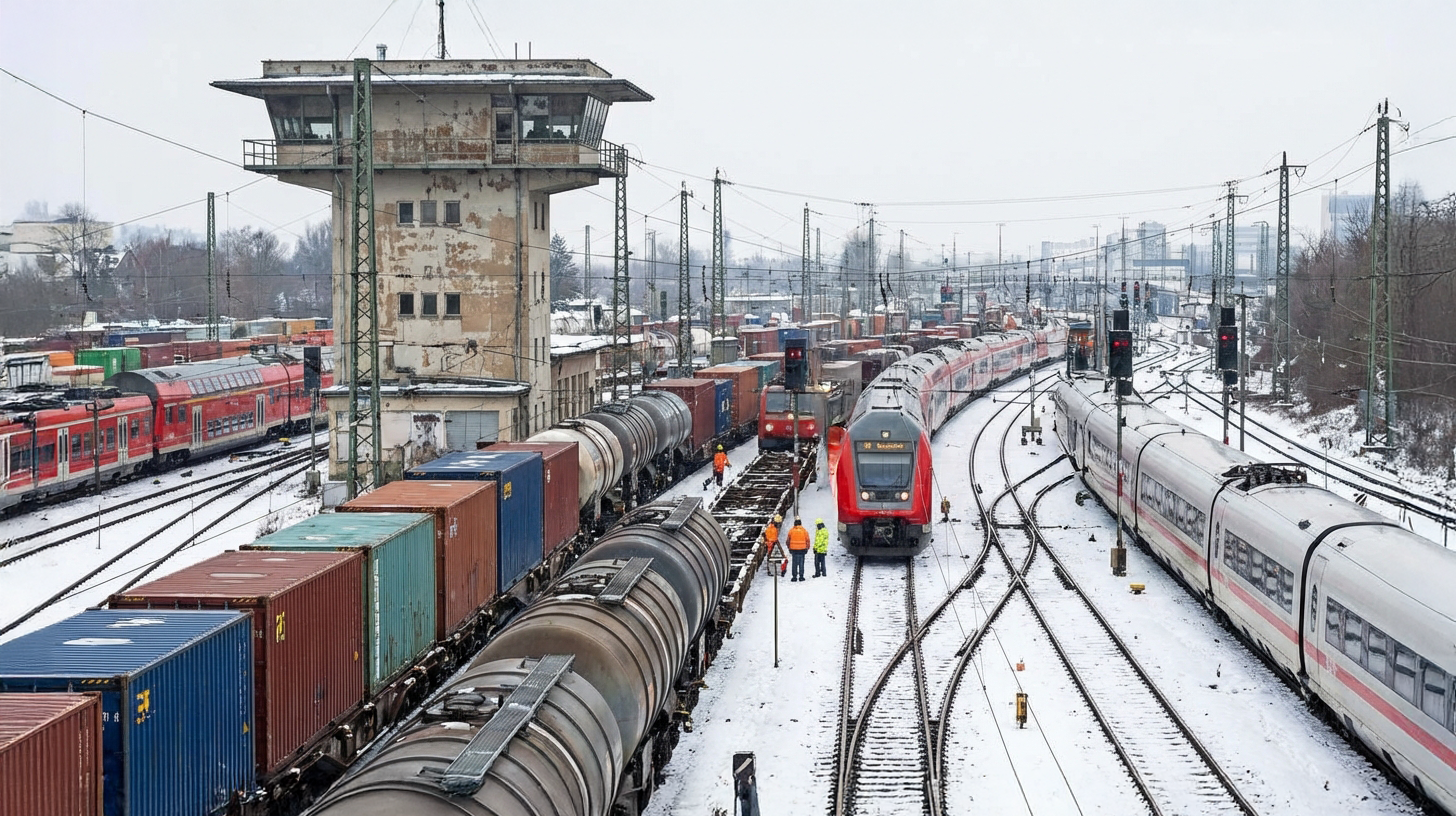
Understanding the background, understanding the situations | Rail chaos and security of supply: Why the mixed traffic network is reaching its limits – Creative image: Xpert.Digital
The 70 percent trap: From this point on, train delays are unavoidable
It is a systemic problem that has resulted from the combination of increased traffic, reduced rail service, and a mixed traffic network
The announcement "Service Delays" has long since become a frustrating daily occurrence for millions of commuters and travelers in Germany. But behind these daily minutes of delay lies far more than just bad weather or a single technical defect. Germany is heading towards a structural dead end: While rail traffic has increased massively since the turn of the millennium, the network has simultaneously been downsized. The result is a heavily burdened "mixed traffic system" in which ICE trains, regional trains, and heavy freight trains have to share the same tracks – a physical and logistical marriage of convenience that has now reached its tipping point.
The consequences of this overload extend far beyond the frustrated train passenger. They threaten the stability of our supply chains, jeopardize economic security, and even raise security policy concerns. When a single bottleneck triggers chain reactions across the entire country, punctuality becomes impossible and planning an illusion.
This article analyzes the root causes of the German rail crisis. It examines why the dogma of mixed traffic is no longer economically viable and why countries like Japan and France are more successful with strictly separated networks. From the necessity of dedicated high-speed and freight corridors to surprising solutions from military dual-use logistics: Learn why we need a completely new infrastructure logic to make mobility and supply reliable again in the 21st century.
Related to this:

Punctuality crisis, growth and network dismantling – an unsolvable vicious cycle?
Since the turn of the millennium, rail transport in Germany has grown significantly, both in passenger and freight traffic. The number of long-distance passengers has more than doubled compared to 2000, while freight traffic in ton-kilometers has increased by about a third. At the same time, the rail network has been continuously reduced. In the last 25 years, around ten to twelve percent of the track kilometers have been closed, primarily branch lines and less profitable connections.
The result is a rail network that now has to handle significantly more traffic per remaining kilometer of track. At the same time, the infrastructure capacity – tracks, hub stations, signaling equipment – remains largely unchanged. The mixed-traffic network, where ICE trains, regional trains, and freight trains share the same tracks, is therefore becoming increasingly strained. Minor disruptions, such as a delay to a local train or a technical breakdown of a freight train, can destabilize the entire system.
The result is escalating delays that spread from a single section through entire corridors and eventually across the whole network. Punctuality is no longer determined by the misconduct of individual actors, but by structural overload. While driver changes at terminal stations may be a symptom in isolated cases, the core problem is a network design that is no longer capable of handling today's traffic density and the demands of reliable service.
Related to this:

The mixed traffic network: strengths, weaknesses and the tipping point of overload
Why mixed traffic is efficient – and vulnerable
The mixed-traffic network is based on a simple logic: maximum utilization of expensive infrastructure. Tracks are expensive, both to build and to maintain. If these tracks simultaneously serve long-distance, regional, and freight traffic, the cost per transport service can be significantly reduced. This approach has worked well for decades.
However, with increasing traffic volume, the system is reaching its limits. ICE trains regularly operate at capacity, while freight trains use the same sections of track as commuter trains during nighttime and peak hours. The different speed profiles – fast ICE trains, slower regional express trains, heavy freight trains – result in constant braking and acceleration, which not only wastes time but also increases the risk of delays.
The tipping point is not determined by a specific percentage of utilized tracks, but rather by the combination of utilization, network structure, and responsiveness. Once the capacity utilization of a section exceeds approximately 70 to 75 percent, punctuality decreases not linearly, but exponentially. In many German corridors, capacity utilization is already at 80 to 90 percent.
Under these conditions, the mixed traffic network loses its stability. Disruptions that could be quickly absorbed in an underutilized network lead to chain reactions in an overloaded one. A slow freight train that only briefly slows down an ICE train propagates over several hours and hundreds of kilometers. The passenger on the ICE sees only the consequence, not the cause.
Overload and security of supply: Where logistics reaches its limits
Freight transport, logistics chains and the risk of bottlenecks
The consequences of this system overload are visible not only to travelers but also to the entire economy. Rail freight is a crucial component of supply security. In Germany, over 400 million tons of goods are transported by rail each year, around a quarter of which travels via international corridors.
When freight traffic is disrupted by delays, congestion, and conflicts with passenger traffic, entire logistics chains are thrown into disarray. Carriers must meet deadlines, and supply chains only function if trains arrive reliably. In times of just-in-time production and global supply chains, a disruption in the rail network can affect production across Europe.
Security of supply here is determined not only by the availability of freight trains, but also by the reliability of the infrastructure. If planning and punctuality are severely impaired, the proportion of truck traffic increases, further burdening the roads and jeopardizing environmental goals.
In extreme cases, structural overload of the mixed traffic network can mean that increased investments in the rail network have less of an impact than hoped. Every additional hour that an ICE or regional train loses on the route must be compensated for in the form of longer headways, extended buffer times, and higher freight transport costs.
Without a clear concept for how passenger and freight trains can be separated more efficiently, the mixed traffic network risks slipping from a profit trap into a system that is becoming increasingly expensive economically and logistically.
Alternatives to mixed traffic networks: The path to efficient, specialized systems
Pure high-speed networks: Speed without conflicts
One of the most important alternatives to traditional mixed traffic are dedicated high-speed networks. These lines are designed exclusively for fast long-distance passenger traffic and are therefore kept clear of slower trains, freight trains, or branch lines.
The purpose of these networks is to achieve maximum travel speed and high punctuality. The track layout features wide curve radii, gentle gradients, and no level crossings. On a technical level, special train control systems such as ETCS Level 2 are used, enabling high-frequency train operation at high speeds. Furthermore, special overhead line designs are often employed to ensure long-term operational stability.
The decisive advantage of these networks is that ICE-like trains no longer have to slow down to avoid slower trains. No regional trains, no shunting operations, no unpredictable freight trains – the result is a system that can operate at significantly higher speeds and with much more stable travel times.
In Germany, such approaches have already been implemented. The new Cologne–Rhine/Main line and the Wendlingen–Ulm high-speed line are examples of dedicated high-speed corridors that are largely free of mixed traffic. International models such as the Shinkansen network in Japan or the LGV lines for the TGV in France demonstrate that these systems can achieve very high performance levels with careful planning and financial support.
However, building such networks is very expensive. Furthermore, they must be integrated into the existing rail system, which presents new challenges at junctions and transfer points. Nevertheless, the idea of a shortened, dedicated high-speed network for the core long-distance network is a viable option for improving the punctuality and attractiveness of long-distance rail travel.
Pure freight networks: heavy-duty, robust, predictable
Alongside high-speed rail networks, dedicated freight networks can be developed as a complement. These routes are specifically designed to meet the requirements of rail freight transport and thus relieve the existing passenger rail network.
Key features of these systems include high axle loads, more favorable profile dimensions for tall containers and longer freight trains, and 24/7 operation. Since they generally do not need to consider noise pollution for nearby residents, they can usually operate without nighttime rest periods.
The advantage is that freight trains do not conflict with fast passenger trains. They can be operated within specific time slots with high frequency and predictability. This reduces delays on the existing network and increases the attractiveness of rail for logistics.
Early examples already exist in Europe. The Betuweroute connects the Netherlands with the German border and is designed as a purely freight route. Similarly, the planned Brenner Base Tunnel is essentially conceived as a corridor through which both passenger and freight traffic can travel, but with clearly defined capacity zones.
In the USA, this model is particularly pronounced: The majority of the rail networks of major freight railways such as BNSF or Union Pacific are primarily freight networks. Here, trains travel long distances without mixed traffic, resulting in high predictability and efficient transport.
Such a separation is particularly important for security of supply. If freight trains can be reliably scheduled within a dedicated corridor, logistics chains can be designed with greater reliability. This relieves the burden on road infrastructure and also supports climate protection goals, as more freight traffic can at least potentially be shifted to rail.
Hub for Security and Defense - Advice and Information

Hub for Security and Defense - Image: Xpert.Digital
The Security and Defence Hub offers expert advice and up-to-date information to effectively support companies and organizations in strengthening their role in European security and defence policy. Working closely with the SME Connect Defence Working Group, it particularly promotes small and medium-sized enterprises (SMEs) that wish to further develop their innovative capacity and competitiveness in the defence sector. As a central point of contact, the Hub thus creates a crucial bridge between SMEs and European defence strategy.
Related to this:
Germany's rail network at its limit: Why the military could now be the solution
Specialized local transport systems: Urbanization, density and autonomy
S-Bahn: Commuter rail service with its own main line
In addition to long-distance and freight transport, local transport systems are another important component. S-Bahn (suburban rail) systems connect cities with their surrounding areas and are optimized for daily commuter traffic.
A key feature lies in the main line: In many cities, such as Berlin or Munich, the S-Bahn trains run on their own tracks in the city center. These main lines are often separated from long-distance and freight traffic, which significantly improves punctuality and frequency in local transport.
In the outer areas, however, S-Bahn trains often share tracks with regional and freight trains. This creates a mixed system that reaches its capacity limits during peak hours. Nevertheless, models like the S-Bahn systems in Berlin or Hamburg demonstrate that the combination of a dedicated core network and integration into the overarching rail system can be an efficient solution for urban transport needs.
Subways and metros: Completely detached and extremely dense
Subways and metros are the example of a completely separate rail system in urban areas. They run on their own, grade-separated tracks, mostly in tunnels or as elevated railways.
This allows them to achieve very high service frequencies. Train intervals of just a few minutes, high vehicle densities, and a wide range of passengers per hour are possible. At the same time, the system is completely independent of long-distance or freight traffic.
Examples such as the Berlin U-Bahn, the London Underground, or the Paris Métro illustrate how significantly such systems contribute to relieving road traffic and organizing densely populated urban areas. This is of great importance for the security of supply in metropolitan areas, as six or five million commuters per day could not be replaced by other means of transport.
Streetcars and light rail: Flexibility as a key feature
Trams and light rail systems often use a hybrid system. They run partly in street traffic and partly on their own dedicated tracks. Modern light rail systems often have tunnel and elevated track sections, which allow for higher capacity.
The defining characteristic of this system is the flexibility of its network design. Tight curve radii, short distances between stops, and close integration with road traffic make trams particularly suitable for inner-city transport.
The Karlsruhe model demonstrates an exciting further development: tram-train systems in which special light rail vehicles can operate on both tram tracks in the city and railway tracks in the surrounding area. This enables a seamless connection between urban public transport and regional services without the need for a transfer.
Possible addition: This model can also be interesting for logistics if special connections are created between industrial centers and hinterland areas.
Related to this:

Special systems: Special solutions for unique requirements
Rack railways, industrial sidings and monorails
Besides the classic rail systems, there are a number of special systems used in specific applications. Rack railways, for example, enable travel on very steep routes in mountainous regions.
Industrial and branch lines are private rail networks that connect large industrial facilities such as steelworks, port terminals, or large production sites to the public network. They are often not authorized for passenger transport, but exclusively for freight transport.
Monorails or suspended railways like the Wuppertal Suspension Railway are niche systems that are often used in tourist or infrastructure areas, for example as airport feeders or on exhibition grounds.
These systems demonstrate that the rail system does not have to be uniform, but can adapt to different needs. Particularly interesting is the fact that in many cases they are completely separate from the general rail network, which increases operational stability and safety.
From network congestion to dual-use networks: How military logic inspires digital solutions
Dual-use claims: More than just cost sharing
Military and defense logistics circles have been exploring dual-use approaches for years – that is, infrastructures that can be used for both civilian and military purposes. In the rail sector, this approach is often discussed only as a financing tool: investments in rail infrastructure that can be used simultaneously for military deployments and civilian freight transport.
But dual-use infrastructure means more than just cost allocation. It means planning infrastructure to achieve maximum performance in both worlds – civilian and military. For defense, this means being able to carry out rapid and predictable brigade and equipment deployments over long distances. For the economy, the goal is to maintain supply chains with the highest possible predictability and minimal delays.
A key finding is that military logistics only functions if it has access to basic civilian infrastructure. Rail lines, port connections, marshalling yards, and transfer points are essential not only for freight transport but also for the movement of troops and equipment. If civilian infrastructure is so overloaded that it cannot provide additional, planned capacity for military operations, national defense is effectively compromised.
Dual-use logistics can therefore help create synergies. Instead of planning separate infrastructure for the military and civilian sectors, a shared network can be built that is used for civilian purposes in peacetime and specifically freed up for defense purposes in times of crisis. However, this requires a clear framework: How are capacities reserved in advance, how is prioritization carried out when needed, and how is the infrastructure expanded to be suitable for both civilian freight transport and rapid deployments?
Related to this:

Military needs as a driver of technological innovation
Time windows, priorities and traffic management
A key problem in mixed-traffic networks is that time slots are rarely explicitly reserved for military deployments during peacetime. In many countries, the rapid deployment of troops and equipment is only considered in times of crisis. However, in an overloaded network, every additional train slot then conflicts with existing civilian traffic.
Dual-use concepts can help here by integrating clearly defined military transport needs into infrastructure planning, even during peacetime. For example, certain corridors or sections could be developed in such a way that it can be guaranteed that no civilian trains are scheduled during troop movements within specific timeframes. This would not only meet military needs but also make civilian infrastructure more predictable.
Innovations in traffic management can also benefit from military requirements. Military logistics operates with precise timeframes, priorities, and contingency plans. These requirements can be transferred to civilian systems, for example, through dynamic prioritization in train control systems. Instead of accepting the same track occupancy at all times, priority trains—peak commercial freight or military deployments—could be specifically routed through certain time windows.
The principle can be generalized technically: networks that have to function in conflict situations are also more robust in peacetime. The development of systems for dynamic capacity allocation, automated scheduling, and risk monitoring can meet military requirements as well as increase the efficiency of civilian rail freight transport.
Separated traffic as a core idea: How clearly separated systems create stability
Relief of mixed traffic through specialization
A key approach to overcoming the congestion of the mixed traffic network is the deliberate separation of traffic types – so-called "segregated traffic". Instead of forcing all traffic types onto the same tracks, long-distance passenger traffic, local traffic and freight traffic are handled on separate or at least clearly segmented infrastructures.
For passenger trains, this means: isolated high-speed networks free of slow trains and shunting operations. For freight traffic: corridors primarily designed for heavy, long trains, unaffected by unexpected timetable changes in passenger services. For local transport: main lines and core networks operating as independently as possible from long-distance and freight traffic.
This separation is not only technically sound, but also economically advantageous. Studies show that highly specialized systems, on average, achieve 20 to 30 percent higher efficiency than purely mixed-traffic networks at the same capacity. The savings result from shorter travel times, fewer delays, reduced buffer times, and improved scheduling.
In Germany, the separation of different traffic patterns has so far only been implemented selectively. The new high-speed lines for the ICE serve as an example, but there are still too few of them, and they are too isolated, to relieve the entire network. Without a strategic expansion of this approach, the mixed-traffic network will continue to reach its limits.
How dual-use can promote the separation of transport modes
Military capacity requirements as a justification for investment
Dual-use considerations can make an important contribution to financing such traffic separation networks. When it is clear that certain corridors are indispensable not only for civilian supply security but also for military deployments, the political justification for investment becomes stronger.
Instead of limiting oneself to a purely cost-benefit analysis, military capacity requirements can be considered as an additional benefit factor. For example, it can be argued that a dedicated freight corridor, which can be used for moving large quantities of defense equipment, simultaneously strengthens the logistics chains of the economy. At the same time, a dedicated high-speed rail network can serve for the rapid deployment of troops and security forces to crisis zones without affecting civilian passengers on ICE trains.
From a defense policy perspective, a clearly separated network is absolutely essential. If military deployments get bogged down in an overloaded mixed-traffic network because they rely on the same tracks as freight trains and high-speed trains, the ability to react quickly in crises can be dramatically impaired. Dual-use considerations can therefore help to legitimize infrastructure projects that would otherwise be rejected as too expensive or too risky.
Related to this:

Practical solutions: How can a balance be found between mixed and separated traffic?
Gradual reduction of mixed traffic
Completely eliminating mixed traffic is not realistic in Germany. Many sections have long been integrated into this role, and the costs of complete separation would be enormous. A realistic strategy therefore aims for a gradual reduction of mixed traffic.
Possible steps include:
- Expansion of high-speed networks on core connection corridors, for example along the most important transit axes such as the Brenner axis or the Rhine corridor.
- Development of specialized freight corridors along the main freight corridors to relieve the main burden of freight traffic from the already overloaded long-distance transport corridors.
- Expansion of main lines and independent local transport networks to relieve inner-city traffic from the overloaded regional and long-distance train stations.
These measures will allow the pressure on the mixed traffic network to be gradually reduced without abruptly changing the existing infrastructure.
In parallel, digitalization can be used to make the remaining mixed-traffic corridors more efficient. Automated train sequence planning, intelligent signal control, and dynamic capacity allocation can help to reduce and improve the predictability of delays.
From a military perspective, these measures are particularly valuable because they increase the predictability of military deployments and make the infrastructure more robust against disruptions. At the same time, they strengthen the security of supply for the economy and the attractiveness of rail as a contribution to climate protection.
Related to this:

A new infrastructure logic for the 21st century
From overload to a system with clear priorities
The core problem with the ICE (Intercity Express) is not the driver change or isolated organizational shortcomings. It is a systemic problem resulting from the combination of increased traffic, track decommissioning, and a mixed-traffic network that is no longer able to meet today's demands.
To ensure the security of supply for the economy and the country's defense capabilities in the future, a different infrastructure logic is necessary. Instead of continuing to force all modes of transport onto the same tracks, a strategy must be pursued that combines clearly separated, specialized networks: high-speed networks for long-distance passenger transport, dedicated freight corridors, independent local and urban rail networks, and a clear role for dual-use logistics as an investment and planning context.
This approach is not only technically feasible but also economically sound. It reduces costs due to delays, increases the attractiveness of rail for freight and passengers, and strengthens a country's military resilience.
In a country that positions itself as a logistics and industrial location, overcoming the mixed traffic conflict is not just a question of punctuality – it is a question of economic and security policy stability.
Consulting - Planning - Implementation

Markus Becker
I would be happy to serve as your personal advisor.
Head of Business Development
Chairman SME Connect Defense Working Group
Consulting - Planning - Implementation
Konrad Wolfenstein
I would be happy to serve as your personal advisor.
contact me at wolfenstein ∂ xpert.digital
Just call me on +49 7348 4088 965 (Munich) .
Your dual-use logistics experts

Dual-use logistics experts - Image: Xpert.Digital
The global economy is currently undergoing a fundamental transformation, a watershed moment that is shaking the foundations of global logistics. The era of hyper-globalization, characterized by the relentless pursuit of maximum efficiency and the "just-in-time" principle, is giving way to a new reality. This new reality is marked by profound structural breaks, geopolitical power shifts, and increasing fragmentation of economic policy. The once taken-for-granted predictability of international markets and supply chains is dissolving and being replaced by a period of growing uncertainty.
Related to this:





