
Rail Baltica and dual-use logistics: How a civilian rail corridor is becoming NATO's most important defense line
Xpert Pre-Release

Available in 27 languages 📢
Prefer Xpert.Digital on GoogleⓘPublished on: April 21, 2026 / Updated on: April 21, 2026 – Author: Konrad Wolfenstein
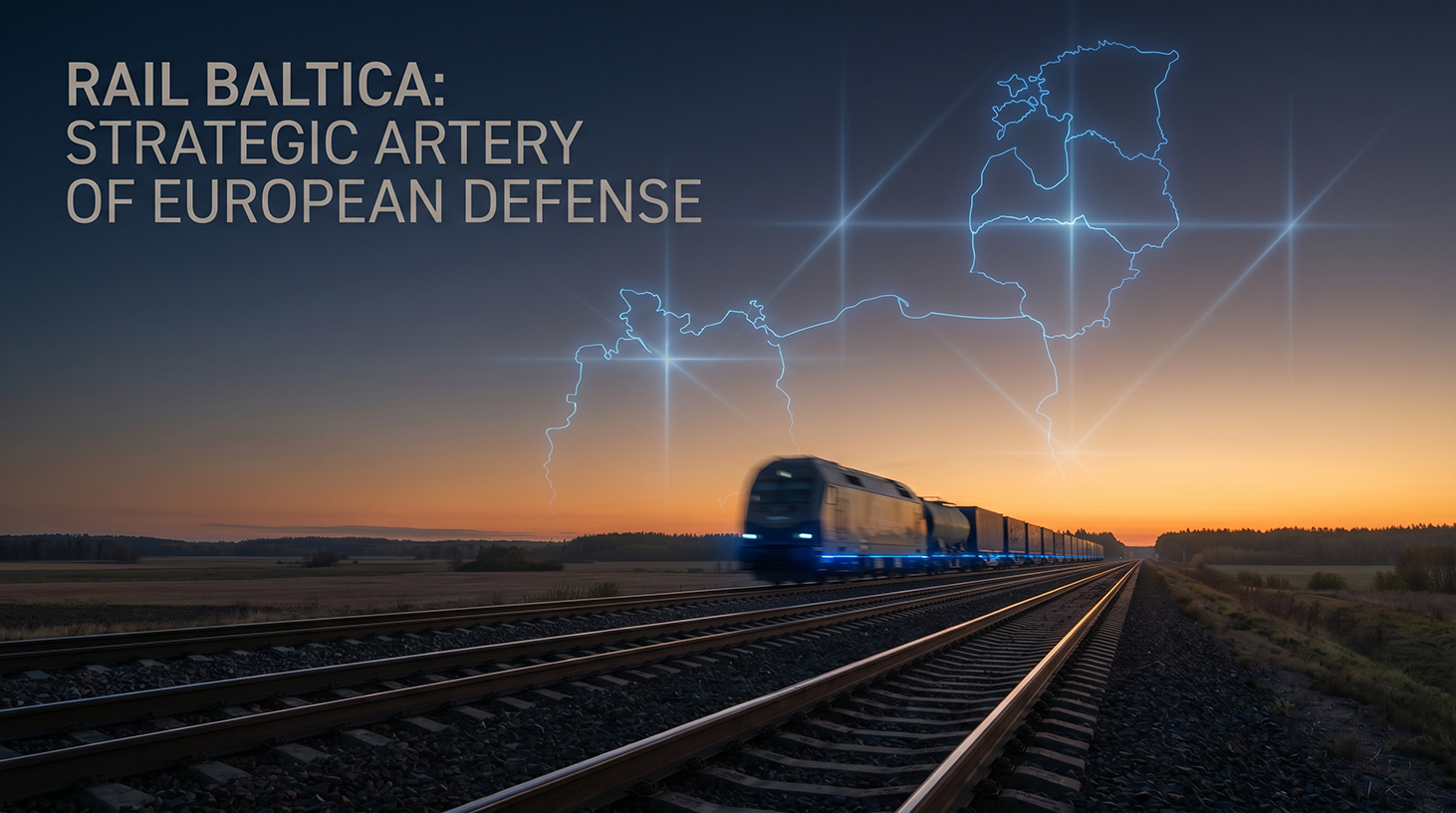
Rail Baltica and dual-use logistics: How a civilian rail corridor is becoming NATO's most important defense line – Image: Xpert.Digital
Latvia's Transport Minister warns: Why our rail network now needs a radical overhaul
Billion-dollar Rail Baltica project: Why Europe's newest railway line must transport tanks in an emergency
The multi-billion-euro Rail Baltica project was originally intended primarily to boost the economy and forge closer ties between the Baltic states and the rest of Europe. However, given the changed geopolitical landscape and the growing threat from Russia, the 870-kilometer high-speed rail line has long since transformed from a civilian construction project into one of NATO's most important strategic defense projects. With a dramatic cost explosion to almost 24 billion euros, the debate surrounding so-called "dual-use" infrastructure has moved sharply into focus: The new standard-gauge European line not only symbolically removes Estonia, Latvia, and Lithuania from Russia's orbit, but also enables the smooth transport of heavy military equipment to the alliance's eastern flank in a crisis. Our comprehensive analysis reveals why a simple railway line has suddenly become the backbone of European security, what logistical hurdles the continent still needs to overcome, and why the Baltic states are far ahead of us in their defense thinking.
Related to this:

When trains have to replace tanks – Why Europe is finally recognizing its railways as a weapon
In April 2026, Latvian Transport Minister Atis Svinka made it unequivocally clear: Europe must now mobilize all its resources. His appeal is not just about civil travel or economic exchange. It is about the survival of the continent in the worst-case scenario. The multi-billion-euro Rail Baltica project, which is intended to connect the Baltic states of Estonia, Latvia, and Lithuania to the Central European rail network via an approximately 870-kilometer-long high-speed line, is at the heart of a strategic debate that Europe has long neglected. It is a debate about infrastructure as security policy, about track gauges as geopolitical statements, and about the question of whether the continent would even be capable of organizing its own defense in a crisis.
From Tallinn to Warsaw: What Rail Baltica really is
The Project of the Century – Genesis and Goals
Rail Baltica is considered the largest railway infrastructure project in the history of the Baltic states. The double-track high-speed line is planned to run from Tallinn via Pärnu, Riga, Panevėžys, and Kaunas to Warsaw, where it will connect to the existing European high-speed network. The planned maximum speed is 240 kilometers per hour. With the future Helsinki-Tallinn tunnel under the Baltic Sea, the line would theoretically even connect the Finnish capital with Berlin and the Western European economic area – an infrastructure project whose scale is truly historic.
The project's origins date back to the late 1990s, when the Baltic states were pushing ahead with their economic and political integration with the West. The foundation for the project's current form was laid after the Baltic states' accession to the EU in 2004. Since then, the geopolitical landscape has changed dramatically – and with it, the significance of the rail project. What was originally conceived as an economic and mobility project has now become a central element of NATO's defense planning for its eastern flank.
The problem of track gauge: A technical question with geopolitical consequences
The crucial technical core of Rail Baltica is also its most strategic aspect: the track gauge. In the Baltic states, the tracks still run on the Russian broad gauge of 1520 millimeters, a legacy of the Soviet era that continues to cause logistical problems at the borders. The new high-speed line, however, is being built to the European standard gauge of 1435 millimeters – the standard used in most Western European countries and in Poland.
This seemingly technical difference of 85 millimeters has far-reaching implications. In two world wars, advancing armies painfully discovered that captured railway lines could only be used after costly gauge conversion. Today, the strategic logic is reversed: A continuous standard-gauge line from Warsaw to Tallinn would mean that NATO troops and heavy military equipment – including battle tanks – could be transported from west to east without transshipment or gauge conversion. Rail Baltica is therefore not only a link between economic regions, but also a geopolitical statement that symbolically and infrastructurally liberates the Baltic states from the Russian sphere of influence.
The numbers behind the ambition: costs, financing, and delays
From 5.8 to 23.8 billion euros – A predictable cost explosion
Few aspects of Rail Baltica concern critics and project proponents alike as much as the dramatic cost increase. In 2017, the total costs were estimated at €5.8 billion. According to the project managers themselves, this figure was far too low and based on premature technical estimates. An updated assessment by the Boston Consulting Group now puts the investment costs for the entire project at €23.8 billion – a fourfold increase over the original estimate. The first construction phase alone accounts for €15.3 billion, with the second phase adding another €8.5 billion.
The cost per kilometer amounts to approximately €26 million. In its 2026 special report, the European Court of Auditors points to a cost explosion of around 160 percent over the past six years, making Rail Baltica, along with the Lyon-Turin rail link, the most striking example of inadequate financial planning in EU infrastructure projects. Around a third of this cost increase is attributed to an expansion of the project scope, and slightly more than half to subsequently revised cost estimates. In other words, the project was pushed through politically before a realistic cost basis had been established.
The funding gap as a systemic risk
The three Baltic audit offices have jointly published an alarming report: To fully complete Rail Baltica in its current form, up to €19 billion more will be needed – approximately €2.7 billion in Estonia, €7.6 billion in Latvia, and €8.7 billion in Lithuania. The Baltic governments themselves estimate the current funding gap for the overall project at around €11 billion. To make matters worse, the current EU funding period ends in 2027 and the next one does not begin until 2028 – creating a two-year funding gap during which construction risks stalling without national bridging loans.
To date, over €4 billion in EU funding has been secured for the project. In 2024, Rail Baltica received an additional €1.2 billion from the Connecting Europe Facility (CEF) – divided into approximately €370 million for Estonia, €346 million for Latvia, and €458 million for Lithuania. Latvia alone has allocated around €260 million for construction in 2026. In a joint statement from Vilnius, the Baltic transport ministers emphasized that completion by 2030 is only possible if all three countries cooperate closely and additional sources of funding are secured – potentially including public-private partnerships and loans backed by future EU funding.
Construction schedule: Between ambition and reality
The section between Tallinn, Riga, and Kaunas was originally scheduled for completion in 2025. This deadline has not been even remotely met. Press photos from spring 2025 show some completed sections – tunnels, level crossings, bridges – but many stretches of track still lack a continuous rail line. According to the plan, around 43 percent of the main line should have been under construction by the end of 2025. Latvia is lagging behind even compared to its partners: Latvian Transport Minister Svinka has admitted that Latvia is about two years behind Estonia.
In response to the funding gap and cost pressures, Rail Baltica has adjusted its construction plan. Instead of a continuous double-track line, a largely single-track line is now planned, with reduced noise protection and a lower track bed than originally intended. Branch lines will retain the Russian broad gauge for the time being. While this "budget line" is intended to approximate the capacity and connection speed of the full project, it falls far short of the original ambitions. Completion of the entire line by 2030 remains the official target, but given the current progress of construction, experts consider a later completion date significantly more likely.
The strategic dimension: When trains move armies
The Suwałki Gap – Europe's critical point
To understand Rail Baltica's military significance, one must know the geographical reality of NATO's eastern flank. The Suwałki Gap—a narrow strip of land only about 65 kilometers wide between the Russian exclave of Kaliningrad and Belarus—is the only land connection between the Baltic states and the rest of NATO territory. In the event of a coordinated Russian-Belarusian military operation, this connection could be severed within hours, cutting the Baltic states off from the alliance and turning them into isolated enclaves in a potential war zone.
The only standard-gauge railway line running through this strategically critical area is the Suwałki–Kaunas line – precisely the section used by Rail Baltica. Whoever controls the Suwałki Gap effectively determines the Baltic states' connectivity in the event of an alliance conflict. Rail Baltica is therefore not just a railway line, but the physical expression of Europe's will to defend itself against Russia. It is a response to a military-strategic vulnerability that has become increasingly apparent to European security experts since the annexation of Crimea in 2014.
Related to this:

Convoy versus railway: The superior capacity of the rail system
The economic and military superiority of rail over road transport in the event of war has been clearly demonstrated by calculations. Egidijus Lazauskas, CEO of the LTG Group, has illustrated, based on the latest cost-benefit analysis by Rail Baltica, that a single 40-car train can replace a seven-kilometer-long military convoy by road. In an evacuation scenario, i.e., during an armed conflict, up to 143,000 people could be transported from the Baltic capitals to Poland in a single day. These figures underscore the enormous logistical leverage that a functioning rail connection represents.
The problem lies in the current reality of European military logistics, which is far removed from this vision. It currently takes up to 45 days to transport military equipment from key Western European ports to NATO's eastern flank. This is not due to a lack of roads or railways per se, but rather to a tangle of national permitting procedures, differing weight classes for bridges, varying track gauges, and a patchwork of administrative regulations. Even within Germany, transporting heavy military equipment from north to south within 30 days is considered fast. The EU Commission has recognized this predicament and presented its most ambitious package on military mobility, which aims for a so-called "military Schengen Area"—with the goal of reducing troop movements from 45 days to just a few hours.
Rail Baltica as a dual-use corridor system
Rail Baltica has recently received direct funding from the EU's military budget – a first for a civilian rail project in EU history. Specifically, the Latvian Ministry of Transport signed a contract with the European Climate, Infrastructure and Environment Executive Agency (CINEA) for approximately €5 million from the EU Military Mobility Fund for planning and monitoring measures, including a Daugava bridge and a multimodal freight terminal in Salaspils. This is the first funding Latvia has received under the new EU procurement procedure, which serves both civilian and military purposes.
In parallel, a dual transshipment infrastructure is being developed in Kaunas, capable of handling both Russian broad gauge (1520 mm) and European standard gauge (1435 mm) – a physical transshipment point intended to coordinate NATO military transports in the event of an emergency. Mobile teams have been trained to secure and load military cargo not only at railway stations, but also in ports, on warships, and in military areas. These measures demonstrate that Rail Baltica is far more than just a railway line – it is the focal point for a comprehensive dual-use infrastructure concept that combines civilian efficiency with military operational readiness.
Hub for Security and Defense - Advice and Information

Hub for Security and Defense - Image: Xpert.Digital
The Security and Defence Hub offers expert advice and up-to-date information to effectively support companies and organizations in strengthening their role in European security and defence policy. Working closely with the SME Connect Defence Working Group, it particularly promotes small and medium-sized enterprises (SMEs) that wish to further develop their innovative capacity and competitiveness in the defence sector. As a central point of contact, the Hub thus creates a crucial bridge between SMEs and European defence strategy.
Related to this:
From containers to convoys: The future of military mobility – How Rail Baltica strengthens Europe's defense
The concept of dual-use logistics: More than just a buzzword
Basic principle: Infrastructure without distinction
In the context of infrastructure, the term "dual-use" refers to the multiple use of facilities, transport routes, and systems for both civilian and military purposes. This is not a new concept – highways were deliberately designed in the post-war period to serve as military corridors in case of emergency. What is new is the systematic approach and strategic determination with which Europe intends to apply this concept today to railways, ports, digital infrastructure, and logistics hubs.
The Federation of German Industries (BDI) has precisely formulated the strategic necessity in a statement on military mobility: Federal investments in dual-use infrastructure must be prioritized, and industry must be involved early and in a binding manner in the planning, operation, and protection of this infrastructure. This involves overcoming decades of regulatory fragmentation, which in Europe has led to a situation where the same road for a 60-ton military transport vehicle is easily approved in one country, but subject to weeks of administrative procedures in a neighboring country.
Related to this:

The intermodal transport unit as a key element
The technical heart of efficient dual-use logistics is the intermodal transport unit (ITE) – standardized loading units such as containers, swap bodies, and semi-trailers that can be transferred between different modes of transport – rail, road, and water – without transshipment of their contents. In combined transport, containers represent the most important loading unit, as they can be transported by all modes of transport. The standardization of these units significantly facilitates the transfer between carriers, since handling equipment in terminals is designed for standardized dimensions.
This results in an elegant solution for defense logistics: If military equipment – from fuel and ammunition to medical supplies and communications technology – is stored and transported in standardized, intermodally compatible containers, it can be loaded onto the fastest available mode of transport without delay in an emergency. A container that is loaded onto a ship in the Port of Hamburg, transported by rail to Kaunas, and then transferred to a military truck is the epitome of this efficiency philosophy. Rail Baltica, built on standard European gauge, is the physical prerequisite for this seamless chain of logic to function all the way to NATO's eastern flank.
Synergies between civilian and military use
The economic core of the dual-use approach lies in its synergies: When a railway line is upgraded for heavy military transport, civilian heavy goods traffic also benefits. When digital platforms offer military precision in cargo tracking, the civilian supply chain gains transparency and resilience. Strengthening a bridge for 60-ton military vehicles automatically benefits heavy construction or industrial vehicles as well. This structural complementarity makes dual-use investments more economically advantageous than purely military or purely civilian infrastructure programs, as a broader user base accelerates amortization and increases political feasibility.
At the same time, there are real areas of tension. The vast majority of German rail capacity is reserved for commercial transport; DB Cargo is contractually obligated to reserve only up to 343 flatcars and two daily time slots for military transport. Under these conditions, providing additional transport capacity at short notice in a crisis is extremely difficult. This demonstrates that dual-use infrastructure requires more than just structural upgrades – it needs binding operational regulations, pre-reserved capacity, and pre-agreed prioritization rules between civilian and military needs.
Latvia as a pioneer: Svinka and the logic of threat perception
A small country with great experience
Latvian Transport Minister Atis Svinka, in office since 2025, represents a perception of reality that differs fundamentally from that of Central and Western Europe. Latvia borders Russia and its close ally Belarus. The country experienced Russian occupation in the 20th century, the stationing of Soviet troops until the early 1990s, and since then, a sustained Russian policy of information dissemination and subversion. Svinka's statement that his country has long known that Russia is a threat is therefore not a rhetorical exaggeration, but rather historically grounded collective knowledge.
This experience has made Latvia one of the most determined defense investors in NATO. For 2025, the country has committed to defense spending of 3.45 percent of its gross domestic product – in absolute terms, around €1.56 billion. This is significantly more than NATO's previous two percent target and is already approaching the new overall target of five percent agreed upon at the NATO summit in The Hague in the summer of 2025.
The five percent target: A historic turning point
At the NATO summit in The Hague in June 2025, all 32 member states agreed to increase their total defense spending to five percent of GDP by 2035. Of this, at least 3.5 percent is to be allocated to direct defense expenditures – armaments, personnel costs, and operations – while the remaining 1.5 percent is explicitly earmarked for defense and security-related infrastructure: roads, bridges, railways, critical infrastructure, and cybersecurity. Germany has announced that it will reach the 3.5 percent target as early as 2029 – six years ahead of schedule. The German Federal Ministry of Defense plans to invest more than €108 billion in 2026, with this figure projected to rise to around €152 billion by 2029.
The implications of this decision can hardly be overstated. NATO's EU members currently spend an average of around 2.0 percent of their GDP on defense. By 2035, they must increase this spending from the current 293 billion US dollars to around 849 billion US dollars – an increase of 190 percent. These sums simultaneously open up enormous investment opportunities in precisely the kind of infrastructure for which Rail Baltica serves as a prime example: dual-use projects that meet both civilian and military requirements.
Svinka's message to Germany
Svinka is explicitly addressing his appeal to countries like Germany. His message is less a request than a transfer of expertise: Driven by existential necessity, the Baltic states have developed a security awareness that Western Europe still needs to catch up with. Svinka directly links the demand for increased defense spending to the protection of the infrastructure that has been built – because a railway line, which in the event of war represents a crucial supply corridor, must also be secured against sabotage, drone attacks, and conventional military threats.
This security dimension is often overlooked in the public debate about Rail Baltica. Building the line is one thing; protecting it in a crisis is a separate strategic challenge, directly addressed by Svinka's five percent demand. Latvia has internalized this lesson and is already putting it into practice with its disproportionately high defense spending relative to its economic output.
The European deficit: Why the continent has failed to do its homework
45 days for a transport that should actually take a few hours to days
The aforementioned fact that transporting military equipment from key Western European ports to NATO's eastern flank currently takes up to 45 days is symptomatic of a deeper failure. It is the result of decades of turning a blind eye to all things military, as MEP Markus Ferber aptly put it. Bridges were not designed for the weight classes required by modern military equipment. Approval procedures for cross-border military transports take up to five working days – in an environment where NATO allocates an operational planning time of 72 hours.
The German Council on Foreign Relations (DGAP) has documented these structural deficiencies in a comprehensive analysis. The problem lies not only in outdated infrastructure, but also in regulatory fragmentation, where 27 EU member states each apply their own national regulations for military transport. A convoy traveling from Rotterdam to Tallinn currently has to obtain permits in several countries, compare bridge classifications, and plan for potential detours. The EU's military mobility package of November 2025 addresses precisely this issue and aims for a military Schengen Area in which troops can move as freely and quickly as goods in the European single market.
The infrastructural quality gap
In addition to regulatory shortcomings, there are significant infrastructure deficiencies. Many European bridges are not designed for the load-bearing capacity required by heavy military equipment – especially 60-ton main battle tanks. The rail network suffers from a fragmentation of national standards, which complicates cross-border military trains. And the digitalization of logistics, which would be essential for real-time tracking of troop movements and supply chains, is still in its infancy in many parts of Europe.
Rail Baltica offers the opportunity to address these shortcomings, at least for the northeastern corridor. The line is being planned from the ground up with military usability in mind: bridges for heavy loads, standard gauge without transition problems, and multimodal freight terminals suitable for military transshipment operations. The dual loading infrastructure already installed in Kaunas for both track gauges is a particularly clever compromise that bridges the transition phase until the entire Baltic rail network is converted to standard gauge.
Economic evaluation: Does the benefit justify the cost?
Cost-benefit analysis under changed conditions
Despite the immense cost increases, the updated cost-benefit analysis concludes that Rail Baltica remains economically justified. This may seem surprising at first glance, but it can be explained by several factors. First, the geopolitical context has fundamentally changed since the original planning: Russia's attack on Ukraine from 2022 onward dramatically increased the strategic premium on militarily usable infrastructure. Second, the current analysis also more carefully calculated secondary economic effects – tourism gains, trade flows, and reduced CO₂ emissions from shifting from road to rail transport.
Thirdly, and crucially: The potential damage of a Russian attack on the Baltic states, facilitated or accelerated by inadequate infrastructure, cannot be fully captured by any conventional cost-benefit analysis. If a single strategic weakness—the lack of rapid connectivity for the Baltic states—determines the success or failure of deterrence in a crisis, then even an investment of €24 billion must be understood as an insurance premium. This strategic premium is difficult to quantify monetarily, but it is real.
Economic interconnectedness as the foundation of security
Beyond its military dimension, Rail Baltica has genuine economic value. The Baltic states are currently poorly connected to the EU's TEN-T core network, which cements their economic peripheral status. A high-speed rail link to Warsaw, Berlin, and beyond would provide companies in Riga, Tallinn, and Vilnius with more direct market access, facilitate commuter traffic, and boost tourism. At the same time, freight transport will benefit: Rail Baltica is also designed for container freight trains operating between the Baltic ports and Western Europe – thus representing a direct competitor to the Russian rail transit route, which has so far handled a significant portion of freight traffic to Central Asia.
The ports of the Baltic states play a key role in this. Riga and Tallinn are important Baltic Sea hubs. With a direct standard-gauge rail connection to the Western European network, they could be positioned as gateways for container transport between Asia and Europe via the northern sea routes – a market that is gaining importance in light of climate change and the opening of Arctic shipping lanes. Svinka explicitly emphasized the strategic importance of Latvian ports as a complement to Rail Baltica: ports and railways together form the intermodal backbone that is indispensable for both civilian and defense logistics.
Perspectives and recommendations for action: What needs to be done now
Closing the funding gap – before 2027
The most urgent task is closing the funding gap before the end of the current EU funding period in 2027. If the Baltic states are dependent on national bridging loans in 2027 and 2028, this will jeopardize not only construction progress but also the entire momentum of the project. Given the changed security situation, the European Commission should consider special funding from the EU Defence Mobility Fund (CEF) that goes beyond the already allocated CEF funds. The precedent of direct military financing for Latvia shows that this approach is institutionally feasible.
At the same time, public-private partnership models should be systematically developed. Rail Baltica generates real revenue during operation – from freight transport, passenger services, and also from its use by NATO for military logistics. This revenue potential makes the project attractive to private investors, provided the regulatory framework is right. EIB financing with a government guarantee could bridge the transition phase.
Regulatory foundation: The military Schengen area must become a reality
The military Schengen Area proposed by the European Commission is the right conceptual framework, but it must be underpinned by binding deadlines and sanction mechanisms. The response time for permits for cross-border military transports must be reduced to the 72 hours demanded by NATO – currently it takes up to five working days. This requires harmonized regulations across Europe for bridge classifications, overtaking bans, and transit permits.
In parallel, capacity reservations for military transport on the rail network must be legally binding and firmly established. The model of the DB Cargo contract with the German Armed Forces, which reserves 343 flatcars and two daily time slots, is a starting point, but completely inadequate given the scale of the new NATO objective.
Dual-use as a planning standard – not as an exception
The most effective long-term measure is the institutional anchoring of dual-use requirements as a binding standard for all new infrastructure projects receiving EU public funding. This includes not only railway projects, but also port facilities, airports, bridges, and digital infrastructure. If dual-use is integrated into the planning from the outset, no additional costs arise from subsequent upgrades – a principle that is convincing both economically and strategically.
The German Armed Forces and the Federal Ministry of Defence have developed a concrete national defence plan, OPLAN DEU, which relies on functioning dual-use infrastructure. Implementing this plan requires a different approach to infrastructure investments than before: moving away from purely business-oriented profit calculations and towards a comprehensive societal assessment that explicitly factors in strategic resilience.
The hour of infrastructure
Rail Baltica is no ordinary railway project. It is the physical manifestation of a geopolitical course correction that Europe is finally undertaking after decades of inaction. The cost explosion from €5.8 billion to €23.8 billion undoubtedly reflects inadequate planning and the political imposition of unrealistic costs in the initial phase – at the same time, it is not a refutation of the project's merits, but rather a benchmark for what strategically necessary infrastructure costs in the 21st century.
The message from Latvian Transport Minister Svinka is that of a country that doesn't view security policy from an academic distance, but experiences it as a daily reality. When he calls for five percent of GDP to be spent on defense and infrastructure and urges Europe to learn from Baltic expertise, there is no hysteria behind it, but rather sober calculation: A Europe that cannot defend its eastern flank is not a stable Europe. And a Europe that does not align its infrastructure with defense requirements cannot defend its eastern flank.
In this context, the concept of integrated intermodal dual-use logistics is not a technocratic gimmick, but rather the most pragmatic answer to the challenge of using scarce resources in a way that generates maximum benefit for both the economy and security. Rail Baltica is the flagship project of this philosophy – and its success or failure will be a decisive factor in Europe's credibility as a strategically capable actor. The clock is ticking, and Atis Svinka is right: now all forces must be mobilized.
Consulting - Planning - Implementation

Markus Becker
I would be happy to serve as your personal advisor.
Head of Business Development
Chairman SME Connect Defense Working Group
Consulting - Planning - Implementation
Konrad Wolfenstein
I would be happy to serve as your personal advisor.
contact me at wolfenstein ∂ xpert.digital
Just call me on +49 7348 4088 965 .





