
Tokyo Lab | Daifuku's 3-Year Plan: When "Physical AI" and classic conveyor technology merge
Xpert Pre-Release

Available in 27 languages 📢
Prefer Xpert.Digital on GoogleⓘPublished on: April 10, 2026 / Updated on: April 10, 2026 – Author: Konrad Wolfenstein
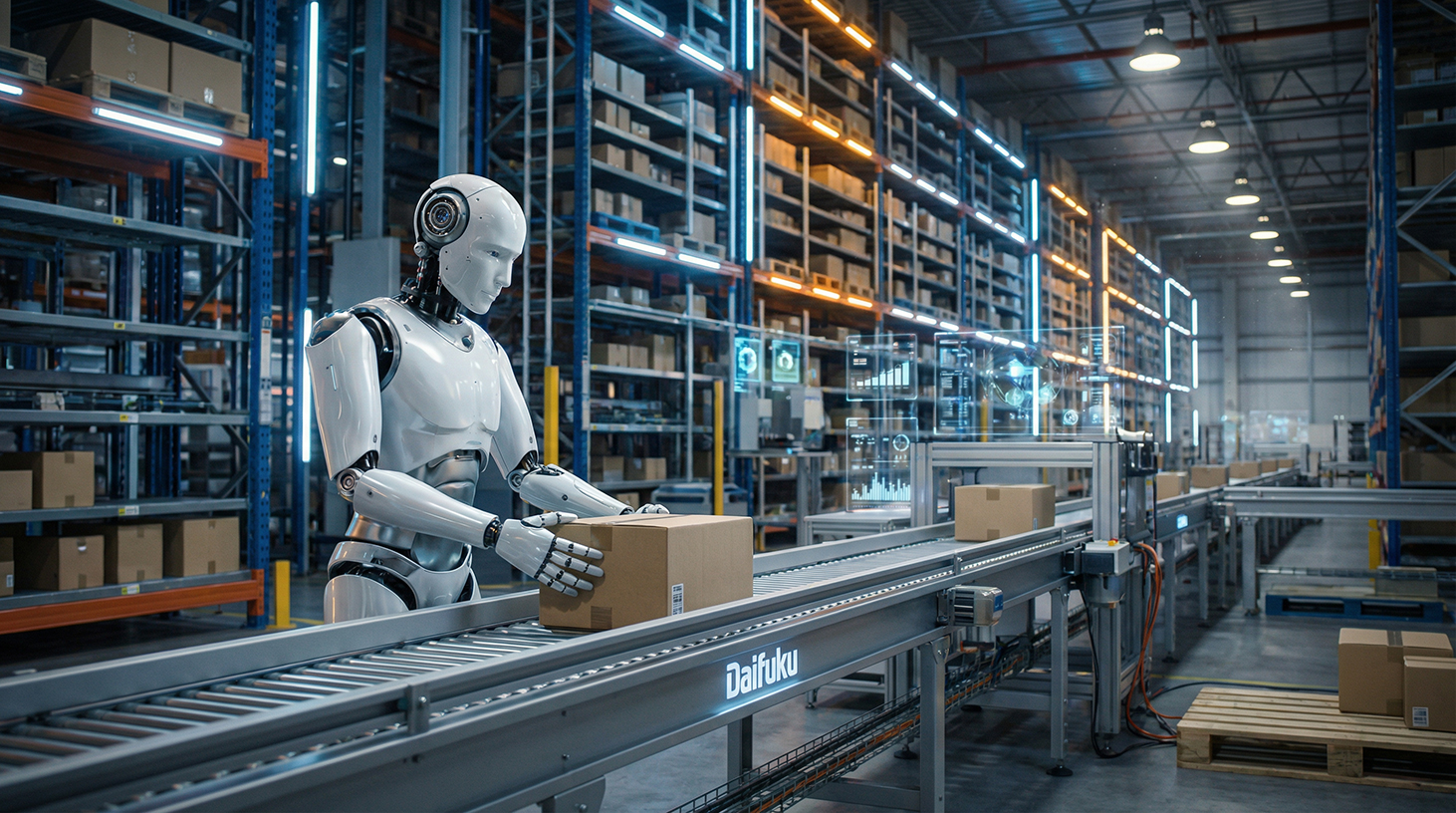
Daifuku's 3-year plan: When "Physical AI" and classic conveyor technology merge – Image: Xpert.Digital
Built for humans, controlled by AI: Will humanoid robots soon take over logistics?
Forget pure start-ups: How a global market leader is making the humanoid robot suitable for industrial use
The global skills shortage, exploding labor costs, and a rapidly aging society are forcing global industry to rethink its strategies – and the solution is increasingly taking on human characteristics. While startups dominate media attention with impressive demonstrations of humanoid robots, a true industrial giant is now making a strategic move: Daifuku, the undisputed Japanese world market leader in automated material handling systems, has announced plans to test humanoid robots for logistics applications within the next three years. With the opening of its new "Tokyo Lab," the long-established company is positioning itself at the forefront of the development of so-called "Physical AI." But what does this step mean for the future of work and the efficiency of supply chains? Daifuku, with its dominance in the highly complex semiconductor industry and decades of experience in system integration, possesses precisely the missing piece of the puzzle that could elevate humanoid robots from a hyped research project to an established industry standard. This article offers an in-depth look at the technology, its economic potential, and the still unresolved challenges of the next wave of automation.
From conveyor system to thinking robot: A global market leader is setting a new course
Daifuku Co., Ltd. is one of the quiet giants of the global industrial landscape. Founded in Osaka in 1937, the company has grown over nearly nine decades to become the undisputed world leader in automated material handling systems, a title it has now defended five times in a row. With total sales of 660.7 billion yen in fiscal year 2025 – equivalent to more than four billion US dollars – and a net margin of 11.8 percent, a significant increase from 10.2 percent the previous year, the company demonstrates remarkable operational discipline. Its product range extends from Automated Storage and Retrieval Systems (AS/RS) and automatic conveyor belts and sorting technology to highly specialized Automated Material Handling Systems (AMHS) for semiconductor factories, where Daifuku holds a global market share of approximately 40 percent.
But this technological giant isn't resting on its laurels. In March 2026, Daifuku announced its intention to begin testing humanoid robots for logistics operations within the next three years. This announcement came shortly after the grand opening of its new Tokyo research and development center, "Tokyo Lab," on March 11, 2026, in the Minato district – the company's third R&D site in Japan, alongside Shiga Works and the Kyoto Lab, which opened in November 2025. The strategic message behind this is unmistakable: Daifuku sees humanoid robots not as a niche technological product, but as a central element of the next evolutionary stage of intralogistics.
Structural constraints as a driver of innovation: Demographics are propelling innovation
To properly understand Daifuku's foray into the world of humanoid robots, it is first necessary to analyze the structural forces behind this decision. Japan is facing an exceptional demographic situation, unparalleled in its industrial history. Around 30 percent of Japan's 123 million inhabitants are over 65 years old, while the under-14 age group now comprises just under 12 percent of the population. The number of people of working age is currently around 74 million – about five million fewer than in 2010 – and this structural decline continues unabated.
The consequences are already being felt. In 2025, 397 companies in Japan filed for bankruptcy due to staff shortages – the fourth consecutive year with an increase in this number. Small and medium-sized enterprises (SMEs) are particularly affected, as they simply can no longer compete with the salaries offered by large corporations. Of the 397 bankruptcies, 152 were attributed to rising labor costs, 135 to a persistent shortage of skilled workers, and 110 to layoffs and staff shortages. The bottlenecks are especially acute in the logistics, hospitality, and service sectors. The ratio of job vacancies to job seekers nationwide is 1.20 – there are 120 vacancies for every 100 job seekers.
In parallel, the Japanese trade union Rengo has called for an average wage increase of 5.94 percent for 2026, reflecting persistent inflation and chronic labor shortages. Last year, Japanese companies had already pledged an average wage increase of 5.25 percent as part of the "Shunto" collective bargaining agreement—the largest wage increase in 34 years. This cost dynamic makes investments in automation technologies more economically attractive than ever for Japanese companies and significantly lowers the threshold for the ROI-positive deployment of humanoid systems.
The Tokyo Lab as a strategic nerve center: Research meets transformation
The opening of the Tokyo Lab on March 11, 2026, is more than a symbolic gesture. With an area of approximately 1,000 square meters in Tokyo's Minato district – the heart of Japan's high-tech and venture capital scene – Daifuku is positioning itself as a serious player in AI-based robotics research. The lab will initially house 30 employees, with a planned expansion to 50 by the end of 2027. It is explicitly dedicated to researching medium- to long-term technologies from a company-wide perspective and is equipped with an R&D area, a collaboration space, and an exhibition and testing area.
Chief Technology Officer Takuya Gondo has clearly defined Tokyo Lab's strategic program: It focuses on developing "Physical AI" as the core of intelligent material handling equipment and establishing new robotics technologies that will ultimately lead to the complete automation of distribution centers and production facilities. Alongside classic technologies such as IoT and digital twins, the integration of next-generation robotics is central. Cooperation with universities, research institutions, and startups is explicitly planned to quickly make insights applicable company-wide.
What distinguishes Daifuku's approach from a purely research-oriented strategy is its close integration with its existing core business. The company is already deeply rooted in the semiconductor industry through its AMHS portfolio. With a global market share of approximately 40 percent in silicon wafer transport systems and an uptime of over 99.99 percent in state-of-the-art cleanroom factories, Daifuku possesses integration expertise in high-precision, fault-tolerant production environments, which is directly transferable to the development of humanoid robots. This technological bridge between AMHS and humanoid robots—for example, for taking over final, still manual handling steps in semiconductor assembly—could be a decisive competitive advantage over pure robotics startups.
What humanoid robots mean for logistics: The promise of the human-like machine
The underlying intellectual premise behind humanoid robots for logistics is strikingly simple: Existing warehouses, distribution centers, and production facilities were built for humans. Aisle widths, shelf heights, stair layouts, door dimensions, and handling equipment are designed for the human body. A humanoid robot can operate within this infrastructure without requiring extensive structural or technical modifications – whereas traditional robotics often necessitates significant investments in conveyor technology, ceiling infrastructure, or shelf adjustments. This aspect is highly relevant from an economic perspective, as it significantly expands the boundaries of automation, extending them towards small and medium-sized enterprises and towards more flexible, dynamically adaptable operating environments.
Furthermore, humanoid robots are particularly well-suited for hybrid task profiles that have previously defied complete automation. Where conventional AMRs (Autonomous Mobile Robots) or AGVs (Automated Guided Vehicles) reach their physical or cognitive limits—for example, when grasping unstructured objects, navigating narrow corridors with varying obstacles, or switching between different task types during a shift—humanoid systems are inherently superior. For Daifuku, whose portfolio is strong precisely in these adjacent areas, this creates a natural synergy: Combining its in-house conveyor, storage, and sorting systems with humanoid robots for the final, non-automatable work steps could create an integrated overall solution that far surpasses what competitors can offer with individual products.
The global market for humanoid robots: Between hype and reality
Forecasts for the global humanoid robot market vary considerably depending on the analyst firm, but paint a clear picture of exponential growth. Mordor Intelligence estimates the market at US$4.82 billion by 2025 and projects a volume of US$34.12 billion by 2030, representing a compound annual growth rate (CAGR) of 47.9 percent. ResearchNester is even more optimistic, expecting a market volume of $81.55 billion by 2035, up from $3.14 billion in 2025. The IDTechEx institute forecasts a somewhat more conservative, but still impressive, growth to around $25 billion by the early 2030s, with a gradual slowdown in growth until 2036. Goldman Sachs cites $38 billion as a target figure by 2035, while Morgan Stanley expects around 63 million humanoid robots to be in use in the US alone by 2050.
The market for AI-based robotics in warehousing alone – a direct playing field for Daifuku – is estimated to reach US$102.67 billion by 2035, with a CAGR of 23.37 percent. Japan, as a single market, is experiencing particularly strong growth: the market volume for humanoid robots is projected to increase from US$0.22 billion in 2025 to US$3.99 billion in 2034, representing an annual growth rate of 43.7 percent. Government support, industrial demand, and the cultural acceptance of robots make Japan a leading market for this technology.
However, these figures should be treated with due analytical caution. Most forecasts were formulated before the current state of technology and historically tend to confuse short-term hype with medium-term reality. The industry is undeniably in an early stage of commercial testing in 2026, not in the industrial mass deployment phase. Gartner, in a January 2026 report, predicted that by 2028 fewer than 20 companies worldwide would be scaling humanoid robots into their supply chains at production scale—a sobering assessment given the media coverage.
Where the technology really stands today: A sober look at initial applications
The real-world deployment landscape of humanoid robots in logistics and manufacturing in 2026 is limited, but instructive. Figure AI has deployed 20 units of its Figure 02 model at the BMW plant in Spartanburg, South Carolina, for structured component handling in assembly cells—highly structured tasks with low product variety. Agility Robotics has demonstrated a far more direct logistics application with its Digit model: More than 100 units were deployed at GXO Logistics for tote transfer tasks—picking up and passing containers between conveyor belt sections. The throughput is 30 to 60 totes per hour per unit, while a human can manage 80 to 120 totes—a performance gap that is still significant. Amazon is also testing Digit's predecessor in Oregon for stacking empty containers, and Tesla is gradually integrating its Optimus robots into its own manufacturing.
The company Apptronik has tested its Apollo robot at Mercedes-Benz in structured assembly tasks. At CES 2026, at least 38 companies presented bipedal robot systems, more than half of them of Chinese origin. Nvidia is positioning its Jetson-Thor platform as the AI brain for an entire generation of humanoid robots, and Google DeepMind is collaborating with Boston Dynamics to control the Atlas robot with Gemini-based AI models. Despite these activities, only a few hundred humanoid robots are actually working productively worldwide – the contrast between media presence and real-world use is striking.
A highly interesting example from an economic perspective is the Helix robot, whose operating costs are estimated at around €4.11 per hour, compared to approximately €25 for a human warehouse worker – a theoretical saving of around 83 percent. Such calculations are tempting, but they presuppose continuous operation and full functionality in all tasks – conditions that hardly any system currently meets.

Expert partner in warehouse planning and construction
Four years amortization or faster? Economics, technology, and Daifuku's strategy
The economic question: Does the humanoid robot pay off?
The business calculations for humanoid robots are complex and depend heavily on the application, operating intensity, and system maturity. Fruitcore Robotics, in a direct comparison of humanoid systems with conventional 6-axis industrial robots, has identified significant discrepancies: While the amortization period for an industrial robot can be three to six months, it currently takes four to five years for humanoid systems. The project investment for a humanoid solution typically ranges from €130,000 to €300,000, compared to €50,000 to €100,000 for comparable industrial robot systems. In addition, there are specific operating cost drivers such as battery management and the necessary human supervision, which do not arise in this form with conventional robots.
A survey conducted by Industrie Magazin among European companies revealed that the majority of respondents are willing to pay less than €100,000 for humanoid robots – which generally aligns with manufacturers' target price range of under €50,000, provided the system's performance is at least half that of a human over a five-year period. However, this calculation shifts considerably when rising labor costs, lost productivity, and the costs of recruitment and retention are factored in. In Japan, where wage increases of nearly six percent per year coincide with a structural labor shortage, the break-even period for humanoid robots is significantly shorter than in markets with moderate wage levels.
Daifuku possesses a crucial resource for its economic viability: an existing global network of end customers in the automotive, aerospace, food, pharmaceutical, and especially semiconductor industries. Integrating humanoid robots as add-on modules to existing Daifuku systems could significantly improve ROI because installation costs, training, and system integration are built upon existing platforms. A company already operating a complete Daifuku AMHS does not need to develop a new system architecture when introducing humanoid add-on modules.
Technological limitations and blind spots: What humanoid robots still can't do
Any sound analysis of the field must identify the significant technical hurdles that impede rapid industrial scaling. Specialized industrial robots still significantly outperform humanoid systems in terms of repeatability, cycle times, and robustness under industrial conditions. The balance between power, weight, and energy efficiency remains a fundamental engineering challenge: A bipedal system must constantly compensate for the mechanical load of its own body weight, resulting in increased energy consumption and wear compared to a stationary robot arm.
The gripping problem is one of the most persistent unsolved issues in robotics. While humans can effortlessly switch between objects of varying shapes, weights, consistencies, and surface textures, current robot grippers regularly fail to grasp unfamiliar objects in unstructured environments. This is critical for logistics applications where thousands of different products are processed daily. Added to this is the problem of hallucinations in AI-controlled systems: While faulty speech output in a chatbot is tolerable, erroneous gripping signals in a robot arm can lead to property damage or injuries.
Legal and safety regulations are another obstacle. Current international standards such as ISO 10218 and ISO/TS 15066 are primarily geared towards robotic arms and collaborative robots, not autonomous humanoid systems that move alongside humans in unstructured environments. Certifying new systems according to standards that are yet to be defined will require time and resources. Gartner's assessment that fewer than 20 companies will be using humanoid robots at scale in production by 2028 takes precisely these regulatory and technical obstacles into account.
Competitive landscape and Daifuku's position: Between start-ups and system integration
In the global race for humanoid logistics robots, a multitude of players with varying strengths and approaches are competing. Pure humanoid startups like Figure AI, Agility Robotics, Apptronik, 1X Technologies, and Boston Dynamics have experience in developing the human form factor but lack direct access to existing customers in industrial logistics. Chinese manufacturers—who accounted for more than half of all bipedal systems presented at CES 2026—combine rapid hardware development with lower production costs but struggle with market entry barriers in Western markets and safety concerns.
Daifuku occupies a unique position in this field: as an established systems integrator with deep domain knowledge in industrial logistics, a global sales network, experience with safety-critical applications in the semiconductor industry, and an organically grown customer base that represents the core of the target market for humanoid logistics robots. The company does not need to develop the robot from scratch itself – it can and will collaborate with startups, license their hardware designs, or enter into strategic partnerships, thereby leveraging its core strength: the integration of humanoid systems into complex, industrial material flow architectures.
The explicit promotion of collaborations with universities, research institutions, and startups within the framework of Tokyo Lab underscores precisely this strategy. Daifuku doesn't need to reinvent the wheel – it needs to put the right wheels on the right axle. The existing SOTR sorting robot portfolio, which was presented for the first time in Europe at LogiMAT 2026 in Stuttgart and achieves up to 10,000 sorting operations per hour at a travel speed of 180 meters per minute, exemplifies how Daifuku is gradually increasing the complexity of its robotics solutions while simultaneously ensuring market maturity and scalability.
Semiconductor synergy: An underestimated strategic lever
A key element of Daifuku's humanoid strategy, often overlooked in public discourse, is its close connection to the semiconductor industry. TSMC, Samsung, and other leading global chip manufacturers are currently investing hundreds of billions of dollars in new factory capacity, driven by AI-fueled demand for advanced semiconductors. Daifuku is a key AMHS supplier for these facilities and, through its cleanroom systems, maintains direct access to the world's most demanding production environments.
In these fabs, there are still work steps performed manually by technicians – inspection, maintenance, and handling tasks that cannot be handled by conventional conveyor systems. This is precisely where humanoid robots could be positioned as a complementary element to existing AMHS systems. A combined offering – consisting of Daifuku's Overhead Hoist Transport (OHT) systems for automated wafer flow and a humanoid robot for remaining manual tasks – would represent a product architecture that no pure humanoid startup, and hardly any other traditional automation provider, could replicate. The synergy logic is compelling: the revenue incentive arises not from the humanoid alone, but from the integrated overall package.
Societal dimensions: Job loss or solution to the labor shortage?
The societal debate surrounding the use of humanoid robots in logistics is characterized by fundamental tensions that manifest themselves very differently depending on the national context. In Japan, where skills shortages and population decline are perceived as existential economic threats, robotics is culturally seen as a necessary and accepted response to structural challenges—not as a threat to jobs, but as a lifeline for both businesses and society. This cultural orientation has historical roots: ever since the 1960s, when Japan first faced a labor shortage, the country has relied on automation rather than immigration.
In Western societies, particularly in Europe, the discussion is more complex. Trade unions, employee representatives, and political decision-makers view the developments with skepticism. Critics often overlook the fact that many of the tasks to be automated in the logistics sector are physically demanding, monotonous, and detrimental to health. Introducing humanoid robots for heavy transport, repetitive order picking, or shift work under unfavorable conditions could improve working conditions for remaining human employees, rather than simply eliminating them. Amazon emphasizes precisely this aspect in its public communications regarding its robotics programs, pointing out that the number of jobs has increased for many years despite the massive rollout of robotics.
The medium-term economic reality is likely to be differentiated: In high-volume, repetitive logistics environments, humanoid robots will gradually replace certain job profiles. In more complex, variable environments, they will more likely serve as a complement to human labor. The net employment effects ultimately depend on the speed of technological maturation, the regulatory framework, the workforce's willingness to learn, and the economic dynamics of the respective industry.
Daifuku's timeline and the credibility of the three-year strategy
The announcement that humanoid robot testing will begin within three years is a carefully worded statement. It avoids exaggerated promises about commercial scaling but clearly signals strategic seriousness. A pilot and test operation within three years – that is, by 2029 – is quite plausible given the company's capacity, especially since the R&D infrastructure is already under construction with the Tokyo Lab and the Kyoto Lab, and operational capital is available.
The company's revenue growth trajectory—with analyst estimates of around seven percent annual revenue growth coupled with improved margins—gives Daifuku sufficient financial flexibility for ambitious R&D investments without impacting its core balance sheet. The five billion yen investment in expanding its US plant in Hobart, Indiana, doubling its production capacity, demonstrates the company's readiness to invest in structural growth. While the expansion of Tokyo Lab to 50 employees by the end of 2027 is modest compared to the personnel resources of large technology companies, it is realistic for a company still operating in the early stages of this technology's development.
A further indication of the substance behind the announcement is Tokyo Lab's focus on "Physical AI"—a research area that essentially describes the development of AI systems that interact directly with the physical world. This formulation from Daifuku's own press material corresponds exactly to the scientific framework in which humanoid robots are developed: as embodied AI systems whose intelligence is manifested not in the digital realm, but in physical actions. The conceptual clarity of the internal strategy communication is a positive sign for the seriousness of the project.
Economic forecast: What Daifuku's move means for the industry
The entry of an established global systems integrator like Daifuku into humanoid robotics has industry-wide implications that extend beyond the company itself. First, it legitimizes the technology for other intralogistics providers who have similar strategic considerations but have been waiting for a market-leading move. Second, the demand side of a global systems integrator—with thousands of existing customers and a global network of over 55 offices—creates new incentives for humanoid robot startups to make their hardware compatible with existing automation systems. Third, Daifuku's standardization proposals for the interface between humanoid robots and conventional material handling equipment could become the de facto industry standard, much like the company played a key role in shaping standards for AMHS protocols in the semiconductor industry.
The question of when humanoid robots in logistics will scale beyond pilot projects into widespread industrial application remains open. The technological challenges of gripping, energy efficiency, and safe human-robot collaboration are real. However, the structural pressures of skilled labor shortages, rising labor costs, and rapidly falling AI costs are shifting the economic viability calculations in favor of automation with each iteration of the technology. When providers like Daifuku, with their integration expertise, customer networks, and capital resources, bridge the gap between humanoid hardware and industrial applicability, it significantly accelerates the industry's maturation.
Daifuku's cautious but determined move may not mark the beginning of a technological revolution, but it is a reliable signal that the laboratory demonstration phase is slowly but irreversibly transitioning into the industrial testing phase. And in a market where the global leader in intralogistics announces its next move, the rest of the industry usually follows closely behind.
Your intralogistics experts

Consulting, planning and implementation of complete solutions for high-bay warehouses and automated storage systems - Image: Xpert.Digital
More information here:
Your global marketing and business development partner
☑️ Our business language is English or German
☑️ NEW: Correspondence in your native language!

Konrad Wolfenstein
I and my team are happy to be available to you as your personal advisor.
You can contact me by filling out the contact form here or simply call me at +49 7348 4088 965. My email address is : [email protected]
I'm looking forward to our joint project.
☑️ SME support in strategy, consulting, planning and implementation
☑️ Creation or realignment of the digital strategy and digitization
☑️ Expansion and optimization of international sales processes
☑️ Global & Digital B2B trading platforms
☑️ Pioneer Business Development / Marketing / PR / Trade Fairs
Our global industry and economic expertise in business development, sales and marketing

Our global industry and economic expertise in business development, sales and marketing - Image: Xpert.Digital
Industry focus areas: B2B, digitalization (from AI to XR), mechanical engineering, logistics, renewable energies and industry
More information here:
A thematic hub offering insights and expertise:
- Knowledge platform covering global and regional economies, innovation and industry-specific trends
- A collection of analyses, insights, and background information from our key areas of focus
- A place for expertise and information on current developments in business and technology
- A hub for companies seeking information on markets, digitalization, and industry innovations










