
The NEURA-Robotics-AWS partnership under scrutiny: When a Metzingen startup uses Amazon as a test lab
Xpert Pre-Release

Available in 27 languages 📢
Prefer Xpert.Digital on GoogleⓘPublished on: May 13, 2026 / Updated on: May 13, 2026 – Author: Konrad Wolfenstein
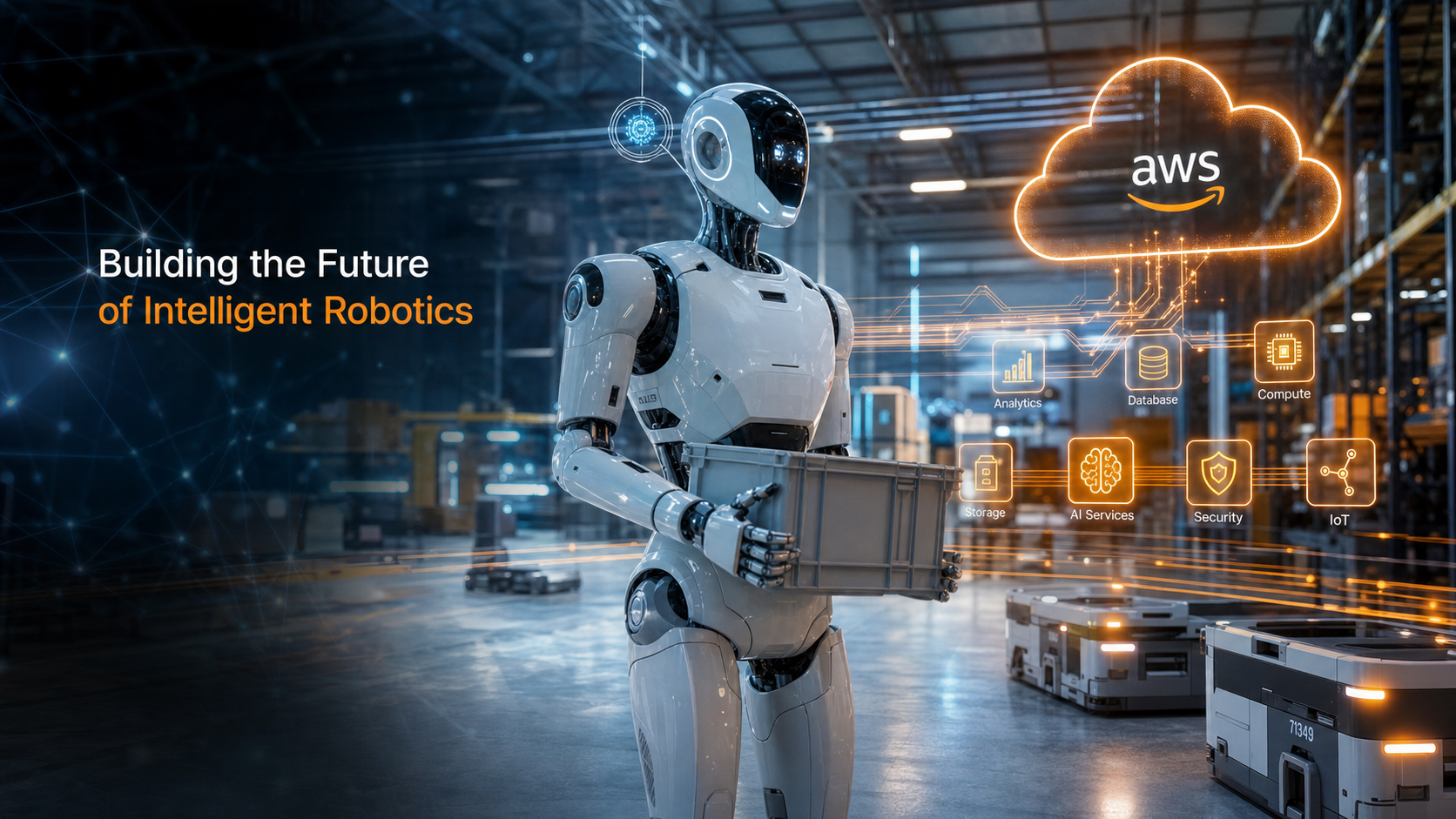
Is "Physical AI" on the verge of a breakthrough? – Creative image: Xpert.Digital
Amazon tests German robots: A brilliant move by Neura Robotics or just PR hype?
Is "Physical AI" on the verge of a breakthrough? The truth about the mega-deal from Metzingen
When a German robotics startup from the Swabian countryside announces a "strategic partnership" with tech giant Amazon Web Services (AWS), it makes headlines. NEURA Robotics from Metzingen aims to bring millions of cognitive robots to market by 2030 and positions itself as Europe's answer to Tesla Optimus and the rising competition from China. But how much substance lies behind the PR facade? This comprehensive analysis scrutinizes the deal. It separates visionary marketing from harsh economic reality, explains the unresolved core problem of "physical AI"—the so-called data gap—and reveals why the European robotics hopeful simply cannot scale without US cloud infrastructure. A deep dive into a multi-billion-dollar race whose outcome is completely uncertain.
Lots of headlines, little substance – or the beginning of a real paradigm shift?
The narrative that is to be sold
On April 21, 2026, NEURA Robotics sent out a press release whose language left little room for restraint. A "strategic partnership" with Amazon Web Services, the goal of "widely rolling out" physical AI, and millions of cognitive robots by 2030 – that's the narrative the Metzingen-based startup is launching together with the world's largest cloud computing company. The announcement fits seamlessly into a series of similarly worded collaborations that NEURA has entered into in recent months: Schaeffler, Bosch, Qualcomm, Dassault Systèmes – the partner list reads like a who's who of the global industrial elite.
However, anyone who reads the press release with an analytical eye will quickly encounter the fundamental problem with all current announcements in the field of humanoid robotics: a significant gap exists between visionary claims and verifiable reality. This analysis does not aim to close this gap—no one can do that at this point—but rather to clearly identify, classify, and economically assess it. Only by understanding the substance behind the marketing can one realistically evaluate the strategic importance of this partnership.
NEURA Robotics: Who is behind Germany's robotics hopeful?
NEURA Robotics was founded in 2019 by David Reger in Metzingen, Baden-Württemberg – a city previously known primarily for Hugo Boss. The company positions itself as Europe's only manufacturer of humanoid robots and a pioneer in cognitive robotics. At its technological core is the Neuraverse – a platform that connects robots, humans, and data on a single collaborative level and is designed as a continuously learning operating system for the age of physical AI.
The company's funding history speaks to the confidence of institutional investors. In January 2025, NEURA closed a €120 million Series B funding round, led by Lingotto Investment Management and co-sponsored by BlueCrest Capital Management, the Volvo Cars Tech Fund, HV Capital, and the state-owned L-Bank. In March 2026, Bloomberg reported that NEURA was preparing another €1 billion funding round, with stablecoin issuer Tether named as an investor—an unusual combination that would position the company at a valuation of approximately €4 billion. NEURA CEO David Reger states the order backlog is nearly $1 billion, with customers including Kawasaki Heavy Industries and Omron.
At the same time, it must be stated soberly: NEURA, like all its competitors in the humanoid robot segment, is not yet a profitable company with proven serial deliveries. Neither NEURA's humanoid robot nor those of its fiercest German competitors are currently in regular operation or commercially available on a relevant scale. This is not a failure, but rather the current state of the entire industry – but this context is consistently omitted from the company's PR materials.
The data gap: The real core problem of Physical AI
To understand the significance of the NEURA-AWS partnership, one must grasp the fundamental technological problem it addresses. Large language models could be trained on trillions of text tokens from the internet. For physical AI—that is, for robots that operate in the physical world—no comparable training corpus exists. Real sensor data, movement sequences under varying environmental conditions, haptic feedback, and error corrections in actual production environments are extremely rare and expensive to collect.
This fundamental problem is known in robotics research as the "reality gap" or "sim-to-real gap": AI models trained exclusively in simulations perform significantly worse in the physical world because simulation and reality inevitably diverge—in coefficients of friction, lighting conditions, sensor noise, and unforeseen human interactions. A 2025 study by arXiv confirms that this gap remains one of the most pressing unsolved challenges in robotics. This is where NEURA's approach with NEURA Gyms comes in: physical training facilities where hundreds of robots learn under controlled, yet realistic conditions and generate high-quality training data that is shared via the Neuraverse.
Integrating this training data with Amazon SageMaker—Amazon's fully managed machine learning service that covers the entire ML lifecycle—makes technological and strategic sense. SageMaker HyperPod has been proven to reduce training time by up to 40 percent through automated cluster management, and the platform supports all major ML frameworks, including GPU-optimized instances.
What the partnership specifically means – and what it doesn't mean
According to the press release, the NEURA-AWS agreement covers three operational areas: firstly, cloud infrastructure, where AWS becomes the preferred provider for the Neuraverse; secondly, AI development, where NEURA Gyms are connected to Amazon SageMaker; and thirdly, real-world validation, where NEURA joins the AWS partner network and Amazon tests the use of NEURA robot technology in selected fulfillment centers.
A precise distinction is crucial here: Amazon is evaluating the use of the robots – not: Amazon is deploying them. This linguistic nuance is economically significant. Amazon operates more than a million robots worldwide in its fulfillment network and, since acquiring Kiva for $775 million in 2012, has developed and deployed systems such as Proteus, Sequoia, Sparrow, and Cardinal. The fact that a company of this caliber is seriously evaluating NEURA's technology is in itself a considerable vote of confidence.
Nevertheless, the phrase "is examining the use" leaves completely open whether, when, to what extent, and under what conditions NEURA robots will actually be deployed in fulfillment centers. Amazon has internal ambitions to automate up to 75 percent of its operations in the long term – this is a significant strategic direction, but no guarantee of a contract with NEURA.
The ecosystem as strategic logic
The true strategic intelligence behind the NEURA-AWS partnership only becomes apparent within the context of the larger partner network. Schaeffler develops and supplies key components for humanoid robots, including innovative actuators for continuous load operation, and has committed to integrating a mid-four-figure number of NEURA humanoid robots into its global production network by 2035. Bosch supports NEURA in the industrialization of hardware and software and participates in the collection of physical training data using sensor suits in Bosch plants. Qualcomm contributes its Dragonwing robotics processors to a long-term platform partnership, while Dassault Systèmes integrates its Virtual Twin technology into the Neuraverse.
This constellation follows an economic logic well-known in the platform economy: network effects. The more partners feed their real-world application data into the Neuraverse, the better the AI models become – and the more attractive the platform becomes for further partners. NEURA thus explicitly pursues not a purely hardware-based approach, but a platform-based approach, comparable to an app store for robotics capabilities, where capabilities can be developed once and deployed globally. In this platform logic, AWS is not an interchangeable infrastructure provider, but a strategic anchor with global computing capacity, an established partner network, and real Amazon operations centers as a testing environment.
🎯🎯🎯 Data-driven B2B industry hub as a quasi-in-house solution

The quasi-in-house solution: How Xpert.Digital closes operational gaps in B2B marketing and sales – Smart Content-Driven Business - Image: Xpert.Digital
Xpert.Digital is a data-driven B2B industry hub led by Konrad Wolfenstein . The company acts as an external, quasi-in-house solution for industrial partners, closing operational gaps in marketing, content, and sales – without requiring additional resources on the client side.
More information here:
NEURA vs. China: What Europe's robotics chances really stand
The market: Breathtaking growth and sobering warning signs
The market environment is both immensely promising and fraught with considerable uncertainty. According to Statista Market Insights, revenues in the AI robotics market are expected to grow from around €24 billion in 2025 to around €146 billion in 2030 – a sixfold increase. GlobalData forecasts growth for the entire robotics market from US$90.2 billion in 2024 to US$205.5 billion in 2030, corresponding to an annual growth rate of 15 percent. The management consultancy Roland Berger estimates the long-term potential of the global robotics market at up to four trillion dollars – a level comparable to the entire automotive industry.
These euphoric forecasts contrast sharply with sobering operational data. According to IDC, global shipments of humanoid robots increased by 508 percent in 2025 – but to just around 18,000 units. Gartner predicts that by 2028, fewer than 20 companies worldwide will actually have brought their humanoid concepts into mass production. Deloitte and Bain both conclude that only a few hundred humanoid robots are currently operating productively worldwide. Gartner sums it up bluntly: The hype far outpaces actual readiness for deployment, and their use will remain limited to strictly controlled, predictable environments in the coming years.
NEURA in global competition: Strengths, weaknesses and the Chinese variable
The humanoid robotics market is dominated by well-capitalized players. Tesla Optimus will be performing real-world production tasks in Gigafactories by 2026 and aims for external sales by the end of 2026 in the $25,000 to $40,000 price range. Figure AI has raised $675 million from NVIDIA, Microsoft, and OpenAI and is actively deployed in BMW plants. Boston Dynamics Electric Atlas is operating on a limited scale in Hyundai production facilities. At CES 2026, NEURA presented its "4NE1," along with an educational variant and a quadrupedal all-terrain robot, positioning itself as a broad platform provider.
The real strategic threat comes from China. Reger himself explains that China intends to replace five percent of its workforce with humanoid robots by 2030 – that would correspond to approximately 40 million robots. Chinese manufacturers operate with significantly lower costs and government support; at CES 2026, 21 of the 38 listed humanoid robot manufacturers were from China. The price competition that this situation will generate poses a serious risk to any European or American supplier whose business model is based on higher margins.
The European dimension: Technological supremacy under pressure
The NEURA-AWS partnership is also a political and economic statement – and simultaneously contains an inherent tension. NEURA explicitly positions itself as a European champion, as a guarantor of European engineering excellence: from Europe, together for the world. And then it chooses Amazon Web Services as its central cloud infrastructure partner. This is not a criticism, but a sober observation of a structural dependency.
At the Berlin Digital Summit in November 2025, German Chancellor Friedrich Merz and French President Emmanuel Macron made clear how serious the situation is: 80 percent of all digital technologies have to be imported into Europe, primarily from the USA and China, and only four of the world's 50 largest technology companies are based in Europe. Cloud infrastructure is one of the most critical areas – and in the field of cloud computing, the dependence on US hyperscalers is so deeply entrenched that there is no short-term alternative. NEURA is therefore acting rationally by relying on AWS: there is simply no European infrastructure with comparable computing power and scalability. But the partnership underscores the fundamental European dilemma: even those who innovate in the hardware and AI layers are dependent on non-European players in the infrastructure layer.
The economic evaluation: What is sound, what is advertising PR
An honest analysis must distinguish between what is substantial and economically sound in this partnership and what falls into the category of strategic communication.
The technological logic behind the partnership is considered sound. NEURA Gyms' integration with Amazon SageMaker addresses the real problem of the sim-to-real gap with a proven toolkit. AWS as the cloud backbone for the Neuraverse is a rational choice given the lack of European alternatives. Joining the AWS partner network opens up go-to-market opportunities that a European startup could not otherwise access. NEURA's valuation of four billion euros reflects serious institutional confidence.
However, this should be viewed as mere advertising PR: The goal of millions of cognitive robots by 2030 is a target figure without a proven operational basis. Amazon's announcement that it is examining the possibility of using them is not a formal commitment. The term "strategic partnership" is used so indiscriminately in the technology industry that it can mean anything from a framework agreement to in-depth joint product development, which is not specified more precisely in the public statements.
The data gap as a business model: A clever approach with an open outcome
What's interesting is how NEURA understands the data gap not just as a problem, but as a business model. The Neuraverse is conceptually designed so that all participants in the ecosystem benefit from everyone else's data – a collaborative learning cycle that becomes exponentially more valuable as the number of participants grows. Every new partnership, every new industrial application generates training data that flows into the system and improves the AI models. Schaeffler and Bosch are already collecting manufacturing and movement data for the Neuraverse; Amazon would provide logistics data.
Whether this flywheel actually gets going depends on factors that cannot yet be assessed: the partners' willingness to truly share proprietary data; NEURA's ability to maintain AI quality within the Neuraverse at a level that offers partners genuine added value; and the speed at which competing ecosystems—particularly those of Tesla or Chinese consortia—build similar network effects. The idea is elegant. Its implementation is still in its early stages.
Why 2026 could still be a crucial year
Despite all the sober assessments, there are strong arguments that 2026 will indeed mark a turning point for humanoid robotics – not in terms of an immediate mass market, but in terms of the first reliable real-world applications. Roland Berger predicts that hardware and software improvements will reduce the operating costs of humanoid robots to two US dollars per hour – a level at which economic scaling becomes realistic in many industrial sectors.
For NEURA, this means: The window of opportunity to maintain a leading position is open, but not permanent. Companies that cannot demonstrate reliable reference deployments within the next 12 to 24 months risk being overtaken by competitors with stronger funding or faster scaling capabilities. The Amazon partnership could – if the trial phase leads to actual deployments – provide precisely the reference order that transforms NEURA from a promising European startup into a serious global player.
The partnership with AWS is not proof of market readiness, but it is a strategically astute move that lays the groundwork for it. In a technology industry that often confuses steps with results, this is an important distinction.
Honest overall picture: Bet on a race that's still open
The NEURA-Robotics-AWS partnership is neither mere PR stunt nor the breakthrough the press release portrays it as. It is a technologically sound, strategically well-considered, and economically viable step by a European company seeking to establish a relevant position in a high-risk global market.
Anyone investing in NEURA Robotics today, or joining as a partner, is not betting on proven market leadership, but on the ability of an ambitious European team to solve one of the most difficult technological challenges of our time – physical AI – faster and better than well-funded American and Chinese competitors. That's a legitimate bet. But it remains just that: a bet.
Your global marketing and business development partner
☑️ Our business language is English or German
☑️ NEW: Correspondence in your native language!

Konrad Wolfenstein
I and my team are happy to be available to you as your personal advisor.
You can contact me by filling out the contact form here simply call me at +49 7348 4088 965. My email address is [email protected]:or
I'm looking forward to our joint project.









