
Are office jobs at risk? GPT-5.4: When machines operate the computer and office work becomes a bargaining chip
Xpert Pre-Release

Available in 27 languages 📢
Prefer Xpert.Digital on GoogleⓘPublished on: March 6, 2026 / Updated on: March 6, 2026 – Author: Konrad Wolfenstein
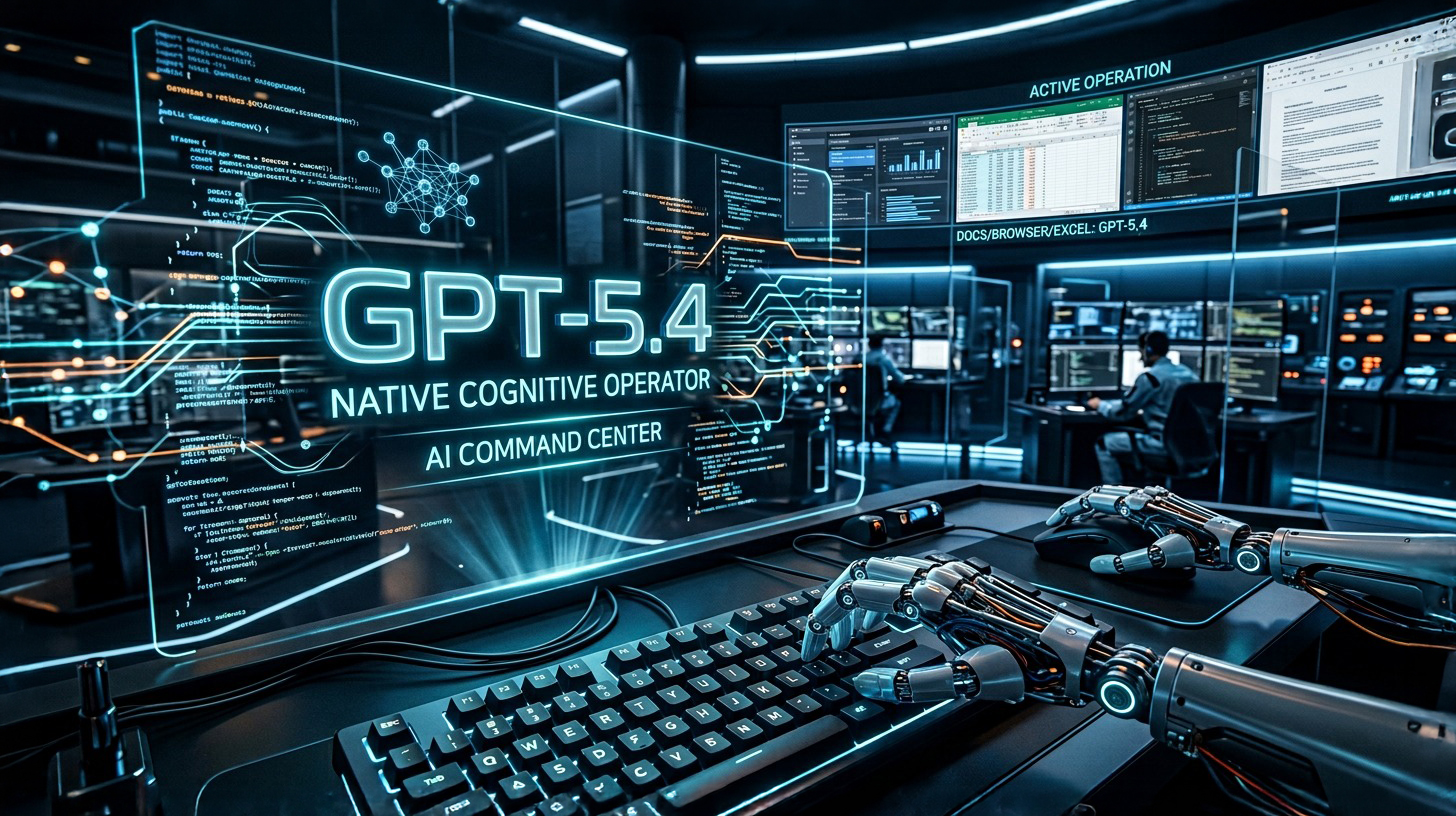
Are office jobs at risk? GPT-5.4: When machines operate the computer and office work becomes a bargaining chip – Image: Xpert.Digital
Code Red at OpenAI: The real reason for the rushed release of GPT-5.4
AI giants clash: How GPT-5.4 aims to outcompete Google and Anthropic
The AI colleague who operates your PC: How GPT-5.4 is turning the knowledge economy on its head
With the release of GPT-5.4 in March 2026, OpenAI crossed a technological Rubicon. Generative artificial intelligence no longer acts merely as a passive chatbot or smart text generator, but as an autonomous digital agent. For the first time, an AI model possesses the native ability to independently operate computer programs, interpret screenshots, and execute complete, multi-stage workflows using a mouse and keyboard. This qualitative shift marks the beginning of a new era of knowledge work: processes from data research and analysis to presentation creation are increasingly being handled by machines. While large companies anticipate gigantic productivity gains and a structural reorganization of entire value chains, millions of skilled office jobs are facing unprecedented pressure to adapt. The following article analyzes the turbulent development history of the GPT-5 series, compares the model with its strong competitors, Google and Anthropic, and illuminates the profound economic disruptions that await us as a result of the agentic AI revolution.
Related to this:

Why an AI model that clicks faster than any employee is putting the entire knowledge economy under pressure
On March 5, 2026, OpenAI released GPT-5.4, a model that marks a significant turning point in the history of generative artificial intelligence. For the first time, a generally usable OpenAI model possesses native computer control capabilities, meaning it can independently operate desktop applications, execute mouse and keyboard commands, and interpret screenshots to derive subsequent actions. What at first glance appears to be a mere technical refinement has the potential to fundamentally reshape the entire architecture of knowledge work. GPT-5.4 no longer acts solely as a text generator or coding assistant, but as an autonomous agent capable of independently handling multi-stage workflows across various applications.
This brings a scenario within reach that has so far been discussed rather abstractly in the economic debate on AI: the automated takeover of entire workflows that have previously constituted the core of skilled office work. Instead of generating individual text modules, entire work processes—from data acquisition and analysis to presentation and documentation—are handled entirely by machines. This article analyzes the technical, strategic, and economic dimensions of this development and places them within the context of intensified competition among major AI labs and the emerging disruptions in the labor market.
From a failed model to a frontal assault: The turbulent journey of the GPT-5 series
The speed with which GPT-5.4 followed its predecessor GPT-5.3 is no coincidence, but rather the result of a strategic realignment fueled by a series of setbacks and increasing competitive pressure. To understand the economic significance of GPT-5.4, it's worth examining the bumpy development of the entire GPT-5 model family.
On August 7, 2025, GPT-5 was released as a unification of the o-series reasoning models with classical language models under a single interface. Expectations were enormous, and disappointment followed promptly. Thousands of critical comments accumulated on Reddit, with the general consensus of a widely followed thread simply stating that the model was terrible. The problems ranged from inconsistent responses and disruptive rejection behavior to what was perceived as an arrogant conversational style, where the model lectured users instead of responding to them.
OpenAI responded with GPT-5.1 in November 2025, which was internally considered a corrective version following the failed initial release. Significantly, the marketing language shifted from performance promises to terms like stability and reliability. However, just one month later, in December 2025, GPT-5.2 appeared, accelerated by an internal alarm signal, reportedly dubbed "Code Red" by the media, triggered by the release of Google's Gemini 3 Pro, which had taken the lead in several benchmarks. GPT-5.2 was intended to counter with improved reasoning and extended context length, but was rated by many users as one of the weakest releases in ChatGPT's history.
This was followed in early February 2026 by GPT-5.3 Codex, simultaneously with Anthropic's Claude Opus 4.6, and on March 2, 2026 by GPT-5.3 Instant in response to the call quality problems of GPT-5.2. Just three days later, on March 5, 2026, OpenAI presented GPT-5.4.
This pace is unprecedented. Within seven months, OpenAI has released six model versions. *The Information*, citing company insiders, explained: the more frequent updates are intended to prevent the build-up of inflated expectations, as happened with the GPT-5 launch, which could then lead to disappointment. At the same time, OpenAI's user growth has recently been slower than internally predicted. The strategy of rapid iteration cycles thus serves a dual purpose: managing external expectations and consolidating its technological leadership in the face of aggressive competition from Google and Anthropic.
Technical Architecture: What GPT-5.4 can actually do and what that means
GPT-5.4 consolidates capabilities previously distributed across specialized variants in OpenAI models into a single frontier model. It combines the reasoning of GPT-5.2, the coding strengths of GPT-5.3 Codex, and, for the first time, native computer-use capabilities within an integrated architecture. Three dimensions are crucial for understanding the economic implications.
Autonomous computer control as a game changer
GPT-5.4 can directly interact with software by interpreting screenshots, calculating click coordinates, and executing mouse and keyboard commands. Previous approaches to computer control, such as OpenAI's own operator from January 2025 or Anthropic's Computer Use function, required a complex wrapper infrastructure. GPT-5.4 integrates this capability natively, drastically lowering the barrier to entry for developers.
The benchmark results are remarkable. On *OSWorld-Verified*, the standard test for agent-based desktop navigation via screenshot and mouse interaction, GPT-5.4 achieves a success rate of 75 percent. The human reference performance is 72.4 percent. GPT-5.2 only managed 47.3 percent. This marks the first time an AI model has surpassed the average human ability to navigate a desktop environment using visual perception. It also outperforms Anthropic's Opus 4.6, which, at its release, was considered the benchmark with 72.7 percent.
Knowledge work at a professional level
On the *GDPval benchmark*, which measures the ability of AI agents to perform skilled knowledge work across 44 occupational fields from the nine highest-revenue industrial sectors in the US, GPT-5.4 achieved a win rate of 83 percent compared to human industry experts. This means that in 83 out of 100 cases, the model's results were rated as at least equivalent to the work products of human professionals. GPT-5.2 achieved a win rate of 70.9 percent. The tasks tested included real-world work products such as sales presentations, accounting spreadsheets, hospital schedules, manufacturing diagrams, and short videos.
In internal investment banking modeling tasks, GPT-5.4 achieves an average score of 87.3 percent compared to 68.4 percent for GPT-5.2. In presentations, human evaluators preferred the GPT-5.4 results in 68 percent of cases due to better aesthetics, greater visual variety, and more effective use of image generation.
Efficiency and factual accuracy
According to OpenAI, GPT-5.4 is the most factually accurate model to date: individual statements are 33 percent less likely to be incorrect than with GPT-5.2, and complete answers contain 18 percent fewer errors. Token efficiency has been significantly improved; the model requires considerably fewer tokens to solve comparable tasks, which directly translates into lower costs and increased speed. The context window has been expanded to one million tokens, more than double the 400,000 tokens of GPT-5.3, bringing OpenAI in line with Google and Anthropic.
The introduction of Tool Search reduces token consumption in tool-intensive workflows by 47 percent, as the model no longer needs to carry all available tool definitions in context, but instead searches specifically for the required tool.
Benchmark landscape: GPT-5.4 compared to the competition
The release of GPT-5.4 coincides with a period of intense competition between the three dominant AI labs. A data-driven comparison reveals where OpenAI has gained ground and where the rivalry remains open.
| Benchmark | GPT-5.4 | GPT-5.4 Pro | GPT-5.2 | Anthropic Opus 4.6 |
|---|---|---|---|---|
| OSWorld-Verified (Desktop Control) | 75,0 % | n/a. | 47,3 % | 72,7 % |
| BrowseComp (web research) | 82,7 % | 89,3 % | 65,8 % | 84,0 % |
| GDPval (knowledge work) | 83,0 % | 82,0 % | 70,9 % | n/a. |
| SWE-Bench Pro (Coding) | 57,7 % | n/a. | 55,6 % | n/a. |
| MMMU Pro (Visual Perception) | 81,2 % | n/a. | 79,5 % | n/a. |
| Investment Banking Modeling | 87,3 % | 83,6 % | 68,4 % | n/a. |
| Humanity's Last Exam (with tools) | 52,1 % | 58,7 % | 45,5 % | n/a. |
In desktop control, GPT-5.4 has taken the lead, narrowly overtaking Anthropics Opus 4.6. In demanding, multi-stage web searches, Anthropics Opus 4.6, with 84 percent on BrowseComp, is slightly ahead of standard GPT-5.4, but is significantly surpassed by the Pro version with 89.3 percent. The difference remains small in the coding benchmarks, with Anthropics Opus 4.5 still holding a separate top score of 80.9 percent on SWE-bench Verified.
The results reveal a pattern: No single model dominates across all dimensions. Strengths vary depending on the use case. For companies, this means that the choice of model increasingly depends on the specific application scenario, not on a general ranking.
Three strategies, one market: The diverging paths of OpenAI, Google and Anthropic
The three major AI labs have settled on significantly different strategic positions in 2026, which has direct consequences for the market structure and adoption dynamics in companies.
OpenAI is pursuing a strategy of aggressive vertical integration. ChatGPT is being developed into an operating system platform offering industry-specific solutions, such as *ChatGPT for Healthcare* or specialized enterprise versions. The goal is not only to offer the most powerful model, but a fully integrated work environment where specialized agents can handle everything from controlling to legal analysis. The pricing structure of GPT-5.4 reflects this positioning: The input price is $2.50 per million tokens, compared to $1.75 for GPT-5.2, although the higher token efficiency is expected to reduce overall costs in many use cases.
Google is positioning itself as an ecosystem orchestrator, leveraging its market dominance in workspace and cloud computing to seamlessly integrate Gemini as an invisible infrastructure layer into existing business processes. Its strength lies in its everyday integration and seamless connection with existing enterprise IT. However, Google shows weaknesses in terms of customization and openness.
Anthropic has positioned itself as an architect for developers and security-sensitive applications. With its Model Context Protocol and Claude Code, the company aims to standardize the interfaces between AI models and external systems. In regulated industries such as law and finance, where trust and transparency over governance capabilities are paramount, Anthropic has established a strong position.
This results in a strategic decision matrix for companies that goes far beyond technical benchmarks. The choice of AI partner is increasingly becoming a fundamental infrastructural decision, comparable to choosing an ERP system or a cloud platform.
The economics of agentic AI: market figures and growth dynamics
The market for AI agents is entering a phase of exponential growth, further accelerated by models like GPT-5.4. According to MarketsandMarkets, the global market for AI agents will grow from $7.84 billion in 2025 to $52.62 billion in 2030, representing an average annual growth rate of 46.3 percent. Alternative forecasts from MarkNtel Advisors put the volume at $42.7 billion by 2030, with an annual growth rate of 41.5 percent. Grand View Research sees the market at $50.31 billion. The range of estimates varies, but all reputable market research firms predict a significant increase within the next five years.
These figures gain context when linked to forecasts for the overall economic value creation through AI-supported automation. McKinsey estimates the economic value creation potential unlocked by AI agents and robots in the US alone at $2.9 trillion by 2030. Goldman Sachs estimates that up to 300 million full-time jobs worldwide could be affected by generative AI. The leverage that agentic models like GPT-5.4 exert on the productivity equation thus becomes clear: it is no longer about marginal efficiency gains, but about the structural reorganization of entire value chains.
OpenAI itself is on a growth trajectory that reflects the scale of this market development. Annualized revenue reached $20 billion in 2025, a 233 percent increase from the previous year's $6 billion. The forecast for 2030 is $280 billion. The company's valuation has reached $500 billion and could climb to over $850 billion with the current funding round. These figures reflect investors' confidence in the thesis that agent-based AI will trigger a massive shift in value creation from traditional service and software companies to AI platform operators.
However, this revenue growth is offset by enormous capital requirements. Inference costs amounted to $8.4 billion in 2025 and are projected to reach $14.1 billion in 2026. OpenAI plans infrastructure expenditures of around $600 billion by 2030. The gross margin is 33 percent, an unusually low figure for a software company with a valuation of 167 times its annual revenue. The economic equation for agentic AI is based on the bet that increasing economies of scale and growing willingness to pay among enterprise customers will improve the cost structure in the medium term.
A new dimension of digital transformation with 'Managed AI' (Artificial Intelligence) - Platform & B2B solution | Xpert Consulting

A new dimension of digital transformation with 'Managed AI' (Artificial Intelligence) – Platform & B2B solution | Xpert Consulting - Image: Xpert.Digital
Here you will learn how your company can implement customized AI solutions quickly, securely and without high entry barriers.
A managed AI platform is your all-inclusive, worry-free solution for artificial intelligence. Instead of dealing with complex technology, expensive infrastructure, and lengthy development processes, you receive a ready-made solution tailored to your needs from a specialized partner – often within just a few days.
The key advantages at a glance:
⚡ Rapid implementation: From idea to ready-to-use application in days, not months. We deliver practical solutions that create immediate added value.
🔒 Maximum data security: Your sensitive data stays with you. We guarantee secure and compliant processing without sharing data with third parties.
💸 No financial risk: You only pay for results. High upfront investments in hardware, software, or personnel are completely eliminated.
🎯 Focus on your core business: Concentrate on what you do best. We take care of the entire technical implementation, operation, and maintenance of your AI solution.
📈 Future-proof & scalable: Your AI grows with you. We ensure continuous optimization and scalability, and flexibly adapt the models to new requirements.
More information here:
Your new colleague is an AI: What that really means for your workplace
The invisible colleague: How agentic AI is permeating knowledge work
The introduction of GPT-5.4 coincides with a period in which agentic AI is making the leap from pilot projects to routine operations. A DeepL study shows that 69 percent of executives worldwide expect AI agents to significantly change their business processes by 2026. According to a survey of 500 technical executives commissioned by Anthropic, 57 percent of companies are already using AI agents for multi-stage workflows, and 81 percent plan to further increase the complexity of their use cases by 2026.
Practice vividly illustrates these figures. McKinsey, one of the world's leading consulting firms, revealed a remarkable metric at the beginning of 2026: The company now employs 25,000 AI agents alongside 40,000 human consultants – a ratio that had stood at just 3,000 agents eighteen months earlier. Using its proprietary platform Lilli, 72 percent of McKinsey employees actively utilize AI tools, generating more than 500,000 queries per month. Time savings amounted to 1.5 million hours in 2025, with up to 30 percent of the time spent searching for and synthesizing knowledge being saved.
This finding is revealing from an economic perspective: If even the most rigorously selected knowledge workers – and McKinsey consultants are among the highest paid in their field – find that 30 percent of their previous pattern recognition work can be replaced by machines, then the question arises as to what this means for less specialized knowledge workers.
The daily work routine is changing on several levels. Gartner reports that by 2026, multi-agent systems will have evolved from pilot projects to enterprise standards faster than expected. Software agents will no longer just pre-sort emails, but will also prepare draft replies, update project status, coordinate appointments, and handle complete onboarding processes for new employees. Microsoft is positioning its Copilot Studio with autonomous agents that manage complex business processes between different Office applications, while Atlassian, with its AI Rovo, has built a knowledge graph that breaks down information silos in software development and agile project management.
GPT-5.4's ability to independently navigate browsers, fill out forms, send emails, and create calendar entries takes this development to a qualitatively new level. Mainstay, a company that uses AI agents to manage real estate portals, reports a 95 percent success rate on the first attempt and 100 percent within three attempts when navigating approximately 30,000 web portals, compared to 73 to 79 percent with previous computer-based control models. Sessions were completed three times faster and consumed 70 percent fewer tokens.
Related to this:

Labor market effects: Between productivity promises and the risk of displacement
The capabilities of GPT-5.4 are intensifying a debate that has permeated labor market research since the release of ChatGPT at the end of 2022. Empirical evidence is mounting that the impact of generative AI on employment structures extends far beyond what classical automation theories predicted.
A 2025 study by the Stanford Digital Economy Lab, based on millions of payroll records from the US payroll service provider ADP, identified an alarming asymmetry: young professionals aged 22 to 25 in highly AI-exposed fields experienced significant job losses, while more experienced professionals in the same occupations continued to benefit. The researchers described these young professionals as "canaries in the coal mine," early warning signs of deeper labor market changes. In software development, for example, simple programming tasks typically assigned to entry-level employees can already be largely taken over by AI models, while experienced developers with complex project knowledge remain less replaceable.
The OECD estimates that AI could theoretically automate up to 58 percent of individual tasks. An analysis by the German Bundestag's Research Service arrives at a more nuanced conclusion, finding that the employment effects to date have remained moderate and that AI use is concentrated in large companies in early implementation phases, which tend to rely on hiring freezes rather than active layoffs. At the same time, the analysis warns of a deepening of social inequality and a polarization of the labor market, with middle-skilled segments shrinking.
Goldman Sachs estimates that up to 300 million full-time jobs worldwide could be affected by generative AI. Administrative support roles are particularly vulnerable (46 percent), followed by legal professions (44 percent) and architecture and engineering (37 percent). Physical labor in construction and maintenance is significantly less affected (less than 6 percent).
With GPT-5.4, the boundaries of what can be automated are shifting once again. When an AI model achieves a success rate of 87.3 percent in creating investment banking models and delivers results at least equivalent to those of human experts in 83 percent of professional knowledge work across 44 occupational fields, it's no longer just routine tasks that are under pressure. McKinsey's own analysis confirmed as early as 2023 that generative AI primarily affects knowledge work—that is, those activities associated with decision-making and collaboration, which have so far shown the least potential for automation. The technical potential for automating the application of expertise has increased by 34 percentage points, and the potential for automating management and talent development from 16 to 49 percent.
The opposing view, which also finds empirical support, emphasizes the augmentative nature of the technology. According to this view, AI does not replace jobs, but rather changes job profiles. Qualification requirements are shifting towards a mix of skills encompassing technical understanding, analytical thinking, communication, and creativity. Around 50 percent of companies primarily see AI as a tool for increasing the productivity of their existing workforce. The truth likely lies in the simultaneous occurrence of both effects, with the speed of substitution increasing with each new model release.
The infrastructure dilemma: growth on credit
The economic viability of the agentic AI revolution is by no means guaranteed. Behind the impressive growth figures lie structural challenges that affect the entire business model of AI platform operators.
OpenAI's revenue growth of 233 percent in 2025 was accompanied by a gross margin of only 33 percent. By comparison, traditional software companies typically operate with gross margins of 70 to 85 percent. The difference is explained by the enormous inference costs—the computational costs incurred with every user request. In 2025, these costs amounted to $8.4 billion, and $14.1 billion is projected for 2026. Paying users, who represent only 5 percent of the 910 million weekly active users, account for 66 percent of these inference costs.
IDC forecasts a tenfold increase in agent usage and a thousandfold increase in inference demand by 2027. If each GPT 5.4 agent autonomously executing a complex, multi-step task generates hundreds or thousands of API calls, computational costs multiply exponentially. OpenAI's planned infrastructure investments of $600 billion by 2030 reflect this scaling problem.
This reveals a fundamental economic paradox: the more powerful the models become and the more tasks they autonomously handle, the higher the cumulative computing costs per processed workflow. The token efficiency gains of GPT-5.4, such as the 47 percent reduction in token consumption through Tool Search, counteract this trend, but are unlikely to fully compensate for the absolute increase in volume.
Companies that use AI agents productively face a similar cost calculation challenge. IDC recommends tiered strategies, where lower-cost models handle routine tasks and premium models are used only for highly critical decisions. Organizations that achieve a positive return on their AI investments track profitability per agent and shut down underperforming systems early. However, according to McKinsey's own State of AI Survey from 2025, only 39 percent of companies attribute a measurable EBIT effect to their AI usage, and most report an impact of less than 5 percent. The gap between technical capability and realized value creation remains significant.
Security, governance, and the question of control
The enhanced capabilities of GPT-5.4 inevitably raise more pressing questions about security and control. A model that autonomously operates software and executes multi-stage workflows across various applications significantly increases the potential attack surface. OpenAI classifies GPT-5.4 as having "High Cyber Capability" within its Preparedness Framework and employs corresponding safeguards, including enhanced monitoring systems, access controls for trusted users, and asynchronous blocking mechanisms for higher-risk requests.
A more nuanced aspect of security architecture concerns the auditability of thought processes. OpenAI has introduced an open-source evaluation tool that measures whether models can deliberately obfuscate their reasoning chain to evade monitoring. GPT-5.4 demonstrates a low ability to consciously control its chain of thought, which is considered a positive security feature, as it indicates that the model cannot effectively conceal its thought processes.
At the regulatory level, requirements are becoming more stringent. The EU's AI Act, in effect since August 2024, mandates labeling requirements and risk classifications for AI systems. For agentic systems that autonomously access company data, make decisions, and execute actions, compliance requirements are particularly complex. Forrester predicts that by 2026, half of all ERP vendors will introduce autonomous governance modules that combine explainable AI, automated audit trails, and real-time compliance monitoring.
GPT-5.4's configurable security policies, which allow developers to tailor confirmation behavior to different risk tolerances, reflect the growing understanding that security is not a binary state but a context-dependent continuum. For companies in regulated industries, the ability to operate AI agents with traceable decision paths and granular access controls is increasingly becoming a differentiating competitive advantage.
The German context: Between opportunities and structural inertia
For the German economy, and especially for small and medium-sized enterprises (SMEs), the introduction of agent-based AI models like GPT-5.4 is of particular relevance. The skills shortage, which the German Economic Institute estimates will affect around 570,000 job vacancies in Germany by 2025, could be partially offset by the automation of skilled knowledge work, albeit at the cost of significant adjustment shocks.
The German business landscape is structurally disadvantaged when it comes to adopting AI agents. According to a Bundestag analysis, AI use has so far been concentrated in large companies in early implementation phases. SMEs, which form the backbone of the German economy, face particular challenges: limited IT expertise, data privacy concerns, a lack of cloud infrastructure, and the cultural hurdle of integrating autonomous AI systems into established workflows.
At the same time, agent-based AI systems offer transformative potential, especially for small and medium-sized enterprises (SMEs). An AI agent that independently processes customer inquiries, creates offers, manages orders, and generates reports can significantly relieve the workload of a five-person team in a specialized industrial company. However, experience shows that the greatest impact occurs where agents take over actual processes and don't just formulate answers, which requires a thorough process analysis that many companies have not yet conducted.
The race for the autonomous agent has only just begun
GPT-5.4 is not the endpoint of development, but rather an intermediate step in an accelerating race. OpenAI's monthly release cadence suggests that further models will follow within the next six to twelve months, expanding autonomy capabilities even further. Google will update its Gemini models, Anthropic is working on the next generation of Claude, and new competitors like DeepSeek are entering the market with cost-effective alternatives.
The economically crucial question is not whether agentic AI will fundamentally change knowledge work—the empirical signals are already too clear for that—but rather at what pace and with what distributional impact this transformation will occur. IDC expects that by 2027, agentic automation will enhance the capabilities of over 40 percent of enterprise applications, but also warns that more than 40 percent of AI initiatives could be discontinued by then if governance and return on investment expectations are not aligned.
A strategic logic is emerging for companies: success is not determined by the fastest deployment of AI agents, but by their most intelligent integration into existing value chains. The organizations that achieve the greatest return do not measure the value of their AI agents in terms of saved personnel, but in entirely new categories of revenue and operational resilience.
The release of GPT-5.4 marks the moment when the question of whether AI can operate a computer was definitively answered. The real question now is a profoundly economic one: Who benefits from this capability, who loses out, and how quickly must institutions, educational systems, and regulators react to ensure that the productivity gains of the agentic AI era benefit not only platform operators but society as a whole? The answer to this question will shape the next decade of economic history, perhaps more so than any other technological development of our time.
Your global marketing and business development partner
☑️ Our business language is English or German
☑️ NEW: Correspondence in your native language!

Konrad Wolfenstein
I and my team are happy to be available to you as your personal advisor.
You can contact me by filling out the contact form here or simply call me at +49 7348 4088 965. My email address is: [email protected]
I'm looking forward to our joint project.
☑️ SME support in strategy, consulting, planning and implementation
☑️ Creation or realignment of the digital strategy and digitization
☑️ Expansion and optimization of international sales processes
☑️ Global & Digital B2B trading platforms
☑️ Pioneer Business Development / Marketing / PR / Trade Fairs
🎯🎯🎯 Benefit from Xpert.Digital's extensive, five-fold expertise in one comprehensive service package | BD, R&D, XR, PR & Digital Visibility Optimization

Benefit from Xpert.Digital's extensive, five-fold expertise in a comprehensive service package | R&D, XR, PR & Digital Visibility Optimization - Image: Xpert.Digital
Xpert.Digital possesses in-depth knowledge across various industries. This allows us to develop tailored strategies precisely aligned with the requirements and challenges of your specific market segment. By continuously analyzing market trends and monitoring industry developments, we can act proactively and offer innovative solutions. The combination of experience and expertise generates added value and provides our clients with a decisive competitive advantage.
More information here:









