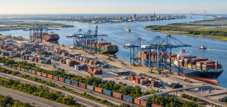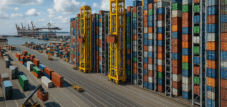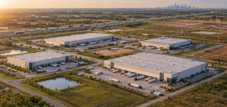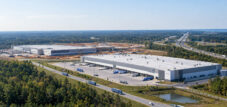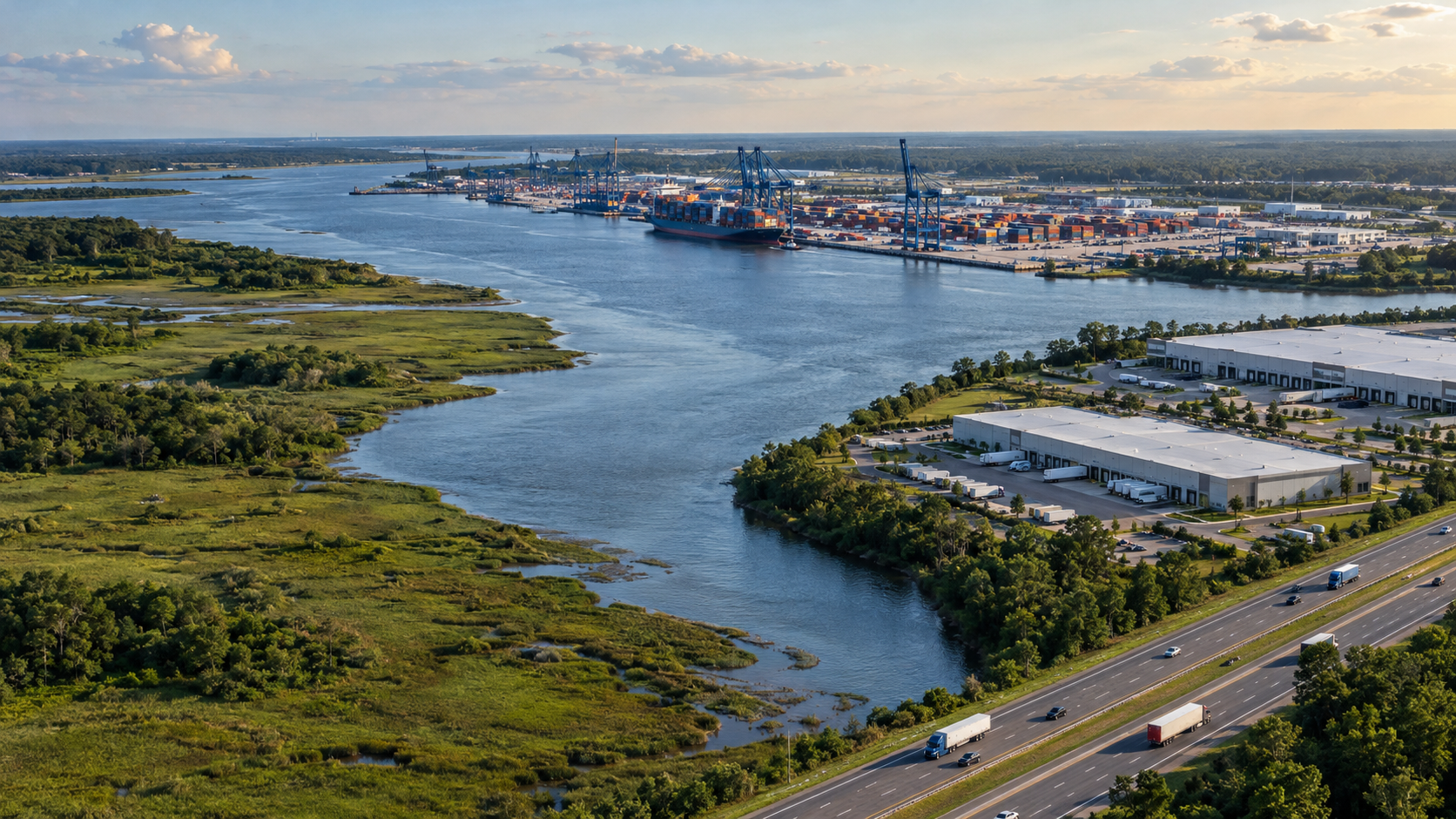
The consequences of the terminal shutdown: More warehouses, but no dedicated port for Jasper County and Hardeeville for now – why Savannah continues to grow – creative image on the topic, created with AI: Xpert.Digital
Exit 3 without Jasper Terminal: Does South Carolina still need the new I-95 interchange?
How the logistics region is changing: Containers, roads, growth: Who really benefits from the expansion in Savannah
The planned Jasper Ocean Terminal on the Savannah River has been suspended indefinitely. This eliminates a crucial future prospect for Jasper County and the city of Hardeeville – but the region's economic development will not automatically grind to a halt. While port authorities are focusing their investments on the existing Port of Savannah and preparing additional capacity there, warehouse and commercial space continues to be developed in South Carolina. At the same time, the planned Exit 3 on Interstate 95 needs to be re-evaluated: its original connection to the port project is no longer a sufficient justification. The crucial question now is whether the region can manage growth productively, efficiently, and sustainably without its own major terminal. Due to space limitations, the revised version of the entire text is not automatically included; therefore, I have not fully edited the provided text.
Port halted, growth postponed: Why Savannah wins and Jasper has to recalculate
No port, yet more trucks
The temporary closure of the Jasper Ocean Terminal does not mean the end of Jasper County as a logistics hub. Rather, it alters the economic division of labor in a region whose port operations, warehousing, transportation networks, and housing have long since merged across the Georgia-South Carolina border. The crucial question, therefore, is not whether growth is possible without a new port. It is what investments this growth actually requires, who benefits from them, and who bears the associated costs.
A clear shift is emerging along the Savannah River: Additional transshipment capacity is primarily intended to be developed within Savannah's established port system. Jasper County and the city of Hardeeville remain important locations for warehouses, distribution centers, and complementary industrial developments. This eliminates one of the original key justifications for Interstate 95 and the planned Exit 3. However, their potential importance for freight traffic and regional development does not automatically disappear. It must be demonstrated anew, independently of a port project that has been suspended indefinitely.
The end is not a collapse in demand
The cessation of active work at the Jasper Ocean Terminal is primarily an investment decision and not evidence of the region's economic decline. The port authorities of Georgia and South Carolina are focusing their financial and organizational resources on projects they currently consider more urgent and economically viable. At the same time, significant additional capacity is being prepared in Savannah. Both of these factors suggest a spatial and temporal realignment of the expansion rather than a general withdrawal from container logistics.
An important distinction must be made here. The joint project is operationally suspended indefinitely, but it is not demonstrably and legally precluded for all time. The agreement stipulates that the two port authorities could jointly rescind their suspension decision in writing. Nevertheless, for companies and municipalities, this represents a significant difference from the previous planning: A terminal without a reliable construction date, ongoing project development, and a secure implementation perspective can no longer be considered a dependable component of short-term location calculations.
Even a potential resumption in the 2040s or later would not be a continuation according to a fixed schedule, but rather a new investment decision based on the prevailing market conditions at that time. By then, ship technology, trade flows, environmental requirements, and the performance of other terminals could have changed considerably. Therefore, from an economic perspective, Jasper is currently a long-term option, not an infrastructure offering with a foreseeable future.
The actual size of the project
The Jasper Ocean Terminal was planned for the north bank of the Savannah River in South Carolina, across from Elba Island. The actual planned terminal area comprised approximately 1,500 acres. This is roughly 607 hectares, not 1,500 hectares. This distinction is significant because confusing the units of area would exaggerate the project's size by approximately two and a half times.
Accuracy is also crucial when it comes to handling capacity. The basic project concept envisioned an annual capacity of seven million TEU. TEU is the unit of measurement for a 20-foot standard container. A 40-foot container corresponds to two TEU. Seven million TEU therefore does not automatically equate to seven million containers actually handled. This difference is a significant factor in traffic forecasts, space requirements, and economic viability calculations.
The project consisted of more than just quays and container berths. Plans included additional road and rail connections, technical infrastructure, a turning basin, and modifications to the waterside access. The rail network was intended to provide connections to CSX and Norfolk Southern. A new road corridor and an additional rail crossing of the Savannah River were also part of the overall concept. Such a terminal would thus have been a self-contained transportation and infrastructure system. Its economic viability would have depended on the coordinated completion of numerous interdependent components.
Two states, different investment interests
The institutional foundations extend further back than the recently discussed joint venture. A joint project structure between the two states was established as early as 2008. The joint venture organization agreed upon in November 2015 was intended to facilitate the planning, construction, and operation of a jointly owned terminal. The original idea was understandable: instead of solely competing against each other for additional port volumes, Georgia and South Carolina could have jointly met their long-term capacity needs.
The difficulty lies in the fact that shared regional interests do not automatically generate identical operational priorities. Each port authority has existing facilities, customer relationships, investment programs, and its own responsibilities. A project that might seem beneficial for the entire region in the long term must therefore compete with immediately implementable expansions within its own jurisdiction. From Georgia's perspective, controllable expansion phases in Savannah currently clearly take precedence over an additional jointly managed location.
The standstill decision, documented with the participation of Jimmy Allgood, chairman of the Jasper Community Project, and Bill Stern, chairman of the South Carolina Port Authority, is dated May 19, 2026. It was made public in October. Environmental project work by the U.S. Army Corps of Engineers was also halted. On the Georgian side, Port Authority Director Griff Lynch and Communications Director Tom Boyd integrated the decision into their own expansion program. For Jasper County Council and the city of Hardeeville, this results in a new planning reality: regional development must proceed without the timely construction of a terminal on their side of the river.
Savannah is pursuing a phased expansion strategy
The most important counterpart to the abandoned Jasper project is the planned Savannah Container Terminal on Hutchinson Island. Approval for this project from the US Army Corps of Engineers was granted in October 2026 following a three-year review. The plans include three berths, an area of approximately 350 acres (142 hectares), and an additional annual capacity of 3.5 million TEU. The investment volume is estimated at US$2.3 billion.
The timeline must be kept strictly separate from another major project. Construction on Hutchinson Island is scheduled to begin in January 2028, with completion expected in the mid-2030s. In contrast, the separate renovation of the existing Ocean Terminal is slated for completion by the end of 2028. This expansion is budgeted at US$1.6 billion and is expected to increase its annual capacity from approximately 200,000 to 1.75 million TEU.
Together, these two projects illustrate the new strategy. Savannah is expanding existing facilities and adding another location to the established port system. This is therefore not solely a modernization of existing facilities, but a combination of renovation and spatially integrated new construction. The announced expansion includes a total of five berths for large vessels. In the long term, the port authority aims for a total capacity of approximately twelve million TEU, building on the current 7.75 million TEU. This overall goal encompasses several measures and should not be understood as the mere addition of a single project.
Turnover and capacity vary
A data-driven assessment must differentiate between actual cargo handled and theoretically available capacity. In fiscal year 2026, which ran from July 1, 2025, to June 30, 2026, the Port of Savannah handled 5.67 million TEU. In the preceding fiscal year, the figure was approximately 5.7 million TEU. This represents a largely stable annual level and not a continuous surge in growth that would immediately justify any additional capacity construction.
Comparing an annual throughput of 5.67 million TEU with the currently stated annual capacity of 7.75 million TEU yields a purely mathematical figure of approximately 73 percent. However, this is not a reliable operational capacity utilization indicator. The capacity figure describes a current situation, while the throughput reflects an entire fiscal year. Furthermore, ship arrivals, container pickups, and terminal loads are neither evenly distributed throughout the year nor evenly distributed across all facilities.
A port can therefore experience temporary bottlenecks despite planned capacity reserves. Conversely, peak months alone do not justify arbitrarily large expansions. In June 2026, for example, container movements were significantly higher than in the same month of the previous year, while the overall fiscal year remained virtually unchanged. For investment decisions, therefore, reliable demand patterns, peak loads, and the efficiency of individual process steps are more important than an isolated growth figure. The planned 12 million TEU is a long-term capacity target and not a guaranteed forecast for future cargo volumes.
Capital needs reliable demand
The economic attractiveness of a port expansion depends not only on its technical container handling capacity. Crucial factors include the timing of demand, the amount of upfront investment, ongoing operating costs, and the speed at which revenue is generated. A new terminal requires the construction of significant infrastructure before the entire system can be effectively utilized. If a key road, rail, or waterway connection is delayed, the benefits of other already financed components may also be affected.
A phased development can mitigate this risk. Not every expansion stage needs to be immediately designed and fully equipped to its final state. However, the prerequisite is that each phase is independently operational. Jasper was also originally planned for phased development. The difference, therefore, lies not in the fact that only existing ports can grow in stages, but in the necessary preliminary investments and the reliability of the underlying business.
Since 2015, approximately US$20 million has been spent on Jasper. The total terminal project was estimated to cost around US$5 billion. The planning expenditures already incurred are not sufficient justification for continuing a significantly larger construction project. They represent sunk costs: the relevant question is whether future expenditures would be justified by future benefits. Likewise, the shutdown does not automatically mean a saving of the entire estimated construction volume. A large portion of this money had not yet been invested, and additional capacity is now being prepared elsewhere.
In the aftermath of the pandemic, adaptability is key
The port authorities justify their increased focus on their core business with, among other things, ongoing disruptions since the pandemic, altered growth opportunities, and cost pressures. No single, clearly quantifiable trigger for Jasper's closure can be identified from this. However, the decision aligns with a fundamental management principle: investments must remain viable even when cargo flows, storage strategies, and the timing of demand develop differently than initially anticipated.
This uncertainty is particularly relevant for long-term infrastructure. A distribution company can adjust a lease or seek additional space at another location. A completed port, on the other hand, can only be repurposed to a limited extent. Quays, access channels, and railway lines are strongly tied to their location. The less flexible an investment is after its completion, the more important verifiable expansion phases and conservative assumptions about the timing of its use become.
The focus on Savannah should therefore be interpreted neither as a mere cost-cutting measure nor as a definitive rejection of large port projects. A new terminal costing US$2.3 billion remains a significant capital investment. The real change lies in integrating the expansion with an existing customer network, current operations, and an already established hinterland. This strategy, too, can fail if demand is overestimated. However, it reduces certain risks associated with building an entirely new port and infrastructure system.
The location follows the network
A port's economic importance is not solely derived from deep water and open waterfront. Its value arises from the interplay of shipping connections, handling quality, rail services, road access, storage capacity, and available services. Ultimately, for a shipper, what matters is how reliably and at what total cost a shipment reaches the recipient from the factory or distribution center.
Savannah already has such a network. Additional capacity can leverage existing relationships with shipping companies, freight forwarders, railway companies, and shippers. A larger facility is therefore not automatically more economical, but a well-integrated expansion can benefit from existing demand sooner than a new location that first needs to establish its operations. This connection explains why the decision to locate in Savannah can simultaneously encourage new businesses to establish operations across state lines.
For Hardeeville, the crucial factor is not on which side of the river a container is unloaded, but rather how well the subsequent transportation can be organized. A warehouse doesn't need its own seaport within the same municipality. It needs a reliable connection to an efficient port. Jasper County can therefore participate in the Port of Savannah's economic output without having to build its own new major terminal. The downside is a greater dependence on decisions made predominantly outside of its own municipal and state jurisdiction.
Hardeeville is growing even without a terminal
Developments along the US-17 corridor demonstrate that the local logistics market wasn't solely focused on the Jasper Ocean Terminal. Warehouse, distribution, and industrial facilities are being built in Hardeeville, whose locational advantages already stem from its proximity to Savannah, Interstate 95, and rail connections. The planned port facility would have provided an additional boost, but not the sole economic foundation.
A particularly large example is the South Atlantic Logistics Terminal, often referred to as SALT. The project is being developed on approximately 880 acres (about 356 hectares), significantly more than the planned 800 acres. The planned warehouse and industrial space extends up to six million square feet, equivalent to roughly 557,000 square meters. At its public presentation in 2024, a project volume of approximately US$200 million was mentioned. Such figures reflect a development intention and do not constitute proof that the entire area is already completed, leased, or permanently occupied.
Riverport and the commercial areas surrounding existing interchanges also remain part of the location's prospects. Hardeeville's city manager, Josh Gruber, therefore does not consider the indefinite suspension of the port terminal a disruption to economic development. This assessment is plausible as long as it is not mistaken for a guarantee for every single real estate project. The location's advantages may persist, while individual warehouses simultaneously face longer marketing periods, higher financing costs, or increased competition.
Your intralogistics experts

Consulting, planning and implementation of complete solutions for high-bay warehouses and automated storage systems - Image: Xpert.Digital
More information here:
Your container high-bay warehouse and container terminal experts


Container terminal systems for road, rail and sea transport in the dual-use logistics concept of heavy-lift logistics - Creative image: Xpert.Digital
In a world marked by geopolitical upheavals, fragile supply chains, and a new awareness of the vulnerability of critical infrastructure, the concept of national security is undergoing a fundamental reassessment. A state's ability to guarantee its economic prosperity, the provision of essential goods and services to its population, and its military capability increasingly depends on the resilience of its logistical networks. In this context, the concept of "dual-use" is evolving from a niche category of export control to a broader strategic doctrine. This shift is not merely a technical adjustment but a necessary response to the "paradigm shift" that demands a profound integration of civilian and military capabilities.
Related to this:
Rail transport: A key to solving logistics bottlenecks?
Many halls do not demonstrate a lack of space
A visible construction boom is not sufficient evidence of a tight rental market. This is illustrated by commercial real estate data for the greater Savannah area. CBRE reports a vacancy rate of ten percent for the third quarter of 2026. Cushman & Wakefield, using its own market definition, arrives at 10.6 percent. These figures should not be averaged uncritically, as data collection methods and geographical boundaries may differ. However, both indicate that despite the long-term strengths of the location, a significant amount of available space remains.
At the same time, demand has by no means disappeared. CBRE puts the net increase in occupied space in the quarter at around 1.5 million square feet, while Cushman & Wakefield reports approximately 1.6 million square feet. In the latter's case, this increase is offset by roughly two million square feet of newly completed space. Net absorption measures how the total occupied space changes. It is not the same as the total volume of newly signed leases, because relocations and vacant existing space must also be taken into account.
For Jasper County, these regional figures do not allow for precise local vacancy rates to be derived. However, they provide an important warning against an overly simplistic boom narrative. A port region with long-term appeal can temporarily build too many warehouses. For developers, therefore, pre-leasing, tenant quality, financing structure, and a realistic construction phase plan are crucial. A terminal closure on one side of the river and new warehouses on the other are neither a logical contradiction nor proof of risk-free growth.
Exit 3 needs new arguments
The planned Exit 3 on Interstate 95 is the most visible example of how the rationale for a transportation project can change. As early as 2009, the Jasper Project Board supported a new highway connection for the future port. In 2019, Jasper County Council approved a corresponding role for the county in the project, which was then estimated to cost approximately $82 million. The exit is planned for the area of Purrysburg Road.
An estimate submitted in December 2024 put the costs at US$85.85 million. At the same time, the project was allocated US$91.19 million at the state level, which had not yet been released by October 2026. These two amounts represent different things: a cost estimate and allocated or committed funding. They must not be added together, nor should they be treated as construction costs already spent. Even a calculated difference between the two sums, without examining the scope of work, financing components, and current prices, does not constitute a freely available surplus.
With Jasper, a significant component of the original demand forecast is temporarily eliminated. This does not automatically render Exit 3 superfluous. A new interchange could better connect existing commercial areas, relieve congestion at other junctions, or reduce local detours. However, these advantages must be demonstrated in an updated study without the expectation of Jasper terminal construction in the near future. A traffic forecast that continues to assume large volumes from a port that is not yet foreseeable would not provide a reliable basis for decision-making.
Transport benefits instead of historical justification
Several economic questions are crucial for a new assessment of Exit 3. First, it must be determined which existing and realistically expected traffic flows would utilize the interchange. This includes freight transport as well as commuter traffic, residential development, and journeys to and from services. Planned commercial areas must not be treated as if they were already developed and fully occupied.
It should then be examined whether the same benefits could be achieved with less expensive or faster-implementing measures. Improved access to existing interchanges, adapted intersections, or a better distribution of truck journeys over time can be alternatives or additions, depending on the specific bottleneck. Furthermore, a new exit does not only provide relief. It can attract additional development and thus generate further traffic in the long term. This development effect must be factored into the evaluation, instead of simply being considered an automatically positive locational advantage.
The distribution of benefits is particularly important. If a public access point primarily enhances the value of certain properties, while road maintenance and subsequent development costs fall predominantly on the general public, a distribution problem arises. This doesn't fundamentally invalidate the project. However, it argues for considering contributions from beneficiaries, the consequences of municipal development, and alternative uses of funds together. The appropriate criterion is not whether Exit 3 suited Jasper in the past, but whether, under current assumptions, the access point provides a convincing additional benefit.
The I-95 remains economically central
The decommissioning of the Jasper Ocean Terminal is clearly separate from ongoing projects on Interstate 95. The expansion from the Savannah River to the US 278 junction encompasses a corridor approximately ten miles (16 kilometers) long. Plans include additional lanes, modernized interchanges, and new bridges. The total cost is estimated at around $825 million, with completion scheduled for 2030. Exit 3 is a separate project and not simply equated with this expansion.
The economic significance of I-95 extends far beyond a single port location. It serves interregional freight traffic, commuting, regional supply deliveries, and passenger traffic. Even if additional Jasper traffic is eliminated, the existing Port of Savannah, new commercial developments, and a growing population remain real drivers of demand. The transportation policy objective therefore shifts from developing a future mega-terminal to efficiently managing an already heavily used economic corridor.
The same applies to US 17 and Speedway Boulevard. The approximately 4.1-mile (6.6-kilometer) long upgraded section at the border was also connected to earlier port plans. However, its use is not limited to this original perspective. At the same time, a distinction must be made between existing road infrastructure and merely planned port rail connections. A completed road proves neither that all previously planned rail lines exist, nor that all components of a former port transportation concept are still needed.
Population growth changes the transport calculation
Jasper County was the fastest-growing county in the US between July 1, 2024, and July 1, 2025, with a population increase of six percent. The population rose by 2,195 to 38,533. This is a significant change for a relatively small county. However, it remains a relatively high figure: a large county can gain significantly more residents and still have a lower growth rate.
For infrastructure planning, it is crucial to recognize that additional traffic will be generated even without a new seaport. New households require utilities, services, and public facilities. However, not every new resident represents an additional workforce for warehouses or industrial plants. Especially in a region that is also attractive as a retirement destination, age structure, labor force participation, and qualifications must be considered separately. Population growth and labor supply are not interchangeable indicators.
In 2024, citizens voted for an additional one percent sales tax, which is expected to generate an estimated $470 million for road improvements and green space projects. A total of 16 major infrastructure projects will be addressed. The anticipated revenue is not yet fully available and should not simply be considered an independent cash reserve in addition to other project financing. Economically, with each new residential and commercial development, the importance of prioritizing roads, drainage, utilities, and municipal capacity increases.
Railing doesn't prevent every bottleneck
The debate about additional port and storage capacity is incomplete as long as the allocation between road and rail remains unclear. In fiscal year 2026, approximately 17 percent of container traffic in Savannah was handled by rail. The remainder was transported by truck. 541,405 containers were handled by rail at the Mason Mega Rail system. This physical container count should not be directly compared to the total port throughput expressed in TEUs.
The scale of the project illustrates two points. First, rail already plays a significant role in the port system. Second, road transport remains crucial for the vast majority of traffic. Therefore, even a larger share of rail transport would not eliminate the need for efficient local roads. Short distances between terminals, container depots, and warehouses may still require truck journeys. Conversely, improved rail connections can replace longer road transport routes and expand the economically accessible hinterland.
The opening of the $134 million Gainesville Inland Port in May 2026 illustrates this approach. Such inland hubs shift some of the logistics interfaces to the hinterland. For Jasper County, the central question is therefore not just how many additional ramps and lanes will be built. The crucial question is whether specific users will gain an economically viable rail connection and whether the overall transportation chains will become more reliable. Mere proximity to a rail line is not proof of a high-performing intermodal hub.
Value creation does not come from concrete
For the economic quality of growth, what happens inside the buildings is more important than the size of their roofs. A warehouse can serve as simple temporary storage or be part of a more sophisticated supply chain, for example, with assembly, quality control, packaging, repair, or temperature-controlled storage. These functions differ in terms of capital requirements, energy consumption, qualifications, and regional integration. Large floor space alone, therefore, says little about the resulting added value.
The number of announced jobs also requires a more nuanced perspective. A distinction must be made between temporary employment during construction, permanent positions within the company, and merely anticipated indirect effects. Wage levels and job stability determine whether new developments actually improve living standards. Rising housing costs and longer commutes can offset some of the higher income. Without reliable data on job duties and compensation, it would be premature to automatically interpret every development as upward social mobility.
Automation and digital process control can improve productivity, but at the same time, they change the nature of the work required. This presents the region with a concrete development challenge: education and training must be aligned with the actual technological demands. Municipal economic development should therefore not only document land sales and square footage, but also sustainable employment, training opportunities, and additional operational functions. The goal would be a location that offers more than simply the relocation of port traffic from Georgia.
The coastal location comes at a price
For all development options, the characteristics of a coastal and riverine area must be considered in the economic analysis. In particular, flood risks, heavy rainfall, drainage, soil bearing capacity, and long-term insurability must be examined. This does not imply that a particular location poses unmanageable risks. It means that land prices and construction costs alone do not fully reflect the true life-cycle costs of an infrastructure project.
The environmental impact assessment is similarly nuanced. A terminal that is not built initially avoids the interventions that would be directly associated with its construction. However, if additional cargo is handled via other terminals and further warehouses are built, the traffic and land-use impacts do not disappear entirely. They shift or take on a different form. Whether this shift is ultimately advantageous depends, among other things, on transport routes, energy supply, land quality, and operational methods.
The planned Jasper site cannot simply be described as a completely untouched natural area. The surrounding area has a historical history of depositing material from river dredging. Therefore, a sound assessment requires an understanding of the actual condition of the land rather than idealized images. The economically relevant question is not simply nature versus port. It is: What realistic alternative uses exist, what are their associated costs, and how will they affect the overall regional transportation and settlement system?
Public costs, unequally distributed profits
The growth of a cross-border port region presents a unique fiscal challenge. Parts of the direct port activity are concentrated in Georgia, while additional storage space and the associated transportation and infrastructure needs arise in South Carolina. Consequently, the geographic distribution of corporate profits, property value increases, tax revenues, and public expenditures may not align. A regionally successful logistics system can place a greater financial burden on some municipalities than others.
New business developments can broaden the tax base. However, this is offset by expenditures for roads, fire departments, drainage, water and wastewater systems, and ongoing maintenance. Furthermore, there may be infrastructure needs arising from new households. Therefore, whether a development strengthens the municipal budget cannot be determined solely from a company's investment amount or the projected market value of the properties. A review of ongoing revenues and expenditures over longer periods is necessary.
The end of active planning for Jasper makes these distribution issues more apparent. A shared port facility would at least have created a different ownership and responsibility structure. In the now foreseeable model, coordination between port authorities, transportation authorities, the county, and the city must succeed without such a large-scale joint project. Therefore, a transparent allocation of beneficiaries is crucial for Exit 3 and further developments. The economically superior infrastructure is not automatically the one whose construction will most significantly drive up property prices.
Efficiency and dependency grow together
Concentrating additional capacity in the Savannah port system can simplify processes and make better use of existing infrastructure. At the same time, it can increase the dependence of surrounding logistics centers on this system. For Hardeeville, a larger, independent terminal in South Carolina would have been a different form of site security than the role of a hinterland location whose freight flows originate primarily elsewhere.
However, this does not automatically mean that Jasper would have been the more resilient solution. Another terminal on the same river might also be subject to certain regional disruptions. Additional berths only create genuine alternative options if their access routes, power supply, and hinterland connections remain usable in the event of a disruption. Spatial proximity can facilitate operational cooperation, but may also limit independence from shared risks.
For shippers and logistics companies, the entire supply chain remains the appropriate benchmark. A cost-effective warehouse location can lose its appeal due to unreliable access. A more expensive location can be economically viable if transit times and inventory risks can be better controlled. Accordingly, the reorganization at the Savannah River should not only be evaluated based on available TEU capacity, but also on reliability, alternatives, and the costs of operational disruptions. More capacity is an advantage, but not the same as greater resilience.
Three possible development paths
In the most likely development trajectory, Jasper County remains a growing hinterland location for Savannah. The expansion of the Ocean Terminal will gradually improve handling capabilities, while Hutchinson Island is preparing for a future capacity increase. Commercial space will be developed according to demand, and transportation measures will be more closely aligned with existing freight and commuter flows. In this scenario, foregoing immediate construction in Jasper would be a prioritization that avoids capital-intensive redundancies for the time being.
A more favorable development path would emerge if the site also acquired higher-value operational functions. This would link warehousing and transport activities more closely with production, technical processing, or specialized services. The economic impact would then depend less on the sheer volume of containers handled. Prerequisites would include a suitable workforce, reliable energy and transport networks, and sufficiently attractive living conditions for employees. Even for these, a new, dedicated seaport is not a mandatory requirement.
In the less favorable development path, the built area grows faster than demand. Underutilized warehouses face high development and financing costs, while additional residential development further strains the roads. A later port expansion would not automatically solve these problems. These three possibilities are not quantified forecasts and do not have assigned probabilities of occurrence. They illustrate why investments should be guided by verifiable milestones rather than relying on a single, consistently optimistic growth assumption.
What investment decisions must now bear in mind
For the next few years, a few precise key performance indicators will be more meaningful than grand capacity announcements. In the port sector, these include actual cargo volumes, terminal utilization, handling reliability, and the progress of individual expansion phases. In the real estate market, occupied space, not just planned space, net absorption, vacancy rates, and tenant retention are crucial. On the roads, specific bottlenecks and reliable travel times are more important than the general expectation of ever-increasing traffic.
For Jasper County and Hardeeville, the municipal follow-up costs, the wage quality of new jobs, and the accessibility of workplaces should also be assessed. Exit 3 requires a transparent cost-benefit analysis that excludes the immediate construction of the Jasper terminal. For new logistics parks, development must be aligned with demonstrable user needs. Expansion that can be broken down into independently viable phases protects both public budgets and private investors from unrealistic expectations.
The decisive competition is therefore not solely between port locations. It is between different qualities of regional development: between mere land consumption and additional value creation, between announced capacity and usable output, between land acquisition and sustainably financeable infrastructure. Whether Jasper can be economically successful without its own new port is therefore not a question of missing container cranes. The crucial factor is how productively and resiliently the region utilizes its existing proximity to Savannah.
Consulting - Planning - Implementation

Konrad Wolfenstein
I would be happy to serve as your personal advisor.
You can contact me at wolfenstein∂xpert.digital or
Just call me on +49 7348 4088 965 .
Your container high-bay warehouse and container terminal experts

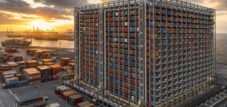
Container high-bay warehouses and container terminals: The logistical interplay – expert advice and solutions - Creative image: Xpert.Digital
This innovative technology promises to fundamentally change container logistics. Instead of stacking containers horizontally as before, they will be stored vertically in multi-story steel racking structures. This not only allows for a drastic increase in storage capacity within the same area, but also revolutionizes all processes at the container terminal.
More information here: