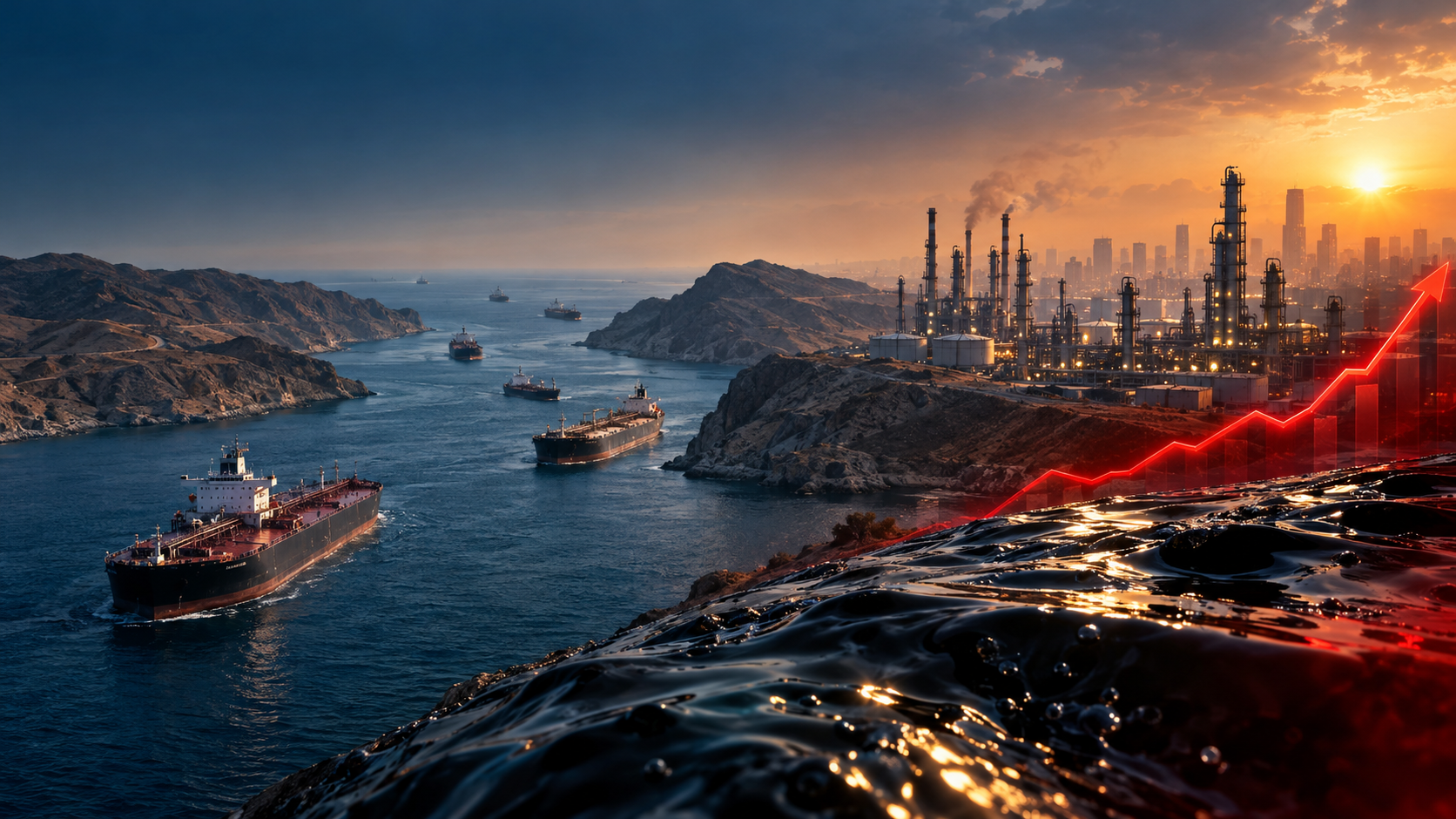
More expensive oil, higher profits: How much of the price shock is truly unavoidable? Scarcity meets market power and potential excess profits – a creative image on the topic, created with AI: Xpert.Digital
Oil is becoming scarce, profits are rising: Where does the crisis end and where does the crisis pension begin?
Oil price shock explained: Why not every price increase is solely due to scarcity
The blockade of the Strait of Hormuz has shaken the oil market and heightened concerns about a new surge in inflation. The strait is a crucial route for global oil trade. When deliveries fail to arrive, are delayed, or become riskier, prices rise – with consequences for motorists, heating oil customers, businesses, and the economy as a whole. But the price shock isn't solely a matter of insufficient volume: Transportation costs, insurance premiums, refinery bottlenecks, and market expectations also influence prices.
This raises a crucial question: How much of the increase is an unavoidable consequence of genuine scarcity – and where are companies exploiting the crisis to expand their margins? High profits are not automatically evidence of inflated prices. At the same time, not every markup can be explained solely by the global market. To understand the 2026 oil crisis, supply and demand must therefore be considered, as well as market power, price pass-through, and cost distribution. This also demonstrates why targeted relief measures and effective competition controls can be more important than blanket price caps.
Oil shock from Hormuz: Between genuine scarcity and lucrative crisis
The war is reducing oil supplies – but at the pump, society also pays for risk, market power, and crisis profits
At the beginning of 2026, the European inflation crisis appeared to be largely contained. Following the historic energy price shock triggered by the Russian attack on Ukraine and the subsequent disruptions in the gas, electricity, and commodity markets, price increases had slowed considerably. In the eurozone, inflation remained close to the European Central Bank's medium-term target of two percent for an extended period. The situation also seemed to be normalizing in Germany. Real wages rose by 3.1 percent in 2024 and by a further 1.9 percent in 2025. This allowed employees to recoup some of the purchasing power losses from 2021 to 2023, even though the price level remained permanently higher than before the crisis.
This stabilization was economically significant. It demonstrated that an exceptional price shock does not necessarily lead to a sustained wage-price spiral. While monetary policymakers had repeatedly warned of second-round effects—higher energy prices could trigger higher wage demands, which companies would then pass on through further price increases—such a self-reinforcing dynamic remained limited in 2024 and 2025. Wages reacted with a delay to the preceding losses in purchasing power, while the declining energy prices dampened inflationary pressure. The distributional conflict between labor and capital was thus not resolved, but temporarily mitigated.
The American-Israeli attack on Iran at the end of February 2026 abruptly changed the landscape. Iran responded with a de facto blockade of the Strait of Hormuz. The strait between Iran and Oman is only about 33 kilometers wide at its narrowest point and forms the strategic bottleneck between the Persian Gulf and the Arabian Sea. Before the war, approximately 20 million barrels of crude oil and petroleum products passed through it daily. This represented roughly one-fifth of global consumption of liquid petroleum products and about one-quarter of global oil trade conducted by sea. A regional war thus immediately became a global economic supply shock.
The central economic question since then is no longer whether scarcity drives up prices. That's obvious. The crucial question is rather what portion of the price increase can be explained by physically lacking quantities, higher transport and insurance costs, and necessary risk premiums – and where companies are using the exceptional situation to expand margins, strategically manage bottlenecks, or proactively overcompensate for anticipated cost increases. Those who dismiss every price increase as pure greed underestimate the actual scarcity. Conversely, those who portray every additional profit as an unavoidable consequence of the market ignore market power, asymmetric information, and the unique pricing dynamics of concentrated energy and refinery markets.
Hormus turns a regional war into a global price shock
The Strait of Hormuz is not systemically important because it is geographically small, but because a significant portion of global export capacity is concentrated behind it. Saudi Arabia, the United Arab Emirates, Kuwait, Iraq, Qatar, Bahrain, and Iran use the Persian Gulf as a central export hub for crude oil, petroleum products, and liquefied natural gas. If access is restricted, not all production will automatically cease. However, a substantial portion of the output will no longer be able to reach customers, or only with significant delays. Economically, this creates a logistical supply shock, similar to a production outage.
The existing alternative routes are insufficient. Saudi Arabia can transport crude oil to the Red Sea via its East-West pipeline, while the United Arab Emirates has a pipeline to the port of Fujairah on the Gulf of Oman. Depending on technical availability, existing capacity, and logistics, an estimated 3.5 to 5.5 million barrels per day could be moved additionally or alternatively via these routes. Compared to the approximately 20 million barrels previously transported daily through the Strait of Hormuz, a structural gap remains. Furthermore, these pipelines are not fully protected against military attacks, sabotage, or technical malfunctions. The alternative to the Strait is therefore neither adequate nor risk-free.
The blockade is not only affecting the actual quantities delivered. The mere threat of further attacks is changing the behavior of shipping companies, insurers, traders, and refineries. Tankers require higher insurance coverage, crews demand hazard pay, charter rates rise, and ships take detours or wait for clearance. Some shipments are organized via intermediate storage facilities, ship-to-ship transshipments, and less transparent trade routes. This increases the logistical effort per barrel. At the same time, the time between extraction, shipping, refining, and delivery grows. The market is thus paying not only for the oil itself, but also for uncertainty, longer capital commitment, and the risk of total loss.
This risk premium is economically real. However, it cannot be precisely separated from other price components. The observed oil price condenses physical scarcity, expectations, speculation, storage decisions, exchange rates, financing costs, and geopolitical probabilities into a single number. A high price, therefore, does not automatically prove manipulation or a perfectly efficient market. It initially only shows that the price threshold for a barrel of short-term availability has risen sharply.
The oil market does not react proportionally, but rather erratically
Even relatively small changes in volume lead to large price fluctuations in the oil sector. In the short term, consumers, freight forwarders, airlines, chemical companies, and heating oil customers can only reduce their demand to a limited extent. Vehicles, machinery, heating systems, and production facilities are already in place and cannot be converted to other energy sources within a few weeks. Therefore, short-term demand is price-inelastic. It initially falls only slightly when prices rise.
Supply also reacts sluggishly in the short term. Additional drilling, pipelines, tankers, refinery capacity, or port terminals take months or years. Strategic reserves can provide temporary relief, but they do not replace a sustainable supply. While some oil-producing countries outside the Gulf region have spare capacity, its size, quality, and actual availability are limited. Furthermore, not every type of crude oil can be processed in every refinery. Sulfur content, density, and other properties must be compatible with the technical equipment.
This creates a market where a gap of just a few percent can trigger a disproportionate price jump. The price rises until demand is squeezed out, additional quantities are mobilized, or stockpiles are released. This rationing is not based on social importance, but on ability to pay. A wealthy motorist, a multinational corporation, or a state with large foreign exchange reserves can acquire scarce energy more easily than a low-income household, a small transport company, or an import-dependent developing country.
It is precisely at this point that the technical scarcity problem becomes a distribution problem. High prices do reduce demand and incentivize additional supply. At the same time, they transfer income from consumers and importing economies to producers, owners of scarce infrastructure, and traders with access to available quantities. The price mechanism coordinates the scarcity, but it does not distribute its burden fairly. Efficiency and distribution must therefore be assessed separately.
From the price of crude oil to the consumer bill
A rise in crude oil prices reaches consumers through several channels. The direct effect is seen in gasoline, diesel, heating oil, and kerosene. In Germany, the final price is further influenced by energy tax, CO₂ pricing, and value-added tax (VAT). Fixed quantity taxes dampen the percentage increase in the final price, while the percentage-based VAT partially reflects the nominal rise. Exchange rate fluctuations also play a role because crude oil is predominantly traded internationally in US dollars. A weaker euro further increases the cost of imports.
The second channel involves production costs. Crude oil is not only a fuel but also a raw material for plastics, chemicals, paints, fertilizers, packaging, and numerous industrial intermediates. If the price of naphtha or other refinery products rises, costs increase along long value chains. Companies pass on this burden with a time lag, depending on competition, contract durations, inventory levels, and demand.
The third channel runs through transport and logistics. Higher diesel prices increase the cost of road freight, agriculture, construction, and municipal services. Higher kerosene prices burden airlines and air freight. More expensive marine fuels and insurance increase the costs of international trade. Because almost every product is transported, energy acts as a cross-cutting factor. However, the pass-through is rarely complete and immediate. Some companies absorb some of the costs in their margins, others raise prices, reduce quality, or postpone investments.
The fourth channel concerns expectations. If households and businesses assume that energy will remain expensive indefinitely, they adjust their behavior. Employees demand higher wages, landlords calculate higher utility costs, companies add safety margins to their bids, and traders build up inventories. Such reactions can transmit an initially external shock into the domestic economy. The longer the conflict lasts and the more frequently energy prices reach new record highs, the greater the risk that temporary oil inflation will develop into broader inflation.
Germany feels the shock first at the petrol station and heating oil tank
In September 2026, German consumer price inflation stood at 3.3 percent, following 2.9 percent in August and 2.8 percent in July. Energy prices rose by 14.9 percent compared to the same month of the previous year. Fuels saw particularly sharp increases of 37.1 percent, followed by heating oil at 74.9 percent. Compared to August, energy products alone increased in price by 3.8 percent within a single month. These figures demonstrate how quickly an external economic shock can impact the cost of living.
At the same time, inflation excluding energy remained significantly lower. Excluding energy, it stood at 2.1 percent in September, and excluding heating oil and fuels, it was even lower at 1.8 percent. Thus, the new surge in inflation was initially primarily an energy-related phenomenon and not yet a fully entrenched general wave of price increases. This distinction is crucial for economic policy analysis. A central bank cannot replace missing oil tankers with higher interest rates. It can only prevent the shock from having a lasting impact on expectations, wages, services, and general price setting.
For households, however, this analytical separation has limited relevance in everyday life. Those who commute, heat with oil, or live in poorly insulated buildings experience the overall burden. Energy costs hit low-income households particularly hard because they consume a larger share of their available budget. Wealthier households often consume more energy in absolute terms, but can more easily absorb price increases and invest more quickly in heat pumps, insulation, photovoltaics, or a more efficient vehicle. The same price shock is therefore relatively regressive.
The impact also varies regionally and at the company level. Rural areas with weaker public transport are more dependent on fuels. Freight forwarders, bus companies, construction firms, agricultural businesses, and energy-intensive industries are under more rapid cost pressure than digital service providers. Export companies can sometimes command higher prices abroad, while locally operating medium-sized businesses with limited market power are more severely squeezed between rising costs and price-sensitive customers.
Why the wage-price spiral has not been the main problem so far
The warning about a wage-price spiral is theoretically plausible, but in the European debate after 2021 it was often used too generally. Real wages initially fell significantly because collective bargaining agreements and individual wage adjustments occurred more slowly than the sudden rise in consumer prices. Subsequent nominal wage increases were therefore to a considerable extent a catch-up adjustment of purchasing power and not the starting point of inflation.
The real wage increases of 3.1 percent in 2024 and 1.9 percent in 2025 did not mean that employees immediately recouped all previous losses. Rather, they showed that, with declining inflation, wage growth was once again exceeding price increases. A dangerous spiral would have required wages, prices, and expectations to continually accelerate each other. The moderate inflation trends in 2024 and 2025 provided insufficient evidence of this.
The new oil shock changes the initial situation, but not automatically the diagnosis. If energy prices once again erode purchasing power, unions and employees will try to limit real income losses. This is initially a normal distributional conflict. It becomes particularly dangerous for inflation when companies can pass on higher labor costs entirely to prices while simultaneously defending or expanding their profit margins. A sole focus on wages is therefore insufficient. Prices are formed from labor costs, intermediate inputs, taxes, productivity, financing costs, and profit margins.
The crucial question is who bears the real loss of prosperity caused by an import price shock. If Europe has to pay more abroad for the same amount of energy, the real income available for distribution within its borders decreases. Employees, businesses, and the government cannot all simultaneously avoid this loss entirely. If all groups try to maintain their existing share unchanged, domestic price pressure increases. Sustainable adjustment therefore requires a temporal and social distribution of the burden, not a unilateral disciplining of wages.
Profit is not automatically excess profit
High corporate profits during a price shock are striking, but in themselves not proof of abusive pricing. For commodity producers, profits rise mechanically when the market price increases, while production costs remain largely unchanged in the short term. An already developed oil field does not suddenly double its production costs simply because a war raises the world market price. The difference between the market price and marginal costs grows. This generates economic rents, i.e., returns that can exceed the normal rate of return necessary to maintain production.
Part of these revenues fulfills a market function. High prices signal scarcity, reward additional production, make more expensive sources profitable, and encourage investment in transportation, refining, and alternative technologies. Producers also bear political, geological, and financial risks. In years of low prices, projects can incur losses. A sound assessment must therefore not only consider an exceptionally profitable quarter but also take investment cycles and the risks of losses into account.
Excess profits begin where returns are not primarily based on additional performance, innovation, or assumed risk, but rather on an unexpected external event, existing property rights to scarce resources, or exploitable market power. The term is therefore not a precise balance sheet item, but rather an economic policy assessment. In practice, it can be approximated by comparing current returns with a multi-year average and taking into account special effects, investment needs, and losses from previous years.
It is also important to distinguish between absolute profit, profit per unit, and profit margin. If the selling price increases in the same proportion as costs, the nominal profit per unit can increase even though the percentage margin remains unchanged. Conversely, a company can achieve high absolute profits while its margin decreases if sales and price levels grow significantly. Therefore, anyone wanting to analyze excess profits must consider quantities, costs, margins, returns on capital, and comparison periods together.
Our global industry and economic expertise in business development, sales and marketing


Our global industry and economic expertise in business development, sales and marketing - Image: Xpert.Digital
Industry focus areas: B2B, digitalization (from AI to XR), mechanical engineering, logistics, renewable energies and industry
More information here:
A thematic hub offering insights and expertise:
- Knowledge platform covering global and regional economies, innovation and industry-specific trends
- A collection of analyses, insights, and background information from our key areas of focus
- A place for expertise and information on current developments in business and technology
- A hub for companies seeking information on markets, digitalization, and industry innovations
The role of market power in the oil price
Various markets lie between the conveyor platform, the refinery, and the gas station
Public debate often speaks of oil companies in general terms. In reality, the industry encompasses very different business models. In the so-called upstream sector, companies search for deposits and extract crude oil and gas. In the midstream sector, raw materials are stored and transported. The downstream sector includes refineries, wholesalers, petrochemical processing, and gas stations. An integrated corporation can operate at several levels, but profits and shortages do not occur simultaneously across all these stages.
Oil companies generally benefit directly from higher crude oil prices, provided their own production doesn't shut down. Refineries earn their money from the difference between the price they pay for crude oil and the selling prices of gasoline, diesel, kerosene, or heating oil. This refinery margin can increase significantly if not only crude oil, but especially certain end products, are in short supply. In 2026, disrupted trade flows and limited refining capacity exacerbated the situation, particularly for middle distillates like diesel and jet fuel. Therefore, diesel can become considerably more expensive than the crude oil price alone would suggest.
Gas stations, in turn, often have limited margins on fuel and earn additional income from shops, car washes, and services. The visible price at the pump makes them a target for criticism, even though the crucial profit may originate elsewhere in the chain. At the same time, local markets with few suppliers or low price transparency can encourage excessive markups. A proper investigation must therefore analyze each stage separately.
The timing of price pass-through is also relevant. Consumers often observe that fuel prices rise rapidly when crude oil prices increase, but fall more slowly when prices decrease. This behavior, known as the "rocket and feather" pattern, can have various causes: inventories were purchased at different prices, taxes and refinery margins change, exchange rates have an opposing effect, or local competition is weak. However, the pattern can also indicate pricing power and a lack of competitive pressure. Therefore, it should be empirically tested and not solely evaluated based on anecdotes.
Scarcity creates space, market power determines its use
In a perfectly competitive market, companies can hardly raise prices independently of market forces. They remain price takers. Energy markets, however, are characterized by high barriers to entry, large capital requirements, lengthy approval processes, concentrated ownership, and geopolitically controlled resources. On the supply side are national oil companies, large integrated corporations, the OPEC+ countries, specialized traders, and a few global infrastructure operators. This structure creates opportunities that can extend beyond mere scarcity.
Market power doesn't necessarily imply collusion. It can arise simply from suppliers knowing that customers have little chance of finding alternatives in the short term. When capacity is scarce, prices are driven by the most expensive supply still required, not by average costs. Companies that secure favorable subsidies or purchase quantities early thus generate high returns. This is a typical outcome of scarcity markets, but it becomes particularly politically sensitive when the underlying good is indispensable.
Added to this is the information asymmetry. Companies know their purchase prices, inventory levels, supply contracts, and hedging arrangements more precisely than government agencies and consumers. A corporation can point to higher expected replacement costs even though parts of its current inventory were purchased more cheaply. Such a valuation based on replacement costs is not inherently wrong from a business perspective, because sold inventory must be replaced later. However, it can temporarily generate significant inventory profits. Whether this results in an unreasonable markup can only be assessed with detailed data.
The correct criterion, therefore, is not whether profits have increased, but why. Profits based on higher volumes, more efficient production, assumed risks, and necessary investments must be assessed differently than profits resulting from artificial restraint, opaque markups, or margin expansion without a corresponding increase in costs. Competition policy requires reliable transaction data, not moral assumptions.
The experience of 2022 was neither pure greed nor pure cost passing on
The wave of inflation following the Russian attack on Ukraine provides important insights. Energy and food prices, as well as disrupted supply chains, were the initial drivers. At the same time, unit profits for many companies rose exceptionally sharply at times. In the euro area, profits contributed significantly to the increase in the GDP deflator, which measures domestic price developments, in several quarters of 2022 and 2023. At times, their contribution was greater than that of unit labor costs.
However, this does not mean that companies caused all of the inflation. With sharply rising input prices, nominal unit profits can increase even with stable percentage markups. Furthermore, there were significant differences between sectors. Producers of scarce energy, individual traders, and certain industrial sectors benefited, while energy-intensive businesses, restaurants, retailers, and smaller service providers often suffered from higher costs. Aggregated profit figures obscure this distribution.
Nevertheless, the episode showed that companies did not absorb the higher costs as effectively through lower margins as had often been the case in previous downturns. In the aftermath of the pandemic, pent-up demand met limited supply. In an environment of generally accepted price increases, it was easier for suppliers to pass on costs or expand margins without immediately losing market share. High inflation, in a sense, provided a smokescreen, making it difficult for consumers to discern the cause of individual price changes.
For 2026, this leads to a clear lesson: the alternative is not scarcity or excess profit. Both can occur simultaneously. The war and the blockade explain the fundamental price impulse. Market structure determines how strong and how lasting this impulse is influencing final prices, margins, and profits. Therefore, an economically sound analysis must trace the causal chain from the missing barrel to the company's financial statements.
Speculation amplifies movements, but it doesn't create oil from paper
Futures markets quickly become suspects during crises. Traders buy and sell futures, options, and other contracts on future oil deliveries. These markets allow producers, refineries, airlines, and transportation companies to hedge prices. Without speculators taking offsetting positions, such hedges would be more expensive and less liquid. Speculation therefore fulfills an economic function.
At the same time, strongly one-sided expectations can amplify short-term movements. If many market participants anticipate further escalation, futures prices and risk premiums rise. Traders build up inventories if later selling prices appear attractive. This reduces supply in the current market, even though the expectation of future scarcity may be rational. Conversely, signals of political easing can trigger abrupt price declines.
The crucial factor is the connection to the physical market. Paper trading can influence prices, but it cannot permanently mask a physical supply gap lasting for months. If refineries actually receive less crude oil and inventories fall, the fundamental pressure remains. The blanket assertion that speculators invented the shock is just as inadequate as the assumption that financial markets perfectly reflect every scarcity at all times.
From a regulatory perspective, high transparency, position reporting, effective limits against market manipulation, and monitoring of unusual concentrations are sensible. Blanket bans on speculative positions, on the other hand, could reduce liquidity and make hedging against real-economy risks more difficult. The goal should not be a politically determined oil price, but rather a market in which prices are distorted as little as possible by deception, insider knowledge, or artificial scarcity.
Monetary policy faces a classic dilemma
An oil price shock simultaneously increases inflation and weakens growth. Households can afford less with their income, businesses face higher costs, investments become less certain, and importing countries lose purchasing power to other countries. Higher interest rates cannot remedy this real scarcity. They make loans more expensive and dampen demand, even though the original problem lies on the supply side.
Inaction is nevertheless risky. If overall inflation remains significantly above the target for an extended period, expectations can change. Companies then regularly factor in higher price increases, employees demand larger wage increases as a precaution, and long-term contracts are adjusted. The European Central Bank must therefore distinguish between the temporary direct energy effect and the threat of inflation becoming entrenched.
The best response depends on the data. If core inflation remains moderate, long-term expectations are stable, and the economy weakens significantly, this argues against aggressive tightening. However, if price increases spread to services and goods, wages rise significantly above productivity and target inflation, or expectations deviate from the two percent target, a monetary policy response becomes more likely. The central bank should clearly communicate that it cannot prevent the first-round effect but will limit a sustained second round.
Monetary policy must not resolve the distributional conflict unilaterally. Higher interest rates burden debtors, construction investments, young companies, and governments, while savers and financial institutions partially benefit. If an imported energy shock is combated solely by dampening demand, the economic side effects may outweigh the inflation-reducing benefits. Monetary policy therefore needs support from targeted fiscal, competition, and energy policies.
Relief must help without denying the scarcity
Broad reductions in energy taxes or general price caps are politically attractive because their effects are quickly visible. However, they have economic drawbacks. They weaken the price signal, stimulate consumption, and can pass on some of the relief to suppliers through higher net prices. In the event of imported shortages, this could potentially increase demand for precisely the commodity that is lacking. Furthermore, households with high consumption benefit disproportionately.
Targeted, income-based transfers are more effective. They maintain the purchasing power of particularly affected households without completely neutralizing the relative price of oil products. Commuters in rural areas, low-income heating oil customers, and employees without reasonable alternative transportation options require different support than wealthy households with multiple vehicles. However, precise assistance requires efficient administrative data and rapid disbursement processes.
Aid for businesses should be tied to clear criteria. Temporarily illiquid but fundamentally competitive companies may need loan guarantees or temporary support. However, permanent subsidies for energy-intensive business models without a transformation perspective perpetuate dependencies. Support should, wherever possible, be linked to efficiency measures, process changes, diversification of energy sources, or binding investment plans.
Strategic oil reserves can bridge extreme shortages and limit panic-driven price spikes. However, they are a form of insurance, not a permanent additional source of supply. If reserves are released too early or in excessive amounts, the buffer against further escalations diminishes. Their use should be internationally coordinated, time-limited, and tied to clearly identifiable physical supply disruptions.
A tax on excess profits can be fair – if it is precisely designed
A temporary levy on exceptional crisis profits is economically justifiable if the profits result primarily from an external shock and not from additional output. It can capture a portion of the scarcity rents and use them to finance targeted relief measures. This spreads the social costs of the shock more broadly without completely overriding market prices.
The structure determines success or failure. Taxation should not be based on revenue, but rather on a clearly defined profit above a multi-year average. Loss years, investment cycles, and industry-specific risks must be taken into account. The reference period must not be chosen in such a way that a randomly weak year artificially lowers the average profit. At the same time, corporations must not be able to easily shift profits out of the taxable sphere through transfer pricing, intra-group financing, or geographical relocation.
Investment incentives can be protected by partially crediting demonstrable additional investments in security of supply, refinery flexibility, efficiency, renewable energies, and climate-neutral technologies. Caution is advised: generous exemptions can erode the tax base and subsidize expenditures that were already planned. A temporary rule with a clear expiration clause is more credible than a retroactive or constantly changing special tax.
It is argued against excess profit taxes that they increase regulatory uncertainty and could discourage future investments in risky energy projects. This argument should be taken seriously. However, it does not argue against all special levies, but rather in favor of predictable criteria. If companies know that extreme, war-related returns above a transparent threshold will be partially taxed, while normal returns and new production remain protected, the investment effect can be limited.
Competition control is more important than symbolic outrage
Taxes redistribute profits retroactively, but they do not prevent abusive pricing. That is the responsibility of competition authorities. They require timely data on refinery utilization, wholesale prices, inventory levels, import costs, transport bottlenecks, and regional gas station prices. Only with this information can it be determined whether price markups are justified by costs and scarcity or whether companies are exploiting their market position.
Refineries and product markets deserve special attention. Even with sufficient crude oil availability, a lack of capacity for diesel, kerosene, or certain petrochemical products can create independent bottlenecks. Maintenance shutdowns, technical failures, and regional specialization significantly impact prices. A policy focused solely on crude oil prices overlooks these bottleneck rents.
Mergers and vertical integration also need to be scrutinized. An integrated corporation can stabilize supply because extraction, transport, and refining are coordinated. However, the same structure can make it more difficult for competitors to access infrastructure and reduce price transparency. Regulators must therefore ensure non-discriminatory access to essential terminals, pipelines, and storage facilities without devaluing necessary investments.
Public price comparison systems can strengthen competition in local fuel markets. However, they are only effective if data is up-to-date, complete, and easily accessible to consumers. While they cannot guarantee low prices during a global supply crisis, they can make unjustified regional markups more difficult. Transparency is no substitute for supply, but it does reduce the scope for hidden margin expansion.
Europe's real weakness is its dependence on the individual barrel
Short-term crisis policies should not obscure the fact that Europe's structural problem lies in its high consumption of imported fossil fuels. As long as transport, heating, chemicals, and parts of industry remain heavily dependent on oil, any geopolitical conflict along a key route can trigger significant revenue losses. Diversifying supplier countries reduces individual risks but does not eliminate dependence on global market prices.
The most effective long-term insurance lies in lower oil demand. Electrification of transport, efficient public transport (both local and long-distance), rail freight, more efficient logistics, building renovation, and alternative industrial raw materials reduce price sensitivity. This transformation is not free and requires power grids, charging infrastructure, storage, skilled workers, and reliable permits. However, it reduces the amount that needs to be imported at peak prices in any future crisis.
Efficiency also possesses strategic value that is often underestimated in normal market prices. A fuel-efficient vehicle fleet, optimized routes, and less energy-intensive production not only reduce emissions but also geopolitical vulnerability. Companies should therefore not view energy solely as a recurring expense but also as a risk factor in procurement, financing, and location planning.
Liquid energy carriers will remain important for the petrochemical industry and for air and maritime transport for the foreseeable future. Research, recycling, synthetic fuels, and sustainable biogenic alternatives are crucial in these sectors. Currently, these options are often expensive and limited in quantity. Precisely for this reason, policymakers should prioritize: scarce climate-neutral molecules should initially be used in applications that are difficult to electrify directly, not in areas with more efficient electricity solutions.
The fair standard combines scarcity, performance, and power
An objective assessment of oil inflation must consider three levels simultaneously. First, there is a real physical and logistical scarcity. Before the war, the Strait of Hormuz transported quantities that cannot be fully replaced in the short term. Higher prices are therefore not merely the result of corporate whims, but a mechanism for adjusting supply and demand.
Secondly, this scarcity generates exceptional rents. Owners of accessible deposits, functioning pipelines, refineries, storage facilities, and trading positions can realize profits far exceeding their short-term increased costs. Such profits are partly systemic and can signal investment. However, they are not automatically socially deserved, especially if they arise solely from war, blockade, or existing market concentration.
Third, market power determines how far companies amplify the shock and how slowly they pass on the easing of restrictions. Therefore, neither a moral condemnation of all profits nor an uncritical reference to the global market is sufficient. What is needed is a data-driven examination of quantities, costs, margins, inventory levels, investments, and competition at every stage of the value chain.
The rationale, therefore, is that the predominant initial impetus for the 2026 oil inflation was a real supply shock. The blockage of Hormuz, increased risks, and limited alternative routes fundamentally explain the sharp rise. However, they do not automatically explain every margin, every regional premium, and every delay in subsequent price reductions. Where profits grow faster than comprehensible costs and risks, this is where policymakers and regulators must examine the area of potential crisis rent.
The scandal is not the profit, but the uncontrolled crisis pension
A market economy needs profits. Without returns, there is insufficient investment in extraction, transportation, refining, efficiency, and alternative technologies. In a crisis, companies assume real risks and mobilize additional quantities. This effort should be compensated. The political mistake would be to declare every profitable company the culprit and thereby weaken the supply-side response.
It would be equally wrong to treat exceptional profits as natural and beyond public scrutiny. Energy is a fundamental factor of production, its markets are concentrated, and its infrastructure has often been enabled over decades by government regulations, concessions, security guarantees, and public investment. When a war increases societal burdens while simultaneously generating extreme rents for certain actors, the state has a legitimate interest in transparency, competition, and a fair share of these profits.
The economically convincing response therefore combines several instruments. Targeted transfers protect particularly burdened households without artificially lowering consumption prices. Temporary aid stabilizes fundamentally viable companies and simultaneously promotes adaptation. Strategic reserves smooth out acute losses. Competition control examines margins and bottlenecks. A precise excess profit tax can partially capture exceptional crisis rents. Monetary policy prevents the energy shock from permanently impacting expectations and general price levels. Investments in efficiency, electrification, and alternative energies permanently reduce vulnerability.
The price of oil is more than just a market indicator in this crisis. It is simultaneously a signal of scarcity, a geopolitical risk premium, a distribution mechanism, and a potential amplifier of economic power. Anyone who considers only one of these aspects arrives at a convenient but false explanation. Scarcity is real. Excess profits can be as well. The crucial task is to clearly distinguish between the two, without denying the market mechanism and without downplaying its power dynamics.
🎯🎯🎯 Data-driven B2B industry hub as a quasi-in-house solution


The quasi-in-house solution: How Xpert.Digital closes operational gaps in B2B marketing and sales – Smart Content-Driven Business - Image: Xpert.Digital
Xpert.Digital is a data-driven B2B industry hub led by Konrad Wolfenstein . The company acts as an external, quasi-in-house solution for industrial partners, closing operational gaps in marketing, content, and sales – without requiring additional resources on the client side.
More information here:
Your global marketing and business development partner
☑️ Our business language is English or German
☑️ NEW: Correspondence in your native language!

Konrad Wolfenstein
I and my team are happy to be available to you as your personal advisor.
You can contact me by filling out the contact form here wolfenstein@xpert.digital:or simply call me at +49 7348 4088 965. My email address is
I'm looking forward to our joint project.