
Mobile Device Management (MDM) for virtual reality glasses: The top ten providers in enterprise use
Xpert Pre-Release

Available in 27 languages 📢
Prefer Xpert.Digital on GoogleⓘPublished on: June 3, 2026 / Updated on: June 3, 2026 – Author: Konrad Wolfenstein
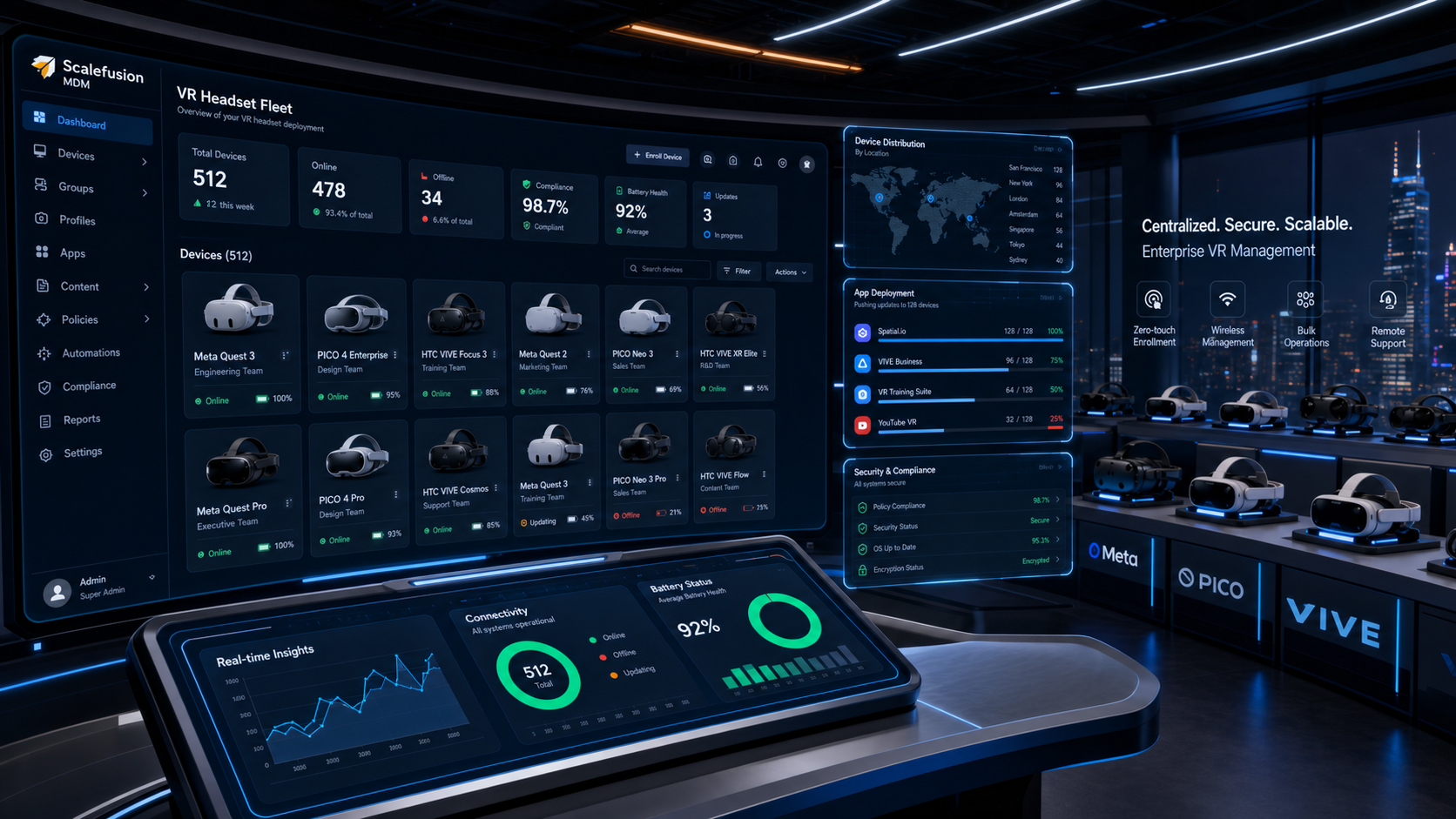
Mobile Device Management (MDM) for virtual reality headsets: The top ten providers in enterprise use – Image: Xpert.Digital
No more expensive gimmicks: This is how professionals manage their virtual reality fleets
GDPR trap VR glasses: These MDM providers protect your sensitive company data
Virtual reality has long since moved beyond the niche of pure entertainment and evolved into a highly profitable tool for business practice. Whether for onboarding, complex industrial simulations, or occupational safety – the technology promises enormous efficiency gains and a measurable return on investment. However, widespread implementation presents a formidable technical and organizational challenge: anyone attempting to manually update, secure, and manage dozens or even thousands of headsets is bound to fail. This is precisely where Mobile Device Management (MDM) for virtual reality comes into play.
Without centralized control software, even the best hardware quickly becomes an incalculable security risk and an expensive gimmick. IT departments need control over app deployments, data privacy, and device health. In this comprehensive guide, we explore why VR-MDM is the absolute prerequisite for scalable XR projects. We demonstrate how agile, specialized solutions differ from established generalists and compare the ten leading platforms—from ArborXR and Meta to Microsoft and a GDPR-compliant solution from Germany—to help you choose the right infrastructure.
If companies take VR seriously, they must also retain control – otherwise the technology will become an expensive gimmick
Why VR without central administration fails in companies
Virtual reality has evolved in recent years from a visionary niche product to a serious enterprise technology. The global enterprise AR and VR market was estimated at $42.8 billion in 2025 and is projected to grow to nearly $198.6 billion by 2034 – an annual growth rate of 18.6 percent. Training and simulation applications lead the market with a 31.2 percent share, and large enterprises account for the lion's share of demand at 67.8 percent. A Forrester report commissioned by Meta shows that enterprise VR training achieves a 219 percent return on investment over three years, with a payback period of less than six months. For an organization with 10,000 employees, 3,300 of whom are trained using VR, costs of $1.9 million are offset by savings of $6.1 million.
These figures sound enticing – but they assume that the hardware can be operated reliably, securely, and efficiently. This is precisely where the real problem begins. Anyone operating 50, 200, or even 2,000 VR headsets in an organization today faces a management challenge that is impossible to overcome without professional infrastructure. Each device must be supplied with the correct operating system update, equipped with the appropriate applications, protected against unauthorized use, and remotely locked in case of loss. Mobile Device Management for VR – VR-MDM for short – is therefore not an optional add-on, but rather the fundamental operational requirement for scalable VR deployment.
The core functions of a professional VR-MDM can be summarized in four dimensions: firstly, the central management of all headsets via a single dashboard that controls updates, app installations, and device status; secondly, kiosk mode, which restricts users to approved applications, thus preventing distractions and accidental configuration changes; thirdly, security and privacy features such as remote locking, data encryption, and device tracking; and fourthly, user account management, which allows login with dedicated company accounts instead of private accounts.
The VR-MDM provider market: specialized solutions versus generalist platforms
A look at the market reveals a fundamental divide between two types of providers. On the one hand, there are specialized XR-MDM platforms developed exclusively for virtual reality, augmented reality, and mixed reality. On the other hand, there are generalist enterprise MDM solutions that treat VR headsets as one of many supported device classes. Both approaches have their merits – but they address fundamentally different organizational requirements.
Specialized solutions understand the unique characteristics of the XR ecosystem: the high fragmentation of hardware platforms, the specific app store architectures of Meta, PICO, and HTC, the need for immersive, real-time content control, and the necessity of operating devices even in Wi-Fi-poor industrial environments. Generalist MDMs, on the other hand, offer the advantage of a consolidated IT infrastructure where VR headsets are managed alongside smartphones, tablets, laptops, and other endpoints—a significant cost advantage for companies with existing MDM contracts.
ArborXR: The most widely used specialized solution for enterprise XR fleets
ArborXR has established itself as the leading specialized MDM platform for the enterprise XR market. Supporting headsets from Meta, PICO, HTC VIVE, and a wide range of other Android-based XR devices, the platform is explicitly designed to meet the needs of IT teams and large organizations. Key strengths include bulk device registration, a sophisticated kiosk mode, real-time monitoring of all headsets, and an in-VR single sign-on feature that enables seamless user switching on the same device.
The pricing model follows a three-tiered subscription: The Starter plan costs $84 per device per year (or $8 per month), the Essential plan $120 per year ($12 per month), while the Enterprise plan is priced individually. Educational institutions benefit from significantly reduced rates of $4 or $6 per month. ArborXR is SOC 2 certified and is in the process of achieving ISO 27001 certification, making the platform suitable for privacy-sensitive industries.
A key advantage of ArborXR lies in its cross-platform functionality: While Meta Horizon Managed Services exclusively supports Meta hardware, ArborXR can be used across different manufacturers, thus offering significantly more flexibility in hardware decisions. Walmart, one of the world's largest retailers, uses ArborXR for its VR training – a testament to the platform's scalability.
ManageXR: User-friendliness as a differentiating feature
ManageXR follows a similar technical approach to ArborXR, but deliberately differentiates itself through a simplified user interface designed for non-technical users. The platform also supports Meta, PICO, HTC VIVE, and other Android-based XR devices, and in addition to kiosk mode, app deployment, and real-time monitoring, it offers an in-VR tutorial function that guides users through operation directly in the headset – a feature that ArborXR lacks.
The pricing structure is nearly identical to ArborXR: $84 per device per year in the Starter plan, $120 annually in the Essential plan, with individual pricing for enterprise customers. ManageXR is particularly well-suited for organizations that want to scale XR without in-depth IT expertise—for example, mid-sized companies implementing VR training for the first time. According to ManageXR, the platform supports some of the world's largest VR deployments.
One difference from the competitor lies in the ecosystem: ArborXR has a publicly accessible app directory, while ManageXR operates a closed "Discover XR" portal. For companies that rely on curated and controlled app environments, the ManageXR model may even be preferable. Both providers are SOC 2 certified and are working towards ISO 27001 certification.
Meta Horizon Managed Services: The essential program for Quest users
Meta has fundamentally restructured its enterprise offering. What was formerly known as "Oculus for Business" and then "Meta Quest for Business" is now called Meta Horizon Managed Services (MHMS) and has been mandatory since 2025 for all new enterprise customers who want to manage Meta Quest headsets with third-party MDMs. MHMS functions less as a full-fledged MDM and more as an enrollment framework that enables registration with external solutions like ArborXR and ManageXR.
The good news: Since February 2026, MHMS has been free for new and existing customers, after Meta initially charged €179.99 per device per year for the subscription – a pricing structure that caused considerable dissatisfaction among many enterprise customers. MHMS itself offers basic features such as app deployment, limited device configuration, and a simple kiosk mode, but lacks the depth of professional MDM solutions. Meta has announced that it will operate MHMS in a maintenance mode until at least January 2030 – no further active development is planned.
For organizations that operate only meta-hardware and require basic management functions, MHMS may suffice as a free entry-level solution. However, those operating across platforms, requiring complex deployment workflows, or needing advanced security features will need to combine MHMS with a specialized MDM.
PICO Business Device Manager: The strong competitor from Asia
PICO, the VR subsidiary of the ByteDance group, offers a comprehensive, proprietary MDM solution specifically for PICO headsets: the PICO Business Device Manager. The platform enables complete remote management of the entire device fleet: restarting, shutting down, factory resetting, data erasure, and real-time live monitoring of a headset. The content management system is particularly powerful, allowing the deployment of apps, videos, files, and even location-based experience maps (LBE maps).
A key technical feature is the video encryption function: content can be encrypted locally using a PC tool, and the decryption keys are distributed exclusively via the device manager platform – a feature particularly relevant in industries with proprietary training content. The role-based access model, with Owner, Admin, Reader, and Device User roles, allows for granular permission assignment in larger IT teams. Single sign-on via Generic OAuth is also supported.
PICO positions itself as particularly attractive for European companies seeking an alternative to Meta – especially given the PICO 4 Ultra Enterprise, which, according to a recent comparison, is considered the best overall package for industrial training and mixed reality. The platform scales seamlessly from a handful of devices to fleets of several hundred headsets.
VMware Workspace ONE XR Hub: Enterprise-level integration
Broadcom (formerly VMware) offers Workspace ONE XR Hub, providing deep integration of VR headsets into existing enterprise MDM infrastructures. The strength of this solution lies not in XR-specific features, but in its seamless integration with the entire Workspace ONE ecosystem: VR headsets are managed together with smartphones, laptops, and other enterprise endpoints via a single console.
XR Hub supports MetaQuest, PICO, and HTC VIVE, and offers zero-touch enrollment, where headsets are automatically enrolled in the MDM upon first power-up—without any manual device configuration. Multi-factor authentication, single sign-on (SSO) access for all apps including WebXR, conditional access control, and integration with Azure Active Directory and other identity providers elevate Workspace ONE to a different security category than pure XR MDM solutions. Furthermore, connectivity to NVIDIA CloudXR enables access to compute-intensive PC VR applications via the cloud.
For DAX-listed companies, financial service providers, or pharmaceutical companies looking to integrate their VR fleet into an existing VMware infrastructure, Workspace ONE XR Hub is the logical choice. The downside: The solution is significantly more complex to set up and operate than specialized XR MDMs, requiring greater IT resource allocation.
🎯🏢🥽 Enterprise XR Solution Hub for B2B projects – from digital twins to customized extended reality solutions

Enterprise XR Solution Hub for B2B projects – from digital twins to customized mixed reality solutions – Image: Xpert.Digital
Xpert.Digital acts as a holistic Enterprise XR Solution Hub, seamlessly integrating high-performance Pimax hardware into industrial B2B workflows. From digital twin analysis in engineering ("top floor") to immersive training on the production floor ("shop floor"), companies receive a customized, comprehensive solution including strategic consulting and support.
More information here:
Is a separate MDM necessary for Pimax?
It depends on the use case. For most enterprise users employing Pimax headsets in PC VR mode, a dedicated VR MDM is unnecessary – management takes place on the connected Windows PC, which is already fully covered by traditional endpoint management solutions (Microsoft Intune, SCCM). In this mode, the headset itself is simply an output device, similar to a monitor.
Why an MDM strategy is crucial before your VR fleet grows
Microsoft Intune: The Microsoft 365 way into VR management
Microsoft Intune offers native support for the Microsoft HoloLens 2, as well as enhanced management capabilities for select Android-based VR headsets such as the PICO Neo 3 and Meta Quest, under the Intune Plan 2 license. For organizations already invested in Microsoft 365 and Azure Active Directory, Intune provides a cost-effective entry point into VR device management without the need to purchase additional MDM licenses.
The HoloLens 2 benefits from deep Intune integration: kiosk mode, BitLocker encryption, VPN profiles, Windows Hello for Business, and automatic software updates can all be fully controlled via the Intune console. However, support for purely Android-based VR headsets is less comprehensive than for specialized XR MDMs – users report that solutions like ArborXR offer significantly more control options for MetaQuest devices than Intune.
The specialty device management feature in Intune Plan 2 extends support to additional XR device classes such as Apple Vision Pro, RealWear, and HTC headsets, but requires an additional license on top of the already paid Intune plans. For large Microsoft 365 organizations, Intune remains an attractive option as long as the managed VR devices are primarily Windows Holographic-based.
SOTI MobiControl: The industrialist among MDM systems
SOTI MobiControl is one of the most established mobile device management solutions for commercially used hardware and explicitly positions itself as a specialist for industrial and ruggedized devices. VR headsets are treated as part of a broader management concept that also includes barcode scanners, industrial handhelds, mobile printers, and specific Windows CE/Mobile systems.
For companies in logistics, manufacturing, or field service that use other specialized mobile devices in addition to VR headsets, SOTI offers a significant consolidation advantage: one platform, one console, one policy management for all endpoints. SOTI supports PICO headsets with generic Android Enterprise profiles and, according to Strivr's compatibility documentation, is certified for the PICO Neo 3 Pro and PICO G2 4K S. Kiosk mode, geofencing, remote maintenance, and data encryption are among its features.
The disadvantage compared to specialized XR-MDMs lies in the less deep integration with manufacturer-specific XR APIs. SOTI thinks in terms of device categories, not immersive experiences – which can be suboptimal for pure VR training environments, but represents a clear added value for convergent industrial equipment fleets.
42Gears SureMDM: The pioneer of VR device management
In 2019, 42Gears was the first third-party vendor to launch a dedicated VR device management solution – initially exclusively for the Oculus Go. Today, SureMDM has evolved into a comprehensive unified endpoint management platform that manages Android, iOS, Windows, Linux, and macOS devices, as well as VR headsets, from a central console.
SureMDM for VR enables kiosk mode, remote screen sharing for live monitoring of headset content, secure file transfer, app whitelisting, and mass device deployment. Positioned as a "Visionary" in the Gartner Magic Quadrant for UEM, 42Gears specifically targets companies seeking consolidated endpoint management and viewing VR as part of a broader device portfolio. Its strength lies in its broad platform support and affordable entry-level pricing – particularly for mid-sized businesses in growing markets such as India, Southeast Asia, and Latin America.
HTC VIVE Business Device Management System: Proprietary and precise
Like Meta and PICO, HTC VIVE pursues a dual strategy: a proprietary device management system for its own hardware combined with openness to external MDM solutions via Android Enterprise. The VIVE Business Device Management System offers a complete suite of tools for pure VIVE fleets: app and user management, device settings, kiosk mode, the VIVE Business AppStore with a curated application catalog, and VIVE Business Training for group training sessions with real-time monitoring of trainee progress by instructors.
The ISO certification of the VIVE Business Device Management System, in particular, sets the solution apart from some competitors. The VIVE Business AppStore complements the system with a curated content platform where companies can purchase ready-made XR applications or commission custom modifications from developers. For organizations that rely exclusively or primarily on HTC VIVE hardware, this proprietary platform offers the most natural and deeply integrated management option.
Cortado MDM: The GDPR-compliant solution from Germany
Cortado Mobile Solutions, based in Berlin, offers Cortado MDM, an enterprise platform explicitly designed to meet European data protection requirements. Support for PICO VR headsets has been gradually expanded: Kiosk mode configuration, remote app and software updates, and analytics access are available via the Cortado Administration Portal.
Cortado uses the Android Enterprise Framework for device management, which requires free Google registration but ensures broad compatibility with Android-based VR hardware. Cortado's particular strength lies in its German origin and explicit GDPR focus: For companies in Germany and the EU that have concerns about data sovereignty with US-based SaaS platforms, Cortado MDM is one of the few noteworthy European alternatives in the VR MDM market. The solution is especially suitable for companies that want to consolidate their entire mobile device management – from smartphones and tablets to VR headsets – under a single European data protection umbrella.
The ten providers in direct comparison
| Provider | type | Main strength | VR platforms | Certification |
|---|---|---|---|---|
| ArborXR | XR specialist | Enterprise scaling, IT-focused | Meta, Pico, HTC VIVE, Samsung, DPVR, Magic Leap, Vuzix, RealWear | SOC-2 |
| ManageXR | XR specialist | User-friendliness, SMEs | Meta, Pico, HTC VIVE, Lenovo, Magic Leap, DPVR, Vuzix, RealWear, XREAL, Samsung Galaxy XR | SOC-2 |
| Meta MHMS | Manufacturer MDM | Free enrollment for Quest | Exclusively Meta | — |
| PICO Business DM | Manufacturer MDM | Video encryption, PICO deep integration | Exclusively PICO | — |
| VMware Workspace ONE | Generalist | Enterprise integration, zero touch | Meta, Pico, HTC VIVE, RealWear | SOC-2, ISO 27001 |
| Microsoft Intune | Generalist | Microsoft 365 integration, HoloLens | HoloLens 2, PICO, Meta (limited) | ISO 27001 |
| SOTI MobiControl | Industrialist | Converged Device Management | Pico (Android Enterprise) | — |
| 42Gears SureMDM | UEM Generalist | Broad platform support, affordable entry | Pico G2, Lenovo Mirage, HTC VIVE Focus | Gartner Visionary |
| HTC VIVE Business DMS | Manufacturer MDM | Curated app store, group training | HTC VIVE only | ISO |
| Cortado MDM | GDPR-focused | European data sovereignty | PICO (Android Enterprise) | — |
Economic decision logic: Which solution for which organization?
Choosing the right VR MDM is not purely a technical decision, but primarily an economic one. Three parameters dominate the evaluation matrix: firstly, the size and composition of the VR fleet; secondly, the existing IT infrastructure; and thirdly, the regulatory requirements of the business environment.
Small to medium-sized businesses deploying their first 10 to 50 VR headsets and lacking a dedicated XR IT team will benefit most from ManageXR, whose intuitive user interface eliminates a steep learning curve. Companies with large, heterogeneous XR fleets from various manufacturers and a professional IT team will find ArborXR to be the most powerful specialized solution. Those operating exclusively with meta-hardware can use MHMS as a free enrollment tool and, if needed, combine it with a specialized MDM solution.
Enterprises with existing VMware or Microsoft infrastructure will likely prefer Workspace ONE XR Hub or Intune, respectively, as consolidation on a single platform will result in significant long-term savings on licensing and operating costs. Industrial companies with converged equipment fleets consisting of barcode scanners, rugged hardware, and VR headsets are well-advised to consider SOTI MobiControl. German and European companies that prioritize data sovereignty and GDPR compliance will find Cortado MDM to be the only noteworthy European alternative on the market.
Regulatory dimension: GDPR, NIS-2 and the data issue in VR
An often underestimated aspect of the VR-MDM decision is the data privacy dimension. VR headsets collect an exceptionally wide range of biometric and behavioral data during operation: eye and hand movements, locations, reaction times, learning progress, and physiological indicators. This data must be treated as particularly sensitive under the GDPR, and its processing by cloud MDM services outside the EU can pose legal risks.
The NIS-2 directive, which has been transposed into German law since October 2024, and the Digital Operational Resilience Act (DORA) for the financial sector significantly tighten the requirements for endpoint management. According to compliance experts, standard MDM solutions do not always offer complete protection against mobile cyber threats such as malware, unauthorized access, and data leaks. For companies in critical infrastructure, the financial sector, or healthcare, the issue of data residency is therefore becoming a key selection criterion.
The concentration of VR MDM solutions among US providers like ArborXR, ManageXR, and Meta presents a structural dilemma for European companies. On the one hand, these platforms offer the greatest depth of functionality; on the other hand, they are subject to the CLOUD Act, which theoretically grants US authorities access to data on American servers. European operators of critical VR training infrastructures should therefore either rely on providers with EU data storage options or consider on-premises deployments for sensitive data.
Market dynamics and strategic implications for 2026 and beyond
The VR-MDM market is in a consolidation phase. Meta's decision to move MHMS into maintenance mode and refrain from active development signals that Meta views VR management as a complementary infrastructure, not a core product. In the long term, this creates space for specialized third-party providers like ArborXR and ManageXR – but also carries the risk of dependency should Meta change its partnership policy again.
The explosive growth rate of the enterprise VR market, at 18.6 percent per year, coupled with a rapid decline in VR hardware prices—headset prices have fallen by around 60 percent since 2016—will significantly increase the number of managed VR devices in the coming years. As fleets grow, the MDM infrastructure becomes increasingly critical for smooth operation. Companies that implement a professional MDM strategy today are laying the foundation for scalable VR adoption, making the promised ROI of over 200 percent a reality.
The most strategically important decision is not which MDM solution to choose – but rather that one is chosen at all and not attempted to manage VR fleets manually. Every hour IT teams spend on manual updates, incorrect device configurations, or searching for lost headsets directly negates the efficiency gains that VR promises compared to traditional training methods.
Your global marketing and business development partner
☑️ Our business language is English or German
☑️ NEW: Correspondence in your native language!

Konrad Wolfenstein
I and my team are happy to be available to you as your personal advisor.
You can contact me by filling out the contact form here [email protected]:or simply call me at +49 7348 4088 965. My email address is
I'm looking forward to our joint project.
☑️ SME support in strategy, consulting, planning and implementation
☑️ Creation or realignment of the digital strategy and digitization
☑️ Expansion and optimization of international sales processes
☑️ Global & Digital B2B trading platforms
☑️ Pioneer Business Development / Marketing / PR / Trade Fairs
🎯🎯🎯 Data-driven B2B industry hub as a quasi-in-house solution

The quasi-in-house solution: How Xpert.Digital closes operational gaps in B2B marketing and sales – Smart Content-Driven Business - Image: Xpert.Digital
Xpert.Digital is a data-driven B2B industry hub led by Konrad Wolfenstein . The company acts as an external, quasi-in-house solution for industrial partners, closing operational gaps in marketing, content, and sales – without requiring additional resources on the client side.
More information here:





