
When a lack of advertising triggers discomfort: The secret conditioning of our brain
Xpert Pre-Release

Available in 27 languages 📢
Prefer Xpert.Digital on GoogleⓘPublished on: May 4, 2026 / Updated on: May 4, 2026 – Author: Konrad Wolfenstein
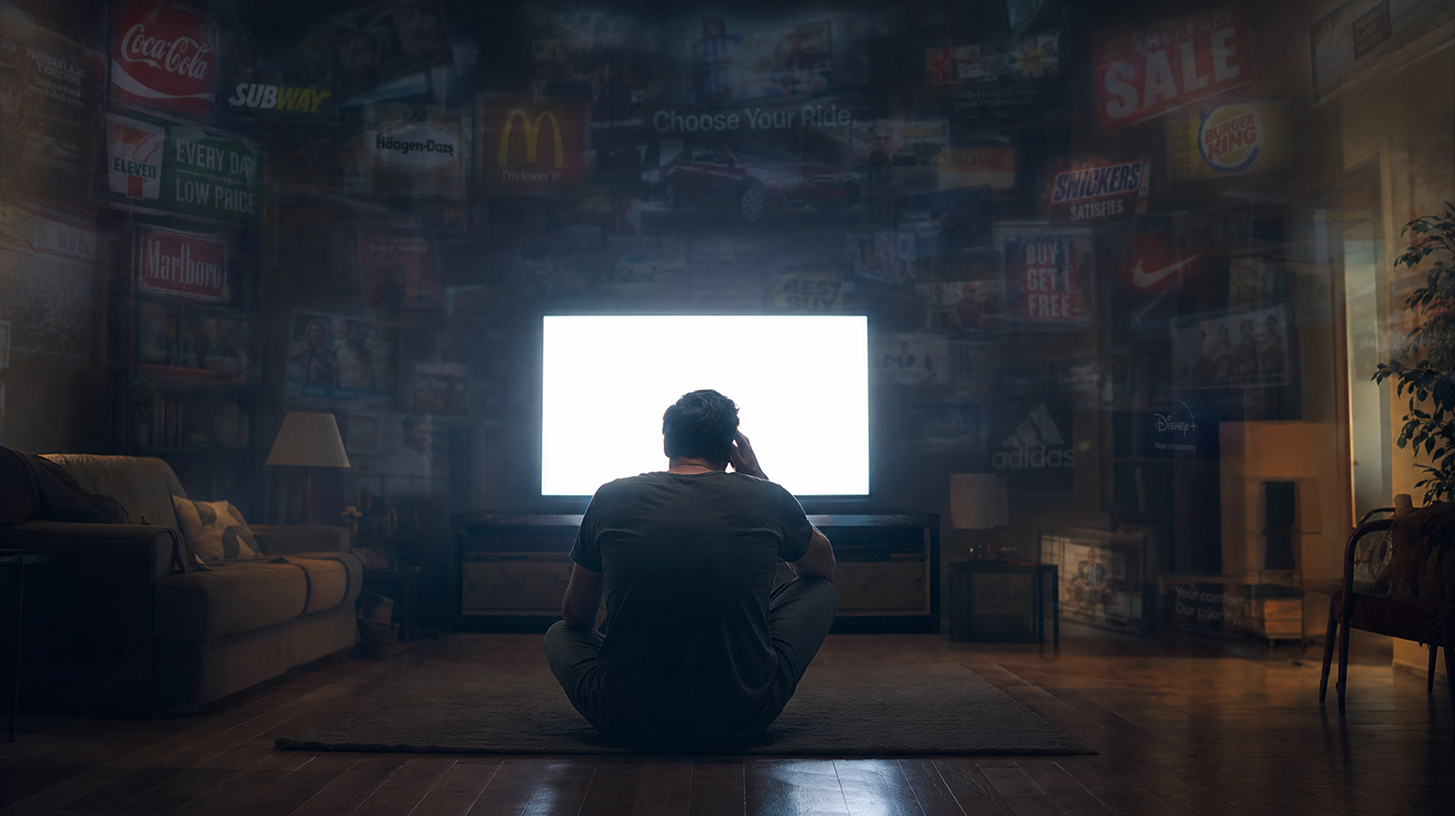
When a lack of advertising triggers discomfort: The secret conditioning of our brains – Image: Xpert.Digital
Why websites without advertising suddenly seem suspicious to us
Only 47 seconds of concentration left: How the ad-supported internet has changed us
The subscription trap: Why we can't escape internet advertising even by paying for it
Do you know that feeling? You open a website and nothing flashes, no video starts automatically, no pop-up interrupts your reading. It should be a cause for celebration – but instead, a quiet unease sets in. Is the site untrustworthy? A fake? This instinctive skepticism towards ad-free silence is no accident, but the result of decades of systematic conditioning by the tech industry.
Our brains have learned to accept constant sensory overload as the norm and to pay for seemingly free services with our most personal data. This text examines the profound psychological, economic, and social consequences of digital surveillance capitalism. It reveals how our attention span has drastically shrunk, why even expensive subscription models don't protect us from ads—and why the real problem is no longer advertising itself, but the fact that we have forgotten how to tolerate its absence.
Conditioned consciousness: How we learned to love advertising – and to fear its absence
The complete normalization
It's a strange phenomenon that has crept in quietly over the last few years: Anyone who opens a website today and there are no flashing banner ads, no videos starting automatically, and no pop-up asking for their email address instinctively feels a slight unease. Something's not right. Is the site outdated? Is there a trick going on? Is it a phishing site? The reflex is irrational, but it's real, and it says more about the state of our digital society than we'd like to admit. Because what we experience in that tiny second of irritation isn't a technical misunderstanding—it's the result of decades of systematic conditioning.
The fact that we have internalized advertising as the norm on the internet is not an inevitable natural phenomenon. It is the product of a business model that has become the infrastructure of our digital lives. It is the result of conscious decisions by platforms, marketers, and technology companies that have identified, industrialized, and sold human attention as a commodity. And it is a symptom of a societal development that goes far beyond the mere issue of internet advertising: the creeping privatization of our perception.
This analysis attempts to grasp this situation in its economic depth, its psychological dimension, and its socio-political consequences. It is not a plea against advertising per se, but rather a sober assessment of what happens when a tool of market communication becomes an unquestioned prerequisite for human information processing.
The Economics of Free Illusion
The internet as we know it is based on a paradox. Services like Google, Facebook, YouTube, Instagram, and TikTok are used by billions of people every day, and for the vast majority, they don't cost a cent. This feeling of free access, however, is fundamentally misleading. What looks like a public good is in reality a barter system, the terms of which very few users have ever consciously negotiated.
The business model operates on a simple equation: The platform offers a service that is valuable to the user. The user doesn't pay with money, but with data and attention. The data is analyzed to create behavioral profiles. The attention is sold to advertisers. And the more precise the profile, the more valuable every single second a user spends on the platform. Since 2022, German law has even enshrined this principle: According to Section 327 of the German Civil Code, personal data is explicitly considered a possible form of payment for digital services, thus officially granting data the status of a means of payment for the first time.
The German advertising market demonstrates the enormous economic power of this system. The total volume of the German advertising market recently exceeded €50 billion. The digital sub-market alone – online display and video advertising – generated revenue of over €7.5 billion in 2025. The Online Marketing Circle within the German Association for the Digital Economy (BVDW) forecasts a further increase to €8.2 billion for 2026, representing growth of 8.7 percent. The programmatic advertising segment surpassed the €5 billion mark for the first time in 2025, accounting for approximately 76 percent of all digital display revenue.
These figures make it clear: Advertising-based financing of the internet is not a fringe phenomenon, but rather the economic foundation of the digital information society. Publishers, platforms, creators, news outlets – they all depend on this system like lifelines. Conversely, this means that advertising is not a bothersome side effect of the internet, but its very condition for existence. And this has profound consequences for how content is produced, how platforms are designed, and how we as users have been trained to experience the web.
Attention as a scarce resource
Long before the internet existed, economist Herbert Simon recognized in the 1970s that in an information-rich world, attention inevitably becomes a scarce resource. What Simon described back then as a theoretical model is today the driving force behind the world's most profitable companies. The attention economy is no longer an abstract academic concept, but rather the operating manual of the modern internet.
According to an IAB report, the human capacity for focused attention has changed dramatically over the past two decades. While the average attention span was around 2.5 minutes in 2004, it is projected to plummet to just 47 seconds by 2025. This is no accident, nor is it a natural biological change. It is the direct result of a design principle shared by platforms, games, apps, and advertising messages: continuous interruption, fragmentation of perception, and the constant presentation of the next stimulus before the current one can be fully processed.
Every day, people are confronted with a dizzying amount of commercial messages. It's estimated that the average consumer sees between 5,000 and 13,000 advertising messages per day. This number is difficult to grasp, but its logic is clear: every logo on the T-shirt of the person sitting opposite you on the train, every sticker on a laptop in a café, every sponsored post in your Instagram feed, every pre-roll ad before a YouTube video, every push notification – they all count. The brain processes these stimuli, whether we want it to or not, and in doing so, learns to automatically filter out most of them.
According to a 2024 study by Kantar, only 31 percent of people worldwide said that social media advertising actually captured their attention – compared to 43 percent the previous year. That's a drop of around 28 percent in just one year. At the same time, measurements show that 81 percent of all ads that are technically counted as seen are never actually noticed by users. The system is therefore paying for visibility that doesn't exist.
The brain learns to ignore it – and then to miss it
Consumer psychology has recognized the phenomenon of banner blindness since the late 1990s. Early scientific studies at that time confirmed what users had already been doing intuitively: systematically ignoring advertising banners at the edge of a website. The brain maps the typical positions of advertising elements and simply filters them out of its visual focus long before conscious awareness even kicks in. A study from the University of Cologne confirmed that advertising banners were viewed only to a very limited extent overall – an effect that researchers refer to as banner blindness.
Classical conditioning—the fundamental principle of Pavlovian learning—explains why advertising is effective even when consciously ignored. Repeated exposure to a particular advertising message creates an unconscious association between the product and specific emotions or situations. This association influences purchasing decisions without the consumer being aware of it. The advertising industry has perfected this principle: not every ad needs to be consciously processed to be effective. Repetition is the key mechanism, and the brain even stores what it believes it is ignoring.
But what happens when this years-long training of constant exposure to stimuli is suddenly interrupted? When a website or app appears without advertising? This is where the real psychological paradox begins. The brain, which has learned to associate certain digital environments with a specific stimulus structure, perceives its absence as a disruption of its expected pattern. It's the von Restorff effect in its inverted form: Normally, the unusual in a homogeneous environment attracts attention. In the digital realm, the unusual is now the absence of the usual – and the usual is advertising.
This psychological reversal is the central theme of this analysis. It demonstrates how deeply commercial logic has permeated our fundamental cognitive expectations. Anyone visiting an ad-free website today instinctively feels skepticism – not because ad-free content is objectively suspicious, but because our conditioned consciousness has learned to equate advertising with a quality indicator, a sign of trust, and the norm.
The Revolt of the Exhausted: Why Adblockers Must Be Understood Morally
It would be unfair to ignore the societal reaction to this development. A significant portion of the population has actively resisted it. In Germany, around 32.7 percent of all internet users used an ad blocker in the third quarter of 2024 – a figure slightly above the global average of 31.3 percent. Other surveys arrive at even higher numbers: One study puts the proportion of German ad blocker users at 44 percent, with more than half of these users having the software permanently activated, regardless of the website they are visiting.
The age distribution is particularly revealing. Among 18- to 29-year-olds, 52 percent use an ad blocker or anti-tracking software – the generation that grew up with the digital network and understands it better than any other. This is no coincidence. Those who have experienced the internet as a natural environment from the beginning have also developed a more precise understanding of its mechanisms and know what it means when a platform doesn't earn attention, but demands it.
In this sense, ad blockers are not an attack on the business model of the free internet, but rather a rational self-protective reaction to an environment of stimuli that has exceeded the limits of what is tolerable. The phenomenon of ad fatigue describes precisely this condition: the cognitive and emotional exhaustion caused by excessive commercial exposure, which ultimately leads to advertising messages not only being ignored, but actively rejected. The fact that 81 percent of all technically counted ads are actually not perceived demonstrates how ineffective the system has become for advertisers themselves.
The platforms' reaction to the ad-blocker uprising was telling. YouTube intensified technical measures to disable ad blockers while simultaneously increasing the frequency and length of its ads to such an extent that unblocked use became virtually unbearable for many. Amazon Prime Video introduced advertising into its standard subscription and charges extra to remove it. The message is clear: the ad-free internet no longer exists. You can only buy your way out.
🎯🎯🎯 Data-driven B2B industry hub as a quasi-in-house solution

The quasi-in-house solution: How Xpert.Digital closes operational gaps in B2B marketing and sales – Smart Content-Driven Business - Image: Xpert.Digital
Xpert.Digital is a data-driven B2B industry hub led by Konrad Wolfenstein . The company acts as an external, quasi-in-house solution for industrial partners, closing operational gaps in marketing, content, and sales – without requiring additional resources on the client side.
More information here:
When silence becomes unpleasant: What constant digital noise does to us
Surveillance capitalism as a structural basis
Behind all this lies an economic system that Harvard professor Shoshana Zuboff comprehensively described in her 2019 work. Surveillance capitalism, according to her concept, is a new form of market that claims human experience as a free raw material for the extraction of behavioral data. It differs fundamentally from classical industrial capitalism because it does not produce and sell goods, but rather predictions about human behavior—predictions that are sold on behavioral futures markets to advertisers, insurance companies, employers, and other interested parties.
The dangerous aspect of this is the asymmetry. Users provide the raw data—their clicks, dwell times, search queries, location data, emotional reactions, purchasing patterns—but they have no control over what happens with it. Platforms like Google and Meta have built up concentrations of knowledge and power that are unprecedented in economic history. And what they do with this power is not merely passive observation: Zuboff describes a shift from monitoring to controlling, from monitoring to actively intervening in human behavior through subtle nudges, rewards, and punishments.
This system only works as long as users use the platforms. And usage is financed by advertising. Advertising, in turn, works better the longer users stay on the platforms. Time spent on the platforms is maximized by content that captures attention. And attention is most effectively captured by outrage, sensationalism, novelty, and confirmation of existing beliefs. The algorithm doesn't optimize for truth or quality, but for engagement – and advertising is the engine that drives this entire cycle. Removing advertising from this system doesn't just solve an aesthetic problem. It undermines the entire economic logic of the modern internet.
The subscription society and its downside
As an alternative to the ad-supported model, the subscription model has become established in recent years. Streaming services like Netflix, Amazon Prime Video, Disney+, and Apple TV+ have proven that people are willing to pay for ad-free content. Indeed, in 2024, the average household in Germany spent almost €60 per month on subscriptions and held an average of at least three active subscriptions simultaneously.
But even the subscription model has reached its limits. A Deloitte study on media consumption in 2026 shows that the video streaming market has entered a mature phase: Subscription numbers are stagnating, even though usage time continues to increase. With an average of 2.5 subscriptions per household in 64 percent of all households, the financial and emotional breaking point seems to have been reached. Almost 40 percent of consumers indicated in surveys that they want to reduce their subscriptions.
The subscription model, however, hasn't solved another conflict, but merely shifted it. Platforms that aren't profitable enough on subscription revenue alone are gradually introducing cheaper, ad-supported plans. Netflix, Amazon Prime, and others offer so-called ad-supported plans, where users pay less but have to put up with advertising. According to the research firm Antenna, in the first five months of 2024, 39 percent of all new subscriptions to streaming services were for precisely these ad-supported options. The advertising that users were supposed to get rid of with a subscription is returning through the back door—this time as a compromise.
This is not a failure of the market. It is its complete development. Advertising is so deeply embedded in the financing structure of digital content that any model that forgoes it comes under economic pressure. The question is no longer whether one wants advertising or not. The question is in what form and at what price one consumes it.
The silent expropriation of our attention
There is a dimension to this issue that is often overlooked in public debate: the moral one. When human attention becomes a tradable resource, when behavioral predictions are traded on industrial markets, when platforms treat their users not as customers but as raw materials – then this is not neutral economic development. It is a form of expropriation.
The user who spends three hours a day on TikTok believes she is consuming entertainment. In reality, she is generating a data stream that maps her behavior, preferences, psychological vulnerabilities, and consumption patterns in real time. This data stream is processed into predictive products and sold in markets the user has never even heard of. And the algorithm that captures her attention wasn't designed to improve her well-being, but to maximize the data stream.
Generation Z, among the most enthusiastic digital natives in Germany and other countries, has been taught that information is free. What no one taught them is the full price of this free access. It's not just data privacy that's affected—it's also the distortion of cognitive habits, the shortening of attention spans, and the growing inability to read longer, coherent texts or follow arguments that take more than 15 seconds. The digital advertising model hasn't just spared our wallets; it has reshaped our perception.
When normality becomes pathology
Let's return to our starting point: the unease surrounding the ad-free website. What at first glance appears to be a harmless cognitive quirk is, upon closer inspection, a diagnostically interesting symptom. It shows that the commercial logic of digital capitalism has penetrated deeply enough to shape our perception of normality.
In psychology and sociology, normality is not an absolute category, but a relational one. What is considered normal is determined by repetition, social consensus, and institutional reinforcement. Online advertising has become normal because it is ubiquitous, because it has been unavoidable for decades, and because the entire economic system of the free internet is based on it. Its absence seems abnormal because the brain expects precisely what it has repeatedly experienced.
This phenomenon has far-reaching implications. If we consider it pathological to demand paid information, but accept it as perfectly normal to pay for free services with our data and attention, then we have a fundamental value problem. We have learned to externalize the real cost of our digital existence – onto our psyche, our privacy, our political judgment, and our cognitive health.
The Austrian media scholar and cultural critic Robert Pfaller has described how ideologies operate most effectively not where they are actively believed, but where they are practiced without conscious conviction. No one has to believe that free internet services are a natural right. It's enough to behave accordingly. And that's precisely what we do. We use the services, accept the terms and conditions, skim the privacy policies, and then wonder why ad-free content seems to emit something strange.
Systemic market failure: What the numbers really tell us
The economic data suggests that the system is trapped in a structural tension from which it cannot extricate itself. The digital advertising market is growing relentlessly – from €6.2 billion in 2024 to €7.5 billion in 2025, and a projected €8.2 billion in 2026. At the same time, the number of people blocking or attempting to circumvent this very advertising is also increasing. In Germany, one in three to one in two internet users employs an ad blocker. The market is growing, but its effectiveness is eroding.
This isn't a classic market failure in the economic sense, because the market is functioning – money is flowing, sales are rising, and companies are expanding. It's a failure of effectiveness. The resource that people are paying for – attention – is no longer reliably available. The number of technically measured advertising contacts is increasing, but actual cognitive engagement is declining. Campaigns that focus on high-quality attention do achieve 124 percent higher attention scores and up to 340 percent higher click-through rates, but they are the exception in a market that predominantly prioritizes quantity over quality.
The symptom of this tension is inflation. The number of advertising messages per day increases because each individual message is less effective. More volume is meant to compensate for the lack of effectiveness. But more volume exacerbates the information overload that created the ineffectiveness in the first place. It's a vicious cycle that doesn't stabilize itself but escalates at the expense of the users.
Between resignation and regulation: Possible ways out of the dilemma
What alternatives are there to a system that simultaneously corrupts and exhausts its users? The answer is uncomfortable because it offers no easy solutions.
As described, the subscription model is not a complete solution. It shifts the problem and creates new dependencies. While pay-per-use models are experiencing a comeback—particularly among Generation Z and Millennials, who prefer flexibility to long-term commitments—they have their own degree of friction and complexity. Public funding models work for certain services but do not scale to the entire internet.
Regulatory approaches are gaining importance. The General Data Protection Regulation (GDPR), the ePrivacy Directive, and the Digital Services Act of the European Union have set initial boundaries. However, given the dynamics and scope of the problem, they are more reactive measures than systemic solutions. The fundamental question—whether attention should even be treated in the way it is today—has not yet been properly posed at the regulatory level.
A more interesting perspective arises from the question of what users truly want. Studies consistently show that people don't fundamentally reject advertising if it's relevant, non-invasive, and honestly labeled. Resistance is directed against intrusive, manipulative, tracking-based, and overwhelming advertising. A middle ground exists, but it would require platforms to exercise economic restraint, collect less data, run less high-volume advertising, and relinquish more control to users. Currently, there's no market incentive for this – because the dominant model remains profitable as long as the infrastructure of surveillance capitalism remains intact.
The actual extent of the damage
There is a final dimension, rarely mentioned, although it is the most fundamental: What do we lose when we lose the ability to endure silence? What happens to a society so conditioned that even the absence of commercial stimuli is perceived as problematic?
Cognitive scientists and neuroscientists emphasize that periods of low stimulation are functionally necessary for the brain. During these times, knowledge is consolidated, creative connections are formed, experiences are processed, and the brain regenerates its attentional capacity. A media environment that does not allow for such breaks degrades these capacities over time. The documented reduction in attention span from 2.5 minutes to 47 seconds in two decades is not merely a usage statistic. It is an indication of a structural cognitive shift that has consequences for everything: for political judgment, for educational processes, and for the ability to engage in democratic discourse.
If someone experiences a blank page on the internet as irritating today, then in a sense that's the most precise symbol of what's happened to us. We haven't just become accustomed to advertising. We've become accustomed to being constantly bombarded with noise, advertisements, surveillance, and optimization. The silence is disturbing because we've internalized noise as the norm. And as long as we perceive noise as normal, we'll hardly be motivated to change anything.
This is perhaps the deepest problem behind this seemingly harmless psychological irritation. Advertising itself isn't the real issue. The problem is that we've stopped perceiving it as a problem. The first step toward a critical examination of the advertising-funded internet would be to take our own irritation seriously—not the irritation we feel before the advertising, but the irritation we feel when it's absent. Because the real diagnosis lies in this second irritation.
Consequences of collective habituation
The societal impact of all this is difficult to quantify, but clearly observable. Media literacy was once an educational goal. Today, it needs to be expanded to include a new dimension: the ability to recognize and critically examine one's own conditioned consumer behavior. It is no longer enough to distinguish fake news from real news. It is also necessary to understand why certain content is perceived as trustworthy simply because it is embedded in a familiar advertising environment.
The fact that more than 80 percent of German consumers prefer services that can be easily canceled demonstrates a growing sensitivity to loss of control. However, this sensitivity remains fragmented and reactive as long as the structural conditions remain unchanged. Individual decisions—installing ad blockers, canceling subscriptions, switching platforms—are necessary but insufficient when the economic system as a whole is moving in a different direction.
The digital advertising market will exceed the €8 billion mark for the first time in 2026 in the German display and video segments alone. Globally, the volume of digital advertising is many times larger. This money works to maintain the status quo. It finances lobbying, technical innovations to circumvent ad blockers, algorithmic optimizations, and new forms of behavioral analysis. The interests that advocate for the status quo are powerful and well-organized.
The opposing interests—the interests of users, democracy, and cognitive health—are diffuse, poorly organized, and often self-aware. Finding silence online unsettling doesn't make you a bad person. You're a product of a system that excels at being invisible. The first task would be to make it visible.
Your global marketing and business development partner
☑️ Our business language is English or German
☑️ NEW: Correspondence in your native language!

Konrad Wolfenstein
I and my team are happy to be available to you as your personal advisor.
You can contact me by filling out the contact form here simply call me at +49 7348 4088 965. My email address is [email protected]:or
I'm looking forward to our joint project.
☑️ SME support in strategy, consulting, planning and implementation
☑️ Creation or realignment of the digital strategy and digitization
☑️ Expansion and optimization of international sales processes
☑️ Global & Digital B2B trading platforms
☑️ Pioneer Business Development / Marketing / PR / Trade Fairs
B2B support and SaaS for SEO and GEO (AI search) combined: The all-in-one solution for B2B companies

B2B support and SaaS for SEO and GEO (AI search) combined: The all-in-one solution for B2B companies - Image: Xpert.Digital
AI search changes everything: How this SaaS solution will revolutionize your B2B ranking forever.
The digital landscape for B2B companies is undergoing rapid change. Driven by artificial intelligence, the rules of online visibility are being rewritten. For companies, it has always been a challenge not only to be visible in the digital mass, but also to be relevant to the right decision-makers. Traditional SEO strategies and managing local presence (geo-marketing) are complex, time-consuming, and often a battle against constantly changing algorithms and intense competition.
But what if there were a solution that not only simplified this process but also made it smarter, more predictive, and far more effective? This is where the combination of specialized B2B support with a powerful SaaS (Software as a Service) platform comes into play, specifically designed for the demands of SEO and GEO in the age of AI search.
This new generation of tools no longer relies solely on manual keyword analysis and backlink strategies. Instead, it leverages artificial intelligence to more accurately understand search intent, automatically optimize local ranking factors, and conduct real-time competitive analysis. The result is a proactive, data-driven strategy that gives B2B companies a decisive advantage: they are not only found, but perceived as the leading authority in their niche and location.
Here's the symbiosis of B2B support and AI-powered SaaS technology that transforms SEO and GEO marketing, and how your company can benefit from it to grow sustainably in the digital space.
More information here:










