
Micro-OLED – tiny displays on silicon chips: The battle for the billion-dollar market for augmented and virtual reality glasses
Xpert Pre-Release

Available in 27 languages 📢
Prefer Xpert.Digital on GoogleⓘPublished on: March 7, 2026 / Updated on: March 7, 2026 – Author: Konrad Wolfenstein
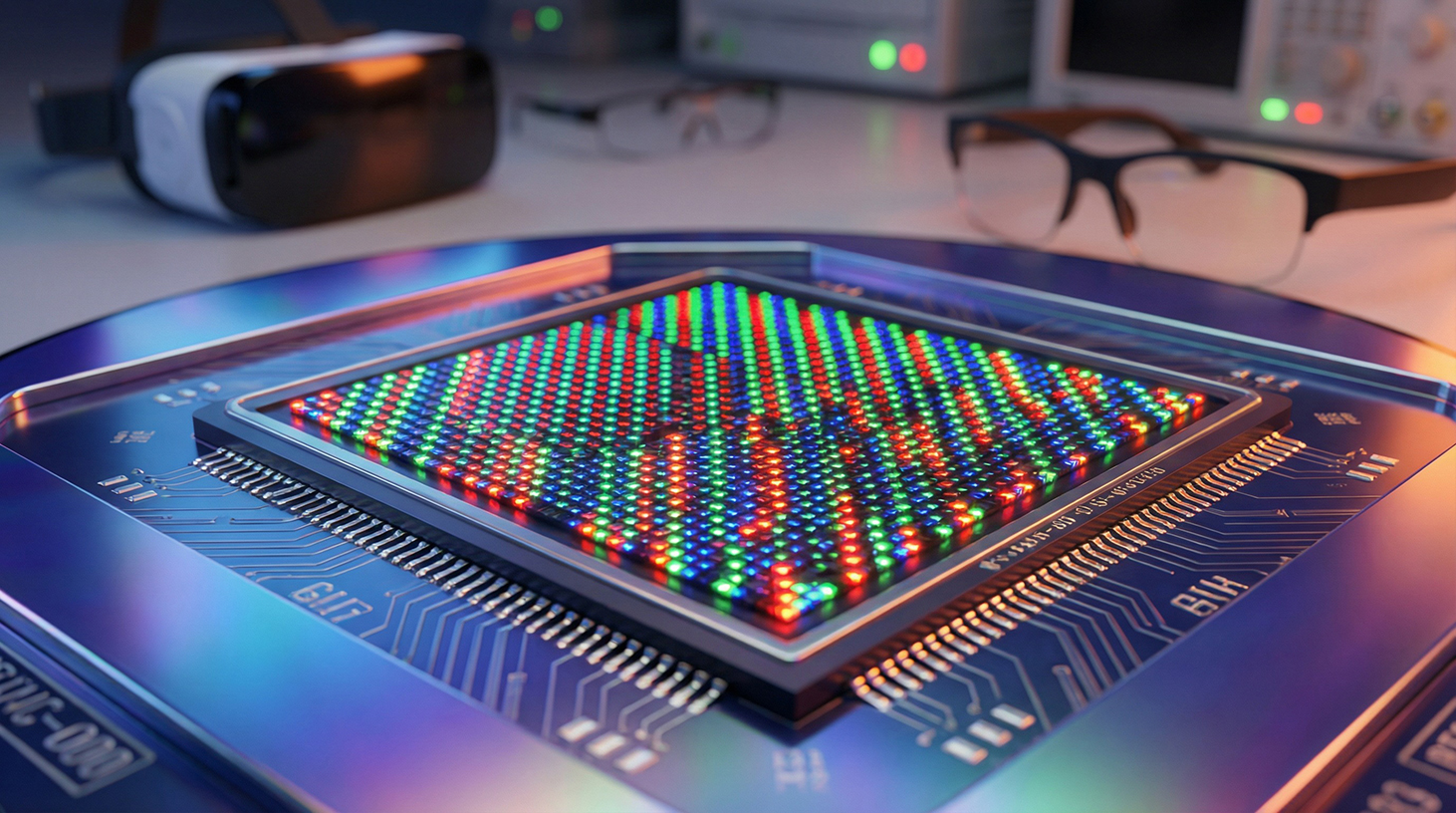
Micro-OLED – tiny displays on silicon chips: The battle for the multi-billion dollar market for augmented and virtual reality glasses – Image: Xpert.Digital
The invisible screen war – How Sony and Samsung are fighting for the future of displays and why China's display manufacturers are suddenly attacking
The end of the smartphone? How a tiny chip from Sony and Samsung is determining our future
In Asia's high-tech labs, a fierce battle is raging for the technology of tomorrow. At its heart is Micro-OLED – tiny displays on silicon chips, barely larger than a postage stamp, but with the potential to eventually replace the smartphone as our primary means of communication. While Sony currently dominates the market as the exclusive supplier for Apple's Vision Pro, Samsung is ramping up its efforts. With breathtaking technological leaps, record brightness levels, and an aggressive expansion strategy, the South Koreans are launching a frontal assault on the Japanese market leader. At the same time, Chinese manufacturers are positioning themselves to shake up the rapidly growing, multi-billion-dollar market for augmented and virtual reality glasses. It's an invisible screen war, the outcome of which will determine the lenses through which we view the digital world in the future.
Related to this:
Billion-dollar Micro-OLED market: A silicon chip becomes the battleground of two Asian giants
In the laboratories and cleanrooms of Kumamoto and Asan, in the semiconductor factories of Japan and South Korea, a technological race is underway that will change the way humanity perceives digital content. At its heart is a display technology that, at first glance, seems unspectacular: organic light-emitting diodes applied to a silicon chip smaller than a postage stamp. But these silicon-based micro-OLED displays are the key to a future in which smart glasses replace smartphones, surgical procedures become more precise thanks to microdisplays, and virtual worlds appear photorealistically before users' eyes.
The technological foundations of a revolution
Micro-OLED, also known as OLEDoS (OLED on Silicon), combines two worlds: CMOS semiconductor technology, used in processors and image sensors, with organic light-emitting diodes, known for their brilliant color reproduction and extreme contrast. The result is a display with a pixel density of over 3,000 pixels per inch, with a diameter typically between one and two inches.
The manufacturing technology is demanding. Unlike conventional OLED panels, where organic materials are applied to glass substrates, micro-OLED uses a monocrystalline silicon wafer as a backplane. This approach enables significantly higher pixel density, lower power consumption, and more compact designs. At the same time, the manufacturing process is complex, leading to high production costs and low yields – the technology's Achilles' heel.
The market: Exponential growth on multiple levels
Market forecasts for OLED microdisplays vary depending on the analyst firm, but they all agree on one point: growth will be exceptional. SkyQuest Technology estimates the market will be worth $1.88 billion in 2025 and is projected to grow to $11.42 billion by 2033, representing an annual growth rate of 25.3 percent. TechSci Research forecasts growth from $2.24 billion in 2025 to $4.97 billion by 2031. The wide range of forecasts reflects the uncertainty surrounding how quickly AR and VR headsets will achieve mass-market adoption.
The overarching OLED market, encompassing all applications from smartphones and televisions to automotive displays, is estimated to reach $34.68 billion in 2026 and is projected to grow to $55.19 billion by 2031. The microdisplay sector is the fastest-growing segment, driven by increasing demand for extended reality devices, medical instruments, and military head-up displays.
Sony: The market leader with vertical integration
Sony Semiconductor Solutions, a subsidiary of the Sony Group, dominates the micro-OLED market with a level of control unmatched in the technology industry. In 2023, Sony accounted for 87 percent of global micro-OLED shipments for XR devices. Sony began developing micro-OLEDs for the VR and AR markets as early as 2016 and achieved mass production in 2019.
Sony's decisive competitive advantage lies in its vertical integration across the entire manufacturing chain. From the development of silicon backplanes and OLED coating to integration into final products, Sony controls every step of the process. This control enables consistent quality and close coordination between design and manufacturing that competitors struggle to replicate.
Sony supplies the micro-OLED displays for Apple's Vision Pro, currently the most advanced mixed-reality headset on the market. The dual 1.42-inch 4K displays achieve a pixel density of approximately 3,386 pixels per inch. However, Sony's dominant position also has a weakness: production capacity. Sony can currently manufacture displays for fewer than half a million headsets per year and has been reluctant to significantly expand production. This capacity limitation has prompted Apple to evaluate alternative suppliers, including the Chinese companies BOE and SeeYa Technology.
Samsung Display: The aggressive challenger
Samsung Display's 2023 acquisition of US-based micro-OLED specialist eMagin provided it with a technological foundation that makes it Sony's most serious challenger. In particular, the acquisition brought Samsung its proprietary Direct Emitter Patterning technology, in which red, green, and blue OLED emitters are applied directly to the silicon backplane, bypassing the intermediate step of white OLEDs with color filters.
The progress since the acquisition has been remarkable and follows a breathtaking pace of development. At Display Week 2025, Samsung Display presented a 1.4-inch prototype with 5,000 pixels per inch, a 5K x 5K resolution, a peak brightness of 15,000 nits at 120 Hz, and 99 percent coverage of the DCI-P3 color gamut. A second prototype with 4,200 pixels per inch achieves an impressive 20,000 nits through the use of a micro-lens array (MLA), the highest value ever reported for an RGB OLEDoS panel.
The pace of development is impressive. In 2023, Samsung's Micro-OLED prototypes reached 5,000 nits, in 2024 already 10,000 nits, and 10,000 nits were also demonstrated at CES 2025. The recent leap to 20,000 nits within just a few months underscores the dynamic innovation Samsung has unleashed since acquiring eMagin.
🗒️ Xpert.Digital: A pioneer in the field of Extended and Augmented Reality

Finding the right Metaverse agency, planning office, or consulting firm - Image: Xpert.Digital
🗒️ Finding the right Metaverse agency, planning office, or consulting firm – Search and search: Top Ten Tips for Consulting & Planning
More information here:
The Display War of the Giants: Samsung's Attack on Sony's Supremacy
The technological differentiating features
The competition between Sony and Samsung revolves around several key technical parameters that are crucial for the quality of AR and VR experiences.
Brightness is the most critical factor, especially for augmented reality applications that need to be usable outdoors. Displays require brightness levels of at least 25,000 nits to compete with ambient light. Samsung is rapidly approaching this value with its latest prototypes. Sony's current displays for the Vision Pro reach around 5,000 nits, supported by microlens technology.
Pixel density determines whether the user can perceive individual pixels – an effect known as the screen-door effect, which significantly impairs the immersive experience. Samsung's 5,000 PPI significantly surpasses Sony's current 3,386 PPI used in the Vision Pro.
RGB Direct Emitter Patterning, the core technology from the eMagin acquisition, already generated 54.62 percent of micro-OLED market revenue in 2025. This technology eliminates color filter losses and increases both brightness and energy efficiency compared to the older approach using white OLEDs and color filters, which Sony's current Apple displays use.
The Chinese flank
While Sony and Samsung battle for technological supremacy, China is systematically building capacity in the mid- to high-end market segment. BOE Technology and SeeYa Technology, supported by government initiatives, are investing heavily in micro-OLED manufacturing. Apple has evaluated both companies as potential alternative suppliers, both for a next-generation Vision Pro model and for a more affordable mixed-reality headset.
Chinese manufacturers benefit from proximity to established semiconductor ecosystems, lower manufacturing costs, and politically driven support for the display industry. Their products don't yet meet the specifications of Sony or Samsung, but the gap is narrowing. For the mass market, especially for more affordable AR glasses and VR headsets, they could become the preferred choice.
The fields of application: Far beyond VR
The micro-OLED market is often reduced to virtual reality and augmented reality, but its applications are considerably broader. In the military sector, micro-OLED displays are used in head-up displays and night vision systems. In medical technology, they enable more precise imaging during minimally invasive procedures. The automotive industry integrates them into next-generation head-up displays, and in industrial settings, they serve as high-resolution control and monitoring systems.
AR and VR remain the single biggest driver, accounting for 42.3 percent of the market segment. The convergence of more powerful AI models, improved sensors, and advanced micro-OLED displays is laying the foundation for a generation of wearables that could replace the smartphone as the primary computing device.
Micro-OLED instead of QLED: This radical step makes Pimax a VR pioneer
Pimax uses both classic QLED/Mini-LED displays and true Micro-OLED panels – and in the Micro-OLED headsets, the panels are explicitly from Sony.
Related to this:

Which Pimax headsets use Micro-OLED?
- Dream Air SE: 5K headset with 2560 × 2560 pixels per eye based on Micro-OLED technology; Pimax positions it as a particularly lightweight, everyday-use standalone headset.
- Dream Air: Compact “8K” headset with 3840 × 3552 pixels per eye, explicitly featuring Sony Micro-OLED panels and pancake optics; weighing under 170 g.
- Crystal Super Micro-OLED: High-end variant of the Crystal series with interchangeable Micro-OLED optical module, resolution 3840 × 3552 per eye, horizontal FOV 116°. Pimax advertises it as the "most powerful Micro-OLED experience" and uses premium Micro-OLED from Sony.
Which Pimax headsets do not (yet) use Micro-OLED?
- Pimax Crystal / Crystal Light: Works with QLED panels plus Mini-LED local dimming, no Micro-OLED; 35 PPD, 105° horizontal FOV.
- Pimax Reality 12K QLED: Uses two 5.5-inch QLED displays with Mini-LED backlight (6K per eye, 12K combined, ~1200 PPI), also no Micro-OLED.
Who supplies the Micro-OLED panels for Pimax?
- In its product announcements, Pimax explicitly names Sony as the panel supplier for Dream Air and Crystal Super Micro-OLED (“Sony Micro-OLED Panels”, “Sony's premium Micro-OLED panels”).
- There is currently no mention in the official documents of Samsung or Chinese OLEDoS suppliers (BOE, SeeYa) for the current Pimax Micro-OLED models; Pimax is positioning itself rather as the first provider to bring Sony Micro-OLED to market in a broad product line with pancake optics.
Pimax is on the system integrator side: They purchase Micro-OLED panels (currently from Sony) and combine them with their own ConcaveView pancake optics, eye tracking, foveated rendering and modular concept (Crystal Super).
In the “display war”, Pimax is thus acting as a testbed or showcase for how far Sony Micro-OLED currently scales in the consumer/prosumer VR sector – while Samsung is still primarily in trade fair mode with prototypes (5K×5K, 5,000 PPI, 15,000–20,000 nits) and Chinese suppliers (BOE, SeeYa) are being evaluated by Apple.
Micro-OLED versus QLED: Which technology will win the battle for the future of VR?
Practical difference (e.g. in headsets): Micro-OLED: Ideal for small displays directly in front of the eye (XR glasses), maximum pixel density, top contrast, but currently expensive and with size limitations.
Micro-OLED is a self-illuminating microdisplay technology on silicon wafers for extremely small, high-resolution near-eye displays, while QLED is essentially a classic LCD with LED backlighting plus a quantum dot layer for greater brightness and color gamut.
- Micro-OLED: Ideal for small displays directly in front of the eye (XR glasses), maximum pixel density, top contrast, but currently expensive and with size limitations.
- QLED (with Mini-LED backlight): Larger panels, very bright and vibrant colors, more commonly used for VR headsets in "classic" large displays within the housing; black level, pixel fill factor and optical size are weaker than with Micro-OLED.
The strategic outlook
The micro-OLED market is entering a phase of exponential growth, during which the hierarchy of suppliers will be reshaped. Sony's vertical integration and lead in mass production are powerful competitive advantages, but its reluctance to expand capacity leaves it vulnerable. Samsung, with its eMagin technology, massive manufacturing capabilities, and materials science expertise, possesses the necessary prerequisites to emerge as a serious alternative within a few years. The tandem OLED structures Samsung is working on, which stack multiple emitter layers, could further increase brightness while simultaneously improving efficiency—a crucial factor for battery-powered XR headsets.
The race for micro-OLED supremacy is far more than a competition between two display manufacturers. It's a battle for control of the interface between humans and the digital world. Whoever delivers the best microdisplays will determine how billions of people consume information, work, and communicate in the future.
Your global marketing and business development partner
☑️ Our business language is English or German
☑️ NEW: Correspondence in your native language!

Konrad Wolfenstein
I and my team are happy to be available to you as your personal advisor.
You can contact me by filling out the contact form here or simply call me at +49 7348 4088 965. My email address is: [email protected]
I'm looking forward to our joint project.









