
Opinion & criticism of “Metaworse”: The Metaverse is crap – and risky, pointless & dangerous for companies | Mechanical engineering & industry sector

Available in 27 languages 📢
Prefer Xpert.Digital on GoogleⓘPublished on: October 14, 2022 / update from: January 24, 2024 - Author: Konrad Wolfenstein

Metaworse - Criticism of the Metaverse plans of major digital corporations and monopolists - Image: Xpert.Digital / Athitat Shinagowin|Shutterstock.com
Metaworse – Criticism of the Metaverse plans of major digital corporations and monopolists
Metaverse sounds exciting and arouses curiosity
If something new and exciting is announced, then two behavior patterns face each other: the childlike curiosity and the critical look with the “Cui-Bono-Tag” (WEM-ZUM-BEIDEID-Marker).
Metaverse sounds as incredibly exciting as the word itself. It has something still unknown and lets us guess a little by the announcements of Meta (formerly Facebook) what this could be. On the other hand, I wonder where the apparently sudden hype comes from the meta verse? “Experts” appear suddenly as if they have always known nothing but meta -verse and many years of experience.
In fact, Meta Inc. Chef Mark Zuckerberg only announced in July last year that Facebook should become a Metaverse company in the next five years. A virtual reality world that "will feel like a mix of today's social online experiences, sometimes expanded in three dimensions or projected into the physical world".
What should be noted at this point: In 2014, Meta took over the XR headset manufacturer Oculus, which, according to the latest evaluation in Q1 2021, has a market dominant position with a market share of 75% in the XR headset sector. So it's in Meta's best interest.
Construction machinery & excavator simulator with virtual reality

Extended reality in mechanical engineering: VR simulator for construction machines & excavators with virtual reality - Image: Xpert.Digital
More about it here:
Just try out our universally applicable (B2B/Business/Industrial) Metaverse configurator for all CAD / 3D demo options:

Share of extended reality (XR) headsets by brand worldwide
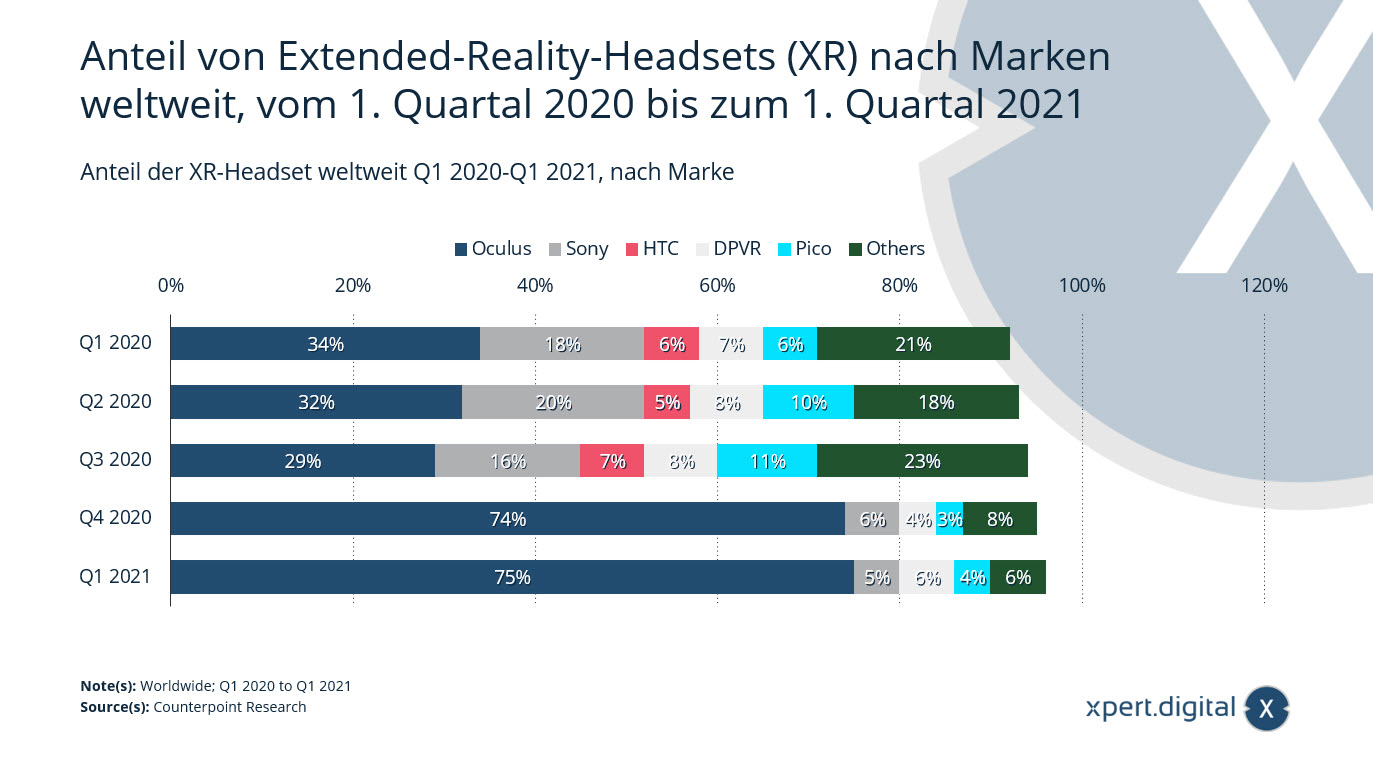
Share of extended reality ➡️ virtual reality headsets by brand worldwide – Image: Xpert.Digital
Share of extended reality (XR) headsets by brand worldwide
Oculus is the largest extended reality (XR) headset brand in 2021, holding 75 percent of the market. Sony took second place among providers with almost 12 percent of deliveries.
Oculus
- Q1 2020 – 34 in %
- Q2 2020 – 32 in %
- Q3 2020 – 29 in %
- Q4 2020 – 74 in %
- Q1 2021 – 75 in %
Sony
- Q1 2020 – 18 in %
- Q2 2020 – 20 in %
- Q3 2020 – 16 in %
- Q4 2020 – 6 in %
- Q1 2021 – 5 in %
HTC
- Q1 2020 – 6 in %
- Q2 2020 – 5 in %
- Q3 2020 – 7 in %
- Q4 2020 – 0 in %
- Q1 2021 – 0 in %
DPVR
- Q1 2020 – 7 in %
- Q2 2020 – 8 in %
- Q3 2020 – 8 in %
- Q4 2020 – 4 in %
- Q1 2021 – 6 in %
Pico
- Q1 2020 – 6 in %
- Q2 2020 – 10 in %
- Q3 2020 – 11 in %
- Q4 2020 – 3 in %
- Q1 2021 – 4 in %
Other
- Q1 2020 – 21 in %
- Q2 2020 – 18 in %
- Q3 2020 – 23 in %
- Q4 2020 – 8 in %
- Q1 2021 – 6 in %
Problems and the reasons for them on Facebook
But there are other aspects that should stimulate thought. Facebook has so far been growing until it had to record around one million users for the first time in the 4th quarter of 2021 compared to the previous quarter. After these figures became known, the Facebook group then lost around 40 % to date (at the end of December 2021 to the beginning of March 2022) of its stock value. Facebook company founder Zuckerberg referred to the rapidly growing competition from Tiktok. Another problem that has been known for a long time is the “aging” of Facebook. Fewer and fewer young people use the social media platform. This target group mostly uses Instagram, WhatsApp, YouTube or TikTok and see no need for Facebook.
The main reason for the reduction in sales was the data protection change Apple made to its iOS operating system last year. At issue is the impact on the advertising industry of Apple's App Tracking Transparency feature, which reduces targeting opportunities by limiting advertisers' access to an iPhone user ID.
"We believe that the effects of iOS are a headwind for our business in 2022," said Dave Wehner, CFO of Meta, in a conversation with analysts according to the company's result report for the fourth quarter. "It is in the order of $ 10 billion, so it is a fairly significant headwind for our business."
Suitable for:
Decrease in daily active users in Q4 2021 by around 1 million users

Decrease in daily active users in the 4th quarter of 2021 by around 1 million users - Image: Xpert.Digital
Facebook lives from personalized advertising. In the exchange of a “free” communication platform, it uses the collected data to earn your money through personalized advertising. Facebook achieved around 97 percent of his sales in 2021 through advertising. The worldwide growing awareness of your own data and data protection endangers the future Facebook business model. In addition to the current difficulties with data protection in Europe, Apple's tracking protection introduced in spring 2021 also shows how vulnerable the business model of Facebook & Co. has become.
This also explains why Mark Zuckerberg announced a change from Facebook to a metaverse in July 2021. Because in your own personalized metaverse, all the resistance that stands in the way of tracking and the associated personalized advertising disappears into thin air.
This metaverse is crap and pointless for companies
The Meta Metaverse is primarily geared towards VR/AR entertainment, with a focus on our own personal data, interests and habits.
In 2020, a market share of 53% in the consumer sector was forecast. Compared to the areas of production, sales and others, this is a considerable proportion, which is primarily and only of interest to Internet companies whose business models are mainly found in the global and digital sector.
Predicted share of spending on augmented and virtual reality (AR/VR) worldwide
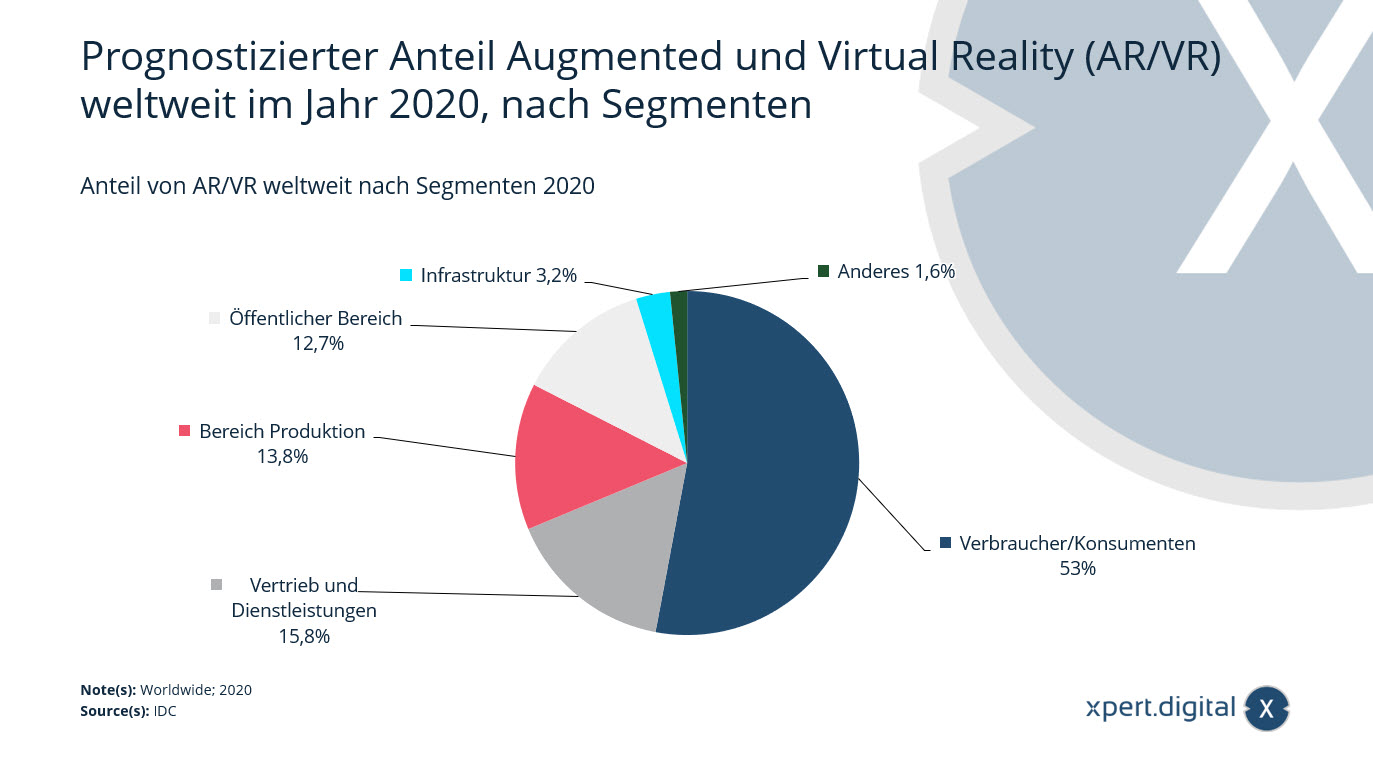
Predicted share of spending on augmented and virtual reality (AR/VR) worldwide – Image: Xpert.Digital
Share of global AR/VR spending by segment 2020
- Consumers – 53 in %
- Sales and services – 15.8 in %
- Production and resources – 13.8 in %
- Public sector – 12.7 in %
- Infrastructure – 3.2 in %
- Other – 1.6 in %
Since the end of 2020, Facebook's sales growth has not been going so well. It stagnates.
Facebook's revenue by segment worldwide through Q3 2021

Facebook revenue by segment worldwide through Q3 2021 – Image: Xpert.Digital
Facebook's advertising revenue was more than $28.2 billion in the third quarter of 2021. Facebook generated the largest share of advertising sales in this period with around 13 billion US dollars in the USA and Canada. In Europe, advertising sales of around 6.82 billion were generated in the same period. Around 5.4 billion US dollars were generated from advertising in the Asia-Pacific region.
More key figures about Facebook
Facebook's total revenue in 2020 was around $85.97 billion. During the same period, the California-based company's profits were about $29.15 billion.
Facebook users
In the US and Canada, the number of daily active Facebook users was 196 million in the third quarter of 2021. This means that the number of daily active users has only increased slightly compared to the previous quarter. In Europe, Facebook is used by around 308 million people every day, an increase of one million users compared to the previous quarter. Globally, Facebook is the most popular social network in terms of the number of monthly active users.
'Tuned' Metaverse Hype - A gathering place for copycats and soldiers of fortune?
From this perspective, it is not surprising that the Metaverse is now seen as the next generation of the Internet. As is usual in such processes, the countless free riders and soldiers of fortune are not too far away and are outdoing each other in this hype with meaningless options and announcements or confusing promises that are dangerous for your wallet.
According to a media report, singer Justin Bieber is said to have paid $1.3 million to be able to hop through the Metaverse as a monkey. The truth behind this cannot be verified, but it is significant that such headlines are circulating around the Metaverse.
What is not yet Metaverse will be made into Metaverse in order to get involved in the saturated advertising-financed media hype. Then z. For example, games that were once called open-world like “The Sandbox,” which is somewhat reminiscent of Minecraft, have been renamed Metaverse. Another media headline reported that a virtual property in “The Sandbox” was sold for $4.3 million. Seriously? According to Wikipedia, adidas, Warner Music Group, Snoop Dogg, Pororo, Shaun the Sheep, The Walking Dead, Atari and PwC Hong Kong are partners. Cameron and Tyler Winklevoss as well as the band Avenged Sevenfold are also among the investors in the virtual land in The Sandbox.
Metaworse: The Metaverse is dangerous
The twin Winklevoss brothers have been running the venture capital company Winklevoss Capital since 2012. According to media reports, they are said to have invested $11 million in the cryptocurrency Bitcoin. In addition, they announced that they wanted to launch a fund for Bitcoins in order to make investing in Bitcoins easier for non-computer-savvy investors. In September 2021, The Sandbox invested $2.9 million in a “Bored Ape” NFT. These Non-Fungible Tokens (NFT) are used for virtual goods. They are considered proof of the rights to digital things and can be collected and traded.
But what the added value or benefit for the physical and real world is supposed to be is more than questionable. It is reminiscent of the well-known Danish fairy tale “The Emperor's New Clothes”.
More stories are spun from stories like these. The “best of the best” are already propagating to experts: “Megatrend Megaverse. Invest in the new internet. The Internet of the future lies in the Metaverse. The Metaverse is a multi-trillion mega market.”
Now all the other buzzwords of the new and “everything about the positively changing future” come into play: cryptocurrencies, blockchain, Internet of Things, artificial intelligence, cloud computing, cybersecurity (“The world is in a global digital war!”) and what not.
Cui bono? Is this art or can it go away? You can safely throw this “metaworse” in the trash can.
Is the Metaverse evil?
The Facebook Metaverse as a further development of a social (tracking-commercialized) technology is aimed purely at the consumer target group, whose supposed added value to the real world needs to be questioned more closely.
Other virtual worlds are working on using crypto and token technology to sell “secure” virtual properties on which the virtual owners can then operate shops, casinos, etc. So these virtual properties are not there to be able to go on virtual vacations (which would obviously be nonsense), but rather serve as a marketplace to do business. So to speak, a digital E-Bay 3D, Amazon 3D or something similar. But not for products that are then delivered to you in the real world, but purely digital products that only one person can own as individual digital items.
The best-known names behind it are the Metaverse projects Cryptovoxels, Sandbox, Decentraland, Substrata, Somnium Space, NFT Worlds, TCG World, Genesis World, Matrix, Utherverse and Realm.
The business model simply explained
A metaverse is intended to represent a legally secure space with extended reality (XR) technology in which property owners can own and operate a property in a “crypto-secure” manner and can conduct business with virtual and physical things and services. Be it a shop (digital or physical products) or services (digital games, tools or services of any kind).
Likewise, consumers who own virtual things in a “token-safe” manner and cannot lose them, but things for real life can also be purchased.
From a consumer perspective, owning virtual properties only makes sense if it somehow relates to “computer games” or something similar. can be sensibly linked together, in the form of a library or “storage space”. The focus is therefore on the digital things that you can purchase - and here the rarity of the real world should be replicated in the digital space. This is made possible by a blockchain like Ethereum, which also causes the energy consumption and CO2 emissions of a medium-sized European industrial country.
This is not sustainable or valuable.
3D platforms, more interesting than “Metaverse” and with added value!
Actually, a metaverse is a place where the physical and digital worlds come together. As a further development of XR technology, which is intended to enable interactions between digital 3D images (cf. digital twins) and digital 3D avatars with each other.
In fact, some metaverses are currently not 3D worlds, but poorly implemented 2D projections that give the illusion of an apparent 3D world.
The metaverse provides a space for endless, interconnected virtual communities using VR headsets, AR glasses, smartphone apps or other devices.
All in all, the meaning and added value should be clear as to why the metaverse in question exists at all. All currently known metaverses use people's childlike curiosity and play instinct to lure people into their virtual world. Be it VR films, VR/AR games or pure VR/AR entertainment (Virtual Reality & Augmented Reality).
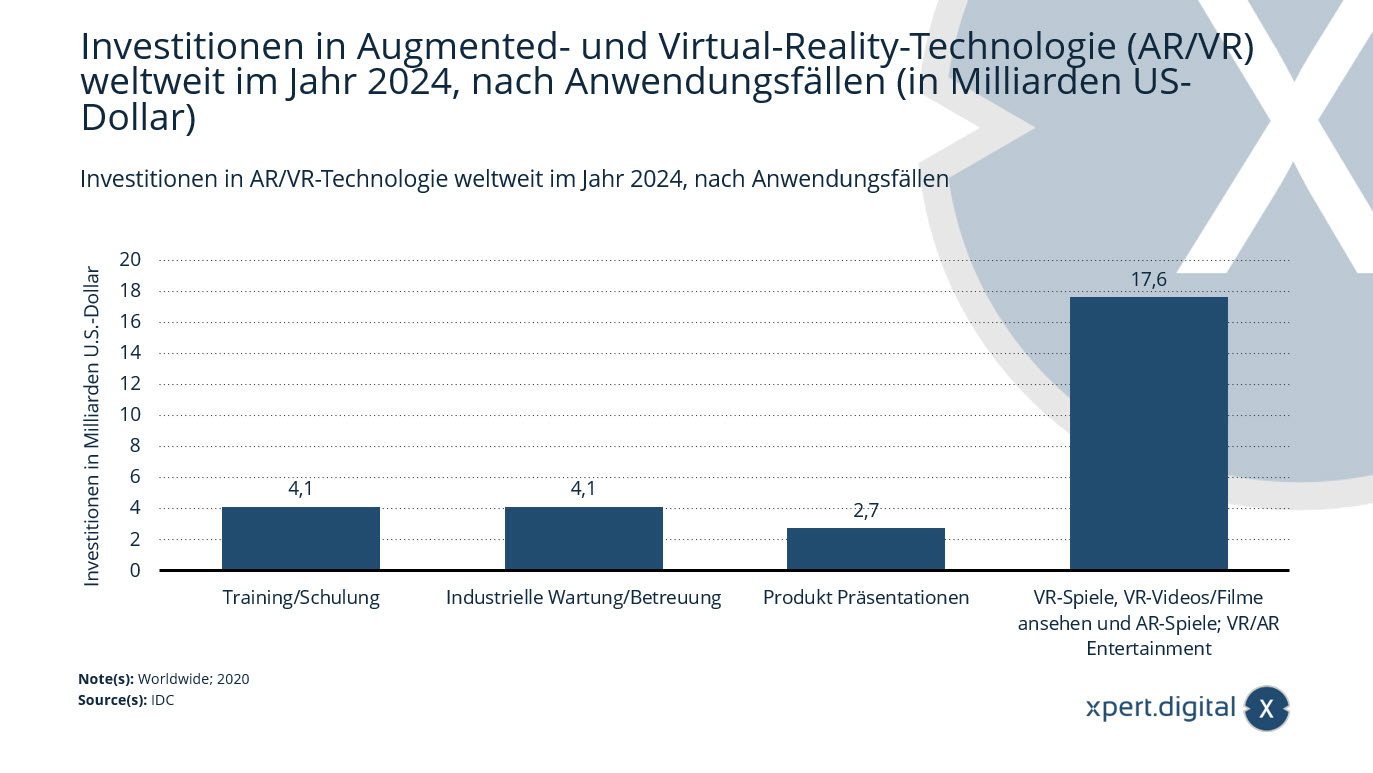
Investments in AR/VR technology worldwide in 2024, by use case – Image: Xpert.Digital
The commercial use cases for augmented and virtual reality (AR/VR) expected to see the largest investments in 2024 are education and industrial maintenance, with $4.1 billion expected to be invested in both areas. VR gaming, VR video/feature viewing, and AR gaming are the three largest use cases for augmented and virtual reality (AR/VR), with $17.6 billion expected to be spent in 2024.
Investments in augmented and virtual reality (AR/VR) technology worldwide in 2024, by use case
- Education/training/education – $4.1 billion
- Industrial maintenance/maintenance/support – $4.1 billion
- Product presentations – 2.7 billion US dollars
- VR games, watching VR videos/movies and AR games; VR/AR Entertainment – 17.6 billion US dollars
Metaverse
The Metaverse is considered the next generation of the Internet and is where the physical and digital worlds come together. As a further development of social technologies, the metaverse is intended to enable interaction between digital images of people, the avatars, in a variety of situations. Whether at work, in the office, attending concerts or sporting events, or even trying on clothes, the metaverse is intended to provide a space for endless, interconnected virtual communities using VR headsets, AR glasses, smartphone apps or other devices to use.
AR/VR in business
The use of VR in companies is often shown in training exercises. Examples of this are scenarios in which new employees are trained on important, technical machines and devices - to take them out of operation for training purposes, would be an expensive and disturbing process for a company in which VR stings to relieve this problem. AR can also help to improve efficiency in a company, especially with the function “I see what I see” for remote support and the overlay of data with the image of the physical world. On-site assembly, security and industrial maintenance are all applications for AR, which will have strong growth in the coming years.
However, the real strength of (Extended Reality) XR technology is not used in such metaverses
This is far from practical use in the company. Quite apart from the fact that Meta (formerly Facebook) will probably make the use of Meta-based products and solutions completely impossible in some companies due to its history on data protection.
In the early days of XR technology, it was primarily the high costs of the 3D models and the constant adjustments to the recurring operating system updates of the devices as well as new devices coming onto the market (mainly smartphones and tablets) that prevented .
For a long time, XR was only able to establish itself to some extent in the gaming sector (entertainment). Instead of using the potential of technology, the keyword “Metaverse” is assigned a connotation exclusively for “entertainment”, even though the underlying 3D technology has the potential to make our everyday lives, especially at work, easier and better – for all of us Save time, money and nerves.
With the first 3D frameworks for companies and no-code 3D platforms, costs could be permanently reduced and kept financially stable, allowing for increased and lasting use with demonstrable added value in the areas
- Training and education
- Industrial maintenance and support
- Product presentations
made possible.
Successful XR operations for maintenance, support, training and education
The use of VR in companies is often evident in training exercises. Examples of this include scenarios where new employees are being trained on key technical machines and equipment - taking these out of service for training purposes would be an expensive and disruptive process for a company, which is where VR steps in to alleviate this problem.
AR can also help to improve efficiency in a company, in particular with the function “see what I see” for remote support and the overlay of data with the physical world view. On-site assembly, security and industrial maintenance are all applications for AR, which will have further strong growth in the coming years.
A 3D platform is the right solution for companies

The 3D experience for B2B Sales & Marketing from Vuframe – Image: Vuframe
The use of VR in companies is often evident in training exercises. Examples of this include scenarios where new employees are being trained on key technical machines and equipment - taking these out of service for training purposes would be an expensive and disruptive process for a company, which is where VR steps in to alleviate this problem.
AR can also help to improve efficiency in a company, in particular with the function “see what I see” for remote support and the overlay of data with the physical world view. On-site assembly, security and industrial maintenance are all applications for AR, which will have further strong growth in the coming years.
It is in the logic of things that the use of extended reality serves a larger market in the consumer sector. However, the market only works with 3D images (digital twins) of the products and machines.
However, these costs and expenses are not even listed in the temptations for the Metaverse. This means that the Metaverse operators make the platform and everything surrounding it available to third parties, with costs that are lucrative for them. You leave the playing and “fun” to others.
This is where the next risks and problems arise for companies and manufacturers.
In no case is the data security of the CAD / 3D models of the products and machines guaranteed, they are easily extractable and lie unprotected at the feet of the competition.
In a 3D platform like that of Vuframe®, this data security of the CAD/3D models is guaranteed.
Non-reverse engineering / data security
Reverse engineering, also known as back engineering, is primarily the process of extracting information from a specific 3D model and reproducing it based on the information extracted through the reverse engineering process. This is not possible with the 3D platform from Vuframe, also called SmartVu (pronounced Smartview). The data stays safe! By the way, a unique selling point of Vuframe!
Building your own 3D platform for your own product presentation and interaction
Whether smart 3D meetings, virtual showrooms, creating CAD / 3D models with a configurator or an intelligent and flexible trade fair appearance from your pocket. Everything from the perspective of data security.
No-code platform for all CAD / 3D models with Vuframe
As an editor without prior programming knowledge, manage and maintain CAD / 3D models like in a CMS backend, e.g. B. like in WordPress, Joomla, TYPO3, Drupal, Wix.com or Shopify.

SmartVu, the no-code platform for all CAD / 3D models with Vuframe - Image: Vuframe
Simply upload the data sets, adjustment and compression takes place automatically. In any case, data security is automatically guaranteed. Copying from third parties is not possible!
Suitable for:


Are you looking for technical and strategic advice for the 3D visualization of digital twins and augmented / extended reality solutions? Xpert.Digital supports you!

Konrad Wolfenstein
I would be happy to assist you as a personal consultant for augmented/extended reality solutions.
You can contact me by filling out the contact form below or simply call me on +49 7348 4088 965 (Munich) .
I'm looking forward to our joint project.
Write to me

Xpert.Digital – Konrad Wolfenstein
Xpert.Digital is a hub for industry with a focus on digitalization, mechanical engineering, logistics/intralogistics and photovoltaics.
With our 360° business development solution, we support well-known companies from new business to after sales.
Market intelligence, smarketing, marketing automation, content development, PR, mail campaigns, personalized social media and lead nurturing are part of our digital tools.
You can find out more at: www.xpert.digital – www.xpert.solar – www.xpert.plus
Keep in touch











