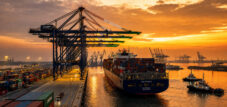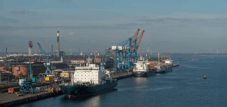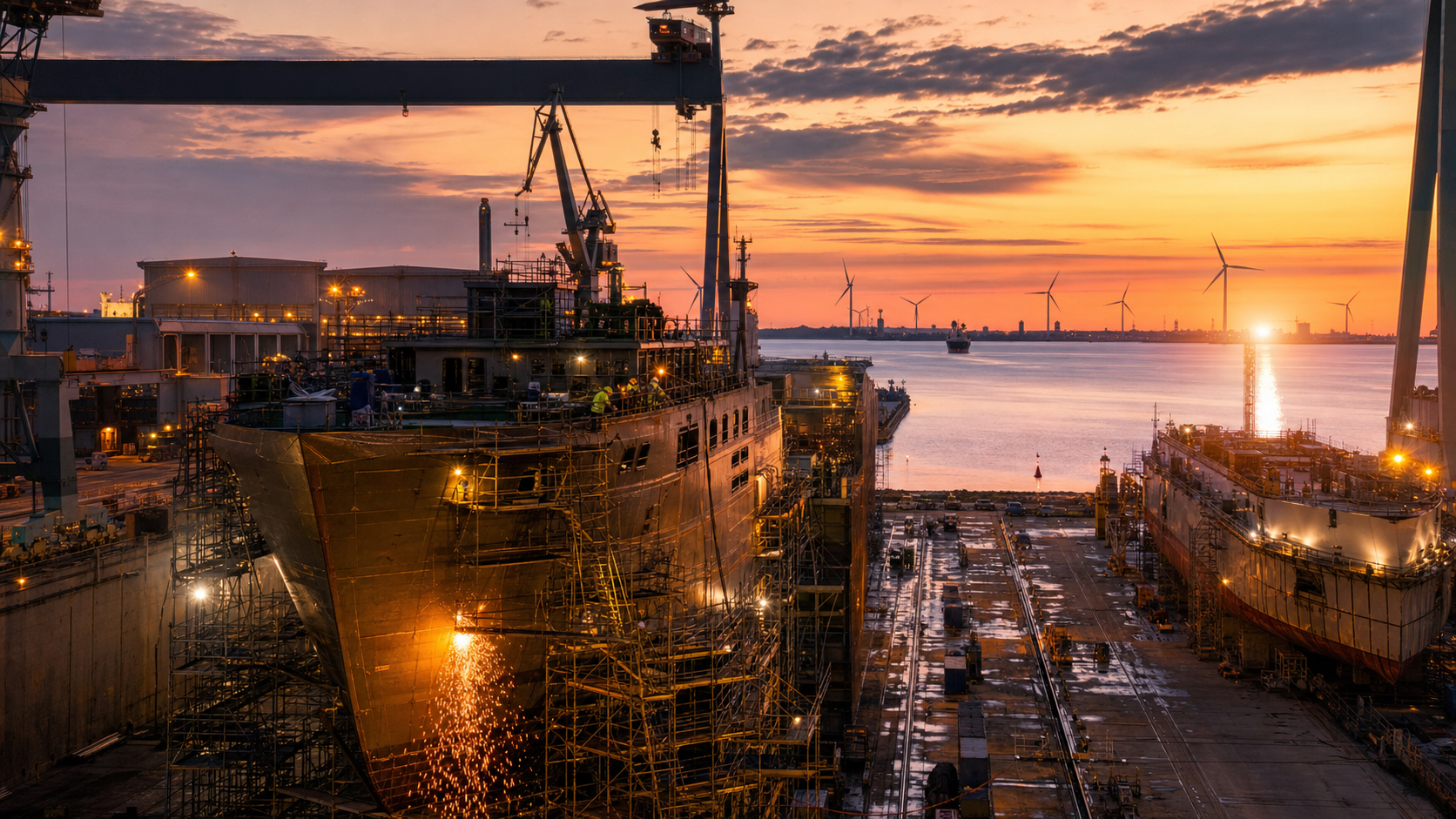
The maritime industry as a growth engine for Northern Germany: Bucking the trend – One sector grows while others shrink – Image: Xpert.Digital
From problem child to job miracle: How the geopolitical shift is changing our coastlines
Rheinmetall, TKMS & Co.: Germany's shipyards are becoming the new economic engine
Submarines, drones & wind power: The incredible comeback of German shipyards
While large parts of German industry are struggling with job cuts, shrinking sales, and structural crises, the north of the country is writing a completely different economic story. The maritime sector, and German shipbuilding in particular, is currently experiencing a historic boom. Driven by the geopolitical shift, the massive expansion of offshore wind energy, and a strategic industrial policy realignment, shipyards' order books are bursting at the seams. Companies like ThyssenKrupp Marine Systems (TKMS), Rheinmetall, and Neptun Werft are reporting record figures and are desperately seeking thousands of new skilled workers. But this unprecedented growth is not only bringing prosperity to the coasts; it also harbors systemic risks: an acute shortage of skilled workers, ethical dilemmas arising from multi-billion-euro arms contracts, and fierce competition from Asia are posing enormous challenges for the industry. This is a comprehensive analysis of who is truly profiting from this gold rush—and how sustainable the maritime upswing actually is.
While other industries are shrinking, German shipbuilding is experiencing a historic boom – but who really benefits, and where do the systemic risks lurk?
German shipyards and the broadly diversified maritime industry are currently experiencing an exceptional economic success story. While German industry as a whole had to cope with a 2.3 percent decline in jobs in 2025 – with 50,000 jobs disappearing in the automotive sector alone, and industrial sales falling by almost five percent within two years – the maritime industry recorded employment growth of 6.9 percent during the same period. This development is neither a coincidence nor a flash in the pan, but rather the result of structural shifts in geopolitics, energy policy, and defense policy priorities at both the national and European levels.
The German government has recognized the significance of this development. At the 14th National Maritime Conference in Emden, held under the patronage of Chancellor Friedrich Merz, it presented a 15-point plan for strengthening the sector. Simultaneously, a €400 million program from the special fund for infrastructure and climate protection is intended to specifically strengthen ports and shipping. Behind these figures lies a realignment of industrial policy that goes far beyond mere subsidies: Germany increasingly understands its maritime industry as systemically important infrastructure for national security, security of supply, and economic resilience.
Between tradition and transformation: What defines the maritime industry
Germany's maritime industry is an exceptionally diverse sector that extends far beyond traditional shipbuilding. It encompasses shipyards for merchant, specialized, and naval vessels, the shipbuilding supply industry, shipping companies, port operators, offshore technology for wind energy, marine and underwater technology, as well as research and education. According to the German Shipbuilding and Ocean Industries Association (VSM), the maritime industry, in its entirety, represents approximately 2,800 companies and just over 205,000 employees. Considering the entire economic value chain, the maritime industry secured a total of 449,800 jobs in 2018, generating direct added value of €29.8 billion and a turnover of €86.3 billion.
The Federal Ministry for Economic Affairs and Energy estimates the annual revenue of the maritime industry at up to €50 billion, supporting up to 400,000 directly or indirectly dependent jobs. For an export nation like Germany, where approximately 95 percent of intercontinental trade is handled by sea, this sector is not a niche industry, but rather the backbone of global trade. The Federal Government's Maritime Coordinator, Christoph Ploß (CDU), puts it succinctly: The maritime industry is not only enormously important as the foundation for exports, but also secures the country's supply of raw materials and energy.
The strength of Germany as a shipbuilding location does not lie in the mass production of standardized container ships – this market has been dominated for decades by East Asian shipyards, primarily in China, South Korea, and Japan. Germany has concentrated on high-quality, specialized vessels: submarines, frigates, corvettes, cruise ships, river cruise ships, icebreakers, research vessels, and offshore platforms. These are precisely the segments currently experiencing an explosive increase in demand.
The order record: When full order books become a structural challenge
The year 2024 marks a turning point for German shipbuilding. German shipyards received orders in 2024 with a total value exceeding that of the four preceding years combined. Civilian shipbuilding saw a new all-time high with order intake of approximately €10.7 billion. The umbrella organization SeaEurope calculated a German order backlog of 16.3 million Compensated Gross Tonnage (CGT) for 2024. At the same time, total revenue for the maritime industry increased by more than 15 percent, while civilian ship deliveries even rose by over 20 percent.
These record figures are not solely attributable to the arms boom, although this is a significant driver. Civilian shipbuilding benefits from global demand for specialized vessels, while naval shipbuilding is driven by the geopolitical situation. At the same time, the massive expansion of offshore wind energy is opening up a completely new industrial pillar for German shipyards, the economic implications of which have yet to be fully grasped.
However, full order books also bring risks. According to a survey by the Northern German Chamber of Industry and Commerce (IHK Nord), 63.7 percent of German shipyards see the shortage of skilled workers as their greatest economic risk, followed by rising labor costs (56.9 percent) and the economic policy framework (almost 99 percent). The discrepancy between order volume and personnel capacity is the industry's central bottleneck issue in the coming years.
TKMS and the submarine boom: Wismar as the new heart of German naval shipbuilding
No company embodies the current upswing in the German maritime industry more clearly than ThyssenKrupp Marine Systems (TKMS). The company, which describes itself as the world's leading manufacturer of conventionally powered submarines – and which has been operating as an independent, publicly listed company from ThyssenKrupp since January 1, 2025 – reported another record year for fiscal year 2024/25. Its order backlog stands at €18.2 billion, representing a 55 percent increase compared to the previous year (€11.6 billion). Revenue rose by 9.3 percent to €2.2 billion, and net profit climbed to €108 million.
Order intake in the 2024/25 financial year amounted to €8.8 billion – almost six times as much as in the previous year. These figures stem from a number of major strategic projects: the reorder of four submarines under the German-Norwegian 212CD program (order volume for the German units alone: €4.7 billion), the construction of the research icebreaker Polarstern II, the major contract for the modernization of six 212A submarines of the German Navy, and an export order for two further 218SG submarines for Asia.
The strategic centerpiece of the expansion is the Wismar site. Following the insolvency of MV Werften, TKMS acquired the site and gradually developed it into a hybrid shipyard – a location capable of handling both submarine and surface shipbuilding projects. On January 5, 2026, over 140 new employees began working in Wismar, bringing the site's workforce to over 400. The stated goal: to create up to 1,500 jobs by the end of 2029, depending on the order situation. Even now, demand for positions significantly exceeds supply – TKMS's technical director reported over 30 applications for a single advertised position in Wismar.
The economic and geographical significance of this development for Mecklenburg-Western Pomerania – one of Germany's most structurally weak states – can hardly be overstated. The creation of 1,500 skilled industrial jobs at a location associated for years with insolvency and economic decline represents a quantum leap in structural policy. And this effect multiplies: for every direct shipyard job, downstream demand from suppliers, service providers, and the local economy is estimated to generate at least five additional jobs.
Rheinmetall takes over Blohm+Voss: Hamburg prepares for the maritime revolution
The most spectacular change of ownership in the German shipbuilding landscape in recent times took place in Hamburg. The defense contractor Rheinmetall acquired the naval division of the Bremen-based Lürssen Group, including the long-established Hamburg shipyard Blohm+Voss. The newly acquired group employs approximately 2,100 people. The purchase price, which Rheinmetall first disclosed in early 2026, underscores the strategic importance of the deal for the company, which until now was primarily known as a manufacturer of tanks, ammunition, and air defense systems.
For Blohm+Voss, the acquisition represents a fundamental strategic realignment. The shipyard, which has been a symbol of North German industrial tradition in the Port of Hamburg for generations, will now become the centerpiece of a maritime defense offensive. At the beginning of 2026, Rheinmetall was seeking more than 500 new employees for its naval division – engineers, physicists, but also welders and other skilled tradespeople. Rheinmetall CEO Armin Papperger emphasized that the company had significantly increased staffing at all locations where it had acquired a stake.
The drone program is particularly revealing regarding future technological direction. Blohm+Voss, in cooperation with its British technology partner Kraken Technology, is to produce Unmanned Surface Vehicles (USVs) – remotely piloted underwater drones capable of speeds up to 90 km/h and designed for surveillance, reconnaissance, and combat missions. Initial production is planned at around 200 drones per year, which could be scaled up to 1,000 units in three-shift operation if demand warrants, creating up to 400 new jobs in Hamburg. In parallel, Rheinmetall is developing fully autonomous drones for military use, sparking controversial debates in Hamburg regarding the ethical implications.
This development fits into a larger trend: According to NDR's assessment, Blohm+Voss is "once again a pure arms company," with the geopolitical situation bringing the company an unexpected upswing. The debate about whether this upswing is being sufficiently reflected upon socially and ethically is justified and necessary – but it does not diminish the economic reality of a shipyard that, after years of stagnation, is back on a growth trajectory.
Flensburg: Phoenix from the ashes of the Windhorst debacle
Few chapters in recent German shipbuilding history are as dramatic as that of the Flensburg Shipbuilding Company (FSG). The venerable shipyard – part of Flensburg's industrial history for 150 years – experienced a gradual decline under investor Lars Windhorst. Orders were not processed as planned, and suppliers terminated their partnerships due to unpaid invoices. The workforce, which around the turn of the millennium still numbered over a thousand people (including those from external companies), was reduced to fewer than 300 over the years. On December 12, 2024, a health insurance company filed for insolvency – not Windhorst himself. According to the IG Metall union, it was a "day of liberation.".
The insolvency administrators acted swiftly. In January 2025, a new owner was found in the Bremerhaven-based Heinrich Rönner Group, specializing in shipbuilding and heavy steel construction. The Australian shipping company SeaRoad, whose ferry was already under construction at the shipyard, acted as a cooperation partner. Production was able to restart in March 2025 – initially with considerable effort, as machinery had to be serviced, gas systems repaired, and supplier relationships painstakingly reactivated. Then, in November 2025, the symbolic moment of a new beginning occurred: a launch after a three-and-a-half-year hiatus – the RoRo ferry Searoad 1 was successfully launched.
At the end of January 2025, the renamed FSG Shipyard GmbH employed 287 people, including 19 apprentices. Further hiring is planned, and shipyard owner Thorsten Rönner expressed confidence: they were optimistic about achieving a final turnaround in the second year after the takeover. In February 2026, the first real newbuild order after the insolvency was launched with the cutting of the steel for a 48-meter-long floating technology platform for the German Aerospace Center (DLR). The Flensburg case study impressively demonstrates how, with the right economic and political framework and qualified managers, a shipyard considered doomed can be revived.
NEPTUN WERFT Rostock: From river cruise ship to offshore infrastructure
Less dramatic in its history, but no less significant from an economic perspective, is the development of the NEPTUN WERFT shipyard in Rostock-Warnemünde. As part of the MEYER Group since 1997, the company has continuously evolved and, with more than 650 employees, is now one of the market leaders in the construction of river cruise ships. With the introduction of the 35-hour week in 2024, the company set a labor market policy example in an industry struggling to attract skilled workers.
The real growth potential, however, lies in a new segment: the construction of offshore converter platforms. These floating substations are critical infrastructure for offshore wind energy: they convert the alternating current generated by wind turbines at sea into direct current, which can be transmitted to land over long distances with significantly lower losses. Given Germany's ambitious expansion targets for offshore wind – 30 gigawatts by 2030, 40 gigawatts by 2035, and 70 gigawatts by 2045 – the demand for these platforms is enormous.
In June 2026, NEPTUN WERFT received a multi-billion euro order from 50Hertz, one of Germany's transmission system operators, for the construction of key components of an offshore converter platform for the North Sea. According to 50Hertz, the total volume of the associated production and service contracts could amount to approximately 2.5 billion euros, primarily in Mecklenburg-Western Pomerania. This is expected to create more than 500 new jobs – at the directly involved companies and their suppliers. Neptun WERFT alone is seeking around 400 new employees in the coming years for converter platform production.
The German Offshore Wind Energy Association (BWO) welcomed this order as a signal of industrial policy: it demonstrates the potential of offshore wind energy for domestic value creation, employment, and innovation. The development of domestic maritime manufacturing capacities for converter platforms will also strengthen the resilience of the offshore wind supply chain and reduce dependence on suppliers outside Europe. In the long term, floating substations for offshore installations are to be built at the purpose-built Warnowwerft naval arsenal in Rostock by 2040 – with a total potential of around 500 jobs at this location alone.
Our EU and German expertise in business development, sales and marketing

Our EU and German expertise in business development, sales and marketing - Image: Xpert.Digital
Industry focus areas: B2B, digitalization (from AI to XR), mechanical engineering, logistics, renewable energies and industry
More information here:
A thematic hub offering insights and expertise:
- Knowledge platform covering global and regional economies, innovation and industry-specific trends
- A collection of analyses, insights, and background information from our key areas of focus
- A place for expertise and information on current developments in business and technology
- A hub for companies seeking information on markets, digitalization, and industry innovations
Research funding as a driving force: How Germany will once again become a world leader in shipbuilding
The multiplier effect: How one shipyard job creates five more
One of the most economically significant, yet least publicly discussed, dimensions of the maritime boom is its multiplier effect on the overall economy. Maritime coordinator Ploß succinctly summarizes it: For every job created in a coastal shipyard, at least five to six new jobs are created in other sectors of the economy. This effect is well-documented empirically: A 2021 study by DIW Econ concluded that 100 jobs in the maritime industry secure another 130 jobs in Germany.
The logic behind this is simple: A modern shipyard is a highly complex systems integrator. A single vessel contains thousands of components – engines, electronics, steel structures, insulation materials, navigation systems, piping, paints, and coatings – manufactured by a dense network of specialized suppliers. In addition, there are service providers for logistics, planning, design, software development, training, and maintenance. The maritime supply industry currently employs around 65,000 people and recorded an average revenue increase of 5.5 percent in 2024; order intake rose by 4.6 percent. Two-thirds of the companies surveyed expect stable or growing demand in 2025.
If, as maritime coordinator Ploß has projected, 9,000 new jobs are created in the North German coastal shipyards alone, the multiplier effect will generate another 45,000 to 54,000 jobs in the supplier industry and downstream sectors. This figure explains why the originally stated goal of over 100,000 additional jobs across the entire maritime industry is not political exaggeration, but a projection based on sound economic principles.
The geopolitical turning point as a driver of growth
The Russian attack on Ukraine in February 2022 fundamentally changed the landscape for German and European naval shipbuilding. What was previously considered a niche industry with no future is now systemically important for national security. Germany is massively modernizing its navy. Procurement projects include eight new F127-class frigates with an estimated total volume of around €26 billion, several new Type 212CD submarines, and the expansion of the corvette fleet. TKMS already puts its order backlog at €18.2 billion – with further potential major projects in the pipeline.
In parallel, other NATO states are seeking reliable partners for conventional submarines. TKMS is competing for a contract for eight to twelve conventional submarines for Canada; a decision is expected in 2026. At the end of November 2025, TKMS delivered the second of a total of six submarines to Turkey. The company has also begun talks regarding the acquisition of its neighboring Kiel shipyard, German Naval Yards (GNY), which currently employs around 400 people and belongs to the French shipbuilding group CMN Naval. Such a consolidation would significantly strengthen TKMS both geographically and in terms of capacity.
Chancellor Merz has increased the defense budget to over two percent of GDP, and the Bundeswehr's €355 billion procurement list includes €19 billion for new naval capabilities alone. This flow of capital is going directly to the North German shipbuilding industry. The sector is aware that this exceptional situation must be carefully managed: overheating, capacity problems, and the development of one-sided dependencies on arms contracts are real risks.
State funding architecture: The maritime research program as an engine of innovation
Behind this upswing lies not only favorable economic and geopolitical conditions, but also years of research funding. The Maritime Research Program of the Federal Ministry for Economic Affairs and Energy (BMWi) fully maps the industry's value chain – from materials development and digitized production to the demonstrated operational capability of complex maritime systems. It is divided into five funding priorities: MARITIME.zeroGHG (Climate-Neutral Ship), MARITIME.green (Maritime Environmental Protection), MARITIME.smart (Maritime Digitization), MARITIME.safe (Maritime Safety), and MARITIME.value (Maritime Resources).
This funding structure has historically been instrumental in enabling German companies to maintain their technological leadership in specialized segments despite Asian cost pressures. Today, innovations in climate-neutral shipping, autonomous systems, and offshore technology are laying the foundation for the next wave of growth. The German Federal Ministry for Economic Affairs and Energy's (BMWi) Maritime Research Strategy 2025 provides a comprehensive framework that supports the industry in developing sustainable technologies while simultaneously strengthening its international competitiveness.
A concrete example of the effectiveness of this funding architecture is offshore converter platform technology. More than a decade ago, Germany held a leading global position in this segment, particularly at the Nordic shipyards in Mecklenburg-Western Pomerania. However, it lost this position due to political errors in synchronizing wind farm expansion and grid connection. Now, with political support through the coalition agreement and government funding, these capacities are returning – with the major order placed with NEPTUN WERFT representing a preliminary high point.
The arms dilemma: Growth with moral weight
An honest analysis of the maritime boom cannot avoid addressing the ethical and socio-political tensions. A significant portion of this growth is directly attributable to arms contracts. TKMS supplies submarines for the German Navy and for foreign clients; Rheinmetall will soon be building weaponized surface drones at Blohm+Voss, which are already being marketed to countries like Egypt and Bulgaria. Peace researchers like Professor Michael Brzoska from the University of Hamburg warn that the arms industry is exploiting the increased societal importance of defense to more aggressively pursue arms exports – and that this development is often not sufficiently recognized.
This criticism deserves serious consideration. At the same time, it would be analytically incomplete to portray maritime growth as a purely arms-driven phenomenon. Offshore wind power, the construction of research vessels, icebreakers for scientific Arctic research, and river cruise ships for the tourism sector are equally strong pillars of growth. The diversity of order books ultimately also serves as an economic safeguard against cyclical fluctuations in the arms industry.
Structural risks: What could slow down the recovery
Historically, growth forecasts in shipbuilding have often disappointed, and the current record orders do not create a right to complacency. Four structural risk factors deserve particular attention:
The shortage of skilled workers is the most immediate obstacle. Shipbuilding requires highly specialized qualifications – naval architects, designers, welders, electricians, and pipefitters – which are not readily available on the job market and whose training takes years. TKMS has already announced plans to hire up to 60 trainees annually in Wismar, but the mismatch between the planned personnel expansion and the available skilled workers is a systemic bottleneck.
The dependence on large government contracts carries a second risk. Bundeswehr procurement projects have regularly resulted in significant delays and budget overruns in the past. The German Navy's F126 frigate project is currently facing considerable difficulties, and while TKMS's assessment that it can provide alternative solutions is economically understandable, it is not yet politically secure. If contracts are postponed or re-awarded, shipyard capacity can quickly become a cost factor.
Competition with Chinese shipyards is the third structural problem. China already produces 60 percent of all new ships worldwide, and state-backed Chinese conglomerates can offer prices that are simply not competitive for European shipyards with their higher labor costs and environmental standards. The shift of European shipping orders to China continues despite political counter-movements: since 2021, orders worth around €310 billion have gone to China.
The fourth risk lies in the financing architecture. Large maritime projects – converter platforms, cruise ships, naval vessels – require substantial upfront financing, which is often difficult for medium-sized shipyards to manage. The current federal government's inclusion of shipyards in its large-scale loan guarantee program is an important step toward mitigating this disadvantage and making multi-billion-euro projects bankable.
Northern Germany as a maritime backbone: Locations on the move
The geographical concentration of the maritime industry in Northern Germany is not a historical accident, but the result of centuries of interaction between the coast, ports, and shipbuilding. Today, the region's industrial landscape comprises a dense network of shipyards, suppliers, and service providers along the North Sea and Baltic Sea coasts, as well as in the Hanseatic cities of Hamburg and Bremen.
Kiel remains the center of German naval shipbuilding, home to the TKMS main plant and the adjacent German Naval Yards. Under TKMS's management, Wismar is developing into the second major location for naval shipbuilding. Rostock-Warnemünde, with its NEPTUN WERFT shipyard, combines civilian shipbuilding with emerging offshore technology. Hamburg, with Blohm+Voss under Rheinmetall, is establishing maritime defense expertise that is gaining a new technological dimension through its drone program. Flensburg is experiencing a restart following the Windhorst debacle, one that is remarkable in its intensity and speed.
These shipyard locations are complemented by Bremerhaven, Emden, Rostock, and the numerous medium-sized supplier locations inland, which provide engines, electronics, hydraulic systems, and specialty materials. This interconnectedness makes the maritime industry a genuine North German economic cluster – with the strategic importance of a national economic factor.
Outlook: A measured new beginning
Germany's maritime industry is poised for a decade of growth unseen since the heyday of German shipbuilding in the post-war period. All key growth drivers remain intact: geopolitical demand for naval shipbuilding, the energy transition driving offshore converter platforms and specialized vessels, the leading global segment for cruise ships and research vessels, and a federal government that, for the first time in years, is treating the sector as strategically important and a political priority.
The goal of creating more than 100,000 additional jobs across the entire maritime industry and its suppliers is ambitious but realistic – provided that the structural challenges are actively addressed. Training capacities must be increased, large-scale loan guarantee programs expanded, industrial policy continuity maintained, and order books diversified beyond pure dependence on defense spending secured.
The case study of the maritime industry serves as a lesson in an economic policy principle that is all too often forgotten in Germany: When government support, industrial expertise, political will, and entrepreneurial initiative come together, growth ecosystems emerge that are globally competitive despite high labor costs and strict regulations. Northern Germany's maritime industry proves that Germany can not only administer but also shape the future.
Your global marketing and business development partner
☑️ Our business language is English or German
☑️ NEW: Correspondence in your native language!

Konrad Wolfenstein
I and my team are happy to be available to you as your personal advisor.
You can contact me by filling out the contact form here wolfenstein@xpert.digital:or simply call me at +49 7348 4088 965. My email address is
I'm looking forward to our joint project.
☑️ SME support in strategy, consulting, planning and implementation
☑️ Creation or realignment of the digital strategy and digitization
☑️ Expansion and optimization of international sales processes
☑️ Global & Digital B2B trading platforms
☑️ Pioneer Business Development / Marketing / PR / Trade Fairs
🎯🎯🎯 Data-driven B2B industry hub as a quasi-in-house solution


The quasi-in-house solution: How Xpert.Digital closes operational gaps in B2B marketing and sales – Smart Content-Driven Business - Image: Xpert.Digital
Xpert.Digital is a data-driven B2B industry hub led by Konrad Wolfenstein . The company acts as an external, quasi-in-house solution for industrial partners, closing operational gaps in marketing, content, and sales – without requiring additional resources on the client side.
More information here: