
Historically low prices in the solar market are a thing of the past: That's why solar systems will become drastically more expensive again from now on
Xpert Pre-Release

Available in 27 languages 📢
Prefer Xpert.Digital on GoogleⓘPublished on: March 7, 2026 / Updated on: March 7, 2026 – Author: Konrad Wolfenstein
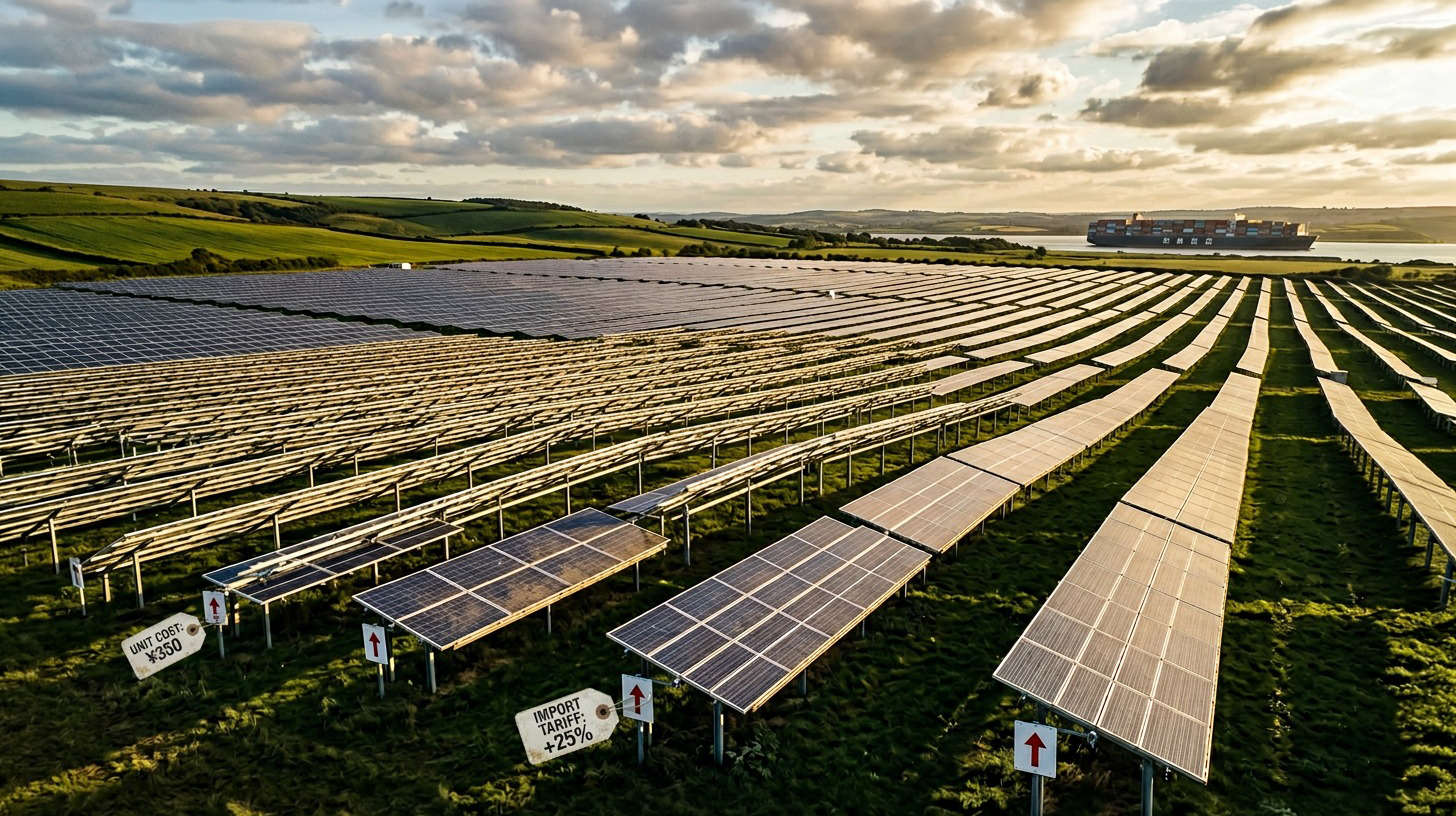
Historically low prices in the solar market are a thing of the past: That's why solar systems will become drastically more expensive again from now on – Creative image: Xpert.Digital
End of feed-in tariffs & expensive modules: The perfect storm in the solar market hits homeowners hard
Photovoltaic shock 2026: Why you absolutely shouldn't wait until next year to install your solar system
After the extreme fluctuations of recent years, homeowners and the solar industry were hoping for a finally calm year in 2026. But reality looks completely different: An unprecedented triple shock is currently shaking the photovoltaic market and threatens to drastically alter the calculations of millions of homeowners. While China is cutting its export subsidies, significantly increasing the price of solar modules, the German government is simultaneously planning to end the crucial feed-in tariff for small systems. This "perfect storm" is being fueled by escalating gas prices as a result of a new Middle East conflict, which inevitably evokes unpleasant memories of the energy crisis. For consumers considering a solar system, as well as for the entire industry, a nerve-wracking race against time is now beginning.
The perfect storm in the solar market – Why the supposedly calm PV year 2026 will be a turning point.
Three shockwaves hit an industry that has only just recovered.
Anyone who thought the German photovoltaic market would finally settle into calmer waters after the turbulent years of 2023 and 2024 will be proven wrong in the first months of 2026. Three developments are converging on a market that is only just recovering from the upheavals of the energy crisis and the subsequent overcapacity: China is eliminating export discounts for PV components, the German government plans to abolish feed-in tariffs for small systems from 2027 onwards, and the conflict with Iran is causing gas prices in Europe to skyrocket. Each of these developments has the potential to significantly shift supply, demand, and prices in the solar market. Together, they could trigger a tectonic shift.
The starting point is anything but simple. After Germany added around 16.5 gigawatts of new photovoltaic capacity in 2025, exceeding the government's target of 15 gigawatts, 2026 got off to a slow start. In the first two months, only around 45,000 systems were installed in the residential segment between 5 and 25 kilowatts peak – a decline of 32 percent compared to the same period of the previous year. Frost, snow, and short days contributed to this, but the figures also reflect a more fundamental uncertainty.
The Chinese export discount is being eliminated – and is changing the global pricing landscape
The first shockwave came from Beijing. On January 9, 2026, the Chinese Ministry of Finance, together with the State Tax Administration, announced that VAT export refunds for photovoltaic products would be completely abolished on April 1, 2026. For battery products, the discount rate will initially be reduced from nine to six percent before being eliminated entirely on January 1, 2027.
This announcement marks the end of over a decade of export subsidies that significantly contributed to Chinese solar panels dominating the global market and driving prices to historic lows. It is the second major adjustment in just over a year. In December 2024, export rebates for photovoltaic products were reduced from 13 to 9 percent. Now they are being eliminated entirely.
The reasons for Beijing's change of course are multifaceted. Officially, the measure aims to curb the ruinous price decline in photovoltaic products, reduce overcapacity, and prevent trade conflicts. Unofficially, it also represents an attempt to consolidate the domestic solar industry, which is suffering from a relentless price war. Dozens of Chinese module manufacturers recently posted losses, and even industry giants were reaching their limits.
The effects on the European market are already being felt. Martin Schachinger, Managing Director of the online marketplace PV Xchange and a long-time observer of module prices, describes the situation as a tsunami that is building faster than expected. In the distribution sector and in online shops, module prices have already been adjusted upwards by up to 30 percent – far more than the nine percent that would be justified by the mere elimination of the export discount. In addition to the export discount, intermediate products such as silicon ingots, silver pastes, cells, glass, and aluminum for the module frames are also becoming more expensive.
For the German market, this marks the end of the historically low price period. In spring 2025, the average prices of complete photovoltaic systems reached a historic low. For turnkey systems, a price range of €1,100 to €1,500 per kilowatt peak was expected in the German market in 2026. This calculation is now being reviewed.
The feed-in tariff is on its way out – a watershed moment in energy policy
The second shockwave originated in Berlin. Federal Minister for Economic Affairs Katherina Reiche plans to abolish the fixed feed-in tariff for new photovoltaic systems up to 25 kilowatts peak from January 1, 2027. A roughly 400-page draft bill on the Renewable Energy Sources Act (EEG), which was obtained by various media outlets, stipulates that even small rooftop systems will have to sell their electricity directly on the market in the future – a model that has so far proven neither technically nor economically viable for private households.
The Ministry of Economic Affairs argues that private solar power systems are now economically viable even without government subsidies and that the existing system costs billions of euros annually. In fact, last year the federal government had to pay around 18 billion euros to grid operators to finance feed-in tariffs – since the abolition of the EEG surcharge in 2022, the state has borne these costs entirely. Furthermore, on sunny days, so much electricity is now generated that supply exceeds demand.
However, the plans are facing massive criticism. The German Solar Association warns that abolishing the feed-in tariff and mandating direct marketing would bring the citizen-led energy transition to a standstill. For the majority of new solar power plant operators, the feed-in tariff remains essential to ensure sufficient profitability. The Fraunhofer Institute for Solar Energy Systems, in its own study, has warned of the consequences and stated that 2027 is definitely too early to abolish the fixed feed-in tariff.
The problem lies in the fees for direct marketing. Especially for small rooftop systems up to 30 kilowatts peak, the costs for the necessary direct marketing could consume up to 69 percent of the revenue over the entire project duration. The self-consumption rate would have to be about 15 percent higher than under the current EEG model to compensate for the lower revenue from electricity sales.
Currently, the feed-in tariff for new installations up to 10 kilowatts peak (kWp) is 7.78 cents per kilowatt-hour for partial feed-in and 12.34 cents for full feed-in. For the power output between 10 and 40 kilowatts peak, rates of 6.73 and 10.35 cents, respectively, are paid. These rates decrease by one percent every six months – the next reduction will take place on August 1, 2026. Anyone wishing to benefit from the current conditions must commission their installation by the end of 2026, as existing installations are grandfathered in.
New: Patent from the USA – install solar parks up to 30% cheaper and 40% faster and easier – with explanatory videos!

New: Patent from the USA – Install solar parks up to 30% cheaper and 40% faster and easier – with explanatory videos! - Image: Xpert.Digital
The core of this technological advancement is the deliberate departure from conventional clamp mounting, which has been the standard for decades. The new, more time- and cost-effective mounting system addresses this with a fundamentally different, more intelligent concept. Instead of clamping the modules at specific points, they are inserted into a continuous, specially shaped support rail and held securely in place. This design ensures that all forces – whether static loads from snow or dynamic loads from wind – are distributed evenly across the entire length of the module frame.
More information here:
The solar trap: Why exploding gas prices are paradoxically slowing down the energy transition
The Iran conflict is driving gas prices to a three-year high
The third and, in its short-term impact, most dramatic shockwave came from the Persian Gulf. Since February 28, 2026, the United States and Israel have been conducting airstrikes against Iran. The energy markets reacted immediately and with unprecedented force. The European gas reference price (TTF) jumped by over 50 percent within 24 hours to around 62 euros per megawatt-hour – the highest level in more than three years. Since the beginning of the week, the gas price has at times more than doubled.
The reasons lie in the strategic importance of the Strait of Hormuz, through which around 20 percent of the world's liquefied natural gas (LNG) trade is conducted. Iran has effectively closed this strait, and a general in the Revolutionary Guard threatened to burn any ship attempting to pass through it. Qatar Energy, the world's largest LNG exporter, halted its gas production following drone attacks on facilities in Ras Laffan and Mesaieed – a disruption for which there is no immediate replacement.
Analysts paint a bleak picture. JPMorgan considers gas prices of €60 per megawatt-hour and more realistic should the conflict last for several weeks. Deutsche Bank does not rule out prices exceeding €80 per megawatt-hour in the extreme scenario – a continued blockage of the Hormuz pipeline and further infrastructure damage. Goldman Sachs warns of a gas price increase of up to 130 percent in Europe, which would mean a return to the levels of the 2022 energy crisis. The price shock at that time pushed millions of German households to the limits of their financial capacity.
Oil prices are also rising sharply. The investment bank Bernstein raised its Brent crude oil forecast for 2026 from $65 to $80 per barrel and, in the extreme case of a prolonged conflict, even sees prices of $120 to $150. The Iranian Revolutionary Guard even predicted an oil price of $200.
How the three factors interact
What makes the current situation so critical is not the individual effect of each development, but their interplay. Rising module prices due to the elimination of Chinese export discounts increase the investment costs for new photovoltaic systems. The looming abolition of feed-in tariffs from 2027 onwards creates uncertainty about long-term profitability. And while soaring gas prices increase the economic incentive for solar installations, they simultaneously intensify general inflationary pressure, which further erodes consumer purchasing power.
This presents a paradoxical scenario for the industry. On the one hand, rising gas and electricity prices could boost demand for solar systems and battery storage in the short term – especially when the feed-in tariff is abolished from 2027 onwards, triggering significant pull-forward effects. On the other hand, higher module prices and rising installation costs drive up the overall investment, which can be a deterrent, particularly for price-sensitive private households.
Market research firm Memodo warns of potential shortages in some product segments. If end customers bring forward their investment decisions to benefit from existing feed-in tariffs, and import prices rise at the same time, supply bottlenecks could occur. The year 2027 would then face a drastic slump in the residential sector.
The numbers behind the uncertainty
The current market dynamics are reflected in the installation figures. By the end of 2025, Germany will have an installed photovoltaic capacity of 117 gigawatts, equivalent to approximately 5.7 million solar installations. Bavaria leads the statistics with 31,452 megawatts of installed capacity, followed by North Rhine-Westphalia and Baden-Württemberg. In 2025, photovoltaics will have become the second most important energy source in the German electricity mix, accounting for 16.8 percent of electricity generation.
To achieve the legally mandated expansion target of 215 gigawatts by 2030, photovoltaic capacity would need to be increased to 22 gigawatts in 2026. Given the sluggish start to the year and the market uncertainties described, this target appears ambitious. The German Solar Association (BSW) had initially forecast an expansion of 17.5 gigawatts for 2025, while the Federal Network Agency projected 16.4 gigawatts – both figures fell short of expectations.
In contrast, the large-scale storage sector is showing encouraging momentum. In the first two months of 2026, nearly 2,000 storage units with a capacity of over 25 kilowatt-hours were installed, representing a 21 percent increase compared to the previous year. The installed capacity has more than doubled. Large-scale storage facilities for arbitrage trading and balancing energy now account for around 80 percent of the newly installed capacity. Rising gas and electricity prices will further accelerate this trend.
What the industry needs now
The photovoltaic industry is facing a turning point that goes beyond purely economic considerations. The question is whether the energy transition in the residential sector – one of the cornerstones of Germany's solar expansion – will continue to progress dynamically, or whether political and geopolitical factors will stifle this momentum.
The debate surrounding feed-in tariffs deserves a more nuanced examination than is currently being conducted. It is true that the existing system costs the state billions annually. However, it is also true that the fixed tariff has been the crucial anchor of trust for millions of homeowners who have invested in solar power systems. An abrupt transition to direct marketing – without establishing the necessary technical and regulatory framework – would destabilize the market.
What the industry needs are clear transition periods, a faster rollout of smart meters that can precisely control feed-in, nationwide dynamic electricity tariffs, and a realistic assessment of what private households can achieve economically and technically. The supposedly quiet year for photovoltaics, 2026, will not materialize. It will be a year of crucial decisions – and of the consequences that will follow from the decisions made in the coming weeks and months.
Your partner for business development in the fields of photovoltaics and construction
From industrial rooftop PV to solar parks and larger solar parking lots
☑️ Our business language is English or German
☑️ NEW: Correspondence in your native language!

Konrad Wolfenstein
I and my team are happy to be available to you as your personal advisor.
You can contact me by filling out the contact form here or simply call me at +49 7348 4088 965. My email address is: [email protected]
I'm looking forward to our joint project.







