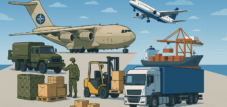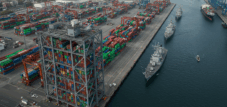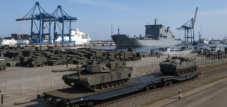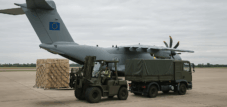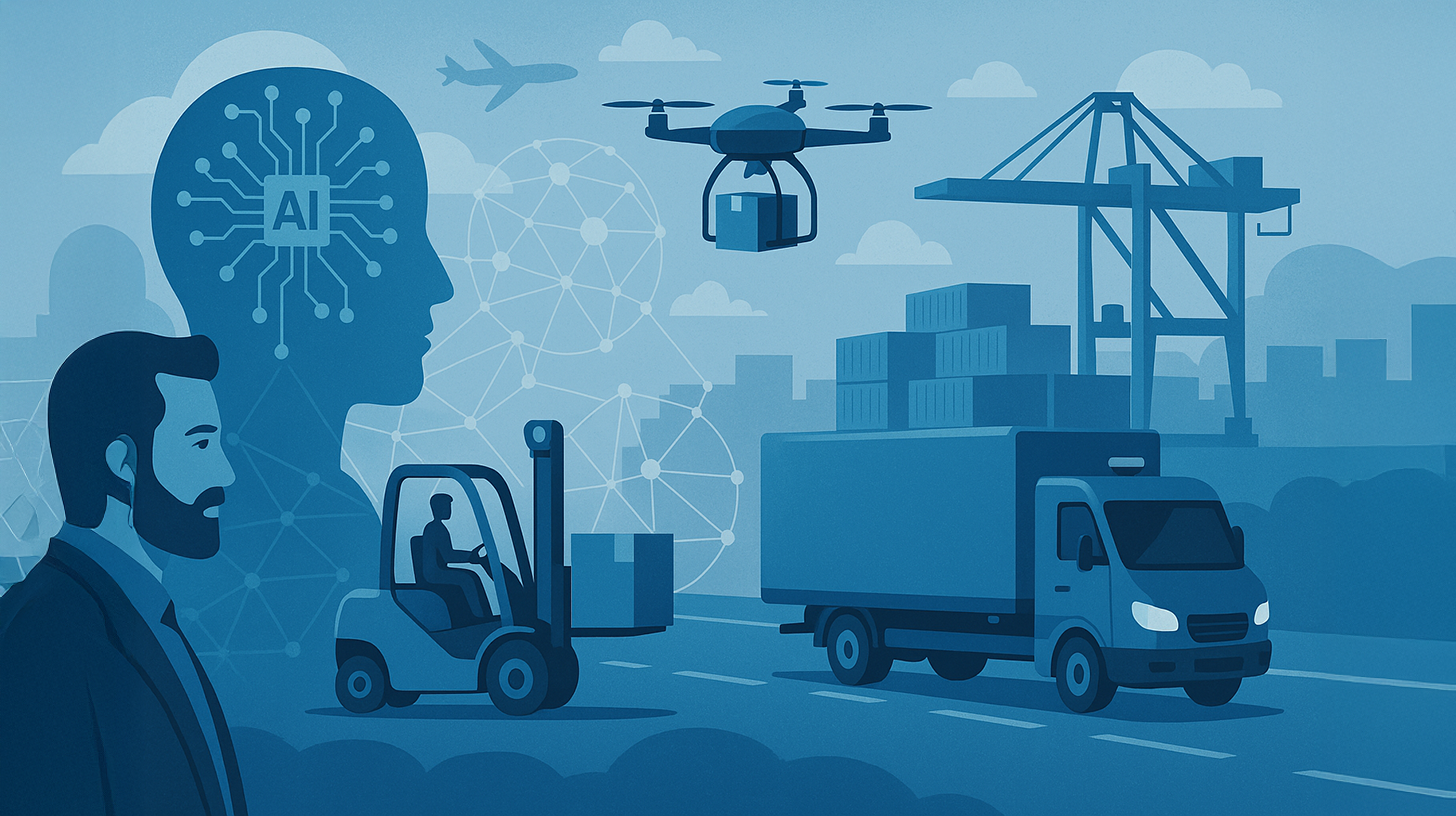
Logistics 4.1 is dual-use logistics as a strategic weapon: resilience and technology with AI, autonomy and automation – Image: Xpert.Digital
Logistics 4.1 as a strategic weapon: Resilience, technology and the role of the militia in modern national and alliance defense
The strategic realignment of logistics in the 21st century
Military logistics, historically often perceived as the "convoy" or a supporting function, is currently undergoing a fundamental transformation. In the face of a dramatically changing global security landscape, characterized by the resurgence of interstate conflicts and the omnipresence of hybrid threats, logistics is proving to be not merely a necessary service, but a crucial strategic capability. It is the backbone and nervous system of modern armed forces, whose effectiveness determines deterrence, endurance, and ultimately, victory or defeat. This report analyzes the multifaceted realignment of military logistics and illuminates why it has become a proactive, strategic weapon.
Related to this:

From "convoy" to "nervous system": The historical development of military logistics
The realization that logistics is crucial to the success of war is by no means new. Even in the Napoleonic Wars, the American Civil War, and the two World Wars of the 20th century, the ability to supply armies with provisions, equipment, and provisions over long distances was a key factor for military success. The Prussian General Carl von Clausewitz recognized that an army's supply system determines its operational range and pace. In World War II, the logistical challenges of global theaters of war led to innovations such as the standardized container and the application of operations research, which continue to shape civilian and military logistics today. The primary function, however, has always been clearly defined: the provision of "food, ammunition, and supplies" to equip the combat troops at the front.
The modern definition of military logistics, however, extends far beyond this classic supply function. Today, it encompasses the comprehensive management, design, and optimization of all logistical structures, systems, and processes with the goal of ensuring the survivability, operational readiness, and endurance of armed forces under all conditions. At its core, it is about what is now referred to as "military mobility": the ability to move troops, equipment, and resources quickly and efficiently over long distances, both within and outside national borders. This makes logistics the central enabler for every military operation.
The “turning point” as a catalyst: Why robust logistics determines victory and defeat
Following the end of the Cold War and the collapse of the Warsaw Pact, Western armed forces systematically aligned their structures and capabilities with international crisis management (ICM) operations. These deployments, for example in the Balkans or Afghanistan, were often characterized by relatively static operations in a limited area and comparatively low expenditures of materiel and ammunition. Logistics during this era were streamlined for efficiency; organic logistical forces and resources were sometimes drastically reduced, for example by over 40 percent in the German Armed Forces (Bundeswehr). The focus shifted to predictable processes, a streamlined depot organization, and civilian service providers.
The illegal annexation of Crimea in 2014 and Russia's full-scale invasion of Ukraine in 2022 marked a turning point and forced an abrupt strategic realignment. National and collective defense (LV/BV) once again took center stage, placing fundamentally different demands on logistics. Plannable, static operations were replaced by scenarios with extremely short reaction times, highly dynamic and mobile warfare across vast areas, and an enormous consumption of ammunition, fuel, and spare parts. The war in Ukraine brutally confirmed the wisdom of General Dwight D. Eisenhower: "You will not find it difficult to prove that battles, campaigns, and even wars are won or lost primarily because of logistics." The kilometer-long, stranded Russian military convoy outside Kyiv in the early weeks of the war, crippled by fuel shortages, flat tires, and inadequate maintenance, became a symbol of logistical failure and its catastrophic strategic consequences. He was the wake-up call that made the West unmistakably aware of the need for robust, durable and resilient logistics.
Logistics is no longer a subordinate service function, reactively awaiting the demands of combat troops. Rather, it is a proactive, strategic capability that enables operational conduct and defines its limits. Its visible mastery is itself a form of deterrence, signaling to a potential adversary the ability to conduct sustained and sustained operations, thus demonstrating the "folly of aggression." The modernization of logistics through the intelligent integration of data, artificial intelligence, and autonomous systems, the systematic utilization of civil-military synergies—particularly through the unique potential of the militia—and the determined overcoming of bureaucratic barriers to innovation are of vital importance for the defense capabilities of modern armies in the 21st century.
A militia is a military or paramilitary organization composed of citizens who are not full-time soldiers. They undertake military duties alongside their civilian employment, particularly in times of defense or emergency.
There are two main forms:
State-organized (e.g., Switzerland): Citizens receive regular military training and can be mobilized in case of emergency.
Independent or irregular: Groups that organize themselves, e.g. in civil wars or resistance movements.
Typical characteristics:
Part-time or voluntary service
Combination of civilian life and military service or readiness for deployment
Often rooted locally or regionally
Militias can be used for national defense, internal security, or in times of crisis.
The transformation of military logistics: From service to strategic capability
The realignment towards national and alliance defense necessitates a fundamental rethinking of the conception and organization of military logistics. It must transform from an efficiency-driven support function into a robust, resilient, and networked system capable of operating even under direct enemy pressure. This transformation is based on new design principles, an engagement with the concept of "contested logistics," and the critical dependence on civilian infrastructure.
Design principles for the battlefield of the future
For military logistics to fulfill its strategic role, it must not become an end in itself. Its design must follow clear principles that ensure it is effectively and efficiently aligned with military requirements. These principles form the conceptual foundation for a modern logistics organization.
Operational focus: The overriding principle is the strict alignment of all logistical structures, processes, and capabilities with the requirements of the operation. This means a conscious departure from purely economic efficiency considerations, which may dominate in peacetime operations. In operational deployments, the lowest costs are not the deciding factor; rather, it is the guaranteed availability of supplies at the right time and in the right place.
Impact orientation: Unlike in the civilian economy, where the goal is profit maximization, the focus of military logistics is on the desired impact: establishing and maintaining combat power, operational readiness, and the endurance of the troops. Every logistical measure is measured by its contribution to the success of the military operation.
Network orientation: Modern military logistics is not a monolithic block, but an integrated network. It links base logistics, operating from home, with the operational logistics of the armed forces, the civilian organizational units of the defense administration, and the services of third parties, such as the private sector and allied partners. This networking requires the highest degree of interoperability – both technical and procedural. The ability to work seamlessly with multinational partners is "the key to success" in alliance operations.
Resource orientation & customer orientation: Even though effectiveness is paramount, efficient use of scarce resources (personnel, materials, finances) is essential. At the same time, the focus must always remain on the end user, the "customer"—that is, the soldier on the front line. A key principle here is the pull principle, where troops report their needs and logistics delivers accordingly, rather than overwhelming troops with supplies (push principle). However, this requires excellent planning and real-time data on demand.
“Contested Logistics”: The Challenge of Supply Under Constant Pressure
A key characteristic of modern conflict scenarios is that logistics no longer operates in a secure, rear area. It itself becomes the primary target of the enemy. This concept is known as "contested logistics." The threat to the military logistics system will increase dramatically in future conflicts, whether through long-range artillery, drones, special forces, or cyberattacks.
This new reality has far-reaching consequences. Logistics forces themselves must possess a high degree of protection, mobility, and endurance to survive and fulfill their mission. The transfer of supplies can no longer take place solely at static supply points but must also be possible dynamically while combat troops are moving. Furthermore, the increased ranges of modern weapon systems mean that truly secure rear areas are becoming increasingly rare. Time-consuming repairs or the replenishment of supplies in supposedly threat-free zones will be severely limited.
The strategic answer to the challenge of "contested logistics" is resilience. Resilience must become the central design principle for the entire logistics system. This represents a fundamental paradigm shift away from the pure efficiency optimization of past decades. While efficiency aims to avoid waste through lean processes and minimal inventory, resilience requires deliberately created buffers and redundancies to compensate for failures and attacks. Specifically, this means investing in the protection of logistics facilities and convoys, creating redundancies through alternative transport routes and means, ensuring secure and encrypted communication channels, and implementing robust cyber defenses for all logistics control and information systems.
Related to this:
The Achilles heel of civilian dependency: support from host nations and infrastructure
Modern armed forces are dependent on civilian capacities and infrastructure to an extent that is often underestimated. Particularly in peacetime, it is neither economically feasible nor necessary to own all the transport capacities required for a large-scale operation – be it trains, trucks, ships, or aircraft. In a crisis or defense situation, this massively increased demand must be met by the civilian sector, either through contractual agreements or, in extreme cases, through requisitioning.
This dependence makes civilian infrastructure a strategic cornerstone, but also a critical vulnerability in collective defense. NATO military operations rely heavily on civilian roads, rail networks, ports, airports, communication networks, and energy supplies. The resilience of this civilian infrastructure is therefore the foundation for national resilience and a prerequisite for collective defense.
Germany's geographical location in the heart of Europe places a special responsibility on it as a transit and hub nation. Within the framework of collective defense, Germany must provide extensive "Host Nation Support" (HNS) for the deployment of allied forces. This encompasses not only transportation but also a comprehensive range of services, including logistical support, refueling, catering, accommodation, and security along the deployment routes.
However, the reality is often sobering. Military mobility is hampered by significant shortcomings. These include a partially dilapidated transport infrastructure, particularly bridges whose load-bearing capacity is insufficient for modern heavy military vehicles, as well as considerable bureaucratic and regulatory hurdles that slow down cross-border transport. Political initiatives such as the EU's PESCO project "Military Mobility" aim to simplify and standardize these national procedures to enable the rapid transport of military personnel and equipment within the EU. Addressing these challenges is an ongoing task and requires close cooperation between NATO and the EU, as many of the obstacles lie within civilian jurisdictions.
Case study: Lessons from Ukraine
The war in Ukraine serves as a real-world laboratory and a drastic illustration of the principles discussed here. It has strikingly confirmed the fundamental importance of logistics for modern, high-intensity warfare.
Logistical failure as a strategic error
The initial failures of the Russian armed forces in the attack on Kyiv were largely due to a catastrophic logistical failure. A lack of fuel, spare parts, and supplies, coupled with poorly coordinated repairs, resulted in entire convoys becoming stranded and easy targets. This demonstrates that even a numerically superior force cannot achieve its combat effectiveness without functioning logistics.
International logistics as a lifeline
Conversely, the massive support for Ukraine from Western states demonstrates how crucial a functioning, internationally networked logistics chain is. The delivery of weapons, ammunition, vehicles, and humanitarian aid over thousands of kilometers to the front lines is a logistical masterpiece that ensures the resilience of the Ukrainian defenders.
The vulnerability of modern systems
The conflict has also exposed the vulnerability of modern technologies. For example, the radio links used to control reconnaissance and combat drones are a constant target for electronic jamming. This underscores the need to develop systems that are more robust or even capable of operating autonomously in order to reduce this vulnerability.
The lessons learned from Ukraine necessitate a reassessment. Logistics over the past 30 years has been optimized for cost-efficiency and just-in-time principles for relatively predictable intergovernmental warfare (ICM) operations. However, the new reality of national and collective defense demands a fundamental shift towards resilience, redundancy, and the ability to operate under constant enemy pressure. This inevitably entails higher costs and a departure from a purely business-oriented approach. Strategic success will no longer be defined by the cheapest, but by the most robust and sustainable logistical process.
Furthermore, it has become clear that the vulnerability of modern, highly networked logistics chains, which rely on civilian infrastructure, makes them a primary target in hybrid and conventional conflicts. An adversary can attempt to cripple an army's combat effectiveness by attacking its supply lines—whether physically through sabotage or digitally through cyberattacks—without having to directly confront a single combat unit. Conversely, the ability to protect one's own logistics and to disrupt the enemy's is becoming a crucial factor in modern warfare. One's own logistical resilience thus becomes a key defensive capability, while the ability to disrupt enemy logistics ("contested logistics") becomes an offensive weapon.
Comparison of civilian and military logistics principles
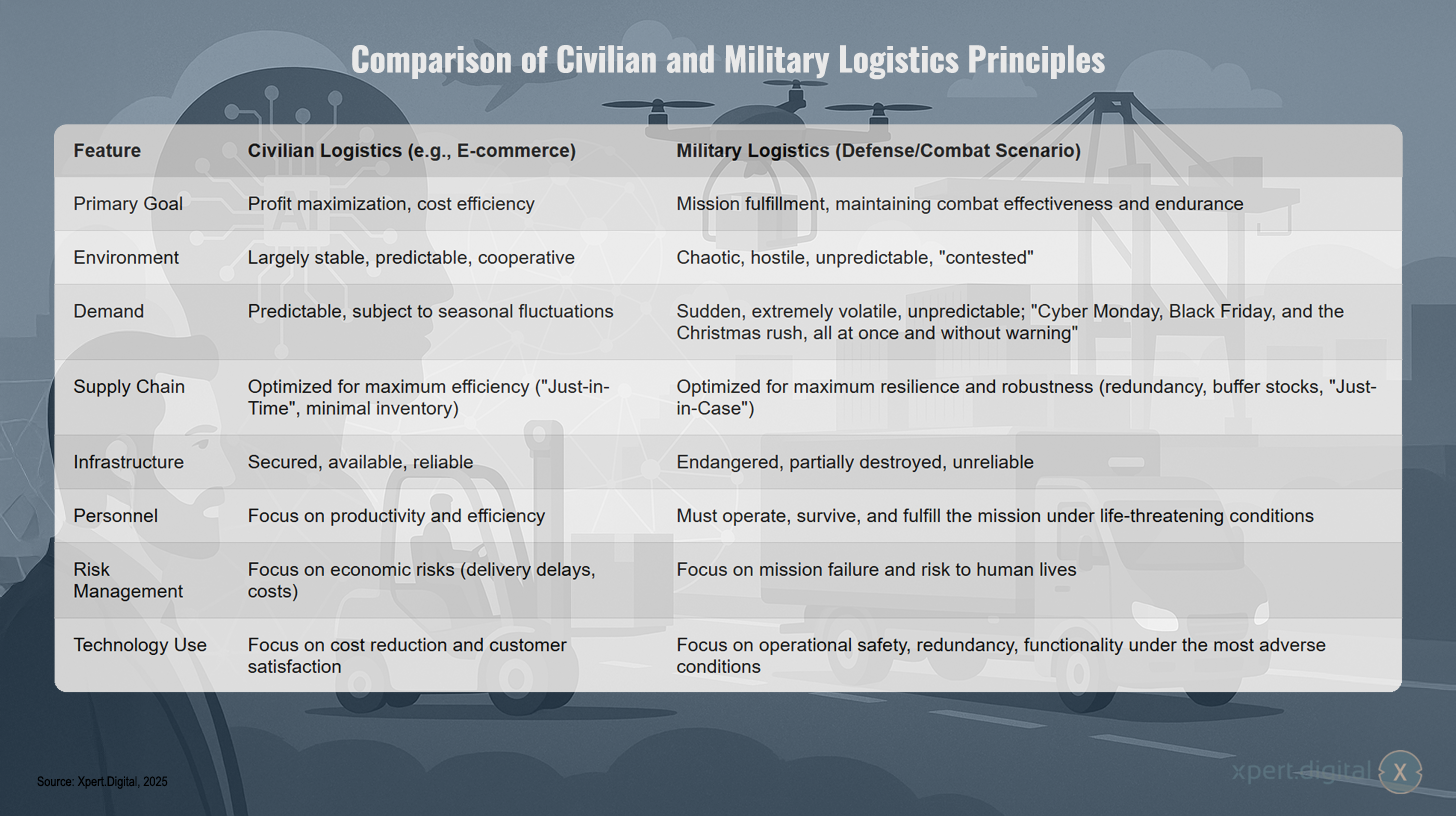
Comparison of civilian and military logistics principles – Image: Xpert.Digital
Civil and military logistics principles differ fundamentally in several aspects. While civil logistics, for example in e-commerce, primarily aims for profit maximization and cost efficiency, military logistics in the LV/BV scenario prioritizes mission accomplishment and maintaining combat effectiveness and endurance. The environment of civil logistics is largely stable, predictable, and cooperative, whereas military logistics operates in a chaotic, hostile, and unpredictable, so-called "contested" environment. Demand in civil logistics is predictable and subject to seasonal fluctuations, while in the military sector it is sudden, extremely volatile, and unpredictable—comparable to unexpected peaks such as Cyber Monday, Black Friday, and the Christmas rush simultaneously. The supply chain of civil logistics is designed for maximum efficiency, for example through "just-in-time" delivery and minimal inventory, while military logistics relies on maximum resilience and robustness, with redundancy, buffer stocks, and the "just-in-case" principle. Infrastructure in civilian logistics is considered secure, available, and reliable, whereas in a military context it can be vulnerable, partially destroyed, and unreliable. Regarding personnel, civilian logistics focuses on productivity and efficiency, while military personnel must be able to operate under life-threatening conditions, survive, and fulfill their mission. Risk management in civilian logistics concentrates on economic risks such as delivery delays and costs, whereas military logistics focuses on mission failure and the endangerment of human lives. Finally, the use of technology in civilian logistics primarily aims at cost reduction and customer satisfaction, whereas in military logistics, operational safety, redundancy, and functionality under the most adverse conditions are paramount.
Your dual-use logistics experts

Dual-use logistics experts - Image: Xpert.Digital
The global economy is currently undergoing a fundamental transformation, a watershed moment that is shaking the foundations of global logistics. The era of hyper-globalization, characterized by the relentless pursuit of maximum efficiency and the "just-in-time" principle, is giving way to a new reality. This new reality is marked by profound structural breaks, geopolitical power shifts, and increasing fragmentation of economic policy. The once taken-for-granted predictability of international markets and supply chains is dissolving and being replaced by a period of growing uncertainty.
Related to this:
Militia as an engine of innovation: a bridge between civilian know-how and military logistics
Technological disruption: Data, AI and autonomy as drivers of Logistics 4.1
Technological development, often summarized under the term "Industry 4.0," is revolutionizing civilian logistics and offers enormous potential for the military. Military logistics aims to create integrated, data-driven, and automated systems through the integration of digital technologies, thereby increasing the effectiveness and efficiency of the entire supply chain. Data, artificial intelligence (AI), and autonomous systems are the key drivers of this transformation.
The data-driven battlefield: the basis for precise control
Digitalization is the fundamental key to accelerating and optimizing the complex decision-making and implementation processes of modern logistics. The overarching goal is to create a shared, interoperable data space that provides all stakeholders – from planning staff to troops in the field – with a unified and up-to-date view of the logistical situation. This allows decisions to be made not only based on outdated reports or past experience, but also on live data.
The technological basis for this is the Internet of Things (IoT) and cyber-physical systems (CPS). By equipping supplies, containers, vehicles, and storage facilities with sensors, data on their location, condition (e.g., temperature in cold chains), movement, and fill level can be continuously collected and transmitted. This real-time transparency across the entire supply chain is a prerequisite for concepts like "smart warehousing." Here, manual and largely analog operational processes are replaced by automated inventory management, optimized storage, and automated picking and shipping processes.
The biggest challenge on the path to data-driven logistics, however, lies in the existing IT landscape. Often, the quality of master data is insufficient, and the IT applications used are isolated solutions that cannot communicate with each other. A prominent example from the German Armed Forces is the "Standard Application Software Product Family" (SASPF), which, while serving as a foundation, often operates with an incomplete standard and poor data quality. These system breaks between different applications and with the systems of civilian suppliers or allied partners prevent a holistic, integrated view and make effective, data-driven control virtually impossible. The introduction of new technologies alone does not solve these fundamental problems. Their true value only unfolds when the underlying processes, data quality, and the users' mindset are adapted. The biggest hurdle for Logistics 4.1 is therefore not the technology itself, but the creation of the organizational and data-related foundations. Without this "groundwork," expensive technology projects remain isolated beacons without broad, sustainable impact.
Related to this:

Artificial intelligence (AI) as a logistics staff officer
Artificial intelligence (AI) and machine learning (ML) have the potential to fundamentally transform logistics planning and control. They can analyze vast amounts of data from diverse sources (e.g., sensor data, consumption statistics, weather data, reconnaissance findings) to identify patterns, make predictions, and provide recommendations for action. It is important to understand that AI does not replace human decision-makers, but rather serves as a high-performance assistance system for logistics planners. The battalion commander or logistics officer ultimately bears the responsibility for the decision, but AI can provide them with the necessary information faster and more accurately than any human could.
The application areas for AI in military logistics are diverse:
Application 1: Predictive maintenance
This is one of the most promising fields of application. Instead of maintaining vehicles and weapon systems at fixed intervals or only after a failure, AI systems continuously analyze sensor data (e.g., from engines, transmissions, hydraulic systems). They detect deviations from the normal state and can thus predict the failure of a component before it occurs. This drastically reduces unplanned downtime, lowers maintenance costs, and increases the material availability and operational readiness of the armed forces. Research and development in this area takes place, among other places, at the universities of the German Armed Forces, for example, in the context of space applications, where the prediction of system failures is critical.
Application 2: Demand and route forecasting
AI algorithms can predict future needs for ammunition, fuel, or medical supplies with high accuracy based on the current tactical situation, planned operations, and historical consumption data. At the same time, they can optimize transport routes in real time by taking into account current information about threats (e.g., enemy positions), road conditions, or bottlenecks, and automatically suggesting alternative routes.
Application 3: Process Automation and Decision Support
AI can automate repetitive and data-intensive tasks in administration and procurement. For example, the AI-PROcure project of the German Armed Forces' Cyber Innovation Hub (CIHBw) aims to accelerate procurement processes and utilize resources more efficiently with the help of AI. In logistical situational awareness, AI can help analyze large amounts of reconnaissance data (e.g., from drone images) to detect hostile activities against one's own logistics at an early stage.
The German Armed Forces and other armed forces are actively promoting the use of AI. Institutions such as the CIHBw and the German Armed Forces' Center for Digitalization and Technology Research (dtec.bw) serve as catalysts. Specific research projects like "AuLoKomp" (development of an autonomous, flexible compact intralogistics warehouse) or "iMOD" (automation and optimization of aircraft assembly and associated logistics) demonstrate the breadth of efforts to harness AI's potential for logistics.
Autonomy on the rise: Unmanned systems in the supply chain
Autonomous and remotely controlled systems are another key technology in military logistics. Their main purpose is to take over dangerous, physically demanding, or monotonous tasks in order to relieve human personnel, protect them from hazards, and increase efficiency.
Unmanned aerial vehicles (UAVs/drones)
Drones are ideally suited for a wide range of logistical tasks. They can be used for "last mile" deliveries, quickly transporting urgently needed supplies such as blood, medicine, or critical spare parts to forward units. They can also be used for reconnaissance of routes, checking them for mines or enemy ambushes, or as flying relay stations to ensure communication in difficult terrain.
Autonomous Ground Vehicles (AGVs)
Unmanned ground vehicles can transport materials, ammunition, and supplies autonomously or remotely. A particularly promising concept is the "leader-follower" system, in which a single driver in a manned command vehicle controls a convoy of several unmanned trucks. This significantly reduces the personnel required for transport tasks and decreases the number of soldiers exposed to the risk of convoy attacks.
Unmanned surface and underwater vehicles (UPS/UUV)
Unmanned systems are also playing an increasingly important role in the maritime sector. They are already being used for wide-area reconnaissance, surveillance, and anti-submarine warfare. This also has logistical implications, as these unmanned platforms require self-supply and maintenance, necessitating new logistical concepts.
Interconnected processes: Opportunities and the Achilles heel of cybersecurity
The comprehensive networking of all logistical actors and systems – from sensors on individual supplies to control systems in depots and mobile forces in the field – creates a highly transparent and potentially very efficient overall system. However, this connectivity is also its greatest vulnerability. Every networked sensor, every vehicle, and every control system represents a potential attack vector for cyberattacks.
The compromise of logistics systems and data can have devastating consequences. A successful attack could lead to supplies being deliberately diverted to the wrong locations, inventory data being manipulated, cold chains being disrupted, or entire depots being crippled. Protecting logistics data and communication networks from espionage, sabotage, and manipulation is therefore of vital importance. Supply chain defense begins with data defense. Cybersecurity is thus no longer a secondary IT task, but a core competency of the logistics team itself.
Furthermore, the increasing use of AI and autonomous systems raises profound ethical and legal dilemmas. Who bears the responsibility if an AI produces a flawed needs assessment that leads to a critical supply shortage with fatal consequences for the troops? How can it be ensured that autonomous transport systems make ethically sound decisions in ambiguous situations (e.g., encounters with civilians)? These questions of responsibility, control, and the moral justifiability of machine decisions remain largely unresolved and represent a significant obstacle to widespread implementation.
Key technologies in military logistics: applications, opportunities and risks
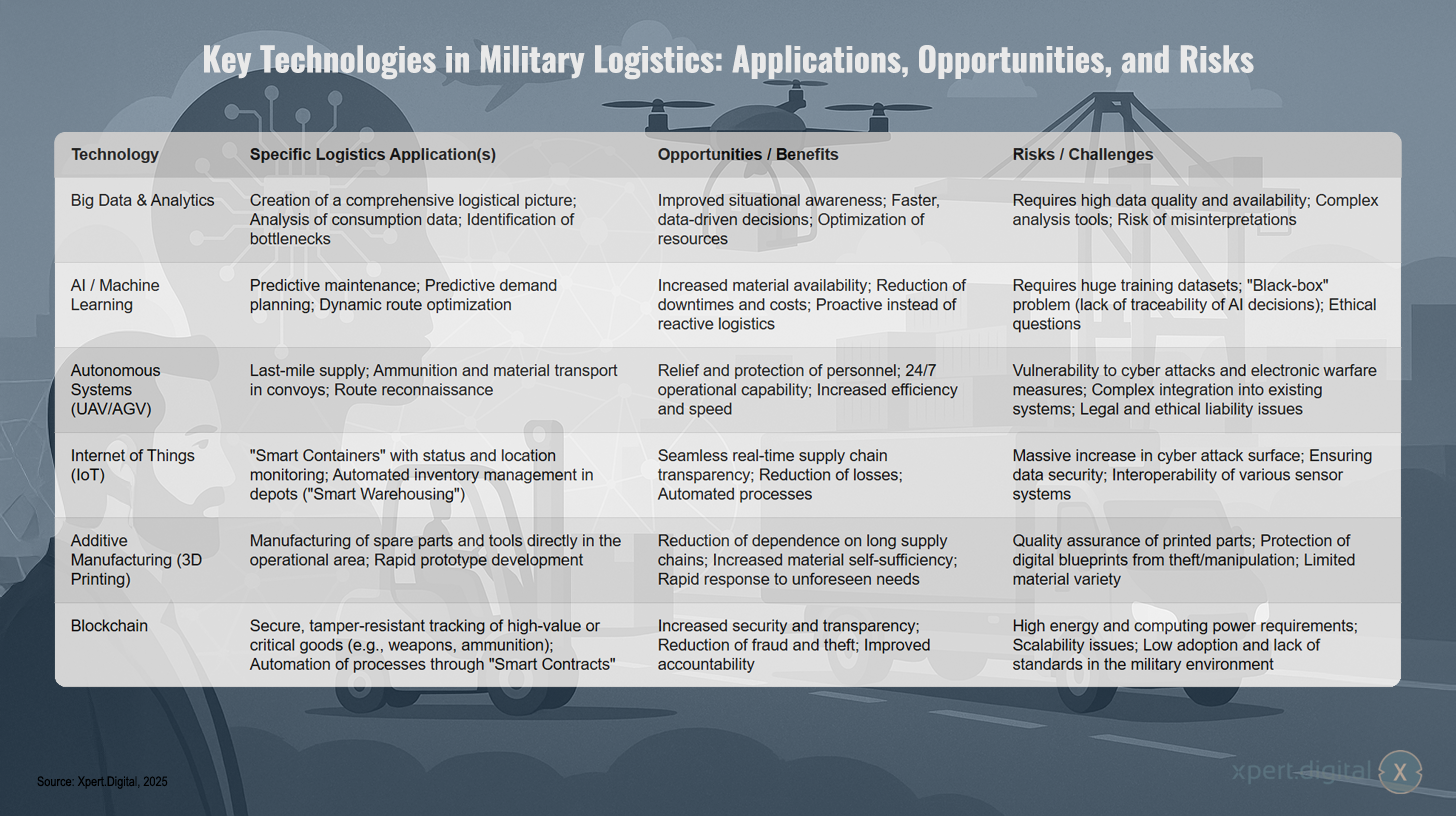
Key technologies in military logistics: applications, opportunities and risks – Image: Xpert.Digital
Key technologies in military logistics encompass various applications, each with its own opportunities and risks. Big data and analytics enable the creation of a comprehensive logistical situational picture, the analysis of consumption data, and the identification of bottlenecks. This improves situational awareness, allows for faster, data-driven decision-making, and optimizes resources. However, this requires high data quality and availability, as well as the use of complex analytical tools, where misinterpretations are possible. Artificial intelligence and machine learning are applied to predictive maintenance, predictive demand planning, and dynamic route optimization. This increases material availability, reduces downtime and costs, and enables proactive logistics. Challenges include the need for large training datasets, the so-called "black box" problem, and ethical considerations. Autonomous systems such as UAVs and AGVs are used for last-mile supply, convoy transport of ammunition and supplies, and route reconnaissance. They relieve and protect personnel, enable 24/7 operation, and increase efficiency and speed. Risks include vulnerability to cyberattacks, complex integration, and legal and ethical liability issues. The Internet of Things (IoT), with its "smart containers" and automated inventory management, ensures seamless, real-time supply chain transparency, reduces losses, and automates processes. The challenge lies in the increased cyber attack surface, data security, and the interoperability of different sensor systems. Additive manufacturing (3D printing) allows for the production of spare parts and tools directly in the field, as well as rapid prototyping. This reduces dependence on long supply chains, increases material self-sufficiency, and enables a quick response to unforeseen needs. However, quality assurance, protection of digital blueprints, and limited material diversity must be considered. Finally, blockchain technology ensures secure and tamper-proof tracking of valuable goods such as weapons and ammunition, as well as the automation of processes through smart contracts. It increases security and transparency, reduces fraud and theft, and improves accountability, but it also entails high energy and computing power requirements, scalability issues, and suffers from a lack of standards in the military environment.
The militia as a strategic reserve: a bridge between civilian know-how and military resilience
In modern armed forces, which must confront both demographic challenges and rapid technological change, the militia is gaining new strategic importance. It is far more than just a personnel reserve for crisis situations. Particularly in the area of logistics, the militia acts as an indispensable bridge between top-level civilian expertise and military resilience, contributing skills and perspectives that are difficult to find in a purely professional army.
The dual competence profile: More than just “citizens in uniform”
The militia system is a traditional cornerstone of armies like the Austrian Armed Forces and the Swiss Army, ensuring a deep integration of the armed forces into society. In Austria, the militia, comprising approximately 64% of the total authorized strength, represents the lion's share of the operational organization. The crucial added value of these "citizens in uniform," however, lies not only in their numbers but also in their dual competence profile.
Militia soldiers bring valuable and highly relevant expertise from their civilian professions. While career soldiers are experts in military skills, militia members often possess cutting-edge knowledge in high-tech civilian fields that are critical to modern military logistics. This includes, in particular, IT security, software development, data analysis, project management, and the application of state-of-the-art civilian logistics procedures. In an era where technology is evolving faster than military training and procurement cycles can keep pace, the militia represents a flexible pool of expertise. It allows the armed forces access to cutting-edge knowledge without having to establish an expensive and lengthy full-time military career for each specialist. The militia is thus not merely a personnel "filler" but a strategic "skill injector" that can protect the army from technological obsolescence.
Knowledge transfer and civil-military partnerships
The militia is the natural and most effective "bridge" between the civilian economy and the military. It facilitates a permanent, reciprocal transfer of knowledge. This exchange is increasingly institutionalized in concrete partnerships that create significant added value for both sides.
A prime example from Austria is the cooperation between the Army Logistics School and the TÜV Academy. The TÜV Academy offers highly specialized civilian training courses, for example in the field of refrigeration and air conditioning technology. The Austrian Armed Forces can nominate their soldiers for these courses and thus benefit from top-level, civilian-certified training without having to invest in expensive teaching materials and instructors themselves. Conversely, the TÜV Academy benefits from military expertise, for example in the joint development of a course on "Establishing a Crisis Management Team," which teaches civilian companies militarily proven methods of staff work.
Switzerland is pursuing a similar path and has created a unique structure with the Militia Staff of the Army Logistics Base (LBA). In this body, civilian logistics experts and high-ranking militia officers work hand in hand to drive the strategic development of the entire army logistics system. They utilize the collective intelligence of the staff to develop solutions for complex challenges such as the decentralization of logistics or planning for an impending energy shortage. This staff acts as an extension of the LBA Chief's command and ensures that civilian best practices and military requirements are optimally integrated. Such models demonstrate how the civilian expertise pooled within the militia can be systematically used to strengthen military capabilities.
Recognition and incentives: The “translation” of military competencies
For a long time, one of the biggest challenges to the attractiveness of militia service was the lack of recognition in civilian professional life for skills acquired in the military. Employers often viewed their employees' service merely as a burden and a source of downtime. To address this problem, a crucial mechanism was created: the civilian certification of military skills.
Austria, in cooperation with the TÜV Austria Academy, has launched a pioneering pilot project. Based on military training materials, certification programs have been developed that certify military-acquired skills according to the internationally recognized standard ISO 17024. For example, a reserve officer can obtain a certificate as a "Certified Leader – Competency Level: Unit/Company Commander." This document translates the military qualification into the language of civilian human resources departments, making the acquired competencies in leadership, organization, project management, logistics, and crisis resilience visible and usable for employers.
This approach creates a win-win-win situation:
For the soldier
His military training becomes a valuable asset for his civilian career.
For the employer
He gets back an employee whose additional, certified skills (e.g., in crisis management) represent direct added value for the company. The employee's absence thus transforms from a burden into an investment in their professional development.
For the army
The attractiveness of militia service is increasing, which facilitates the recruitment and retention of qualified personnel.
The formalization and civilian recognition of military training is therefore not a "nice-to-have", but a strategic instrument for securing the personnel base of the militia and for strengthening overall national resilience.
Challenges: Staff shortages and administrative burdens
Despite its strategic importance, the militia faces significant challenges in many areas. A key problem is the shortage of personnel in critical roles. In Austria, for example, there is a considerable lack of specialist non-commissioned officers and officers, even though the overall staffing level is theoretically high. This points to structural problems in recruiting and training personnel.
Another serious problem is the often inadequate equipment. The Austrian Court of Audit found that in 2021, the militia's equipment level was only around 27%. Equipment allocated to the militia was often used by the active-duty forces or on deployments abroad, significantly impairing the training and operational capability of the militia units.
In addition, militia officers, especially commanders at the unit and troop levels, suffer from an enormous administrative burden. Tasks such as managing requests for deferment of service, qualifications, and equipment lists consume valuable time that is then lacking for their actual leadership duties – training and leading soldiers. The Swiss Army has recognized this problem and is working on digitizing and simplifying these processes to relieve the militia officers and enable them to use their time more efficiently.
Finally, maintaining motivation is a constant challenge. While basic training is often perceived as interesting, motivation can suffer during annual refresher courses if the exercises are seen as unchallenging or meaningless. The key to motivation lies in high-quality training, demanding scenarios, and competent supervisors who create a positive service experience.
Hub for Security and Defense - Advice and Information

Hub for Security and Defense - Image: Xpert.Digital
The Security and Defence Hub offers expert advice and up-to-date information to effectively support companies and organizations in strengthening their role in European security and defence policy. Working closely with the SME Connect Defence Working Group, it particularly promotes small and medium-sized enterprises (SMEs) that wish to further develop their innovative capacity and competitiveness in the defence sector. As a central point of contact, the Hub thus creates a crucial bridge between SMEs and European defence strategy.
Related to this:
Accelerated procurement: Ways out of the innovation gridlock
From innovation to implementation: Overcoming hurdles in military procurement
The best technological idea and the cleverest logistical concept are worthless if they don't reach the troops quickly and reliably. Introducing innovations into large, bureaucratic organizations like armed forces is one of the greatest challenges. The path from idea to widespread use is often long and arduous, a process known as the "valley of death" of innovation. Overcoming these hurdles requires new, agile approaches, a reform of procurement processes, and above all, a cultural shift.
The “valley of death” of innovation: Why good ideas don't reach the troops
The central problem in modernizing military logistics is often not a lack of innovative ideas, but the inability to translate these ideas into sustainable, effective capabilities for the troops. Overly slow and rigid financing and procurement processes prevent technological developments from reaching soldiers in a timely manner. While technology evolves in cycles of months, military procurement processes often take years.
The procurement organization of the German Armed Forces is a complex network of various actors, with the Federal Office of Bundeswehr Equipment, Information Technology and In-Service Support (BAAINBw) as the central, powerful player. The procedures are formalized and lengthy. General public tenders take an average of 8.5 months. The entire organization is strongly characterized by a "safety-first" mentality that aims to avoid any risk and potential error. This pursuit of a 100% perfect solution, which is often outdated by the time it is implemented, stands in stark contrast to the fast, iterative, and error-tolerant approach necessary for innovation. This cultural problem is often a greater obstacle than the legal requirements themselves.
Agile Enablers: New ways to promote innovation
To escape the “valley of death”, armed forces such as the German Bundeswehr have created new, more agile structures and processes that are intended to serve as catalysts for innovation.
Innovation hubs
The German Armed Forces' Cyber Innovation Hub (CIHBw) plays a key role here. It acts as a fast and flexible interface between the German Armed Forces, startups, and established industry. The CIHBw identifies innovative technologies on the civilian market and tests their military applicability in short, agile projects. Its approach of fostering bottom-up innovation ("grassroots innovation") is particularly important. With formats like the "Logistics Innovation Challenge," ideas are gathered directly from within the armed forces and developed into prototypes. Successful projects such as "Yarded," an app for digitizing the deployment management of heavy equipment, and "Assembly Tracking," which elevates the logistics processes of an entire service unit to Industry 4.0 standards, have emerged from such initiatives.
Cooperation projects with industry
Alongside the agile hubs, strategic collaborations with industry are being promoted. The German Armed Forces Logistics Command (LogKdoBw) is leading the project "Future-Oriented Cooperation in Logistics." This project aims to establish long-term strategic alliances with civilian logistics companies in key areas such as material management, warehousing, transport, and maintenance. The goal is to firmly integrate civilian capacities and expertise into military logistics planning, thereby increasing the resilience and performance of the overall system.
Bottom-up approach
The traditional top-down process, in which the General Staff defines a capability gap and the Federal Office of Bundeswehr Equipment, Information Technology and In-Service Support (BAAINBw) procures a solution years later, is unsuitable for the rapid adoption of technology. The new, agile models reverse this process. The troops, the end users, identify a practical problem in their daily work and are actively involved in developing a solution. This early and continuous involvement of soldiers is the crucial key to developing practical solutions, ensuring acceptance within the troops, and boosting morale, as the expertise of the users is valued.
The path to the troops: How to convince decision-makers
To obtain the necessary resources and support for the introduction of innovations, military and political decision-makers must be convinced. This is rarely achieved through theoretical concepts or presentations alone.
The crucial step is the development of demonstrators and prototypes. New software or a new device must prove in a realistic exercise or test environment that it delivers tangible added value. The opportunity to "hands-on" an innovation and experience its impact firsthand is far more convincing than any theoretical treatise.
A thorough and professional market analysis is also a prerequisite for a sound investment decision. Procurement agencies need to know which technologies and solutions are already available on the civilian market in order to avoid reinventing the wheel and to formulate realistic requirements.
An often overlooked but critical factor is the motivation and qualifications of the staff within the procurement departments themselves. They must be empowered and encouraged to utilize the scope of procurement law for innovative approaches. Targeted professional development programs, for example through the Bundeswehr University, and incentive systems that reward not only error-free execution but also the successful completion of innovative projects can make a significant contribution here.
Legal and procedural accelerators
In addition to agile structures and cultural change, adapted legal and procedural instruments can also significantly accelerate innovation procurement.
Innovation partnership
This special procurement procedure, enshrined in the European Procurement Regulation (§ 19 VgV), was explicitly created for the development and subsequent acquisition of innovative solutions that do not yet exist on the market. It combines a research and development phase, in which one or more partners develop prototypes, with the subsequent option for the contracting authority to procure the successful solution. This procedure is ideally suited for complex, high-risk projects in the fields of IT, AI, or other advanced technologies, as it allows for flexibility and close collaboration between the contracting authority and industry.
Laws for accelerated procurement
In light of this "turning point," the German Federal Government has introduced legislation specifically aimed at accelerating armaments projects. These laws stipulate, among other things, that exceptions to strict European procurement law can be made in cases of significant security interests, that the requirement to divide contracts into small lots can be waived, and that European cooperation will be strengthened.
Raising value limits
A pragmatic, yet potentially very effective lever is raising financial thresholds. Currently, all Bundeswehr procurement projects exceeding €25 million must be submitted to the Budget Committee of the Bundestag for approval. At the same time, around 80% of all contracts awarded by the BAAINBw (Federal Office of Bundeswehr Equipment, Information Technology and In-Service Support) fall below a threshold of €500,000. A significant increase in the threshold for parliamentary approval and for simplified national procurement procedures could relieve the BAAINBw and the political process of a multitude of smaller projects and concentrate resources on the truly large, strategic projects.
Ultimately, laws and new procedures are important tools, but they remain ineffective if the culture within administration and among decision-makers remains risk-averse. True change requires a willingness to take calculated risks, to fail gracefully, and to learn from prototypes, rather than waiting for the 100% perfect but hopelessly outdated solution. Fostering a culture of "doing" and prototyping is the real key to accelerating logistics modernization.
Strategic recommendations: Ensuring delivery capability in every scenario
This analysis has traced the profound transformation of military logistics from a reactive service to a proactive, strategic capability. In an era of renewed great power competition and national and collective defense, the ability to sustainably and resiliently supply armed forces under hostile pressure has become a crucial element of deterrence and military operations. Mastering logistics is no longer a secondary concern, but a central factor that determines success or failure.
Synthesis of key findings
Ensuring logistical performance in every conceivable scenario rests on four inextricably linked pillars that must be developed in harmony:
Strategic realignment
The paradigm shift from efficiency-driven internal control logistics to resilience- and endurance-oriented supply chain/business-scale logistics is fundamental. This requires a clear commitment to redundancy, stockpiling, and protected, mobile logistics forces, even if this entails higher costs. Logistics itself is a goal and must be designed accordingly.
Technological adaptation
The intelligent use of data, artificial intelligence, and autonomous systems is not an end in itself, but rather the crucial tool for creating a transparent, predictive, and responsive logistics system. Technologies such as predictive maintenance, AI-supported demand forecasting, and autonomous transport convoys are no longer futuristic concepts, but essential building blocks for increasing efficiency and protecting personnel. However, their implementation will fail if the necessary data and process foundations are not in place.
Human capital
Technology alone is not the solution. Strategically leveraging the potential of the militia as a bridge to top-level civilian expertise is a crucial factor in bringing technological and procedural innovations into the armed forces. Civilian recognition and certification of military-acquired skills is a key instrument for ensuring the attractiveness of militia service for highly qualified experts and their employers.
Agile Organization
Rigid and lengthy procurement and implementation processes are the biggest obstacle to modernization. Overcoming these bureaucratic and cultural hurdles through new cooperation models with industry, agile innovation hubs, and a culture of experimentation is essential. A shift is needed from a purely risk-averse mindset to a willingness to take calculated risks and foster bottom-up innovation.
Recommendations for decision-makers
From this synthesis, concrete recommendations for action are derived for the various relevant stakeholders:
For the military leadership
- Establishing a "resilience doctrine": Firmly anchor the principles of resilience, redundancy, and "contested logistics" in logistics doctrine, training, and exercise planning. Resilience must become the primary planning objective, taking precedence over pure efficiency.
- Promoting bottom-up innovation: Strengthen formats such as innovation challenges and create space and resources for soldiers and lower-level command to develop and test pragmatic solutions to logistical problems. Establish a positive culture of learning from mistakes.
- Strategic use of the militia: Identify and recruit militia experts with civilian know-how in critical areas (IT, cyber, logistics 4.1) and systematically integrate them into planning staffs, project teams and exercises.
For the political leadership
- Accelerating procurement and budgeting: Consistently implement the laws passed to accelerate procurement and examine further simplifications, such as raising the thresholds for parliamentary approval, to relieve the burden on the administration and speed up processes.
- Creating incentives for businesses: Develop incentive models (e.g., tax-related) for companies that release their employees for militia service. Promote and communicate the added value of civilian-certified military training.
- Investments in dual-use infrastructure: Prioritize investments in the modernization of critical, civil-military usable infrastructure (railways, roads, bridges, ports) to ensure military mobility as the core of alliance capability.
For industry
- Development of dual-use solutions: Focus on developing modular, interoperable, and robust technologies that can be used in both civilian and military contexts. Offer solutions based on open standards to facilitate integration into existing systems.
- A willingness to cooperate in partnership: Proactively engage in new, flexible cooperation models such as innovation partnerships. See yourself not only as a supplier, but as a strategic partner of the armed forces in the joint development of capabilities.
Related to this:

The future of military logistics
The future of military logistics lies in a highly networked, intelligent, and civil-military integrated ecosystem. Success is no longer measured solely in transported tons or kilometers driven, but in the speed and precision of logistical decision-making, the proactive anticipation of needs and disruptions, the adaptability of the overall system, and ultimately, its unwavering ability to supply combat troops even under the most severe pressure. Logistics that achieves this is more than just a support system—it is a strategic weapon that secures peace and provides the decisive advantage in the event of conflict.
Consulting - Planning - Implementation

Markus Becker
I would be happy to serve as your personal advisor.
Head of Business Development
Consulting - Planning - Implementation
Konrad Wolfenstein
I would be happy to serve as your personal advisor.
You can contact me at wolfenstein∂xpert.digital or
Just call me on +49 7348 4088 965 .