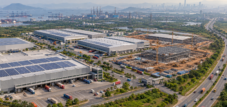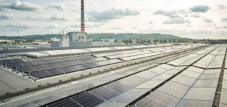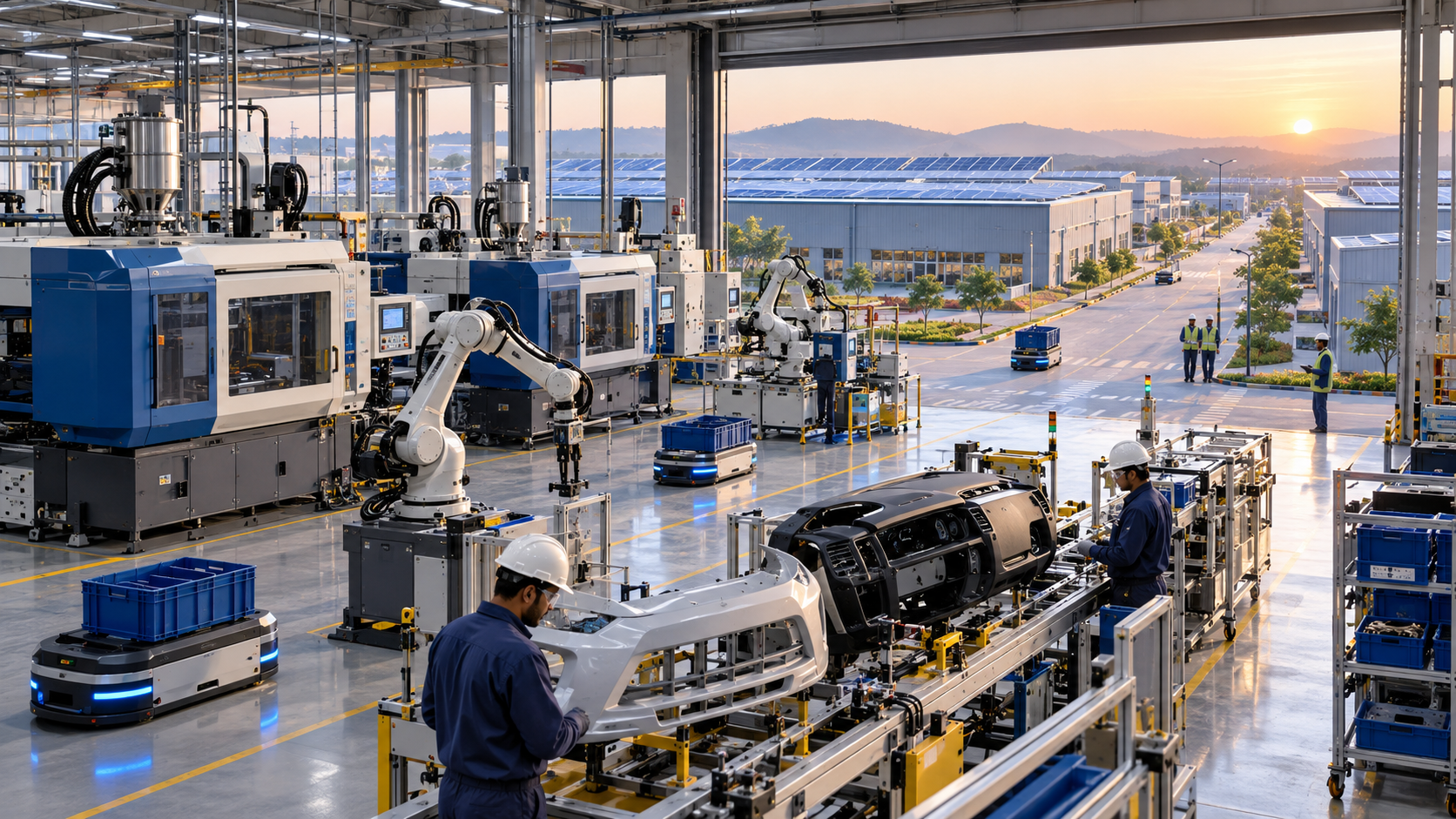
Local production in India: India on the move – The key to more sustainable supply chains and local production – Creative image on the topic, with AI: Xpert.Digital
India as the new center of world production: What does that mean for Europe?
India's Industrial Revolution: Opportunities and Challenges for Investors
India is on the cusp of a new industrial era, with foreign companies investing billions in local manufacturing capacity. This wave of investment is particularly evident in key industries such as automotive and packaging, where multinational corporations are shifting their production closer to the growing domestic market and regional supply chains. But this trend is driven by more than just an escape from rising costs in China. India's combination of a vast, burgeoning market and politically supported localization makes it a promising location for future industrial development.
At the same time, the challenge should not be underestimated. Despite rapid growth and increasing demand, the manufacturing sector's share of economic output remains relatively small. To transform individual investments into a sustainably competitive industrial system, productivity, infrastructure, and skills development must be improved. The coming years will be crucial for setting the right course and fully realizing India's potential as a global manufacturing hub. This article examines the background of this development, the specific opportunities for investors, and the challenges that need to be overcome.
India's new factories: Why foreign industrial companies are now investing billions in local production
Those who view India only as a sales market are leaving the industrial future to others
India is experiencing a new investment cycle in factory construction. This is particularly evident in the automotive industry, among suppliers, packaging manufacturers, and construction-related industries. Foreign corporations are building additional plants, expanding existing capacities, or acquiring existing production platforms to be closer to customers, growth markets, and regional supply chains. Recent projects by Japanese automotive suppliers such as Toyoda Gosei, Toyota Boshoku, and NITTAN, as well as the expansion plans of the US packaging company Ball, demonstrate that this is not an isolated industry trend. At the same time, the acquisition of a large sanitary ware production facility in Neemrana underscores the growing importance of existing industrial plants as a means of accelerating access to capacity, markets, and export opportunities.
This development is driven by more than the familiar "China plus one" strategy. India is not simply being developed as a cost-effective alternative production location. The crucial difference compared to many other emerging economies lies in the combination of a large domestic market, growing industrial demand, politically supported localization, a broad supplier ecosystem, and the prospect of serving further markets from Indian factories. For manufacturers, a factory in India can therefore fulfill several functions simultaneously: it supplies local customers, reduces import and logistics risks, meets requirements for local value creation, opens up new customer segments, and creates a foundation for regional exports.
The investment boom should not, however, be interpreted as proof that India is already the world's new factory floor. The manufacturing sector's share of economic output remains at only about 16 to 17 percent. Thus, industrial transformation is falling short of the political ambition to make production a significantly larger engine of growth. Factory projects are therefore both a sign of success and an indication of incomplete development. India has sufficient demand and capital inflows to attract large-scale plants, but it must further improve productivity, skills, infrastructure, planning reliability, and local supply chain depth if individual investments are to develop into a sustainably competitive industrial system.
The domestic market is becoming the most important locational advantage
India's fundamental economic dynamics are exceptional. Real GDP grew by approximately 7.6 percent in the 2025/26 fiscal year, according to current estimates. Growth of around 7 percent was projected for the 2026 calendar year, while the global economy expanded considerably more slowly. At the same time, India boasts a young population of over 1.4 billion people. Rising incomes, urbanization, formalized consumption, increasing credit availability, and the development of digital payment and administrative structures are broadening the commercial base for industrial products.
For factory investors, it's not just the size of the market that's crucial, but also its increasing capacity. In India's 2025/26 fiscal year, approximately 28.3 million vehicles were sold domestically. Sales rose by a good 10 percent. All major vehicle categories combined reached record highs for the first time in seven years. Passenger car sales amounted to about 4.64 million vehicles, while two-wheelers reached around 21.7 million. A market of this magnitude justifies domestic, customer-centric production capacity, even if the export share initially remains limited.
The automotive market is also changing its structure. For a long time, demand was primarily driven by inexpensive small cars and motorcycles. Now, sporty SUVs, better-equipped models, safety components, and higher-quality interiors are gaining importance. This increases the value added per vehicle. For suppliers, this creates sales opportunities for bumpers, instrument panels, seats, airbags, steering wheels, plastic lines, and numerous electronic or material-intensive components. Growth is therefore not only driven by production volume but also by higher-quality features.
A similar trend exists outside the automotive industry. The consumption of packaged beverages is increasing, modern retail formats are expanding, and major national and international brands are increasing their presence. This is driving demand for aluminum cans and other standardized packaging solutions. At the same time, residential construction, hotels, commercial real estate, and urban infrastructure are fueling the need for sanitary products. Factory expansion, therefore, is not driven by some abstract industrial policy objective, but rather by concrete end markets whose volume, quality requirements, and geographic reach are growing.
Automotive suppliers are building entire production clusters
The expansion of Toyoda Gosei in Maharashtra illustrates the logic of new factory construction particularly clearly. The company is planning a new plant in the Bidkin industrial zone on a plot of land measuring approximately 78,400 square meters. The building area is planned to encompass about 29,200 square meters. The investment is projected to be approximately 5.758 billion rupees, or about 9.3 billion yen. Production is scheduled to begin in the first half of 2029. By 2030, the site is expected to employ approximately 570 people.
The plant will manufacture large interior and exterior components such as bumpers and instrument panels. It will also produce safety systems, including airbags and steering wheels, as well as functional plastic parts like fuel filler necks. This will create a platform for multiple product groups with varying manufacturing requirements, rather than a narrow, single-product assembly operation. Large electric injection molding machines, a high-quality paint shop for bumpers, driverless transport systems, and solar panels are among the planned equipment. Digital production control, networked processes, and automated tool changes are intended to reduce setup times and increase plant utilization.
What's remarkable is the combination of capital-intensive automation and simple mechanical solutions. Collaborative robots are to be combined with so-called Karakuri technology, in which levers, springs, gravity, and mechanical movements support complex tasks with low energy and investment requirements. For a cost-sensitive market, this makes more economic sense than maximum automation at any price. The key is not the highest robot density, but rather the best balance between quality, flexibility, capital costs, and local labor productivity.
The plant is being built as a branch of Toyoda Gosei South India and will be the group's eighth presence in India. Even more significant is its proximity to the future Toyota Kirloskar Motor vehicle plant in the same industrial park, whose production is also scheduled to begin in the first half of 2029. The synchronization of these timelines demonstrates that supplier capacity and vehicle assembly are being considered together. Large, bulky components such as bumpers or instrument panels are expensive and prone to disruption during long-distance transport. Production close to customers shortens transport routes, reduces inventory, facilitates model launches, and allows for a faster response to changes in the production program.
Toyota Boshoku is also expanding its presence in western India. A new plant for vehicle seats and other interior components is planned for the Sambhajinagar area of Maharashtra. The planned investment is approximately 4 billion rupees, or around 7 billion yen. Completion is scheduled for October 2027. The project will increase supply capacity in areas where new assembly lines and vehicle programs are being developed. Seats are highly variable, logistically complex modules that are delivered to vehicle plants at short intervals. The larger regional automotive production becomes, the more cost-effective local manufacturing becomes.
NITTAN pursues a similar, but technologically different, growth strategy. The company produces precision-forged engine valves for two- and four-wheeled vehicles. At its Andhra Pradesh site, capacity has already been doubled from one million to two million valves per month with the addition of a building section of approximately 7,350 square meters. This corresponds to an increase from twelve to 24 million units per year. The number of employees increased from approximately 270 to 370 as a result of the expansion. This growth was driven, in part, by new orders from a major vehicle manufacturer.
Now, another plant is planned on an adjacent plot of land measuring approximately 30,000 square meters, with operations scheduled to begin in the second half of 2027. NITTAN aims to roughly triple its Indian revenues by 2030 and significantly expand its production capacity. At first glance, this investment appears to run counter to the global trend toward electromobility, as purely electric vehicles do not require conventional engine valves. However, it makes economic sense: India's vehicle fleet, its strong two-wheeler segment, hybrid drives, commercial vehicles, and the long-term continued demand for combustion engines create a different demand profile than in Western Europe. The transformation path is not uniform across the region.
The supplier network follows the end manufacturer
The new plants clearly demonstrate that factory decisions are rarely made in isolation. A final manufacturer creates demand for seats, cockpits, bumpers, safety modules, engine parts, packaging, and industrial services. Suppliers, in turn, need toolmakers, material suppliers, logistics providers, maintenance specialists, automation partners, testing laboratories, and qualified personnel. Once enough players concentrate in a region, transaction costs decrease, and the likelihood of further companies establishing operations increases.
Maharashtra benefits from this self-reinforcing effect. The state combines major sales markets, established industrial centers, supplier expertise, ports, and a skilled workforce. The corridor around Pune, Mumbai, Nashik, Aurangabad/Sambhajinagar, and the Bidkin industrial zone offers companies the opportunity to leverage existing networks while simultaneously developing new areas. The establishment of a large vehicle factory acts as an anchor in this process. It improves the long-term capacity utilization prospects for suppliers and reduces the risk of a new plant failing to generate sufficient local orders.
Andhra Pradesh and the Sri City industrial park follow a similar model in the south. The region is within easy reach of the greater Chennai area, one of India's most important automotive and export clusters. Companies can leverage existing port connections, suppliers, and labor without necessarily incurring the exorbitant costs of established prime locations. Uttar Pradesh, on the other hand, relies on its enormous population and consumer base, the expansion of its highway network, new logistics centers, and its proximity to the capital region. Rajasthan, with Neemrana, offers a location in the industrial corridor between Delhi and Mumbai and is attractive to manufacturers serving northern India or looking to acquire existing industrial facilities.
This federal competition is a key component of the Indian investment model. States compete with land, infrastructure, tax incentives, expedited permitting, and sector-specific support. This creates negotiating leverage for investors but also increases complexity. "India" is not a homogenous location. Electricity prices, land access, labor laws, permitting speed, water availability, logistics costs, and administrative expertise vary considerably. Therefore, a sound location decision must be broken down to the state level, the industrial park level, and the specific customer cluster level.
Ball is betting on India's next wave of consumption
Ball's planned factory in Uttar Pradesh expands its reach beyond the automotive sector. The company already operates plants in Taloja, Maharashtra, and Sri City, Andhra Pradesh. Now, a new beverage can factory with two production lines is planned, scheduled to begin operations in 2029. Together, the three sites will form a geographical network that better serves western, southern, and northern India.
The investment follows a different demand than the automotive projects, but is based on the same fundamental economic logic. Aluminum cans have a high transport volume relative to their value. Long distances increase delivery costs and the need for safety stocks. A regional network of plants reduces freight costs, shortens delivery times, and lessens the risk of customers not being adequately supplied during peak demand. Because the new plant is intended to be supported by customer contracts, it is also less speculative than simply expanding capacity in anticipation of future demand.
Since entering the Indian market in 2016, Ball has gradually expanded its presence. The company supplies international and major domestic beverage brands with various can formats. This expansion is driven by the expectation that the Indian packaging market will not only grow in volume but also undergo structural change. Brand manufacturers require standardized quality, reliable high-volume production, printable surfaces, and recyclable materials. Aluminum also benefits from its inherently high recyclability. However, the actual environmental benefit depends on collection systems, recycling rates, energy sources, and material cycles. Therefore, a new factory is not automatically sustainable; it must be integrated into a functioning return and recycling infrastructure.
The choice of location in Uttar Pradesh also demonstrates that northern India is catching up industrially. The state is not only a huge end market but is also expanding its manufacturing and logistics corridors. For Ball, a third location improves its reach to most Indian states. This reduces dependence on individual plants and creates redundancy. In a country with vast distances, regionally varying demand patterns, and occasional infrastructure bottlenecks, a distributed production network can be more economically robust than a single, oversized central factory.
Existing works become a strategic shortcut
Not every industrial expansion begins on a greenfield site. The acquisition of Global Ceramics' sanitary ware production facility in Neemrana by Jaipur Capital demonstrates the importance of so-called brownfield strategies. The industrial site, factory buildings, machinery, and other operational assets were transferred. Production will continue under the bathroom and living solutions platform Melozzo Living. This means that an existing facility will not be shut down, but rather used as a foundation for capacity expansion, product development, and new partnerships.
The site covers approximately 20 acres, or just over eight hectares, and has about 900,000 square feet of built-up area. Current production output is around 62 tons and, according to the company, can be doubled to 124 tons within 30 to 60 days. The facility has previously manufactured sanitary ware under its own brands and as a contract manufacturer for Indian and international brands. Existing products and customer relationships can therefore be continued, while the new ownership structure opens up additional markets.
Economically, an acquisition offers several advantages. An existing plant significantly reduces the time to production. Land, buildings, firing and molding technology, supplier relationships, and experienced employees are already in place. This reduces project risks compared to a new build, whose permitting, construction, commissioning, and ramp-up can take several years. At the same time, there is the risk of inheriting outdated equipment, inefficient layouts, or hidden environmental and maintenance liabilities. Therefore, it is crucial whether the purchase price adequately reflects the necessary modernizations and the operational risks.
India offers a dual perspective for sanitary ware. The domestic market is growing with urbanization, new construction, renovations, the hotel industry, and public infrastructure. At the same time, a competitive factory can serve customers in the Middle East, Southeast Asia, and Africa. This shifts the business model from a purely national brand to a combined platform of in-house production, contract manufacturing, and export. An Indian production partner can be particularly attractive for medium-sized international brands if they can offer design, consistent quality, scalability, and reliable delivery times.
Our Asia expertise in business development, sales and marketing

Our Asia expertise in business development, sales and marketing - Image: Xpert.Digital
Industry focus areas: B2B, digitalization (from AI to XR), mechanical engineering, logistics, renewable energies and industry
More information here:
A thematic hub offering insights and expertise:
- Knowledge platform covering global and regional economies, innovation and industry-specific trends
- A collection of analyses, insights, and background information from our key areas of focus
- A place for expertise and information on current developments in business and technology
- A hub for companies seeking information on markets, digitalization, and industry innovations
Industrial policy and productivity in India: Opportunities and challenges
Industrial policy creates capital, but not productivity
The Indian government supports factory construction with production-related incentives, infrastructure programs, investment promotion, and a largely open regime for foreign capital. In many industrial sectors, foreign direct investment of up to 100 percent is possible via an automatic approval process; restrictions apply to investors from countries sharing a land border. The core policy is not only to facilitate capital inflows but also to reward production, employment, exports, and local value creation.
The Production-Linked Incentive (PCI) programs cover 14 strategic sectors. By the end of March 2026, 892 applications had been approved. Actual investments triggered by the programs exceeded 2.40 trillion rupees, reported production and sales exceeded 22.66 trillion rupees, and exports exceeded 15.2 trillion rupees. The programs are estimated to have supported a total of approximately 1.415 million direct and indirect jobs, including about 840,000 direct jobs. By the end of June 2026, cumulative investments had risen to approximately 2.58 trillion rupees, according to more recent data.
These figures demonstrate that industrial policy can influence private decisions. However, they do not prove that every subsidized production would be internationally competitive without subsidies. Production premiums can lower investment thresholds and accelerate economies of scale. However, if local suppliers, research, toolmaking, and skills development remain weak, there is a risk of subsidy-supported final assembly with limited domestic value creation. Success should therefore not be measured solely by investment volumes or gross sales, but also by productivity, export capacity, local procurement, technical expertise, and the ability to produce profitably after incentives expire.
The timing is also crucial. A factory project with a production start in 2029 is designed based on demand and cost assumptions that extend several years into the future. While subsidies are helpful, companies also need reliable regulations, predictable tariffs, stable technical standards, and legal certainty. Frequent changes can erode the value of an incentive. Industrial policy is most effective when it doesn't permanently protect individual investments, but rather eliminates bottlenecks and fosters competition.
Infrastructure reduces costs – but remains a bottleneck
India has invested heavily in roads, railways, ports, airports, industrial parks, and digital administration in recent years. A recent government study estimates logistics costs for 2023/24 at approximately 7.97 percent of gross domestic product, or 9.09 percent of non-service sector output. In absolute terms, this amounts to around 24.01 trillion rupees. These figures are lower than many older, often generalized estimates and indicate measurable progress.
For individual companies, however, the national average is not very meaningful. What matters are the costs of a specific supply chain: distance to the customer, port access, reliability of rail freight, tolls, empty runs, handling times, refrigerated or hazardous goods requirements, and the quality of the last mile. A bumper factory has a different logistics profile than a valve factory. Bulky plastic parts require proximity to the customer, while compact precision parts can be transported and exported over longer distances.
Energy and water are also crucial factors. Modern injection molding machines, paint shops, metalworking facilities, and ceramic kilns have very different consumption profiles. Solar panels on factory roofs can reduce electricity costs and emissions, but they don't automatically replace a stable, 24/7 power supply. Companies need grid access, backup systems, storage, or contractually secured renewable energy. In water-scarce regions, the energy consumption of painting, cooling, and sanitary ceramic processes can pose a risk to site selection and permitting.
The quality of an industrial park is therefore not solely determined by inexpensive land. A location is truly competitive when it combines reliable energy, water, wastewater treatment, data connectivity, a company fire brigade, customs clearance, housing, training opportunities, and dependable transport links. This is precisely where it is decided whether a project stays on schedule or becomes more expensive due to numerous small inefficiencies.
Automation does not replace the question of qualifications
The manufacturing sector contributes approximately 16 to 17 percent to India's economic output and employs more than 27 million people. Given the size of the working-age population, this is insufficient to meet the demand for productive, formal jobs. The new wave of factory construction therefore has macroeconomic significance that extends beyond investment and tax revenue. It can transfer workers from less productive jobs into more modern industrial processes.
At the same time, new factories are more highly automated than previous generations. Driverless transport systems, digital production planning, networked quality control, and collaborative robots reduce the number of simple tasks. The approximately 570 planned jobs at Toyoda Gosei are important, but they represent a significant investment and a high degree of automation. The main employment effect, therefore, will not only occur within the factory itself, but also at suppliers, logistics companies, maintenance firms, construction companies, and local service providers.
For India, this is not an argument against automation. Without consistent quality, process control, and productivity, factories cannot meet global customer demands or export sustainably. The challenge lies in training workers for more demanding tasks: machine operation, robotics, tool changes, maintenance, painting, quality assurance, data analysis, workplace safety, and energy management. Companies, vocational schools, and states must develop training models that keep pace with the rate of capacity expansion.
The International Monetary Fund estimates that more innovation-friendly framework conditions and the reduction of business barriers could increase India's productivity growth by almost 40 percent. This figure illustrates that the next phase of development depends less on additional working hours than on better organization, technology adoption, and business dynamism. New factories can serve as learning centers, provided that knowledge is embedded locally and does not remain entirely in foreign headquarters.
Localization determines the economic value
The Indian automotive supplier industry's revenue reached approximately 7.6 trillion rupees, or US$85.9 billion, in the 2025/26 financial year, representing growth of 12.7 percent. Deliveries to vehicle manufacturers increased by 16.3 percent, while exports reached around US$24 billion. Despite geopolitical risks, further industry growth of 8 to 10 percent was expected for the 2026/27 financial year.
This dynamic is remarkable, but foreign trade still exhibits dependencies. In the first half of 2025/26, exports of vehicle components rose by 9.3 percent to US$12.1 billion. Imports simultaneously grew by approximately 12.5 percent to US$12.3 billion, resulting in a small trade deficit. An expanding industry, therefore, still requires imported electronics, specialized materials, machinery, precision tools, and other intermediate products.
The economic benefits of foreign factories therefore depend heavily on local sourcing. If imported components are merely assembled, employment, tax base, and knowledge transfer remain limited. However, if mold making, plastic granules, metal parts, textiles, electronics, software, maintenance, and development are sourced from India, deeper value chains are created. Localization, however, must not be enforced through rigid quotas if local quality and scalability are still lacking. Otherwise, costs will rise, and international competitiveness will suffer.
A sensible approach combines phased localization with supplier development. Large corporations can audit Indian suppliers, communicate technical standards, commit to long-term purchase volumes, and provide support in automation and quality management. Simultaneously, they should establish multiple sources of supply so that local dependence doesn't simply replace previous import reliance. This represents a significant market for German machine manufacturers, automation providers, and industrial service providers: not only the factories themselves, but also their suppliers require equipment, software, testing facilities, energy efficiency measures, and further training.
Electromobility is changing the winners of the boom
The Indian vehicle market is growing, but its technological direction is unclear. Internal combustion engines will continue to play a major role for a long time, particularly in motorcycles, commercial vehicles, and price-sensitive passenger cars. At the same time, registrations of electric vehicles are increasing, while hybrid models are gaining in importance. Suppliers must therefore invest without knowing for sure what the future powertrain mix will be.
NITTAN is particularly exposed to this risk because engine valves are directly linked to the internal combustion engine. The planned capacity expansion could still be profitable if India undergoes a longer transition period and if the plants also supply export markets. However, the company must carefully plan depreciation periods, capacity utilization, and technological flexibility. A factory starting up in 2027 should not be based on the assumption that today's drive system proportions will remain unchanged until the 2040s.
Other supplier products are more powertrain-neutral. Seats, bumpers, instrument panels, airbags, and steering wheels are needed in both combustion engine and electric vehicles. They benefit from increasing vehicle sales and higher levels of equipment, regardless of the engine. However, electric vehicles change architecture, weight requirements, interior concepts, and electronic integration. Manufacturers who simply source existing components could miss the next technological leap.
India's industrial opportunity therefore lies not only in the reproduction of established products. The market can become a development base for cost-effective, robust, and energy-efficient solutions. These include lightweight materials, software integration, battery management, power electronics, thermal systems, and new mobility concepts. Foreign companies that build up development expertise locally gain more than just production costs: they learn to design products for rapidly growing, price-sensitive markets.
The risks lie in execution and overcapacity
The positive investment momentum should not obscure the fact that factory construction in India remains challenging. Land acquisition can be delayed by ownership issues, compensation, and local interests. Permits are spread across multiple administrative levels. Environmental regulations, water rights, electricity connections, and access roads must be clarified early on. Even a well-announced project can fail during ramp-up due to a lack of skilled workers, inadequate supplier quality, or delayed tooling.
Another risk is overcapacity. If several suppliers simultaneously pursue high growth rates, supply can outpace actual demand. Standardized products with high fixed costs are particularly vulnerable. Price competition then squeezes margins before the plants are operating at full capacity. Customer contracts, platform commitments, and realistic volume scenarios are therefore more important than optimistic market forecasts.
Currency fluctuations work in both directions. A weaker rupee can make exports more competitive, but it increases the cost of imported machinery, raw materials, and components. If investments are financed in yen, dollars, or euros, and revenues are generated primarily in rupees, additional risks arise. Therefore, companies need a financing and procurement structure that provides natural hedges, rather than relying on permanently favorable exchange rates.
Geopolitically, India benefits from the diversification of global supply chains. However, this does not mean that corporations will completely replace China. China still possesses exceptionally dense supply networks, large infrastructure capacities, and a high degree of vertical integration. For many companies, India is an additional pillar, not a complete replacement. Those who view India solely as a political safeguard underestimate its market dynamics and overestimate its short-term export potential.
Sustainability is transformed from an advertising argument into a question of cost
New factories are increasingly being designed with solar panels, electric machinery, material efficiency measures, and digital consumption management. This is driven by both environmental and economic factors. Energy prices, CO₂ requirements from international customers, reporting obligations, and financing conditions are making resource consumption a significant cost factor. An energy-efficient factory is less vulnerable to price increases and can offer products with a lower emissions profile.
However, the effect depends on the details. An electric injection molding machine can save energy and operate more precisely than hydraulic systems. A modern paint shop can reduce material waste and emissions. Driverless transport vehicles optimize internal routes. Solar panels reduce grid electricity consumption at certain times of day. None of these elements alone guarantees sustainable production. Crucial factors include capacity utilization, the energy mix, reject rates, water consumption, chemical management, recycling, and product lifespan.
The firing process plays a central role in sanitary ware production. Doubling capacity without more efficient kilns would increase energy consumption and emissions almost proportionally. For aluminum packaging, the proportion of recycled material is particularly relevant because primary aluminum production is energy-intensive. In automotive manufacturing, material selection, weight, and recyclability determine the ecological footprint. Sustainability thus becomes an engineering challenge, not merely a matter of symbolic gestures.
This presents an opportunity for India. New plants can be more efficient than older factories in established industrialized nations. If renewable energies, modern process design, and a circular economy are integrated from the outset, the country will not have to repeat every historical stage of development. Conversely, if grid stability, recycling infrastructure, and environmental controls are lacking, there is a risk of energy- and resource-intensive production being relocated without a corresponding modernization effect.
What the factory boom means for European companies
For European and German companies, India's industrialization opens up three distinct roles. First, manufacturers can produce themselves if the local market promises sufficient scalability. Second, machine builders, software providers, automation specialists, energy companies, and technical consultancies can equip the new factories. Third, medium-sized suppliers can partner with Indian companies to manufacture locally or serve regional markets.
Market entry should not be based solely on low wages. Labor costs often represent only a limited portion of the total costs for automated systems. More important are customer proximity, system availability, scrap rates, energy, logistics, financing, taxes, supplier quality, and management effort. The appropriate benchmark is not the hourly wage, but the total cost of a high-quality product for the customer.
The choice between greenfield, brownfield, and joint venture also requires a nuanced decision. New construction offers optimized processes, modern sustainability standards, and full control, but takes time. An acquisition accelerates market access but may involve legacy technical issues. A joint venture facilitates relationships, recruitment, and local sourcing, but creates governance and conflicts of interest. The Neemrana example demonstrates the speed of a brownfield approach; the projects in Bidkin and Uttar Pradesh illustrate the strategic reach of bespoke new builds.
Companies that don't treat India as merely an extended production site will be successful. Local leadership, product adaptation, procurement, development, and rapid decision-making are essential to responding to a diverse market. A multi-year ramp-up plan is equally important. Land, construction, and machinery are only the visible part. Supplier qualification, leadership development, government relations, work culture, and customer acquisition determine true success.
India's industrial test begins after the groundbreaking ceremony
The new plants of automotive suppliers, packaging manufacturers, and construction-related producers send a strong signal. They demonstrate that companies are no longer merely observing India, but are actively building capacity for the second half of this decade. Production launches in 2027 and 2029 reflect long-term expectations regarding vehicle sales, consumption, urbanization, and regional supply chains. Particularly compelling is the fact that many projects are tied to specific customers, existing clusters, or already growing sales segments.
At the same time, the gap between investment announcements and industrial competitiveness remains significant. A plant only creates sustainable value when it ramps up production on schedule, achieves quality standards, develops its suppliers, trains its employees, and remains profitable without requiring permanent special treatment. The crucial phase therefore begins not with the groundbreaking ceremony, but with the first production runs, customer complaints, model changes, and rounds of cost reduction.
The central challenge for the Indian economy is to transform individual factories into a dense production system. This requires high-performing medium-sized enterprises, toolmaking, research, technical training, reliable infrastructure, and a competitive capital market. If this succeeds, the industrial share can grow without India having to abandon its successful service-based model. Industry and services, in fact, reinforce each other: factories need software, logistics, financing, development, and data analysis; modern services, in turn, attract stable industrial clients.
The rationale is therefore neither euphoric nor skeptical. India will not replace China as a comprehensive manufacturing hub in the short term. However, it is developing into an indispensable second industrial center with its own demand base. It is precisely this independence that makes the location more attractive than a mere backup option. Those who establish a local network, suitable products, and robust supply chains early on can participate in a multi-year structural transformation. Conversely, those who rely on quick cost advantages or political slogans are likely to fail due to the complexity of the market.
The factory boom is therefore real, but not yet a sure thing. It reflects a great economic promise: India can combine growth, employment, and technological modernization. Whether this will lead to a new industrial era depends on productivity, execution, and local value creation. That is precisely where the real competition lies – not between announcements, but between factories that consistently produce better results.
🎯🎯🎯 Data-driven B2B industry hub as a quasi-in-house solution


The quasi-in-house solution: How Xpert.Digital closes operational gaps in B2B marketing and sales – Smart Content-Driven Business - Image: Xpert.Digital
Xpert.Digital is a data-driven B2B industry hub led by Konrad Wolfenstein . The company acts as an external, quasi-in-house solution for industrial partners, closing operational gaps in marketing, content, and sales – without requiring additional resources on the client side.
More information here:
Your global marketing and business development partner
☑️ Our business language is English or German
☑️ NEW: Correspondence in your native language!

Konrad Wolfenstein
I and my team are happy to be available to you as your personal advisor.
You can contact me by filling out the contact form here wolfenstein@xpert.digital:or simply call me at +49 7348 4088 965. My email address is
I'm looking forward to our joint project.