
For Chinese: The EU better understand - from Guangdong to Germany - how similar do the business giants really tick?
Xpert pre-release

Available in 27 languages 📢
Prefer Xpert.Digital on GoogleⓘPublished on: July 7, 2025 / Updated on: July 7, 2025 – Author: Konrad Wolfenstein

For Chinese readers: Understanding the EU better – From Guangdong to Germany – How similar do these economic giants really think? – Image: Xpert.Digital
Beyond GDP comparison: Why Chinese provinces and EU states function fundamentally differently despite similarities
A structural comparison of the economic engines of China and the European Union
This article aims to identify structural economic analogies through a detailed bottom-up analysis of leading Chinese administrative units and the member states of the European Union (EU). The analysis is intended to go beyond superficial comparisons of gross domestic product (GDP) and provide deeper insights into the composition of the economies, their industrial specializations, and the underlying development models. The methodology is divided into three phases:
Creation of individual business profiles
A detailed economic profile is being prepared for each of the 33 Chinese administrative units and the 27 EU member states, including sectoral GDP composition, key industries and economic specializations.
Comparative analysis
The profiles are systematically compared to identify economic archetypes and structural parallels. This includes an examination of industrial composition, the importance of the service sector, and the role of agriculture and natural resources.
Synthesizing pairing analysis: Based on the identified similarities, the most suitable EU countries are proposed as analogies for the leading Chinese administrative units, and the respective pairing is explicitly justified.
Fundamental premise and central thesis
While structural similarities in sectoral GDP composition or the identified key industries may appear at first glance, it becomes clear that the underlying economic models are fundamentally different. China's state-capitalist system, characterized by a dominant role for state-owned enterprises (SOEs), massive state subsidies, and centrally controlled industrial policy, contrasts sharply with the social market economies of Europe, which are characterized by a rules-based internal market, strict competition and state aid rules, and a predominantly private-sector structure. These systemic divergences represent the crucial limitation of any direct comparison and are analyzed as a central theme throughout the report. They mean that even with identical industrial specialization, competitive conditions, capital allocation, and innovation dynamics are not directly comparable.
Economic profiles of leading Chinese administrative units
The Chinese economy is not a monolithic entity, but a complex mosaic of regional economies with highly diverse structures, stages of development, and specializations. The following overview table and the subsequent detailed analyses illustrate this diversity.
Economic and sectoral profile of the main Chinese administrative units (data 2022-2024)
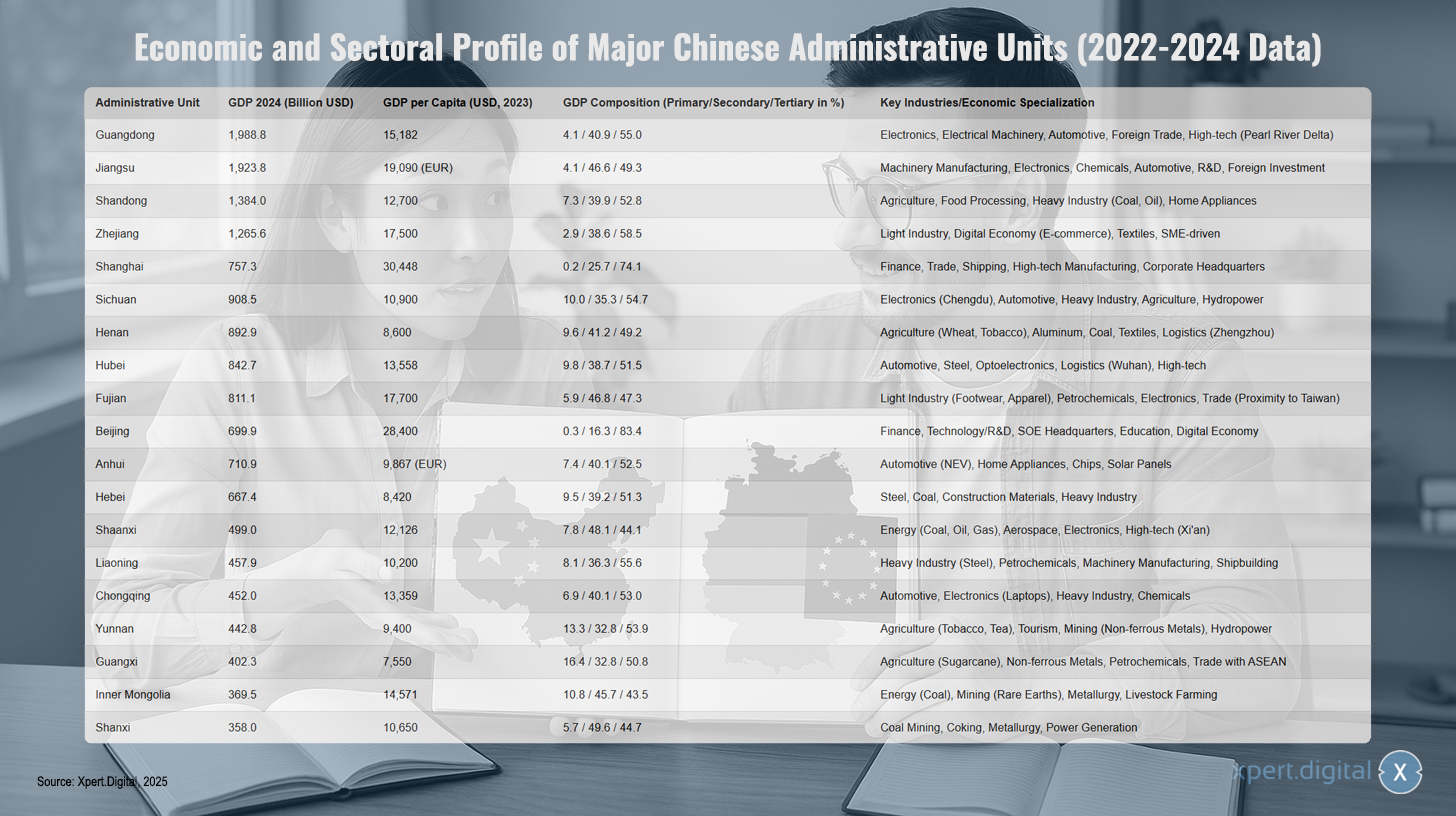
Economic and sectoral profile of the main Chinese administrative units (data 2022-2024) – Image: Xpert.Digital
Note: Sectoral data are based on the most recent available sources (mostly 2021-2023) and may be subject to slight fluctuations. GDP composition was calculated from the source data where necessary.
China exhibits significant regional disparities in economic development, clearly reflected in the gross domestic products and economic structure of its various administrative units. Guangdong Province leads the way with a GDP of USD 1,988.8 billion in 2024 and a per capita GDP of USD 15,182. Its economy is comprised of 4.1 percent primary sector, 40.9 percent secondary sector, and 55.0 percent tertiary sector. Electronics, electrical machinery, automotive, foreign trade, and high-tech industries dominate the Pearl River Delta's economic specializations.
Jiangsu follows with a GDP of USD 1,923.8 billion and an above-average per capita GDP of EUR 19,090, with an economic structure comprised of 4.1 percent primary sector, 46.6 percent secondary sector, and 49.3 percent tertiary sector. The province specializes in mechanical engineering, electronics, chemicals, automotive, research and development, and foreign investment.
Shandong has a GDP of USD 1,384.0 billion and a per capita GDP of USD 12,700, with an economic structure of 7.3 percent primary sector, 39.9 percent secondary sector, and 52.8 percent tertiary sector. Key industries include agriculture, food processing, heavy industry (coal and oil), and household appliances.
Zhejiang has a GDP of USD 1,265.6 billion and a per capita GDP of USD 17,500, with an economic structure of 2.9 percent primary sector, 38.6 percent secondary sector, and 58.5 percent tertiary sector. The province is known for light industry, the digital economy including e-commerce, textiles, and is characterized by small and medium-sized enterprises.
Shanghai stands out with a GDP of USD 757.3 billion and the highest per capita GDP of USD 30,448, although its economic structure is heavily tertiary, with only 0.2 percent primary sector, 25.7 percent secondary sector, and 74.1 percent tertiary sector. The megacity specializes in finance, trade, shipping, high-tech manufacturing, and is home to the headquarters of numerous corporations.
Sichuan has a GDP of USD 908.5 billion and a per capita GDP of USD 10,900, with an economic structure of 10.0 percent primary sector, 35.3 percent secondary sector, and 54.7 percent tertiary sector. The province specializes in electronics in Chengdu, automotive, heavy industry, agriculture, and hydropower.
Henan has a GDP of USD 892.9 billion and a GDP per capita of USD 8,600, with an economic structure of 9.6 percent primary sector, 41.2 percent secondary sector, and 49.2 percent tertiary sector. Key industries include agriculture (wheat and tobacco), aluminum, coal, textiles, and logistics in Zhengzhou.
Other important administrative units include Hubei with a GDP of USD 842.7 billion, specializing in automotive, steel, optoelectronics and logistics in Wuhan; Fujian with a GDP of USD 811.1 billion, focusing on light industry, petrochemicals and trade due to its proximity to Taiwan; and Beijing with a GDP of USD 699.9 billion and the highest tertiarization at 83.4 percent, specializing in finance, technology, state-owned enterprise headquarters and the digital economy.
The remaining provinces, such as Anhui, Hebei, Shaanxi, Liaoning, Chongqing, Yunnan, Guangxi, Inner Mongolia and Shanxi, show different specializations ranging from automobiles and household appliances to energy and mining, and from agriculture to tourism, with per capita GDP values varying between USD 7,550 and 14,571 and economic structures exhibiting regionally adapted focuses.
Detailed analysis of the top administrative units
1. Guangdong (廣東)
With a GDP that surpasses that of industrialized nations like Spain or South Korea, Guangdong is the undisputed economic engine of China. The province generates around 10.5% of China's total GDP and has transformed itself from an economic backwater into a global manufacturing and trade hub since the beginning of Deng Xiaoping's reform and opening-up policy.
The sectoral composition, with a tertiary sector share of 55% and a secondary sector share of 41% (as of 2022), indicates a mature, diversified economy that nevertheless remains an industrial powerhouse. The core of its economic strength lies in the Pearl River Delta, a megalopolis encompassing the high-tech centers of Guangzhou and Shenzhen. This region is a global epicenter for electronics manufacturing; the production of computers, communications equipment, and other electronic devices alone accounts for 24% of the province's industrial value added. Other key industries include electrical machinery, the automotive industry, and a wide range of consumer goods. Guangdong is not only China's largest exporter but also its largest importer, underscoring its central role in global supply chains. A key characteristic is the dominance of the private sector, which makes the economy more agile and less dependent on state investment than many other provinces. The immediate proximity to the financial center of Hong Kong has been and remains a crucial catalyst for investment and access to international capital.
2. Jiangsu (江蘇)
Jiangsu, the province with the second-highest GDP in the country and the highest per capita GDP among all provinces, is another industrial powerhouse. With a secondary sector share of almost 47%, its economic structure is even more heavily industrialized than Guangdong's. Historically focused on light industries such as textiles and food processing, Jiangsu has undergone an impressive transformation since 1949 towards modern heavy and high-tech industries. Today, mechanical engineering, electronics, chemicals, the automotive industry, and telecommunications dominate its economic landscape.
The province is a magnet for foreign direct investment (FDI), particularly in the highly developed industrial parks around the cities of Suzhou and Wuxi. Suzhou, for example, is home to the largest Italian industrial park abroad, with over 170 companies. A crucial factor for future development is the strong focus on innovation. Jiangsu invests heavily in research and development (R&D), with expenditures reaching 2.72% of the regional GDP—a figure that rivals many developed countries and underscores the strategic shift from a purely manufacturing-based economy to a knowledge-based economy.
3. Shandong (山東)
Shandong, the third-largest provincial economy, has a distinct dual structure that sets it apart from the purely industrial or service-oriented coastal provinces. With a primary sector share of 7.3%, it is an agricultural superpower and is often referred to as “China’s most outstanding agricultural province.” It is a leader in the production of vegetables, fruits, meat, and aquatic products.
At the same time, Shandong boasts a massive heavy industry based on rich deposits of coal, iron ore, and petroleum from the Shengli oil field, one of China's largest. This has led to the development of strong petrochemical, steel, and energy industries. In manufacturing, the province is known for world-renowned brands of household appliances such as Haier and Hisense, as well as for machinery manufacturing and the long-established Tsingtao Brewery. This mix of strong agriculture and heavy industry gives the economy a broad, but also more traditional, foundation. The strong presence of state-owned enterprises, particularly in the raw materials sector, is another defining characteristic.
4. Zhejiang (浙江)
Zhejiang is one of China's wealthiest and most dynamic provinces, considered a prime example of a privately driven economy. With a tertiary sector share of over 58%, its economy is heavily reliant on services and light industry. Historically a center for handicrafts, silk, and tea production, Zhejiang has transformed itself into a leading player in the digital economy. The province is home to Alibaba, one of the world's largest technology companies, and has cultivated a unique ecosystem encompassing e-commerce, logistics, and specialized market cities like Yiwu, renowned for its international trade fairs.
Zhejiang's economy is characterized by an exceptionally high density of small and medium-sized enterprises (SMEs), which are considered agile, innovative, and strongly export-oriented. This private-sector structure clearly distinguishes it from the heavy-industry and state-owned enterprise-dominated economies of northern China. Leading industries today include electrical machinery, computer equipment, automotive components, and chemical fibers, reflecting the modernization of traditional light industry.
5. Shanghai (上海)
As one of China's four municipalities directly under the central government, Shanghai is less a province than a global megacity and the undisputed financial and commercial center of the country. Its economic structure, with a service sector accounting for over 74%, is extremely well-developed and resembles that of global financial centers. The primary sector, at 0.2%, is practically non-existent.
Shanghai serves as a showcase for the modern Chinese economy. It is home to the Shanghai Stock Exchange, the largest stock exchange in the Asia-Pacific region, the world's busiest container port, and China's first free trade zone, which serves as a testing ground for economic reforms. The city is a magnet for the headquarters of multinational corporations and Chinese companies. Beyond its dominant financial and trade services, Shanghai boasts a highly developed industrial sector in the Pudong New Area, focused on high-end manufacturing such as automobiles, electronics, and biotechnology.
6. Beijing (北京)
As the capital of the People's Republic of China, Beijing's economy is inextricably linked to its political function. With a GDP of nearly USD 700 billion, the economy is massively dominated by the tertiary sector, which accounts for over 83% of value added. The city is the center of state power and home to the headquarters of most of the major state-owned enterprises (SOEs), which drives the financial and business services sectors.
Furthermore, Beijing has become a leading global center for science and technology. R&D spending exceeds 6% of the city's GDP, one of the highest rates worldwide. This has fostered a thriving ecosystem of technology startups, unicorn companies, and established tech firms in fields such as software, artificial intelligence, and biotechnology. The digital economy alone already contributes over 42% to the city's GDP, highlighting Beijing's successful transformation from an industrial to a post-industrial knowledge economy.
Hidden Patterns and Implications
The analysis of individual provinces reveals two profound patterns that are crucial for understanding the overall Chinese economy.
First, a pronounced coastal-inland divide exists. The coastal provinces of Guangdong, Jiangsu, and Zhejiang, along with the cities of Shanghai and Beijing, concentrate a disproportionate share of the nation's wealth, technology, and international trade connections. For example, Jiangsu's per capita GDP is more than double that of the inland province of Henan, despite Henan being one of the most populous provinces. This disparity drives massive flows of capital and labor from the interior to the coast, creating an internal economic dynamic that differs from the situation in the EU, where cohesion funds actively seek to reduce such regional imbalances.
Secondly, there is a strong path dependency in development, largely shaped by political decisions. The economic specialization of the provinces is not a purely organic result of market processes. Guangdong and Fujian benefited enormously from their geographical proximity to Hong Kong and Taiwan and their early designation as Special Economic Zones under Deng Xiaoping's "Open Door Policy." This gave them a development advantage that lasted for decades. In contrast, northeastern provinces like Liaoning still suffer from the legacy of outdated heavy industry from the planned economy era. Current initiatives such as the "Go West" strategy, which promotes centers like Chengdu and Chongqing, or the creation of the Shanghai Free Trade Area demonstrate that economic development continues to be heavily steered by central political directives. This contrasts sharply with the more decentralized and competitive development of economic regions within the EU Single Market.
B2B procurement: supply chains, trade, marketplaces & AI-supported sourcing

B2B procurement: Supply chains, trade, marketplaces & AI-powered sourcing with ACCIO.com - Image: Xpert.Digital
More about it here:
Economic archetypes in Europe: Six models that shape the EU single market
Economic profiles of the member states of the European Union
The European Union also represents a heterogeneous economic area, whose member states exhibit a wide range of economic models and specializations. The following analysis examines the profiles of the EU's largest and most representative economies.
Economic and sectoral profile of the main EU Member States (data 2022-2024)
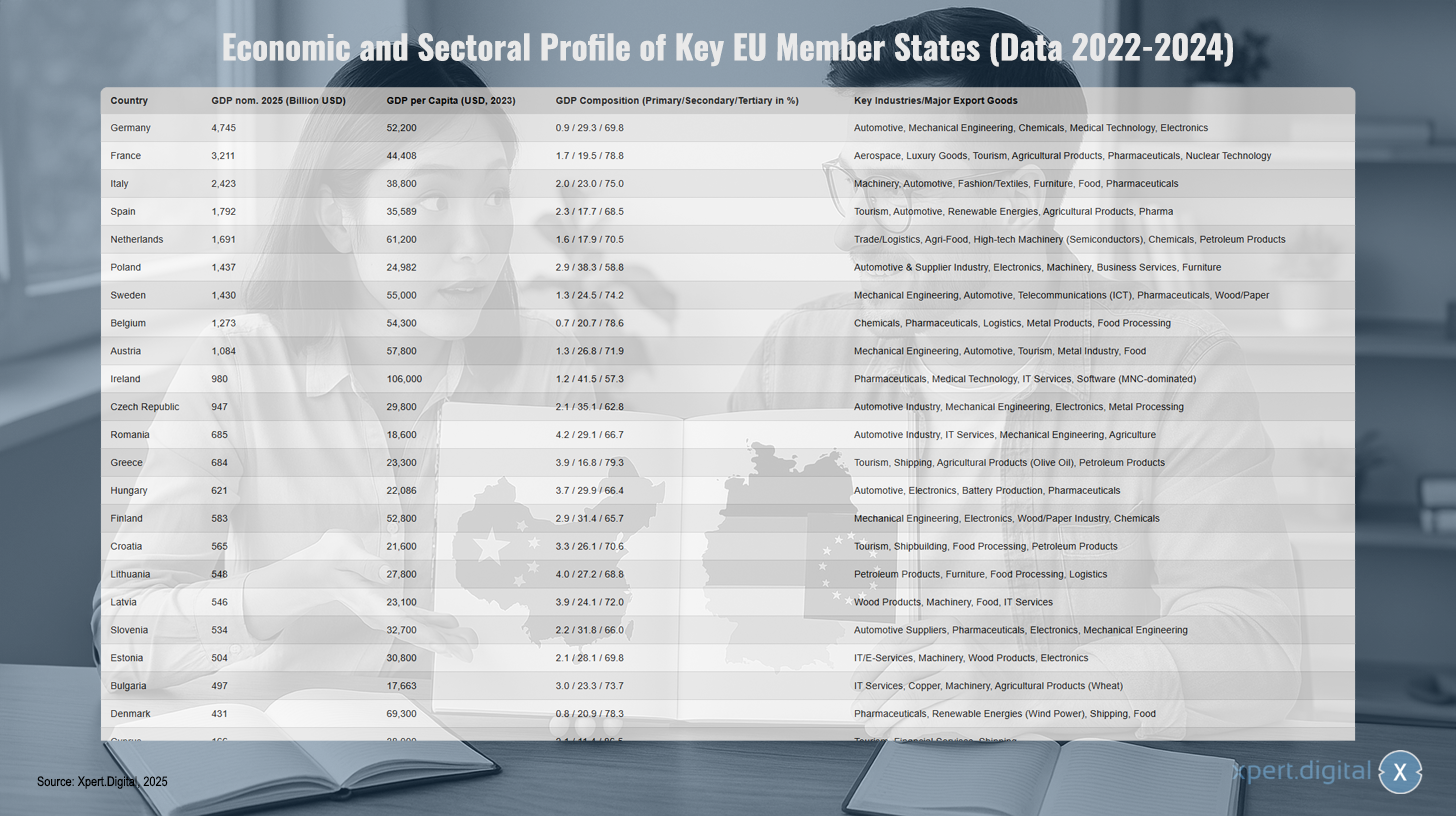
Economic and sectoral profile of the most important EU member states (data 2022-2024) – Image: Xpert.Digital
Note: Sectoral data are based on the most recent available sources (mostly 2021-2023) and may vary slightly depending on the source (e.g., World Bank, Eurostat, national statistical offices). The composition has been normalized for better comparability.
The economic and sectoral profile of the main EU Member States is based on data from 2022 to 2024. Germany leads with a nominal GDP of USD 4,745 billion in 2025 and a GDP per capita of USD 52,200. Its economic structure consists of 0.9 percent primary sector, 29.3 percent secondary sector, and 69.8 percent tertiary sector. Key industries include automotive, mechanical engineering, chemicals, medical technology, and electronics.
France follows with a GDP of USD 3,211 billion and USD 44,408 per capita, with a sectoral distribution of 1.7/19.5/78.8 percent and a focus on aerospace, luxury goods, tourism, agricultural products, pharmaceuticals, and nuclear technology. Italy reaches USD 2,423 billion GDP at USD 38,800 per capita (2.0/23.0/75.0 percent sectoral distribution) with a focus on machinery, automobiles, fashion/textiles, furniture, food, and pharmaceuticals.
Spain has a GDP of USD 1.792 trillion and a per capita income of USD 35,589 (2.3/17.7/68.5 percent), with tourism, automotive, renewable energy, agricultural products, and pharmaceuticals as its main industries. The Netherlands reaches USD 1.691 trillion with a high per capita income of USD 61,200 (1.6/17.9/70.5 percent) and specializes in trade/logistics, agri-food, high-tech machinery for semiconductors, chemicals, and petroleum products.
Poland has a GDP of USD 1.437 trillion with USD 24,982 per capita and a still predominantly industrialized structure of 2.9/38.3/58.8 percent, dominated by the automotive and supplier industries, electronics, machinery, business services, and furniture. Sweden reaches USD 1.430 trillion with USD 55,000 per capita (1.3/24.5/74.2 percent) with mechanical engineering, automotive, telecommunications, pharmaceuticals, and the wood and paper industry.
Belgium has a GDP of USD 1.273 trillion and USD 54,300 per capita (0.7/20.7/78.6 percent) with industries including chemicals, pharmaceuticals, logistics, metal products, and food processing. Austria reaches USD 1.084 trillion with USD 57,800 per capita (1.3/26.8/71.9 percent) and focuses on mechanical engineering, automobiles, tourism, the metal industry, and food processing.
Ireland stands out with a GDP of USD 980 billion and an exceptionally high per capita income of USD 106,000 (1.2/41.5/57.3 percent), its economy heavily influenced by multinational corporations in pharmaceuticals, medical technology, IT services, and software. The Czech Republic reaches USD 947 billion with USD 29,800 per capita income (2.1/35.1/62.8 percent), driven by its automotive, mechanical engineering, electronics, and metal processing industries.
The other EU countries show different levels of development: Romania (USD 685 billion, USD 18,600 per capita) with automotive, IT services and agriculture, Greece (USD 684 billion, USD 23,300 per capita) with tourism, shipping and agricultural products, Hungary (USD 621 billion, USD 22,086 per capita) with automotive, electronics and battery production, and Finland (USD 583 billion, USD 52,800 per capita) with mechanical engineering, electronics and the wood/paper industry.
Smaller EU countries like Croatia, Lithuania, Latvia, Slovenia, and Estonia have GDPs between USD 504 and 565 billion, with diverse specializations ranging from tourism and IT services to timber products. The Nordic countries, including Denmark (USD 431 billion, USD 69,300 per capita), excel in pharmaceuticals and renewable energy, while the smallest EU member states—Cyprus (USD 166 billion), Luxembourg (USD 153 billion, with an exceptional USD 141,080 per capita), and Malta (USD 101 billion)—focus on services such as finance, tourism, and specialized industries.
Detailed analysis of selected EU countries
1. Germany
As the largest economy in the EU and one of the world's leading export nations, Germany is the industrial heart of Europe. Its economic structure is that of a classic, highly developed industrial nation, in which the secondary sector accounts for an exceptionally high share of GDP at around 29%. The backbone of the economy is the manufacturing sector, supported by three pillars: the automotive industry, mechanical and plant engineering, and the chemical industry. These sectors together account for almost 41% of German goods exports. A distinctive feature is the crucial role of the "Mittelstand" – highly specialized small and medium-sized enterprises that are often global market leaders in their niche markets and represent the innovative strength and quality "Made in Germany." However, Germany's export orientation (trade/GDP ratio of approximately 83%) also makes it vulnerable to global economic fluctuations.
2. France
The EU's second-largest economy is more service- and consumption-oriented than Germany's. The tertiary sector dominates, accounting for almost 79% of GDP, while manufacturing contributes just under 10%. France is characterized by a diversified economy with significant state influence in strategic sectors. Key industries include aerospace (led by Airbus), luxury goods (LVMH, Kering), automotive, and pharmaceuticals. A global peculiarity is its nuclear sector, which generates around 78% of the country's electricity, making France the smallest CO2 emitter among the G7 nations. Furthermore, France is the EU's leading agricultural power, a major producer of wine, grain, and dairy products, and the most visited country in the world, making tourism a mainstay of its economy. Paris serves as a global financial and business center.
3. Italy
Italy's economy, the third largest in the Eurozone, is characterized by a pronounced industrial north-south divide. The north is highly industrialized, while the south is more dependent on agriculture and government transfer payments. The strength of the Italian economy lies in the production and export of high-quality niche products, known worldwide under the "Made in Italy" label. These include machinery, vehicles (especially in the premium segment), pharmaceuticals, furniture, fashion, and food. Similar to Germany's Mittelstand (SMEs), but often on a smaller scale, Italian industry is based on a dense network of specialized SMEs organized into regional clusters. This structure gives the economy flexibility but also makes it vulnerable to financing bottlenecks.
4. Netherlands
The Netherlands is a prime example of a small but extremely open, globalized, and prosperous trading nation. Its economy is inextricably linked to its geostrategic location and its role as the "gateway to Europe." The Port of Rotterdam is the largest seaport in Europe and a central logistics hub for the continent. This is reflected in a strong specialization in trade, transport, and logistics. Furthermore, the Netherlands is a global leader in the agri-food sector, achieving enormous productivity through advanced technology and efficiency despite limited land area. In the high-tech sector, it is home to key companies such as ASML, the world leader in lithography systems for the semiconductor industry, making the Netherlands a critical link in the global tech supply chain. The chemical industry and petroleum processing are other important sectors.
5. Poland
As the largest economy in Central and Eastern Europe, Poland has undergone impressive economic convergence since joining the EU in 2004. The economy is driven by a strong industrial sector, which, at over 38% of GDP, boasts one of the highest shares in the EU. Poland has become the “workshop of Europe” and is a key location for foreign direct investment, particularly in the automotive and supplier industries, electronics manufacturing, and mechanical engineering. Large international corporations use the country as a production base for the EU single market. In parallel, a dynamic service sector has developed, especially in business process outsourcing (BPO) and IT, where cities such as Warsaw, Krakow, and Wroclaw have become important hubs.
6. Ireland
The Irish economy is a unique phenomenon within the EU. It is a small, highly globalized economy whose official GDP figures are heavily influenced and often distorted by the activities of multinational corporations (MNCs). Ireland has positioned itself as the European headquarters for hundreds of US technology and pharmaceutical companies, leveraging its very low corporate tax rate and highly skilled English-speaking labor market. Consequently, Ireland's export and industrial structure is dominated by sectors in which these MNCs operate: pharmaceuticals, medical technology, software, and IT services. Industry appears to account for over 40% of value added, but this is largely due to the booking of profits and intellectual property in Ireland. Ireland is thus the most prominent example of an export-oriented FDI platform, serving as a gateway for non-European companies into the EU single market.
Hidden Patterns and Implications
The analysis of EU economies reveals two fundamental characteristics that distinguish them from the Chinese economic landscape.
First, a far greater diversity of economic models is evident. While the Chinese provinces essentially represent variations of a centrally controlled, state-capitalist model, fundamentally different national economic systems coexist within the EU. The comparison between Germany and Ireland vividly illustrates this: both are highly developed, export-oriented nations. However, Germany's strength is rooted in its domestic industrial Mittelstand (SMEs) and its engineering tradition, while Ireland's prosperity is based on the successful attraction of foreign capital and intellectual property. Other models include the state-influenced French system, the Dutch trading model, and the Polish convergence model. A comparison of a Chinese province with "the EU" as a whole is therefore methodologically inadequate; the comparison must be made with specific types of EU countries.
Secondly, the role of the EU single market as a deeply integrated economic area is crucial. The economic performance and export profiles of many EU countries cannot be understood without the context of the single market. A significant portion of the “exports” of countries like Poland, the Czech Republic, or Hungary are in reality supplies for German or French industry, particularly in the automotive sector. The single market enables complex, cross-border value chains based on common rules, standards, and the absence of tariffs. While China’s interprovincial trade is also immense, it remains subject to stronger internal barriers, differing local regulations, and overarching control by the central government. This differing nature of market integration makes a direct comparison of trade data and production networks extremely complex.
Economic power dynamics: A direct comparison of the largest EU economies
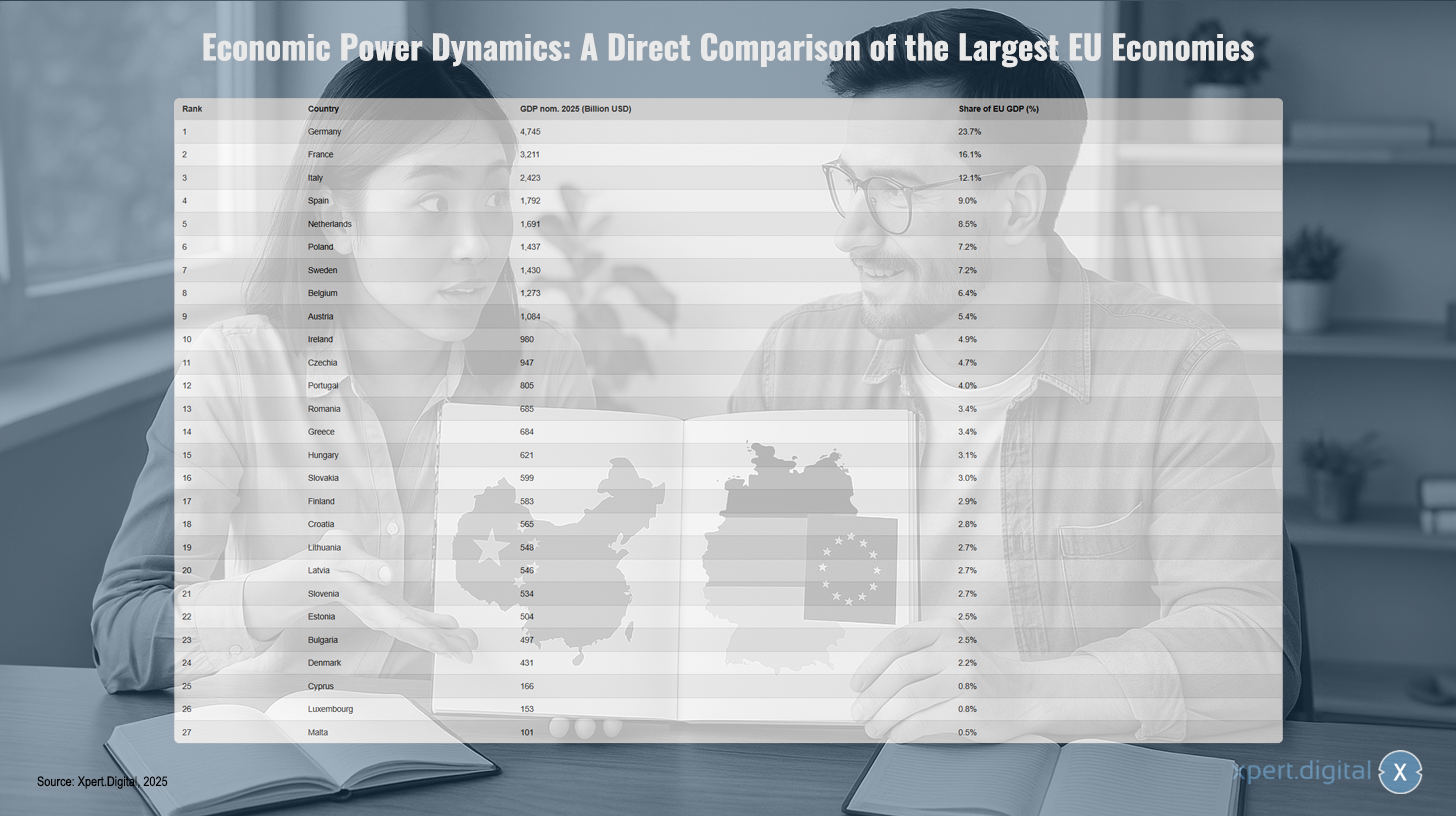
Economic power dynamics: A direct comparison of the largest EU economies – Image: Xpert.Digital – Image: Xpert.Digital
The economic balance of power within the European Union is largely determined by a few countries. With a nominal gross domestic product (GDP) of US$4,745 billion in 2025, Germany is clearly the strongest economy in the EU, contributing 23.7 percent to the total EU GDP. France follows with a GDP of US$3,211 billion and a share of 16.1 percent. Italy ranks third with US$2,423 billion and a share of 12.1 percent, followed by Spain (US$1,792 billion; 9.0 percent) and the Netherlands (US$1,691 billion; 8.5 percent). Poland, Sweden, and Belgium also make significant contributions to European economic output, each with a GDP exceeding US$1,200 billion and shares between 6.4 and 7.2 percent. Austria, Ireland, and the Czech Republic occupy the middle ground with GDPs between US$947 billion and US$1.084 trillion and shares between 4.7% and 5.4%. The remaining countries, including Portugal, Romania, Greece, Hungary, Slovakia, Finland, Croatia, Lithuania, Latvia, Slovenia, Estonia, Bulgaria, and Denmark, each have GDP shares below 4.5%. The smaller economies of Cyprus, Luxembourg, and Malta together account for less than two percent of total EU GDP. This distribution underscores the significant economic heterogeneity within the European Union, with the six largest economies already representing more than two-thirds of total economic output.
Comparative analysis and structural synthesis
Comparing Chinese and European economic entities requires an analysis that goes beyond a purely sector-based approach and takes into account the fundamental systemic differences.
Comparison of economic models: State capitalism vs. social market economy
A comparison between a Chinese province and an EU country is not a comparison of like with like. Rather, it is a comparison between an actor in a hierarchically controlled, state-centric system and an actor in a decentralized, rules-based market system. This systemic divergence is the primary limitation of any structural analogy.
A key difference lies in the role of state-owned enterprises (SOEs). In China, SOEs dominate strategic sectors such as energy, heavy industry, telecommunications, and finance. Provinces like Shandong, Hebei, and Shanxi have an economic structure heavily influenced by these often less productive but politically protected giants. In the EU, with few exceptions, the economy is predominantly privately organized, and state-owned enterprises are subject to the same competition rules as private ones.
Another crucial factor is state subsidies and industrial policy. China's industrial policy, as expressed in strategies like "Made in China 2025," utilizes massive state subsidies to specifically promote sectors such as electromobility, batteries, and solar panels. These subsidies lower prices and increase export volumes, but distort international competition. EU companies, on the other hand, operate under strict state aid rules that prevent such practices within the single market. The "efficiency" or "productivity" of a sector in a Chinese province cannot therefore be directly compared with that of an EU country without taking into account the fundamentally different costs for capital, land, and energy—which are often artificially kept low for Chinese SOEs.
Finally, the nature of market integration differs. The EU single market is a supranational, rules-based order founded on the “four freedoms” (free movement of goods, people, services, and capital). China’s national market, while vast, is driven less by competition and free allocation of resources than by centralized five-year plans and political directives from Beijing. Theories of comparative economic analysis suggest that while state-directed systems may potentially achieve a better distribution of risk, they are susceptible to political distortions and rent-seeking, whereas market-based systems may be more efficient in allocation and innovation but are prone to market failures. This theoretical foundation must be considered in any practical comparison.
Identification of structural archetypes and cluster analogy
Despite the systemic differences, archetypes can be identified at a structural level that serve as a basis for mating analysis.
Archetype 1
Export-oriented manufacturing giants: This includes regions that function as global “workshops” and whose economies are dominated by massive industrial production and exports.
- Chinese example: Guangdong, Jiangsu
- EU example: Germany
Archetype 2
Financial and service centers: These are metropolises or small states whose economies are dominated by financial services, corporate headquarters, and highly specialized services.
- Chinese example: Shanghai, Beijing
- EU example: Luxembourg, Ireland, Paris region
Archetype 3
Agile, SME-driven innovation clusters: These regions are characterized by a high density of innovative, often owner-managed small and medium-sized enterprises that operate in specialized niches.
- Chinese example: Zhejiang
- EU example: Northern Italy (Lombardy, Emilia-Romagna)
Archetype 4
Diversified agri-industrial economies: Economies with a significant, often highly productive agricultural sector, accompanied by a strong, partly traditional, partly modern industrial sector.
- Chinese example: Shandong, Henan
- EU example: France, Spain
Archetype 5
Logistics and trade gateways: Regions whose economic function is primarily based on their geostrategic location as a gateway to a larger economic area, with dominant port and logistics infrastructures.
- Chinese example: Guangdong, Shanghai
- EU example: Netherlands, Belgium
Archetype 6
Inland industrial centers in convergence: Regions that have established themselves as downstream manufacturing locations for more highly developed centers and whose growth depends heavily on foreign direct investment in sectors such as the automotive and electronics industries.
- Chinese example: Sichuan, Hubei, Chongqing
- EU example: Poland, Czech Republic, Slovakia, Hungary
Our recommendation: 🌍 Limitless reach 🔗 Networked 🌐 Multilingual 💪 Strong sales: 💡 Authentic with strategy 🚀 Innovation meets 🧠 Intuition

From local to global: SMEs conquer the global market with clever strategies - Image: Xpert.Digital
At a time when a company's digital presence determines its success, the challenge is how to make this presence authentic, individual and far-reaching. Xpert.Digital offers an innovative solution that positions itself as an intersection between an industry hub, a blog and a brand ambassador. It combines the advantages of communication and sales channels in a single platform and enables publication in 18 different languages. The cooperation with partner portals and the possibility of publishing articles on Google News and a press distribution list with around 8,000 journalists and readers maximize the reach and visibility of the content. This represents an essential factor in external sales & marketing (SMarketing).
More about it here:
From Shanghai to Sichuan: The surprising similarities between Chinese and European economic centers
Pairing analysis: Chinese provinces and their EU counterparts
Based on the preceding analysis, the most suitable European analogies are now proposed for the leading Chinese administrative units. Each pairing is explained in detail, and its limitations are explicitly outlined.
1. Guangdong → Germany + Netherlands
This dual pairing is necessary to represent the two central facets of Guangdong's economy.
Rationale: The pairing with Germany stems from the sheer scale of industrial production and their role as global export powers. Both economies are leaders in the manufacture of machinery and vehicles and possess a highly developed, diversified industrial base. Guangdong is China's "export champion," just as Germany is Europe's leading export nation. The pairing with the Netherlands reflects Guangdong's function as the primary logistics and trade gateway for the vast Chinese market and global supply chains. The ports of the Pearl River Delta (particularly Shenzhen and Guangzhou) serve a similar function to the Port of Rotterdam as a gateway to Europe. Both regions are hubs for the import and export of goods and raw materials.
Limitations: The comparison with Germany is flawed regarding the nature of manufacturing. While Germany is known for high-precision special-purpose machinery and premium automobiles, Guangdong's focus is on the mass production of consumer electronics, although this is changing. Furthermore, state influence and support in Guangdong, particularly in strategic sectors, are far more direct than in Germany. The comparison with the Netherlands is limited by the different nature of the interconnected economic systems: Guangdong serves a centrally controlled nation-state, while the Netherlands serves the supranational EU single market.
2. Jiangsu → Germany + Poland
Jiangsu also requires a dual analogy to do justice to its complex economic structure.
Rationale: The analogy to Germany is based on the extremely strong, technologically advanced, and diversified industrial base. Like Germany, Jiangsu is a powerhouse in mechanical engineering, electronics, and chemicals. Furthermore, Jiangsu's high level of R&D activity indicates ambitions to achieve similar innovation leadership to Germany. Poland's inclusion stems from its role as a preferred location for foreign direct investment in high-tech manufacturing. Much like Poland has been for Western Europe over the past two decades, Jiangsu has become a crucial production platform for global corporations, benefiting from a favorable business environment and a skilled workforce.
Limitations: Jiangsu has a stronger focus on electronics manufacturing than Germany, which dominates in mechanical engineering and automotive manufacturing. Compared to Poland, Jiangsu is economically much larger, has a higher per capita income, and is already more advanced in terms of R&D intensity.
3. Shandong → France + Poland
Shandong's dual economic structure finds its best equivalent in a combination of France and Poland.
Rationale: The pairing with France is based on their shared structure as leading agricultural powers with a simultaneously significant heavy industry. Both are top national producers in agriculture and possess a wide range of agricultural products intended for both the domestic market and export. At the same time, both have a strong industrial base. The analogy with Poland arises from the historical and, to some extent, current importance of coal mining and the heavy industry based on it as the backbone of the economy. Both regions have a long tradition of coal mining and energy-intensive production.
Limitations: French industry is now more heavily focused on high-tech sectors such as aerospace and nuclear technology, while Shandong is more heavily reliant on traditional heavy industries like steel and petrochemicals. Poland's economy has undergone a radical transformation and is now far less dominated by state-owned enterprises than the heavy industry in Shandong, where SOEs continue to play a central role.
4. Zhejiang → Northern Italy (Lombardy/Emilia-Romagna regions) + Estonia
This is one of the most apt pairings, comparing a specific European regional economy with a Chinese province.
Rationale: The primary and strongest analogy is with the industrial regions of northern Italy. Both Zhejiang and Lombardy or Emilia-Romagna are characterized by dynamic, highly export-oriented economies supported by dense clusters of innovative, flexible, and often family-run SMEs. Specialization in light machinery, high-end consumer goods, textiles, and furniture is strong in both regions. The complementary pairing with Estonia stems from Zhejiang's pioneering role in the digital economy. With Alibaba as its anchor company and a thriving online commerce ecosystem, Zhejiang mirrors, on a much larger scale, Estonia's specialization in digital services, e-government, and tech startups.
Limitations: The economies of scale and the size of the domestic market for Zhejiang's digital giants are incomparably greater than those for Estonia. Furthermore, the political and regulatory environment for private companies in China differs fundamentally from that in Italy, particularly with regard to capital flows, the rule of law, and the influence of the Communist Party.
5. Shanghai → Luxembourg + France (Île-de-France/Paris region)
To understand Shanghai's function, a comparison with a national capital region and a specialized financial state is necessary.
Rationale: The pairing with Luxembourg results from the extreme dominance of the financial sector and the consequent high share of the service sector in GDP. Both are central hubs for financial transactions and asset management in their respective economic regions. However, the analogy to the Paris region (Île-de-France) is more apt than a comparison with France as a whole. Both the Shanghai metropolitan area and the Paris metropolitan area are the undisputed economic, financial, and cultural centers of their nations, generating a disproportionate share of national GDP and serving as the headquarters for the country's largest companies.
Limitations: The function of financial centers differs. Shanghai is the gateway to and control center for a continental, centrally managed economic area. Luxembourg specializes in cross-border financial services within the highly regulated EU single market. Paris is also integrated into this European system and competes with other EU financial centers such as Frankfurt or Amsterdam.
6. Sichuan → Czech Republic + Romania
As an emerging inland center, Sichuan finds its counterparts in the converging economies of Central and Eastern Europe.
Rationale: The analogy with the Czech Republic is based on its development into a major center for automotive and electronics manufacturing, which benefits greatly from foreign investment. The high-tech zones in Chengdu and Mianyang mirror the development that cities like Prague and Brno have undergone to become integral parts of European supply chains. The additional pairing with Romania captures Sichuan's dual structure, which, alongside its emerging industry, also has a very significant agricultural base. Similar to Romania, Sichuan combines strong agricultural production with a growing industrial sector, particularly in automotive manufacturing.
Limitations: The scale is fundamentally different. Sichuan is a landlocked province with over 80 million inhabitants, whose sheer size and logistical challenges are not comparable to those of the smaller, but fully integrated into the EU single market and its infrastructure, Eastern European states. Its political autonomy and economic decision-making powers are also incomparable.
7. Hubei → Czech Republic + Belgium
Hubei, with its capital Wuhan as a central hub, is best compared to a combination of a manufacturing center and a logistics hub.
Rationale: The similarity to the Czech Republic stems from the strong presence of the automotive and optoelectronics industries. Hubei is a major center for Chinese automotive production, much like the Czech Republic is for European production. The analogy to Belgium arises from its role as a central logistics and transportation hub. Wuhan, situated at the confluence of the Yangtze and Han rivers, is a crucial inland port and railway hub for Central China, comparable to the function of Antwerp and Belgium's transportation infrastructure as a hub for Western Europe.
Limitations: Belgium's logistics function is geared towards trade between sovereign EU member states, while Hubei's function primarily serves domestic freight transport. Czech industry is more strongly integrated into the EU's cross-border value chains.
8. Henan → Spain + Poland
Henan, as a populous inland province with a mix of agriculture and traditional industry, finds its analogy in Spain and Poland.
Rationale: The pairing with Spain stems from their role as agricultural giants. Henan is China's "breadbasket" and a leader in wheat production, much like Spain is a leading agricultural producer in Europe. Both also have diversified industries, though not among the absolute world leaders. The analogy with Poland arises from the importance of the raw materials industry (coal in both regions) and the development of a large textile industry. Zhengzhou is also developing into a major logistics hub, much like Polish cities benefit from their central location in Europe.
Limitations: Spain's economy is heavily reliant on tourism and renewable energy, sectors that play a minor role in Henan. Poland's economy is more modern and privately owned than Henan's, where SOEs play a major role in the raw materials sector.
9. Fujian → Italy + Portugal
Fujian, characterized by its coastal location, its historical emigration and its export-oriented light industry, shows parallels to southern European coastal nations.
Rationale: The strongest analogy is with Italy, particularly its central and southern regions. Both are characterized by a strong specialization in light industries such as footwear, clothing, and ceramics, often dominated by SMEs. The importance of ports and the maritime economy is also a shared feature. Portugal's inclusion stems from its historical role as a gateway for global trade networks and its large diaspora, which fosters investment and trade. Fujian is historically one of the main sources of the Chinese diaspora, which similarly benefits its economy.
Limitations: The growth dynamics and technological progress in Fujian's industrial clusters (e.g., in electronics in Xiamen) are currently higher than in many traditional Italian or Portuguese industrial regions.
10. Beijing → France (Île-de-France region/Paris) + Belgium (Brussels)
Beijing's unique role as a political and technological center necessitates a comparison with the political centers of Europe.
Rationale: The primary analogy, as with Shanghai, is to the Paris region. Both capital regions are the dominant centers of their nations in politics, economics, culture, and education. They are home to the central governments and a high concentration of corporate headquarters. The addition of Brussels reflects Beijing's function as the seat of a higher-level political administration. Just as Brussels houses the institutions of the European Union, Beijing is the seat of the central government of the People's Republic of China, resulting in an immense concentration of administrative and lobbying activities.
Limitations: The crucial difference lies in the nature of the political systems. Beijing is the center of a one-party state with centralized power, while Paris and Brussels are the centers of democratic and supranational structures, respectively. Beijing's R&D sector is heavily state-controlled, whereas the European innovation sector is more strongly influenced by market mechanisms and international cooperation.
Why China-EU economic comparisons are misleading: Structural similarities vs. systemic differences
A detailed analysis of the economic structures of leading Chinese administrative units and EU member states reveals that, despite enormous differences in size and development, structural analogies can be identified. These pairings, based on industrial sectors, economic functions (e.g., manufacturing hub, financial center, logistics gateway), and the role of agriculture or natural resources, offer valuable heuristic models. They make it possible to understand China's complex and heterogeneous economic landscape more readily by comparing it with more familiar European economic models and to sharpen the specific profiles of the provinces. Clear archetypes emerge: from the export-oriented manufacturing giants on the coast (Guangdong, Jiangsu) to the privately driven innovation clusters (Zhejiang) and the service-dominated metropolises (Shanghai, Beijing), all the way to the resource- and heavy-industry-based inland provinces (Shandong, Shanxi).
Emphasis on systemic boundaries
The crucial conclusion of this article, however, is that these structural analogies find their fundamental limits in the diametrically opposed economic and political systems. The identified parallels persist at a functional level but break down upon analysis of the underlying mechanisms and competitive conditions. The central role of state-owned enterprises in China, the massive and targeted state subsidization of strategic industries, politically influenced capital and land costs, and the nature of market integration within a centrally controlled nation-state preclude a direct comparison of competitiveness, productivity, or efficiency with actors in the rules-based, supranational EU single market. A Chinese company in a “similar” industry to its European counterpart operates under entirely different conditions.
Strategic Implications
For businesses and investors, this means that a strategic analysis relying solely on superficial sectoral data or market sizes is insufficient and potentially misleading. A successful market or investment strategy for a Chinese province requires a deep understanding of that region's specific political and systemic characteristics. This includes identifying key government actors, understanding local five-year plans and industrial policies, and analyzing the relationship between the public and private sectors. The pairings presented in this article can serve as a starting point for asking the right questions, but not for directly transferring strategic blueprints.
For policymakers, the analysis underscores the need for a differentiated China policy that acknowledges the country's immense regional diversity. Cooperation with Zhejiang in the area of SME innovation requires a different approach than cooperation with Shandong in the agricultural sector or a debate with Hebei on industrial standards. At the same time, the article makes it clear that cooperation based on apparent economic similarities must not ignore the fundamental differences in competitive conditions and regulatory philosophies. The comparison thus serves not to equate the two regions, but to sharpen the focus on the specific opportunities and risks that arise from the interaction of these two powerful yet fundamentally different economic areas.
China: Economic Diversity and Regional Differences
China is a country of impressive geographical size and economic dynamism. The People's Republic comprises 23 provinces, 5 autonomous regions, 4 cities directly under the central government, and 2 special administrative regions. Each of these parts of the country contributes its own unique economic strengths and characteristics to the overall structure of the Chinese economy. Cities like Shanghai and Beijing are among the country's economic engines, generating a significant share of the national gross domestic product, while various provinces also stand out for their innovative capacity, industrial production, or agricultural potential. China's economic diversity is evident not only in its different industries and technologies but also in the varying levels of development between urban centers, rural regions, and special administrative regions like Hong Kong and Macau. China's economic success is based on the close integration of these regions, with the central government playing a crucial steering and balancing role. This allows the People's Republic to continually reinvent itself and maintain its position as one of the world's leading economic powers.
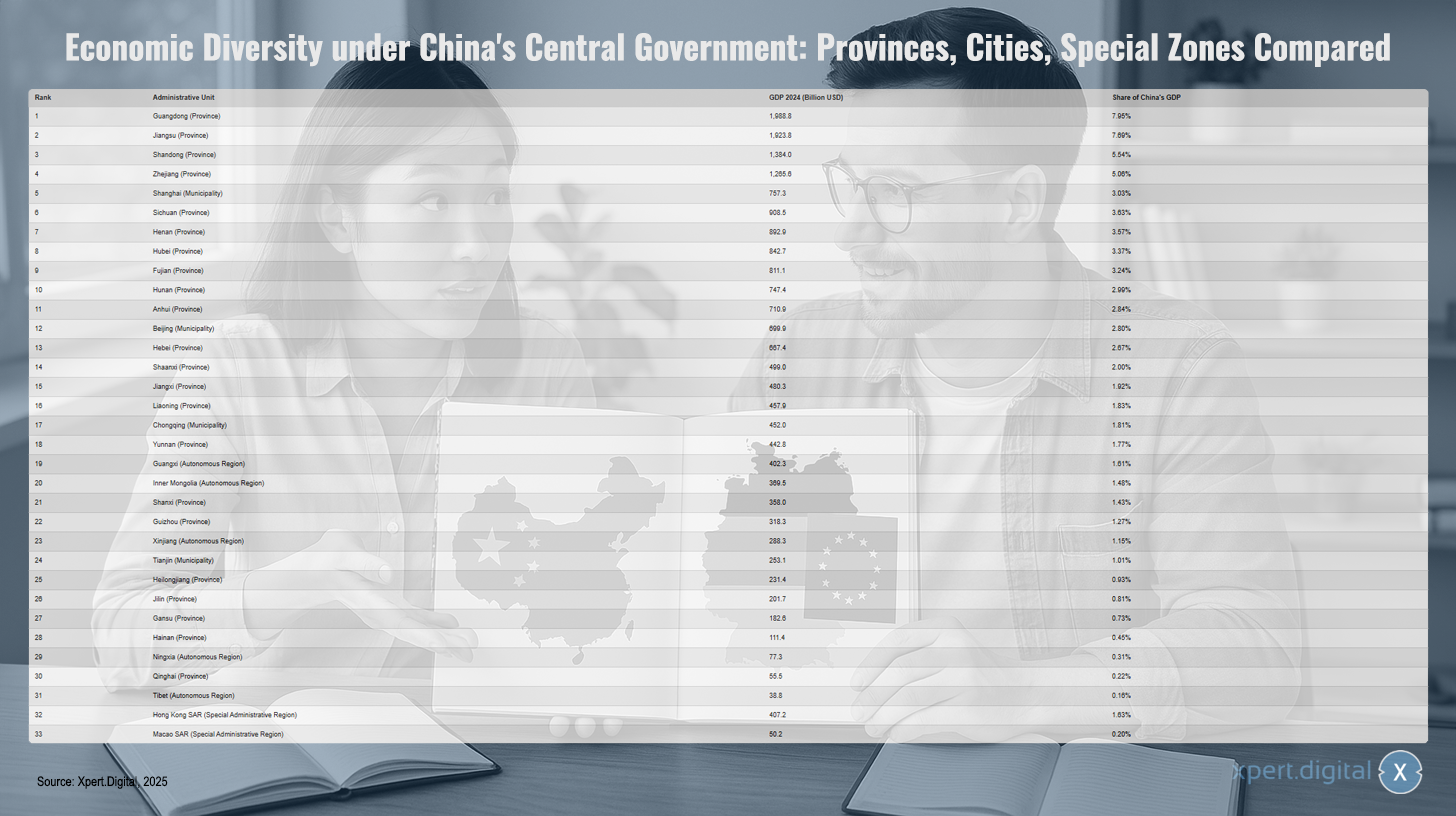
China: Economic diversity and regional differences – Image: Xpert.Digital
Under the leadership of the central government, China is characterized by remarkable economic diversity. The country comprises 23 provinces, 5 autonomous regions such as Tibet and Xinjiang, 4 municipalities directly under central government control, including Beijing and Shanghai, and 2 special administrative regions – Hong Kong and Macao. All these administrative units are directly subordinate to the central government. The provinces and cities vary considerably in their economic performance. Guangdong leads the ranking with a gross domestic product (GDP) of US$1,988.8 billion, representing 7.95% of China's total GDP, followed by Jiangsu (US$1,923.8 billion, 7.69%) and Shandong (US$1,384.0 billion, 5.54%). Particularly strong economies like Shanghai (USD 757.3 billion, 3.03%) and Beijing (USD 699.9 billion, 2.80%) also make significant contributions to the economy. While leading provinces such as Sichuan, Henan, and Hubei each contribute over USD 800 billion to GDP, smaller or less developed regions like Tibet (USD 38.8 billion, 0.16%) and Qinghai (USD 55.5 billion, 0.22%) achieve considerably lower figures. The Special Administrative Regions of Hong Kong (USD 407.2 billion, 1.63%) and Macau (USD 50.2 billion, 0.20%), despite their small size, each demonstrate considerable economic output, with Hong Kong standing out in particular due to its international connections. The economic disparities between the individual administrative units illustrate the enormous heterogeneity of the country.
We are there for you - advice - planning - implementation - project management
☑️ SME support in strategy, consulting, planning and implementation
☑️ Creation or realignment of the digital strategy and digitalization
☑️ Expansion and optimization of international sales processes
☑️ Global & Digital B2B trading platforms
☑️ Pioneer Business Development

Konrad Wolfenstein
I would be happy to serve as your personal advisor.
You can contact me by filling out the contact form below or simply call me on +49 7348 4088 965 (Munich) .
I'm looking forward to our joint project.
Write to me

Xpert.Digital - Konrad Wolfenstein
Xpert.Digital is a hub for industry with a focus on digitalization, mechanical engineering, logistics/intralogistics and photovoltaics.
With our 360° business development solution, we support well-known companies from new business to after sales.
Market intelligence, smarketing, marketing automation, content development, PR, mail campaigns, personalized social media and lead nurturing are part of our digital tools.
You can find out more at: www.xpert.digital - www.xpert.solar - www.xpert.plus
Keep in touch







