Future visions of artificial intelligence: Will AI improve or complicate our lives? A look at the next 3 to 5 years

Language selection 📢
Published on: July 12, 2024 / Updated on: July 12, 2024 – Author: Konrad Wolfenstein
Technological forecasts: Will AI improve or worsen our future? Artificial intelligence – A look at the next 3 to 5 years – Image: Xpert.Digital
🤖📊 Challenges posed by Artificial Intelligence in Germany
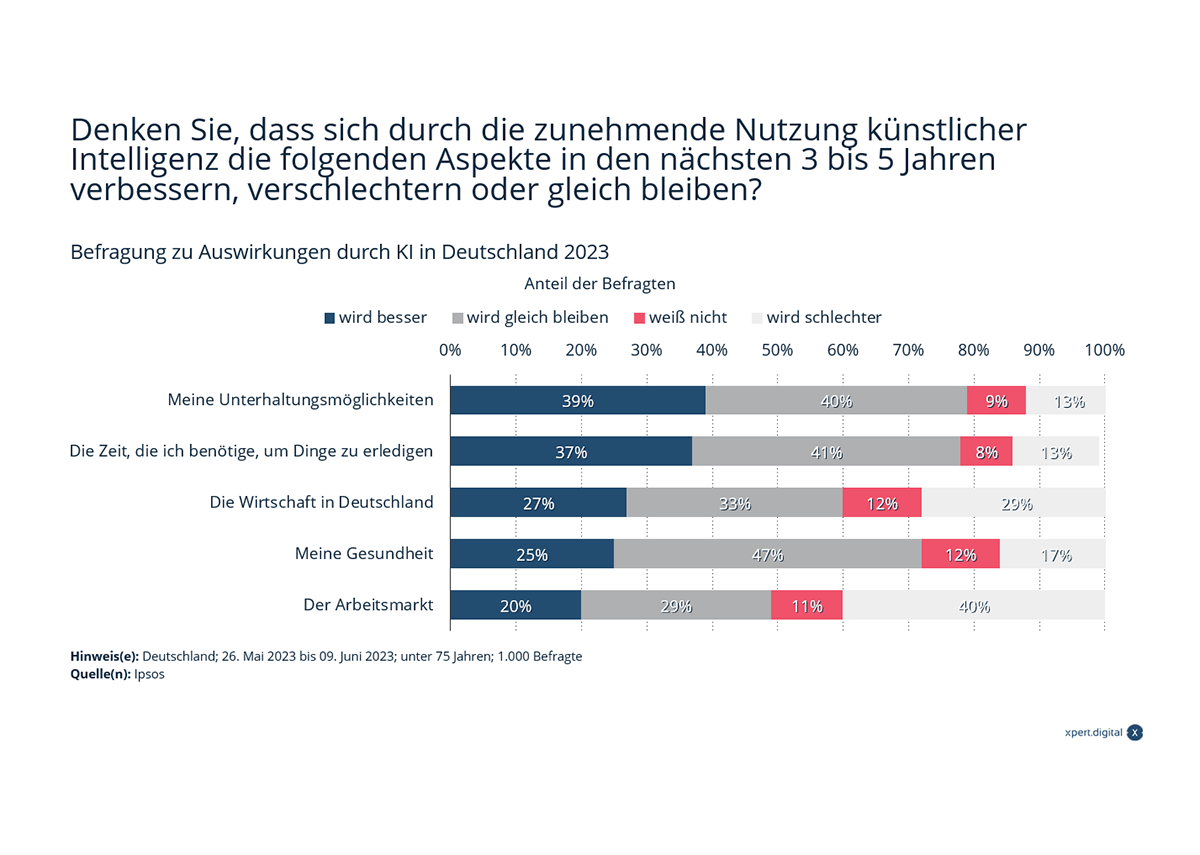
Artificial intelligence (AI) is developing rapidly and is already having a significant impact on various aspects of daily life and the economy. In Germany, as worldwide, people are facing the challenge of adapting to these technological changes. An Ipsos survey conducted from May 26 to June 9, 2023, sheds light on Germans' views on the impact of the increasing use of AI over the next three to five years. The survey results provide insights into the public's expectations regarding entertainment options, efficiency in everyday life, economic development, health, and the job market.
📺 Entertainment options
Entertainment options are an area where 39% of respondents believe the situation will improve. Only 13% expect a decline, while 40% think nothing will change and 9% are unsure. This optimism could be attributed to the already visible progress in areas such as video games, streaming services, and personalized entertainment. AI-based recommendations on platforms like Netflix and Spotify enhance the user experience through tailored content, thereby increasing user satisfaction.
⏰ Efficiency in everyday life
Another aspect influenced by AI is the time people need to complete tasks. Here, 37% of respondents believe their efficiency will improve, while 13% expect a decline. 41% believe there will be no change, and 8% are unsure. AI-powered assistants like Siri, Alexa, and Google Assistant can simplify routine tasks, set reminders, and quickly provide information, making everyday life more efficient.
📈 Economic development
The impact of AI on the German economy is viewed with mixed feelings. Only 27% of respondents believe the economy will benefit, while 28% expect a decline. 33% think nothing will change, and 12% are uncertain. This skepticism could stem from fears of job losses and unequal wealth distribution. At the same time, however, AI also offers the potential for economic growth through innovation and efficiency improvements across various sectors.
🩺 Health
In the healthcare sector, 25% of respondents expect improvements through AI, while 17% fear a deterioration. 47% believe nothing will change, and 12% are unsure. AI can bring significant benefits to medicine through improved diagnostics, personalized treatment, and more efficient management of health data. Nevertheless, concerns also exist regarding data privacy and the quality of AI-supported decisions.
💼 Job market
The labor market is the area where most respondents (40%) expect a deterioration, while only 20% foresee an improvement. 29% believe nothing will change, and 11% are uncertain. Concern about job losses due to automation and the use of AI is widespread. At the same time, however, there is also the potential for new jobs and professional fields arising from the integration of AI.
🤖💬 Diverse opinions: Germany's view on the future of AI
The survey reveals that Germans' opinions on the impact of AI are diverse and often contradictory. While optimism prevails in some areas, concerns and uncertainties dominate in others. It is clear that the acceptance and integration of AI in various aspects of life must be carefully and responsibly managed to maximize its benefits while minimizing its negative impacts. Policymakers, businesses, and society as a whole must collaborate to address these challenges and shape a positive future with AI.

Artificial Intelligence – Perspective of the German Economy (Industries and Markets) – Image/PDF: Xpert.Digital
📣 Similar topics
- 🎬 AI in entertainment: German expectations and concerns
- 🕰️ Everyday efficiency: How AI could influence the lives of Germans
- 📉 Economy and AI: Optimism and skepticism in Germany
- 🏥 Healthcare sector: How AI could change German medicine
- 💼 Job market and AI: Fear of job loss vs. new opportunities
- 🤖 AI Integration: Opportunities and Challenges for Germany
- 🎮 Personalized entertainment: AI is revolutionizing streaming and gaming
- 📈 AI and Economic Growth: German Perspectives and Forecasts
- 🛠️ AI assistants: Increasing efficiency in everyday German life
- 🔮 The future of work: AI conditions in the German labor market
#️⃣ Hashtags: #AIinGermany #ArtificialIntelligence #LaborMarket #Economy #HealthWithAI
Our recommendation: 🌍 Limitless reach 🔗 Networked 🌐 Multilingual 💪 Strong sales: 💡 Authentic with strategy 🚀 Innovation meets 🧠 Intuition

From local to global: SMEs conquer the global market with clever strategies - Image: Xpert.Digital
At a time when a company's digital presence determines its success, the challenge is how to make this presence authentic, individual and far-reaching. Xpert.Digital offers an innovative solution that positions itself as an intersection between an industry hub, a blog and a brand ambassador. It combines the advantages of communication and sales channels in a single platform and enables publication in 18 different languages. The cooperation with partner portals and the possibility of publishing articles on Google News and a press distribution list with around 8,000 journalists and readers maximize the reach and visibility of the content. This represents an essential factor in external sales & marketing (SMarketing).
More about it here:
🤖 The impact of the increasing use of artificial intelligence in the next 3 to 5 years
🤖 The rapid development and integration of artificial intelligence (AI) into various areas of life represents one of the greatest technological revolutions of our time. Given this, many people are wondering how this development will affect different aspects of our lives in the coming years. Significant changes are expected, particularly in the next three to five years, which could have both positive and potentially negative effects. Below, I will examine these aspects in detail, predict the possible changes, and analyze whether they might lead to improvements, setbacks, or a continuation of the current situation.
🧑💼 Labor market and employment
A frequently discussed topic is the impact of AI on the labor market. In the coming years, this sector will undoubtedly undergo further transformation due to increasing automation. Jobs involving repetitive or routine tasks could be increasingly replaced by machines. Industries such as manufacturing, warehousing, and even the service sector could be significantly affected. For example, the use of AI in manufacturing will not only optimize production processes but also reduce the need for human labor in certain areas.
Nevertheless, the widespread adoption of AI is not without its drawbacks. The elimination of certain job types also creates new employment opportunities. There will be a growing demand for specialists capable of developing, maintaining, and improving AI systems. Furthermore, AI systems can boost productivity in many areas, thereby creating new economic opportunities. In medicine, for example, intelligent systems support doctors in diagnoses and treatments, which can improve both the quality and efficiency of healthcare.
📚 Education and further training
Another important area is education. AI can be used to create tailored learning programs and adaptive learning environments that address the individual needs of learners. This could help improve educational outcomes and better prepare learners for the future. Learning platforms based on artificial intelligence can analyze data to determine which methods are most effective for specific students and thus create personalized learning plans.
The role of teachers will also change. Instead of primarily conveying content, they will increasingly act as mentors and coaches, supporting learners in using AI-powered learning tools. This could significantly improve the quality of education and enable a deeper, more individualized learning experience.
🏥 Healthcare
The potential of AI is particularly evident in healthcare. The ability of AI systems to analyze large amounts of medical data in a short time could lead to earlier and more accurate diagnoses. A notable example is the application of AI in image analysis, such as X-rays or MRI scans, where it can already, in some cases, work alongside or even better than experienced radiologists.
Furthermore, personalized medicine and therapies could be improved through AI. By analyzing genetic information and other health data, specific treatment plans can be developed for patients that are more effective and have fewer side effects. For example, cancer therapy could be revolutionized by precisely tailoring the treatment to the genetic characteristics of the tumor.
🔒 Data protection and security
However, the increasing prevalence of AI also presents significant challenges regarding data protection and security. AI systems collect and analyze vast amounts of data, raising concerns about privacy and the protection of personal information. Developing robust security protocols and legal frameworks is crucial to prevent the misuse of these technologies.
Another threat is the use of AI in cybercrime. Cybercriminals could use AI to carry out sophisticated attacks that are harder to detect and defend against. At the same time, however, AI can also be used to improve cybersecurity by identifying patterns in cyberattacks early on and initiating appropriate countermeasures.
⚖️ Social and ethical aspects ⚖️
The spread of AI also raises far-reaching societal and ethical questions. A central question is that of accountability. If AI systems make autonomous decisions, how is responsibility for their actions regulated? This particularly concerns the areas of autonomous driving and medical decision-making.
The ethical dimension also includes the concern that AI could exacerbate existing social inequalities. For example, the benefits of AI-powered healthcare services could primarily accrue to wealthier segments of the population, further disadvantaging poorer groups. It is therefore crucial to establish political and regulatory frameworks that promote equitable access to and the fair use of AI.
🤖 Interactive and social technologies
Another aspect is the transformation of our social interactions through AI. With intelligent assistants like chatbots and voice-controlled systems, we are increasingly interacting with machines in ways that were previously reserved for human interaction. This could fundamentally change the way we communicate. For example, social robots could be used in elderly care to support and provide companionship to the elderly. While this offers many advantages, there is also the risk that human contact and empathy will be pushed into the background.
Another example is social networks, which increasingly rely on algorithms to personalize content. While this can improve the user experience, it also poses risks such as reinforcing filter bubbles and spreading misinformation. AI could act as both a problem solver and a problem creator in this context.
🎨 Creativity and Culture
Interestingly, AI also influences creative processes and culture. Intelligent algorithms can generate artworks, musical pieces, or literary texts that are virtually indistinguishable from the works of human artists. These technologies open up new possibilities for artistic expression and creative collaborations. One example is the music industry, where AI is used to compose new melodies or remix existing music.
However, the question remains as to what extent such machine-generated works can be considered genuine art and how this affects the role of traditional artists. Will human artists be replaced by AI, or can they use these technologies to expand their own creativity?
🌍 AI technology for everyone
The increasing use of AI over the next three to five years presents both opportunities and challenges. The crucial question is how we, as a society, deal with these changes. Through responsible management and targeted policy measures, we can maximize the positive aspects and minimize the negative ones. A collaborative effort by governments, businesses, scientists, and the public is necessary to ensure that the benefits of AI technology accrue to everyone and that we successfully manage potential risks. The future with AI will undoubtedly be complex and dynamic, but it also offers a unique opportunity to further develop and shape our society.
📣 Similar topics
- 🤖 AI technology: Opportunities and challenges of the future
- 💼 The changing job market: How AI is transforming employment
- 🧑🏫 Education 4.0: How AI is revolutionizing learning
- 🏥 Health of the future: AI-powered medicine
- 🔒 Data protection and security: Challenges of the AI era
- ⚖️ Ethics and Society: The Social Impact of AI
- 🤖 Human-machine interaction: How AI is shaping our communication
- 🎨 Creativity and Culture: AI as an artist and source of inspiration
- 🌍 AI for all: Equal opportunities in the digital transformation
- 💡 Visions of the future: The diverse facets of AI technology
#️⃣ Hashtags: #AITechnology #JobMarket #Education #Health #DataProtection
📌 Other suitable topics






We are there for you - advice - planning - implementation - project management
☑️ SME support in strategy, consulting, planning and implementation
☑️ Creation or realignment of the digital strategy and digitalization
☑️ Expansion and optimization of international sales processes
☑️ Global & Digital B2B trading platforms
☑️ Pioneer Business Development

Konrad Wolfenstein
I would be happy to serve as your personal advisor.
You can contact me by filling out the contact form below or simply call me on +49 89 89 674 804 (Munich) .
I'm looking forward to our joint project.
Write to me

Xpert.Digital - Konrad Wolfenstein
Xpert.Digital is a hub for industry with a focus on digitalization, mechanical engineering, logistics/intralogistics and photovoltaics.
With our 360° business development solution, we support well-known companies from new business to after sales.
Market intelligence, smarketing, marketing automation, content development, PR, mail campaigns, personalized social media and lead nurturing are part of our digital tools.
You can find out more at: www.xpert.digital - www.xpert.solar - www.xpert.plus
Keep in touch