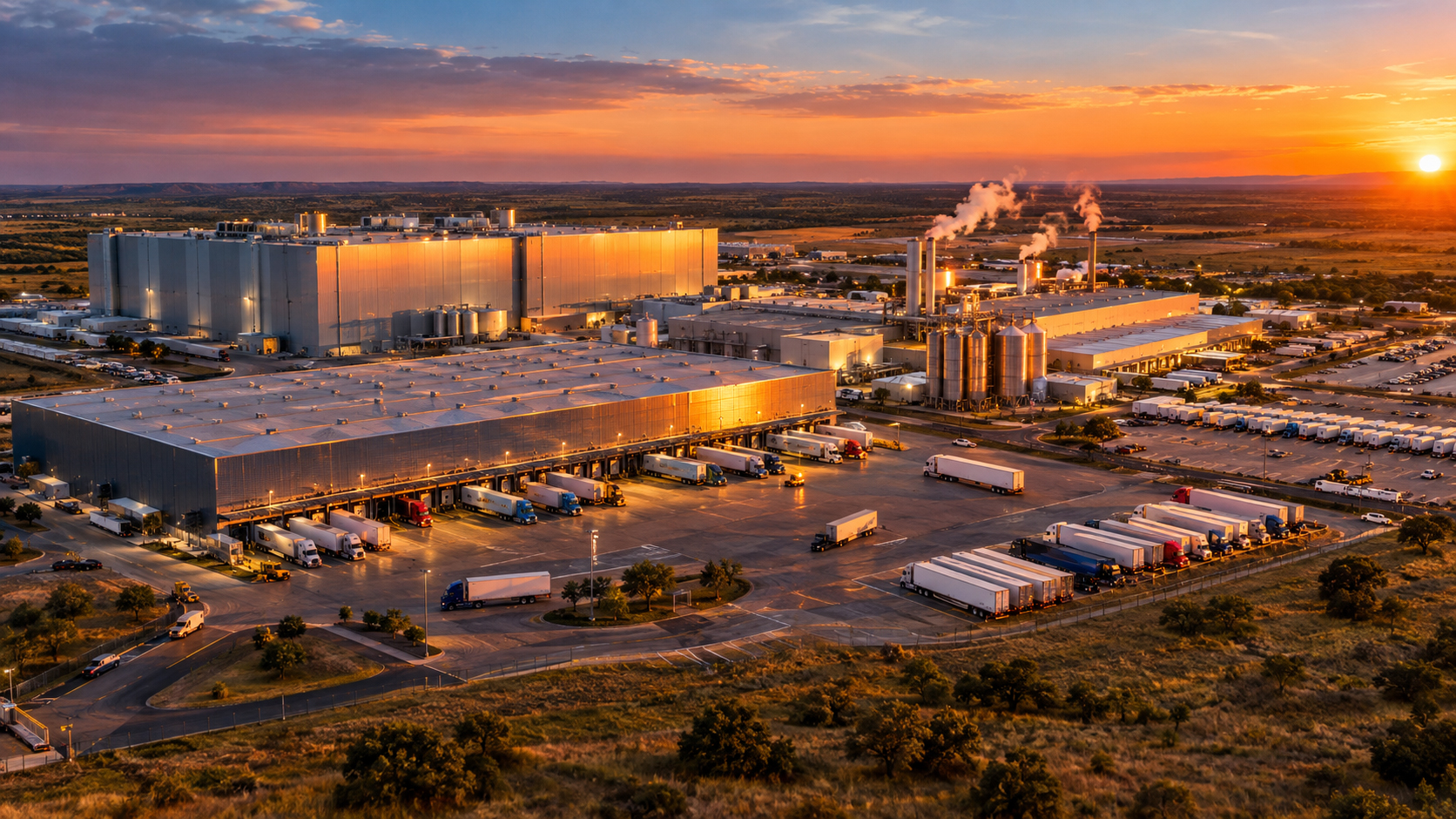
Logistics city San Antonio: The Texas-based retail giant HEB is building its future on 870 hectares – fighting against Walmart & Co. – Creative image on the topic, with AI: Xpert.Digital
From plot of land to logistics city: The 870-hectare master plan for the supermarkets of the future
HEB vs. Walmart: How the Texan retail giant is extending its lead with gigantic retail spaces
With a massive investment of around $700 million, the Texas-based food retailer HEB is poised to redefine the standards in US retail. A state-of-the-art logistics and production campus is being built on an 870-hectare site in San Antonio, bringing together a bakery, cold storage, and transportation network in a single, strategically located site. This project is far more than just a simple expansion of capacity: it is the culmination of nearly a decade of strategic land acquisition and marks the trend toward crisis-proof, independent supply chains. For the region, the mega-project means more than 1,000 new, well-paid jobs; for competitors like Walmart and Kroger, it represents a serious challenge. This is how a Texan brownfield site is being transformed into a generation-defining economic project, and why HEB is pursuing a clear master plan.
The $700 million bet on its own supply chain
San Antonio-based grocery retailer HEB has announced plans to invest approximately $700 million in expanding its logistics and production infrastructure. A potential location is the more than 870-acre site on Foster Road on San Antonio's East Side, which HEB acquired in 2018. While the final site selection has not yet been made at the time of the announcement, all indications point to further expansion at the existing facility. For a family-owned company traditionally considered a major economic force in Texas, this project marks a historic turning point in its investment history.
Chief Supply Chain Officer Carson Landsgard emphasized that this was one of the most significant investments in the company's history, one that would enable HEB to serve even more people in Texas. This statement can be seen in economic terms as a classic response to continued store expansion: HEB now operates more than 455 locations under the brands HEB, Joe V's Smart Shop, Central Market, and Mi Tienda, and each new store increases the pressure on the existing distribution infrastructure.
When a property becomes a strategic asset
The real point of this story lies not in the investment volume alone, but in the underlying timeframe. HEB purchased the Foster Road site back in 2017 and 2018 and has since invested more than $445 million there, including in a warehouse and production facility spanning over two million square feet. This means that the current $700 million expansion is not a spontaneous reaction to acute capacity constraints, but rather the next step in a plan pursued for almost a decade to secure land and develop the site in phases.
This long-term land reserve strategy is paying off in a market environment where industrial and logistics sites in growing US metropolitan areas are becoming increasingly scarce and expensive. Securing large, contiguous areas early on allows for later expansions without the need for new site searches, zoning disputes, or fragmented parcels. Should the entire project at the Foster Road site be implemented, the total investment there would increase to well over one billion US dollars, and the workforce would grow from approximately 1,400 to around 2,600 employees.
Thinking back from the shelf: Bakery, cold chain and transport hub all in one
The preliminary construction plans include the construction of a modern bakery production facility, a cold storage warehouse, a transport building, and an expansion of the existing production plant. Of particular note is the deliberate spatial integration of production, cold chain, and transport logistics on a single, contiguous campus. This hub strategy significantly shortens the distances between production and delivery, thereby reducing turnaround times, transport costs, and the risk of quality loss for perishable goods.
The project has since been further defined through several individual applications to the Texas Department of Land Management and Logistics (TDLR). In June 2026, HEB announced plans for a $125 million bakery production and storage facility with approximately 356,000 square feet of floor space, scheduled for completion in September 2028. Shortly thereafter, they announced a $175 million, two-story cold storage building with 675,000 square feet of floor space, including office and administrative wing, with construction slated to begin in August 2026 and be completed by March 2028. These individual projects demonstrate that the $700 million figure is not merely a marketing promise, but is being broken down into concrete, officially documented construction projects with firm timelines.
Your intralogistics experts

Consulting, planning and implementation of complete solutions for high-bay warehouses and automated storage systems - Image: Xpert.Digital
More information here:
Strategic location policy: What HEB's multi-million dollar investment reveals about US retail
Jobs as bargaining chips between corporation and municipality
HEB anticipates creating approximately 720 new full-time positions by 2028 and increasing this number to over 1,200 additional positions by 2038. Interestingly, the figures vary depending on the source and context: While the company announcement speaks of more than 1,200 new full-time positions over a decade, a county document relating to the specific grant application mentions a slightly lower investment of $636.5 million, linked to the same 720 new positions. Such discrepancies are typical for large projects in the planning phase, where public corporate communications are naturally somewhat more optimistic than the formal grant application submitted to the municipality.
In exchange for these job commitments, HEB received a ten-year, 85 percent property tax credit from the Bexar County Commissioners, equivalent to approximately $15 to $16.4 million. In return, the company pledged to create 720 new jobs by the end of 2030 and maintain the existing 1,389 jobs at the site. The commissioners unanimously described the project as a generational one for the region at their August 2026 meeting. Such tax agreements are an established tool in the US for location competition between municipalities, exchanging short-term tax revenue for long-term employment and economic benefits, although the actual net benefit of such agreements for the public sector is often difficult to quantify in economic literature.
What this number reveals about the US food trade
The average annual salary for the newly created positions was stated in the negotiation documents as approximately US$52,778. This is significantly higher than the minimum wage level for traditional retail jobs and suggests that these are primarily skilled and qualified positions in production, logistics, and plant control, rather than simple warehouse worker roles. This aligns with the broader picture of a grocery retailer increasingly transforming itself into an industrial enterprise.
The investment is part of an industry-wide trend toward vertical integration in the US grocery retail sector. Instead of relying on external suppliers and logistics providers, large retail chains are increasingly building their own manufacturing, warehousing, and distribution facilities to increase independence, cost control, and responsiveness. According to HEB, the Foster Road project is the largest single investment in the company's history in the manufacturing and supply chain sector and, if realized, is expected to be among the largest industrial investments in the San Antonio area.
Risks between planning reservations and political tailwinds
Despite the positive atmosphere, it must be noted that the final site decision has not yet been officially made, as HEB itself has repeatedly emphasized. While the parallel TDLR construction applications, the approved tax break, and the already commenced land acquisition strongly suggest that the project will indeed be implemented at the Foster Road site, it is formally still a project in the planning phase. The political support from Bexar County, demonstrated by the unanimous approval of the tax agreement, significantly reduces the risk of delays or a change of location.
From a macroeconomic perspective, the project also exemplifies the ongoing construction boom in Texas, where population growth, the influx of businesses, and a comparatively business-friendly tax and regulatory environment have led to above-average investment in industrial and logistics real estate for years. At the same time, a construction volume of this magnitude entails typical implementation risks, such as rising construction costs, a shortage of skilled workers in the construction industry, or delays in obtaining regulatory approvals, which could postpone the originally targeted completion date of 2028 for the first facilities.
A blueprint for resilient supply chains
Overall, the Foster Road project reads like a textbook example of how an established retail group can future-proof its supply chain: through early land acquisition, consistent clustering of production, cold chain logistics, and transport at a single location, and close, incentivized cooperation with local government. The phased implementation, spanning multiple building permits and years, also demonstrates that modern supply chain investments rarely occur in a single construction phase, but are designed as long-term, phased capacity expansions that can scale with the growth of the store network.
For the San Antonio region, the project means not only several hundred new, above-average-paying industrial jobs, but also a signaling effect for further developments in the Texas logistics sector. If the timeline holds true, it should become clear around 2028 whether HEB can actually achieve the hoped-for competitiveness against national chains like Walmart or Kroger with this investment in its own infrastructure.
Your global marketing and business development partner
☑️ Our business language is English or German
☑️ NEW: Correspondence in your native language!

Konrad Wolfenstein
I and my team are happy to be available to you as your personal advisor.
You can contact me by filling out the contact form here wolfenstein@xpert.digital:or simply call me at +49 7348 4088 965. My email address is
I'm looking forward to our joint project.