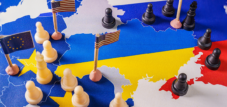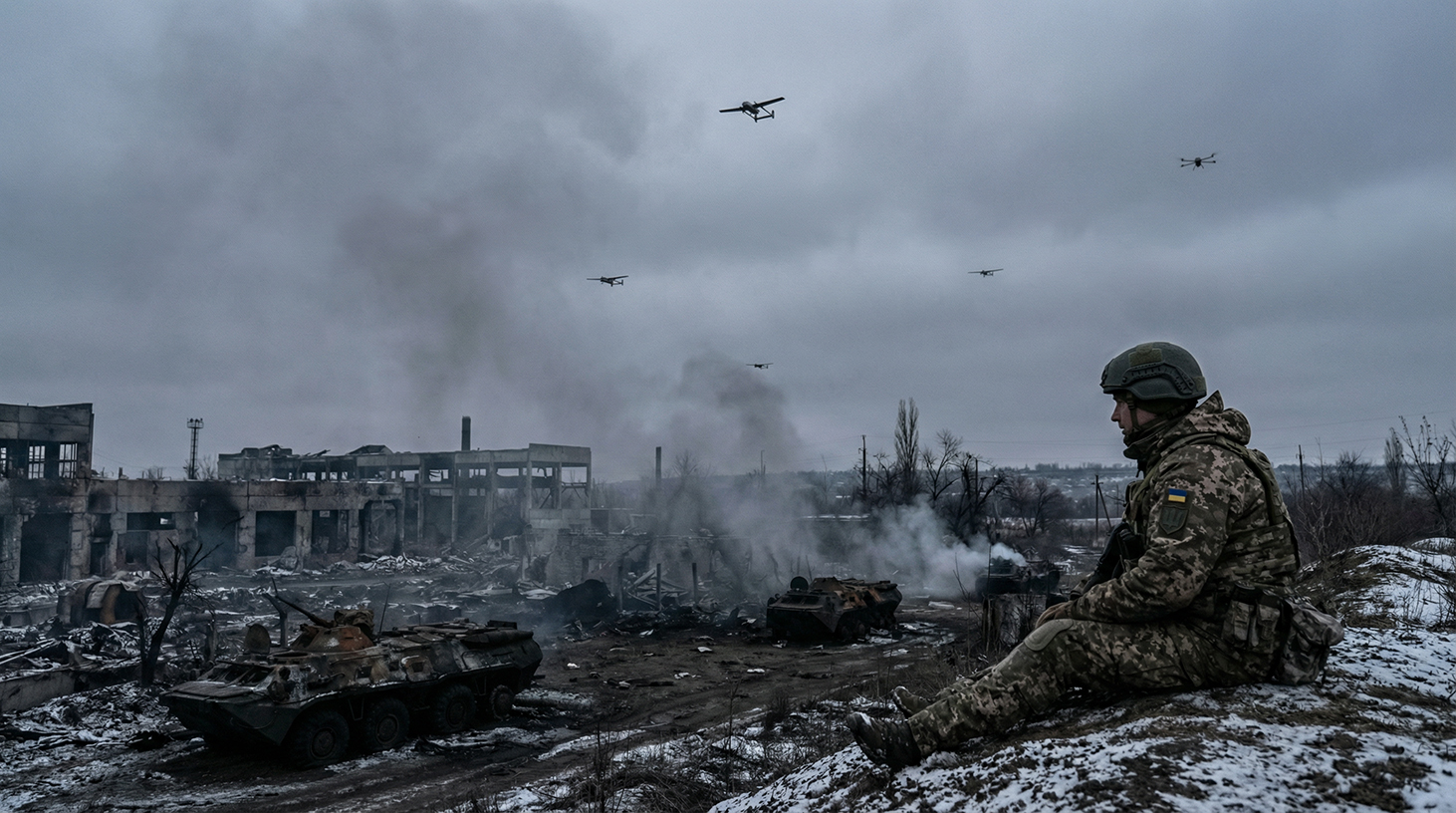
Four years of war and no end in sight: Analysis of the Russia-Ukraine front – Between territorial gains and a propaganda battle – Creative image: Xpert.Digital
Attack on NATO? What's really behind the threatening "Estonia scenario"?
The gradual hemorrhage: Military experts warn of a grim worst-case scenario in the Ukraine war
Surprising turn of events on the front: Why Ukraine is suddenly gaining ground again
Four years after the Russian invasion of Ukraine, the conflict stands at a paradoxical turning point. While Kyiv makes surprising territorial gains in the spring of 2026 and successfully disrupts large-scale Russian counterattacks, Moscow's arms production machine is running at full throttle on an unprecedented scale. In the thick fog of propaganda, astronomical casualty figures, and potential NATO threat scenarios—such as a much-discussed attack on Estonia—it is becoming increasingly difficult to separate stark facts from psychological warfare. Is Russia truly on the verge of collapse due to its immense losses, or is Europe knowingly heading toward a strategic worst-case scenario? This comprehensive assessment examines the military, industrial, and political realities in March 2026 and demonstrates why Europe's race against time must be waged with the utmost urgency.
Related to this:


Between territorial gains and propaganda battles: What's really happening at the front?
February 24, 2026, marked the fourth anniversary of Russia's invasion of Ukraine. It is a war that has left the Western world in a state of strategic exhaustion and analytical confusion. Reports of Ukrainian counterattacks and Russian arms build-ups, of peace talks and NATO threat scenarios—Estonia is said to be Russia's next target!—alternate at a pace that makes objective assessment increasingly difficult. This article attempts a sober evaluation of the military, strategic, and political situation in March 2026.
The front in March 2026: Ukraine regains ground for the first time since 2023
The most important military news of recent weeks is one that threatens to disappear amidst the daily headlines about Russian missile attacks: Since mid-February 2026, for the first time since the counter-offensive of summer 2023, Ukraine has recaptured more territory than it lost to Russia during the same period. This is not a symbolic territorial gain, but an operationally relevant result that the Institute for War Studies (ISW), in its analysis from March 2026, classified as tactically, operationally, and strategically significant.
Specifically: In the southeastern Ukrainian region of Dnipropetrovsk, where Russian forces had been advancing toward the strategically important town of Andriivka since the end of 2025, the Ukrainian army conducted a coordinated counter-offensive, combining two simultaneous attacks toward Hulyaipole and Oleksandrivka. According to the Ukrainian General Staff, more than 400 square kilometers have been recaptured, while the International Security Assistance System (ISW), in its cautious mapping, estimates at least 279 square kilometers since January 1, 2026. According to Ukrainian sources, the Dnipropetrovsk region is now almost entirely back under Kyiv's control.
The strategic importance of counterattacks
What makes these territorial gains significant beyond their purely cartographic dimension is their impact on Russia's operational planning. The ISW assesses the Ukrainian counterattacks as a direct attack on Russia's preparations for an expected spring offensive in 2026. Russian forces, which had been concentrated and prepared for a planned spring offensive, had to be withdrawn for defense. According to the ISW's assessment, plans for further advances toward Zaporizhzhia and Donetsk had to be at least revised, if not partially abandoned.
Ukrainian President Volodymyr Zelenskyy has publicly expressed doubts about the strength of the expected Russian spring offensive. According to Ukrainian assessments, Russian forces are insufficient to launch the attack as planned. The attack plans do not correspond to the actual position of Russian troops. These are statements driven by self-serving propaganda – but they align with the independent analysis by the International Security Institute (ISW).
Russia's resource equation: Unlimited losses over time
Despite Ukraine's territorial gains, it would be a mistake to overestimate the structural situation. Russia even slightly accelerated its territorial advance during 2025: In 2024, Moscow conquered approximately 3,500 square kilometers of Ukrainian territory, and by 2025 this figure had risen to about 4,500 square kilometers. The proportion of Ukrainian territory controlled by Russia increased from 18.52 percent at the end of 2024 to 19.24 percent at the end of 2025.
This advance is being bought at an extreme cost in lives. According to Ukrainian and NATO figures, Russia lost around 30,000 soldiers in December 2025 – killed, wounded, and missing – a figure that shows a slight upward trend after earlier months of the year with losses of approximately 29,000 soldiers. This pattern continued into January 2026. Adding together Ukrainian and Russian casualties, the total number of deaths on both sides, according to projections by the Center for Strategic and International Studies, already exceeds 250,000 to 325,000 soldiers since the start of the war. This is sixteen times the total number of victims of the entire First Chechen War.
The cumulative Ukrainian report of Russian losses (killed and wounded) from March 1, 2026, puts total Russian losses since February 24, 2022, at approximately 1,267,730 soldiers. This figure is Ukrainian propaganda disguised as statistics—its methodological basis is unclear—but it is roughly in line with independent estimates based on obituaries in Russian media.
Russia's arms machine: Mass production in the drone age
Anyone who believes that heavy losses will bring Russia to its knees overlooks the industrial foundation on which Moscow is waging its war. Since 2021, Russia has radically restructured its military-industrial complex. The production of artillery ammunition has increased more than 17-fold compared to 2021. NATO Secretary General Mark Rutte summarized the situation in remarkably direct language: Russia is reorganizing at a speed unprecedented in recent history and produces more ammunition in three months than the entire NATO alliance does in a year.
Particularly worrying is drone production. Ukrainian Commander-in-Chief Oleksandr Syrskyi stated that Russia's current production capacity is 404 Shahed drones per day – with the long-term goal of increasing this capacity to up to 1,000 per day. Forecasts for 2026 predict over 50,000 Geran attack drones, almost 1,000 ballistic missiles (including North Korean imports), and 2,500 to 3,000 cruise missiles. The attack on Ukraine on March 14, 2026, in which Russia deployed almost 500 drones, missiles, and cruise missiles, demonstrates these capabilities in practice.
Hub for Security and Defense - Advice and Information

Hub for Security and Defense - Image: Xpert.Digital
The Security and Defence Hub offers expert advice and up-to-date information to effectively support companies and organizations in strengthening their role in European security and defence policy. Working closely with the SME Connect Defence Working Group, it particularly promotes small and medium-sized enterprises (SMEs) that wish to further develop their innovative capacity and competitiveness in the defence sector. As a central point of contact, the Hub thus creates a crucial bridge between SMEs and European defence strategy.
Related to this:
Russia's true strategy: Why the West is dangerously underestimating the situation
Media reality and military logic: Why Russia is not finished
A recurring narrative in Western media and political circles is that Russia is running out of steam. This is a desirable scenario, but a misleading assessment. Analysts from the Federal Agency for Civic Education and independent research institutes paint a more nuanced picture. Russia still has the option of forced mobilization, which—despite immense domestic political costs—can replenish its troop reserves. Moscow could also pause land offensives at any time and concentrate on long-range bombing raids to consolidate losses before launching another attack.
Russia's strategic calculations are not geared towards a swift military victory. They aim for erosion: Ukrainian losses are intended to be harder to replace than Russian ones. If Kyiv eventually lacks sufficient soldiers and equipment to hold the front, it will collapse even without a decisive Russian breakthrough. This is the realistic worst-case scenario that NATO analysts are discussing: not a defeat through overrunning, but a gradual hemorrhage.
Related to this:
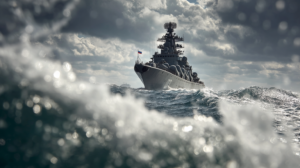
The Estonia scenario: Real threat or strategic psychology?
Few headlines resurface as regularly as warnings of a Russian attack on Estonia or other Baltic NATO states. Most recently, in the fall of 2025, Russia invaded Estonian airspace with three fighter jets – an incident that triggered consultations under Article 4 of the NATO Treaty. The reaction was symbolically strong, but strategically unambiguous: provocation, yes; attack, no.
The Estonian Foreign Intelligence Service (FIS) issued a clear assessment in its February 2026 annual report: Russia does not intend to launch a military attack against a NATO member state this year or next. At the same time, the FIS emphasizes that Russia is actively rearming and replenishing its strategic artillery ammunition stockpiles – with a view to potential future conflicts, not to immediate aggression. Kaupo Rosin, Director of the Estonian FIS, succinctly stated: Despite its incompetence, Russia remains a dangerous country, and vigilance is necessary. However, panic is unwarranted.
Propaganda, reality, and the logic of information warfare
The truth behind the constant warnings: Who benefits from the talk of the next war?
Why do headlines about a Russian threat to NATO's eastern flank appear so regularly when even the Estonian intelligence service – the service with the best sources on Russia – does not expect an imminent attack? The answer lies in the structure of the information war being waged parallel to the military front.
For Ukraine, it is in its immediate interest to remind its Western partners of Russia's threat and thereby secure arms deliveries and financial support. For NATO members on its eastern flank—especially the Baltic states and Poland—emphasizing the Russian threat is a legitimate means of politically legitimizing their own arms buildup and demanding a greater troop presence from allies. For Russian state media, maintaining a latent atmosphere of threat is part of a strategy of intimidation.
This does not mean that all warnings are propaganda. Russia's airspace violations over the Baltic states are documented and strategically calculated. Research into so-called Narva scenarios—thought experiments about a limited Russian attack on the Estonian-Russian border town of the same name—is conducted by serious military analysts and is not simply dismissed as science fiction. But: It is a scenario, not an immediate intention. The difference is fundamental.
Narva scenarios refer to war games in which Russia unexpectedly occupies the Estonian border city of Narva (the largest Russian-speaking city in the EU) in order to test NATO and plunge it into an existential crisis.
The assumption is that Moscow will conduct hybrid and military operations with limited forces (e.g., a few brigades), quickly create facts on the ground, and then wait to see whether NATO will react militarily under Article 5 or shy away from action for fear of escalation – even nuclear war.
The ceasefire that never comes
In March 2026, trilateral talks were underway between the US, Ukraine, and Russia regarding a possible end to the conflict. Zelenskyy announced that a meeting scheduled for early March would be postponed due to the situation in the Middle East. This is indicative of the state of the negotiations: they exist formally, but without substance. According to the Estonian intelligence service, for Russia, peace talks are merely a tactical maneuver to continue the war under more favorable conditions—not a genuine withdrawal. Putin is obsessed with controlling Ukraine, writes the Estonian foreign intelligence service. This effectively precludes a genuine compromise that respects Ukrainian sovereignty.
Europe's race against time
For Europe, the situation is a constant strategic wake-up call. NATO is building up weapons depots on its eastern flank and developing a new defense zone with robotic technology and automated systems along the border with Russia and Belarus. Military spending in Europe is rising faster than at any time since the Cold War. Germany is discussing the reintroduction of conscription, Sweden and Finland are integrating their armies into NATO structures, and Poland is building one of the most powerful land forces in Europe.
The critical variable is time. Estonian intelligence estimates that Europe could be capable of conducting independent military action against Russia within two to three years – and that Russia wants to prevent precisely that. This makes supporting Ukraine not just a moral question, but a strategic gain in time for European self-defense capabilities. Every month that Ukraine holds out is a month in which Europe can rearm.
What the front really says
The military balance sheet for March 2026 is paradoxical: Ukraine achieves tactical successes and, for the first time in a long time, regains more territory than it loses – yet it is structurally in a weaker position than Russia because its losses are harder to replace. Russia suffers immense losses and cannot force a decisive breakthrough – yet it is able to industrially finance its war and operate a drone production that permanently overwhelms Ukrainian air defenses.
The war will not end in 2026. A ceasefire is conceivable, but unlikely. The most probable outcome is a continuation of the bloody conflict of attrition, in which Europe's support for Ukraine will determine whether the front can be stabilized in the autumn of 2026—or erode further. As for the headlines about Estonia: they are not noise to be ignored. But they are also not an immediate warning of danger. They are a constant reminder that what is happening in Ukraine could be only the first act of a larger drama—if Europe does not become strong enough in time.
Consulting - Planning - Implementation

Markus Becker
I would be happy to serve as your personal advisor.
Head of Business Development
Chairman SME Connect Defense Working Group
Consulting - Planning - Implementation
Konrad Wolfenstein
I would be happy to serve as your personal advisor.
You can contact me at wolfenstein∂xpert.digital or
Just call me on +49 7348 4088 965 .