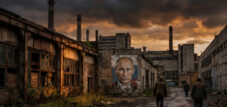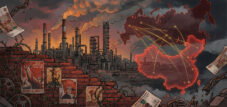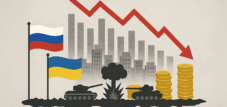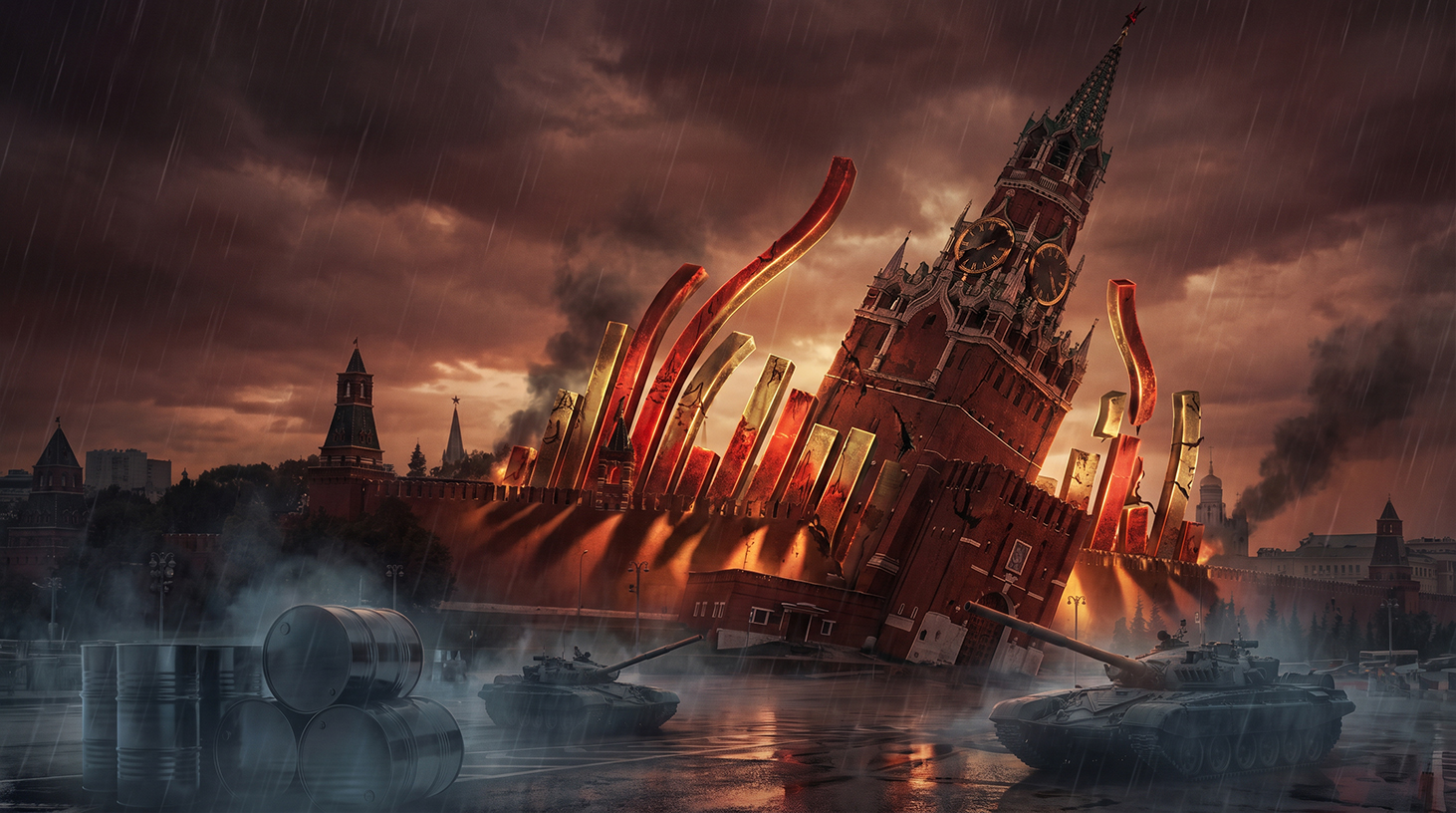
Russia: The systematic falsification of Russian economic statistics and the true state of the war economy – Image: Xpert.Digital
An empire on borrowed time: This is how catastrophic the state of Russia's economy really is
The 30 billion gap: Why the Russian economic miracle is now just an illusion
Toxic war debts: The ticking time bomb in Putin's banking system
Officially, the Kremlin presents the world with an economy that defies Western sanctions and boasts relentless growth. But behind this carefully constructed facade, the system is crumbling dramatically. Consistent reports from European intelligence agencies—including the German Federal Intelligence Service (BND) and the Swedish military intelligence agency MUST—paint a stark and alarming picture: Russia is systematically manipulating its economic data to simulate stability. From drastically inflated inflation rates and gigantic, hidden budget deficits to toxic war debts that are eating away at the banking system from within, the Russian war economy increasingly resembles a Potemkin village. Particularly explosive is the fact that the filtering of uncomfortable truths to the top has now reached a level that suggests even Vladimir Putin has lost sight of the true state of his empire. An in-depth analysis reveals why the sanctions are having an effect and whether the Russian economy is facing a gradual decline or a sudden collapse.
The Great Deception: Why Russia's Economy is Heading for Collapse – Why Russia's Figures Lie
In April 2026, the Financial Times reported on an alarming assessment by the Swedish military intelligence agency MUST (Militära underrättelse- och säkerhetstjänsten): Russia is systematically manipulating its economic data to present Western observers and its own population with an image of economic stability that bears little resemblance to reality. This finding is not new, but it comes at a particularly delicate time: Putin himself admitted for the first time in a cabinet meeting broadcast on state television that economic development was lagging behind expectations. At the same time, independent evidence is mounting that the Russian economic model is structurally unsustainable.
The Kremlin's admission and its limited significance
It was a rare gesture of public self-criticism: In April 2026, Vladimir Putin admitted in a meeting with the government and central bank that economic development was lagging behind his own projections. For January and February 2026, the Kremlin officially reported a 1.8 percent decline in economic output. Central Bank Governor Elvira Nabiullina spoke of a "virtually continuous deterioration of external conditions.".
But even these admissions are, according to Western intelligence agencies, heavily embellished. Thomas Nilsson, head of the Swedish military intelligence service MUST, told the Financial Times that the actual economic situation was "even worse" than officially portrayed. His agency possesses intelligence indicating that Russia is deliberately falsifying key economic indicators – with the stated aim of making the West believe that the Russian economy can easily withstand the pressure of sanctions and the costs of the war.
Particularly revealing is Nilsson's assessment of the flow of information within the Russian power structure itself: "If you have created a system like Putin's, he himself may not know how bad the situation really is." This statement touches on a core problem of authoritarian systems: The systematic filtering of unpleasant truths upwards leads to even the ruler making decisions based on distorted information – a phenomenon that historians have also documented for the late Soviet economy.
Statistical manipulation as state doctrine: A historical classification
The manipulation of official economic data has a long tradition in Russia. Even in the Soviet Union, it was common practice to embellish production figures, inflate plan fulfillment rates, and classify inconvenient data. The state statistics agency Rosstat has been considered an extension of the Kremlin for years, and its independence is structurally limited.
Following the start of the war of aggression against Ukraine in February 2022, the obfuscation of economic data increased dramatically. Russian authorities have since removed almost 600 data sets from government websites. These include information on imports, exports, foreign trade, foreign exchange and gold reserves, as well as oil production figures – all indicators that would allow conclusions to be drawn about the true economic burden of the war and the sanctions.
In this context, the Stockholm Institute for Economic Research (Rosstat) published an analysis commissioned by Swedish authorities, expressing suspicion that the officially reported GDP growth of 3.6 percent in 2023 was a statistical construct – the actual development could have been between minus 1.7 and minus 10.8 percent. Rosstat has repeatedly attracted attention in recent years for unusual revisions to its initial data: figures that initially indicated significant declines were subsequently rewritten as positive values without any discernible methodological justification.
One particularly explosive detail: In 2018, Rosstat received a new head shortly after Putin had hinted at potential problems with statistical data collection. The result: The reported GDP growth for 2018 suddenly exceeded all estimates by private analysts and surprised even international financial institutions. Alexei Kudrin, former finance minister and then head of the audit office, also published his own, significantly lower estimates.
The inflation lie: Between official policy and monetary reality
One of the most glaring contradictions in Russian economic statistics concerns the inflation rate. The Russian central bank recently reported an inflation rate of 5.86 percent – a figure that, given the realities of monetary policy, is simply unbelievable.
The most important indirect evidence of this is the central bank's own key interest rate. In October 2024, the Bank of Russia raised its key interest rate to 21 percent – the highest level since 2003. No rationally acting central bank would maintain such a high key interest rate if the actual inflation rate were below 6 percent. Key interest rates primarily serve to combat inflation; a rate of 21 percent is a monetary policy emergency measure that indicates a far higher real rate of price increases.
The Swedish military intelligence agency MUST therefore concludes that the actual inflation rate in Russia is more likely around 15 percent – closer to the key interest rate than to the official target. This figure aligns with the assessments of independent economists who analyze the structural drivers of Russian inflation: massively increased government spending on the military, the loss of Western imports due to sanctions, a severe labor shortage due to frontline service and emigration, and the resulting wage spiral.
Starting in June 2025, under pressure from a weakening economy and increasing corporate lawsuits, the central bank began gradually lowering the key interest rate. By February 2026, the key interest rate stood at 15.5 percent – still a level indicating significant price pressure problems. At the same time, Russia's foreign debt exceeded US$60 billion for the first time in 20 years.
The true budget deficit: Two intelligence agencies, one realization
One of the specific discrepancies in figures uncovered by Western intelligence agencies concerns the Russian budget deficit. Both the Swedish military intelligence service MUST and the German Federal Intelligence Service (BND) have reached the same conclusion: Russia underreports its budget deficit by approximately 30 billion US dollars.
In March 2026, the BND (Federal Intelligence Service) published its own analysis, concluding that the actual federal budget deficit for 2025 was 2.36 trillion rubles – roughly 26 billion euros – higher than officially reported. This corresponds to a real budget deficit of approximately 3.6 to 3.7 percent of gross domestic product. Independent economists, such as the Le Monde Institute, estimate that the deficit could even exceed 4.4 percent of GDP in 2026.
What lies behind this gap? On the one hand, Russia's defense spending has exploded. Officially, 13.5 trillion rubles have been budgeted for 2025, representing about 40 percent of all public expenditure. On the other hand, the Kremlin has established a system that obligates state-owned banks to grant loans to arms companies at state-set interest rates – regardless of the recipients' creditworthiness. These loans do not appear in the official budget, but they burden bank balance sheets and obscure the true fiscal cost of the war.
Financial historian and former investment banker Craig Kennedy of Harvard University described this system in a widely acclaimed study as "Russia's hidden war debts." The Kremlin has pursued a "two-pronged strategy" since the beginning of the war: in addition to the official defense budget, it finances the war through shadow loans that Russian banks are forced to grant at the Kremlin's behest, regardless of credit risk. This system, Kennedy argues, could develop into a destabilizing foundation of toxic debt—similar to the mechanism that triggered the US banking crisis of 2007/2008.
The military-industrial complex as a growth illusion
For several years, the Russian arms sector was considered the true driving force of the economy. State investments in weapons and military equipment fueled reported GDP growth and created hundreds of thousands of jobs. This model had a name that Western economists describe as apt but dangerous: "military Keynesianism.".
The problem with this model is fundamental: the product of this economic activity – tanks, missiles, ammunition – is destroyed on the battlefield. It generates no infrastructure, no productivity gains, no social value. The Russian economist Alexandra Prokopenko succinctly put it: “Russia’s economy today runs on what could be called ‘military rent’: budget allocations to defense companies that generate wages and simulate economic activity” – but the money is being used to pay for goods that are destined to be destroyed.
The first cracks in this model became visible in the fall of 2025. Wages in the Russian defense sector fell for the first time since the start of the invasion—a new development indicating a slowdown in military expansion. Russian Deputy Industry Minister Vasily Osmakov had already spoken in March 2025 of a "turning point" reached by the war economy. The demand for additional labor in the defense sector fell to a record low since the start of the war by August 2025.
The situation at Promsvyazbank (PSB), the main lender to the Russian defense industry, is particularly telling. It reported a loss of 19.2 billion rubles – around 220 million euros – for 2025, after having to set aside 300 billion rubles for non-performing loans. Loans to defense companies totaled over 200 billion US dollars, representing more than 23 percent of all Russian corporate loans. A Kremlin-affiliated institute, the Centre for Macroeconomic Analysis and Short-term Forecasting, has already spoken of a "banking crisis.".
Our global industry and economic expertise in business development, sales and marketing


Our global industry and economic expertise in business development, sales and marketing - Image: Xpert.Digital
Industry focus areas: B2B, digitalization (from AI to XR), mechanical engineering, logistics, renewable energies and industry
More information here:
A thematic hub offering insights and expertise:
- Knowledge platform covering global and regional economies, innovation and industry-specific trends
- A collection of analyses, insights, and background information from our key areas of focus
- A place for expertise and information on current developments in business and technology
- A hub for companies seeking information on markets, digitalization, and industry innovations
Why Russia's oil boom is only a temporary lifeline
Oil revenues: Short-term buffer, structurally insufficient
A frequently used argument to defend Russia's economic strength is the reference to oil revenues. Indeed, in the months prior to this analysis going to press, Russia temporarily benefited from higher oil prices, triggered by the escalation of the Middle East conflict and blockades in the Strait of Hormuz. Russia expert Janis Kluge told ARD Tagesschau that Russia is currently receiving more than double the price for its oil compared to January and February 2026.
However, according to Swedish intelligence chief Nilsson, this upswing is structurally insufficient. To cover the budget deficit alone, the price of Russian Ural oil would have to remain above $100 per barrel for an entire year – and even longer to solve the other commercial problems. This bar seems exceptionally high given the historical volatility of oil prices.
Furthermore, structural revenues from oil and gas exports are declining in the long term. According to the Finnish think tank CREA, Russian export revenues from fossil fuels fell by 19 percent in the twelve months to February 2026 compared to the previous year – and were even 27 percent below the level before the start of the war. The most important customers, India and China, also significantly reduced their imports from Russia; India by 31 percent, China by 14 percent. Sanctions against the Russian shadow fleet and price caps are forcing Moscow to sell its oil at substantial discounts.
In December 2025, oil and gas revenues for the Russian state budget were at their lowest level since the COVID-19 pandemic in 2020. Independent economists estimated that total oil and gas revenues in 2026 could reach 7.5 to 7.8 trillion rubles – significantly below the planned target of 10.5 trillion rubles.
The structural banking problem: Toxic debt as a ticking time bomb
One of the most underestimated risks to the Russian economy lies in the banking system. Russian banks were effectively drawn into a wartime cycle: On Kremlin orders, they granted loans to arms companies at subsidized interest rates, but had to refinance themselves at significantly higher market rates. This gap – lending at 5 to 8 percent, refinancing at 15 to 21 percent – systematically generates increasing losses.
The Russian central bank itself acknowledged the problem and, in November 2025, tightened capital requirements for banks that lend to highly indebted companies. In the first nine months of 2025, the share of corporate groups with dangerously high debt levels rose from 6.5 to 10.2 percent. The central bank doubled the capital surcharges for such loan positions from 20 to 40 percent. Of the 78 largest Russian companies, 13 had an interest coverage ratio of less than one in the previous year—meaning they did not earn enough to cover their own interest payments.
According to Bloomberg, at least three major Russian banks were already seeking government support. Sberbank CEO Herman Gref admitted, "It won't be easy." In the consumer loan sector, 13.3 percent of all claims were already in the danger zone. Such a buildup of toxic debt, spreading across the entire corporate credit market, is structurally reminiscent of the preconditions for systemic financial crises.
Sanctions: Impact stronger than expected, but no quick knockout.
A central question in the Western debate about Russia's economic situation is: Are the sanctions having any effect at all? The answer, which can be distilled from intelligence analysis and independent studies, is nuanced: Yes, the sanctions are having an effect – but slowly and with a delayed impact.
The German Federal Intelligence Service (BND) stated in its analysis from March 2026: "Sanctions against Russia are having a far-reaching impact." Besides the effects on oil revenues, the sanctions primarily affect Russia where Western technology is needed for arms production and industrial plants. Russia's war economy not only runs on debt but is also structurally dependent on Chinese intermediaries to procure Western goods.
The 18th EU sanctions package, which came into force in January 2026, targeted for the first time refined petroleum products made from Russian crude oil, regardless of where they were processed. The price ceiling for Russian crude oil was lowered from $60 to $47.60 per barrel. These measures are currently only partially effective, as Turkish and Indian refineries continue to process Russian oil – but the pressure is noticeably increasing.
The logic behind sanctions is one of gradual hemorrhaging: they do not prevent an immediate economic collapse, but they further restrict the Kremlin's room for maneuver with each month of war. The arms sector slows down, banks accumulate toxic loans, oil and gas revenues shrink structurally, and inflation erodes the population's purchasing power.
The two-way scenario: gradual decline or sudden shock
Thomas Nilsson, head of Swedish military intelligence, formulated the future prospects for Russia's economy in unusually clear terms: The Russian economy will inevitably go through one of two scenarios – either a long-term decline or a sudden shock. In both cases, Russia will "continue to slide in a downward spiral towards financial catastrophe.".
The scenario of gradual decline is more likely: Oil revenues are falling structurally, the defense sector is losing momentum, banks are burdened by non-performing loans, and government spending is financed by rising taxes. The value-added tax is set to increase from 20 to 22 percent, and the 2026 defense budget has been officially reduced slightly—although national security spending increased at the same time, so the effective decrease amounts to only 0.6 percent.
The scenario of a sudden shock is less likely, but not impossible. A sustained decline in oil prices below the break-even point for the Russian budget, combined with a banking crisis and a loss of confidence in Russian government bonds, could trigger a chain reaction. The systemic nature of the problem, as Nilsson emphasizes, lies precisely in the fact that no one—not even Putin himself—knows the full extent of the economic fragility because the system operates on the basis of falsified data.
In his study, Harvard economist Kennedy pointed to a structural parallel with the 2008 US financial crisis: Back then, too, systemic risk was concealed for years through misleading accounting tricks until the entire system collapsed within a few weeks. The difference: In the US, it was private market participants, while in Russia, the state acts as the central orchestrator of the concealment.
War economy as a self-destruction machine
The deepest structural contradiction of the Russian economic model lies at its core: an economy cannot grow by producing goods that are subsequently destroyed on the battlefield. Nilsson put it succinctly: "It is not sustainable growth if you produce material for war that is then destroyed on the battlefield."
The Washington-based Center for Strategic and International Studies estimated Russian military casualties by early 2026 at 1.2 million, including 325,000 killed. Every soldier killed or permanently wounded also represents an economic loss: as a worker, as a consumer, as a taxpayer. Millions more Russians have left the country since 2022. The long-term demographic and human capital consequences of the war will burden Russia's economic potential for decades.
According to an analysis by the magazine "Pragmaticus," Russia's economic model of a war economy rests on three interconnected cycles: a fiscal system that directs around 40 percent of the budget to defense, a financial cycle that transforms private deposits into war loans via government bonds with interest rates of up to 18 percent, and an industrial network that binds entire regions to arms production. All three cycles are structurally unprofitable—they can only be sustained through continuously increasing government revenues or growing debt.
The credibility problem: When the liar lies to himself
Ultimately, this leads to an economic policy insight of systemic significance: governments that falsify their own statistics lose, in the long run, the capacity for rational economic policy. When inflation data is manipulated, monetary policy sends the wrong interest rate signals. When budget deficits are concealed, the informational basis for sound fiscal policy is lacking. When industrial production figures are inflated, the state invests in supposed strengths that are not actually strengths.
The Soviet model failed precisely because of this phenomenon: the planned economy ultimately produced not for needs, but for statistics. Russia is repeating this pattern, this time under the conditions of a globally interconnected market economy with obvious anomalies – a key interest rate of 15 to 21 percent with officially low inflation, an arms sector that is posting losses despite being considered an engine of growth, and a banking system that is structurally drifting toward crisis, while the state maintains its position of stability.
The dual analysis by the BND and MUST thus provides not only an assessment of the Russian economic situation – it also contributes to the theory of informational state failure under authoritarian regimes. Those who falsify their own figures not only lose credibility externally, but also their ability to orient themselves internally. In a system where truth has become a danger and lies have become state policy, economic policy becomes a blind flight.
The fact that this blind flight is taking place on borrowed time – supported by high oil prices that could fall again at any time, and a banking system that is slowly but surely buckling under the weight of its hidden war debts – does not make Russia's situation any less, but more dangerous.
Your global marketing and business development partner
☑️ Our business language is English or German
☑️ NEW: Correspondence in your native language!

Konrad Wolfenstein
I and my team are happy to be available to you as your personal advisor.
You can contact me by filling out the contact form here wolfenstein@xpert.digital:or simply call me at +49 7348 4088 965. My email address is
I'm looking forward to our joint project.