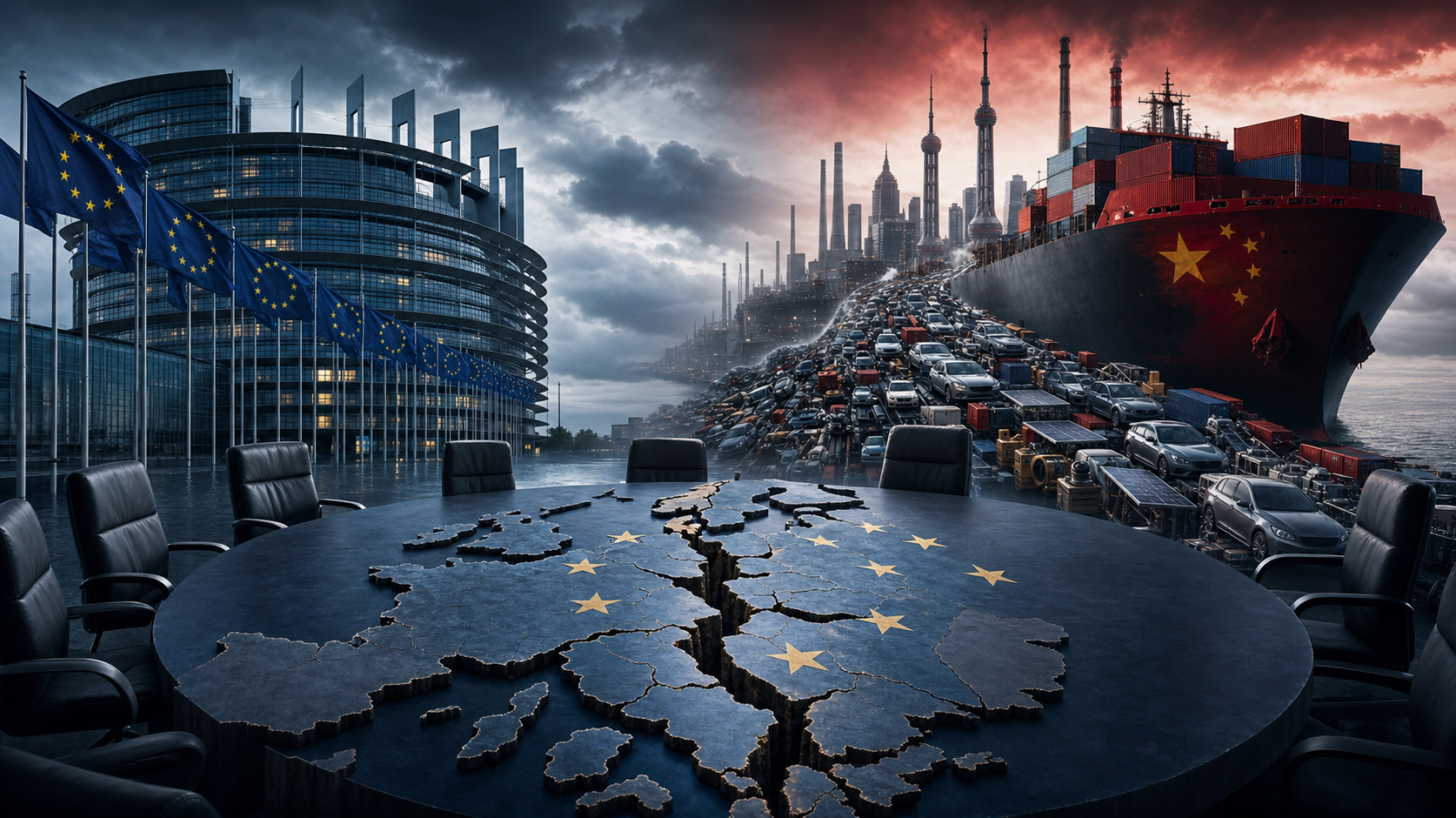
China's export power and Europe's divisions: How the EU is caught between self-assertion and internal gridlock – Image: Xpert.Digital
The billion-dollar betrayal in Brussels: How Spain is sabotaging Europe's response to the China shock
3,000 euros cheaper than VW: China's master plan to destroy Europe's car industry
Europe's new "trade bazooka": With this secret plan, the EU wants to stop Beijing's export flood
The European economy is under unprecedented pressure. A massive, state-subsidized "China shock" is flooding the continent with electric cars, solar panels, and industrial goods at prices that domestic manufacturers simply cannot match. While Brussels attempts to protect Europe's industrial backbone with new tariffs and an unprecedented "trade bazooka," a fatal problem is emerging at the highest political levels: European unity is crumbling dramatically. Member states like Spain are breaking ranks, becoming entangled in a fatal double game with Beijing and torpedoing joint protective measures. Caught in the middle of this geopolitical vice is Germany – as the EU's largest net contributor and a traditional export nation, the country faces the painful end of its current business model. This in-depth analysis shows why Europe's response to China's export power requires far more than just tariffs and how internal gridlock threatens the strategic independence of the entire continent.
When your own table wobbles before your opponent even sits down
The structural imbalance: How China is systematically flooding the world market
To understand the current state of the European economy, one must first grasp the scale of what economists now unequivocally call the "China shock." In 2025, the People's Republic exported goods worth a record 3.8 trillion US dollars, an increase of 5.5 percent compared to the previous year. Exports to Germany alone rose by 10.5 percent. What at first glance reads like ordinary trade data, upon closer inspection is a fundamental attack on the industrial backbone of Europe.
The pattern of this export offensive is no coincidence. For years, China has been massively using state subsidies to promote selected industrial sectors, including electric vehicles, wind turbines, solar panels, and rail vehicles. According to studies by the Kiel Institute for the World Economy, industrial subsidies in China are three to nine times higher than in comparable EU and OECD countries. The result is structurally distorted competition: Chinese manufacturers can offer products at prices that European competitors simply cannot produce profitably without state support. Even at the beginning of the debate, a Chinese electric car from BYD, after several price reductions, was already around €3,000 cheaper than the comparable VW ID.3 model. Solar panels manufactured in China are 20 to 30 percent cheaper than European products.
The trade balance between the EU and China has taken on a worrying dynamic. For every container of EU goods destined for China, there are currently three and a half containers of Chinese goods destined for the EU. The situation has become particularly dramatic in the automotive sector, the heart of European industrial heritage: EU exports of cars and car parts to China fell by 34 percent in 2025 compared to the previous year, to €16 billion. Compared to the historic peak of almost €30 billion in 2022, this represents a decline of over 54 percent to just €13.6 billion. For Germany, China is now only the sixth most important export market for vehicles. Mechanical engineering has overtaken the automotive industry as the most important export sector to China – a quiet structural shift that reveals the full extent of Germany's dependence on and vulnerability to Beijing.
Related to this:

Brussels' response: Between reaction and strategic calculation
The European Union did not react passively to this development, but neither did it act with the decisiveness that many European industry associations had demanded. The first truly visible step was the initiation of an anti-subsidy investigation against electric vehicles from China in October 2023, which resulted in the implementation, from October 2024, of graduated special tariffs ranging from 7.8 percent for Tesla to 35.3 percent for the state-owned company SAIC, in addition to the regular import tariff of ten percent. These tariffs are in effect for five years.
The EU Commission's approach follows a deliberate logic of proportionality. Unlike the US, which imposed a blanket 100 percent import tariff on Chinese electric cars, Brussels opted for a differentiated approach, depending on the Chinese manufacturers' willingness to cooperate and the proven subsidy damage. This differentiation is politically astute because it keeps negotiating options open, but it also raises the question of whether it provides sufficient protection.
In parallel, the EU is developing a broader range of instruments. The European Commission worked until mid-2026 on plans to extend trade defense measures to entire industrial sectors, instead of limiting them to individual products or companies. A new sector-wide protection mechanism is intended to make it possible to protect entire industries, such as chemicals, metals, and clean technologies, with countervailing duties. At the same time, a flat tariff of three euros on low-value online packages is to be introduced from July 1, 2026, with the aim of regulating the booming direct-to-consumer shipping business of Chinese platforms like Temu and Shein. EU Trade Commissioner Maroš Šefčovič succinctly summarized the EU's strategic course: not a confrontational approach, but a rebalancing. Industry Commissioner Stéphane Séjourné, for his part, called for the extension of protective tariffs to entire sectors.
At the beginning of 2026, a compromise also emerged in the previously contentious electric vehicle tariff dispute. The EU Commission presented guidelines according to which Chinese manufacturers could adhere to minimum prices for their vehicles sold in Europe instead of paying tariffs. These minimum prices would have to correspond either to the previous price including applicable tariffs or to the selling price of comparable, unsubsidized models manufactured in the EU. China described the move as a healthy development in trade relations.
The EU's power instruments: What Brussels has in its toolbox
To understand European trade policy, one must be familiar with the range of available instruments, because the EU is by no means defenseless. By the end of 2025, the EU had imposed 172 anti-dumping and anti-subsidy measures, over three-quarters of which targeted Chinese companies. This arsenal ranges from classic countervailing duties and the exclusion of subsidized companies from public tenders to more far-reaching instruments.
The so-called Anti-Coercion Instrument (ACI), adopted in 2023, is considered a European trade bazooka. It allows the EU to take retaliatory measures against third countries that exert economic pressure on individual EU member states to force a change in policy. Ten possible countermeasures are provided for, ranging from import restrictions and investment limitations to measures protecting intellectual property. So far, the instrument has not been used, but its deterrent effect is already evident.
The International Procurement Instrument (IPI) complements this arsenal by allowing bidders from third countries to be excluded from EU tenders or given lower ratings if these countries do not grant EU companies comparable market access. In doing so, the EU closes an asymmetry that has long disadvantaged European suppliers: European companies participated in Chinese tenders under difficult conditions, while Chinese state-owned enterprises participated unhindered in European procurement procedures.
In addition, there is the regulation on subsidies for third countries, which allows the Commission to block company takeovers or exclude bidders if they have received more than €50 million in aid from non-EU governments in the past three years. China, for its part, has reacted to these developments by launching its own investigation into EU practices in subsidy investigations – a sign that the power struggle has intensified.
The June 2026 summit: Big agenda, divided group
Against this backdrop, the EU summit in Brussels in June 2026 could have been a historic moment. Chancellor Friedrich Merz had already pushed through his long-standing desire that the meeting begin with economic and competitiveness issues. Even though Merz phrased his remarks diplomatically, he left no doubt about the direction: Europe could not and would not stand idly by while others failed to adhere to common rules, and it had to protect itself from distortions caused by the trade practices of other states. Merz had already visited Beijing in person in February 2026, but at the same time emphasized the value of free and fair trade relations.
There was broad agreement among EU member states that the economic imbalance with China is problematic in the long term and that action is needed. In addition to electric cars, hybrid vehicles manufactured in China were also to be included in tariff considerations at the summit in order to keep European manufacturers competitive. Even the German government, traditionally rather pro-China, had shifted towards a more critical stance, while France and the Baltic states had already been pursuing this course for some time.
This seemed to have paved the way for a truly coordinated European response. The hope was real: with the political end of Viktor Orbán's dominance in Hungary, there was a sense that greater unity was within reach. But what happened next revealed once again the structural dilemma of European unity.
Sánchez as a brake: Spain's double game between Brussels and Beijing
The figure who disrupted the summit in two ways was not the expected dissenter from the East, but Spain's Prime Minister Pedro Sánchez. Upon his arrival, he used the opportunity to make a statement in front of the cameras, a stance that many of his counterparts viewed as sabotage: China was a potential ally, and Europe had to adopt a pragmatic approach in its dealings with Beijing. There was no stance against dumping prices or distortions in state subsidies; instead, he employed a rhetoric of rapprochement that undermined the painstakingly achieved consensus.
Sánchez's stance is not spontaneous, but the result of a deliberate bilateral policy shift. He has visited China three times in just a few years and positioned Spain as a mediator between Beijing and Brussels. In April 2026, during a visit by Xi Jinping, he concluded 19 bilateral agreements with China and announced a strategic dialogue. The economic context is clear: Chinese companies have invested billions in Spain, including a CATL battery factory and a green hydrogen production plant by Envision. Before the vote on EU tariffs on Chinese electric cars, Spain abstained in the crucial vote after Beijing made investment commitments. China's carrot-and-stick strategy toward European capitals is therefore working, and Spain is its most prominent example.
What makes this dynamic so explosive is its systemic dimension. When China rewards individual EU member states with investments and market access in order to undermine European common policy, a structural incentive to defect from the collective framework is created. Beijing doesn't need to overwhelm European institutions; it suffices to draw a sufficient number of member states into its orbit with asymmetric bilateral offers to create blocking capacity in Brussels. Sánchez is not alone in this logic; he is merely the most visible actor in a widespread pattern.
Unfair subsidies and overcapacities: The economic model behind the export boom
To understand the trade policy debate beyond the headlines, it is worth examining the structural foundations of the Chinese economic model that generates the flood of EU exports. For years, China has pursued a policy of targeted support for strategic industries that goes beyond what is considered permissible state intervention in Western market economies. The five-year plans define key sectors that are systematically promoted through cheap loans from state-owned banks, direct subsidies, tax breaks, favorable energy prices, and regulatory backing.
The result is an industrial overcapacity problem. When state-subsidized companies operate not primarily according to market-driven profit logic, but rather according to centrally planned employment and growth targets, a production volume arises that exceeds the domestic market and must be transferred to the global market. Europe has already experienced this pattern with solar modules, whose prices were driven down by Chinese overproduction to a level that forced European manufacturers to cease production. This pattern is now repeating itself with electric vehicles, wind turbines, steel, and increasingly also with machinery and chemicals.
At the EU-China summit in Beijing in July 2025, European Commission President Ursula von der Leyen made it unequivocally clear: trade relations between the EU and China had reached a turning point; with the deepening of cooperation, imbalances had also deepened, and now China had to present genuine solutions. Xi Jinping, for his part, appealed to the EU at the same meeting to keep the trade and investment market open and to refrain from restrictive economic and trade instruments – a call that documents the fundamental asymmetry in the perception of the conflict.
The EU-China summit in July 2025 highlighted the deep divisions: trade imbalances, China's stance on the war in Ukraine, and restrictions on Chinese exports of critical raw materials to the EU remained unresolved points of contention. At the same time, the European Parliament adopted a resolution on China's export restrictions on critical raw materials, an often overlooked element of China's negotiating strategy: Beijing controls significant portions of the global supply of rare earths and other key materials essential to European industry and uses this dependence as leverage.
Our EU and German expertise in business development, sales and marketing

Our EU and German expertise in business development, sales and marketing - Image: Xpert.Digital
Industry focus areas: B2B, digitalization (from AI to XR), mechanical engineering, logistics, renewable energies and industry
More information here:
A thematic hub offering insights and expertise:
- Knowledge platform covering global and regional economies, innovation and industry-specific trends
- A collection of analyses, insights, and background information from our key areas of focus
- A place for expertise and information on current developments in business and technology
- A hub for companies seeking information on markets, digitalization, and industry innovations
EU Budget 2028–34: Why Germany is fighting against Spain
The budget clash: When net contributors and recipients collide
The second debacle at the Brussels summit was as predictable as it was politically explosive: migration policy. But the more fundamental, long-standing conflict behind it is the dispute over the EU budget for 2028 to 2034. And in this dispute, Sánchez and Merz are on opposite sides.
With a negative budget balance of €13.1 billion in 2024, Germany is the largest net contributor to the European Union, both in absolute terms and as a percentage of its gross domestic product. Per capita, Germany leads the way with a net payment of €157. Spain, on the other hand, was one of the largest net recipients in 2024, with a positive balance of €2.2 billion. In April 2026, the European Parliament voted to set the EU budget for 2028–2034 at 1.27 percent of the EU's gross national income. For Germany, an ambitious multiannual financial framework means increased contributions, while for Spain it means increased transfer payments – a zero-sum conflict with clearly defined opposing sides.
In this context, the scandal surrounding Spain's use of NextGenerationEU funds takes on a particular gravity. According to reports, the Sánchez government diverted more than ten billion euros from the EU's COVID-19 recovery program: in 2024, around 2.38 billion euros flowed into the civil servants' pension fund and minimum pension supplements, and at least another 8.5 billion euros are said to have flowed into the Spanish social security system in 2025. The Ministry of Finance in Madrid confirmed this practice. The European Commission examined the legality and clarified that the payment of current pensions is generally not eligible for funding under NextGenerationEU, but acknowledged that member states could temporarily use some of the liquidity to cover other budget expenditures.
The European Taxpayers Federation described the affair as a major scandal. For the net contributor coalition led by Germany, the Spanish practice represents a fundamental problem of trust: those who co-finance hundreds of billions of euros of joint debt for a reconstruction fund not intended for current social spending must be able to expect the recipients to adhere to the agreed-upon earmarking. If, on the other hand, countries like Spain use the funds at their own discretion without facing consequences, a moral hazard problem arises that undermines the political legitimacy of future joint financing.
Related to this:
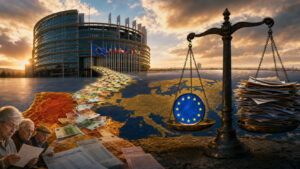
Germany's strategic situation: The largest economy in a vice
The current situation is particularly challenging for Germany because the country is under pressure from several sides simultaneously. As the largest European economy and the largest net contributor to the EU budget, Germany bears a disproportionate financial burden of European solidarity. As a traditionally export-oriented economy that has historically been heavily dependent on automobile exports to China, it is particularly hard hit by Chinese competitive pressure.
The reversal of trade flows in the automotive sector marks the end of an era. As recently as 2022, China was one of the most important sales markets for German automakers. The more than 54 percent collapse in car exports within just three years is structural, not cyclical: Chinese manufacturers have caught up with and overtaken the technological lead in electric vehicles, while German premium manufacturers clung to the combustion engine model for too long and missed the transition to electromobility. At the same time, they have no medium-term prospects in the Chinese mass market segment against price competition. The IW analysis for 2025 shows that the China shock is having an impact through shrinking exports and simultaneously rising imports.
For Merz, this represents a tightrope walk in foreign policy. On the one hand, during his visit to China in February 2026, he was keen to emphasize economic cooperation and promote free trade. On the other hand, shortly before the summit, he stated that Europe would not stand idly by while others broke the rules. This ambivalence is not a personal hesitation, but rather an honest portrayal of Germany's dilemma: a complete economic decoupling from China is neither realistic nor desirable, but unconditional openness is no longer tenable in light of systematically distorted competitive conditions.
Europe's strategic answer: De-risking instead of decoupling
The EU's conceptual guideline in its China policy is de-risking, a term coined by Commission President von der Leyen and now adopted by most member states. It refers to the attempt to reduce critical dependencies on China without fundamentally severing trade relations. In practice, this means: selective safeguard measures for strategic industries, diversification of supply chains for critical raw materials and semiconductors, and simultaneous openness to trade and investment in less sensitive sectors.
This strategy has an internal logic, but also its limitations. China is simultaneously a partner, competitor, and systemic rival, as the EU has officially described its strategic approach since June 2023. The problem is that these three roles cannot always be separated. A Chinese investor in Spanish solar energy is also an actor who makes Spain's government susceptible to influence on EU trade policy issues. A Chinese company operating in European infrastructure can create potential dependencies that extend beyond purely trade interests.
Europe's institutional response remains caught in the debate between different models. France leans toward a more interventionist industrial policy approach with stronger state control and more ambitious safeguards. Germany has traditionally been free-trade oriented but, faced with industrial erosion, is moving toward selective protectionism. The Central and Eastern European states value Chinese investment in their growing economies. And Spain, as demonstrated, pursues a special policy of bilateral rapprochement.
Consequences for European industry: The silent structural change
What often gets lost in diplomatic pronouncements and trade policy debates is the concrete reality behind the figures: factories closing, jobs disappearing, technological advantages eroding. Europe's solar industry has already largely fallen victim to Chinese competition, a cautionary tale that Brussels doesn't want to repeat with electric cars. The wind turbine industry is under similar pressure.
In the steel sector, the EU and the European Parliament provisionally agreed on a new safeguard system in April 2026: The annual duty-free import quotas for steel are to be reduced to 18.3 million tons, approximately 47 percent below the level of the 2024 safeguard quota, and the tariff rate for quantities exceeding the quota is to increase to 50 percent. This represents a significant shift towards safeguarding policy and demonstrates that the EU is readjusting its industrial policy priorities.
At the same time, the EU is trying to make its own production more competitive. The Clean Industrial State Aid Framework (CISAF) is intended to allow member states to provide greater support for their own industries without violating EU state aid rules. It is an attempt to avoid falling behind in the global subsidy race between China, the US with its Inflation Reduction Act, and other players.
The Orbán vacuum and the new troublemaker
A significant context for the Brussels summit was the expectation surrounding Viktor Orbán's political withdrawal in Hungary. For years, Hungary's prime minister had blocked EU decisions, softened his criticism of China, and undermined EU unity on Ukraine policy. After his resignation and the election of a new Hungarian government, the path seemed clear for greater coherence.
The summit revealed that the vacuum was not filled with unity, but with another maverick. Sánchez involuntarily assumed a structurally similar role, albeit for different political reasons. Orbán acted out of a mixture of authoritarian-nationalist calculations and proximity to Putin's Russia. Sánchez acted out of a combination of Spain's economic interests, ideological affinity for non-Western multilateralism, and the domestic political calculation of enhancing the profile of his left-socialist minority government through foreign policy independence.
Both patterns lead to the same result: The EU is structurally vulnerable to veto powers that, through unanimous decision-making in the European Council, give individual member states a disproportionate blocking effect. As long as the EU does not develop more effective majority decision-making procedures in trade policy and does not create mechanisms to reduce the bilateral economic dependence of individual members on China, this problem will persist.
Between trade and geopolitics: Why Europe's response to China requires more than tariffs
The trade policy debate on China ultimately falls short when it is reduced to tariffs and minimum price regulations. What is at stake is Europe's strategic autonomy in a multipolar world order, in which the US under Donald Trump is at least partially challenging transatlantic alliances. China is aware of this situation: Xi Jinping's call in April 2025 to stand with the EU against US tariff pressure was a clever attempt to readjust the EU-China relationship on an anti-American basis.
That Beijing made this appeal to the Spanish Prime Minister is significant. Sánchez was the first European head of government to travel to China after Trump's US tariff announcements, thus becoming the catalyst for a European rapprochement with China that Brussels explicitly did not want to pursue. Spain recently exported goods worth around €7.4 billion to China but imported Chinese goods worth €45 billion – a massive trade deficit that is by no means offset by bilateral investment agreements, but can, in fact, be structurally exacerbated by them.
A European China strategy worthy of the name must therefore address several levels simultaneously: securing strategically important industries through trade policy, reducing dependencies on critical raw materials and technologies, strengthening the EU's institutional decision-making capacity through majority voting, creating positive economic incentives for member states to make bilateral Chinese investment pledges less attractive, and finally, coherent communication with Beijing that defines clear red lines.
A long road to European trade maturity
The EU summit in Brussels in June 2026 demonstrated that Europe is still far from formulating a truly coherent and strategically sound response to China's economic challenge. The structural hurdles are real: the unanimity rule for strategic decisions, the asymmetric economic dependencies of member states, the differing industrial policy traditions of Berlin, Paris, Madrid, and Warsaw, and the fact that China has the capacity to draw individual EU members out of the collective framework through bilateral offers.
At the same time, the instruments are in place: The EU's anti-subsidy and anti-dumping arsenal is broad and is being used increasingly. The planned expansion to sector-wide protection mechanisms marks an important paradigm shift. The Anti-Coercion Instrument as a deterrent and the minimum price regulations for electric cars demonstrate that Brussels is capable of action when there is political consensus.
The crucial question is whether this consensus can be achieved if countries like Spain pursue a counter-strategy of bilateral rapprochement, thereby undermining the EU's collective negotiating space. Germany, as the largest net contributor and the most affected industrialized nation, bears a special responsibility, but also a particular temptation: The combination of economic dependence on China, domestic pressure for competitive export conditions, and the painstakingly maintained European consensus creates a political tension that explains Merz's cautiously determined phrasing. Europe's path to becoming a more mature trade policy vis-à-vis China will be long and will require both greater institutional clout and more mutual trust than currently exists.
Your global marketing and business development partner
☑️ Our business language is English or German
☑️ NEW: Correspondence in your native language!

Konrad Wolfenstein
I and my team are happy to be available to you as your personal advisor.
You can contact me by filling out the contact form here wolfenstein@xpert.digital:or simply call me at +49 7348 4088 965. My email address is
I'm looking forward to our joint project.