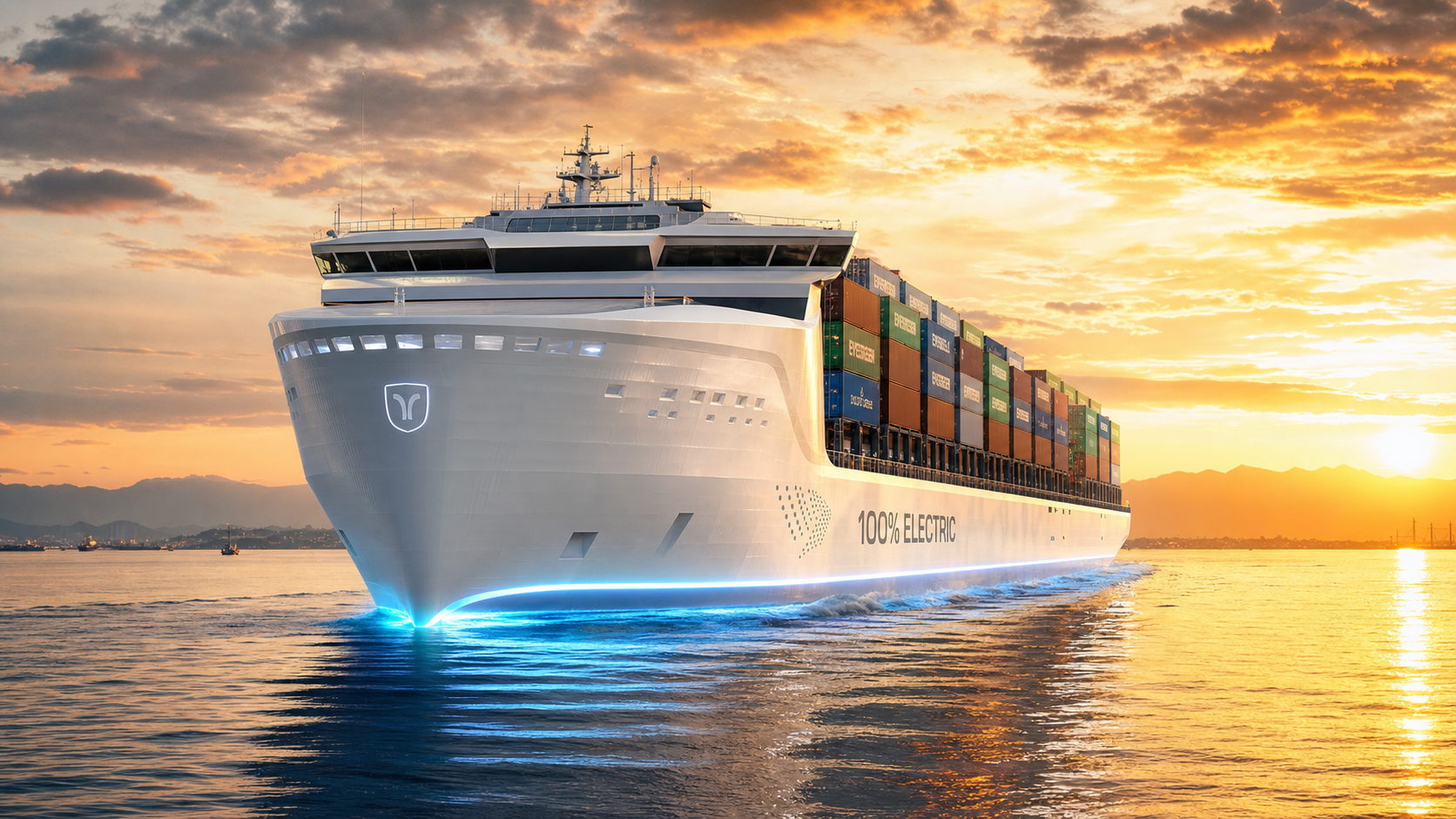
Electric ships and global logistics: When container ships sail without tanks – The quiet and slow change on the world's oceans – Creative image: Xpert.Digital
The unexpected end of the heavy oil era? This is how electric shipping is already profitable today
Battery swapping instead of refueling: The ingenious trick for emission-free cargo ships
For a long time, it was considered an immutable law of physics: cargo ships are too heavy and the distances on the world's oceans too vast for batteries to ever replace marine diesel engines. But this decades-old certainty is currently crumbling at breakneck speed. A dramatic drop in battery cell prices, innovative swappable battery concepts, and the increasingly stringent climate regulations of international shipping have marked a historic turning point. While research into fuels like green ammonia is still underway for intercontinental ocean routes, a massive transformation is already taking place on short- and medium-haul routes. Fully electric container ships and high-performance ferries are no longer experimental niche projects. They are an economic reality with the potential to forever change almost half of global container traffic.
The myth "It can't be done electrically" – and why it is currently being disproven
For decades, feasibility studies on the electrification of shipping were considered conclusive: it couldn't be done. The reasoning was physical and seemingly insurmountable. Diesel stores 40 to 80 times more energy per kilogram than a lithium-ion battery. Anyone wanting to move large ships over long distances needs enormous amounts of energy – and no technology in the world could build a battery that could even come close to matching the power of a heavy fuel oil tank. This physical fact long formed the basis for the collective judgment of an entire industry: deep-sea shipping would remain fossil fuel-based.
But judgments of this kind have a weakness: they refer to the state of the art at the time they are formulated. And technologies in an early stage of development change at a speed that is systematically underestimated by most observers. What was a physical limitation yesterday is an obstacle overcome tomorrow. The history of the lithium-ion battery teaches us this, and so does the transformation currently underway in shipping.
The crucial factor isn't what's happening on the water, but rather in the cost structure. Ship batteries, which cost around €1,400 per kilowatt-hour in 2012, recently fell below €400 – and the decline continues. BloombergNEF has projected a global average price of $108 per kilowatt-hour for 2025, a drop of eight percent compared to the previous year and a historic low. By comparison, in 2010 this figure was around $1,474, adjusted for inflation to 2025. This represents a price fall of more than 93 percent in fifteen years. BloombergNEF expects a further decline to around $105 in 2026. Goldman Sachs even anticipates that battery prices could fall below $100 per kilowatt-hour within the next few years.
This price development is changing an equation that previously favored diesel. A study published in the journal Nature Energy in 2022 precisely demonstrated this connection: as soon as the cell price falls towards US$100, over 40 percent of global container transport can be economically electrified – specifically on routes under 1,500 kilometers. This is not an academic exercise. It is an economic threshold that, given the current pace of price development, will be reached or has already been crossed in the foreseeable future.
The end of the exemption – the growing electric fleet
Anyone who has followed the headlines of the past two years will have noticed a striking increase: ships that could previously only have been built theoretically are now entering commercial operation. This development is happening at a speed that is challenging even the most optimistic forecasts.
The best-known example is the Green Water 01 from COSCO, the Chinese shipping giant. The 120-meter-long vessel, with a capacity of 700 TEU (700 standard containers), began regular service on the Yangtze River in 2024. The route covers almost 1,000 kilometers without any refueling stops. The ship has a battery capacity of 50,000 kilowatt-hours, which can be expanded to 80,000 kilowatt-hours if needed. The battery packs are housed in specially designed containers that can be exchanged by crane – the same principle that would be adopted by its successor a few months later.
In April 2026, the Ning Yuan Dian Kun, currently the world's largest all-electric container ship, entered commercial operation. Developed independently by the Shanghai Merchant Ship Design and Research Institute, the vessel is 127.8 meters long, 21.6 meters wide, and can carry 742 standard containers. Ten swappable container batteries with a total capacity of approximately 20,000 kilowatt-hours power two permanent magnet synchronous motors, each with an output of 875 kilowatts. The ship is expected to reduce CO₂ emissions by 1,462 tons annually and operate emission-free, noise-free, and pollutant-free. A sister ship, the Ning Yuan Dian Peng, has already been ordered.
The electric avant-garde is by no means limited to China. In Europe, two projects from 2026 have attracted particular attention. On March 10, 2026, the Scandlines ferry The Baltic Whale began regular service between Puttgarden in Schleswig-Holstein and Rødby in Denmark. The ship is equipped with one of the world's largest battery systems on board a ferry – ten megawatt-hours of storage capacity. The charging infrastructure in both ports allows for a full charge in just twelve minutes per crossing. In Rødbyhavn, the ship can even be charged in 17 minutes via a 50-kilovolt cable with a power output of 25 megawatts. While this ferry also has diesel generators for emergency operation, it runs purely on electricity during normal service.
Another significant European project comes from Norway. The Eitzen Group, with government funding from the innovation fund Enova, has commissioned two feeder vessels, each with a capacity of 850 containers. Each ship will be equipped with a battery pack of more than 100 megawatt-hours – enough to transport containers on routes between Norway, Sweden, and Germany. Once launched, these ships are expected to be the world's largest fully electric container ships. Enova is providing a total of 362 million Norwegian kroner for the entire package of seven electric ships and four high-performance charging points.
In March 2025, the shipping company Norden-Frisia launched the first all-electric seagoing vessel under the German flag on German territory: the Frisia E-1, an electric catamaran for 150 passengers operating on the route between Norddeich and Norderney. The vessel is powered by an 1,800-kilowatt-hour battery and can be fully charged in just 28 minutes. A further innovation followed in 2026: the ship will be powered by a vehicle-to-grid (V2G) system, in which electric cars parked at the shipping company's lot, in conjunction with a photovoltaic system, will generate electricity for the ferry.
According to the Maritime Battery Forum in Norway, more than 1,000 of the world's 109,000 ships are powered by electric or hybrid propulsion – and this number is rising, as the count only captures a portion of the electric fleet. More than 460 additional electric ships are currently under construction. In 2024, the number of ships with large battery systems alone reached 944, with another 451 under construction – out of a total fleet of approximately 90,000 to over 100,000 ships.
The limits of what's possible – why the high seas will remain fossil fuel-rich
As impressive as the growth figures are, a sober assessment of the limitations is equally important. Shipping is among the most technically demanding sectors of the energy transition – and for good reason.
The fundamental bottleneck is energy density. A 1,000-ton heavy fuel oil tank provides an amount of energy that, even with the most advanced batteries, could only be replaced by a storage system of immense weight and volume. For a transatlantic container ship of the Neopanamax class, operating on routes of several thousand kilometers, a purely battery-powered strategy is simply not feasible at present – at least not without sacrificing a large portion of its cargo capacity. A rule of thumb: With current battery technology, an ocean-going vessel would have to sacrifice almost half of its available cargo space for batteries to achieve the required range. This is economically and logistically absurd.
The proportion of truly all-electric vessels in the ocean-going fleet is correspondingly small. Of the more than 1,000 ships with electric or hybrid propulsion worldwide, only a small fraction, according to available data, operate purely electrically – estimated at around 18 percent – while nearly two-thirds are hybrids. In 2024, over 130 all-electric ships were in operation worldwide, 65 of them in Europe alone. The vast majority of these ships operate on short to medium routes: around 60 percent of the electric ships launched since 2021 are designed for voyages of less than 100 nautical miles.
Engineers and companies worldwide are working to bridge this gap between local and deep-sea transport. The principle of swappable container batteries, used by both COSCO and the Chinese manufacturers of the Ning Yuan Dian Kun, is a first step: instead of charging the ship itself, the energy source is exchanged – similar to swappable batteries for e-bikes. This requires a dense charging infrastructure along the routes, meaning charged battery containers in every port. This sounds simpler than it is: behind every container port lies complex logistics, and building a global network of shipping containers requires not only technical but also political and economic coordination on a scale that no one has yet systematically pursued.
A study by Siemens Energy and the environmental organization Bellona has reached a remarkable interim conclusion: 81 percent of the world's approximately 91,000 ships are small or medium-sized and could already be converted to electric or hybrid propulsion using current technology. While this sounds encouraging, it obscures the fact that these small and medium-sized vessels represent only a fraction of the total tonnage transported. The ocean-going giants that handle the majority of global freight traffic are excluded from this finding.
Your container high-bay warehouse and container terminal experts


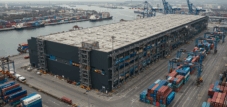
Container terminal systems for road, rail and sea transport in the dual-use logistics concept of heavy-lift logistics - Creative image: Xpert.Digital
In a world marked by geopolitical upheavals, fragile supply chains, and a new awareness of the vulnerability of critical infrastructure, the concept of national security is undergoing a fundamental reassessment. A state's ability to guarantee its economic prosperity, the provision of essential goods and services to its population, and its military capability increasingly depends on the resilience of its logistical networks. In this context, the concept of "dual-use" is evolving from a niche category of export control to a broader strategic doctrine. This shift is not merely a technical adjustment but a necessary response to the "paradigm shift" that demands a profound integration of civilian and military capabilities.
Related to this:
Electric instead of diesel: Why short-haul ships are already winning today
The regulatory foundation – what the IMO has decided and what it costs
Technological change in an industry characterized by capital intensity and long investment cycles requires reliable political frameworks. In 2023, the International Maritime Organization (IMO) took a decisive step: all 175 member states agreed on a revised greenhouse gas strategy with the goal of making international shipping carbon neutral by 2050. The interim targets are ambitious: emissions are to be reduced by 20 to 30 percent by 2030 compared to 2008, and by 70 to 80 percent by 2040.
In April 2025, the IMO followed up with the adoption of a globally binding climate agreement: Starting in 2027 – with the commitment beginning in 2028 – all ships over 5,000 gross register tons must gradually reduce their annual greenhouse gas intensity. Ships emitting above the baseline target must purchase so-called remediation units at a cost of US$380 per ton of CO₂; ships that fail to meet the more ambitious direct target will pay US$100 per ton. This emissions pricing, expected to come into force in 2027, creates for the first time an economic lever that systematically increases the cost of fossil fuel propulsion.
From an economic perspective, this is a historically significant turning point. Shipowners ordering new vessels or modernizing existing ones today must factor future CO₂ costs into their calculations. This fundamentally alters investment calculations. A ship designed for diesel today risks facing increasing levies in ten years and losing its competitiveness. Conversely, investments in low-emission technologies become more economically attractive due to the elimination of future CO₂ penalties – a mechanism that further accelerates demand for electric and hybrid propulsion systems.
The overlooked structural advantage – the energy transition reduces the task
There is an argument for the electrification of shipping that is too rarely heard in public discourse. It's not just how ships are powered that is changing; it's also what they have to transport.
Today, fossil fuels account for a significant portion of global maritime freight volume. According to figures from the Federal Agency for Civic Education, based on Clarkson data from 2022, oil and gas accounted for well over a quarter of total maritime freight volume in ton-miles, with coal as a component of dry bulk cargo making up a further share. Various studies estimate the share of coal, oil, and gas in global maritime freight volume at between 36 and nearly 40 percent – depending on the calculation method and data basis. In Germany alone, coal, crude oil, and natural gas accounted for around 15 percent of the transshipment volume in 2024.
What does this mean for the decarbonization of shipping? Every ton of fossil fuel that no longer needs to be transported across the oceans due to the ongoing energy transition reduces the task. A tanker that currently carries crude oil from the Arabian Peninsula to Rotterdam will no longer have a function in a decarbonized global economy. Not because it has been scrapped, but because the demand for its cargo will disappear. The same applies to bulk carriers transporting coal from Australia to Germany.
Shipping and the energy transition are thus inextricably linked in two ways: On the one hand, shipping itself must be decarbonized because, according to the German Federal Environment Agency, it is responsible for approximately 2.6 percent of global CO₂ emissions – and this share could rise to as much as 17 percent by 2050 without countermeasures. On the other hand, the decarbonization of other economic sectors reduces the demand for sea freight in the most fossil-intensive category. The remaining fleet that actually needs to be electrified is therefore smaller than the current fleet size would suggest.
Market dynamics and investment logic – who builds and who finances
The economic dynamics behind the electrification of shipping are complex, but clear in their basic outlines. The global market for electric ships was estimated at just under five billion US dollars in 2025 and is projected to grow to over 22 billion US dollars by 2034 – at an annual growth rate of 18.5 percent. Europe dominates this market with a share of almost 55 percent. The market for maritime hybrid propulsion systems is even larger and was valued at around 17.9 billion US dollars in 2024, with an expected annual growth rate of almost twelve percent until 2035.
The driving forces are structural in nature. Government support programs like Enova in Norway, which is supporting Eitzen with 200 million Norwegian kroner for two electric feeder vessels, create incentives for early investors who bear the risk of new technologies. At the same time, regulatory requirements, especially the new IMO Emissions Trading System from 2027, are driving up the operating costs of fossil fuel propulsion systems. In Norway, over 50 percent of newly ordered ferries in 2023 were already fully electric.
The involvement of Chinese shipyards and shipping companies is particularly revealing. China already dominates the shipbuilding market, but the country has declared the electrification of shipping a strategic national goal. This is evident not only in the types of ships being developed there, but also in the listing of the Ning Yuan Dian Kun on China's official register of green and low-carbon technology demonstrations. Behind this classification lies an industrial policy that links technological leadership with climate goals – and explains the speed of development.
The question of profitability is interesting. According to current analyses, battery-powered ships are already cheaper to operate than diesel-powered ships on routes up to 1,000 kilometers – even without factoring in environmental benefits. On short-haul routes, which constitute the majority of European coastal traffic, the economic calculation is already tipping in favor of electrification. A study by Transport & Environment concludes that by 2035, around 60 percent of European ferries could be battery-electric – often more economically than using fossil fuels.
Looking ahead – technological maturity, systemic issues and the long road to the high seas
So where does electric shipping really stand? An honest assessment leads to a nuanced result.
In the short-haul sector – ferries, river vessels, coastal traffic – electrification has moved beyond the pilot project phase. It is economically viable, technically proven, and expanding rapidly. The Scandlines ferry on the Fehmarn Belt route, COSCO's Chinese Yangtze River service, the North German Frisia E-1, and the planned Eitzen feeder vessels between Scandinavia and Germany are no longer experiments. They are commercial operations delivering real economic performance on genuine trade routes.
The potential identified in the Nature Energy study lies in the medium-range segment – routes between 500 and 1,500 kilometers. While the economic viability threshold hasn't yet been reached everywhere in this segment, it is approaching with falling battery prices. The concept of swappable battery containers, currently being tested in China and by American startups like FleetZero, could open up this sector sooner than previously expected. A prerequisite, however, is the development of a port charging infrastructure, which is currently lacking.
For deep-sea routes – 1,500, 5,000, or 10,000 kilometers – batteries remain an unrealistic solution for the time being. Here, hydrogen, ammonia, synthetic fuels, and LNG, as a less polluting interim solution, are competing for the favor of shipping companies. None of these alternatives is yet available at a price that would seriously challenge diesel – but here, too, the learning curve is driving costs down. The electrolyzer, which produces green hydrogen from renewable energy sources, and the plant that synthesizes ammonia from this hydrogen are still expensive today. In ten years, they will be cheaper.
What distinguishes shipping from other modes of transport is the length of its investment cycles. A ship launched today often sails for 25 to 30 years. Those who place an order today are not only deciding for the next decade, but are making a technological decision that will have repercussions well into the 2050s – and thus affecting emissions taxes, fuel prices, and regulatory requirements that are not yet fully foreseeable. The real challenge lies in this uncertainty: not in the question of whether electric propulsion will eventually become superior, but in the question of whether it will do so quickly enough to justify today's investment decisions.
Historically, there are good reasons for optimism. Lithium-ion battery prices have followed an exponential downward trend for over a decade, a trend that most forecasts underestimated. The drop from $1,474 per kilowatt-hour in 2010 to $108 today is not a technical footnote—it is the result of massive government investment, Chinese production scaling, technological innovation, and global competition. All these forces continue to operate. Goldman Sachs expects prices to fall by an average of 11 percent per year between 2023 and 2030.
It would be presumptuous to claim that the electrification of all shipping is a foregone conclusion. The physical limits of energy density are real, the high seas present a different technical challenge than coastal shipping, and the infrastructure task is considerable. But it would be equally presumptuous to claim that the electric container ship will remain a niche solution. Anyone who views the tankless container ship as a curiosity overlooks the systematic economic and technological transformation behind it. The Ning Yuan Dian Kun currently plies its route between Ningbo and Jiaxing, reducing CO₂ emissions by 1,462 tons annually. That sounds modest compared to a global shipping industry that emits hundreds of millions of tons of CO₂ per year. But all technological revolutions have to start somewhere.
Consulting - Planning - Implementation

Konrad Wolfenstein
I would be happy to serve as your personal advisor.
You can contact me at wolfenstein∂xpert.digital or
Just call me on +49 7348 4088 965 .
Your container high-bay warehouse and container terminal experts

Container high-bay warehouses and container terminals: The logistical interplay – expert advice and solutions - Creative image: Xpert.Digital
This innovative technology promises to fundamentally change container logistics. Instead of stacking containers horizontally as before, they will be stored vertically in multi-story steel racking structures. This not only allows for a drastic increase in storage capacity within the same area, but also revolutionizes all processes at the container terminal.
More information here: