
Agri-photovoltaics as a double harvest: The 12-step roadmap to an approved system
Xpert Pre-Release

Available in 27 languages 📢
Prefer Xpert.Digital on GoogleⓘPublished on: April 21, 2026 / Updated on: April 21, 2026 – Author: Konrad Wolfenstein
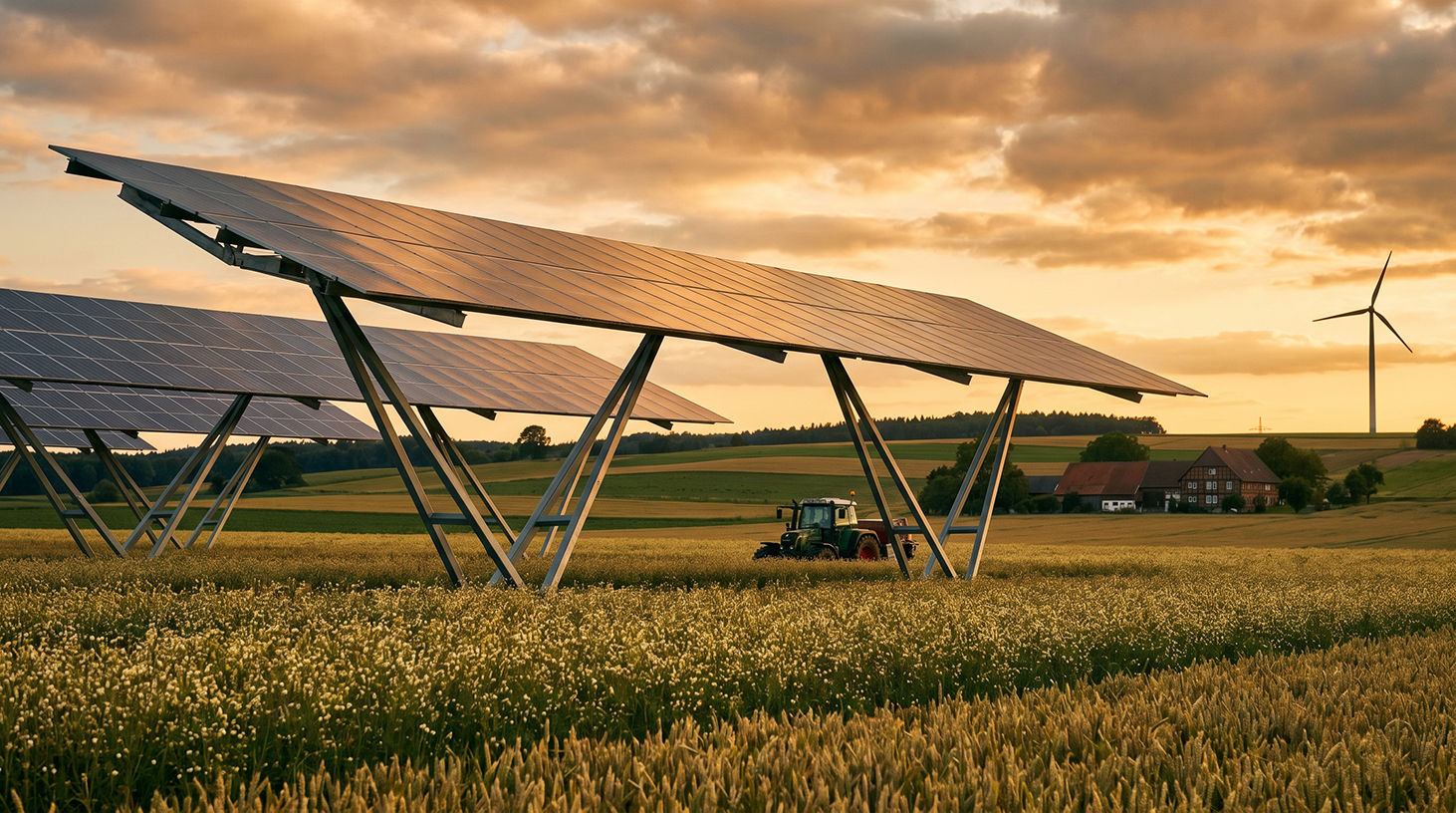
Agri-photovoltaics as a double harvest: The 12-step roadmap to an approved system – Image: Xpert.Digital
Double harvest, double profit: Why agri-photovoltaics is transforming agriculture
Avoiding permitting pitfalls: How farmers can correctly plan their agri-PV system
Millions in potential in the field: The ultimate roadmap for your agri-PV project
Agricultural land is a scarce and valuable resource in Central Europe. Traditional ground-mounted photovoltaics are increasingly diverting this vital land away from food production – a growing conflict of objectives that is sparking heated debates in both society and politics. The solution to this dilemma is agri-photovoltaics (agri-PV). It transforms traditional farmland into a state-of-the-art dual-use area: emission-free solar power is produced above, while agricultural crops continue to grow undisturbed below.
For farmers, project developers, and investors, this symbiosis holds enormous economic potential. Instead of having to choose between agriculture and energy production, two completely independent income streams can be generated on the same land. At the same time, the system protects the plants from extreme weather events and reduces water evaporation. However, the transformation from farmland to power plant is demanding. Planning an agri-PV system requires legal acumen, agronomic expertise, and the highest level of technical precision. Those who enter the permitting process unprepared quickly encounter significant bureaucratic hurdles and lose valuable time. The following guide will lead you along the way: Learn in 12 consecutive steps how to implement a privileged agri-PV project in a rural area, from the initial idea to ongoing regular operation, in a legally compliant, efficient, and highly profitable manner.
Why the field must become a power plant – and who is still resisting this change
The economic logic behind dual land use
Agri-photovoltaics, or agri-PV for short, is no longer just a technological gimmick, but has developed within just a few years into one of the most economically attractive components of Germany's energy transition. Behind the seemingly simple principle of combining agricultural use and electricity generation on the same land lies a fundamental re-evaluation of the most economically scarce resource in densely populated Central Europe: soil. While conventional ground-mounted solar installations take arable land away from food production, thus creating a socially sensitive competition for land, agri-PV resolves this conflict of objectives by making the soil doubly productive.
The economic appeal stems from several sources. A farm suddenly generates two independent income streams on the same hectare of land, with electricity revenue typically reaching several times the pure agricultural contribution margin. Added to this are risk diversification, weather protection for crops, reduced evaporation, and often even higher yields for heat-sensitive specialty crops. However, those wishing to capitalize on these opportunities must master a structured project process, as agri-PV is planning-intensive, subject to permitting requirements, and technically demanding. The following guide describes the complete path from initial concept to ongoing regular operation in twelve sequential steps for privileged projects in rural areas.
Step 1: The legal groundwork before the first screw
A fundamental prerequisite for a successful agri-PV system is the legal classification of the planned project. The central question is whether the project qualifies as a privileged project in a rural area under the German Building Code, specifically Section 35, Paragraph 1, Number 8 or Number 9. If so, the complex and often years-long planning process via a development plan is eliminated, drastically shortening the overall project timeline and significantly reducing transaction costs. A standard building permit application is still required, but the substantive hurdles are considerably lower.
The stakeholders involved in this first stage are the farmer and the project developer. Together, they assess, based on the planned plant configuration, the type of land, and the farm's operational parameters, whether preferential treatment is even a possibility. If the assessment is negative, planning permission is required, and the project becomes significantly more complex in terms of both time and cost. A positive assessment opens the door to a simplified procedure, which is crucial for the economic viability of the entire project. This preliminary legal clarification is not a mere formality, but rather the decisive factor, as it determines the speed, risk, and return potential of the project.
Step 2: From field to business model – the site-specific feasibility study
If the preferential treatment is plausible, a thorough evaluation of the specific location follows, along with the development of an initial, robust concept. This includes both a rough layout of the future facility and an initial economic feasibility study. Only if both elements are compatible is it worthwhile to proceed with the costly detailed planning of the subsequent phases.
As part of the preliminary layout, the suitability of the site is first analyzed based on topography, soil conditions, and current land use. In parallel, the preliminary technical concept is defined, i.e., the decision between elevated construction, vertical module arrays, or tracking systems. The economic evaluation clarifies whether on-site electricity consumption, feed-in tariffs, or a long-term power purchase agreement (PPA) represents the most viable revenue structure. Finally, an initial assessment of environmental sensitivity is carried out, particularly with regard to protected areas, biotopes, and potential indicator species.
This phase involves the farmer and the project developer, ideally supplemented by an experienced consultant with specific expertise in agri-PV. The result is a preferred option, either in a raised or ground-level design, as well as an initial project outline. This outline then serves as the common reference point for all further planning steps and prevents detailed decisions in later phases from inadvertently undermining the overall economic viability of the project.
Step 3: Early coordination with authorities as a risk precaution
Before significant budgets are allocated to detailed technical and environmental planning, the most important framework conditions must be clarified with the relevant authorities. This coordination is often underestimated in practice, but it is crucial in determining whether the project develops smoothly or with considerable delays. Discussions with the district office, the building authority, and the lower nature conservation authority, as well as an early grid connection inquiry with the responsible grid operator, ensure a smooth approval process.
The aim of this vote is, firstly, to officially confirm the preferential status, which, under certain conditions, can also be substantiated by recognized certification bodies. Secondly, the scope of necessary environmental impact assessments is estimated; thirdly, the precise permitting process is determined; and fourthly, an initial binding grid connection statement is obtained. Without this grid connection statement, all subsequent planning is speculative because the feed-in capacity may be significantly lower than the technically possible capacity. Careful planning of this step often reduces the risk of later delays by months and protects the project budget from unpleasant surprises.
Step 4: Species conservation as an economic lever
In the next phase, it will be determined which species protection and nature conservation requirements apply at the specific location and which expert reports must be submitted. Species protection is not an end in itself, but has a direct economic dimension, as missing or insufficient studies are the most frequent cause of permit delays and subsequent requirements.
Typical investigations include a preliminary assessment under species protection law, often referred to as a specific species protection assessment, as well as targeted mapping. Depending on the location and surrounding area, breeding birds, amphibians, reptiles, bats, insects, and migratory and resting birds are recorded, although not all species groups necessarily need to be surveyed. The results inform construction scheduling regulations to protect sensitive breeding and migration periods, as well as avoidance and mitigation measures. If these are insufficient, so-called advance compensation measures, or CEF measures in technical terms, may be required. Professional handling of these nature conservation aspects is not a cost factor, but rather an investment in planning certainty and the legal validity of the subsequent permit.
Step 5: Engineering meets agricultural economics
The project is now being developed in such detail that it is ready for approval. Two planning strands are running in parallel: the technical planning of the solar power plant and the agricultural planning for the continued farming operations. Both strands must be coordinated with millimeter precision, because this very integration is what defines agri-PV as distinct from a conventional ground-mounted solar array.
On the technical side, the substructure, including the mounting height and axle spacing, module type and configuration, as well as the core electrical components, are dimensioned. These include the transformer station, inverters, and, if applicable, a battery storage system. If the site geometry and crops require it, an irrigation and drainage concept is also developed. On the agricultural side, the management method and crop selection are defined in detail, i.e., whether the area will continue to be used as arable land, grassland, for specialty crops, or for livestock farming. Simultaneously, passage widths and working heights for the machinery used are dimensioned to ensure unimpeded operation. The sustainability of agricultural yields is demonstrated in a utilization concept, which also forms part of the subsequent building permit application.
During this phase, the project developer works closely with the farmer, supplemented by the building authority and the regional chamber of agriculture. The result is a complete design and approval plan; for privileged projects, this means a full building application including an agricultural utilization concept and module occupancy plan.
New: Patent from the USA – install solar parks up to 30% cheaper and 40% faster and easier – with explanatory videos!

New: Patent from the USA – Install solar parks up to 30% cheaper and 40% faster and easier – with explanatory videos! - Image: Xpert.Digital
The core of this technological advancement is the deliberate departure from conventional clamp mounting, which has been the standard for decades. The new, more time- and cost-effective mounting system addresses this with a fundamentally different, more intelligent concept. Instead of clamping the modules at specific points, they are inserted into a continuous, specially shaped support rail and held securely in place. This design ensures that all forces – whether static loads from snow or dynamic loads from wind – are distributed evenly across the entire length of the module frame.
More information here:
Grid connection, permitting, repowering — the critical decisions for agri-PV
Step 6: Revenue architecture and grid connection strategy
At this stage, the decisive decisions regarding grid connection and economic viability are finally made. From the initial grid inquiry to the binding grid commitment, it is determined whether and at what capacity the plant is permitted to feed into the grid. This question is by no means trivial in an increasingly congested distribution network, as grid capacity is scarce in many rural regions and expansion measures involve considerable costs and waiting times.
In parallel, the appropriate revenue model is determined. Options include the statutory feed-in tariff under the Renewable Energy Sources Act (EEG), direct marketing on the electricity exchange, or a long-term power purchase agreement with an industrial customer or a municipal utility. Each of these options has specific advantages and disadvantages regarding price security, administrative effort, and upside potential in the event of rising electricity prices. A hybrid model is also frequently chosen, in which a base volume is secured through long-term contracts and the remaining electricity volume is marketed dynamically. Simultaneously, preparations for financing begin, which, given the investment volumes in the single-digit to double-digit millions, requires early and solid communication with banks. At the end of this phase, a reliable basis is established for the building permit application, the final investment decision, and the project timeline.
Step 7: The formal process through the approval authorities
Now, all technical, agricultural, and environmental documents are compiled and submitted to the responsible authority as a complete building application. This step is essential even for privileged projects; only the substantive requirements and participation obligations are reduced. The authority reviews the documents both formally and substantively, involving other specialist departments depending on the project's scope, until the permit is finally issued.
The standard scope of an agri-PV building application includes the official site plan, the final module layout plan, a pile driving plan based on the surveyed area, and detailed construction drawings including a system cross-section. In addition, the application must include technical descriptions of the essential system components, the compiled environmental documentation, formal proof of preferential treatment under the building code, and the aforementioned agricultural land use concept. The quality of these documents significantly influences the processing time, as requests for further information from the authorities regularly extend the procedure by several months. Therefore, a precise, complete, and legally sound submission is the quickest path to approval.
Step 8: From paper to construction site
Once the building permit is granted, the project is prepared organizationally and practically for construction. This transition from the planning to the execution phase is often underestimated in practice, but it requires considerable coordination resources. The first step involves tendering and awarding the contract to a general contractor or a specialized EPC (Engineering, Procurement and Construction) provider, who will handle the turnkey construction. Given the technical complexity and the long service life of the plant, which is at least twenty years, selecting this partner is one of the most important strategic decisions.
A detailed construction schedule is then drawn up, which strictly adheres to the construction timeframes stipulated by species protection regulations and incorporates any necessary compensatory measures. Simultaneously, the construction site is set up, the components are delivered, and ecological construction supervision is activated to document compliance with nature conservation regulations throughout the entire construction phase. This supervision is not merely a bureaucratic add-on, but rather protects the client from subsequent claims by the authorities and ensures legally compliant commissioning.
Step 9: Precision work outdoors
The plant is now actually being built on site. At the same time, all permitting and environmental protection requirements are being strictly adhered to and fully documented to avoid future conflicts with the authorities and any associated delays. At the end of this phase, the technically completed plant will be ready for acceptance testing and formal commissioning.
The typical process begins with the completion of preparatory construction work, followed by precise surveying of the site. Next comes the driving of the piles, which is particularly demanding for elevated systems due to the structural requirements, as they must reliably withstand wind and snow loads for decades. The substructure is then assembled, and, if included in the design, the irrigation and drainage system is installed. This is followed by module assembly and the installation of electrical components, including the transformer station and cabling. Finally, the actual grid connection is made, in coordination with the grid operator. Each of these steps requires qualified personnel and close communication with the farmer, whose farming activities on adjacent land should be disrupted as little as possible.
Step 10: Acceptance and official start of production
After successful installation, the completed system undergoes technical testing and is officially handed over to the grid operator and the future plant operator. This process includes several separate acceptance tests, including those conducted by independent experts who certify electrical safety, structural integrity, and compliance with all relevant standards. In addition, the grid operator performs a formal acceptance test, which forms the basis for the initial feed-in of electricity.
This is followed by formal commissioning, which involves a number of official reporting obligations. In particular, timely registration in the Federal Network Agency's Market Master Data Register is mandatory, as otherwise remuneration claims may be reduced or even forfeited entirely. Only after these reports have been completed can the plant regularly generate electricity and the generated energy either be compensated under the Renewable Energy Sources Act (EEG), directly marketed, or supplied via existing supply contracts. This administrative diligence is at least as important for the economic viability as the technical quality of the plant itself.
Step 11: Regular operation as a long-term revenue generator
The plant is now operating normally, ensuring continued agricultural use and reliable electricity production. With a typical lifespan of twenty to thirty years, the operational phase is significantly longer than the entire planning and construction phase combined, thus determining the majority of the overall return on investment. Continuous monitoring, predictive maintenance, and meticulous documentation ensure ongoing tracking of yields, plant availability, and compliance with permit requirements.
Technical monitoring detects reduced yields in individual strings or defective inverters in near real-time, enabling rapid repairs. Simultaneously, ecological monitoring documents compliance with compensatory measures and the development of vegetation beneath the modules. In the agronomic sphere, crop yields and soil quality are recorded to provide scientific evidence of continued agricultural use. This wealth of data not only creates planning certainty but also provides the entire industry with empirical insights into the actual performance of different agri-PV configurations.
Step 12: Dismantling, repowering and the end of the life cycle
An often overlooked but increasingly economically relevant twelfth step is the strategic planning of the end of the life cycle. An agri-PV system is neither a permanent structure nor a disposable product, but a technical system with foreseeable renewal needs. After the original project duration has expired, operators face the decision between completely dismantling the system, repowering it with more modern, efficient components, or continuing operation at a reduced output outside of the feed-in tariff scheme.
The decommissioning obligation must be secured with appropriate guarantees as early as the initial permitting stage, which must be considered in the economic viability analysis from the outset. Repowering typically allows the existing substructure, transformer station, and grid connection to be reused, saving investment costs and enabling new project cycles with less permitting effort. From an economic perspective, this final step extends the amortization period by incorporating additional option values that are often not included in the original calculation. A forward-thinking project developer therefore considers the conditions for future repowering when selecting a site and secures corresponding lease options.
Perspectives: Agri-PV between boom and stumbling block
The economic future of agri-PV in Germany depends on several factors, the combination of which determines the pace and extent of its expansion. On the political side, the expansion of preferential treatment provisions, the stability of feed-in tariffs, and the acceleration of grid connection processes are key influencing factors. On the technical side, system costs for bifacial modules, vertical structures, and tracker systems are continuously decreasing, while efficiency levels are increasing. These two developments together mean that agri-PV is no longer seen merely as a niche application for specialty crops, but is increasingly becoming economically viable on conventional arable land as well.
At the same time, structural obstacles are increasing. Network capacities in rural distribution networks are becoming a limiting factor, qualified project developers are scarce, and competition for suitable land is rapidly intensifying. Anyone starting a project today must expect a total duration of two to three years from the initial idea to grid connection, requiring substantial upfront financing and robust project management. The twelve steps presented here are therefore not a theoretical sequence, but a tried-and-tested minimum framework for a project that aims to be financially viable, legally sound, and socially acceptable.
Double harvest as an economic profit formula
Agrivoltaics is one of the few areas of the energy transition where economic viability, business profitability, and social acceptance all point in the same direction. The dual use of scarce land significantly increases soil productivity, diversifies agricultural income streams, and relieves land of the artificial competition between food production and energy generation. For farmers, this opens up the opportunity to evolve from pure food producers to hybrid agricultural and energy entrepreneurs; for investors, it creates an asset class with an attractive risk profile; and for Germany, it offers the chance to accelerate the expansion of photovoltaics without further land sealing.
Discipline in the project process remains crucial. Those who consistently follow the twelve described steps – from the initial legal framework and detailed technical and agronomic planning to the strategically planned end of the life cycle – transform a potential conflict between food production and energy into a productive symbiosis. Agri-PV is therefore not just a technical concept, but a prime example of how intelligent planning can generate two yields from a single scarce resource.
Your partner for business development in the fields of photovoltaics and construction
From industrial rooftop PV to solar parks and larger solar parking lots
☑️ Our business language is English or German
☑️ NEW: Correspondence in your native language!

Konrad Wolfenstein
I and my team are happy to be available to you as your personal advisor.
You can contact me by filling out the contact form here or simply call me at +49 7348 4088 965. My email address is : [email protected]
I'm looking forward to our joint project.







