
Digital Twin Planner and Consultant – Digital Twin Metaverse Planning, Consulting and Implementation

Available in 27 languages 📢
Prefer Xpert.Digital on GoogleⓘPublished on: June 24, 2023 / Updated on: June 25, 2023 – Author: Konrad Wolfenstein

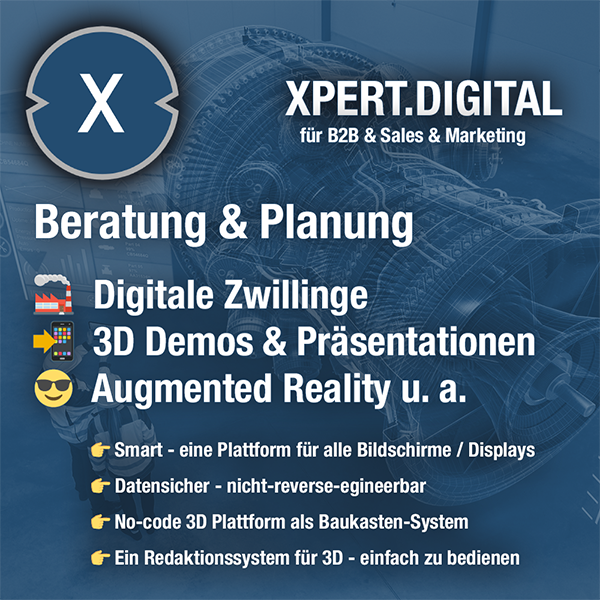
Digital Twin / Digital Twin Metaverse Planner – Image: Xpert.Digital
The diversity of opportunities in the Digital Twin Metaverse: A revolution for industry and B2B business
The digital twin and the metaverse offer a multitude of opportunities in the industrial and B2B sectors. Combining XR technologies such as Extended Reality (XR), Mixed Reality (MR), Augmented Reality (AR), and Virtual Reality (VR) with the digital twin and virtual showrooms opens up numerous possibilities:
More efficient communication and collaboration
The digital twin allows various stakeholders, such as engineers, designers, suppliers, and customers, to come together in a virtual environment and communicate more effectively. XR technologies enable them to seamlessly connect real and virtual elements, for example, to present virtual prototypes or collaborate on design projects.
Virtual training courses and training environments
XR technologies offer an interactive and immersive learning environment where employees can participate in training and education without being physically present. By using digital twins, complex machines and systems can be virtually simulated to make training and education as realistic as possible.
Improved product development
The digital twin enables companies to test products virtually before they are physically manufactured. By using XR technologies, engineers and designers can interact in a virtual environment and optimize the development process. Virtual prototypes can be tested and iterative improvements made, saving time and money.
Virtual showrooms and sales
Companies can create virtual showrooms where customers can experience products in an immersive environment. Using XR technologies, customers can view, customize, and try out products in 3D before making a purchase decision. The use of 2D matrix codes also allows customers to access further product information or place orders directly from within the virtual environment.
Maintenance and repair
Digital twins and XR technologies enable companies to provide training and instructions for the maintenance and repair of machinery and equipment. Technicians can use AR glasses or mobile devices to view instructions and overlay virtual information onto real-world objects to diagnose faults and find solutions.
Data analysis and optimization
The digital twin continuously collects data from its physical counterpart, enabling companies to comprehensively analyze and optimize production processes. By using XR technologies, data can be visualized and monitored in real time to identify bottlenecks, improve efficiency, and make informed decisions.
➡️ These opportunities demonstrate the enormous potential of the digital twin in conjunction with XR technologies and virtual showrooms in the industrial and B2B sectors. The combination of these technologies enables companies to work more efficiently, improve product development, optimize sales, and simplify maintenance and repairs.
Our Industrial Metaverse Configurator
Simply try out our universally applicable (B2B/Business/Industrial) Metaverse Configurator for all CAD / 3D demo options:

Xpert (B2B/Business/Industrial) Metaverse Configurator for all CAD / 3D data, usable on all end devices, one platform!
Related to this:
Application example of digital twins in e-commerce, industrial and B2B business metaverse
The digital twin has the potential to fundamentally transform e-commerce, industrial, and B2B sectors. In conjunction with the metaverse, it opens up diverse application possibilities that improve the customer experience, enable more efficient business processes, and create new forms of collaboration. Here are some extensive application examples for the digital twin in these areas:
E-commerce metaverse
In e-commerce, the digital twin offers the opportunity to create virtual product presentations and personalized shopping experiences. Customers can view products in a virtual environment, examine them from different angles, and even virtually try them on. Through XR technologies such as augmented reality, customers can virtually try on clothing or visualize furniture in their living spaces. The digital twin also allows for real-time access to product attributes and details and provides an interactive interface for the purchasing process.
Another advantage of the e-commerce metaverse with the digital twin is the ability to use virtual sales assistants. Customers can interact with AI-powered avatars that assist them with product selection, provide recommendations, and answer questions. These virtual sales assistants can deliver personalized recommendations based on customer preferences and behavior to improve the shopping experience and strengthen customer loyalty.
Industrial Metaverse
In the Industrial Metaverse, the Digital Twin offers a realistic representation of machines, systems, and production processes. Companies can create virtual models of their physical assets and monitor them in real time. The Digital Twin enables engineers and maintenance technicians to access detailed information about the condition of the equipment and plan preventive maintenance. Through the integration of XR technologies, technicians can be trained in a virtual environment to perform maintenance and repair tasks more efficiently.
Another application example for the digital twin in the industrial metaverse is the simulation of production processes. Companies can create virtual environments in which they can test new production lines, make optimizations, and identify bottlenecks before implementing physical changes. By integrating real-time data, companies can continuously monitor production processes and make adjustments to increase efficiency and minimize downtime.
B2B Business Metaverse
In the B2B sector, the digital twin in the metaverse enables improved collaboration between companies and their partners. Companies can create virtual meeting rooms where teams from different locations can come together to work on projects. XR technologies allow participants to share and edit 3D models, plans, and data in real time. This promotes efficient communication, shortens decision-making processes, and improves productivity.
Furthermore, B2B companies can use the digital twin to offer their customers virtual training and workshops. XR technologies allow complex products or services to be explained in an interactive and immersive environment. This enables customers to better understand the product or service and optimize its implementation or use.

Augmented & Extended Industrial Metaverse – Xpert Reality / Showrooms Agency – Planning Office
➡️ Digital twins and the metaverse offer a wide range of applications in e-commerce, industrial sectors, and B2B. By integrating XR technologies, virtual showrooms, and 2D matrix codes, companies can create personalized shopping experiences, optimize product development, improve collaboration, and make training more efficient. The digital twin opens up new avenues for companies to offer innovative solutions and strengthen their competitiveness in the digital age.
Related here:
Digital twins and the 2D matrix code - potentials and possibilities
A digital twin is a virtual representation of a real-world object, product, or process. It is a digital copy that collects data in real time and is synchronized with its physical counterpart. This data can originate from sensors, IoT devices, or other sources and enables continuous monitoring, analysis, and optimization of the real-world object.
A 2D matrix code (also called a QR code) is a two-dimensional code that stores information in the form of black and white squares. It can be captured and interpreted by mobile devices or scanners. The information contained in a 2D matrix code can be diverse, such as a web address, product information, contact details, or links to digital content.
The combination of digital twins and 2D matrix codes opens up various potentials and possibilities:
Product tracking and authentication
Integrating 2D matrix codes into the digital twin allows for the unique identification and tracking of products. Each product receives a unique code containing information about its manufacturing, supply chain, inventory, and other relevant data. This enables improved traceability and transparency throughout the entire value chain. Customers can scan the code to access product information and verify its authenticity.
Interactive product information
The 2D matrix code allows companies to provide comprehensive product information accessible via the digital twin. Customers can scan the code and view detailed product descriptions, instructions, videos, or customer reviews on their mobile device. This offers an interactive and informative experience that enhances the buying experience and builds trust.
Personalized marketing campaigns
By integrating 2D matrix codes into marketing materials or advertising campaigns, companies can provide personalized content. Customers can scan the code and access special offers, discounts, or tailored content. This allows companies to target their customers more effectively and personalize the customer experience.
Efficient data collection
2D matrix codes can be used to transfer data from the physical object to the digital twin. For example, sensor data, maintenance information, or operating parameters can be captured via the code and automatically fed into the digital twin. This enables continuous monitoring and analysis of the object and contributes to the optimization of maintenance, operation, and efficiency.
Remote maintenance and diagnostics
By using 2D matrix codes, technicians or service personnel can access the data of the digital twin to perform maintenance or repair work. The code allows them to view relevant information and troubleshooting instructions on their mobile device. This facilitates remote maintenance and diagnostics, reduces downtime, and improves the efficiency of the service process.
➡️ The combination of digital twins and 2D matrix codes opens up a wealth of potential and opportunities to improve traceability, interactivity, personalization, and efficiency across various areas. From product tracking and personalized marketing campaigns to remote maintenance and diagnostics, they offer innovative approaches to optimize the customer experience and improve business processes.
To put it simply and directly: Why does the digital twin exist and what is it used for?
The digital twin was developed to create a virtual representation of a real-world object, product, or process. It serves as a digital image and enables the monitoring, analysis, and optimization of its real-world counterpart. There are several reasons why a digital twin is needed:
Optimization of products and processes
Digital twins allow companies to optimize products and processes in a virtual environment before physical implementation. Through continuous, real-time data collection, the digital twin provides accurate information about the condition, performance, and behavior of the real-world object. This enables the detection of weaknesses, the identification of bottlenecks, and the implementation of improvements to increase efficiency and quality.
Prediction and preventive maintenance
The digital twin enables predictive analysis and maintenance. Through continuous monitoring of the digital twin, companies can detect deviations or anomalies in the behavior of the real-world object at an early stage. Based on this information, preventive maintenance measures can be planned to resolve potential problems before they lead to costly breakdowns or disruptions.
Data-driven decision-making
The digital twin provides comprehensive data about the real-world object, which can be analyzed to make informed decisions. By integrating data analytics and machine learning, patterns and correlations can be identified, providing insights into performance, user behavior, and other relevant aspects. This enables data-driven decision-making and contributes to the optimization of business processes.
Training and simulation
The digital twin enables companies to conduct training and simulations in a virtual environment. Employees can interact with the digital twin to familiarize themselves with the properties, functions, and behaviors of the real-world object. This is particularly useful in sectors like industry, where complex machinery, systems, or processes are involved. Training and simulations using the digital twin improve employee understanding and skills, reduce training costs, and promote efficient learning.
Improved customer experience
The digital twin can also benefit customers. Companies can offer customers personalized product visualizations and simulations to provide a realistic representation of the product and its features. Through the digital twin, customers can also access detailed product information, instructions, or interactive features to support their purchasing decisions and enhance their customer experience.
➡️ The digital twin is used in various industries, including manufacturing, healthcare, energy, logistics, and many more. It offers companies the opportunity to optimize their processes, increase efficiency, reduce costs, and provide innovative solutions to remain competitive.
Digital twins for prototyping across countries, borders and great distances
Digital twins offer an excellent solution for prototyping across national borders and vast distances. Traditionally, prototyping requires the physical transport of products or prototypes, which can be time-consuming and expensive. With digital twins, however, companies can create virtual prototypes and share them across different locations.
By using digital twins, development teams can access the same data and models in real time, regardless of their location. Changes and adjustments to the virtual prototype can be made in real time, and all team members involved have immediate access to the updated information.
Digital twins also enable collaboration in a virtual space. Teams can work together on virtual prototypes, provide feedback, and make changes as if they were physically in the same location. This promotes efficiency and reduces development times, as no time needs to be spent on physical shipping and coordinating meetings.
Furthermore, digital twins can be combined with other technologies such as augmented reality (AR) or virtual reality (VR) to create an even more immersive prototyping experience. Team members can view the virtual prototype in a virtual environment, analyze it, and even simulate interactions to better understand product behavior.
The use of digital twins for prototyping across national borders offers a number of advantages, including:
Cost efficiency
Transporting physical prototypes over long distances is expensive. Using digital twins eliminates these costs, as the prototype can be shared and edited virtually.
Time saving
Digital twins enable seamless, real-time collaboration. Teams can work on a prototype simultaneously without having to wait for the physical delivery of changes or feedback.
Improved cooperation
Teams can collaborate across national borders without needing to be physically present in a specific location. This facilitates collaboration among experts from different locations and promotes the exchange of knowledge.
Improved flexibility
Digital twins can be quickly updated and adapted, enabling agile prototyping. Changes can be implemented and evaluated immediately to drive product development.
Reduced risk
By using digital twins, potential errors or problems can be identified and corrected early on, even before a physical prototype is created. This reduces the risk of costly mistakes in later development phases.
➡️ Overall, digital twins offer an effective way to facilitate prototyping across national borders and vast distances. They promote collaboration, accelerate the development process, and enable cost-effective and efficient prototyping.
Prototyping with digital twins
Prototyping refers to the process of creating a preliminary model or early version of a product, system, or application to test and validate its functionality, user experience, and design concepts. It is an iterative method in which a prototype is developed, tested, evaluated, and adjusted as needed to optimize the final version.
Prototyping can be applied in various fields and industries, including product development, software development, industrial design, mechanical engineering, architecture, and many others. It serves to visualize ideas, validate concepts, and identify potential problems early on, before full implementation.
There are different types of prototypes that can be used depending on the application and objective.
Paper prototype: This is a simple and cost-effective method where the product or application is sketched or drawn on paper. It allows for rapid changes and can be used for early user testing.
Interactive prototype
This is a more advanced form of prototyping, where a functional prototype is created that simulates user interactions. This can be done using wireframes, mockups, or interactive tools to demonstrate the user experience.
3D prototype
For physical products, a 3D prototype can be created that represents the look, feel, and functionality of the final product. This can be achieved through 3D printing, CNC machining, or other manufacturing techniques.
Software prototype
In software development, a prototype can be created to demonstrate the user interface, functionality, and interactions of an application. This can take the form of wireframes, mockups, or even fully functional interfaces.
➡️ The purpose of prototyping is to gather feedback, identify potential weaknesses or areas for improvement, and verify user acceptance before final implementation. Prototyping allows developers to quickly respond to changes, iteratively improve the product, and minimize the risks and costs of a faulty implementation.

Xpert.Plus – industry expert, here with its own 'Xpert.Digital Industry Hub' in the field of mechanical engineering with over 1,000 specialist articles.

Konrad Wolfenstein
I would be happy to serve as your personal advisor.
You can contact me by filling out the contact form below or simply call me on +49 7348 4088 965 (Munich) .
I'm looking forward to our joint project.
Write to me

Xpert.Digital – Konrad Wolfenstein
Xpert.Digital is a hub for industry focusing on digitalization, mechanical engineering, logistics/intralogistics and photovoltaics.
With our 360° Business Development solution, we support renowned companies from new business to after-sales.
Market intelligence, smarketing, marketing automation, content development, PR, mail campaigns, personalized social media and lead nurturing are part of our digital tools.
You can find more information at: www.xpert.digital – www.xpert.solar – www.xpert.plus
Keep in touch









