
Strengthen people through automation: the development of human-robot collaboration in modern storage
Xpert pre-release

Language selection 📢
Published on: May 27, 2025 / update from: May 27, 2025 - Author: Konrad Wolfenstein
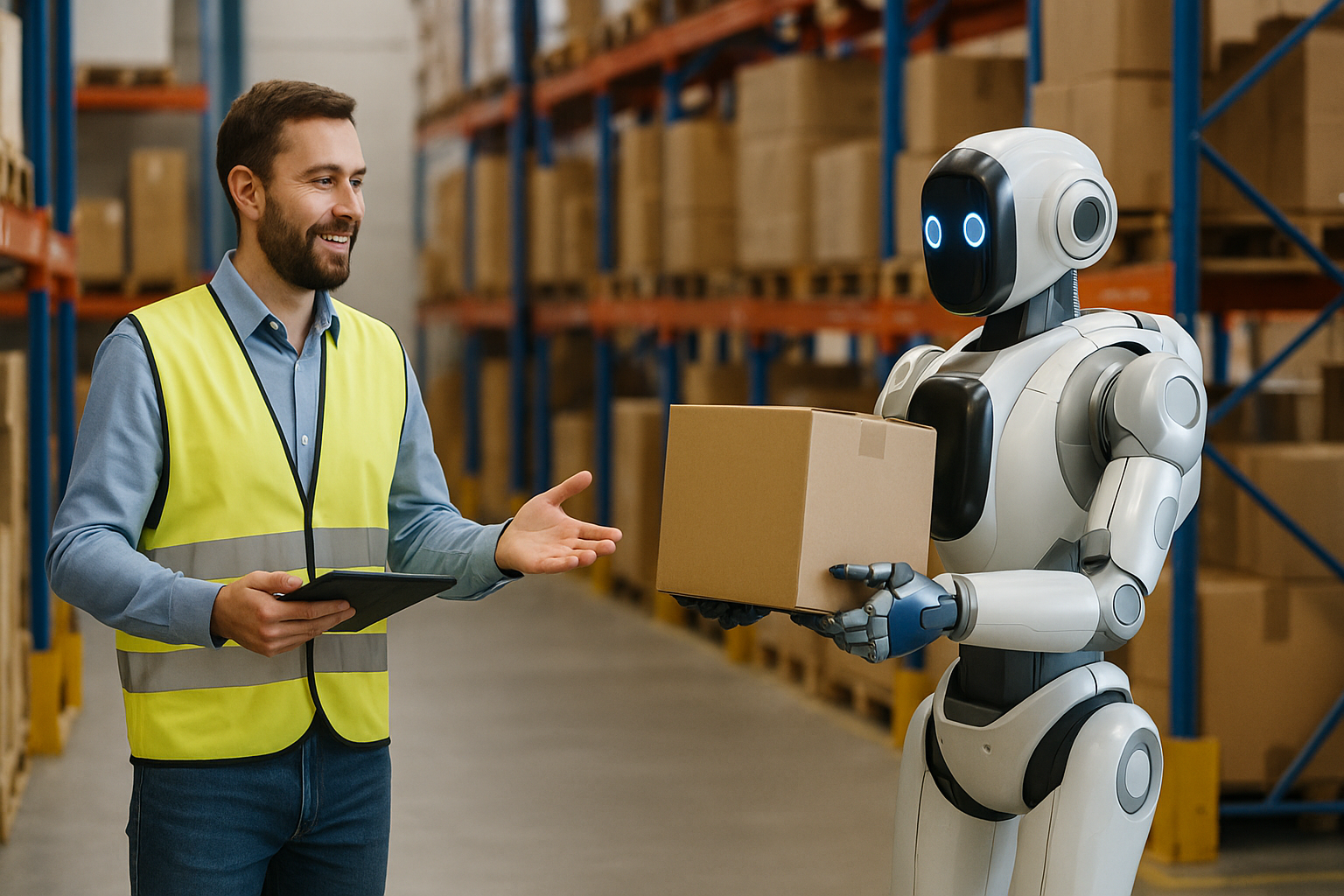
Strengthening people through automation: the development of human-robot collaboration in modern storage-Image: Xpert.digital
Hybrid warehousing: man and machine in the perfect interaction
Efficiency increase through robot -based cooperation in the warehouse
Modern warehousing experiences a fundamental change in which the cooperation between human workers and robotic systems becomes a decisive success factor. While traditional approaches either rely entirely on human work or completely on automation, it is becoming increasingly evident that hybrid models offer the highest efficiency and flexibility. This development is promoted through technological progress in robotics, artificial intelligence and sensors, which enable people and machines to act safely and productively in common work rooms.
Current challenges in warehousing
Today's warehouse landscape faces a variety of complex challenges that bring traditional approaches to their limits. One of the most critical problems is the accuracy of the inventory, which relates to how precisely the documented inventory figures reflect the actual stock in the warehouse. Inaccuracies in existing management can lead to delays in order processing, excesses or critical bottlenecks that have a direct impact on customer satisfaction and profit margins.
In addition to the accuracy problems, warehouses are faced with steadily increasing labor costs. The continuing shortage of skilled workers increases this challenge considerably, since companies are increasingly difficult to find and maintain qualified employees. This shortage of personnel not only leads to higher wage costs, but also to capacity bottlenecks that affect operational efficiency.
Adaptation to seasonal fluctuations in demand is particularly challenging. Many companies have to drastically increase their storage capacities during the high season, while overcapacities arise in quieter periods. This uneven occupancy makes planning difficult and leads to inefficient use of resources if not corresponding strategies for flexibility are implemented.
In 2025, the transport industry faces additional challenges, such as rising costs, capacity bottlenecks and persistent delivery difficulties. These external factors increase the pressure on internal warehouse logistics, more efficient and adaptable.
The synergy between humans and robots
The combination of human skills with robotic systems creates a unique synergy that compensates for the weaknesses of both sides and maximizes their strengths. People bring indispensable cognitive skills into the work process, such as critical thinking, problem -solving competence and the ability to adapt to unforeseen situations. These properties are particularly valuable for complex decision -making processes, quality control and the coping with exceptional situations.
Robots, on the other hand, are characterized by their consistency, precision and endurance. You can carry out repetitive tasks without fatigue and ensure consistently high quality. The combination of these complementary properties leads to a significant increase in overall efficiency. A study by the Massachusett Institute of Technology shows that people can reduce their unproductive times by 85 percent when they work with robots.
The advantages of this collaboration are diverse and measurable. The most important include increased speed and improved throughput, since robots can continuously work and human employees focus on value -adding activities. The precision of robotic systems leads to a significant reduction in human errors, which is directly reflected in reduced costs and higher customer satisfaction.
Automation is particularly important. Robots can lift heavy loads, carry out monotonous sorting activities and work in environments that would be stressful for humans. This not only leads to an improvement in work ergonomics, but also to reduce the risk of injury and the failures -related failures.
Collaborative robot as a gamechanger
Collaborative robots, also called cobots, represent a special category of robotic systems that were specially developed for direct cooperation with people. In contrast to traditional industrial robots who work in shielded areas, cobots are equipped with advanced security systems that enable safe interaction with human workers.
These systems use modern sensor technology to continuously monitor their surroundings and to react accordingly when people approach. The EU-financed Safelog project has developed innovative security concepts that make it possible for robots to reduce or completely stop their speed when people approach without having to interrupt the entire warehouse.
Cobots bring several specific advantages into warehousing. They significantly reduce the running paths of the employees by taking over the transport of goods between different storage areas. This enables employees to use their time more efficiently and to focus on more complex tasks that require human judgment.
Another important aspect is the ergonomic relief. By taking over severe lifting or transport work, Cobots reduce the physical stress on employees and reduce the risk of injury. This is particularly relevant in view of the aging workforce in many industrialized countries and the increasing sensitivity to workplace health.
The flexibility of modern cobots is a decisive advantage over traditional automated systems. While classic automated guided vehicles (AGV) operate on fixed, preprogrammed routes, modern autonomous mobile robots (AMR) can independently grasp their surroundings and dynamically adapt to changing warehouse routes. This adaptability makes it ideal for flexible and dynamic logistics environments.

Xpert partner in warehouse planning and construction
How autonomous systems transform warehouse logistics
Technological solutions for warehouse automation
Modern warehouse is automated by a variety of specialized technologies, which take on specific tasks and together form an integrated system. These technologies can be divided into different categories that cover different aspects of warehouse logistics.
Driverless transport systems and mobile robotics
Driverless transport systems (FTS) or automated guided vehicles (AGV) form the backbone of many automated warehouses. These unmanned systems use a combination of lasers, cameras and floor markings to move autonomously through the warehouse and to transport goods between different areas. They are ideal for applications such as inventory filling, support for picking, product processing and buffer storage.
The latest generation of these systems, the Autonomous Mobile Robots (AMR), goes one step further. These robots are equipped with advanced sensors and can independently map and navigate their surroundings. They adapt dynamically to changes in the warehouse layout and can certainly navigate between employees and obstacles, which makes them ideal for flexible and changing work environments.
Automated storage and provision systems
Automated storage and provision systems (AS/RS) revolutionize the way in which goods are stored and accessed. These systems consist of a combination of automatic warehouse shelves, shelf control units and computer-controlled systems that enable fully automatic storage and storing goods.
AS/RS systems not only maximize efficiency when storing and withdrawing, but also the use of space by enabling higher storage density. You can use the available storage space by up to 80 percent more efficiently than traditional systems. This leads to considerable cost savings, since companies may not have to invest in larger camps.
The integration of AS/RS systems with other technologies such as barcode scanners, RFID readers and merchandise management systems significantly improves warehouse management and traceability of goods. This networking enables precise inventory management and reduces the risk of errors in picking.
Goods-to-person systems
The Goods-to-Person (GTP) concept represents a paradigmatic change in picking. Instead of the fact that employees have to go through the warehouse to collect goods, automated systems bring the required products directly to the jobs of the picker.
These systems typically use automatic container stores, which are equipped with miniload shelf control devices or shuttle systems. The goods are saved in containers that are automatically transported to picking stations, where the employees take the required items. After picking, the containers are automatically brought back to their storage spaces.
The advantages of GTP systems are considerable. They drastically reduce the running paths of the employees, which leads to a significant increase in productivity. At the same time, the possibility of errors and accidents is significantly reduced because the employees remain in a controlled work area.
Strategic implementation and change management
The successful introduction of automated systems in warehousing requires more than just buying and installing technology. A comprehensive strategy requires that change management, employee integration and continuous optimization.
Automation projects transform entire work processes and therefore require a functioning change management that is developed from the start. This includes a detailed analysis of the current processes, the definition of new work processes and the training of employees for their new tasks.
The analysis of existing problems is a critical first step. Typical challenges in camps include traceability and precision problems such as excess stands and lack of references, unequal personnel distribution and irregular picking trails, unused storage capacity and low efficiency of the handling devices as well as quality problems in customer service.
The calculation of the investment return (ROI) plays a central role in automation decisions. Companies not only have to take into account the initial investment costs, but also the long -term savings through improved efficiency, reduced error quotas and lower personnel costs.
Optimization of human-robot interaction
Research to improve cooperation between humans and robots in camp has produced important insights that are of great importance for practical implementation. Studies from the Technical University of Munich and the University of Cologne show that effective human-robot teams require special management.
A central aspect is the formation of effective teams in which people and robots take over complementary roles. While robots usually stay on programmed tracks, people can spontaneously take other ways. This requires algorithms that enable adequate coordination and rescheduling.
Modern planning algorithms can manage the organization and coordination of up to 1,000 robots in a warehouse. These systems take into account both the predictable movements of the robots and the flexible routes of human employees and continuously optimize the work processes.
Security remains a critical factor in human-robot interaction. Advanced security concepts enable people to safely enter robotic work areas without having to interrupt the entire warehouse. These systems use inexpensive technologies for approximation detection, which are much more affordable than the equipment of all robots with expensive laser security scanners.
Economic advantages and ROI considerations
The economic advantages of warehouse automation are varied and measurable. Automated systems offer increased operational efficiency through faster and more precise processing of products. The ability to work around the clock ensures a constant and optimized warehouse operating, which leads to higher productivity and better responsiveness to market demand.
Improved accuracy is another important advantage. Automated systems minimize human errors and increase precision in inventory management and product selection. This prevents product losses and reduces shipping errors, which has a positive effect on customer satisfaction.
In the long term, automated systems lead to considerable cost savings. They enable better use of the storage space and maximize the storage capacity without physical extensions being necessary. By minimizing errors and improving efficiency, you also reduce the costs caused by inventory errors, rework and product losses.
Optimizing the supply chain is another strategic advantage. Automated systems rationalize the processes for incoming goods, storage and shipping, which leads to a more precise planning of the supply chain, better demand management and shorter response times.
In the case of ROI calculation, companies must take both direct and indirect advantages into account. Direct advantages include reduced personnel costs, improved efficiency and reduced error quotas. Indirect advantages include improved customer satisfaction, higher employee satisfaction due to more ergonomic jobs and improved scalability for future growth.
Technological trends that revolutionize tomorrow's warehouse logistics
The future of warehouse logistics is shaped by several technological trends that will continue to promote human-robot collaboration. Artificial intelligence and machine learning play an increasingly important role in optimizing warehouses. These technologies enable systems to learn from experiences and to continuously improve.
Digital twins will play a central role in planning and optimizing warehouses. These virtual images of real storage systems enable companies to simulate different scenarios and test optimizations before they are implemented in the real environment. The bidirectional flow of information between digital twin and real system creates a continuous feedback loop for process improvement.
The integration of blockchain technology will increase the transparency into supply chains and improve traceability. This is particularly important for companies that are subject to strict compliance requirements or handle high-quality products.
Autonomous systems such as drones are expected to play a larger role in warehouse logistics, especially with inventory and transport in difficult areas. The combination of different autonomous systems will lead to even more efficient and more flexible warehouses.
The development towards fully automatic camps will continue, with the focus on creating harmonious work environments in which people and robots work together seamlessly. This evolution will not only increase efficiency, but also create new career opportunities for workers who focus on surveillance, maintenance and strategic decisions.
Human robot collaboration: the future of warehouse logistics
The future of warehousing is not in full automation or the exclusive dependence on human work, but in the intelligent combination of both approaches. Human robot collaboration offers enormous potential to increase efficiency, improve the quality of work and increase competitiveness.
However, successful implementations require more than just technological solutions. You need a well thought -out strategy that includes change management, employee integration and continuous optimization. Companies that pursue these holistic approaches will not only achieve their operational goals, but also create resilient and future -proof camp environments.
The developing technologies such as artificial intelligence, digital twins and advanced sensors will further expand the possibilities of human-robot collaboration. At the same time, new challenges such as cyber security and the need to develop continuous qualification will arise.
Ultimately, the success of warehouse automation will depend on how well companies find the balance between technological innovation and human expertise. The future belongs to those organizations that understand that people and robots are not competitors, but a partner in creating efficient and sustainable logistics solutions.

Xpert.Plus warehouse optimization - high-bay warehouses such as pallet warehouses consulting and planning
We are there for you - advice - planning - implementation - project management
☑️ SME support in strategy, consulting, planning and implementation
☑️ Creation or realignment of the digital strategy and digitalization
☑️ Expansion and optimization of international sales processes
☑️ Global & Digital B2B trading platforms
☑️ Pioneer Business Development

Konrad Wolfenstein
I would be happy to serve as your personal advisor.
You can contact me by filling out the contact form below or simply call me on +49 7348 4088 965 (Munich) .
I'm looking forward to our joint project.
Write to me

Xpert.Digital - Konrad Wolfenstein
Xpert.Digital is a hub for industry with a focus on digitalization, mechanical engineering, logistics/intralogistics and photovoltaics.
With our 360° business development solution, we support well-known companies from new business to after sales.
Market intelligence, smarketing, marketing automation, content development, PR, mail campaigns, personalized social media and lead nurturing are part of our digital tools.
You can find out more at: www.xpert.digital - www.xpert.solar - www.xpert.plus
Keep in touch











