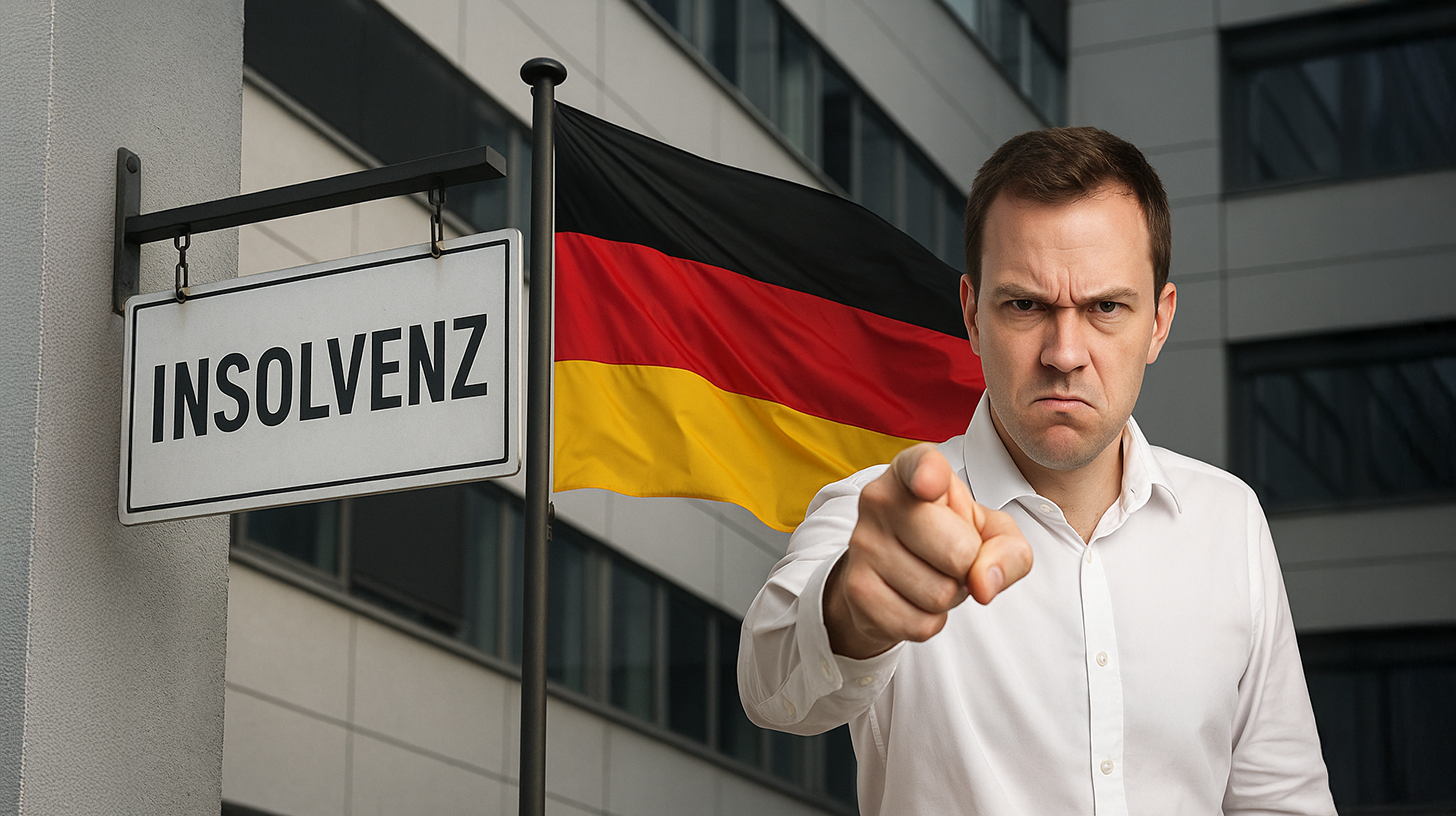
Corporate insolvencies in Germany: Wake up and stop blaming politicians! – Image: Xpert.Digital
Digital Disaster: How outdated strategies and sluggish internet are ruining German companies
Self-inflicted crisis: These fatal mistakes are now truly driving German companies into bankruptcy
Bankruptcy instead of profit: Are German CEOs making crucial, avoidable mistakes? The inconvenient truth about the wave of bankruptcies: Not interest rates, but these management errors are often a major contributing factor
From cold calling to AI chaos: How German companies are jeopardizing their future with yesterday's methods
Insolvency figures in Germany are skyrocketing, painting a bleak picture for the economy. With over 21,000 corporate insolvencies in 2024 and a further increase projected, calls for political bailouts and blame-shifting are growing louder. The usual suspects are quickly identified: high energy prices, rising interest rates, and paralyzing bureaucracy. But this one-sided view is too simplistic and obscures a far more uncomfortable truth: a large proportion of the bankruptcies are self-inflicted.
While external factors undoubtedly increase the pressure, it is often years of internal failure that erode a company's foundation until it collapses under the strain. Strategic shortsightedness, a stubborn refusal to adapt to a digitized world, and a deep-seated fear of change are the real accelerants of the current crisis. Many businesses fell behind long before interest rates rose or energy became more expensive.
This article exposes the structural deficiencies that are paralyzing many German companies from within. From fundamental management errors such as a lack of controlling and outdated sales strategies from the last millennium to the haphazard implementation of artificial intelligence – the list of corporate shortcomings is long. It is a wake-up call, demonstrating that the responsibility for success cannot be solely shifted to politicians, but begins first and foremost within the company itself.
Related to this:


Corporate insolvencies in Germany: Between failed policies and entrepreneurial failures
The debate surrounding rising insolvency figures in Germany is often oversimplified as a consequence of political missteps. While macroeconomic factors undoubtedly play a role, another perspective deserves greater attention: many companies failed to adapt to changing market conditions in time and have consequently fallen behind the competition.
The figures are alarming: In 2024, over 21,000 companies filed for insolvency, representing an increase of more than 22 percent compared to the previous year. Further increases to as many as 25,800 cases are projected for 2025. However, while politicians and business associations primarily attribute this development to external factors such as rising interest rates, energy prices, or bureaucratic hurdles, a more in-depth analysis reveals structural deficiencies in the management and strategic direction of many German companies.
Management errors as the main cause of corporate insolvencies
A comprehensive study by the Center for Insolvency and Restructuring at the University of Mannheim identifies management errors as the most frequent cause of corporate insolvencies. The three most critical areas are a lack of controlling, financing gaps, and inadequate receivables management. These factors are not the result of external circumstances, but rather of direct entrepreneurial decisions and omissions.
A lack of controlling is the leading cause of self-inflicted insolvency. Many entrepreneurs neglect the systematic planning, coordination, and management of their business processes, especially when they are overwhelmed by day-to-day operations. This strategic shortsightedness means that problems are only recognized when it is already too late. Regularly setting goals with clearly defined timeframes could prevent many insolvencies.
Receivables management represents another critical area. Companies that fail to professionally monitor their incoming payments jeopardize their liquidity and, consequently, their survival. The often half-hearted payment practices of business customers are particularly problematic, as they can lead to significant cash flow problems. Outsourcing your receivables management to a professional service could considerably reduce these risks.
Related to this:

Digitalization deficits as a competitive obstacle
A particularly serious area of corporate shortcomings lies in the lack of digital transformation. Germany lags significantly behind in digitalization, which directly impacts the competitiveness of its companies. In the Digital Economy and Society Index, Germany ranks only 13th out of 27 EU member states. This position is all the more worrying given that countries like Lithuania, Slovenia, and Estonia achieve better digitalization scores despite having weaker economies.
The reasons for this lag are multifaceted. A study by the European Center for Digital Competitiveness shows that 95 percent of executives see Germany as lagging behind in digitalization. The main reasons are strategic shortcomings, fragmented responsibilities, and insufficient investment. Small and medium-sized enterprises (SMEs) in particular struggle with budget constraints, a lack of expertise, and a severe shortage of IT professionals.
The practical effects of these digitalization deficits are measurable: twelve percent of employees lack access to a stable internet connection, and seventeen percent are not optimally equipped for working from home. These technical shortcomings not only hinder internal efficiency but also weaken the company's competitive position compared to more digitally advanced competitors.
Outdated sales and marketing strategies
Another critical area lies in the fact that many B2B companies are stuck in outdated sales and marketing approaches. Despite advancing digitalization, numerous companies still rely primarily on traditional cold calling and trade fair appearances. However, these methods are becoming increasingly ineffective, as the purchasing behavior of business customers has fundamentally changed.
The millennial generation, which makes important purchasing decisions today, expects an "Amazon experience" in the B2B sector as well. They prefer to research and conduct business without human interaction. According to a Harvard business study, 81 percent of customers try to solve problems themselves before picking up the phone. Companies that ignore these changing expectations are systematically losing market share.
The problem is exacerbated by the nature of corporate websites. Many B2B companies still view their website as a digital business card or a replacement for glossy brochures. This static approach squanders the website's potential as an interaction platform and lead generation engine. Instead of regular, valuable content, many B2B websites feature only sporadic updates that offer no real added value and are often impersonal or even anonymous.
Dysfunctional content strategies and approval processes
The quality of corporate communications suffers from overly bureaucratic approval processes that stifle spontaneity and authenticity. Many companies have established approval procedures that meticulously scrutinize every sentence and every word before content is published. The result is sterile texts devoid of discernible motivation or vision, written in interchangeable, glossy marketing language.
These bureaucratic hurdles lead to significant delays in content production. Studies show that marketing teams spend an average of 33 percent of their productive time on approval and authorization processes. For 78 percent of B2B marketers, unclear approval processes cause content delays at least weekly.
Many B2B companies misunderstand social media as a mere "we're on it too" activity, instead of using it as a channel for genuine added value. A lack of strategy, inconsistent activity, and fear of negative feedback characterize the social media presence of many companies. Instead of fostering authentic communication, they often publish the same overly regulated content that has already failed on other channels.
Artificial intelligence: between hype and bewilderment
The implementation of artificial intelligence (AI) particularly highlights the strategic weaknesses of German companies. Although 38 percent of B2B companies already use AI and 74 percent are increasing their investments in this area, there is often a lack of planning when it comes to practical implementation.
The biggest obstacles to AI deployment are a lack of personnel (62 percent), insufficient data (62 percent), and inadequate financial resources (50 percent). However, these obstacles are largely self-inflicted and result from a lack of strategic planning and insufficient investment in digital infrastructure.
A particularly problematic aspect is that only 14 percent of companies are driving AI forward at the executive level. This lack of leadership support leads to fragmented, isolated measures without a strategic direction. Many companies implement AI solutions without clear goals or measurable success criteria, resulting in costly failures.
Structural deficiencies in the digitalization strategy
The problems with digital transformation extend beyond technical aspects and are rooted in fundamental strategic shortcomings. Only about one-fifth of medium-sized companies have a comprehensive digitalization strategy. This lack of strategic direction leads to inefficient, isolated measures without any discernible synergies.
Particularly serious is the lack of willingness among decision-makers and employees. While managers recognize the strategic benefits of digitalization, they often shy away from the necessary investments and changes. At the same time, many employees lack the motivation or understanding for new technologies, leading to a gradual erosion of competitiveness.
Organizational structures exacerbate these problems. Traditional hierarchies and outdated processes hinder digital transformation. Instead of developing cross-departmental solutions, investments are often made ad-hoc and without strategic direction. The focus is on short-term goals rather than a long-term digital realignment.
Industry-specific challenges and solutions
The challenges of digitalization manifest themselves to varying degrees across different sectors. Traditional industrial and craft businesses are particularly affected, as they are often hesitant to re-evaluate their established business models. These companies frequently struggle with integrating new technologies into existing processes and organizational structures.
A systematic approach to digitalization should begin with a thorough analysis of the current situation. Companies must assess their existing processes, identify weaknesses, and prioritize their digital transformation. The selection of suitable technologies should be based on specific requirements and available resources, not on current trends or marketing promises.
Successful digitalization also requires a phased implementation with continuous performance measurement. Companies should start with smaller projects, evaluate the results, and then adjust their measures accordingly. This iterative approach minimizes risks and enables organizational learning.
🔄📈 B2B trading platform support – Strategic planning and support for export and the global economy with Xpert.Digital 💡


B2B trading platforms - Strategic planning and support with Xpert.Digital - Image: Xpert.Digital
Business-to-business (B2B) trading platforms have become a critical component of global trade dynamics and thus a driving force for exports and global economic development. These platforms offer significant advantages to companies of all sizes, especially SMEs—small and medium-sized enterprises—which are often considered the backbone of the German economy. In a world where digital technologies are increasingly prominent, the ability to adapt and integrate is crucial for success in global competition.
More information here:
B2B in Transition | Digital Failure: Why German Companies Are Losing Market Share - 85% of all Decision-Makers Start Their Research Online
International competitiveness and market realities
The consequences of these entrepreneurial failures become particularly clear in international comparison. While German companies are often still stuck in traditional ways of thinking, competitors from other countries have already completed the digital transformation and are benefiting from greater efficiency gains and better customer reach.
The COVID-19 pandemic accelerated these developments and ruthlessly exposed the weaknesses of many traditionally managed companies. Businesses that had already invested in digital infrastructure and modern sales channels before the crisis were able to adapt much better to the changed conditions. Companies without such preparation, on the other hand, came under enormous pressure and are still struggling with the consequences today.
Globalization and easier access to international markets are further increasing competitive pressure. German companies no longer compete solely with local suppliers, but with globally operating firms that are often more cost-efficient and customer-oriented. Without appropriate adjustments, they will systematically lose market share.
Related to this:


Human resource management and organizational development
An often overlooked aspect of corporate crises lies in inadequate human resources management and a lack of organizational development. Many companies fail to adequately prepare their employees for digital transformation and to develop the necessary skills. This neglect of human resources is particularly detrimental in times of accelerated change.
The shortage of skilled workers exacerbates these problems. Companies that cannot offer attractive jobs and development opportunities lose qualified employees to the competition. The situation is particularly dire for IT specialists, where six-figure shortages are expected as early as 2024.
Corporate culture plays a crucial role. Companies with hierarchical structures and a low willingness to innovate have greater difficulty attracting and retaining talented professionals. This lack of openness to change and experimentation particularly deters younger workers, who prefer dynamic and future-oriented work environments.
Financial management and investment decisions
Flawed financing decisions and inadequate liquidity planning also contribute significantly to the rising number of insolvencies. Many companies increased their debt during the low-interest-rate period without setting aside sufficient reserves for changing market conditions. The interest rate turnaround since 2022 has hit these businesses particularly hard, as follow-up loans have suddenly become significantly more expensive.
The investment policies of many companies also reveal strategic shortcomings. Instead of investing in future-proof technologies and business models, many companies cling to outdated structures. This conservative approach may save costs in the short term, but leads to competitive disadvantages and market losses in the medium term.
A particularly problematic aspect is the often inadequate measurement of investment success. Many companies cannot accurately assess which measures actually contribute to business success and which represent a waste of resources. This lack of transparency leads to suboptimal allocation decisions and inefficient resource utilization.
Customer focus and market adaptation
A fundamental problem for many insolvent companies lies in their lack of customer focus and inability to adapt to changing market demands. While customer needs and purchasing habits are rapidly evolving, many businesses cling to traditional business models without critically examining their relevance.
The B2B landscape has fundamentally changed. Business customers now expect the same user experience as in the B2C sector: easy navigation, comprehensive product information, fast availability, and personalized communication. Companies that fail to meet these expectations systematically lose orders to better-positioned competitors.
This shift is particularly evident in information gathering. 85 percent of all B2B decision-making processes now begin online, long before the first contact with sales. Companies with an inadequate online presence are not even noticed during this crucial phase and therefore have no chance of making it to the shortlist.
Related to this:

Innovation management and future viability
The lack of innovation among German companies significantly contributes to their deteriorating competitive position. While other countries systematically invest in research, development, and new technologies, many German businesses exhibit a conservative attitude toward innovation. This inertia in innovation leads to a gradual erosion of competitiveness.
A particularly problematic aspect is the often-lacking systematic market monitoring and trend analysis. Companies that fail to recognize market developments in a timely manner or misjudge them miss crucial turning points and fall behind. Digitalization has significantly accelerated the pace of change, making such oversights more quickly a threat to a company's survival.
In many companies, innovation management is limited to sporadic, isolated measures lacking strategic integration. Instead of establishing systematic processes for idea generation, evaluation, and implementation, many businesses rely on chance or individual dedicated employees. This unstructured approach leads to missed opportunities and suboptimal results.
Quality management and process optimization
Deficiencies in quality and process management exacerbate the problems of many companies. Inefficient processes, high error rates, and a lack of standardization lead to excessive costs and dissatisfied customers. These operational weaknesses add up to significant competitive disadvantages.
Many businesses fail to regularly analyze and optimize their processes. Digitalization offers significant potential for improvement through automation, data analysis, and continuous monitoring. Companies that don't utilize these opportunities incur unnecessarily high costs and lower productivity.
Quality control is often limited to final inspection instead of implementing systematic preventative measures. This reactive approach leads to higher costs and longer lead times. Modern quality management systems enable continuous monitoring and improvement of all process steps.
Supply chain management and partnerships
Weaknesses in supply chain management and partner selection also contribute to corporate crises. Many companies have not sufficiently diversified their dependencies on individual suppliers or markets and are therefore vulnerable to disruptions. The COVID-19 pandemic and geopolitical tensions have painfully exposed these vulnerabilities.
The digitalization of supply chains lags significantly behind in many German companies. Modern supply chain management systems enable better transparency, predictability, and risk minimization. Companies without such systems work with incomplete information and can only react to disruptions.
The selection and evaluation of business partners is often still based on traditional criteria, without utilizing modern analytical methods. Digital tools now enable significantly more precise risk assessment and continuous monitoring of partner relationships. However, these opportunities remain untapped if companies do not invest accordingly.
Sustainability and social responsibility
The consideration of sustainability aspects and social responsibility is also becoming increasingly important. Companies that ignore these trends risk not only reputational damage but also the loss of customers and skilled workers. Younger generations place great value on ethical and sustainable business practices.
Regulatory requirements in the area of sustainability are constantly becoming stricter. Companies that fail to adapt to these developments in a timely manner risk compliance problems and additional costs. A proactive approach, on the other hand, can create competitive advantages and open up new business opportunities.
Integrating sustainability aspects often requires fundamental changes to business models and processes. Companies that address this transformation too late face higher conversion costs and lower chances of success. Early investments in sustainable technologies and practices pay off in the long run.
Legal compliance and risk management
Insufficient adherence to legal requirements and inadequate risk management also lead to corporate crises. The regulatory landscape is becoming increasingly complex, particularly in the areas of data protection, IT security, and sustainability. Companies without appropriate compliance structures risk substantial fines and reputational damage.
In many companies, risk management is limited to traditional areas such as credit and insurance risks. New risk categories, such as cyberattacks, supply chain disruptions, or regulatory changes, are often inadequately addressed. These gaps can become existential threats if such events occur.
Documentation and monitoring of compliance measures are often still done manually and unsystematically. Modern software solutions enable automated monitoring and reporting, reducing risks and increasing efficiency. Companies without such systems operate with higher risks and costs.
Wave of insolvencies in Germany: Digital transformation, strategic reforms and entrepreneurial responsibility as antidotes
The analysis of the rising insolvency figures in Germany reveals a complex picture involving external factors and corporate failings. While political decisions and macroeconomic developments undoubtedly contribute to the crisis, structural deficiencies in corporate governance must not be overlooked.
Many of the identified problems are self-inflicted and result from strategic oversights, a lack of willingness to innovate, and a refusal to critically examine established business models. Digitalization offers significant opportunities for increased efficiency and new business opportunities, but only companies that are prepared to invest and change can capitalize on them.
International competition will intensify further, and the pace of technological change will accelerate. Companies unwilling to adapt their structures, processes, and mindsets will increasingly lose market share and ultimately cease to exist.
The responsibility for creating better framework conditions does not lie solely with politicians. Entrepreneurs must take the initiative to future-proof their businesses and actively address the challenges of digital transformation. Only through a combination of political reforms and entrepreneurial responsibility can the German economy regain its competitiveness and secure sustainable growth.
The time for structural reforms and strategic realignment is running out. Companies that fail to act now risk contributing to the insolvency statistics of the coming years. Digitalization and the associated cultural shift are not optional add-ons, but rather existential necessities for survival in the modern market environment.
Related to this:

Your global marketing and business development partner
☑️ Our business language is English or German
☑️ NEW: Correspondence in your native language!

Konrad Wolfenstein
I and my team are happy to be available to you as your personal advisor.
You can contact me by filling out the contact form here wolfenstein@xpert.digital:or simply call me at +49 7348 4088 965. My email address is
I'm looking forward to our joint project.