
The evolution from container hangar to container high-bay warehouse
Xpert Pre-Release

Available in 27 languages 📢
Prefer Xpert.Digital on GoogleⓘPublished on: February 16, 2026 / Updated on: February 16, 2026 – Author: Konrad Wolfenstein
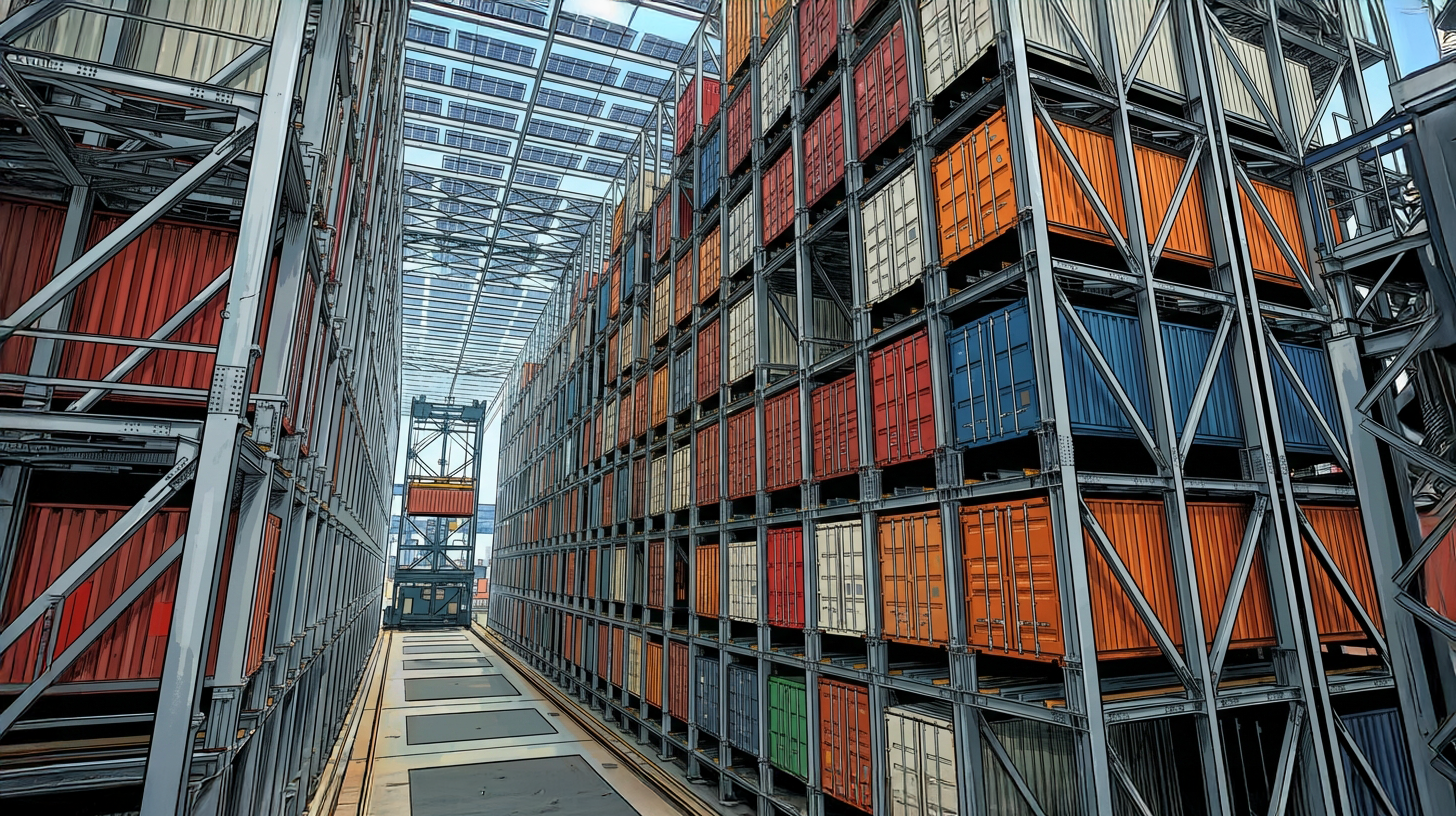
The evolution from container hangar to container high-bay warehouse
No more "Tetris" in the port: Why high-bay container warehouses herald the end of block stacking
Swiss Army as a pioneer: How the military maintains multi-ton containers in high-bay racking
For decades, global container logistics followed a simple geometric law: growth required space. In the world's major seaports, increased capacity almost inevitably meant horizontal expansion – through land purchases or costly land reclamation. But this classic model of block stacking is reaching its physical and economic limits in times of skyrocketing land prices and volatile supply chains. The industry's response is radical: instead of sprawling outwards, the modern port is growing upwards.
The evolution from a simple container hangar to a fully automated high-bay warehouse marks far more than just a technical update. It's a fundamental system change. Technologies like BOXBAY in London and Dubai, the pioneering systems by JFE in Tokyo, and the specialized heavy-lift systems of the Swiss Army demonstrate that logistics is moving away from the inefficient "stack logic." Where reach stackers once had to laboriously rearrange containers to access the bottom box, high-bay systems now allow direct, fully automated access to every single unit – without a single unnecessary manual movement.
This transformation is driven by the need to achieve significantly higher storage densities on expensive land, manage empty containers more efficiently, and electrify processes. The following analyses illuminate how these "cathedrals of logistics" function, why they are profitable despite high investment costs, and why they are becoming a strategic game-changer, especially for metropolitan ports and defense logistics. From reefer efficiency in Japan to the "empty superstack" on the Thames: the container is learning to fly.
Related to this:

How vertical container storage redefines space costs, productivity and logistics strategies
Why traditional container yards in expensive seaports increasingly appear to be an economic misallocation
Container high-bay warehouses represent a profound technological leap in port and defense logistics because they fundamentally change land use, energy consumption, and process logic. Economically, this is not simply an automation upgrade, but a new infrastructure category with its own cost and revenue logic, as the three completed projects in Tokyo, Dubai/London, and at the Swiss Army exemplify.
From flat surfaces to high-rise storage: Economic drivers for container high-bay warehouses
The primary impetus for container high-bay warehouses is the increasing scarcity and rising cost of port space in urban areas, combined with growing volatility in freight flows. Traditional block-stack yards primarily scale in terms of area; with increasing throughput, additional storage spaces quickly lead to prohibitively high land and infrastructure costs, especially in metropolitan ports like Tokyo or near conurbations like London.
Furthermore, the ratio of full to empty containers is becoming increasingly unbalanced. Export-oriented regions are systematically accumulating empty container capacity that needs to be stored for months – an ideal use case for extremely dense vertical storage systems like BOXBAY's Empty Superstack with up to 16 levels of pure empty container storage. At the same time, environmental and regulatory requirements are also coming into play: Electrified, enclosed systems facilitate emission reduction, noise control, and compliance with safety regulations significantly more effectively than open diesel yards.
Technological principles: What distinguishes container high-bay warehouses from classic yards
Three technological features are particularly relevant from an economic perspective: high storage density, direct access to each unit, and full automation capability. High-bay systems are defined in the literature precisely by this combination: they enable vertical stacking significantly beyond the level of conventional yard stacks, provide addressable access to each storage location, and are structurally designed for automated storage and retrieval systems or stacker cranes.
Unlike block stacking with reach stackers or straddle carriers, time-consuming restuffling operations are eliminated because the system accesses individual storage locations directly, rather than rearranging entire stacks. At the JFE container hangar in Tokyo, containers can be stored and retrieved directly, regardless of their position; the time- and energy-intensive overhead transfers are completely eliminated. BOXBAY goes a step further: Each module operates like a three-dimensional container robot with its own travel paths and lifting axes, enabling simultaneous processing at multiple locations.
Tokyo as a pioneering case: The container hangar of JFE and NYK
container hangar in Tokyo, commissioned in 2011, is considered the first real-world implementation of a high-bay container warehouse with stacker cranes in a seaport. The facility at the Oi Container Terminal covers a footprint of approximately 8,400 square meters (about 150 by 56 meters), is 31 meters high, and stores containers on seven levels with a total capacity of 840 TEU, distributed across 420 storage locations for 40-foot units.
Two stacker cranes, each with a lifting capacity of up to 40 tons, form the core of the system and together achieve up to 48 container movements per hour. These are complemented by two overhead cranes that exchange containers with trucks at intervals of approximately 2.5 minutes and insert them into the system via turntables, ensuring they are correctly oriented. Particularly relevant from an economic perspective is the complete integration of refrigerated containers on all levels, which significantly increases the usable reefer capacity compared to conventional five-layer stacking.
Economic lessons from Tokyo: Productivity, security, and reefer yield
The example of Tokyo clearly demonstrates how a high-bay warehouse pays off in several economic dimensions, without necessarily having to achieve spectacular TEU figures. Firstly, the hangar increases effective space utilization by offering a significantly higher number of storage spaces for reefers and standard containers on the same footprint; this reduces the long-term need for additional terminal space in an extremely expensive port area.
Secondly, the system improves the productivity of handling processes because it significantly reduces the number of unproductive movements and allows for considerably better planning. Direct access eliminates marshalling operations and overhead transfers, which in traditional yards consume a considerable portion of crane time and thus block capacity. Thirdly, occupational safety and process stability increase because traffic routes for trailers, cranes, and personnel are spatially separated, and collision-prone mixed-use zones are eliminated.
BOXBAY as a second generation: From prototype to industrial system
Roughly a decade after Tokyo, BOXBAY marks the second generation of container high-bay warehouses, initially as a pilot installation at Jebel Ali Terminal 4 in Dubai. There, a module with 792 storage locations was erected, handling nearly 500,000 TEU movements over approximately two years, thus demonstrating the technical and operational viability of the concept. The system operates fully automatically with electrically driven lifting and travel units, allowing access to every container without restacking, similar to a giant three-dimensional automated storage system.
This pilot project led to the transition to the commercial phase: A first regular contract was awarded for the Port of Busan, where BOXBAY is expected to reduce truck handling times by a significant double-digit percentage by minimizing waiting times through improved direct access and increased parallel processing. The technology is not intended to replace the entire yard layout, but rather as a targeted addition that relieves bottlenecks – particularly empty container logistics.
London Gateway Empty Superstack: A vertical solution to the empty container problem
BOXBAY's most ambitious project to date is the Empty Superstack system at London Gateway Port, where DP World is investing around £170 million in a high-bay warehouse dedicated solely to empty containers. The facility will accommodate up to 27,000 TEU, storing containers up to 16 levels high in an enclosed, fully automated system and operated entirely by electric stacker cranes. Positioned at a new, fully electric berth, the system is designed as a "powerhouse" for empty container logistics, relieving the rest of the ASC yard of the burden of large-volume, but lighter and lower-value empty units.
Technically, BOXBAY in London utilizes modules approximately 15.6 meters wide in double-deep storage, with each module capable of handling around 20 container movements per hour. Along a 360-meter berth, approximately 23 such modules can be arranged, resulting in a total of around 460 waterside movements per hour – a figure that, according to the manufacturer, is roughly three times that of a typical ASC benchmark. This shifts the bottleneck from the yard towards the ship's crane capacity and nautical handling, underscoring the strategic importance of such systems for high-performance terminals.
Density, throughput, power: The economic logic of BOXBAY
From an economic perspective, BOXBAY targets three key levers: space efficiency, throughput, and electrification. Regarding land use, the manufacturer states that the empty superstack system achieves more than double the number of storage spaces per hectare compared to a conventional yard configuration – values exceeding 5,200 TEU per hectare compared to approximately 2,200 TEU per hectare in classic layouts. For operators in high-priced land markets, this investment thus transforms into an option to build additional capacity vertically rather than horizontally, postponing expensive land acquisitions or costly land reclamation projects.
At the same time, the architecture, with its narrower modules and multiple grabs operating in parallel, significantly increases the potential handling capacity, particularly on the water side. The ability to operate several active modules along a single berth increases the number of potentially simultaneously serviced container positions, resulting in higher ship crane utilization and shorter turnaround times. Finally, complete electrification and enclosure enable a clearer decarbonization and safety strategy: emissions from diesel equipment are reduced, noise protection is improved, and the impact of weather on personnel and equipment is minimized.
Busan and other locations: Consolidation of the business model
The order for a BOXBAY system for the Port of Busan is an important signal from an economic perspective, as it transfers the technology from the pilot phase into regular plant construction. While the Dubai pilot project primarily addressed technical and operational risks, the focus in Busan is on demonstrating, in a scalable way, that improved space utilization and shorter service times on the truck side translate into lower unit costs and higher revenues per hectare.
At the same time, BOXBAY is establishing itself as a specialized solution to the structural problem of empty containers in modern container ports. In trading systems with highly asymmetrical cargo flows, empty containers are increasingly becoming the dominant space consumer without generating correspondingly high direct revenues. By decoupling them into a separate, extremely dense superstack, the economic use of the remaining yard space is optimized for more valuable full containers and time-critical traffic.
LTW Solutions

LTW Intralogistics – Engineers of Flow - Image: LTW Intralogistics GmbH
LTW offers its customers not individual components, but integrated complete solutions. Consulting, planning, mechanical and electrotechnical components, control and automation technology, as well as software and service – everything is networked and precisely coordinated.
In-house production of key components is particularly advantageous. This allows for optimal control of quality, supply chains, and interfaces.
LTW stands for reliability, transparency, and collaborative partnership. Loyalty and honesty are firmly anchored in the company's philosophy – a handshake still means something here.
Related to this:
Swiss Fortress 2.0: Insights into the army's new super-camp
The Swiss special approach: High-bay warehouses for defense logistics
A third implementation line opens up a completely different field of application: defense logistics. LTW Intralogistics implemented a container high-bay warehouse for the Swiss Federal Office for Defence Procurement (armasuisse), serving as a heavy-duty storage facility for ISO containers, swap bodies, and roll containers. The system comprises an approximately 20-meter-high storage and retrieval system with a payload capacity of 18 tons and a total of around 206 storage locations, distributed across several levels in a single-aisle aisle.
Special features include a unique door system that allows containers to be stored with their doors open, as well as the ability to perform maintenance and repair work directly at the storage location within the racking system. Furthermore, the storage and retrieval machine has a redundant drive system to ensure high availability even in the event of partial malfunctions – an essential criterion in military logistics, which is designed for crisis resilience and system robustness.
Related to this:

Added value in the military and industrial heavy-duty sector
Economically, the Swiss application differs significantly from port projects because the focus here is not on throughput per hour, but rather on the availability and protection of critical resources. The facility enables the Swiss Armed Forces to store non-stackable swap bodies, special containers, and roll containers on a minimal footprint while simultaneously ensuring access for inspection and maintenance. This streamlines expensive reserve capacity and concentrates the entire fleet logistics on a small footprint.
The integrated maintenance access in the racking system also increases the productivity of technical staff because transport times to separate workshop areas are eliminated and work can be carried out directly at the storage location. Overall, this creates a hybrid system of storage and workshop infrastructure that consolidates the acquisition and operating costs of various previously separate systems and generates significant added value, especially for weather-sensitive, high-priced equipment.
Comparison of the three reference projects: Key data and deployment logic
A comparison of the key figures illustrates the different strategies behind the three projects. The JFE container hangar in Tokyo, with a capacity of 840 TEU, seven levels, and a height of 31 meters, is relatively compact, but clearly designed for reefer capability and safe, efficient handling in a high-density urban terminal. In contrast, BOXBAY's Empty Superstack in London, with a capacity of up to 27,000 TEU and up to 16 levels, aims for a radical densification of empty container storage in a major terminal that was already among the most efficient in the country.
The LTW system for armasuisse, with its 206 parking spaces, operates on a different scale, but addresses highly specialized heavy-load requirements with an 18-ton payload and integrated maintenance logic. The focus here is not on maximizing TEU per hectare, but rather on the ability to store heterogeneous, sometimes non-stackable load carriers in a safe, weatherproof environment with high system availability.
Land efficiency and opportunity costs
A key argument for high-bay container warehouses is the opportunity cost of port or military logistics space. In metropolitan areas with high land prices, doubling or tripling the number of storage spaces per hectare – as BOXBAY aims for with more than 5,200 TEU per hectare compared to approximately 2,200 TEU for conventional solutions – can significantly determine the project's net present value. Instead of acquiring additional land or developing it through land reclamation, the investment is in vertical densification, which is also faster to implement than large-scale construction projects in the port basin.
At the same time, separating certain container categories – such as empty containers or special containers – from the general yard not only frees up space but also allows the remaining areas to be better utilized for high-value transshipments like the import and export of full containers. This is particularly relevant when empty container logistics, while operationally essential during periods of high freight rates, is not very profitable. The economic logic is thus similar to outsourcing low-margin but unavoidable processes to specialized, highly productive ancillary facilities.
Investment and operating costs: Capital-intensive, but structurally transformative assets
At first glance, container high-bay warehouses appear to be capital-intensive, specialized solutions, as exemplified by the investment of approximately £170 million for the BOXBAY Empty Superstack in London. However, this capital expenditure is not isolated but must be considered in comparison to alternatives: additional land purchases, costly dredging and land reclamation projects, or the construction of entirely new terminal areas. Particularly in established ports with existing infrastructure and intense competition for space, the relative additional costs of a high-bay warehouse compared to a conventional yard can therefore be significantly lower.
On the operating cost side, the trade-off lies primarily between higher maintenance and repair costs for complex electromechanical systems on the one hand, and lower energy costs, reduced handling time per container, and lower personnel costs on the other. Fully electric stacker cranes and enclosed systems reduce the diesel consumption of conventional yard equipment and facilitate load management, for example, through the use of peak shaving or on-site power generation. At the same time, the elimination of reshuffling not only saves energy and time but also reduces mechanical wear on equipment and container stacks.
Process quality, safety and resilience as value drivers
Besides direct cost and performance indicators, container high-bay warehouses also influence qualitative factors that are indirectly reflected in the balance sheet. In Tokyo, the hangar concept improves occupational safety by clearly separating traffic routes and avoiding collision-prone mixed zones; this reduces accident risks, downtime, and insurance costs. Similar effects are achieved in London through enclosure and automation, which largely eliminates personnel contact with moving loads and enables maintenance work to be carried out in a controlled environment.
In defense logistics, another aspect comes into play: resilience to disruptions. The LTW system for the Swiss Army uses redundant drives on the storage and retrieval machine to ensure operational readiness even in the event of partial failures, and allows critical systems to be stored in weatherproof, access-controlled structures. In a crisis or during prolonged supply chain disruptions, such a high-bay warehouse can significantly safeguard operational capability – a value that cannot be measured solely by TEU figures.
Classification compared to alternative automation concepts
High-bay container storage systems don't directly compete with the full range of terminal-side automation, but rather address a specific gap. Automated stacking cranes (ASCs), autonomous straddle carriers, or shuttle carrier systems increase process efficiency in shallow yards, but reach their physical limits when it comes to vertical compaction and direct access to low-lying containers. High-bay systems circumvent this problem through a consistently three-dimensional storage architecture in which transverse and longitudinal traffic are decoupled from the lifting process.
At the same time, high-bay warehouses can be combined with existing automation levels, as demonstrated by the BOXBAY project in London. There, the ASC yard for full containers remains in place, while the Empty Superstack, as an upstream specialized unit, consolidates empty container logistics, thereby increasing the overall system's efficiency. In Tokyo, the container hangar is connected to road traffic via overhead cranes and can be seamlessly integrated into conventional terminal processes.
Risks, path dependencies and market entry barriers
Despite their advantages, container high-bay warehouses are by no means a risk-free investment. Technical complexity, dependence on a few specialized suppliers, and a relatively short operational history create path dependencies that make particularly conservative terminal operators hesitant. Operating a facility with dozens of electrically driven axes, complex software, and sophisticated building physics requires new expertise in maintenance, IT security, and crisis management.
Furthermore, there are long-term technology and contractual commitments: Those who opt for a proprietary system like BOXBAY or a specialized heavy-duty solution like that from LTW are usually bound to a specific supplier and service stack for decades. This commitment can become problematic in the event of technological paradigm shifts or consolidations on the supplier side, but at the same time it can also act as a barrier to entry, providing successful innovators with a sustainable competitive advantage.
Market outlook until 2035: Niche with high strategic relevance
By around 2035, it is expected that high-bay container warehouses will not become a universal solution for every port, but rather serve a growing, yet clearly segmented niche. Typical candidates are densely populated metropolitan ports, terminals with massive volumes of empty containers, and sites with special security, environmental, or defense requirements. In these segments, the structural advantages—space efficiency, land prices paid, decarbonization pressure, and the desire for resilient, weather-independent processes—clearly favor vertical solutions.
At the same time, the learning curve from pilot and early-stage projects like those in Tokyo, Dubai, London, and the Swiss facilities will reduce investment risks. The more data available on life cycle costs, availability, and actual performance gains, the easier it will be to formulate a robust business case that goes beyond mere technological fascination. Moderate widespread adoption is therefore likely—not as a replacement for traditional yards, but as a highly specialized complement in particularly critical or value-intensive segments of the logistics chain.
Perspectives beyond seaports: Industry, energy and defense
Swiss defense logistics suggests that the application of container high-bay warehouses extends far beyond ports. Heavy industry, energy infrastructure, and railway technology can have similar requirements for compact, weatherproof storage of heavy, sometimes non-stackable units – from transformers and large components to modular technical containers. In such scenarios, the TEU figure is less important than the combination of load-bearing capacity, space efficiency, and integrated maintainability.
Even industrial clusters with limited available space and high logistics volumes could utilize high-bay container warehouses as a link between plant logistics and rail or inland waterway transport, concentrating buffer stocks and specialized containers in a compact area. The ability to store containers with the door open and process them on the rack, as in the LTW project, opens up additional possibilities for integrated service and maintenance processes within the same footprint.
High-bay warehouses as a strategic instrument of logistics economics
The three projects examined – the container hangar in Tokyo, the BOXBAY system in Dubai/Busan/London, and the LTW high-bay warehouse for the Swiss Army – demonstrate that container high-bay warehouses are not merely technical experiments, but rather clearly positioned, economically viable infrastructure components. Tokyo utilizes the high-bay racking system to efficiently and safely handle reefer and standard containers in a very confined space; London consolidates its lower-rated, but space-intensive, empty container logistics with BOXBAY; and Switzerland relies on a heavy-duty high-bay warehouse for the protected, compact, and maintenance-integrated storage of critical military assets.
What all these systems have in common is that they rebalance the economic use of space, time, and energy, breaking down traditional trade-offs between capacity, access time, and process stability. Container high-bay warehouses thus become a strategic instrument with which operators and governments can specifically address bottlenecks, meet decarbonization pathways and security requirements, and reposition themselves in the competition for scarce space advantages in ports and logistics hubs. In a world of increasing land scarcity, volatile goods flows, and growing resilience requirements, the trend "from horizontal to vertical" is likely to be less of a short-term fad and more of a long-term structural transformation of logistics infrastructure.
Consulting - Planning - Implementation

Konrad Wolfenstein
I would be happy to serve as your personal advisor.
contact me at wolfenstein ∂ xpert.digital
Just call me on +49 7348 4088 965 (Munich) .
Your container high-bay warehouse and container terminal experts

Container high-bay warehouses and container terminals: The logistical interplay – expert advice and solutions - Creative image: Xpert.Digital
This innovative technology promises to fundamentally change container logistics. Instead of stacking containers horizontally as before, they will be stored vertically in multi-story steel racking structures. This not only allows for a drastic increase in storage capacity within the same area, but also revolutionizes all processes at the container terminal.
More information here:










