
The Nasdaq is dancing on the edge of a volcano: AI acts as both a turbocharger and a driver of volatility on the stock market
Xpert Pre-Release

Available in 27 languages 📢
Prefer Xpert.Digital on GoogleⓘPublished on: February 16, 2026 / Updated on: February 16, 2026 – Author: Konrad Wolfenstein

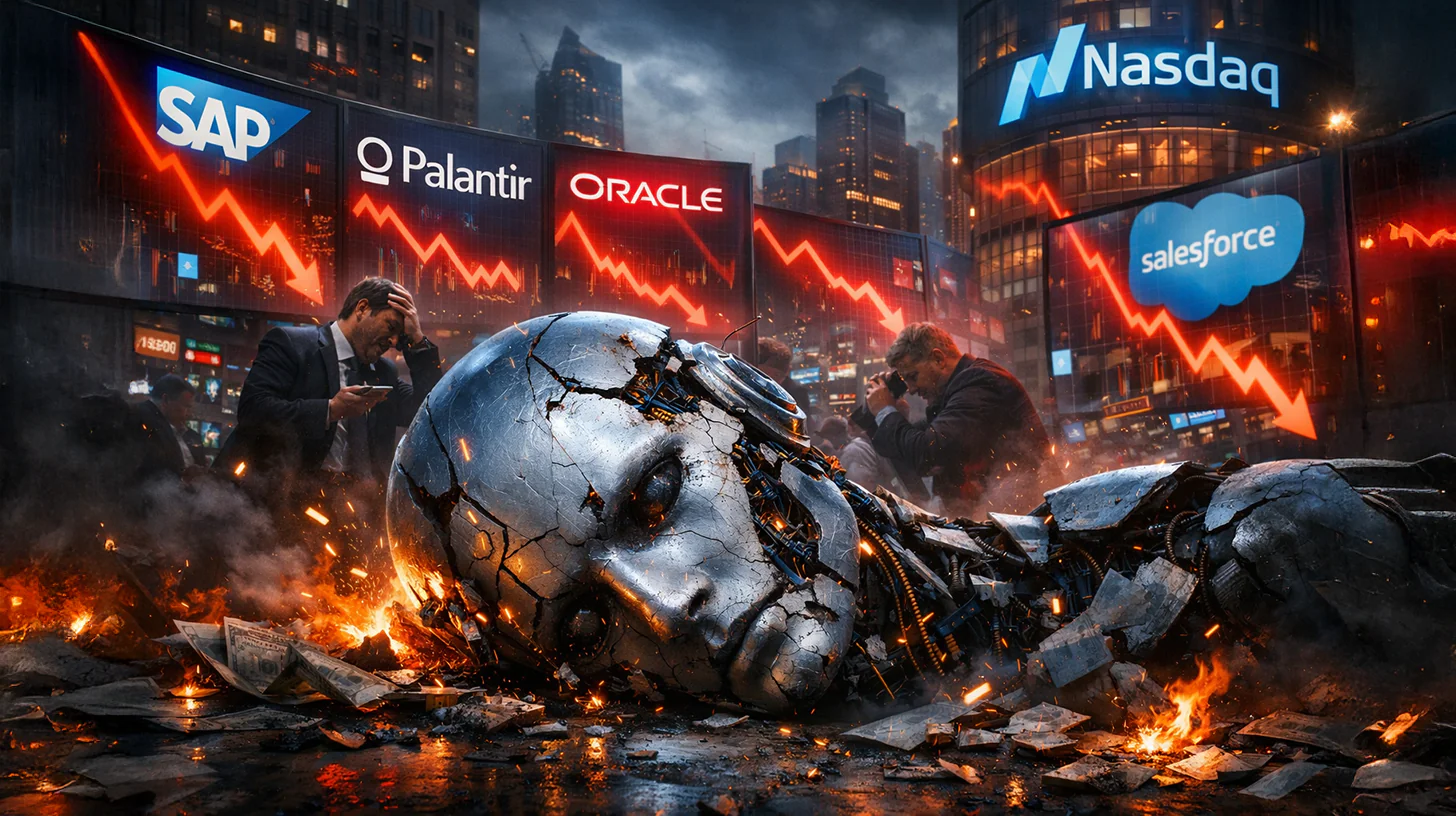
The Nasdaq is dancing on the edge of a volcano: AI acts as both a turbocharger and a driver of volatility on the stock market – Image: Xpert.Digital
Turbo or crash? How AI is making the stock market unpredictable
The great AI illusion: Investors cling to promises that no one keeps
Dancing on the volcano: Are we facing a new dot-com crash in 2026?
In February 2026, the Nasdaq technology exchange is in a state of deceptive calm. While the index hovers steadily around the 23,000-point mark, outwardly projecting strength, a great deal of turmoil is brewing beneath the surface. The central narrative that has driven the markets for years—artificial intelligence—is now having a Janus-faced effect: it is no longer just the undisputed engine of growth, but is increasingly mutating into an unpredictable amplifier of volatility.
AI acts on the stock market like a high-performance engine with a loose accelerator pedal. It's less of a clear "bullish" or "bearish" moment and more of an accelerant for existing market conditions. Where growth and expectations are high, it drives prices to dizzying heights; however, where doubts about profitability and valuation arise, it accelerates downward movements with brutal force. Major tech companies like Nvidia, Microsoft, and Alphabet have invested heavily in infrastructure, and investors have long rewarded this with substantial premiums. But now we're approaching the point where mere imagination is no longer enough.
We are currently witnessing the clash between hype and fundamental data. The valuations of many AI-related companies are now based almost exclusively on narratives, not on actual profits. When quarterly reports reveal that AI investments are indeed expensive, yet are impacting margins or disrupting sales plans, the narrative falters – and share prices react with sharp declines. Warning signs from industry giants like Cisco and AMD vividly illustrate this: there is little share price movement without AI, but massive fluctuations occur when high expectations are disappointed.
In the following analysis, we examine how this dangerous dynamic unfolds, why companies like Palantir and Tesla operate in a league of their own despite questionable fundamentals, and why the current market situation bears striking similarities to the dot-com bubble of the turn of the millennium. AI is fueling the stock market – but the foundation upon which this boom rests is becoming increasingly fragile.
Related to this:

AI as a turbocharger: Growth engine for tech stocks
AI has become a central narrative on the stock markets, especially on the Nasdaq. The major tech companies – such as Nvidia, Microsoft, and Alphabet – have invested heavily in AI infrastructure, data centers, and software, and these moves are being rewarded by investors with significant share price increases.
Many analysts believe that 2026 will be the year when AI investments actually translate into broader revenue and profit increases, further driving up share price gains.
At the same time, it is predicted that the AI arms race will reshape the economic landscape in the coming years, which in turn could further boost the shares of platform and infrastructure companies.
AI as a volatility amplifier: Hot air meets fundamental data
At the same time, AI is driving volatility because the valuations of many AI-related companies are currently based on expectations and narratives, not on actual profits.
If a quarterly report shows that AI investments are expensive but are squeezing profit margins, or that sales targets are not being met as quickly as hoped, the AI narrative can immediately falter – and share prices react with massive, sudden drops.
Furthermore, the concentration of stock market capital on a few AI “champions” such as Nvidia or cloud giants is seen as an additional risk factor: little price movement without AI, but high fluctuations if AI expectations are disappointed.
Related to this:

AI is heating up the stock market – but not in a stable way
AI therefore functions like a high-performance engine with a loose accelerator pedal:
- When sentiment and fundamentals are right, it fuels record rallies and accelerates the upswing.
- However, if expectations, debt, data center capacity utilization, or margins come under pressure, AI can just as quickly become a catalyst for significant corrections or even crash scenarios in individual sectors.
In short: AI is neither a pure bull nor a pure bear factor – it is an amplifier of dynamics that both propels the stock market higher and causes it to fall apart more violently.
When AI euphoria meets reality: Technology giants caught between stock market fantasies and economic disillusionment
The Nasdaq is dancing on the edge of a volcano, and investors are clinging to promises that no quarterly report can deliver
In February 2026, the Nasdaq technology exchange is in a state of deceptive calm. The index has been hovering around the 23,000-point mark for weeks, outwardly projecting an image of stability. But beneath this sideways movement lies a nervousness that is becoming increasingly apparent in individual stocks. Price drops of ten percent or more in a single trading day, as recently seen with AMD, Microsoft, and Cisco, are no longer anomalies but have become a recurring pattern. In all cases, the dynamics revolve around the same issue: artificial intelligence and the question of whether the multibillion-dollar investments in this technology will actually deliver the promised returns.
Volatility has reached a level that is causing alarm among experienced market participants. The CBOE Volatility Index, known in industry jargon as the fear gauge, climbed to over 26 points in mid-February, a level significantly above the long-term average. Investors are reacting to any negative note in quarterly reports with massive sell-offs, even when the overall figures meet or exceed expectations. The underlying rationale is as simple as it is worrying: the valuations of numerous technology companies are so inflated that a single shadow in the outlook is enough to wipe out billions in market capitalization.
When record numbers fail to stop the free fall
The most recent example of this paradoxical mechanism came from Cisco Systems on February 13, 2026. The network equipment provider and global leader in routing presented significant revenue increases thanks to its booming business with AI data centers. Earnings per share also met market expectations. However, a single aspect of the quarterly report shattered the positive sentiment: Management warned that the price explosion in memory chips resulting from AI demand would translate into declining product margins. The reaction was devastating. Cisco's stock plummeted 12.3 percent, dragging the entire technology sector down with it. The Nasdaq fell two percent that Thursday, a decline that is unusual even in volatile times.
Just a few days earlier, AMD had suffered a nearly identical fate. The chipmaker reported record quarterly revenues of $10.3 billion and earnings per share of $1.53, significantly exceeding analysts' estimates. But the outlook for the first quarter of 2026 poisoned the mood. Two factors triggered panic: First, business with Chinese data centers collapsed due to tightened US export controls. Revenue from the sale of AI chips to China, which had reached $390 million in the fourth quarter of 2025, was projected to shrink to a mere $100 million. Second, rising development costs for the next generation of chips weighed on margin prospects. The result: a 17.3 percent drop in the share price in a single day. This pattern demonstrates with alarming clarity that markets are now priced in a way that leaves no room for imperfections.
The valuation anomaly at Palantir: Between surveillance state and investor's dream
The tension between AI euphoria and economic reality is particularly striking in the case of Palantir Technologies. The company, specializing in data analytics and surveillance software, significantly exceeded its revenue expectations for 2025 in three consecutive quarters thanks to major contracts with the US Immigration and Customs Enforcement (ICE). Revenue from government contracts rose by 66 percent to $570 million per quarter, with ICE contracts alone contributing $51 million in the third quarter. CEO Alex Karp projected a further revenue increase of more than 60 percent for 2026 and described the results as the best performance of any technology company in the past decade.
Then came the crucial addendum: Palantir boasted impressive revenues, but not an impressive number of new customers. Investors reacted with a sharp drop in the share price. The revelation struck a nerve, as it exposed the company's structural Achilles' heel. Palantir's price-to-earnings ratio (P/E ratio) currently ranges from around 191 to 250, depending on the calculation method. By comparison, profitable technology companies like Alphabet, Meta, or Apple trade at P/E ratios between 26 and 32. Palantir's current market capitalization is around $330 billion, compared to projected revenues of just $4.5 billion in 2025. This results in a price-to-sales ratio of approximately 67, a figure unmatched even among the most highly valued cloud stocks.
P/E ratio stands for price-to-earnings ratio. It is a key metric in stock valuation and measures the multiple at which a stock is traded on the stock exchange.
The result shows how often the annual profit is included in the current share price – or: after how many years the profit “pays back” the purchase price of the share if the profit remains constant.
Importance for investors
- A low P/E ratio often indicates a relatively favorable valuation, but can also point to worse expectations or problems within the company.
- A high P/E ratio often signals a high valuation and usually implies strong expectations for future earnings growth.
Since it depends on the industry and the economic climate, the P/E ratio should always be considered in comparison with similar companies and with the company's historical performance.
Our global industry and economic expertise in business development, sales and marketing

Our global industry and economic expertise in business development, sales and marketing - Image: Xpert.Digital
Industry focus areas: B2B, digitalization (from AI to XR), mechanical engineering, logistics, renewable energies and industry
More information here:
A thematic hub offering insights and expertise:
- Knowledge platform covering global and regional economies, innovation and industry-specific trends
- A collection of analyses, insights, and background information from our key areas of focus
- A place for expertise and information on current developments in business and technology
- A hub for companies seeking information on markets, digitalization, and industry innovations
The Ghosts of 2000: Is the AI industry heading for the next big crash?
Reputational risks and the Swiss debacle
Particularly in Europe, Palantir faces significant resistance in acquiring new customers, and the reasons for this are multifaceted. Its heavy involvement with Trump's Immigration and Customs Enforcement (ICE) has been accompanied by negative headlines for months. In April 2025, Palantir was awarded a $30 million contract to develop ImmigrationOS, a system for real-time tracking of self-deportations and prioritizing deportations. In August, CEO Karp described the results as an expression of patriotic values, while the company was simultaneously under fire for the deadly consequences of ICE operations.
In December 2025, the Swiss magazine Republik published a two-part investigation based on documents obtained through freedom of information requests. The articles detailed how Palantir had unsuccessfully attempted to win over Swiss federal authorities and the army as clients since 2018. Despite high-level meetings, including with then-Federal Councillor Ueli Maurer in Silicon Valley and Federal Chancellor Walter Thurnherr at the World Economic Forum in Davos, the company was turned down by civilian authorities at least nine times. The Swiss Army General Staff had evaluated the software and explicitly advised against cooperation in an internal report. The military experts feared that the leakage of sensitive data to US intelligence agencies such as the CIA and NSA could not be technically prevented. Furthermore, the complexity of the software necessitated a permanent on-site presence of Palantir technicians, raising additional sovereignty concerns.
Following the reporting, Palantir sued the Swiss magazine in the Zurich Commercial Court, demanding a retraction. This move produced a classic Streisand effect: the lawsuit generated significantly more attention than the original articles. Europol had already decommissioned Palantir's software in 2019 after deciding to develop and operate its own internal platform for all core data. After the Swiss investigation, the British Labour Party cited the security concerns there as a cautionary example.
Related to this:
Tesla's astronomical P/E ratio: When promises replace the share price
As unrealistic as Palantir's valuation may seem, Tesla's dwarfs it. Elon Musk's company's stock more than doubled in value at one point since March 2025, climbing from 222 to an all-time high of 481 points in mid-December. Tesla's forward P/E ratio is over 400, a figure that would be exceptional even for the most speculative software company, but is simply absurd for a hardware-centric automaker.
This soaring hype stands in stark contrast to operational reality. Global sales of Tesla models have been declining since 2024. In Europe, sales plummeted by 27.8 percent in 2025, with individual markets experiencing even more dramatic drops: Germany down 48.4 percent, Sweden down 70 percent, and France down 37 percent. It is particularly noteworthy that these declines occurred in an environment where the overall European electric vehicle market grew by 27 percent. The reasons lie in a combination of an outdated model range, intensified competition, and significant reputational damage inflicted on the brand by Musk's political activities.
BYD has overtaken Tesla as the world's largest manufacturer of electric vehicles. The Chinese company sold 2.26 million all-electric vehicles worldwide in 2025, while Tesla delivered only 1.64 million units. BYD is currently trading at a forward P/E ratio of just 23, which further highlights the valuation gap. Rivian, a US competitor, is also closing the gap with its R2 model, a compact SUV planned for 2026, which will be priced starting at around $45,000 and positioned directly against Tesla's Model Y.
Musk is responding to Tesla's dwindling dominance in the automotive industry by promising that the company will focus on AI, robotics, and battery storage in the future. He has repeatedly asserted that autonomous driving is imminent and that the humanoid robot Optimus will demonstrate revolutionary capabilities starting in 2027. However, there is no reliable data to justify such a strategic shift and the associated assessment. The promised 500 robotaxis in Austin have dwindled to approximately 30 vehicles with safety drivers operating in a cordoned-off urban area. Approval for California is still pending.
Coreweave: 50 billion in market capitalization without a single cent in profit
Coreweave, a company specializing in the construction and operation of AI data centers, embodies another dimension of the AI valuation bubble. The company, which only went public in March 2025 and in which Nvidia holds a significant stake through share swaps and a recent $2 billion investment, simply has no price-to-earnings ratio because it is not profitable. In fiscal year 2025, Coreweave recorded a net loss of approximately $825 million on revenue of $4.3 billion. Nevertheless, its market capitalization is around $50 billion.
Analysts predict that revenue will double to nearly $12 billion by 2026, driven by a massive order backlog of $55.6 billion and major clients such as Meta, Microsoft, and OpenAI. The share price has exhibited extreme volatility since its IPO, fluctuating between $33 and $187 within a year. The next quarterly report, due on February 26, is eagerly anticipated, especially after the last report triggered a sharp drop in the share price due to delivery delays from a contractor involved in the construction of AI data centers.
The six tech giants and the valuation gap
To properly contextualize the excessive valuations of Palantir, Tesla, and Coreweave, it's worth looking at the key figures of the most profitable technology companies. Alphabet, Google's parent company, has a P/E ratio of around 28, Meta Platforms is at about 27, Apple at 32, and even Nvidia, the undisputed heavyweight of the AI boom, has a P/E ratio of nearly 45. These companies generate billions in revenue, have diversified business models, and deliver consistently growing profits. The valuation gap to Palantir, with a P/E ratio of 191, and Tesla, with a forward P/E ratio of over 400, cannot be bridged by any serious fundamental analysis.
The concentration of market capitalization further exacerbates the risk. The six or seven largest technology stocks now represent roughly 60 percent of the total Nasdaq market capitalization, the highest concentration in the index's history. In 2000, this figure was only 50 percent. Passive index funds amplify this distortion, as every dollar invested flows disproportionately into the already largest stocks. This creates a self-reinforcing feedback loop in which the narrative drives the valuation, and the valuation, in turn, feeds the narrative.
The Ghosts of 2000: Structural Parallels to the Dotcom Era
The parallels to the dot-com bubble of the turn of the millennium are not merely superficial; they are structurally worrying. At the end of January 2000, the Nasdaq index plummeted by 3.3 percent in a single trading day, which analysts interpreted as the start of a long-overdue correction following an 85 percent year-on-year gain in 1999. From April 2025 to the beginning of February 2026, the Nasdaq experienced a comparable rally, rising from 15,000 to almost 24,000 points, an increase of nearly 60 percent.
In the spring of 2000, the market initially rebounded, with the same wild leaps as today. The mood on the stock exchange was the same: nervous volatility coupled with the conviction that the underlying technology was transformative. Analysts at the time were in consensus that many new companies could not expect a quick return on investment. It was also acknowledged that certain business models would not work as hoped and that a number of companies were vastly overvalued. Between March 2000 and October 2002, the Nasdaq then lost 78 percent of its value, falling from 5,048 to 1,139 points.
However, there is one crucial difference. Today's AI giants like Nvidia, Alphabet, and Microsoft are highly profitable companies with real revenues and substantial cash flow, not speculative startups lacking a viable business model. The forward P/E ratio of the Nasdaq-100 was around 60 in March 2000; today it is significantly lower. But this average obscures the extremes at the extremes. Companies like Palantir, Tesla, and Coreweave have valuations that have become detached from any fundamental basis. In one respect, they resemble Pets.com and WebVan stocks at the turn of the millennium: their prices are not based on demonstrable earnings, but on projections of a future that has yet to materialize.
What the current situation means for investors
Morningstar forecasts several periods of heightened volatility for 2026 and recommends a barbell strategy that combines further upside potential in technology and AI stocks with high-quality value stocks. This assessment reflects the ambivalence of the situation: The AI revolution is real, the underlying technology is transformative, and investments are flowing into real infrastructure. But valuations have become decoupled from the economic substance of a growing number of companies.
The market is at that stage where the euphoria surrounding a new technology collides with the sobering reality of quarterly reports, margin developments, and customer acquisition costs. History teaches us that such phases don't end with a single crash, but rather unfold over months and years in a series of corrections, recoveries, and renewed setbacks. For investors who want to remain invested in this environment, a sober valuation analysis is more important than ever. After all, when a stock has a P/E ratio of 400 and underlying sales are declining, it doesn't take a prophet to guess which way the pendulum will swing in the medium term.
Barbell strategy
A barbell strategy is an approach in which resources are divided into two extreme areas, deliberately neglecting the "middle ground." Originally from the financial sector, the term is now also applied to other fields such as management, innovation, and personal development.
Basic principle of the barbell strategy
At its core, the strategy combines
- a very low-risk, conservative portion (e.g. cash, government bonds, stable underlying assets) and
- a very risky, speculative part (e.g. start-ups, crypto, highly volatile investments or experimental projects),
while medium, “balanced” risks are largely avoided.
Typical application in the plant
Investment strategies often employ a distribution of approximately 80–90% in very safe investments and 10–20% in high-risk, but potentially profitable positions. The goal is to avoid financial ruin (through the safe portion) while simultaneously profiting from extreme gains (through the risky portion).
Barbell in the context of fixed-income securities
In a classic bond strategy, a barbell variant mixes short-term and long-term bonds, but deliberately avoids medium-term maturities. This allows for better control of returns and a reduction in interest rate risk under certain interest rate scenarios.
Transfer to other areas
The concept of the barbell strategy can also be applied to corporate management or personality strategy:
- A large portion of the resources is being invested in a strong, secure core business
- A small portion invested in highly speculative ventures (e.g., innovation, experiments), without relying on "medium security".
In short: The barbell strategy seeks security and extreme upward potential simultaneously by deliberately ignoring the middle ground.
Your global marketing and business development partner
☑️ Our business language is English or German
☑️ NEW: Correspondence in your native language!

Konrad Wolfenstein
I and my team are happy to be available to you as your personal advisor.
You can contact me by filling out the contact form here or simply call me at +49 7348 4088 965. My email address is: [email protected]
I'm looking forward to our joint project.
☑️ SME support in strategy, consulting, planning and implementation
☑️ Creation or realignment of the digital strategy and digitization
☑️ Expansion and optimization of international sales processes
☑️ Global & Digital B2B trading platforms
☑️ Pioneer Business Development / Marketing / PR / Trade Fairs
🎯🎯🎯 Benefit from Xpert.Digital's extensive, five-fold expertise in one comprehensive service package | BD, R&D, XR, PR & Digital Visibility Optimization

Benefit from Xpert.Digital's extensive, five-fold expertise in a comprehensive service package | R&D, XR, PR & Digital Visibility Optimization - Image: Xpert.Digital
Xpert.Digital possesses in-depth knowledge across various industries. This allows us to develop tailored strategies precisely aligned with the requirements and challenges of your specific market segment. By continuously analyzing market trends and monitoring industry developments, we can act proactively and offer innovative solutions. The combination of experience and expertise generates added value and provides our clients with a decisive competitive advantage.
More information here:










