
Eight-hour day | Flexible working hours in Germany: Comprehensive analysis of labor reform
Xpert Pre-Release

Available in 27 languages 📢
Prefer Xpert.Digital on GoogleⓘPublished on: January 28, 2026 / Updated on: January 28, 2026 – Author: Konrad Wolfenstein
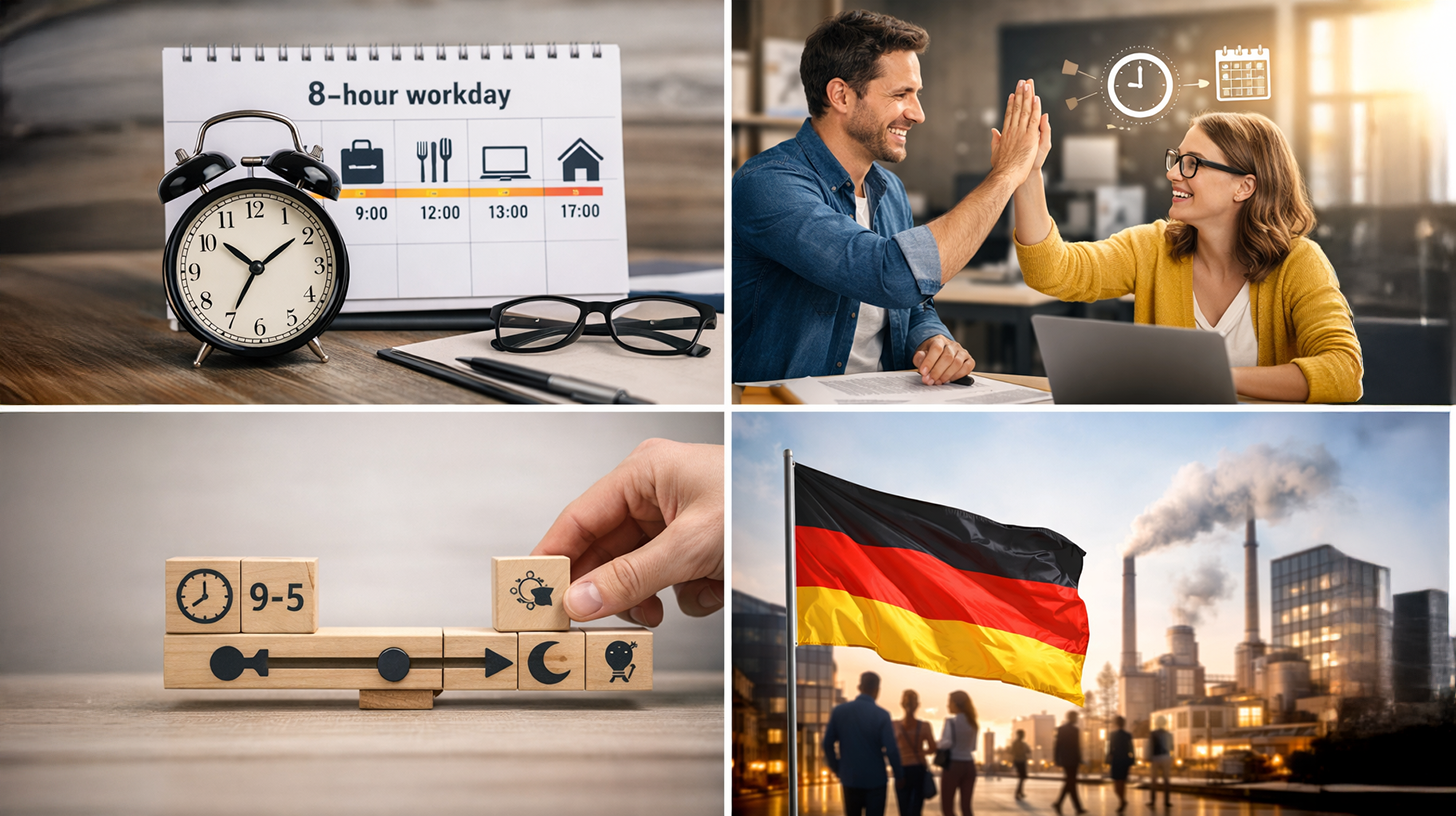
Eight-hour day | Flexible working hours in Germany: Comprehensive analysis of the labor market reform – Image: Xpert.Digital
Tax-free overtime and a 48-hour week: Who really benefits from the new flexibilization?
Farewell to the rigid eight-hour day: A historic paradigm shift in the German labor market
It is one of the oldest and most symbolic protective rights in the German labor market: the eight-hour workday, enshrined since 1918. However, in light of a dramatic shortage of skilled workers, changing lifestyles, and a weakening economy, the federal government is now planning a reform that will shake the very foundations of this model. At its core is the shift from a strict daily maximum working time to a more flexible weekly limit.
The goal is ambitious: by allowing employees to distribute working hours more flexibly – and to extend them significantly beyond ten hours on peak days – the German economy is to become more competitive. In particular, sectors with strong seasonal fluctuations, such as tourism or project-based industries, should be able to better manage peak order periods without immediately falling into the cost trap of overtime pay or bureaucratic hurdles.
But the proposal is socially explosive. While business associations welcome the long-overdue adaptation to the modern “New Work” reality, occupational health physicians and unions are sounding the alarm. They warn of health risks, declining productivity due to fatigue, and an erosion of work-life balance under the guise of flexibility.
Can this reform truly alleviate the skills shortage and improve the work-life balance, or is it a step backward in work culture? The following analysis examines the economic hopes, the concerns from an occupational health perspective, and the concrete effects on your wallet and daily work life.
Suitable for:

What does the planned change from daily to weekly maximum working hours mean?
The German government plans to reform one of the most fundamental regulations of the German labor market: the eight-hour workday, enshrined in law since 1918. Instead of a daily maximum of ten hours, there will only be a maximum weekly working time of 48 hours. In practical terms, this means that employees could work up to twelve hours and fifteen minutes on some days, as long as the average over six months does not exceed 48 hours per week. The cabinet approved this reform in early 2026 as part of the national tourism strategy, with formal legislation following later that same year.
The legal background is crucial here: Current working time legislation already permits a daily extension to ten hours if an eight-hour average per working day is maintained over a six-month period. The government argues that this regulation is too rigid and does not reflect modern working realities, especially in sectors with seasonal fluctuations.
What are the economic advantages for the German economy?
The planned flexibilization of working hours brings several significant advantages for the German economy. The federal government's central argument focuses on combating the massive shortage of skilled workers, which is severely impacting German industry. This shortage is already destroying €90 billion in added value annually, equivalent to more than two percent of the gross domestic product. According to the government's logic, more flexible working hours could partially compensate for this gap through increased working hours.
More flexible working hours allow companies to utilize their equipment, such as machinery and production facilities, more efficiently. The Federal Institute for Occupational Safety and Health (BAuA) documents that flexible working time models enable longer operating and machine run times, thereby shortening lead times. This reduces costs per unit and simultaneously increases market presence.
Another crucial advantage lies in improved handling of peak order volumes. During seasonal fluctuations or unexpected large orders, companies can deploy their staff more flexibly without immediately resorting to expensive overtime arrangements. This is a significant competitive advantage, particularly important for companies struggling with fluctuating workloads.
The government also hopes to increase its attractiveness as an employer. Flexible working time models could specifically attract skilled workers who would not enter the labor market under the existing system – for example, parents who can combine longer working days on certain days with days off, older employees, or people with caregiving responsibilities. This could partially increase the supply of workers in the labor market and thus indirectly stabilize wages and non-wage labor costs.
Will this also have a relieving effect on industry and mechanical engineering?
The B2B sector, and mechanical engineering in particular, faces a complex situation. Employers' associations, led by Gesamtmetall, generally view the reform positively. Gesamtmetall stated that it considers the proposal for more flexible working hours "fundamentally positive." This makes sense, as mechanical engineering struggles with seasonality and project-based bottlenecks.
However, the situation for mechanical engineering is less dramatic than for tourism or hospitality. Mechanical engineering already benefits from existing collective bargaining agreements that allow for greater flexibility. Over the past decades, the IG Metall union has negotiated various flexible working models with employers, meaning the German mechanical engineering industry already enjoys considerable flexibility. The real bottleneck lies not in flexible working hours, but in the actual availability of skilled workers.
The current situation in the mechanical engineering sector is worrying: In October 2025, approximately 40 percent of mechanical engineering companies reported a decline in their competitiveness. However, this is less attributable to rigid working hours than to unit labor costs, energy prices, and a shortage of skilled workers. German industry has the seventh-highest unit labor costs internationally, with a productivity advantage of only eight percent over its international competitors – a significant decrease from the twelve percent advantage of 2018.
For small and medium-sized enterprises (SMEs) in the B2B sector, the reform could provide some relief, but it is not a panacea. A GIM study shows that 85 percent of SMEs see bureaucracy as the main obstacle, not flexible working hours. Rather, SMEs primarily demand that the government reduce red tape and provide cost-effective solutions. While flexibility during peak order periods could be significant for these companies, it does not replace necessary investments in digitalization, innovation, and infrastructure.
Who specifically benefits from the reform and what challenges arise?
The primary beneficiaries are the tourism and hospitality industries. These sectors struggle with extreme seasonality, where peak seasons are characterized by alternating periods of high workload and low demand. Flexible working hours will allow hotels, restaurants, and travel providers to utilize staff intensively during peak season without exceeding the ten-hour workday limit. Simultaneously, contributions to the travel insurance fund are expected to decrease, which in turn could lower travel prices.
The reform is also intended to provide relief from unnecessary documentation requirements. The document explicitly mentions that "practical checks" are meant to identify superfluous regulations and reporting obligations in companies, particularly to protect small businesses. This suggests a broader deregulation agenda.
Tax incentives are also significant: Overtime pay, up to 25 percent of the base wage, is to be tax-free. Part-time employees will receive tax breaks for one-off bonuses when they increase their working hours. These measures aim to increase net income for overtime and thus boost the incentive to work.
The challenges, however, are considerable. Ergonomics consistently shows that longer working days lead to decreased performance. Olaf Struck from the University of Bamberg states that longer working hours beyond the eight- to nine-hour mark lead to more errors and lower overall productivity – even with high employee motivation. A Harvard study by Martin S. Feldstein as early as 1967 showed that an increase from 41 to 50 working hours per week marginally improved work output but then led to significant exhaustion. More recent research by Edward Shepard and Thomas Clifton (2000) found that a ten percent increase in overtime resulted in two to four percent less productivity per working hour.
Unions are warning of health risks. An IAB survey from 2025 shows that 72 percent of respondents want workdays of a maximum of eight hours, while 98 percent would like to work less than ten hours per day. At the same time, reality reveals that 43 percent of employees already regularly work more than eight hours a day – often against their will.
Our EU and Germany expertise in business development, sales and marketing

Our EU and Germany expertise in business development, sales and marketing - Image: Xpert.Digital
Industry focus: B2B, digitalization (from AI to XR), mechanical engineering, logistics, renewable energies and industry
More about it here:
A topic hub with insights and expertise:
- Knowledge platform on the global and regional economy, innovation and industry-specific trends
- Collection of analyses, impulses and background information from our focus areas
- A place for expertise and information on current developments in business and technology
- Topic hub for companies that want to learn about markets, digitalization and industry innovations
New working time rules: Who benefits from them and who ends up paying more?
Can the reform really improve the compatibility of family and career?
The government argues that the new regulation allows for a better work-life balance. Theoretically, this approach is not without merit: parents could combine longer working days on certain days with days off to, for example, fulfill childcare responsibilities or care for relatives. This would indeed be a form of time sovereignty that flexible working arrangements can offer.
However, this is where the government's fundamental misunderstanding lies. Research on the topic shows that genuine work-life balance depends primarily on employee participation in time management. If employers unilaterally determine when long days occur, this does not lead to better work-life balance, but potentially to worse. The Federal Institute for Occupational Safety and Health (BAuA) documents that company-imposed flexibility requirements – that is, flexibility enforced by the employer – lead to increased depression, stress, and burnout risks.
A look at successful models like the four-day week shows that true work-life balance is achieved through predictable, employee-designed models, not through forced flexibility. Studies of four-day week pilot programs even suggest that productivity can be maintained or increased because employees are more motivated by the improved work-life balance.
Suitable for:

How do tax incentives affect the actual increase in labor supply?
Tax-free overtime pay is a key incentive instrument of the reform. However, analysis and research show that its actual effect is likely to be limited. The Scientific Advisory Board of the Federal Ministry of Finance argues that the tax exemption "creates more problems than it solves." A concrete example illustrates this: An employee with a gross annual income of €56,000 receives a net income of €6.50 for a regular overtime hour of €10. With the tax-free overtime bonus, this only increases to €22.67 gross, which corresponds to a net benefit of approximately €3.50 per overtime hour. This modest difference will probably not lead to the increase in overtime that the government hopes for.
The tax exemption is also not as generous as often portrayed: it only applies up to 25 percent of the basic wage and remains subject to social security contributions. The actual net benefit is therefore significantly less than political rhetoric suggests.
What are the real opportunities for economic growth?
The chances for genuine economic growth through flexible working hours are moderate. The German Economic Institute (IW) argues that the overall volume of work in Germany could decline with the upcoming retirements of the baby boomer generation, and therefore an increase in individual working hours is important. This is demographically accurate.
However, there is a difference between theoretical workload and actual productivity and economic growth. Research consistently shows that longer working days do not lead linearly to increased productivity. An optimum working day is around eight hours, while longer days lead to a decrease in output. This means that even if flexible working hours lead to an expansion of the workload, productivity per hour worked decreases—and thus overall output may not increase.
The real relief for German industry will not primarily be achieved through flexible working hours, but rather through investments in digitalization, infrastructure, and innovation. The planned investments in highways, railways, cycle paths, and improvements to Germany's aviation sector could have a greater impact than working time reform.
What role do documentation and bureaucracy reduction play?
One positive aspect of the planned reform is the announced review of unnecessary documentation requirements. The government draft explicitly mentions that "practical checks" are intended to identify superfluous regulations, particularly to protect small businesses. This addresses a genuine need of small and medium-sized enterprises (SMEs): 85 percent of SMEs cite bureaucracy as a major burden.
These could be the truly significant relief mechanisms of the reform – not the flexible working hours themselves, but the reduction of administrative burdens. For SMEs, which are already struggling with a shortage of skilled workers, less bureaucracy could bring more relief than more working hours per employee.
However, it remains unclear how ambitious this bureaucracy reduction component truly is. The announcement is cautiously worded as "practical checks," which does not necessarily mean that concrete rule reductions will occur.
How does the reform differ in its practical application across industries?
The practical effects of the reform vary considerably between sectors. For the tourism industry, hospitality, agriculture, and seasonal businesses, the reform offers genuine relief. These sectors can benefit from the complex seasonal patterns, where periods of high workload are interspersed with periods of low activity.
For industry and mechanical engineering, which generally have more stable capacity utilization, the added value is smaller. These sectors already benefit from flexible working arrangements through collective bargaining agreements and struggle less with rigid working hours than with a shortage of skilled workers.
In the service sector and in knowledge work, longer working days could even be counterproductive. Research shows that knowledge work requires a high level of concentration, which declines after about six to seven hours. Longer working days lead to more errors, not more output.
What international benchmarks exist?
A look beyond national borders reveals that other European countries are taking different approaches. Portugal, for example, introduced stricter working hours during the Euro crisis and found marginally positive, but not transformative, productivity effects. Countries like the Netherlands and those in Scandinavia, on the other hand, are increasingly focusing on shorter working hours and greater flexibility with co-determination, sometimes with better productivity results.
The EU Working Time Directive already limits weekly working hours to an average of 48 hours. Germany is therefore within this framework, but must ensure that the planned minimum breaks and rest periods are maintained.
A pragmatic compromise with limitations?
The planned flexibilization of working hours represents a pragmatic attempt to adapt rigid working hours to modern realities. It will bring genuine relief to the tourism industry, hospitality sector, and seasonal businesses. The reduction of unnecessary documentation requirements could noticeably ease the burden on SMEs.
However, expectations regarding the economic stimulus effect of the reform should be tempered. Labor studies consistently show that productivity does not increase linearly with working hours. Tax incentives for overtime have limited effectiveness. The real relief for German industry and mechanical engineering will not primarily be achieved through flexible working hours, but rather through investments in innovation, infrastructure, and skilled worker development.
The critical success factor is that flexible working hours do not lead to forced overtime, but rather give employees genuine control over their time. Otherwise, the theoretical compatibility of family and career risks being undermined in practice by company-imposed flexibility – with negative consequences for health, motivation, and ultimately productivity. The reform will only reach its full potential if it is accompanied by genuine co-determination in time management and the promised reduction in bureaucracy.
Your global marketing and business development partner
☑️ Our business language is English or German
☑️ NEW: Correspondence in your national language!

Konrad Wolfenstein
I would be happy to serve you and my team as a personal advisor.
You can contact me by filling out the contact form or simply call me on +49 7348 4088 965 (Munich) . My email address is: wolfenstein ∂ xpert.digital
I'm looking forward to our joint project.
☑️ SME support in strategy, consulting, planning and implementation
☑️ Creation or realignment of the digital strategy and digitalization
☑️ Expansion and optimization of international sales processes
☑️ Global & Digital B2B trading platforms
☑️ Pioneer Business Development / Marketing / PR / Trade Fairs
🎯🎯🎯 Benefit from Xpert.Digital's extensive, five-fold expertise in a comprehensive service package | BD, R&D, XR, PR & Digital Visibility Optimization

Benefit from Xpert.Digital's extensive, fivefold expertise in a comprehensive service package | R&D, XR, PR & Digital Visibility Optimization - Image: Xpert.Digital
Xpert.Digital has in-depth knowledge of various industries. This allows us to develop tailor-made strategies that are tailored precisely to the requirements and challenges of your specific market segment. By continually analyzing market trends and following industry developments, we can act with foresight and offer innovative solutions. Through the combination of experience and knowledge, we generate added value and give our customers a decisive competitive advantage.
More about it here:










