40% cheaper: How China's ruthless subsidy strategy is pushing European industry to the brink – Image: Xpert.Digital
Red alert in mechanical engineering: Is Germany losing its export core to China?
Historic turning point: Why even free trade advocates are suddenly demanding tough protective tariffs
Electricity for 1.5 cents: The four real reasons for China's enormous competitive advantage
Europe's core industries are sounding the alarm: Chinese competitors are flooding the European market with price advantages of up to 40 percent – a huge gap that can no longer be closed through traditional deregulation or domestic tax cuts. Behind the rapid rise of imports from the Far East lie massive state interventions in the market, ranging from heavily subsidized industrial electricity to an artificially weakened currency. This highly distorted starting point has led to a historic rethink in German and European politics: Even traditional proponents of free trade are now calling for more robust protection for domestic economies. But the European push towards protective tariffs remains a dangerous balancing act – especially for the German automotive industry, which is deeply rooted in China and often fears potential retaliatory measures from Beijing more than the unfair competition itself.
China's competitive advantage and the limits of European countermeasures: When the will to reform fails due to mathematical limitations
Behind the dry trade data between the European Union and the People's Republic of China lies a fundamental economic policy debate that extends far beyond day-to-day political squabbles. At its core, the issue is whether Chinese companies are more successful because they are more innovative and efficient, or because the Chinese state grants them competitive advantages that cannot be compensated for by purely market-based means. This question is by no means academic, because its answer will determine whether Europe can rely on traditional location-based policies or whether structural protection measures will become unavoidable.
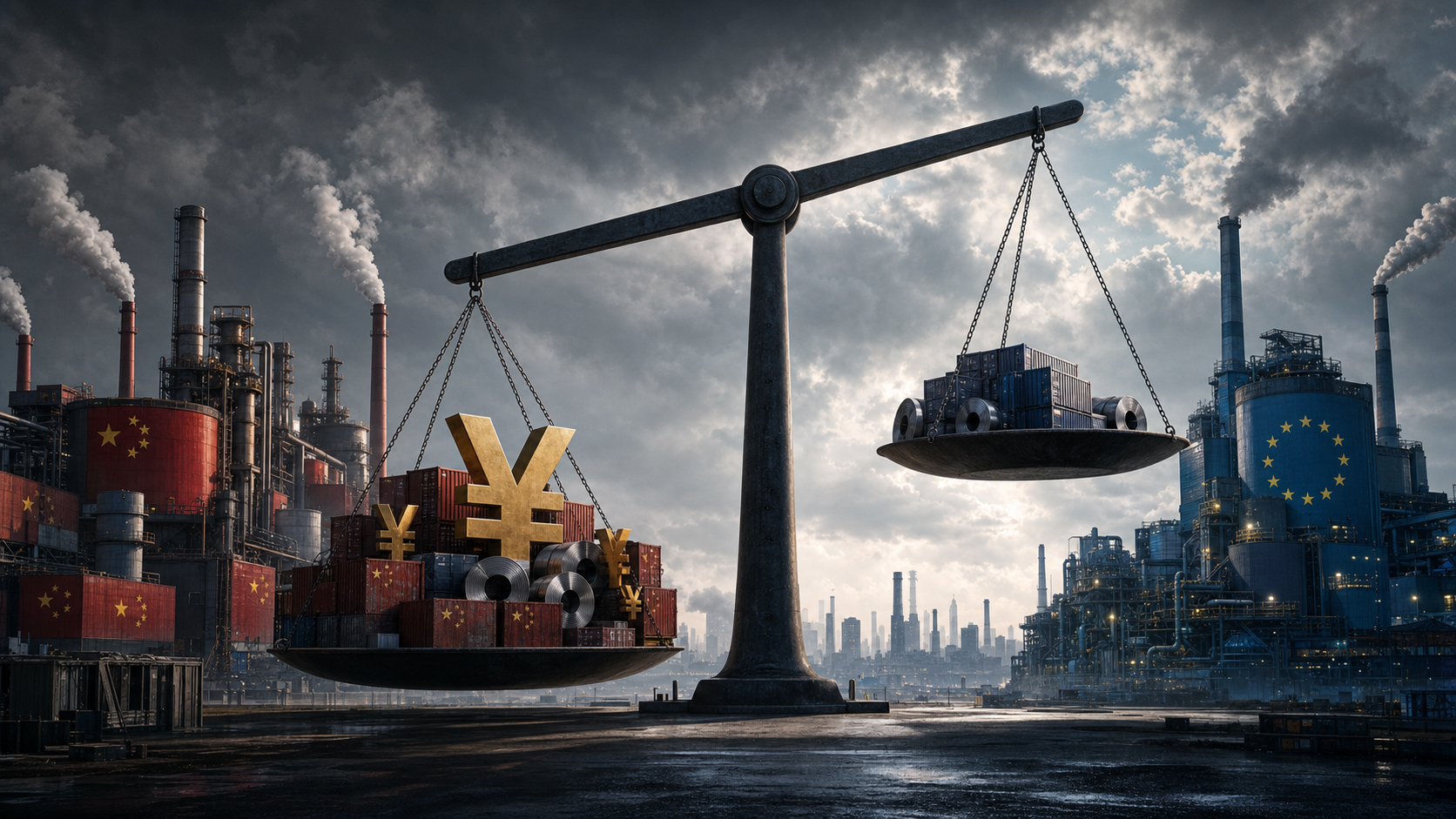
The Federation of German Industries (BDI) has estimated the cost disadvantage of European companies compared to their Chinese competitors at around 40 percent over the past two to three years. This enormous difference is not due to a single factor, but rather to the complex interplay of several distortion mechanisms: government subsidies at various administrative levels, distorted capital costs due to government-controlled financing conditions, an artificially undervalued exchange rate, and significantly lower energy costs due to government-supported industrial electricity prices. To understand this complex situation, each of these components must be examined individually, because only their sum explains why European reform efforts have so far been so ineffective.
Why traditional location reforms are not sufficient from a mathematical perspective
Sandra Detzer, the economic policy spokesperson for the Green Party's parliamentary group, made it unequivocally clear at a conference of the German Engineering Federation that no amount of deregulation, tax cuts, or innovation subsidies could close the described cost gap domestically. It was simply not mathematically possible. Therefore, structural protective measures were unavoidable. Remarkably, this assessment did not come from a traditionally protectionist politician, but from a representative of a party that has traditionally been open to free-market principles and international free trade.
CDU Member of Parliament and renowned China expert Johannes Volkmann underscored this position with equally clear language: It would be impossible to reduce bureaucracy, lower taxes, or reform so many ancillary costs to offset this market-distorting advantage domestically. Volkmann, together with Green Party politician Anton Hofreiter, presented a joint CDU/Green Party position paper on China policy, strongly advocating for European countermeasures as the only effective remedy. What is remarkable here is less the content of the demand itself than the political constellation behind it: A conservative foreign policy expert and a Green economic policy expert arrive at virtually identical conclusions, which represents an unusual signal of political convergence in the otherwise contentious economic policy debate.
The president of the Federation of German Industries, Peter Leibinger, echoed this sentiment, describing how Chinese companies have learned to replicate the German success model of innovation and industrial production, but that subsidies and an undervalued currency are distorting competition too much. He also pointed out that producer prices in China have fallen by over 40 percent in recent years compared to Europe, making competition extremely difficult for European manufacturers.
Mechanical engineering as a case study of a gradual loss of power
The growing global dominance of Chinese manufacturers is particularly evident in the mechanical engineering sector. According to current figures from the industry association, the global market share of Asian, primarily Chinese, mechanical engineering producers already stands at around 35 percent, while Germany's share has fallen to just over 11 percent, dropping it to third place in the global ranking behind the United States with 13 percent. This shift occurred within just a few years and marks a historic break for an industry that for decades was considered the heart of German engineering exports.
Association President Bertram Kawlath described the coming months as crucial for the future of the industry and called for a robust European regulatory policy that combines openness with the capacity to act. He put it bluntly: China is not playing fair, as Chinese competitors often disregard the rules of global trade. It is particularly noteworthy that the association has advocated for a regulatory policy and free trade for decades and has traditionally rejected state intervention in the market. Its current, intense call for state support is an unusual shift in policy, which, according to Kawlath, does not signify a fundamental departure from its previous approach, but merely reflects a desire for greater resilience within the existing regulatory framework.
The association documents not only pure price competition, but also blatant violations of regulations. Representatives of the association report cases in which Chinese machines, although bearing the CE marking mandatory for the European market, did not actually comply with European safety standards because importers misinterpreted the abbreviation as standing for "China Export" instead of the required conformity marking. For safety-critical products such as laser machines, this lax interpretation can pose significant risks to users.
The four pillars of China's cost advantages
To make the magnitude of the competitive distortion tangible, it is worthwhile to consider the individual cost components separately, which make up the estimated total advantage of around forty to fifty percent.
Energy costs represent one of the most tangible differences. A study by the Research Association for Energy Economics (FGYO) determined an industrial electricity price of around eight cents per kilowatt-hour in China, while large German consumers paid about thirteen cents and medium-sized industrial companies recently even around eighteen cents per kilowatt-hour. According to calculations by the IG BCE trade union, the Chinese industrial electricity price, taking into account municipal subsidies, is sometimes as low as one and a half to two cents per kilowatt-hour, which is seven to ten times higher than the German price. This massive difference is structurally explained by the fact that both electricity producers and grid operators in China are entirely state-owned, allowing the state to directly influence pricing, for example through targeted municipal subsidies for energy-intensive industries. The industrial electricity price of five cents per kilowatt hour targeted by the German government has so far proven to be hardly effective in practice due to strict funding requirements, as research by the ARD business magazine Plusminus shows, according to which the actual relief in sample calculations only amounts to from eighteen to about seventeen and a half cents.
Exchange rate policy represents the second pillar of China's cost advantage. According to several economists, the yuan is artificially undervalued, with estimates ranging from 20 to 30 percent. American economist Brad Setser and German economist Jürgen Matthes of the German Economic Institute (IW), applying the methodological standards of the International Monetary Fund, conclude that China's current account surplus rose to approximately US$735 billion last year, equivalent to 3.7 percent of Chinese economic output. This methodological approach already suggests an undervaluation of about 19 percent. However, Setser and Matthes assume that the actual structural surplus is closer to 5 percent of GDP, resulting in an undervaluation of approximately 30 percent. German Chancellor Friedrich Merz publicly addressed this criticism, warning that without a correction to this exchange rate policy, Germany would remain permanently disadvantaged. A study by the German Economic Institute estimates that a fairly valued yuan could increase Germany's inflation-adjusted gross domestic product by around 43 billion euros by 2028, measured against 2025 prices.
The third pillar consists of direct and indirect subsidies, which flow in diverse and sometimes difficult-to-trace forms. Foreign trade expert Jürgen Matthes from the German Economic Institute vividly describes how provincial governments provide companies with land free of charge or, in some cases, even entire factory buildings without compensation. When these various forms of subsidies are combined with the exchange rate undervaluation, Matthes arrives at an estimated unfair price advantage for Chinese suppliers of fifty percent or more. The Organisation for Economic Co-operation and Development (OECD) concludes in its own study that around sixty percent of China's global market share gains between 2005 and 2023 can be attributed to the exceptionally high Chinese industrial subsidies compared to other countries. When these subsidy-related gains are combined with the state-controlled currency undervaluation, relatively little room remains for purely market-driven successes of Chinese companies.
The fourth component concerns the cost of capital, which is systematically distorted by a state-controlled banking system. Chinese state-owned banks often grant loans to strategically favored industries at conditions that could not be obtained on the open capital market, thus driving investment decisions politically rather than purely by market forces. While this distortion is more difficult to quantify than energy prices or exchange rates, experts consider it a structural component of the entire Chinese subsidy system.
🎯🎯🎯 Data-driven B2B industry hub as a quasi-in-house solution


The quasi-in-house solution: How Xpert.Digital closes operational gaps in B2B marketing and sales – Smart Content-Driven Business - Image: Xpert.Digital
Xpert.Digital is a data-driven B2B industry hub led by Konrad Wolfenstein . The company acts as an external, quasi-in-house solution for industrial partners, closing operational gaps in marketing, content, and sales – without requiring additional resources on the client side.
More information here:
Europe's new trade policy: How Brussels is tackling Chinese overcapacities
The political reaction in Brussels and Berlin
The political reaction to these findings has intensified significantly in recent months. In May 2026, EU Commissioner for Industry Stéphane Séjourné announced four new safeguard measures designed to better protect European industry from Chinese overcapacity. First, companies in strategic sectors will be required to diversify their supply chains more effectively, with a guideline under discussion that no more than 60 percent of supplies may originate from a single country. Second, existing trade defense instruments are to be applied more quickly and broadly. Third, the Commission is planning a new, sector-wide safeguard mechanism that would allow the EU to impose countervailing duties on entire sectors, rather than just individual products or companies. Fourth, the European regulation against foreign subsidies is to be tightened, so that a Chinese supplier excluded from a public tender due to illegal subsidies could automatically be barred from other tenders in the same sector.
The new regulations are already particularly advanced in the steel sector. In April 2026, the Council of the European Union and the European Parliament reached a provisional agreement on a new system for steel imports, intended to replace the existing safeguard measures. The plan is to reduce the annual duty-free import quotas to 18.3 million tons, representing a reduction of approximately 47 percent compared to the 2024 protection level, while the tariff on quantities exceeding this quota will increase to fifty percent. The Commission explicitly intends this model to serve as a blueprint for broader sector-wide application, particularly in the chemical, metal, and clean-tech industries, which, according to Séjourné, are facing existential pressure from state-supported Chinese overcapacities. (Note: Here, "are" has been corrected to the singular "is" because the relative pronoun refers to "the industry.")
At the member state level, a growing coalition is forming in favor of a tougher stance. France, Italy, Spain, the Netherlands, and Lithuania have drafted a joint paper blaming systemic and structural industrial overcapacities for the loss of one million jobs in EU-wide industry between 2019 and 2025 and calling for higher tariffs on Chinese goods. The German government has also now explicitly welcomed this initiative, following Chancellor Friedrich Merz's emphasis on taking a more decisive stand against distortions of competition and his refusal to rule out tariffs altogether. Among the measures under consideration are a diversification law to reduce dependencies, sectoral countervailing tariffs in the range of 30 to 50 percent, and a set of instruments for so-called safeguard tariffs, modeled on the American Section 301. The EU's daily trade deficit with China of around one billion euros underscores the urgency with which Brussels and the national capitals are discussing effective instruments.
The German Engineering Federation (VDMA) is not calling for blanket import quotas, but rather for precisely tailored countervailing duties at the product group level. This would allow for a faster and more targeted response than traditional anti-dumping procedures, which are often too slow to take effect in the face of irreversible market losses. A proposed reversal of the burden of proof would also compel Chinese companies to disclose their actual competitive conditions. The federation explicitly emphasizes that this is not about protectionism, but about restoring fair competition, while tariff revenues would be used to promote technology-neutral innovation and provide compensation.
The contradictory role of the Chinese car market
A particularly vivid example of the ambivalence of European policy is the dispute over punitive tariffs on Chinese electric vehicles. The EU Commission imposed tiered provisional tariffs, varying in amount depending on the manufacturer: for example, 17.4 percent for BYD, 20 percent for Geely, and 38.1 percent for SAIC, the state-owned Chinese partner of Volkswagen. China's Ministry of Commerce reacted sharply, threatening countermeasures to protect the rights and interests of Chinese companies, while a spokesperson for the Chinese Foreign Ministry openly accused the EU of protectionism.
Interestingly, German automakers themselves opposed these tariffs because they are heavily dependent on the Chinese market, fearing Chinese retaliation. This situation reveals a key dilemma of European policy toward China: the same companies that suffer from unfair competition in their domestic market simultaneously earn a significant portion of their profits in China and therefore fear harsher trade policy reactions more than the distortion of competition itself. Analyses by the research institute Rhodium also suggest that even a 30 percent tariff would not render many Chinese electric vehicle models unprofitable, as they are sometimes sold in Europe for twice the price of those in their Chinese home market, thus diminishing the actual deterrent effect of tariffs.
Limits and risks of the protectionist response
While the complaints described are certainly valid, the opposing view also deserves nuanced consideration. Critics warn that selective protectionism could ultimately harm the EU itself, as it provokes countermeasures, increases supply chain costs, and raises consumer prices without actually addressing Europe's underlying structural competitive disadvantages. The Federation of German Industries (BDI) itself remains divided on the issue of trade policy: For a large part of German industry, which traditionally exports more than it imports, a confrontational trade policy is risky because Germany currently has a growing bilateral trade deficit with China and remains heavily reliant on open markets. The president of the German Engineering Federation (VDMA) also explicitly emphasized that the issue is not a fundamental departure from free trade, but merely greater resilience within a continued open trade policy framework.
Furthermore, viewing China as an innovation partner reveals a more complex reality than simply portraying it as an unfair competitor. Industry president Leibinger acknowledged that many German companies develop and produce in China for Chinese customers, thereby profiting directly from the Chinese market. Therefore, a complete withdrawal from this market would have disastrous consequences for parts of the German industry. This interconnectedness explains why, despite increasingly harsh rhetoric, German and European policymakers have so far acted relatively cautiously, relying more on sector-specific, targeted instruments than on blanket trade barriers.
Added to this is a domestic political debate about the correct order of measures. While part of the political spectrum, particularly within trade unions and sections of the Social Democratic Party, prioritizes strengthening domestic purchasing power and rejects cuts to social benefits or more flexible dismissal protection, the president of the Federation of German Industries points out that income tax in Germany is effectively the central corporate tax, since around eighty percent of companies are organized as partnerships and higher tax rates for top earners would therefore directly reduce the economy's investment capacity. This domestic political controversy demonstrates that the debate about the right response to China cannot be conducted in isolation from the fundamental debate about Germany's economic competitiveness.
An inventory with an open outcome
The available data and assessments, taken together, paint a remarkably consistent picture: The economic success of Chinese companies in international competition is only partly due to genuine productivity and innovation advantages, while a significant, empirically well-documented portion stems from state-driven distortions in energy prices, exchange rates, subsidies, and capital costs. This very realization has led to an unusual political convergence in recent months, with conservative and green politicians, traditionally free-trade-oriented industry associations, and economists traditionally critical of protectionism all concluding that conventional economic reforms alone cannot close the resulting cost gap.
At the same time, the practical implementation of the European response remains a balancing act between economic self-assertion and the risk of self-destructive escalation. The coming months, in which the sector-wide protection mechanisms announced by the EU Commission are to be fleshed out, will therefore be crucial in determining whether Europe can successfully transition from a reactive, ad hoc trade defense policy to a systematic, yet still rules-based, industrial policy, without losing sight of its own export dependence on the Chinese market and the risk of Chinese countermeasures.
📈🚀 From visibility to trust 👀🤝 Your scalable path with Xpert.Digital

From visibility to trust: Your scalable path with Xpert.Digital - Image: Xpert.Digital
In industrial B2B, sustainable business relationships rarely emerge overnight. They develop step by step – through visibility, professional relevance, recurring touchpoints, and growing trust. Xpert.Digital's 4-stage model addresses precisely this: It offers a structured path that begins with a manageable entry point and can evolve into deeper collaboration in business development if needed.
Instead of relying on loud marketing promises, this model puts the relationship at the forefront. Companies start with clearly defined, easily calculable measures and then decide, based on their own experience, how far they want to expand the collaboration. A key factor for this undisturbed trust-building process: The platform completely avoids annoying advertising ads, so the editorial focus remains solely on the companies' expertise.
More information here:
Your global marketing and business development partner
☑️ Our business language is English or German
☑️ NEW: Correspondence in your native language!

Konrad Wolfenstein
I and my team are happy to be available to you as your personal advisor.
You can contact me by filling out the contact form here wolfenstein@xpert.digital:or simply call me at +49 7348 4088 965. My email address is
I'm looking forward to our joint project.