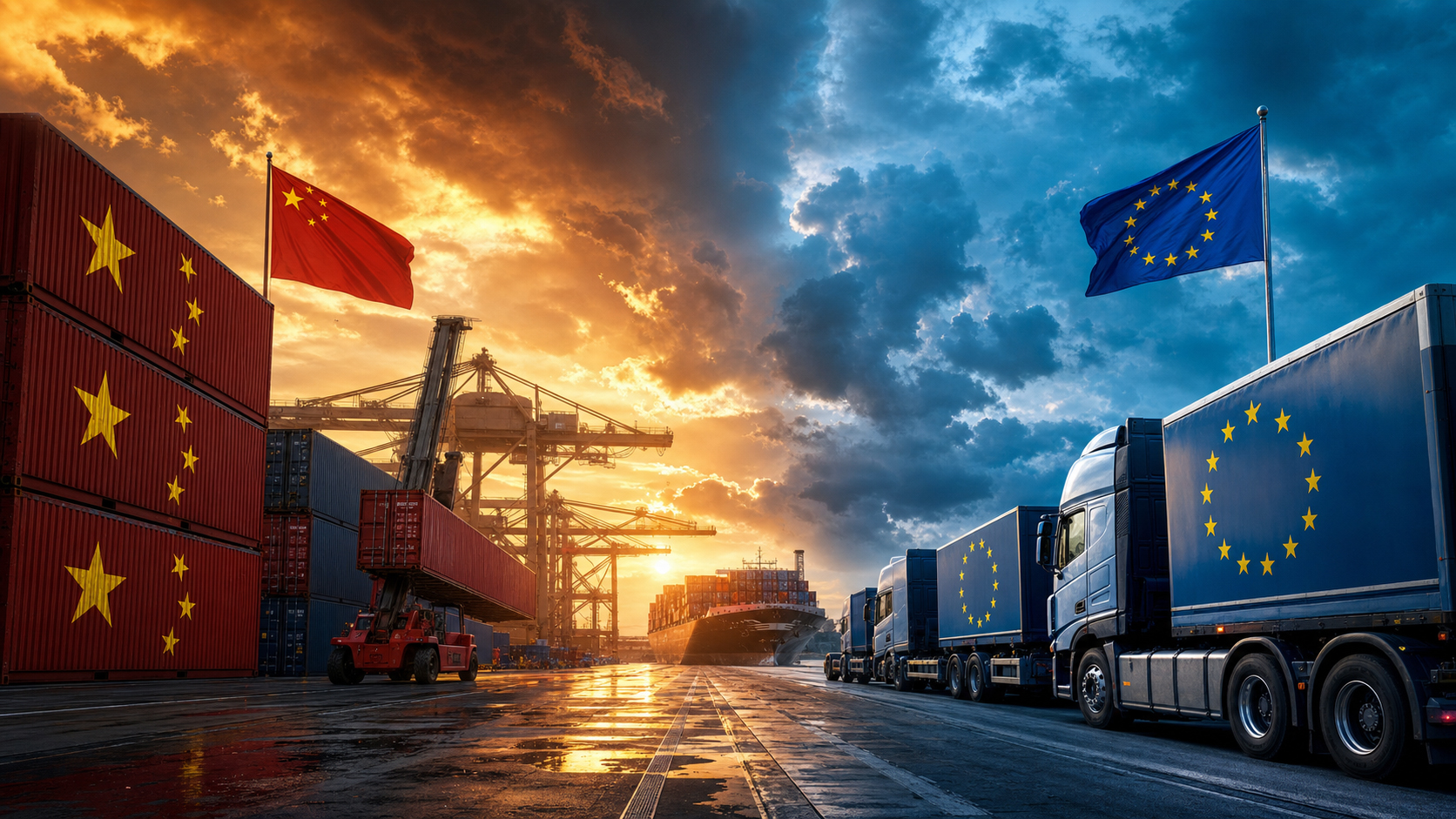
Temu, Shein & Co.: Why the fate of our China packages now lies in Bulgaria – Image: Xpert.Digital
Why China's and Europe's goods are now meeting in Bulgaria
Record deficit and parcel flood: Why Bulgaria is suddenly becoming the new China-EU trade route
Bulgaria has suddenly found itself at the center of a global economic conflict. While the European Union is attempting to protect its markets from the gigantic flood of cheap Chinese goods—driven by platforms like Temu and Shein—with new tariff barriers, Beijing is deliberately using the southeastern European country as a strategic gateway. With massive investments in logistics centers and local production facilities, China is undermining European trade barriers directly from within. For Bulgaria, this influx means a hoped-for economic upswing, but for Brussels, it reveals a dangerous vulnerability. The following text analyzes why this small EU country has become a bottleneck in international trade and what this geopolitical tightrope walk means for the future of the entire European economy.
A small country becomes the scene of a major conflict
Bulgaria, a country with just six million inhabitants and an economic output that ranks rather low in European comparison, is currently assuming an economic role that hardly corresponds to its size. At its Black Sea ports, along its railway corridors, and in its industrial parks, two opposing economic forces collide, the friction of which extends far beyond the country's borders. On the one hand, there is the Chinese export machine, which, following the American tariffs of recent years, is increasingly targeting the European market. On the other hand, there is the European Union, which, with new customs regulations, safeguard measures, and diplomatic pressure, is attempting to protect its own industry from a flood of cheap Chinese goods. Geographically and logistically, Bulgaria lies precisely at the intersection of these two forces, making it an exemplary case study of what European trade policy will actually mean in 2026.
The question of why this particular southeastern European country has become a flashpoint cannot be explained by mere chance. Historically, Bulgaria was one of the first Western countries to diplomatically recognize the People's Republic of China and has maintained close, albeit economically underdeveloped, relations with Beijing for decades. At the same time, the country has been a member of the European Union since 2007 and must adhere to its new, stricter rules regarding Chinese imports. This dual membership makes Bulgaria a test case for how geopolitical centrifugal forces manifest themselves in a single member state.
The record deficit as background noise in European politics
To understand why so much is happening in Bulgaria right now, one must consider the broader context of the European Union as a whole. In 2025, the EU exported goods worth approximately €199.6 billion to China, but imported goods worth roughly €559.4 billion. This resulted in a trade deficit of nearly €359.8 billion, the highest ever recorded in the history of bilateral relations. To put this in perspective, this deficit is more than one and a half times the total economic output of a country like Slovakia. For the first time in 2025, every EU member state had an individual trade deficit with China – a symptom of just how deeply interdependent this trade has permeated the entire Union.
This increase is not an isolated phenomenon, but closely linked to American tariff policy. After the United States, under President Trump, drastically increased its tariffs on Chinese goods, China lost a significant portion of its most important export market and had to relocate its enormous production capacity. Europe, with its more than 400 million consumers and its comparatively open single market, presented itself as an obvious alternative destination. Between November 2024 and November 2025, Chinese imports into the EU rose by almost fifteen percent; in some countries, such as Italy, the increase even exceeded twenty-five percent. In this context, Commission President von der Leyen repeatedly warned of a so-called second China shock, alluding to the wave of deindustrialization between 1999 and 2007, which at that time already cost a massive number of jobs in the manufacturing sector.
How Bulgaria became a logistical hub between East and West
Bulgaria's geographical location has always predestined the country for a role as a transit corridor. The Black Sea ports of Varna and Burgas, along with the well-developed rail network, connect Turkey, the Middle East, and ultimately Asia with the rest of the European Union. As early as 2017, a so-called e-commerce logistics hub was opened in the Trakia economic zone near Plovdiv. This hub was originally established as part of China's cooperation initiative with sixteen Central and Eastern European countries. It was intended to consolidate trade in agricultural and other products between China and the entire region and thus represents an early example of how Chinese economic diplomacy attempted to infiltrate the European trade architecture via smaller, less prominent countries.
In recent months, this role has intensified. In the spring of 2026, the Chinese ambassador to Sofia publicly emphasized that Bulgaria, with its ports and railway infrastructure, could play a key role in connecting China and Europe. Chinese companies have invested in Bulgarian agriculture, auto parts production, and renewable energy in recent years. In October 2025, a high-tech auto parts plant belonging to the Chinese company ZS Europe opened near Plovdiv – a visible sign that China is not only transiting goods through Bulgaria but also producing directly on-site to circumvent EU trade barriers. At the same time, China is increasingly importing Bulgarian agricultural products such as wine and rose oil, providing the Bulgarian government with some economic compensation and ensuring the relationship is not perceived as a purely one-way street.
The EU's new customs wall and its immediate consequences for Bulgaria
As China expands its economic presence in Bulgaria, the European Union implemented a sweeping reform of its customs rules on July 1, 2026, specifically targeting small goods that flood into the Union from China via platforms like Temu, Shein, and AliExpress. Until then, shipments with a value of less than €150 were completely duty-free – a regulation systematically exploited by Chinese platforms. The number of such small shipments into the EU rose from around 1.4 billion in 2022 to approximately 5.9 billion in 2025, with an estimated 90 percent originating from China. Since July 1, a flat fee of €3 is levied on each individual item within a shipment, regardless of its customs classification. From November 2026, an additional handling fee of around €2 will be added. This transitional arrangement will remain in place until the complete reform of the Customs Union and the introduction of a central EU customs database in 2028.
For Bulgaria, as a transit country with growing parcel volumes, this new regulation presents an immediate logistical and administrative challenge. Customs authorities, courier services, and logistics centers must adapt their processes to correctly record and declare each individual product within a shipment, significantly increasing the administrative burden. At the same time, the EU drastically tightened its protective measures against steel imports in the same reform package: the duty-free import quota was reduced by approximately 47 percent to 18.3 million tons annually, while imports exceeding this quota are now subject to a doubled tariff of up to 50 percent. Furthermore, starting in October 2026, importers will be required to prove in which country the steel was actually smelted and cast, in order to make it more difficult to route the steel through third countries like Bulgaria.
Why small packages suddenly develop political explosiveness
What at first glance appears to be a bureaucratic detail actually has significant economic consequences. The German Retail Federation (HDE) has estimated the lost value added in Germany alone due to unfair competition from Chinese platforms at several billion euros annually, with a considerable portion of this attributable to the brick-and-mortar retail sector. In addition, the systematic undervaluation of goods shipments and the evasion of VAT obligations are estimated to cost the tax authorities several hundred million euros per year in Germany alone – a figure that multiplies many times over when extrapolated to the entire EU. Tens of thousands of jobs in European retail are now considered at risk because local retailers, who must adhere to all regulations and tax rates, are competing with platforms that have been able to systematically circumvent these rules for a long time.
Bulgaria acts as a kind of bottleneck in this system, through which a significant portion of these small consignments pass on their way to other parts of the EU. The new three-euro fee therefore affects not only end consumers, who will have to pay higher prices for their orders, but also the Bulgarian logistics sector, which finds itself caught between increasing volumes of goods and stricter control requirements. Paradoxically, this new bureaucracy could even create additional jobs in Bulgaria's customs and logistics infrastructure, as more inspection personnel, more storage capacity, and more digital recording systems will be needed.
Find a partner in Bulgaria 🇧🇬 🔍🤝 and become a partner ➕


Bulgaria - Find and become a partner - Image: Xpert.Digital
Bulgaria is transforming from an underestimated EU market into a strategic nearshoring hub for European industrial SMEs. With low location costs, EU legal certainty, access to the Eurozone, and strong logistics networks on the Black Sea, the country offers robust alternatives to Asian supply chains.
At the same time, Bulgarian companies also benefit from this growing economic network, which serves as a strong springboard for their own expansion into Germany, Europe and global markets.
More information here:
A thematic hub offering insights and expertise:
- Knowledge platform covering global and regional economies, innovation and industry-specific trends
- A collection of analyses, insights, and background information from our key areas of focus
- A place for expertise and information on current developments in business and technology
- A hub for companies seeking information on markets, digitalization, and industry innovations
Europe's China dilemma: Why a unified trade strategy is still a long way off
China's strategic interest in the European periphery
From a Chinese perspective, the increased focus on countries like Bulgaria makes perfect strategic sense. While large Western European economies such as Germany, France, and the Netherlands are increasingly wary of Chinese investments and resist them in security-sensitive sectors like semiconductors and critical infrastructure, smaller, economically weaker EU member states often offer more willing partners. Bulgaria is among the poorer member states of the Union and relies on foreign direct investment to modernize its infrastructure and create jobs. Beijing is deliberately exploiting this economic vulnerability to gain a foothold in agriculture, automotive suppliers, and renewable energy without immediately attracting the political attention that comparable investments in larger countries would generate.
At the same time, China's presence in Bulgaria serves an interest in circumventing EU trade barriers. When Chinese companies produce directly in the EU, for example at the aforementioned auto parts plant near Plovdiv, the goods manufactured there are no longer subject to the same tariffs as directly imported Chinese products. This practice, often referred to in expert discussions as the local assembly strategy, allows Chinese corporations to obtain European origin labels while simultaneously benefiting from lower labor costs and more favorable operating conditions in countries like Bulgaria. For the affected regions, this means new jobs in the short term, but in the long term, it leads to a growing structural dependence on Chinese capital and Chinese supply chains.
The Bulgarian government's ambivalence between two loyalties
Bulgarian politics operates within this tension between two conflicting loyalties. As an EU member, Bulgaria is obligated to uphold all common trade rules and sanction mechanisms, including the new customs reforms and potential future safeguards against Chinese overcapacity. At the same time, the Bulgarian economy benefits significantly from Chinese investments and the growing flow of goods through the country. This dilemma is by no means unique to Bulgaria, but rather reflects a fundamental problem shared by many small and medium-sized EU member states in Central and Eastern Europe: the political will for European solidarity clashes with the immediate economic self-interest of attracting Chinese capital and trade flows as unimpeded as possible.
This ambivalence also explains why the European Union has so far struggled to develop a truly unified and effective strategy towards China. Trade expert Alicia Garcia Herrero from Natixis Bank recently summed it up perfectly, stating that the EU essentially lacks effective leverage against China. Tariffs on Chinese electric vehicles, introduced in 2024, proved largely ineffective in retrospect, while Beijing responded with its own punitive tariffs of up to 42.7 percent on European pork and dairy products. These patterns of response demonstrate that any European protective measure immediately provokes retaliatory measures, which in turn could particularly affect certain member states, such as Bulgaria, whose agricultural exports to China are growing.
Rare earths as leverage and the limits of European autonomy
Another aspect that weakens the European Union's overall negotiating position, and thus also affects the situation in Bulgaria, concerns control over critical raw materials. As global tariff tensions escalated during 2025, China began to selectively restrict its exports of rare earth elements—a move that directly threatened the European automotive, technology, and defense industries. Only after a face-to-face meeting between US President Trump and Chinese President Xi Jinping in late October 2025 did Beijing ease these restrictions, with European diplomacy virtually excluded from these negotiations. This episode painfully illustrated how little independent negotiating power the European Union actually possesses in critical geopolitical moments when it is caught between the world's two largest economies.
The case of the Dutch chip manufacturer Nexperia, whose control was initially taken over by Dutch authorities before being returned to the original owners under Chinese pressure, exemplifies how limited the scope for action is for individual member states in the face of Chinese economic interests. For a smaller country like Bulgaria, which has far less diplomatic clout than the Netherlands, the room for independent negotiations with Beijing is likely to be even smaller, making reliance on EU instruments all the more crucial.
A new consultation mechanism as a cautious step forward
Despite the tensions described, a certain easing of tensions in relations between the European Union and China has been evident since the summer of 2026. Both sides have agreed on a joint mechanism to systematically monitor mutual trade flows and contribute to reducing the European trade surplus in the long term. There are also initial signs of more pragmatic cooperation regarding rare earth elements. Nevertheless, it remains questionable whether such a mechanism can actually have a structural impact as long as the underlying causes of the imbalance—namely, massive state subsidies for the Chinese export industry and structural overcapacities in sectors such as steel, electric vehicles, and photovoltaics—remain unaddressed.
In the first quarter of 2026 alone, Chinese imports into the European Union rose by another four billion euros compared to the same period of the previous year, reaching a total of 145 billion euros; proof that the fundamental trend of a growing import surplus remains unbroken despite all diplomatic efforts. For Bulgaria, this means that its role as a transit corridor and investment location for Chinese capital is likely to increase rather than decrease in the foreseeable future, regardless of any political declarations made at the European level.
What the Bulgarian experience means for the entire European periphery
The developments in Bulgaria can be seen as a case study of a pattern that can be observed in similar form in other Central and Eastern European countries, such as Hungary, Serbia, and Greece, which are also increasingly attracting Chinese investment and trade flows. These countries benefit in the short term from new jobs, infrastructure investments, and growing trade, but are increasingly becoming structurally dependent, which could weaken their negotiating position within the European Union. Should Brussels decide on stricter EU-wide protective measures against Chinese imports in the future, such as comprehensive diversification requirements or sector-wide protection mechanisms as currently being discussed, those countries that benefit most from Chinese capital would have to cope with the greatest pressure to adapt.
This structural tension raises fundamental questions about the cohesion of European trade policy. A Union whose member states are so differently dependent on Chinese investment and imports will naturally find it difficult to pursue a unified and consistent China strategy. Bulgaria may be geographically small and economically relatively insignificant, but the country starkly illustrates how difficult it is for the European Union to simultaneously remain open to global trade and protect its own industry from unfair competition. This simultaneity of economic openness and the need for political protection will shape European trade policy for years to come, and Bulgaria will most likely remain an insightful point of observation.
A sober assessment of further developments
Realistically speaking, there is little to suggest that the underlying dynamics will reverse in the foreseeable future. As long as the Chinese economy struggles with massive production overcapacity and the American market remains closed to a significant portion of this production, Europe will remain an attractive alternative market, and smaller, receptive economies like Bulgaria will be particularly affected. The new European customs rules from July 2026 may lead to higher costs and administrative friction in the short term, but they do not address the deeper structural causes of the imbalance. A truly sustainable solution would require a coordinated industrial policy response that goes far beyond individual tariff measures and ultimately raises the question of how much economic sovereignty individual, economically weaker member states like Bulgaria within the European Union are willing and able to relinquish in order to achieve a common strategic goal.
🎯🎯🎯 Data-driven B2B industry hub as a quasi-in-house solution


The quasi-in-house solution: How Xpert.Digital closes operational gaps in B2B marketing and sales – Smart Content-Driven Business - Image: Xpert.Digital
Xpert.Digital is a data-driven B2B industry hub led by Konrad Wolfenstein . The company acts as an external, quasi-in-house solution for industrial partners, closing operational gaps in marketing, content, and sales – without requiring additional resources on the client side.
More information here:
Your global marketing and business development partner
☑️ Our business language is English or German
☑️ NEW: Correspondence in your native language!

Konrad Wolfenstein
I and my team are happy to be available to you as your personal advisor.
You can contact me by filling out the contact form here wolfenstein@xpert.digital:or simply call me at +49 7348 4088 965. My email address is
I'm looking forward to our joint project.