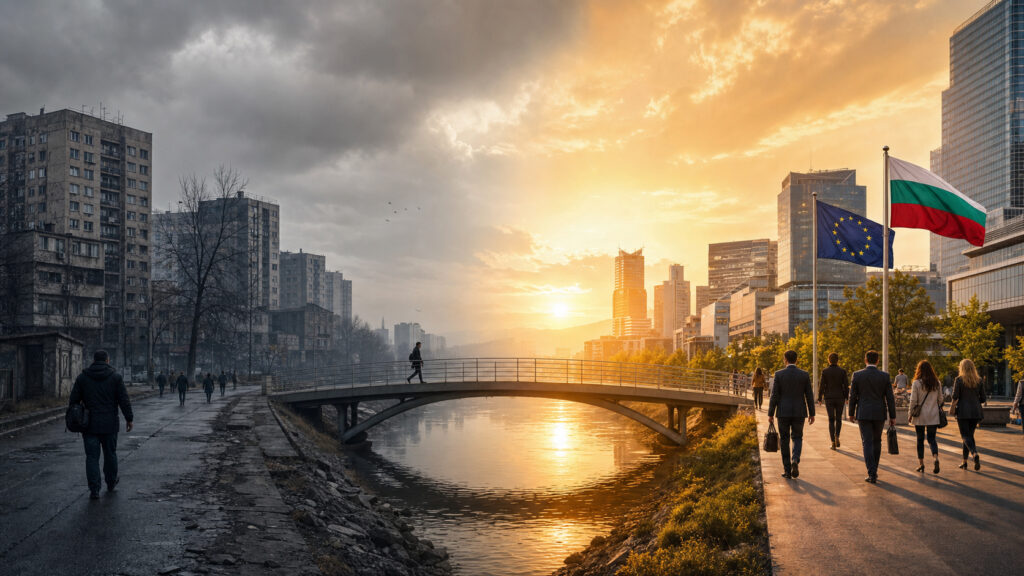

A beneficiary of global crises? How Bulgaria's strategic location could make the country rich – Creative image: Xpert.Digital
Bulgaria on the rise of economics – an assessment with obstacles
Economy in transition: What still separates Bulgaria from a major economic upswing
New Silk Road & AI Boom: What Bulgaria's Future Should Look Like
A country caught between dream economic figures and harsh structural reality: Bulgaria stands at a historic turning point. With one of the lowest debt-to-GDP ratios in the entire EU, stable economic growth, and the targeted euro accession in January 2026, the Balkan state presents macroeconomic data on paper that many Western European countries envy. But behind this glittering facade lies a profound dilemma: Bulgaria remains the weakest economic member of the European Union. While the government is pushing ahead with ambitious plans for technological modernization, AI centers, and the expansion of global trade routes, political instability, a massive skills shortage, and deep-rooted corruption threaten to block the path from low-wage economy to a modern high-tech economy. What opportunities do the new geopolitical realities offer – and is the country prepared to pay the price for far-reaching structural reforms? A comprehensive assessment.
Low debt, high ambitions – but who ultimately pays the price of modernization?
The meeting in Sofia between Bulgarian Prime Minister Rumen Radev, IMF Managing Director Kristalina Georgieva, and the IMF's Head of Mission for Bulgaria, Fabian Bornhorst, has more than just diplomatic symbolic significance. It marks a moment in which Bulgaria is seriously seeking international recognition of its economic policy shift. The topics—investment climate, technological modernization, education reform, and the country's strategic location between Europe and Asia—are not abstract policy formulas. They precisely identify the bottlenecks that, despite solid macroeconomic data, have so far prevented Bulgaria from achieving an economic breakthrough.
Solid foundation, dangerous stagnation
The macroeconomic picture Bulgaria presents today is impressive at first glance. GDP grew by 3.4 percent in 2024, significantly exceeding the eurozone average of 0.9 percent. For 2025, the National Statistical Office confirmed GDP growth of 3.1 percent in the first quarter compared to the previous year, corresponding to a nominal GDP of €23.3 billion. The OECD forecasts annual growth of between 2.4 and 3.0 percent for the period 2025 to 2027. The World Bank, however, revised its forecast for 2025 to just 2.0 percent – in response to external shocks and structural slowdowns.
Bulgaria's public debt remains among the lowest in the EU. According to Eurostat, at the beginning of 2024 it stood at just 22.6 percent of GDP, the lowest figure among all EU member states, along with Estonia. By comparison, the EU average was around 82 percent during the same period, and in the Eurozone it was almost 89 percent. With an eye toward its planned euro accession on January 1, 2026, Bulgaria reported a debt-to-GDP ratio of 23.8 percent, meeting all four Maastricht criteria. The inflation rate was 2.6 percent in 2024, and the unemployment rate fell to 3.3 percent in April 2025 – a remarkable figure for Eastern Europe.
But Prime Minister Radev himself warned that these figures were no cause for complacency. And he is right. For behind the solid macroeconomic framework lies a structural dilemma that has accumulated over years: despite respectable growth, Bulgaria remains the weakest economic member of the EU. In 2025, its purchasing power parity (PPP) adjusted GDP per capita will have an index value of 68 in the EU comparison (average = 100), which corresponds to an absolute value of €28,300 – compared to the EU average of €41,600. Luxembourg achieves 3.5 times that amount. Even taking into account the progress made in recent years, Bulgaria remains at the bottom of the rankings. This persistent income gap cannot be closed by growth figures alone – it requires an increase in productivity, human capital, and institutional quality.
The euro as a catalyst – or merely as a symbol?
Bulgaria's accession to the Eurozone on January 1, 2026, is a historic milestone, culminating over two decades of national preparation. Since 1997, the Bulgarian lev has been pegged to the euro, initially via the Deutsche Mark, and then directly. The transition was therefore practically complete before it was legally enacted. The fixed exchange rate of 1.95583 BGN per euro remained exactly stable throughout the entire ERM II reference period.
The economic benefits of formal euro accession lie primarily in the area of trust. Credit agencies previously assessed Bulgarian bonds at a discount because, technically, they were considered "foreign currency debt"—even though the lev de facto mirrored the euro. This discount now disappears, improving creditworthiness and reducing financing costs. Furthermore, exchange rate risks for trading partners are eliminated, which is particularly significant for Germany, Bulgaria's most important trading partner with a bilateral trade volume exceeding €12 billion in 2024. The Chambers of Industry and Commerce (IHK) and the German-Bulgarian Chambers of Commerce (AHK) anticipate increased attractiveness for nearshoring investments and shared service centers, further enhanced by the flat corporate and income tax rate of 10 percent—one of the lowest in the entire EU.
ECB President Christine Lagarde described Bulgaria's accession to the eurozone as strengthening its economic foundation and its resilience to global shocks. An initial assessment after 100 days shows that the feared sharp rise in prices failed to materialize. The ECB reported that the impact on consumer prices was limited, with an additional inflationary impulse of only 0.2 to 0.4 percentage points – comparable to other eurozone accessions. Nevertheless, skepticism remains warranted. Nearly half of Bulgarians rejected the euro in EU surveys, particularly in rural areas and among lower-income groups. Economists like Rossitsa Rangelova of the Bulgarian Academy of Sciences warn that the euro alone will not generate increased prosperity if the necessary structural reforms are not implemented.
The investment climate: between new beginnings and political paralysis
The central economic policy thesis of the Radev government is that Bulgaria should transform itself from a low-wage location into a hub for high-quality value creation. This is ambitious and correct – and simultaneously the most dangerous self-assertion for an economy that is not yet structurally equipped for it. High-quality investments flow to countries with stable institutional frameworks, efficient judiciaries, low corruption risks, and a skilled workforce. Bulgaria performs below average in all these areas.
In Transparency International's Corruption Perceptions Index, Bulgaria ranks 67th out of 180 countries worldwide – second to last within the EU. The Bertelsmann Transformation Index 2026 describes the political landscape as characterized by persistent instability, increasing party pluralism without a core program, and declining public trust. Between 2021 and 2024, there were seven parliamentary elections, and in December 2025, the coalition government resigned following mass protests against corruption and a controversial draft budget. Tens of thousands demonstrated in Sofia, with the younger generation, Generation Z, in particular leading the protests against cronyism and the misappropriation of state funds.
This political instability is not mere cyclical noise, but structural in nature. The EU Commission withheld reconstruction funds because reforms in the judiciary and anti-corruption measures were not sufficiently implemented. At the same time, it is evident that the minority government was dependent on the parliamentary support of the DPS party, whose leader, Delyan Peevski, was sanctioned by the US and the UK for corruption. This sends a devastating signal to international investors. Economist Georgi Angelov of the Open Society Institute emphasized that a stable government for at least one to two years is essential to truly reap the benefits of joining the Eurozone. This stability is precisely what is lacking.
The OECD, which Bulgaria aims to join by the end of 2026, clearly outlines the need for reform: market entry barriers must be reduced, competition strengthened, and institutional capacities expanded. Parliament has passed eleven legislative amendments to implement OECD recommendations in 18 months – measurable progress, but given the depth of the problem, only a first step.
The geostrategic location as an economic ace
Despite all its internal challenges, Bulgaria possesses a structural asset that no reform package can replace: its geographical location. Situated at the crossroads of five pan-European transport corridors, the country forms a bridge between Europe and the Middle East. Prime Minister Radev has deliberately placed this strategic dimension at the heart of his economic policy – thereby tapping into a nerve that is particularly sensitive in the current geopolitical climate.
Russia's war of aggression against Ukraine has virtually paralyzed the Northern Corridor of transcontinental logistics routes from China through Russia to Europe. The Trans-Caspian International Transport Route, also known as the Central Corridor, is rapidly gaining in importance: Transport volume increased from approximately 586,000 tons in 2021 to nearly 1.87 million tons in 2025, and container traffic grew from 25,000 TEU to 77,000 TEU during the same period. A volume of 10 million tons is expected for 2028.
Bulgaria is positioning itself as the European terminus of this route. The Black Sea ports of Varna and Burgas are being modernized using public-private partnership models. In April 2025, a new deep-water berth was completed at the Burgas-West port after two years of construction – representing an investment of €85 million, almost half of which came from the EU's Connecting Europe Facility funding mechanism. The new facility allows 290-meter-long ships to dock and is expected to increase cargo throughput by 30 percent. This puts Burgas-West in direct competition with the significantly larger Romanian port of Constanta.
In December 2025, the transport ministers of Greece, Bulgaria, and Romania signed a cooperation agreement for the Black Sea-Aegean Corridor Platform (BACP), which EU Transport Commissioner Apostolos Tzitzikostas described as an "essential artery in the trans-European transport network." Priority measures include the reopening of the Sofia-Thessaloniki railway line, a new rail link between the port of Alexandroupolis and Burgas, and the construction of the Shipka Tunnel under the Balkan Mountains. In November 2025, after years of deadlock, North Macedonia and Bulgaria also agreed to complete the Deve Bair border tunnel by 2030, which would complete Pan-European Corridor VIII from the Adriatic to the Black Sea.
Bulgaria and Kazakhstan, meanwhile, signed a Memorandum of Understanding on the development of the Trans-Caspian Route, in which Radev highlighted the enormous potential of the connection via Bulgaria's Black Sea ports to Georgia and further into the Caucasus. EU studies show that traffic on the Central Corridor has exploded since 2022 and that transit times between Europe and China could be halved through multimodal connections.
Digital corridors and Bulgaria's AI bet
In addition to physical infrastructure corridors, Radew explicitly identified digital and energy corridors as a strategic area for development. This formulation is no coincidence – it reflects a broader European and global reality in which data infrastructures, AI capacities, and energy security are just as crucial as highways and railway lines.
Bulgaria's country report on the European Commission's Digital Decade 2026 paints a nuanced picture. On the positive side: progressive fiber optic coverage, improved broadband access, and participation in European initiatives in the fields of semiconductors and quantum technologies. The national digital roadmap comprises 60 measures with a total budget of €2.19 billion, equivalent to 2.11 percent of GDP. On the negative side, there are significant deficits in digital skills, the digitalization of small and medium-sized enterprises, and overall innovation capacity.
Bulgaria holds a strategically significant advantage in the field of artificial intelligence: Sofia is home to one of the EU's AI factories within the European program, as well as the INSAIT institute, which conducts research at an international level. According to MEP Eva Maydel, Bulgaria possesses all the necessary prerequisites to develop company-specific AI models for various sectors. Furthermore, since 2020, Bulgaria has had a national AI strategy with six main pillars covering infrastructure, education, research, and data potential. However, the challenge lies not in strategic will, but in implementation capacity: a shortage of skilled workers, brain drain, and weak cooperation between companies and research institutions are hindering the realization of the existing potential.
Bulgaria's IT outsourcing market is projected to reach approximately €164 million in revenue by 2025. While this is small compared to other European countries, it is growing steadily. Bulgaria is positioning itself as an attractive nearshoring destination for European companies due to its geographical location, cultural proximity to Europe, and comparatively low labor costs. Sofia and Varna have established themselves as dynamic tech hubs with internationalized university programs – computer science studies are offered in English, with tuition fees ranging from €3,000 to €4,200 per year.
Our EU and German expertise in business development, sales and marketing


Our EU and German expertise in business development, sales and marketing - Image: Xpert.Digital
Industry focus areas: B2B, digitalization (from AI to XR), mechanical engineering, logistics, renewable energies and industry
More information here:
A thematic hub offering insights and expertise:
- Knowledge platform covering global and regional economies, innovation and industry-specific trends
- A collection of analyses, insights, and background information from our key areas of focus
- A place for expertise and information on current developments in business and technology
- A hub for companies seeking information on markets, digitalization, and industry innovations
Bulgaria at a turning point: How education and reforms can stop the brain drain
Education, skilled workers and the dilemma of human capital
Prime Minister Radev explicitly emphasized the importance of Bulgaria's educational tradition in the exact sciences and called for its strengthening in order to train more engineers, IT professionals, and highly skilled specialists. This statement touches upon one of the most sensitive contradictions in the Bulgarian development model: For decades, the country has produced well-trained graduates in STEM fields – and systematically loses them to other countries.
In its economic analysis of Bulgaria, the OECD notes that learning outcomes are below the OECD average and recommends comprehensive reforms: later tracking in the education system, rotation of qualified teachers to disadvantaged regions, and workplace-based training in vocational education. Wage growth was strong in 2024 and early 2025 – a sign that the labor market is tight. Companies are increasingly responding by recruiting international workers.
Historically, brain drain has been one of Bulgaria's most serious structural problems. According to recent data from DataPulse Research based on Eurostat, Bulgaria and Lithuania are among the few EU countries that have reversed their brain drain. This is a remarkable sign. Rising wages, improved economic prospects, and euro accession could reinforce this trend—but only if political instability does not deter people from returning. Per capita GDP is growing steadily in purchasing power parity terms: from an index of 52 in 2017 to 68 in 2025. Convergence is real, but slow.
One of the structural causes of the persistent lag lies in the productivity gap. The OECD confirms that while Bulgaria has reduced its income gap with OECD countries, the productivity gap remains large. Growth driven solely by increased consumption and rising wages is not sustainable – it requires a combination of technological adoption, innovation, and institutional reliability.
Energy policy: Between coal compromise and net zero
An often overlooked aspect of Bulgaria's competitiveness is its energy policy. In its latest economic report on Bulgaria, the OECD recommends an accelerated phase-out of coal, reforms to fuel and vehicle taxation, and grid investments for renewable energies – without jeopardizing security of supply. Bulgaria has already met the EU's 2030 emissions reduction target (a 55 percent reduction compared to 1990). However, the path to net-zero emissions by 2050 requires detailed plans for phasing out coal.
Bulgaria's strategic importance as an energy corridor should not be underestimated. The country lies at the crossroads of potential hydrogen transport routes from Turkey and the Caucasus towards Central Europe, is part of the Trans-Adriatic Pipeline infrastructure, and could serve as a hub for liquefied natural gas (LNG) terminals on the Black Sea. At the same time, the structurally necessary phase-out of coal presents a socio-economic challenge: the coal-fired power plants in the Stara Zagora region employ thousands of workers in an area with few economic alternatives.
Structural reforms in the context of the OECD accession process
Bulgaria's goal of OECD membership by the end of 2026 is not merely a diplomatic distinction. It means, in concrete terms, a commitment to reform standards across 25 thematic working groups, ranging from competition policy and education to anti-corruption legislation. OECD Secretary-General Mathias Cormann, presenting the economic study on Bulgaria in Sofia in February 2026, confirmed the progress made and expressed his hope that the process would be completed by the end of 2026.
The OECD specifically recommends five priority reform areas: education, the labor market with a focus on skills development, competition, anti-corruption measures, and energy. Particular emphasis is placed on reducing regulatory barriers to competition, which, together with greater efficiency in the justice system, would stimulate investment flows and increase productivity through more efficient resource allocation. Parliament has passed eleven legislative amendments to implement OECD recommendations – measurable progress, but one that requires sustained political commitment.
In light of the aging population, rising defense and investment needs, and the green transition, the OECD recommends not only moderate consolidation but also measures against undeclared work and for improved tax compliance. The EU's autumn 2025 forecast also warns that planned defense spending could lead to the budget deficit rising to 4.3 percent of GDP by 2027 – which would put the currently low debt ratio under pressure in the medium term.
The IMF perspective: Opportunities and risks in balance
The meeting between Prime Minister Radev and IMF Managing Director Kristalina Georgieva – herself of Bulgarian origin and IMF Managing Director since 2019, confirmed for a second term in 2024 – is significant both in terms of content and symbolism. The IMF forecasts GDP growth of over 3 percent annually for Bulgaria between 2025 and 2027. The agenda discussed at the meeting largely aligns with the OECD reform roadmap: improving the business climate, attracting high-value investments, technological modernization, and education reform.
What the IMF is particularly focused on with regard to Bulgaria are the fiscal risks. The currently low level of public debt is not a sustainable comfort if, at the same time, increased spending on defense, social services, and infrastructure puts a strain on the budget balance. The European Commission already anticipates that the deficit will have risen to exactly 3.0 percent of GDP by 2024 – the Maastricht limit. A prudent fiscal policy is therefore not merely a technical requirement, but a strategic necessity to avoid jeopardizing the recently acquired Eurozone status through future excessive deficit procedures.
Structural analysis: What is really holding Bulgaria back
The economic analysis of Bulgaria reveals a complex interplay of strengths and weaknesses that cannot be resolved by a single reform measure. Low debt and solid growth are genuine strengths. Its geostrategic location is a geographical advantage that has gained economic value due to the war in Ukraine. Its tradition of education in STEM subjects represents real human capital. The low tax rate sends a clear investment signal.
In contrast, there are structural obstacles deeply rooted in institutional structures: corruption at almost all levels of government and the economy; political instability that repeatedly interrupts long-term reform projects; a productivity gap that cannot sustain wage growth despite all successes; a demographic deficit due to population decline and selective brain drain; and a judicial system that lacks the efficiency and independence to serve as a reliable basis for complex economic relationships.
The interplay of corruption and political instability, in particular, creates a vicious cycle: Unstable governments have no incentive for far-reaching structural reforms because the time horizon is too short. A lack of reform entrenches corruption. Corruption undermines trust in state institutions. This lack of trust manifests itself in low civic engagement and electoral fragmentation. The mass protests at the end of 2025 did not break this cycle – they merely brought it to light.
The strategic bet: High-quality investments without an institutional basis?
The government's goal of attracting high-value-added investments is economically sound and necessary. It builds on Bulgaria's comparative advantages: low taxes, a well-trained workforce in STEM fields, geographical proximity to Western Europe, Eurozone membership, and a favorable wage structure. However, high-quality investors—in technology, pharmaceuticals, defense, logistics, or financial services—are selective. They compare investment locations not only based on cost parameters, but also on legal certainty, predictability, regulatory quality, and political stability.
In this respect, Bulgaria competes not only with Poland, the Czech Republic, and Romania, but also with non-European locations that offer similar wage advantages. The nearshoring potential is real – Germany, with a trade volume of over €12 billion, is Bulgaria's largest trading partner and benefits from the elimination of exchange rate risks following its entry into the Eurozone. German companies are actively seeking nearshoring alternatives to Asia, and Bulgaria is, in principle, well-positioned for this. However, institutional risks remain a significant obstacle.
The EU Commission's country report on the Digital Decade 2026 makes an important point: the challenges of SME digitalization and innovation capacity cannot be solved by government programs alone. What is needed is an ecosystem of functioning access to capital markets, entrepreneurial networks, technology transfer from universities, and government support, which is still under development in Bulgaria.
A country on the brink
Bulgaria is at a turning point that is rarer than it seems: there is real pressure for reform from below – from the younger generation, the mass protests, and the societal demand for anti-corruption measures. There are external frameworks – the IMF, the OECD, and the EU – that demand concrete reform agendas and guide the process. There are economic strengths – macroeconomic stability, Eurozone membership, and geostrategy capital – that could serve as the basis for a catch-up movement. And there is a clear government narrative focused on modernization and strategic positioning.
What is lacking is the institutional reliability and political continuity needed to truly navigate this turning point. Bulgaria's history of repeated government collapses, stalled reform processes, and manipulated state structures serves as a cautionary tale. Eurozone membership is not a foregone conclusion. Low debt is not a guarantee of long-term stability. Geostrategic location alone will not generate added value if infrastructure is not built, the investment climate is not improved, and the education system is not reformed.
The talks between Radev, Georgieva, and Bornhorst mark a moment when Bulgaria is asking the right questions. Economic analysis shows that the answers will depend crucially on whether Bulgaria's political class is prepared to allow the institutional changes that will generate not just growth figures, but structural prosperity. That is the real challenge – and it is greater than any debt ratio.
🎯🎯🎯 Data-driven B2B industry hub as a quasi-in-house solution


The quasi-in-house solution: How Xpert.Digital closes operational gaps in B2B marketing and sales – Smart Content-Driven Business - Image: Xpert.Digital
Xpert.Digital is a data-driven B2B industry hub led by Konrad Wolfenstein . The company acts as an external, quasi-in-house solution for industrial partners, closing operational gaps in marketing, content, and sales – without requiring additional resources on the client side.
More information here:
Your global marketing and business development partner
☑️ Our business language is English or German
☑️ NEW: Correspondence in your native language!

Konrad Wolfenstein
I and my team are happy to be available to you as your personal advisor.
You can contact me by filling out the contact form here wolfenstein@xpert.digital:or simply call me at +49 7348 4088 965. My email address is
I'm looking forward to our joint project.