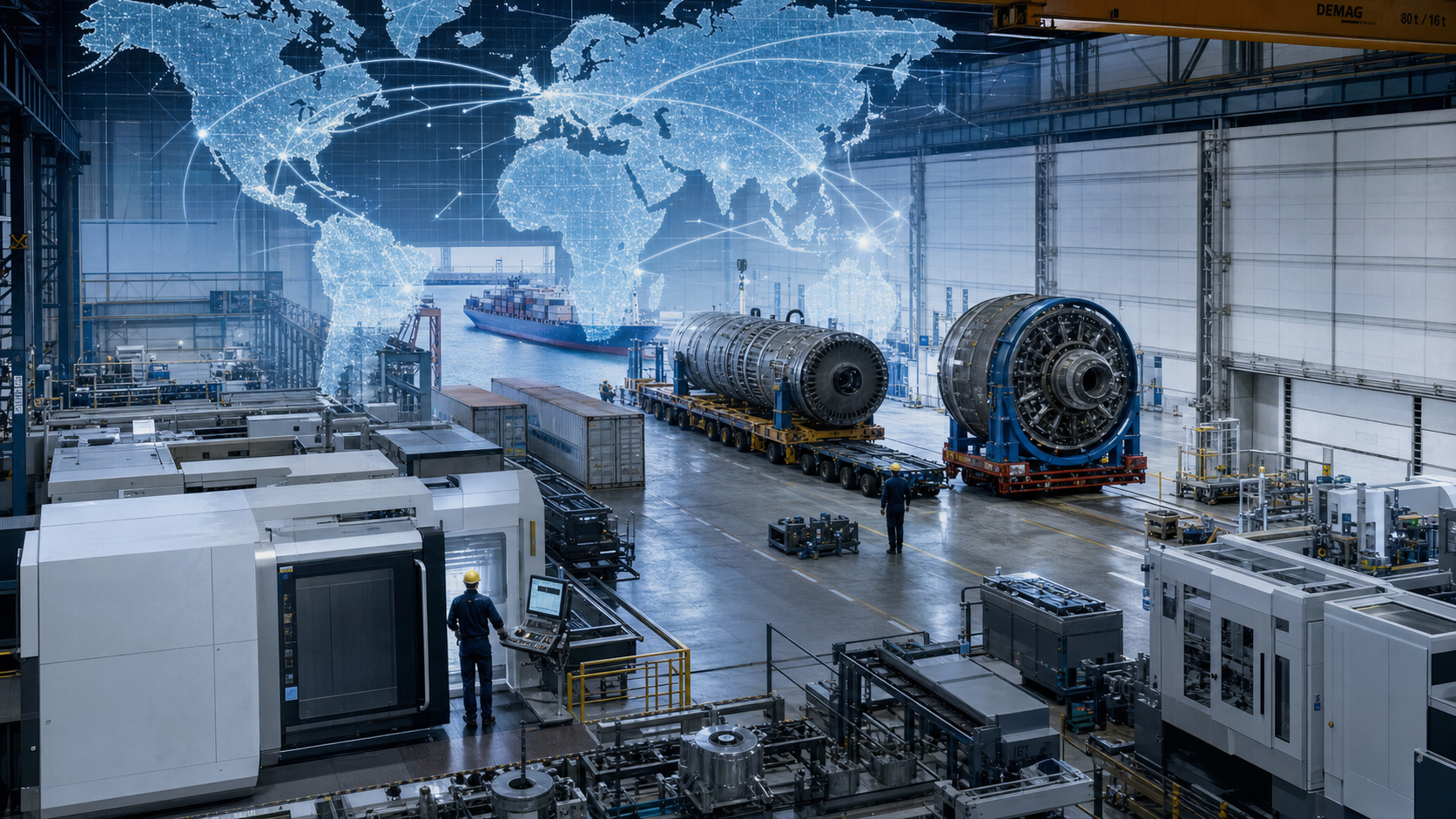
Apparent boom in industry: The bitter truth behind the new mechanical engineering figures – Image: Xpert.Digital
Despite record numbers in June: Why our flagship industry is in deep crisis
Dependent on foreign suppliers: How large orders mask the crisis in German mechanical engineering
Warning sign for Germany as a business location: The real problem behind the 21% increase in orders
A surprising 21 percent increase in orders in June 2026 – at first glance, the German mechanical and plant engineering sector appears to be on a spectacular recovery. But this celebratory mood is massively deceptive. A closer look at the latest VDMA statistics reveals a symptom of a profound structural imbalance. The supposed boom is driven almost exclusively by individual large orders from overseas, while domestic and Eurozone demand is collapsing dramatically. High energy costs, paralyzing bureaucracy, and global geopolitical tensions are causing an unprecedented investment backlog in Europe. The current record figures are therefore not a breakthrough, but rather a loud wake-up call for Germany as a business location.
Germany's mechanical engineering sector lives off foreign imports, no longer off its own resources
When large contracts mask weaknesses in one's own country
The latest figures from the German Engineering Association (VDMA) sound like a success story at first glance. In June 2026, orders were 21 percent higher than in the same month of the previous year, adjusted for inflation, driven by several large orders from overseas. This resulted in a five percent increase for the first half of the year compared to the same period last year. However, a closer look quickly reveals that this apparent upswing rests on a single pillar: foreign business, particularly business with customers outside the Eurozone, which is currently sustaining the industry. Without this segment, the balance sheet of Germany's second most important export sector would be disastrous. This discrepancy between a superficially positive headline and a structurally worrying reality warrants deeper economic analysis, as it reveals much about the true state of Germany's industrial sector.
The bare facts behind the success story
To understand the full extent of this development, it's worth examining the individual components of the order statistics. Orders from customers outside the Eurozone rose by 16 percent in the first half of 2026, while in June alone, total foreign orders increased by 29 percent and orders from non-Eurozone countries by 54 percent. These enormous increases are largely attributable to one-off effects in the large-scale plant business—that is, individual, very large orders that carry significant statistical weight but do not reflect a broader upswing in demand. At the same time, orders from Germany itself declined by two percent in the first half of the year, while orders from the Eurozone fell by eight percent. In June alone, business with Eurozone partner countries dropped by 17 percent, although this decline is partly due to an unusually strong figure for the previous year. Domestic business remained virtually unchanged in June, with an increase of just one percent. These figures paint a picture of an industry that is practically stagnating or shrinking in its own country and in its most important economic area, the Eurozone, while individual large projects from distant markets pull the overall statistics upwards.
Why a single large order distorts the entire statistics
The mechanical and plant engineering sector is particularly dependent on large-scale projects, such as complete factory plants, power plant components, or large petrochemical installations, whose order value often amounts to several hundred million euros. If such an order is booked in a particular month, it can shift the monthly growth rate of the entire sector by double-digit percentage points, even though the fundamental demand situation remains unchanged. This effect is precisely what is evident in June 2026, when several large orders from overseas significantly influenced the statistics. Economically, this means that monthly order intake figures in plant engineering should be interpreted with caution and always considered within the context of longer periods. The three-month average or a half-year comparison therefore provides a more reliable picture than a single monthly figure. Looking at the second quarter as a whole, there is an increase in orders of seven to eight percent compared to the previous year, which, while also positive, does not alter the fundamental diagnosis of export-driven and weak domestic economic development.
The reluctance to invest is the real core problem
The crucial finding lies not in the fluctuating export figures, but in the persistent reluctance of German and European companies to invest. When German firms themselves order fewer machines and equipment, it signals a deep-seated caution regarding their own economic location. Companies only invest in new production facilities if they anticipate rising demand, if energy costs are predictable, if bureaucracy remains manageable, and if the political framework offers planning certainty. These are precisely the areas where Germany has been struggling for years. High energy prices, complex permitting processes, sluggish digitalization of public administration, and a comparatively high tax burden on corporate profits are deterring investment decisions. The association's economic expert sums it up perfectly when she points out that Germany and Europe lack the necessary framework conditions to encourage companies to invest more again. This statement is not mere association rhetoric, but is consistent with a multitude of other indicators, such as the declining capacity utilization in the industry over the years, which has recently fallen to around 78 percent and is thus significantly below the long-term average of about 86 percent.
How the geographical map of exports is shifting
A look at the regional distribution of exports reveals a remarkable shift in global trade flows. The two traditionally most important individual markets for German mechanical engineering, the United States and China, are noticeably declining in significance. In 2025, exports to the US fell by eight percent, while exports to China even dropped by 8.2 percent. Both declines are closely linked to geopolitical upheavals, particularly the US government's tightened tariff policy on European industrial goods and the continued reluctance of Chinese industrial companies to invest, as they increasingly rely on domestic machine manufacturers. At the same time, significant growth impulses are evident in other regions of the world. Exports to the Mercosur countries increased by 5.3 percent, exports to the Middle East rose by 7.1 percent, and deliveries to Africa even grew by 9.2 percent. This shift is economically significant because it shows that the German mechanical engineering sector is in a phase of realigning its global sales markets, away from its previous main customers and towards a more diversified, but also more volatile, customer portfolio in emerging markets.
The role of the USA and its tariff policy as a burden factor
The development of the American market, which for many years was the most important single sales market for German machinery and equipment, deserves particular attention. The tariffs imposed by the US government on industrial goods significantly impacted the sector's export balance last year, resulting in German companies facing noticeable competitive disadvantages compared to local American manufacturers. This trend continued in the first quarter of 2026, with exports to the US declining by 6.7 percent. This development is so serious because it not only reflects a short-term economic downturn but also indicates a structural realignment of transatlantic trade relations. Companies heavily dependent on US business are faced with the choice of either accepting higher tariffs and sacrificing margins, establishing production capacity directly in the US to circumvent tariff barriers, or focusing on other sales markets. All three options involve considerable costs and strategic risks and illustrate the extent to which geopolitical decisions now determine the operational planning of German industrial companies.
Europe is gaining in importance, but demand remains fragile
Interestingly, despite the aforementioned declines in the Eurozone, the European single market is gaining relative importance for certain mechanical engineering sectors in the long term. In some sub-sectors, such as general aeronautical engineering, the share of EU member states in total exports is expected to rise to around 60 percent by 2026, while the importance of North America, and especially China, continues to decline. This shift within Europe, however, is a double-edged sword. On the one hand, geographical and cultural proximity to European customers offers stability and lower transaction costs. On the other hand, current developments show that the Eurozone itself is suffering from weak investment activity, meaning that a greater focus on Europe does not automatically equate to more robust growth. Countries like Italy and Spain recorded double-digit and high single-digit export growth in 2025, at 9.5 and 8.4 percent respectively, while France and Austria reported declining orders. These differences within the Eurozone illustrate that the economic recovery is highly uneven and that sweeping statements about the European market as a whole can be misleading.
🎯🎯🎯 Data-driven B2B industry hub as a quasi-in-house solution


The quasi-in-house solution: How Xpert.Digital closes operational gaps in B2B marketing and sales – Smart Content-Driven Business - Image: Xpert.Digital
Xpert.Digital is a data-driven B2B industry hub led by Konrad Wolfenstein . The company acts as an external, quasi-in-house solution for industrial partners, closing operational gaps in marketing, content, and sales – without requiring additional resources on the client side.
More information here:
Structural crisis in mechanical engineering: Between short-term stabilization and prolonged slump
The long shadow of three weak years
To properly assess the current situation, one must look at the preceding years. Between 2022 and 2025, the German mechanical engineering sector experienced three consecutive years of declining or stagnant order intake. Only in 2025 was a trough reached with zero real growth, following a decline in 2024. This prolonged period of stagnation has left deep scars on the industry, evident, among other things, in low capacity utilization and a subdued willingness to invest on the part of the companies themselves, which are postponing their own expansion investments in light of the uncertain order situation. The initial hope for a significant recovery in 2026, with real production growth of one percent, had to be revised downwards several times during the year. At one point, production fell by 2.6 percent in real terms from January to April 2026, prompting the industry association to lower its annual forecast to zero growth. Against this background, the positive headline from June is considerably less significant, as it marks at best a short-term stabilization at a low level, but not a sustainable trend reversal.
Geopolitical uncertainty as a constant companion
In addition to trade disputes with the United States, further geopolitical crises are impacting the industry's planning certainty. The war in the Gulf region and ongoing tensions in the Middle East have repeatedly led to uncertainty regarding investment decisions in recent months and further delayed the industry's recovery. Around 15 percent of companies are now reporting new supply chain problems attributable to these geopolitical tensions. This complex situation of tariff disputes, armed conflicts, and fragile supply chains makes it considerably more difficult for companies to make long-term investment decisions, as planning horizons are drastically shortened in such a volatile environment. If companies don't know whether a new production facility will still be economically viable in two years because tariffs, energy prices, or supply chains may have fundamentally changed, investment decisions are postponed or canceled altogether. This very mechanism explains a significant part of the persistent weakness in investment in Germany and Europe.
Structural location disadvantages that will not resolve themselves
The improved framework conditions repeatedly called for by industry associations address a whole range of structural factors that cannot be remedied in the short term through monetary policy measures or economic recovery. These include the comparatively high energy costs in Germany, which particularly increase the cost of energy-intensive manufacturing processes in mechanical engineering; an above-average density of regulations compared to other countries, which often delays approval processes for new production facilities for years; and a shortage of skilled workers, which is increasingly becoming a limiting factor for production expansion, especially in technical professions. In addition, many medium-sized mechanical engineering companies have a comparatively low investment rate in digitalization and automation, which could cause them to lose ground in the global competition for technological leadership. These structural problems act as a brake that will persist even if the overall economic climate improves. Without targeted political reforms in these areas, the reluctance of German companies to invest is likely to remain a permanent condition, even if global demand for industrial equipment recovers.
Mechanical engineering as an early indicator for the overall economy
The mechanical and plant engineering sector has traditionally been considered a particularly sensitive leading indicator for the development of the overall German economy, as the industry is at the beginning of many industrial value chains. When companies in the automotive, chemical, or electrical engineering industries reduce their investments, mechanical engineering companies feel this immediately in the form of declining orders, often even before this trend is reflected in other macroeconomic indicators. Against this backdrop, the persistent weakness of domestic business should be seen as a warning signal that extends beyond the sector itself and allows conclusions to be drawn about the general investment sentiment across the entire German industrial landscape. Should this reluctance continue, there is a risk of repercussions for the labor market in the medium term, because an industry that relies primarily on exports and experiences little growth domestically is significantly more vulnerable to external shocks such as sudden tariff increases, geopolitical escalations, or slumps in demand in individual target markets.
Opportunities beyond crisis rhetoric
Despite all the justified concerns about the structural weaknesses of the industry, the analysis should not remain solely focused on crisis rhetoric, as there are indeed signs of the sector's adaptability and technological strength. Global demand for innovative machinery and equipment, particularly in the areas of automation, energy technology, and water and environmental technology, remains consistently high. German companies continue to possess unique technological advantages in many of these segments, which are in high demand internationally. The recent increase in orders from the Middle East, Africa, and the Mercosur countries demonstrates that there are growth markets that have not yet been sufficiently developed and whose development represents a genuine strategic opportunity. Similarly, the increasing shift of production capacities away from China to other locations in Southeast Asia and India offers German mechanical engineering companies an opportunity to position themselves as suppliers to these new manufacturing sites. The crucial factor will be whether German companies and policymakers actively seize these opportunities instead of focusing solely on defending traditional sales markets.
What needs to be done now, both politically and entrepreneurially
From an economic perspective, the current data clearly indicates a need for action, affecting both policymakers and businesses. At the political level, there is an urgent need for a significant reduction in energy costs for energy-intensive industries, a drastic acceleration of approval processes for investment projects, and a reduction in bureaucratic hurdles, which disproportionately burden small and medium-sized enterprises (SMEs). At the European level, a coordinated trade policy would be desirable, one that speaks with one voice to both the US and China, thereby wielding more negotiating power than individual member states could ever achieve. On the corporate side, increased diversification of sales markets is necessary to reduce dependence on single major markets like the US or China and instead build a broader, more resilient customer portfolio. Furthermore, companies should invest more heavily in their own digitalization and automation to enhance their competitiveness and counteract the skills shortage through higher productivity per employee. These measures will not work overnight, but without them, Germany's key industry risks permanently slipping into the role of merely a recipient of global major projects, instead of growing on its own and with solid domestic demand.
A wake-up call, not a reason to sound the all-clear
The June figures for the mechanical and plant engineering sector ultimately serve as a cautionary tale about how deceptive individual economic reports can be when viewed in isolation. A 21 percent increase compared to the previous month sounds like a success story, but on closer inspection reveals itself as a symptom of a profound structural imbalance. A key German industry with a long tradition is almost entirely dependent on the goodwill of large foreign customers, while the domestic economy and the European economic area are providing hardly any impetus. This development should be understood as a clear warning signal requiring swift and decisive political action. If such action is not taken, Germany risks the gradual erosion of its industrial base in a sector that has been considered a showcase of German engineering for decades and that should continue to play a central role in the country's prosperity and employment.
📈🚀 From visibility to trust 👀🤝 Your scalable path with Xpert.Digital


From visibility to trust: Your scalable path with Xpert.Digital - Image: Xpert.Digital
In industrial B2B, sustainable business relationships rarely emerge overnight. They develop step by step – through visibility, professional relevance, recurring touchpoints, and growing trust. Xpert.Digital's 4-stage model addresses precisely this: It offers a structured path that begins with a manageable entry point and can evolve into deeper collaboration in business development if needed.
Instead of relying on loud marketing promises, this model puts the relationship at the forefront. Companies start with clearly defined, easily calculable measures and then decide, based on their own experience, how far they want to expand the collaboration. A key factor for this undisturbed trust-building process: The platform completely avoids annoying advertising ads, so the editorial focus remains solely on the companies' expertise.
More information here:
Consulting - Planning - Implementation

Konrad Wolfenstein
I would be happy to serve as your personal advisor.
You can contact me at wolfenstein∂xpert.digital or
Just call me on +49 7348 4088 965 .