
AI-supported procurement management, purchasing and controlling: an analysis of accio.com and market alternatives
Xpert pre-release

Language selection 📢
Published on: June 10, 2025 / update from: June 10, 2025 - Author: Konrad Wolfenstein

AI-supported procurement management, purchasing and controlling: An analysis of accio.com and market alternative-Image: Xpert.digital
Procurement 4.0: Why artificial intelligence fundamentally changed B2B shopping - from the search for delivery to the product comparison
For the management: The AI platform gives small and medium-sized companies large corporate shopping power
The strategic importance of artificial intelligence (AI) in modern procurement increases rapidly. AI technologies transform traditional purchasing processes, enable significant efficiency increases, cost savings and data-based decision-making. This report analyzes the skills of AI-based tools, especially the Accio.com platform, for procurement management, purchasing and controlling. Accio.com positions itself as a AI-based B2B platform that aims to simplify complex procurement processes and uses technologies such as Large Language Models (LLMS) and knowledge graphs. The core advantages of accio.com include functions such as "Perfect Match" for finding ideas and supplier selection as well as "Super Comparison" for the product comparison, which can be of great value, especially for small and medium -sized companies (SMEs).
The report illuminates the unique selling points of accio.com compared to other established AI tools and traditional supplier directories. It becomes clear that platforms such as accio.com could advance democratization of advanced procurement intelligence. This opens SME, which traditionally did not have the resources for extensive market research and supplier examination, new opportunities and could increase competitiveness within their supply chains. However, the implementation of such AI solutions also has challenges, including data quality, costs, qualification gaps and ethical aspects that have to be carefully addressed. Roles in purchasing and controlling are expected to develop, away from manual data acquisition and to strategy tasks such as the validation of AI generated knowledge and the management of exceptional cases.
The changing landscape of procurement: the advance of artificial intelligence
The procurement system is in a fundamental change, driven by the progressive development and implementation of artificial intelligence. This technological revolution not only changes individual process steps, but also the entire paradigm of how companies shape their shopping, procurement and controlling functions and align strategically.
Transformative effects of AI on procurement, purchasing and controlling
Artificial intelligence acts as a catalyst that transforms the procurement of a primarily tactical, cost -focused function into a strategic, value -oriented partner in the company. An essential aspect is the automation of routine tasks. Activities such as manual data input, processing of orders and the comparison of invoices can be adopted efficiently by AI systems, which releases human labor for higher-quality, strategic tasks.
In addition, AI-based analyzes enable significantly improved data use. Companies benefit from increased transparency through their expenses (donation visibility), optimization potential for reducing costs can identify more precisely and recognize risks at an early stage. The decision making is placed on a solid, data -based basis by predictive analyzes, more precise demand forecasts and the evaluation of market trends. This not only leads to better purchasing conditions, but also contributes to the development of more dynamic and resilient supply chains, since AI systems are able to signal potential disorders at an early stage and show alternative options for action.
The implementation of AI in purchasing goes beyond the mere optimization of existing processes; It creates the basis for completely new procurement models. Concepts such as predictive sourcing, in which future needs and market changes are anticipated, or the establishment of dynamic supplier ecosystems that adapt flexibly to changed conditions can only be realized by AI. The ability of AI to model complex dependencies in global delivery networks and proactively control, as described as a vision for AI-controlled marketplaces and autonomous agents, indicates a fundamental redesign of the procurement. Companies that do not use these technological possibilities run the risk of falling behind in terms of cost efficiency, agility and the quality of their strategic supplier relationships. The competitive advantage will increasingly be among those organizations whose procurement functions are expanded and strengthened by AI.
Key AI technologies in procurement (NLP, ML, Genai, knowledge graph, AI agent)
The transformation of the procurement system by AI is based on a portfolio of various, often linked technologies:
Natural Language Processing (NLP)
NLP enables computer systems to understand, interpret and generate human language. NLP is used in purchasing to analyze unstructured data such as contracts, supplier correspondence and market reports. It drives chatbots for internal and external communication and allows users to formulate inquiries in natural language, which significantly improves the usability of procurement tools. The extraction of relevant clauses from contracts or the mood analysis in supplier feedback are other fields of application.
Machine learning (ml)
ML algorithms are the heart of many AI applications in procurement. They are used for sample recognition in large amounts of data, for predictive analyzes (e.g. demand forecasts, risk assessments), for the evaluation and classification of suppliers (supplier scoring) and for the automatic categorization of expenses (Spend Classification). ML models learn from historical data and can continuously improve your forecasts and decisions.
Generative AI (Genai)
Genai, especially through LLMS, has the potential to revolutionize the creation of content in the procurement process. Applications include the design of offer inquiries (RFQS), the combination of analysis reports, generating contractual clauses or personalized supplier communication. Genai can also support the development of negotiation strategies, for example by suggesting argumentation lines or alternative scenarios.
Knowledge graphs (Knowledge Graphs)
Knowledge graphs serve to structured complex information about suppliers, products, markets and their relationships with each other. They enable a holistic view of the procurement environment and can generate deeper, context -related insights that go beyond simple data analyzes. Accio.com, for example, uses over 200 industry -specific knowledge graphs.
AI agent (Ai Agents)
AI agents are (semi-) autonomous software entities that can take on specific tasks in the procurement process. This includes the automated search for delivery, the implementation of negotiations (see autonomous negotiating agents), monitoring risks or processing of inquiries.
The true strength of these technologies often only unfolds in their interaction. For example, NLP enables a GEMAI application to understand the natural language request of a buyer for the creation of a draft contract, while ML models can help refine and optimize the generated content based on the analysis of past contract success. The ACCIO.com platform illustrates this integrative approach by combining LLMs with NLP and knowledge graphs to edit complex inquiries. This synergetic interaction is crucial for the development of advanced AI solutions and paves the way for “Agentic Ai” systems in which these combined technologies act with increasing autonomy. For companies, this means that understanding the individual technologies and their interdependencies is essential to develop effective AI strategies and select the appropriate tools. An isolated use of individual AI components is rarely developing the same transformative potential as an integrated approach.
Deep insight: Accio.com-AI-based procurement and source finding
Accio.com is entitled to fundamentally simplify and optimize the procurement and source finding processes, especially for small and medium-sized companies (SMEs) by using artificial intelligence. A detailed view of the platform, its functions and the underlying technology is crucial to understand your potential and positioning in the market.
Core mission, vision and platform identities
The core mission of Accio.com, a platform developed by the Alibaba Group, is to simplify product procurement and to accompany companies on their way from the first idea to the finished creation. Inspired by the magic saying “Accio” (lat. “I call up”) from the Harry Potter series, the platform aims to provide users quickly and efficiently access to relevant supply chain resources. This focus is explicitly aimed at global SME buyers, trading agents and cross-border sellers.
Accio.com defines its identity over three core areas:
- A AI-based B2B search engine.
- A AI-based B2B-Wikipedia.
- An end-to-end e-commerce platform.
This triple identity underlines the endeavor to be far more than just a simple sourcing tool. Accio.com wants to create an integrated ecosystem for B2B trading that combines information discovery (search engine), knowledge acquisition (Wikipedia aspect, e.g. via market trends, product details) and transaction processing (e-commerce platform). The platform is based on over 25 years of industry experience from its original company, the Alibaba Group. If accio.com succeeds in the successful integration of these three identities, this could significantly reduce the friction losses in international trade for SMEs by offering a central point of contact for the entire process. However, the implementation of such a comprehensive vision carries considerable challenges and risks in execution.
Key functionalities for procurement, purchasing and controlling
Accio.com offers a number of AI-controlled functionalities that are tailored to the specific needs of procurement, purchasing and controlling:
AI-controlled source finding and "Perfect Match" ideas finding
An outstanding feature is the ability to enable users to formulate business ideas or complex requirements in natural language. Accio.com analyzes these entries - be it texts, images, files or URLs - and translates them into concrete, implementable steps. This includes the identification of relevant suppliers, the provision of cost calculations and shipping details. The "Perfect Match" process aims to conceptualize business ideas and find suitable, verified products and suppliers. The platform uses a global supplier network with over a million verified providers, including sources such as Alibaba.com, 1688 and Europages. A “Deep Search” function also supports with complex requirements and the assessment of supplier reliability. This approach that frees users from pure keyword search and instead tries to understand the intention and context of profoundly understand new sourcing options and in particular support the early phase of product development. For companies that explore new product lines or for start-ups, this can significantly reduce the entry hurdles, since the initial research work is significantly expanded by AI.
The "Super Comparison" function
This function enables an immediate and comprehensive comparison of selected products. It highlights the best -selling and most competitive options from millions of products and provides detailed comparison overviews.
Product encyclopedia and market insights
Accio.com acts as a kind of "B2B-Wikipedia" by showing dynamically product specifications, price tension, sales data and other multi-dimensional information. Users receive access to real-time social media trends and retail knowledge. The platform includes over 200 industry -specific knowledge graphs that are continuously updated. A “Business Research” function can even create professional business plans including cost estimates and supplier recommendations.
Accio AI agent
The platform integrates four specialized AI agents for product operation, intelligent reception, marketing support and risk advice. The "Intelligent Reception Agent", for example, can not only edit customer inquiries, but also call up logistics information, clarify details with buyers and design orders. The use of such agents indicates a trend towards autonomous procurement tasks, in which the AI not only informs but actively participates in the workflow. This promises significant efficiency gains, but at the same time raises questions regarding surveillance, responsibility for the actions of the AI agents and the need for robust human-in-the-loop (HITL) mechanisms, especially in the case of critical processes such as order releases or risk reviews.
Controlling-related functions
Accio.com supports controlling by consolidating processes on a single platform, which facilitates cost control and expenditure management. Integrated tools such as a profit margin calculator and templates for orders (Purchase Order) are also available. The platform also automates the creation of offer inquiries (RFQ) and the supplier selection with the aim of receiving offers within 24 hours. The possibility of receiving cost estimates and feasibility analyzes at an early stage is of great value for budget planning and investment decisions in controlling.
The following table summarizes the core skills and AI-based functions of accio.com:
Accio.com-core skills and AI-based functions

Accio.com-core skills and AI-based functions-Image: Xpert.digital
Accio.com offers comprehensive AI-based functions for procurement, purchasing and controlling. The platform enables naturally language ideas with “Perfect Match” technology, which process business ideas and automatically identify suitable suppliers, costs and shipping options. The use of Large Language Models, Natural Language Processing and knowledge graphs is simplified and enables an early cost estimate.
The “Super Comparison” function offers immediate, comprehensive product comparisons and highlights bestsellers and competitive options. With the help of machine learning and data analysis, users can make well-founded product decisions and identify the best price-performance options.
The global supplier network comprises over one million verified suppliers of platforms such as Alibaba.com, 1688 and Europages. The AI-controlled “Deep Search” function enables also to meet complex requirements and significantly expands the supplier pool, while at the same time the quality and reliability is improved.
The integrated product encyclopedia offers dynamic product data, price span, sales trends and real-time social media trends from over 200 industrial knowledge graphs. This supports strategic decisions and helps to identify new market trends and business opportunities.
The business plan through the “Business Research” function creates professional business plans with cost estimates and supplier recommendations using a generant AI. Four specialized AI agents automate routine tasks in the areas of product operation, intelligent reception, marketing and risk advice, which relieves the staff and improves customer interaction.
RFQ automation accelerates the offer processes considerably, with the aim of receiving offers within 24 hours. The offer is supplemented by a profit margin calculator for pricing and profitability analysis as well as extensive cost control and expenditure management tools, which enable a better overview of expenses and identify saving potential.
Underlying AI technology (QWEN LLM, NLP, knowledge graphs etc.)
Accio.com's performance is based on advanced AI technologies developed by the Alibaba Group. A central element is the proprietary Large Language Model (LLM) called Qwen. This model forms the basis for understanding and generation of language. In combination with Deep Learning and Natural Language Processing (NLP), it enables the platform to process complex user inquiries in natural language, filter supplier information and provide precise solutions.
Another important building block are knowledge graphs. Accio.com uses over 200 industry -specific knowledge graphs that are updated in real time. These structure the immense volume of B2B trade data, create relationships between entities (e.g. suppliers, products, materials, market trends) and thus enable deeper, context-related analysis and more precise search results. To ensure the trustworthiness of the data, Accio.com relies on AI-based cross validation and the inclusion of supplier credit scores. The AI of the platform was also trained on the basis of decades of industry expertise and an extensive product ecosystem. In a related context of “Oe Artificial Intelligence”, a broader AI initiative from Alibaba, advanced concepts such as “adaptive neural framework (beginning)” and “quantum-enhanning models” are also mentioned. Even if their direct use in accio.com is currently not explicitly confirmed, they indicate the state -of -the -art research environment from which the platform can be drawn and what future developments could influence.
The use of a company-owned LLMS such as Qwen and extensive, domain-specific knowledge graph gives acci.com a potential competitive advantage over generic AI tools or platforms that are based exclusively on publicly available models. General LLMs may have broad skills, but they often lack the specific vocabulary, the context and the data relationships that are crucial for the nuanced B2B purchase. The training based on “decades of industry expertise” and specialized knowledge graphs can lead to significantly more relevant and reliable results. The quality and the continuous update of these proprietary models and knowledge graphs become a critical factor for the long -term success and the differentiation of accio.com.
Target group and promise of value for SMEs
Accio.com is explicitly aimed at global and medium -sized companies (SMEs), trade agents and cross -border sellers. The platform aims to help those actors, in particular, need quick access to cost -efficient supply chain resources. A user base of over 500,000 SMEs is called for the wider platform, which belongs to Accio.com or represents further development.
The promise of value for SMEs lies in the simplification of the traditionally complex B2B trade. Accio.com promises an efficient supplier and product finding, the support of the implementation of business ideas (“from Concept to Creation”) and a user experience that comes to advice from a “professional product specialist”. This focus on SME addresses a market segment that is often neglected by complex and expensive enterprise grade procurement software. The simulation of an expert advice aims to close the knowledge gap with which many SMEs are confronted because they typically do not have large, specialized shopping cards. A AI tool that leads them through complex procurement processes, provides market knowledge and even helps with the creation of business plans, offers considerable added value by expanding its limited resources. This could empower SMEs to act more competitive in global markets. However, acceptance will depend on the user -friendliness, the affordability and the detectable return on investment (ROI) for this segment.
🎯🎯🎯 Benefit from Xpert.Digital's extensive, fivefold expertise in a comprehensive service package | R&D, XR, PR & SEM

AI & XR 3D Rendering Machine: Fivefold expertise from Xpert.Digital in a comprehensive service package, R&D XR, PR & SEM - Image: Xpert.Digital
Xpert.Digital has in-depth knowledge of various industries. This allows us to develop tailor-made strategies that are tailored precisely to the requirements and challenges of your specific market segment. By continually analyzing market trends and following industry developments, we can act with foresight and offer innovative solutions. Through the combination of experience and knowledge, we generate added value and give our customers a decisive competitive advantage.
More about it here:
From the idea of the product: Why AI-based procurement platforms overtake traditional directories
Comparative analysis: Accio.com against SAP Ariba, Coupa and other market leaders in procurement
In order to comprehensively evaluate the value and positioning of accio.com, a comparison with other procurement solutions available on the market is essential. This includes both other AI-based platforms as well as traditional supplier directories and generic AI tools.
Accio.com compared to other AI supported procurement solutions
The market for AI-based procurement software is diverse and includes both comprehensive suites and specialized niche providers.
Comparison with comprehensive suites (e.g. SAP Ariba, Coupa, GEP)
Established solutions such as SAP Ariba, Coupa and GEP often offer end-to-end source-to-play (S2P) functionalities, deep integration with ERP systems and a long-term track record in the enterprise segment.
- SAP Ariba is strong in process automation, ERP integration (especially with SAP systems), in supplier management and offers access to a large global supplier network.
- Coupa positions itself as a comprehensive donation management platform with functions for S2P automation, guided purchase (guided buying), AI-controlled workflows and supplier risk management.
- GP relies on an “AI-First” S2P software that focuses on category and risk management and focuses on innovation and ROI.
In comparison, the focus of accio.com seems to be more on the initial “sourcing intelligence” and the phase “from the idea for the product”. Accio.com could serve as a complementary tool or as a more agile, more SME-friendly alternative to the often complex enterprise suites.
Comparison with specialized AI sourcing tools (e.g. Scoutbee)
Platforms such as Scoutbee focus on AI-based supplier finding and use technologies such as graph technology, predictive and prescriptive analyzes to gain deep insights into suppliers (e.g. with regard to ESG criteria, risks, diversity). Accio.com also offers functions for supplier finding, but integrates them more into a wider context of ideas and e-commerce functionalities.
Comparison with AI spend analytics tools (ZG Suplari, Jaggaer)
These tools specialize in the classification of output data, the detection of anomalies and the identification of savings potential. Accio.com has some controlling functions such as a winning computer and order templates, but is probably not as profound in expenditure analysis as dedicated platforms.
Essential distinction features of acci.com
The “Ideee-Bis reality” approach, the concept of the “Ki-B2B-Wikipedia”, the potential deep integration with the e-commerce ecosystem from Alibaba and the clear focus on SMEs accumulate accio.com from many other solutions.
The market for AI procurement solutions shows a tendency towards fragmentation in wide S2P suites on the one hand and specialized best-of-break solutions on the other. Accio.com seems to fill a niche by combining intelligent procurement with ideas and a direct path to transaction, which can be particularly attractive for SMEs. Established actors such as SAP Ariba and Coupa offer extensive, often complex S2P platforms, while Scoutbee specializes in deep supplier intelligence. The unique selling point from Accio.com lies in the upstream idea -finding support and the connection to a huge supplier network via Alibaba. For companies, this means careful consideration of their specific needs. A large company with an existing ERP system could prefer an integrated S2P suite, while a SME or a company that focuses on product innovation may perceive the approach of accio.com. The decision discussed by BCG between “Build vs. Buy” for AI functions is relevant here-Accio.com offers an “Out-of-the-box” intelligence solution.
Accio.com compared to traditional supplier directories (e.g. wlw.de)
Traditional supplier directories such as “Who delivers what” (wlw.de) have long been a contact point for the search for delivery. However, the comparison with AI-supported platforms such as accio.com reveals significant differences:
Functionality
Traditional directories are primarily static databases that can be searched via keywords, company names or product categories. They offer company profiles, contact information and product lists. Accio.com, on the other hand, offers interactive, dialog -oriented AI that understands complex needs, makes comparisons, delivers market information and can even support in creating business plans. Traditional directories are not interactive and provide unidirectional search results.
AI and interactivity
The fundamental difference lies in intelligence and interactivity. While WLW.de provides lists based on explicit search terms, acci.com aims to understand implicit needs and generate solutions - as the example "I build a ski area in a desert" illustrated.
Data depth and validation
Accio.com advertises with AI Cross validation, supplier credit scores and real-time data. Traditional directories may have less dynamic or validated data.
Strategic value
ACCIO.com positions itself as a strategic partner from the finding of ideas to implementation, while traditional lists mainly serve to fundamentally supplier identification.
The distance between AI-supported platforms such as accio.com and traditional directories is not only gradually, but also represents a paradigm shift-from pure information procurement to generation of intelligence and problem solving. Traditional directories run at risk of losing importance if they do not integrate more AI functions. For users, AI platforms offer a significantly more efficient, more efficient and strategically more valuable sourcing experience and can potentially reduce the need to use several disparate tools.
Accio.com compared to generic AI tools and traditional software approaches
In addition to specialized procurement solutions and directories, companies are also available to generic AI tools and classic software.
Traditional software
Classic, rule -based software is deterministic and inflexible. Changes for new scenarios require manual adjustments. However, procurement processes often include unstructured data and complex decisions that are unsuitable for purely regular -based systems.
Generic AI tools (e.g. General LLMS)
Tools such as freely available LLMs can support in tasks such as text position or basic research. However, they lack the domain-specific training, curated B2B data, integrated workflows and supplier validation mechanisms that are essential for the procurement. The need to train LLMs specifically for purchasing (“Fine-Tuning”) is highlighted.
Advantages of specialized AI procurement tools like Accio.com
- Domain -specific AI: trains on procurement data, understands industry jargon, supplier properties and market dynamics. Accio.com states that his AI is based on “decades of industry expertise”.
- Integrated workflows: combines different procurement phases (ideas, sourcing, comparison, RFQ) on a platform.
- Curated and verified data: access to verified supplier networks and validated data.
- Period-bound functions: features such as “Super Comparison”, “Perfect Match” and AI agents are specially tailored to procurement tasks.
Although generic AI has broad skills, specialized AI tools such as accio.com offer significant advantages in procurement due to their domain expertise, curated data and tailor-made workflows. The “last mile” of the procurement requires specific knowledge that generic models often lack. Companies should therefore be careful to use generic AI for complex procurement tasks without significant adjustment and data integration efforts. Specialized platforms probably offer faster added value and more reliable results in this area.
The following table offers a structured comparison of accio.com with selected alternatives:
Comparative matrix: Accio.com vs. key alternative

Comparative matrix: Accio.com vs. key alternative - picture: xpert.digital
The comparative analysis between accio.com and its main alternatives shows significant differences in the positioning and skills of the different platforms. Accio.com focuses on sourcing intelligence with a comprehensive approach, from finding ideas to the finished product and on B2B e-commerce. The platform uses advanced AI technologies such as QWen LLM, Natural Language Processing, over 200 knowledge graphs, machine learning and AI agents. The most important AI-controlled functions include the “Perfect Match” finding ideas, “Super Comparison”, “Deep Search”, a comprehensive product cyclopedia and specialized AI agents.
In comparison, Scoutbee specializes in deep supplier intelligence, discharge and qualification. The platform relies on graph technology, predictive and prescriptive analyzes as well as machine learning and NLP for smart supplier discovery, risk assessment and ESG diversity screening. Coupa, on the other hand, offers a comprehensive AI-based source-to-play suite with a focus on donation management and automation. The platform uses AI-controlled workflows, machine learning for spend analyzes, fraud detection and NLP for invoice processing. The traditional directory WLW.de focuses on basic supplier identification with limited or no advanced AI functions.
Accio.com has a global network with more than one million verified suppliers, AI validation and credit scores for sourcing capabilities. Scoutbee offers a global supplier database with detailed profiles and validation processes, while Coupa provides supplier management tools, network access and performance ratings. The purchasing support at accio.com includes RFQ automation, offer comparisons, order templates and potential e-commerce integration.
With regard to the controlling functions, Accio.com offers profit margins, cost calculation as part of the idea of ideas and a donation management overview. Coupa scores here with detailed donation analytics, budget control and compliance monitoring. The target groups also differ: Accio.com is aimed at SMEs, trading agents and cross-border sellers, while Scoutbee and Coupa address medium to large companies with complex sourcing requirements or corporations.
In terms of user-friendliness, Accio.com focuses on simplification with natural language input and a “consumer-like purchase experience”. In data validation and trustworthiness, the platform relies on AI cross validation, supplier credit scores and verified networks, which distinguishes it from the other providers, each pursuing its own approaches to data verification and risk assessment.
Advantages of AI-based tools such as accio.com in procurement and controlling
The implementation of AI-supported tools such as Accio.com in the areas of procurement and controlling offers companies a variety of tangible advantages. These range from efficiency increases and cost optimizations to strategic improvements in supplier management and risk management.
Increased efficiency and automation repetitive tasks
A primary advantage of AI in procurement is the massive increase in efficiency through the automation of routine and repetitive tasks. AI systems can significantly accelerate data acquisition, input and processing. Accio.com, for example, automates the creation of offer inquiries (RFQ) and the pre -selection of suppliers. Working processes for order requirements, permits and invoice comparison can be tightened, whereby AI agents from Accio.com can even create order designs. This leads to a significant reduction in manual effort and time, which must be spent on routine activities. This releases valuable personnel resources that can instead concentrate on strategically more important tasks, such as complex negotiations, the development of innovative procurement strategies or the management of critical supplier relationships. Studies underpin this efficiency gains: McKinsey reports that AI can halve the processing time of invoices, and a Deloitte study shows that AI tools can shorten the processing of orders and invoices by almost 30%. These increases in efficiency not only mean that the same tasks are done faster, but fundamentally they change the nature of the procurement work by shifting the focus of transactional to strategic activities. For companies, this results in the need to invest in the further training of their procurement teams in order to optimally use these newly gained freedom and to focus on tasks such as complex negotiations, promoting innovations in the supplier relationship and advanced risk management.
Improved data analysis, expenditure transparency and cost optimization
AI systems are able to analyze huge and complex data records in order to uncover spending patterns, anomalies and savings potential that may remain hidden. Accio.com, for example, provides information on product price teams and competitive options. This enables almost real-time transparency of the expenditure and advanced analyzes. This allows so-called “Maverick Buying” (non-compliant purchases) and possibilities for supplier consolidation. More positive effects are more positive effects, whereby Accio.com offers tools such as cost calculations and a profit calculator. The quantifiable advantages are significant: McKinsey produces a reduction in procurement costs by 10% by AI use, another McKinsey report mentions up to 20% operational cost reduction. Early users from AI in procurement recorded a return on investment up to five times. AI-supported expenditure analyzes go beyond the past past and provide predictive and prescriptive knowledge. This enables proactive cost management and more strategic financial planning. Controlling departments can work more closely together with the procurement and use AI-generated insights for more precise forecasts, budgets and financial risk reviews. The CFO office thus receives a mighty ally when controlling company -wide expenses.
Strategic procurement and supplier relationship management (SRM)
AI tools revolutionize strategic procurement and the SRM. They enable more intelligent supplier finding, evaluation and selection based on a variety of criteria such as costs, quality, risk, ESG conformity (environment, social affairs and corporate management) and innovation potential. Accio.com supports this with functions such as "Perfect Match" and "Deep Search". The monitoring of the supplier performance and the evaluation of risks are also improved by AI. In addition, KI can assist in negotiations and contract management, for example by suggesting relevant clauses or recognizing deviations from standards. Cooperation and transparency with suppliers can be promoted by common data platforms and AI-based communication aids. McKinsey reports that AI can accelerate the supplier selection by 30%. AI transforms the SRM from a reactive, often administratively complex process to a proactive, data -controlled strategic function. This can create considerable added value beyond pure cost savings, for example through the identification of innovative suppliers or the increase in supply chain resilience. Procurement teams can use AI to build more resistant and diversified supplier tribes and to work more effectively on common goals, which is of crucial importance in today's volatile global economy.
Advanced risk management and compliance
The ability of AI to proactively identify and reduce risks in the supply chain is another significant advantage. This includes risks such as supplier failures, geopolitical disorders or price volatility. Accio.com offers a special risk overall appetite. AI enables automated compliance tests based on contracts, regulations and internal guidelines. The fraud detection is also improved by AI algorithms. An increased transparency and complete test paths (Audit Trails) support compliance with regulatory requirements. Studies indicate that AI can improve compliance rates by triple. AI shifts risk management from a periodic, manual review process to a continuous, automated surveillance and predictive system. This improves the ability of a company to predict and react to threats and enables more agile and more resistant supply chains. For controlling, this means better quantification of potential financial effects of various risks and more sound provisions. In view of the increasing complexity of global regulations, such as the EU AI Act, AI-based compliance monitoring is becoming increasingly important.
Strengthening controlling through real-time views and predictive analyzes
Controlling also benefits significantly from AI use. AI gives controllers faster access to more precise and more granular data for financial analyzes and reporting. Real -time data enable an agile reaction to market changes and strengthen competitiveness. Predictive analyzes lead to more precise forecasts, improved budgeting and a more informed scenario management. AI systems can generate data-based action recommendations and improve the monitoring of payment flows and the early detection of liquidity risks. AI transforms controlling from a primarily past -oriented report function to a future -oriented, strategic advisory role within the organization. Controllers that are equipped with AI tools can provide management more valuable strategic insights and thus influence important business decisions in relation to investments, resource assignment and risk to risk. The cooperation between procurement and controlling becomes more dynamic and data -based.
The following table summarizes the most important advantages of AI use in procurement and controlling:
Ki's key advantages in procurement & controlling

Ki key advantages of AI in procurement & controlling - Image: Xpert.digital
The implementation of artificial intelligence in procurement and controlling offers numerous strategic advantages for companies. In the area of increasing efficiency, AI enables automation repetitative tasks such as data entry, RFQ creation and accounting comparison, which reduces the invoice processing time by up to 50 percent and the order and invoice processing can be accelerated by almost 30 percent. Solutions such as Accio fully automate RFQ creation and supplier selection.
Significant cost savings arise from the AI-based identification of savings potential, improved negotiation positions and the reduction of Maverick Buying. Companies can reduce their procurement costs by 10 percent and reduce operational costs by up to 20 percent, with early users achieve five times return on investment.
The strategic procurement benefits from intelligent supplier finding and selection, improved performance monitoring and AI -based negotiations. The supplier selection can be accelerated by 30 percent, supported by functions such as Accios “Perfect Match” and “Deep Search”.
In risk management, KI enables proactive detection of risks such as supply chain disorders or supplier failures as well as automated compliance tests, which leads to three times better compliance rates. The Accio Risk Super Colon Agency supports continuous monitoring.
Controlling is strengthened by faster and more precise data provision for analyzes and reporting, supplemented by predictive forecasts and concrete recommendations for action. This enables a faster reaction to market changes and improved liquidity planning.
Finally, AI revolutionizes data analysis and transparency through the processing of large amounts of data, real-time donation visibility and the uncovering of patterns and anomalies. Tools such as the Accio product encyclopedia with market insights and the Suplari Insight generator offer comprehensive analytical support.
B2B procurement: supply chains, trade, marketplaces & AI-supported sourcing

B2B procurement: supply chains, trading, marketplaces & AI-supported sourcing with accio.com-Image: xpert.digital
More about it here:
From the idea for the deal: why intelligent procurement platforms will conquer the middle class
Challenges and considerations in implementing AI in procurement
Despite the significant advantages, the introduction of AI in procurement is associated with challenges that have to take into account and proactively take companies into account. A realistic assessment of these hurdles is essential for successful implementation and achieving the expected benefit.
Data quality, availability and integration hurdles
Data is the life elixir of AI systems. Their quality, availability and integration often represent the greatest challenges. AI models need large amounts of high-quality, well-structured data for effective training and reliable operation. Inadequate data quality is named as one of the main obstacles in the KI introduction. Many companies struggle to access and integrate data from different internal systems such as ERP and S2P tools as well as from external sources. Data silos and a lack of standardization make the effective use of AI more difficult.
Therefore, the establishment of robust data governance frameworks is essential.
The quintessence is that data is also the largest capable and the biggest bottleneck for AI in procurement. Without a solid data basis, AI initiatives will likely fail or remain below expectations. Several sources emphasize the critical role of data quality. Studies such as the Ivalua cited and the Bitkom study on German companies, bad data management and lack of data availability explicitly list as a central implementation hurdles. Companies must therefore prioritize data strategies, data adjustment and integration efforts- either before or in parallel to the introduction of AI tools. The “tidying up for the AI” mentioned is a basic requirement.
Implementation costs and ROI law production
The introduction of AI is associated with considerable costs. This includes expenses for the development or purchase of the AI software, implementation and integration into existing system landscapes. In particular, these high costs are a major challenge for German companies. In addition, there is the difficulty of quantifying the expected return on investment (ROI) in advance and creating a convincing business case, which can be a hurdle, especially for smaller companies. Running costs for maintenance, updates and specialized staff must also not be neglected.
Although AI promises a significant ROI in the long term, the initial investments and the challenge to predict the advantages can be significant deterrent, especially for SMEs. The studies show in detail how high costs and difficulties in quantifying the yields represent significant barriers for German companies, especially for SMEs that are faced with fixed costs for AI development. Companies therefore need a gradual implementation approach that begins with use cases that promise high benefits with less complexity in order to demonstrate success at an early stage and to create acceptance. Clear metrics for the pursuit of AI performance and the ROI are essential.
Qualification gaps and change management in organizations
The successful use of AI not only requires the right technology, but also appropriately qualified employees and effective change management. Often there is a lack of technical know-how and specific AI expertise in the procurement teams. Employee training and further training measures are necessary to enable the workforce to work effectively with the new AI tools. Resistance to changes and the fear of loss of job can also occur and must be addressed. The importance of effective change management strategies and clear communication of the advantages and goals of the AI introduction cannot be assessed highly enough.
The “human factor” is just as important in AI implementation as the technology itself. AI tools are tools whose success depends on human acceptance and adaptability. Several sources emphasize the need to equip the workforce, to operate change management and to clarify the employees about how AI extends their roles and not replaced. The statement from a CPO survey is significant here: "AI will not replace people, but people who use AI will replace people who do not." Companies have to invest in personnel development and create a culture that promotes cooperation between people and AI. Roles in purchasing will develop and new skills in the areas of data interpretation, AI tool management and strategic thinking will require.
Ethical considerations: algorithmic bias and transparency
The use of AI also raises ethical questions that have to be taken into account. A major risk is that AI systems existing (BIAS), which are contained in the historical training data, perpetuate or even intensify or even intensify. This can lead to unfair supplier selection or distorted market analyzes. The so-called “Black Box problem”-difficulty to understand how AI models get to your decisions-can undermine responsibility and trust. Transparency, explainability (explainable AI, Xai) and fairness in the AI algorithms are therefore required. Human supervision is essential to validate AI recommendations and reduce bias.
Ethical AI is not just a question of compliance, but a fundamental prerequisite for the establishment of trust and ensuring a responsible use of AI in procurement, an area that manages significant financial transactions and strategic relationships. The sources underline transparency, explanability and fairness as central leading principles. Warnings of algorithmic bias in the supplier finding are explicitly. Companies must therefore implement robust AI government frameworks (see section VII.C), which include mechanisms for recognizing bias, fairness tests and clear structures of responsibility. The non -observance of ethical concerns can lead to reputation damage, legal problems and incorrect business decisions.
Security and data protection concerns (including the effects of the EU AI Act on B2B software)
The protection of sensitive procurement data-such as supplier information, contracts and pricing-when using AI tools, in particular cloud-based solutions, is of the utmost importance. Risks also arise from AI components from third-party providers and the software supply chain. Compliance with data protection regulations such as the GDPR and new AI-specific legislation such as the EU AI Act is imperative. The EU AI ACT classifies AI systems according to risk levels and relieves operators of high-risk systems, which are often found in corporate software (e.g. in personnel or finance), strict duties. This has a direct impact on B2B procurement software. For high-risk-KI systems, the EU AI ACT calls transparency, human supervision, data governance and monitoring after commissioning.
The regulatory landscape for AI is developing rapidly, and compliance (especially with comprehensive regulations such as the EU AI Act) becomes a critical factor in the selection and use of AI procurement solutions. The sources explicitly describe the effects of the EU AI Act on B2B technology, including procurement software. The risk-based approach means that providers and users of AI procurement tools are subject to different examination and compliance obligations. Procurement manager must work closely with legal and IT departments in order to evaluate the conformity of AI tools. AI providers who proactively address these regulatory requirements and integrate functions for transparency, auditability and data protection will have a competitive advantage. This also affects contractual clauses with AI providers.
The following table summarizes the most important challenges and considerations when implementing AI in the procurement:
Key challenges & considerations in AI implementation in procurement
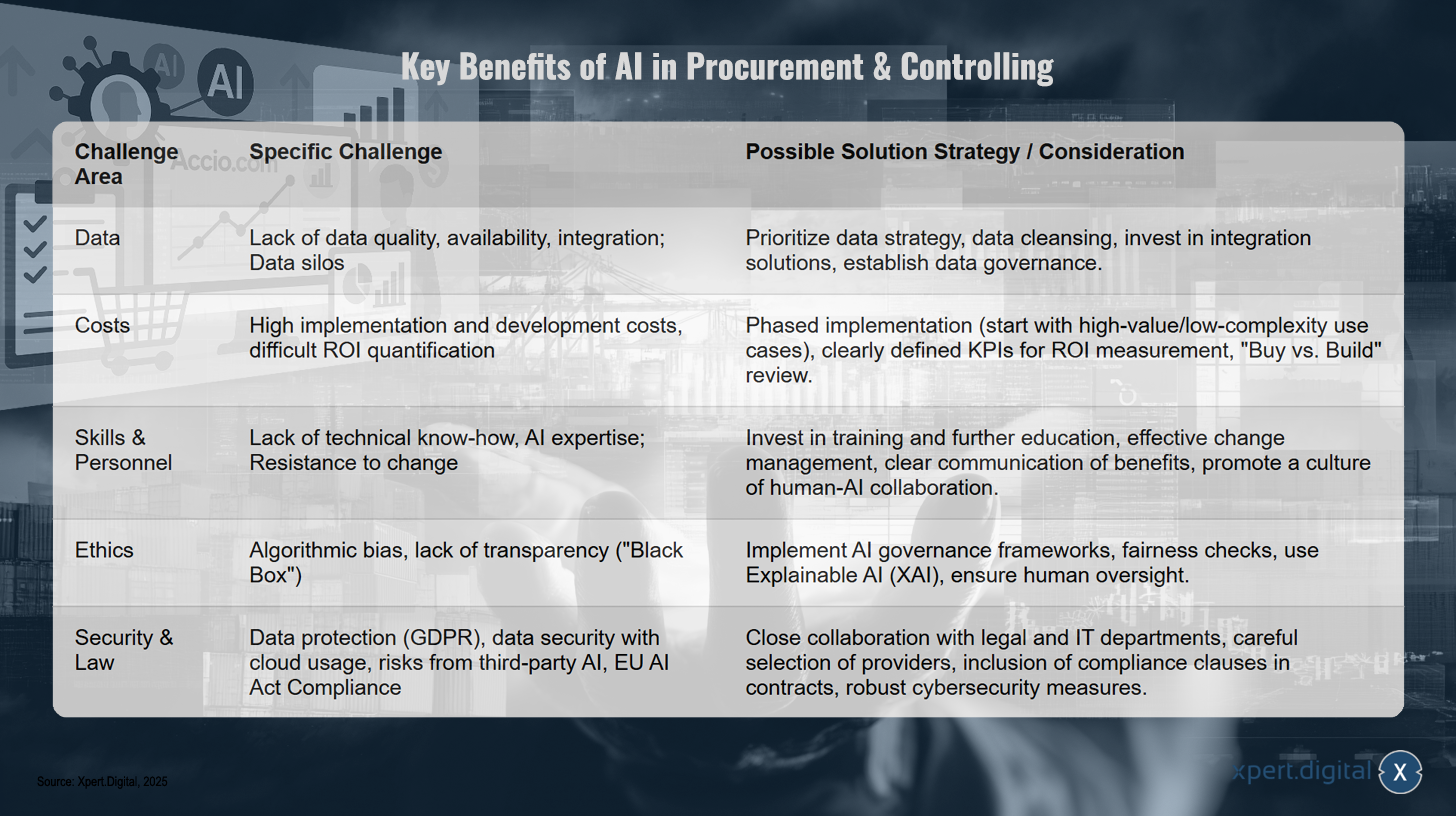
Key challenges & considerations in AI implementation in procurement-Image: Xpert.digital
The implementation of AI in procurement brings with various key challenges that require well -thought -out solution strategies. In the area of data, the lack of data quality, availability and integration as well as existing data silos represent central problems that can be addressed by priorizing a comprehensive data strategy, systematic data adjustment, investments in integration solutions and the establishment of a solid data governance.
Cost-related challenges include high implementation and development costs as well as the difficult quantification of the return on investment. This is recommended here in phases implementation, starting with use with high value and low complexity, the definition of clear KPIs for ROI measurement and the careful examination of the “Buy vs. Build” decision.
In the field of skills and staff, technical know-how and AI expertise often lack resistance to changes. Solution approaches include investments in training and further education, effective change management, clear communication of the advantages and the promotion of a culture of human-Ki collaboration.
Ethical considerations concern algorithmic bias and lack of transparency due to “Black Box” systems. The implementation of AI Governance frameworks, regular fairness checks, the use of explainable AI and ensuring human supervision are central measures here.
Finally, security and right-wing aspects such as data protection in accordance with GDPR, data security for cloud use, risks by third-party KI and EU AI Act Compliance must be taken into account. Close cooperation with legal and IT departments, careful selection of providers, the inclusion of compliance clauses in contracts and robust cyer security measures are essential for this.
Strategic recommendations for the introduction of AI in procurement
The successful integration of artificial intelligence into procurement and controlling processes requires a well thought-out strategic approach. Companies that want to use AI to increase their efficiency, reduce costs and achieve strategic advantages should take the following recommendations into account.
Development of a AI introductory strategy for procurement
Ad-hoc implementation of AI tools rarely leads to success. Instead, a comprehensive strategy is required:
Digital maturity level rating
First of all, an honest inventory of the digital maturity of the company and in particular the procurement department should take place. This helps to identify weaknesses and set realistic goals.
Define clear business goals and KPIs
It must be clearly defined which specific business goals should be achieved with AI use (e.g. cost reduction by x%, reduction of the throughput time for y by Z days). Measurable key performance indicators (KPIS) are essential to pursue success.
Coordination with the company -wide digital strategy
The AI strategy for procurement should not be considered in isolation, but should be inserted into the overarching digital transformation agenda of the company.
Identification of applications with great benefits
Instead of trying to transform everything at once, specific applications should be identified in which AI can offer the greatest added value with comparatively low complexity. This creates early successes and promotes acceptance.
Founded "Buy Versus-Build" decisions
Companies have to decide whether they want to buy standard AI software or want to develop tailor-made solutions. This decision depends on factors such as the need for competitive advantages through adaptation, the existing know-how and the budget.
In phases, implementation
A step -by -step approach reduces risks and enables the organization to learn from initial experiences and to adapt the strategy if necessary.
A successful AI introduction in the procurement is less a question of pure technology rejection as well as the strategic orientation towards business goals and a clear understanding of where KI can solve specific problems or create new value. The framework proposed by BCG is correctly beginning with an evaluation of the digital maturity and the understanding of weaknesses. McKinsey's recommendations emphasize the focus on high -quality use cases and warn against striving for a complete transformation immediately. Companies that develop a clear, strategic timetable for the KI introduction, which is tailored to their specific context and maturity, have a higher probability of achieving the desired results and avoiding costly mistakes.
Creation of a business case and measurement of the ROI
Every investment in new technologies requires a solid business case that quantified the expected benefit.
Definition of the value contribution of the AI
It must be clearly defined which contribution the AI should make in the procurement - be it an incremental improvement of existing processes or a fundamental redesign of procurement models.
Identification of measurable advantages
The potential advantages such as cost savings, efficiency increases, risk reduction, improved compliance and faster throughput times must be named in concrete terms and, where possible, quantified.
Estimation of the costs
The implementation and operating costs must be realistically assessed.
Tracking of effects
After implementation, the financial effects and operational efficiency must be continuously monitored and measured. Examples of ROI are up to five times ROI for early users, a reduction in operational costs by 10-20% and a 30% faster supplier selection.
A robust business case for AI in procurement must go beyond vague promise of efficiency and contain specific, measurable, achievable, relevant and time -related (smart) goals and KPIs. The emphasized need to define the “AI value contribution” and to pursue the financial effects and operational efficiency is central here. The difficulty of quantifying the advantages in advance makes a strong, evidence -based business case all the more important. Securing support from the management and the budget for AI initiatives depends largely on a convincing business case that clearly explains the expected ROI and the strategic value.
Addressing of data governance and ethical framework conditions
The responsible handling of data and compliance with ethical principles are of crucial importance in the KI introduction.
Establishment of strong data governance practices
This includes ensuring data quality, integrity, security and data protection.
Implementation of AI Governance Frameworks
These should define clear principles such as responsibility, transparency, fairness and risk management.
Formation of AI ethics councils or governance committees
These bodies should include representatives from procurement, IT, law and risk management and determine guidelines and check larger AI initiatives.
Definition of clear roles and responsibilities
Clear responsibilities and escalation paths for AI-related decisions must be determined.
Implementation of risk reviews
New AI tools should be assessed in terms of accuracy, bias, security gaps and legal implications.
Ensuring human supervision
AI tools must enable mechanisms for human review and intervention.
A proactive AI government is not only essential for compliance with regulations and the risk reduction, but also for the development of trust in AI systems among employees, suppliers and other stakeholders. The source emphasizes that less than a third of the large companies allow the unrestricted AI use due to security and compliance concerns, which makes governance a top priority. It also emphasizes responsibility and ensures that human managers are responsible for decisions. Companies that integrate ethical considerations and a robust governance into their AI strategy from the start are better positioned in order to use the advantages of AI responsibly and sustainably and to avoid potential pitfalls in connection with bias, lack of transparency or data abuse.
Promotion of human-Ki collaboration for optimal results
AI should not be regarded as a replacement for human labor, but as a tool that expands and improves human skills.
Recognition of AI as a supporting tool:
AI serves to assert human skills, not to replace them completely.
Design of collaborative workflows:
Working processes should be designed in such a way that they optimally use the strengths of people (critical thinking, empathy, complex ethical judgments) and AI (data processing, sample recognition, speed).
Implementation of "Human-in-the-Loop" (HITL) systems:
These enable people to direct AI decisions, validate and, if necessary, overlap.
Investment in training and change management:
Employees must be trained and prepared for the new roles and working methods with AI.
The most effective AI implementations in procurement will be those who promote a symbiotic relationship between humans and AI and create an “extended workforce”. The sources provide detailed explanations of Hitl and emphasize the cooperation. Gartner is quoted: "Companies that fail to combine AI with human expertise, risk, get behind." The need to reconsider how procurement teams interact with AI-controlled systems is also emphasized. This requires a cultural change towards the acceptance of AI as a partner. The management level must advance this collaborative model and invest in the development of “AI competence” in the entire procurement function. The future is not in AI or humans, but in AI with man.
The future of procurement: autonomous systems and developing AI
The influence of artificial intelligence on procurement is only at the beginning. Future developments indicate even more profound changes, with the potential for autonomous systems and the integration of further groundbreaking technologies.
The way to autonomous procurement and AI agents
The development in the AI area indicates a path that leads from AI assisted to AI-augmented to potentially autonomous procurement processes. AI agents, such as those intended, for example, are expected to cope with a growing range of tasks with increasing independence, for example. This includes the aggregation of data, the implementation of negotiations, the assessment of risks and monitoring ESG conformity. Visions of “self -healing” supply chains, which can autonomously adapt to disorders, gain contour. In such a scenario, the roles of the procurement teams could change to those of “value architects” that design the overarching strategies, which are then implemented by a digital AI core.
However, this development towards autonomous systems is associated with considerable challenges. This includes the already discussed aspects of data quality and change management, but also specific ethical questions in dealing with autonomously crucial AI, cyber security aspects and complex legal questions regarding liability for actions of autonomous agents. Autonomous procurement, although still an emerging concept, represents the long -term potential of AI to manage entire procurement cycles for certain categories or tasks with minimal human intervention. This raises profound questions about the accountability obligation, legal framework for the ability of AI and the future required skills of procurement experts who may become designers and overseers of these autonomous systems. The EU AI Act will also have a significant impact on the use of such high -ranking autonomous systems.
The role of data ontologies and standards (e.g. Eprocurement Ontology, GS1)
In order for AI systems to develop their full potential, especially in networked environments, standardized data formats and semi -stables are essential. Data ontologies and standards play a key role in the interoperability and effectiveness of AI.
- The Eprocurement Ontology (EPO), developed by the EU's Office for Publications, aims to create a formal, semantic basis for data in public procurement. It guarantees consistent terms, definitions and relationships and is intended to cover the entire procurement process from the announcement to payment.
- Wider standards such as Common Core Ontologies (CCO) and the Basic Formal Ontology (BFO) offer framework for knowledge representation and data interior operability across various domains.
- GS1 standards offer a universal system for identifying products (e.g. GTINs, barcodes), to ensure data accuracy, traceability and the seamless exchange of information in supply chains. They support AI applications by providing structured, verifiable product data and enabling technologies such as digital twins or blockchain integrations.
These standards can improve data quality for AI systems, facilitate data exchange between different systems and organizations and thus support more demanding analyzes and automation. With the increasing spread of AI, the need for robust data ontologies and standards is becoming increasingly important to ensure that AI systems can effectively communicate, interpret data consistently and operate via various platforms and organizations. The Eprocurement Ontology directly addresses the interoperability gap. GS1 standards provide the “common reference base” and the “building blocks” for AI operations in supply chains. Without such standards, AI systems run the risk of operating in data silos or interpreting data incorrectly. The assumption of these standards will be decisive in order to exploit the full potential of the AI when creating really networked and intelligent procurement ecosystems. This can require industry -wide cooperation and investments in data standardization initiatives.
Emerging technologies (short overview: quantum computing, daos)
In addition to the already established AI technologies, other disruptive developments are emerging on the horizon that could affect the procurement system in the long term:
Quantum computing
This technology harbors the potential to solve extremely complex optimization problems that are unreachable for classic computers. In the area of logistics and procurement, this could revolutionize route optimization, demand forecast and warehouse management by analyzing huge amounts of data and variables at the same time. Although quantum computing is still in an early stage of development, companies should begin to make “ready to quantum” and to observe developments.
Decentralized autonomous organizations (Daos)
Daos are communities guided by members that are managed by decentralized computer programs and blockchain technology. They could potentially be used for the creation of transparent, automated and jointly controlled procurement or supply chain management systems. However, the legal status and practical implementation for procurement are still extremely experimental and associated with considerable hurdles.
Although quantum computing and DAOS are still a further used for the broad application in procurement, they represent disruptive forces that could fundamentally change the long -term optimization skills and organizational models. The ability of quantum computing to solve complex problems far beyond the capacity of classic computers could enable unprecedented efficiency increases. Daos offer a radical other governance model that could theoretically be applied to decentralized procurement consortiums or the financing of supply chains. Strategic foresight requires procurement managers to be aware of this technologies, even if an immediate introduction is not feasible. The observation of their development and potential applications can inform long -term planning and innovation efforts.
Procurement 4.0: When artificial intelligence makes shopping a strategic value driver
The integration of artificial intelligence transforms procurement management, purchasing and controlling fundamentally and shifts these functions from operational necessities to strategic value drivers in the company. AI-supported tools offer the potential to increase efficiency, optimize costs, to better manage risks and make more well-founded, data-based decisions.
The analysis of accio.com has shown that the platform with its AI-based approach, in particular through functions such as "Perfect Match" and "Super Comparison" as well as the use of technologies such as LLMs and knowledge graphs, is breaking innovative ways in finding sources and supplier management. Especially for small and medium -sized companies (SMES), Accio.com can be a valuable resource in order to navigate the complexity of global procurement markets and to receive access to a broad supplier network. The platform positions itself as a tool that not only searches, but also conceptualized and paves the way from the idea for realization.
Compared to established enterprise suites such as SAP Ariba or Coupa, which often cover comprehensive end-to-end processes, and specialized tools such as scoutbee for the deep supplier analysis, acci.com seems to occupy a niche, the intelligent sourcing functions with a strong emphasis on the idea-forming phase and a potential e-commerce integration connected. Compared to traditional supplier directories such as WLW.de, Accio.com offers significant added value through interactivity, deeper data analysis and strategic support.
However, the use of AI in procurement is not a sure -fire success. Challenges regarding data quality and availability, implementation costs, necessary qualification adjustments in employees as well as ethical considerations regarding algorithmic bias and transparency must be addressed proactively. Safety and data protection aspects, especially in the light of new regulations such as the EU AI Act, are of crucial importance.
The future of procurement will inevitably be more data -controlled, intelligent and collaborative - both between systems and between humans and machine. The path towards partial autonomous or even autonomous procurement processes, supported by AI agents and advanced analyzes, is prescribed. The standardization of data by ontologies such as the EPROCUREMENT ontology or GS1 standards will play an important role in ensuring interoperability and data quality.
The journey of AI in procurement is an ongoing development, not a one -off implementation. Continuous learning, adaptation to new technological options and a focus on responsible innovation are key to sustainable success. Companies that promote a culture of agility and continuous improvement in their procurement functions will best be positioned in order to effectively navigate and use the developing AI landscape. The decision is not whether AI should be introduced, but how this can happen strategically and responsibly in order to achieve a real competitive advantage. Tools such as accio.com can, if they are carefully and implemented as part of a clear strategy, support organizations in building more efficient, more resistant and more value -adding procurement operations.
We are there for you - advice - planning - implementation - project management
☑️ SME support in strategy, consulting, planning and implementation
☑️ Creation or realignment of the AI strategy
☑️ Pioneer Business Development

Konrad Wolfenstein
I would be happy to serve as your personal advisor.
You can contact me by filling out the contact form below or simply call me on +49 7348 4088 965 (Munich) .
I'm looking forward to our joint project.
Write to me

Xpert.Digital - Konrad Wolfenstein
Xpert.Digital is a hub for industry with a focus on digitalization, mechanical engineering, logistics/intralogistics and photovoltaics.
With our 360° business development solution, we support well-known companies from new business to after sales.
Market intelligence, smarketing, marketing automation, content development, PR, mail campaigns, personalized social media and lead nurturing are part of our digital tools.
You can find out more at: www.xpert.digital - www.xpert.solar - www.xpert.plus
Keep in touch








