
Is AI search and AI research more dominant and important in the B2B sector than social media such as LinkedIn?
Xpert Pre-Release

Available in 27 languages 📢
Prefer Xpert.Digital on GoogleⓘPublished on: May 7, 2025 / Updated on: May 7, 2025 – Author: Konrad Wolfenstein

Is AI search and AI research more dominant and important in the B2B sector than social media such as LinkedIn? – Image: Xpert.Digital
Dominance and importance of AI search and AI research vs. social media (e.g. LinkedIn) in the B2B sector
AI instead of LinkedIn? Why B2B is now focusing on intelligent search – a change in B2B strategy?
In the B2B sector, AI-powered search and research are rapidly gaining importance and are already considered more dominant and strategically important in many industries than traditional social media platforms like LinkedIn. Nevertheless, social media – especially LinkedIn – remains a central element of B2B communication.
Related to this:
AI search and AI research in B2B:
High usage rate and efficiency
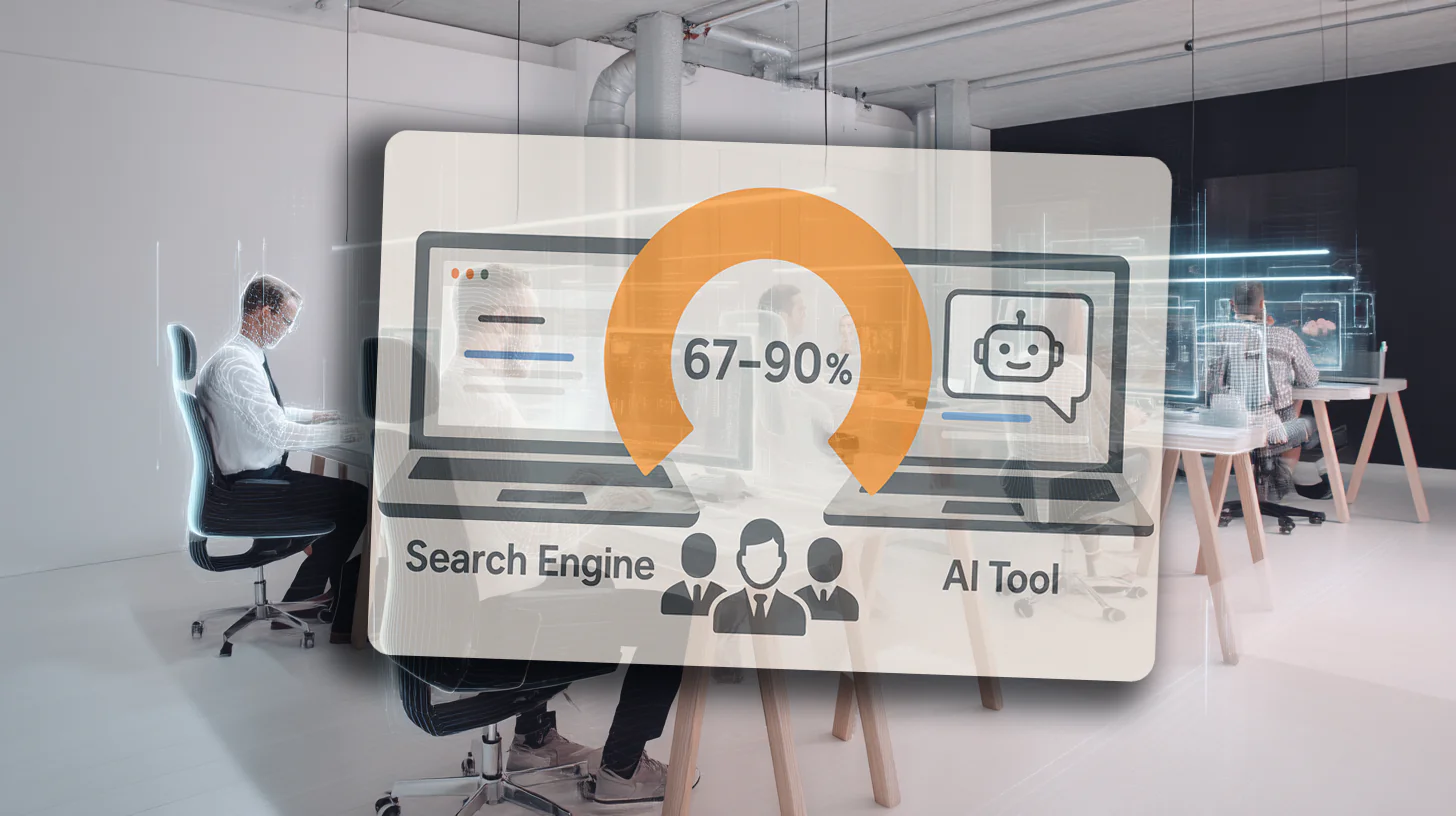
Between 67% and 90% of B2B companies now prefer web searches using AI tools to traditional search engines. AI-powered research and search tools such as Microsoft Copilot, ChatGPT, and Perplexity AI are being used to access specialist information, market analyses, and decision-making tools more quickly and effectively.
Competitive advantage through AI
AI technologies enable efficient automation, data-driven decision-making, and personalized customer communication. They accelerate processes such as keyword research, content optimization, and competitive analysis, resulting in a clear competitive advantage in the B2B sector.
Strategic importance
Especially in technically demanding industries (e.g., mechanical engineering, large-scale plant construction), AI-supported research has become essential for product development, market monitoring, and lead generation. The ability to analyze large amounts of data and derive trends or risks from them makes AI tools indispensable for B2B companies.
Social media (LinkedIn) in B2B:
Very high distribution
The use of social media in B2B communication is at an all-time high: 97.4% of companies in the DACH region use social networks, with LinkedIn clearly being the dominant platform.
The role of AI in social media
AI-powered tools are increasingly being used on LinkedIn and other platforms for content creation, audience targeting, and performance analysis. Over 82.6% of companies regularly use AI tools in their social media communication.
Lead generation & image cultivation
LinkedIn remains important for networking, employer branding, and targeted communication with decision-makers. The platform is particularly well-suited for building relationships, sharing expertise, and positioning oneself as a thought leader.
Comparison: AI search/research vs. social media (LinkedIn) in B2B
Comparison: AI search/research vs. social media (LinkedIn) in B2B – Image: Xpert.Digital
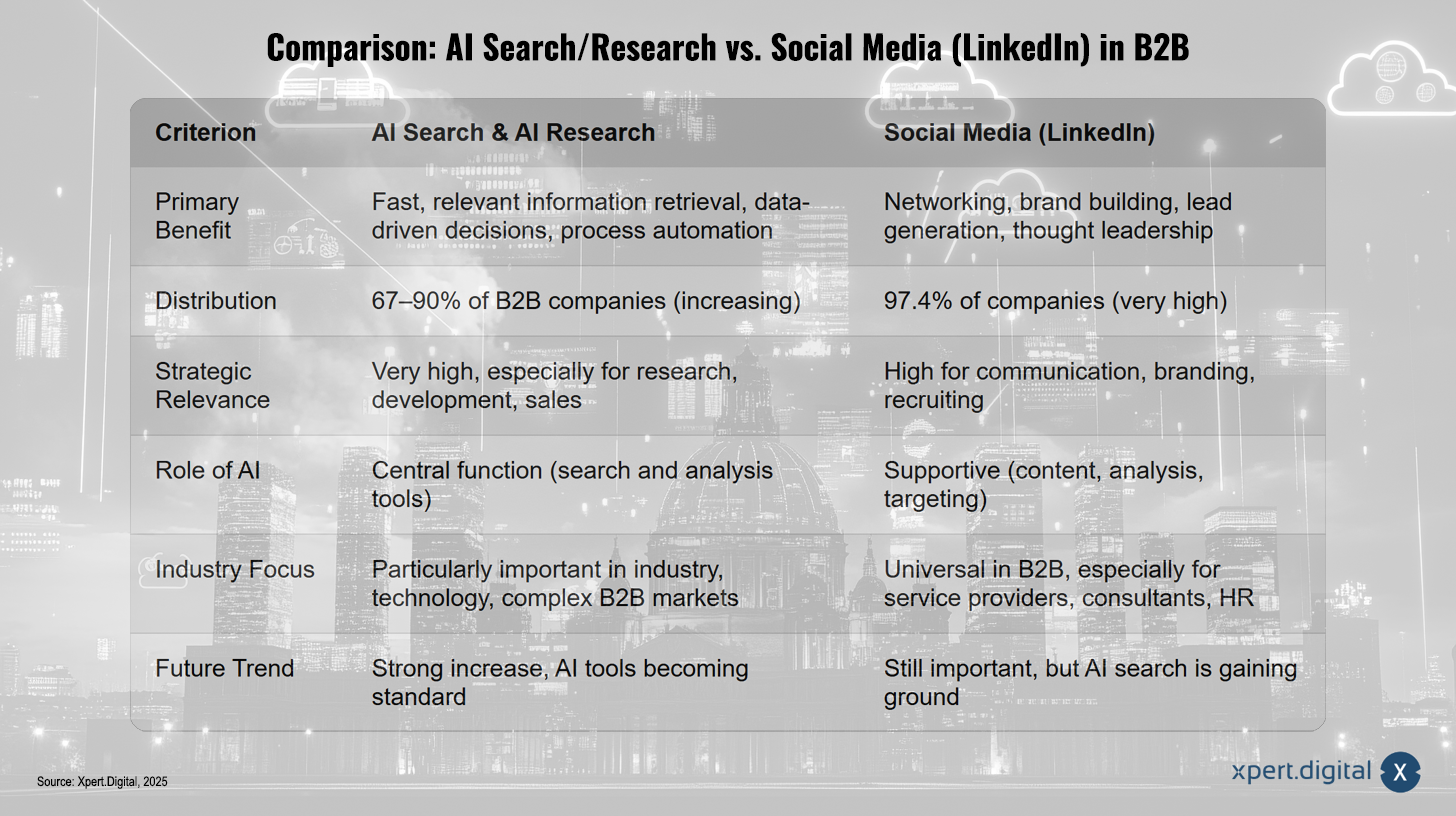
A comparison between AI search/research and social media (LinkedIn) in the B2B sector reveals significant differences in the applications and strengths of the two approaches. AI search and research enables rapid and relevant information retrieval, supports data-driven decisions, and promotes process automation. In contrast, the primary benefits of social media, particularly LinkedIn, lie in networking, brand building, lead generation, and positioning as a thought leader. While the adoption of AI tools in B2B companies is increasing by 67–90%, LinkedIn, with a usage rate of 97.4%, is already widespread. Strategically, AI search is particularly relevant for areas such as research, development, and sales, while LinkedIn primarily supports communication, branding, and recruiting. AI plays a central role in search and analysis, whereas on social media, it is predominantly used to support content, analysis, and targeting. Regarding industry focus, AI search is prioritized primarily in manufacturing, technology, and complex B2B markets, while LinkedIn is used universally, especially by service providers, consultants, and HR professionals. Trends indicate that AI tools will become increasingly standard in the future, while social media will remain significant but will be increasingly complemented by AI-powered search and research solutions.
Efficient and visible: How AI and social media should work together
In the B2B sector, AI-powered search and research is now at least as important, and in many cases even more dominant, than traditional social media platforms like LinkedIn when it comes to targeted information gathering, market monitoring, and data-driven decision-making. However, social media, especially LinkedIn, remains indispensable for building relationships, brand positioning, and lead generation. The future lies in the intelligent combination of both approaches: AI-based research for efficiency and precision, and social media for visibility and networking.
Our recommendation: 🌍 Limitless reach 🔗 Connected 🌐 Multilingual 💪 Sales power: 💡 Authentic with strategy 🚀 Innovation meets 🧠 Intuition

From local to global: SMEs conquer the world market with a clever strategy - Image: Xpert.Digital
In an era where a company's digital presence determines its success, the challenge lies in creating an authentic, personalized, and far-reaching presence. Xpert.Digital offers an innovative solution that positions itself as the intersection of an industry hub, a blog, and a brand ambassador. It combines the advantages of communication and sales channels in a single platform and enables publication in 18 different languages. Cooperation with partner portals and the ability to publish articles on Google News and a press distribution list with approximately 8,000 journalists and readers maximize the reach and visibility of the content. This represents a crucial factor in external sales and marketing (SMarketing).
More information here:
What advantages does AI offer B2B companies compared to LinkedIn?
Automation and efficiency improvement
AI significantly outperforms LinkedIn in the area of process automation. While LinkedIn is a platform that requires predominantly manual engagement, AI can fully automate repetitive tasks.
Resource optimization through AI
AI systems operate autonomously and can significantly accelerate marketing and sales processes. They automate repetitive tasks such as data analysis and content creation, considerably reducing manual effort. In contrast, LinkedIn requires continuous employee support, which ties up resources.
Related to this:

Time savings in the sales process
A significant advantage of AI lies in its ability to relieve the burden on sales staff: “AI accompanies and supports sales representatives, giving them more time for what matters most: selling.” This support includes automated reports, logs, and data collection and analysis, while LinkedIn activities such as networking and content creation require active participation.
More comprehensive data analysis and personalization
AI offers significant advantages in the in-depth analysis and use of customer data.
Deeper data analysis
AI provides B2B marketers with tools "that make it possible to analyze huge amounts of data in a very short time and gain deeper insights." In comparison, LinkedIn is limited to its users' profile information and their interactions.
More precise personalization
AI enables far more precise personalization than LinkedIn's targeting options. It analyzes customer behavior and delivers "tailored offers and communication, which strengthens customer loyalty." This goes significantly beyond LinkedIn's demographic and profession-based targeting capabilities.
Predictive abilities and forward-looking analysis
A key difference between AI and LinkedIn lies in their ability to make predictions.
Completion probabilities and potential analysis
AI systems in B2B sales are based on historical transaction and interaction data and, based on this, provide precise predictions for future customer behavior. LinkedIn lacks these predictive capabilities, as it primarily works with current and historical data.
Identifying promising leads
A concrete example of the added value of AI: “Predictive analytics tools analyze the behavior of website visitors, evaluate historical data, and predict with a high degree of probability which leads are particularly promising.” While LinkedIn offers targeting options for campaigns, it does not provide comparable predictive analytics.
Scalability and resource efficiency
AI solutions offer significant advantages in scaling business processes.
Flexible growth
AI systems can easily scale with growing data volumes and customer demands, while LinkedIn activities require proportionally more resources as their reach increases. Of particular note is the “optimization of marketing processes and precise targeting of audiences at lower costs.”.
Cost efficiency
In the long term, AI can reduce operating costs: “Automated workflows and data-driven decisions reduce the need for manual intervention and free up time for strategic tasks.” LinkedIn, on the other hand, incurs ongoing costs through premium subscriptions and advertising expenditures, while the drawback of Sales Navigator is that “subscription fees can be high, especially for small businesses or individual users with tight budgets.”.
Broader application possibilities
AI can be used in significantly more business areas than LinkedIn.
Versatile applications
While LinkedIn is primarily a platform for networking, marketing, and recruiting, AI can be used “in virtually all areas of business processes, including marketing, finance, human resources, manufacturing, and supply chain management.” This versatility makes AI a more comprehensive tool for B2B companies.
Content creation and management
AI offers particular strengths in the content area: “I see the greatest potential for B2B marketing where it comes to content: research, aggregation, validation, and multimodal generation.” While LinkedIn serves as a platform for content distribution, it does not offer integrated tools for content creation.
Related to this:

Synergistic potential: Combining AI and LinkedIn
Despite the advantages outlined, B2B companies should bear in mind that AI and LinkedIn can be viewed not as competing, but as complementary technologies.
Optimizing LinkedIn activities through AI
AI can be used to optimize LinkedIn activities – for example, through automated content creation for LinkedIn posts, intelligent analysis of network connections, or the identification of the best posting times. The “process acceleration for campaign planning, execution, and optimization” through AI can significantly increase the effectiveness of LinkedIn marketing.
Data extraction from LinkedIn for AI systems
LinkedIn remains a valuable source of professional data with “direct access to decision-makers and CEOs,” which in turn can serve as input for AI systems. This combination allows companies to leverage the strengths of both technologies.
Strategically leverage complementary strengths
Compared to LinkedIn, AI offers significant advantages in automation, data analysis, personalization, scalability, and application versatility. While LinkedIn remains an indispensable platform for B2B networking and targeted engagement with decision-makers, AI can provide deeper insights, automate processes, and enable predictive analytics.
For B2B companies, a strategic approach that combines the strengths of both technologies is therefore recommended: LinkedIn as the primary platform for professional networking and AI as the engine for automation, personalization, and data-driven decisions. This combination promises the greatest chances of success in the increasingly digitalized B2B landscape.
🎯🎯🎯 Benefit from Xpert.Digital's extensive, five-fold expertise in one comprehensive service package | BD, R&D, XR, PR & Digital Visibility Optimization

Benefit from Xpert.Digital's extensive, five-fold expertise in a comprehensive service package | R&D, XR, PR & Digital Visibility Optimization - Image: Xpert.Digital
Xpert.Digital possesses in-depth knowledge across various industries. This allows us to develop tailored strategies precisely aligned with the requirements and challenges of your specific market segment. By continuously analyzing market trends and monitoring industry developments, we can act proactively and offer innovative solutions. The combination of experience and expertise generates added value and provides our clients with a decisive competitive advantage.
More information here:
How effective is AI search in the B2B sector compared to traditional search methods?
AI for optimizing target group communication in B2B: Methods, advantages and practical examples
Artificial intelligence is transforming how B2B companies identify, segment, and engage their target audiences. By analyzing vast amounts of data, automating processes, and delivering personalized communication, AI enables more precise, efficient, and effective audience targeting. The technology helps companies better understand customer needs, optimize resource allocation, and ultimately increase revenue through more targeted marketing efforts. The combination of data-driven insights, automated processes, and personalized customer experiences, in particular, makes AI an indispensable tool in modern B2B marketing.
Related to this:

Personalization on a new level: AI in B2B marketing
Personalization of marketing measures is no longer an optional extra, but a fundamental expectation of B2B customers. AI takes this personalization to a new level, going far beyond simply addressing customers by their first name.
AI enables tailored offers and personalized communication, which demonstrably strengthens customer loyalty. This technology analyzes customer data such as browsing history, purchasing behavior, social media interactions, and demographic information to identify specific needs and preferences. Based on these insights, product recommendations or customized content can be delivered in real time.
The results speak for themselves: Personalized experiences can double the conversion rates for booked meetings, and calls to action in personalized content show a 68% higher interaction rate than generic content. Particularly impressive: Personalized experiences lead to almost four times as many demo requests as non-personalized interactions.
Modern B2B personalization goes beyond individual touchpoints and includes a system-wide, context-sensitive approach – including individual pricing, relevant product suggestions or tailored content based on customer segment, industry or purchase history.
Hyper-personalization as the next step
AI-powered hyper-personalization takes this a step further: Companies can connect with customers on a deeper level by tailoring messages, content, offers, and product recommendations to individual people. A McKinsey study shows that fast-growing companies achieve 40% more revenue through hyper-personalization than slower-growing competitors.
AI-powered customer segmentation: From demographics to behavior
Precise customer segmentation is key to effective targeting. AI is revolutionizing this area by going beyond traditional demographic criteria and recognizing complex behavioral patterns.
Traditional vs. AI-based segmentation
Traditional customer segmentation is primarily based on demographic data such as age, gender, income, and location. While these criteria offer important insights, they are often insufficient to fully understand the complex behavior and motivations of customers.
In contrast, AI enables multidimensional B2B customer segmentation, where multiple criteria are considered simultaneously for grouping. Machine learning allows for the automated processing and analysis of vast amounts of data to create more accurate and specific customer profiles.
Advantages of AI-based customer segmentation
B2B customer segmentation using AI offers numerous advantages:
- Identifying revenue potential and cross-selling opportunities: AI segmentation reveals the potential revenue that customers may have
- Individual content: The appropriate content can be planned and presented for each segment
- Resource saving: Targeted communication avoids wasted resources
- Demand-oriented product development: Products and services can be better aligned with customer needs
- Individual pricing: Prices can be adjusted according to the segments
Intelligent recommendation systems and lead prioritization
One key area where AI is revolutionizing audience targeting is intelligent recommendation systems and automated lead scoring.
AI recommendation systems in a B2B context
AI recommendation systems are intelligent algorithms that analyze customer behavior and preferences to generate personalized recommendations in real time. These systems increase the conversion rate and maximize customer lifetime value through various methods:
- Collaborative filtering: Recommendations based on similar user behavior and preferences
- Content-Based Filtering: Analysis of product characteristics for tailored recommendations
- Context-based recommendations: Consideration of context such as time of day, location, and device
AI-based lead scoring
AI Lead Scoring is an automated system for evaluating sales contacts. The AI analyzes customer data such as purchasing behavior and interactions to assess and prioritize potential leads based on predefined criteria.
There are different approaches to AI lead scoring:
- Predictive Lead Scoring: Uses machine learning to analyze historical and demographic data and identify patterns that indicate high conversion potential
- Behavioral Lead Scoring: Focuses on analyzing real-time actions such as website visits, email engagement, and content downloads
- Conversational AI Lead Scoring: Uses data from chatbot interactions and messages to assess a lead's potential
The advantages are clear: B2B marketing teams, who are often overwhelmed by a large number of leads, can use AI to quickly identify the most valuable leads, allowing sales teams to use their time efficiently.
Increasing efficiency in B2B sales through AI
AI not only offers advantages in personalization and segmentation, but also increases efficiency throughout the entire B2B sales process.
Automation of routine tasks
One of the biggest challenges in B2B sales is time-consuming and repetitive tasks. AI can automate these tasks, allowing sales representatives to use their time more efficiently. Examples of such tasks include:
- Data maintenance
- Lead scoring
- Conducting email campaigns
By automating these processes, sales staff can invest more time in strategic activities, such as maintaining customer relationships and developing sales strategies.
Optimization of resource allocation
AI enables optimized marketing processes and precise target group targeting at lower costs. Machine learning allows processes to be automated, and employees receive concrete, data-driven recommendations for action.
Practical advantages of AI in B2B marketing include:
- Personalization and customer satisfaction: AI enables tailored offers and communication, which strengthens customer loyalty
- Cross-selling and upselling: Identifying potential for increasing revenue through data-driven recommendations
- Efficiency and automation: Optimization of marketing processes and precise target group targeting at lower costs
Practical examples and implementation strategies
The successful integration of AI into B2B target group communication requires a well-thought-out strategy and adherence to best practices.
AI architecture for B2B personalization
A modern architecture for AI-powered personalization in the B2B sector typically includes the following components:
- Customer Data Platform (CDP): As a central data hub, the CDP links account, user role, and interaction data across all touchpoints, thus enabling a consolidated view of business customers and their decision networks
- Recommendation engines: AI-based machines identify relevant cross-selling and upselling opportunities based on purchasing behavior, seasonal demand, or industry-specific patterns
- Experience level: Shop portals, self-service tools or offer configurators access the personalization system via APIs
- AI and predictive models: These forecast reorder probabilities, sales opportunities or customer churn and enable data-driven interactions in real time
Best practices for AI implementation
When implementing AI for target group analysis, B2B companies should consider the following steps:
- Data cleansing: Artificial intelligence can help identify and correct erroneous, duplicate, or incomplete data. It can filter out irrelevant data, thus significantly improving data quality
- Data integration: AI can combine data from various sources and check it for consistency. This enables a more complete and accurate picture of customers
- Data collection: AI tools can collect and interpret a wealth of data points that would not be visible or understandable to humans
Related to this:

Challenges and solutions
Despite all the advantages, companies face challenges when implementing AI:
- Data protection and compliance: Data protection regulations must be observed when processing customer data
- Integration into existing systems: The AI solutions must work seamlessly with existing CRM and marketing automation systems
- Employee training: Teams need to be trained in the use of AI tools in order to fully exploit their potential
According to a study, 75% of B2B marketers plan to invest in generative AI in the next twelve months, although many are not yet actively working with it and some have only a limited understanding of how it works.
The future of AI-supported target group communication in B2B
AI-powered audience targeting in B2B marketing offers tremendous opportunities for increased efficiency, personalization, and ultimately, revenue growth. B2B companies that strategically use AI to improve their marketing processes can gain a decisive competitive advantage.
The most important advantages are summarized below:
- In-depth personalization and precise customer segmentation
- Automation of marketing processes and precise target group targeting
- Identification of sales potential and cross-selling opportunities
- More efficient resource allocation and reduction of wasted resources
Anyone who wants to succeed in B2B e-commerce cannot ignore intelligent, data-driven, and AI-powered personalization. The technology is becoming increasingly sophisticated and accessible, enabling even small and medium-sized B2B companies to benefit from the advantages of AI.
The future belongs to companies that view AI not as a replacement for human intelligence, but as a powerful extension that enables them to better understand customers, target them more effectively, and build long-term business relationships.
Your global marketing and business development partner
☑️ Our business language is English or German
☑️ NEW: Correspondence in your native language!

Konrad Wolfenstein
I and my team are happy to be available to you as your personal advisor.
You can contact me by filling out the contact form here or simply call me at +49 7348 4088 965. My email address is: [email protected]
I'm looking forward to our joint project.










